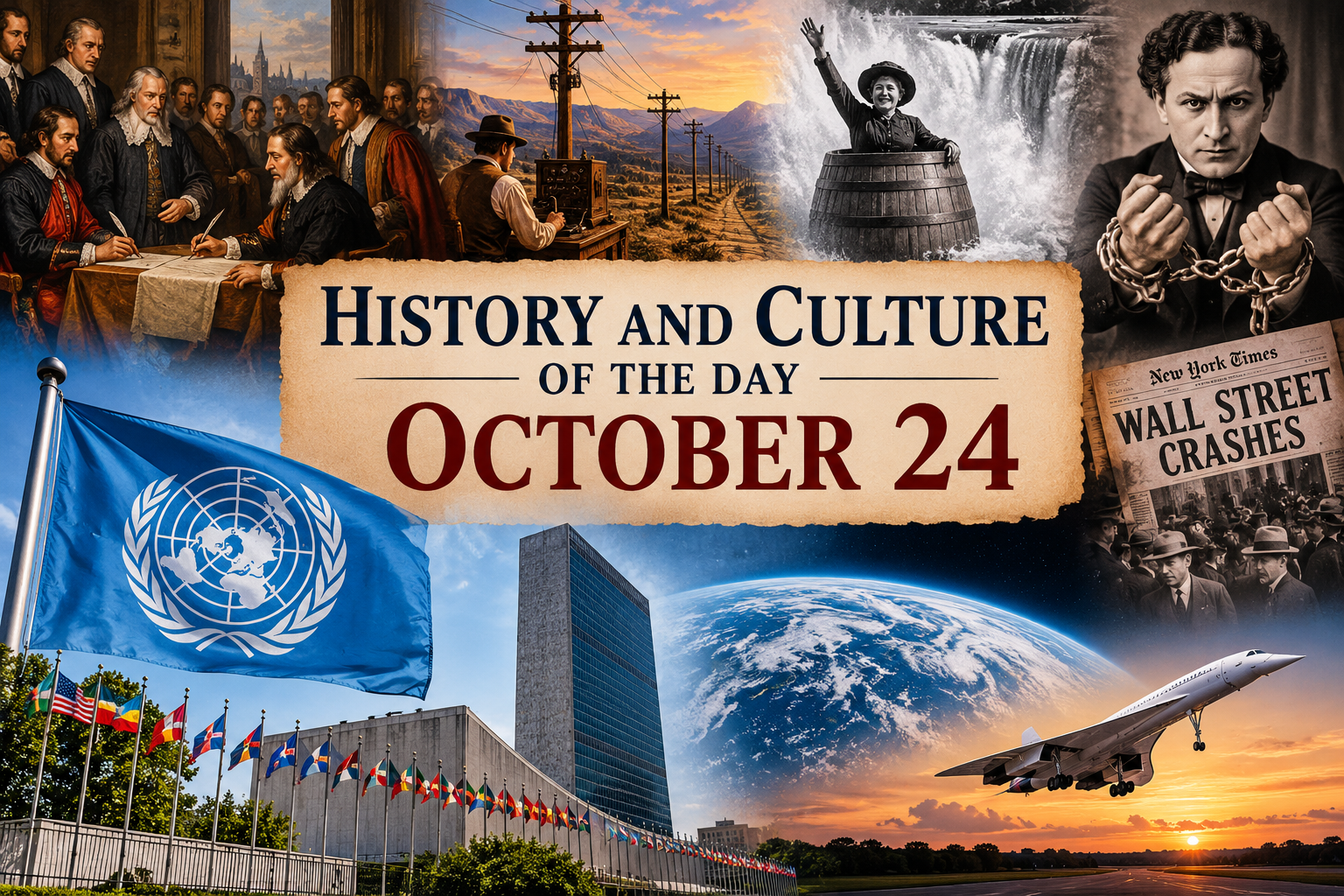
Every date on the calendar carries stories from the past, but October 24 has an especially interesting place in world history and culture.
It is a day connected with international cooperation, exploration, scientific discovery, technological advancement, music, entertainment, and moments that helped shape the modern world.
Perhaps most importantly, October 24 is closely associated with the creation of the United Nations, an organization established after the devastation of World War II with the ambitious goal of encouraging countries to work together rather than allowing disagreements to lead to another catastrophic global conflict.
But that is only one chapter in the story of October 24.
From the completion of a revolutionary transcontinental communication system in the United States to groundbreaking discoveries about our planet and memorable moments in popular culture, October 24 reminds us that history is constantly being shaped by people willing to explore, communicate, create, and imagine something new.
Let’s look back at the history and culture connected with October 24.
1648 — The Peace of Westphalia Helps End the Thirty Years’ War
One of the most important diplomatic developments in European history is associated with October 24, 1648.
The Peace of Westphalia refers to a collection of treaties that helped bring an end to the Thirty Years’ War, a devastating European conflict that began in 1618.
The war involved numerous European powers and was influenced by religious, political, and territorial disputes.
Its effects were catastrophic, particularly in parts of Central Europe. Warfare, famine, disease, and displacement devastated communities and populations.
The peace agreements signed in 1648 helped establish a new political order in Europe.
Historians often associate the Peace of Westphalia with the development of ideas surrounding national sovereignty—the principle that states have authority over their own territories and political affairs.
The modern international system did not suddenly appear because of a single treaty, but the Peace of Westphalia became an important milestone in the long development of diplomacy between independent states.
More than three centuries later, the themes surrounding those agreements—war, sovereignty, diplomacy, and cooperation—remain central to international relations.
Interestingly, October 24 would later become associated with another major attempt to encourage international cooperation: the creation of the United Nations.
1861 — The First Transcontinental Telegraph Is Completed
Imagine living in the United States during the middle of the 19th century.
Sending information across the country could take days or even weeks.
Letters traveled by horseback, stagecoach, railroad, and other transportation networks.
Then the telegraph changed everything.
On October 24, 1861, the first transcontinental telegraph system connecting the eastern and western United States was completed.
A telegraph line connected the existing eastern network with the West Coast, dramatically changing communication across the nation.
Messages that once required long journeys could suddenly travel enormous distances in minutes.
The achievement also contributed to the end of one of the most famous institutions of the American frontier—the Pony Express.
The Pony Express had become legendary for carrying mail rapidly across the American West using relays of horseback riders.
But technology was advancing quickly.
Once the transcontinental telegraph became operational, the Pony Express could no longer compete with nearly instantaneous electronic communication. It ceased operations shortly afterward.
The transition offers an early example of something we continue to experience today: new technology replacing systems that once seemed essential.
The telegraph was, in many ways, an ancestor of the communication revolution that eventually produced telephones, radio, television, the internet, email, smartphones, and social media.
Today we can send a message across the planet almost instantly.
In 1861, that ability seemed revolutionary.
1901 — Annie Edson Taylor Goes Over Niagara Falls in a Barrel
October 24 also produced one of the more unusual stories in American popular history.
On October 24, 1901, schoolteacher Annie Edson Taylor became the first known person to survive going over Niagara Falls in a barrel.
It was also her 63rd birthday.
Taylor hoped the stunt would bring fame and financial security.
She climbed into a specially constructed barrel that was designed to protect her from the enormous force of the falls.
Then she went over Horseshoe Falls.
Remarkably, she survived.
Her story became part of the colorful history surrounding Niagara Falls, which had already become a destination for tourists, adventurers, performers, and daredevils.
Taylor reportedly advised others not to repeat what she had done.
Her experience demonstrates a fascinating part of human culture: our attraction to people willing to attempt something that seems impossible.
Long before viral videos and social media challenges, spectacular public stunts could capture international attention.
1926 — Harry Houdini Performs for the Last Time
October 24 is also connected to one of the greatest entertainers and illusionists in history.
Harry Houdini became famous for extraordinary escape performances involving handcuffs, chains, locked containers, water tanks, and other seemingly impossible situations.
His name eventually became almost synonymous with escaping.
On October 24, 1926, Houdini gave what would become his final stage performance at the Garrick Theatre in Detroit.
He was seriously ill but reportedly continued with the performance.
Houdini died on October 31, 1926.
His influence extended far beyond stage magic.
More than a century after his career, the name Houdini remains recognizable around the world. Magicians, illusionists, escape artists, filmmakers, writers, and entertainers continue to draw inspiration from his work.
His legacy demonstrates how deeply entertainers can become embedded in popular culture.
Sometimes a person’s name becomes larger than the individual.
Houdini is one of those rare examples.
1929 — “Black Thursday” Shakes Wall Street
October 24, 1929, became one of the most famous dates in American financial history.
It became known as Black Thursday.
During the 1920s, the United States experienced enormous economic expansion and widespread speculation in the stock market.
Many investors believed stock prices would continue rising.
Some purchased shares using borrowed money, increasing both potential profits and potential losses.
Then confidence began collapsing.
On October 24, massive selling hit the New York Stock Exchange.
Millions of shares changed hands as frightened investors attempted to sell their holdings.
Black Thursday was not the only day associated with the famous crash. The market experienced additional devastating declines during the following days, including Black Monday and Black Tuesday.
The crash became one of the events associated with the beginning of the Great Depression.
However, the Great Depression was a complicated economic catastrophe with numerous causes and contributing factors. The stock market crash alone did not create every economic problem that followed.
Still, October 24 became symbolic of how quickly financial confidence can disappear.
The lessons remain relevant.
Markets are influenced not only by numbers but also by human behavior—confidence, fear, optimism, greed, uncertainty, and expectations about the future.
1945 — The United Nations Officially Comes Into Existence
One of the most historically significant events connected with October 24 occurred in 1945.
The United Nations officially came into existence after its founding charter had been ratified by the required countries.
The organization emerged from the devastation of World War II.
The war had killed millions of people, destroyed cities, displaced enormous populations, and demonstrated the horrifying consequences of global conflict.
World leaders faced an enormous question:
Could nations build a system that would help prevent another world war?
The United Nations was created as part of that effort.
Its founding purposes included maintaining international peace and security, developing friendly relations among nations, encouraging international cooperation, and promoting human rights.
The organization began with 51 original member states.
Over the decades, membership expanded dramatically as colonies gained independence and new nations were established.
Today, the United Nations has 193 member states.
Its work extends far beyond diplomacy.
United Nations organizations and agencies are involved in humanitarian assistance, public health, refugees, food security, education, children’s welfare, cultural preservation, peacekeeping, development, and numerous other global issues.
The organization has certainly faced criticism and controversy throughout its history. Nations frequently disagree, political interests collide, and international cooperation can be extremely difficult.
Yet the fundamental idea behind the organization remains significant:
Countries need places where they can communicate.
Sometimes simply keeping people at the negotiating table can matter.
October 24 Is United Nations Day
Because of the events of 1945, October 24 is observed annually as United Nations Day.
The observance recognizes the anniversary of the UN Charter coming into force.
It also provides an opportunity to consider the importance—and difficulty—of international cooperation.
The world contains different governments, religions, cultures, languages, economies, political systems, and national interests.
Agreement is never guaranteed.
But history repeatedly demonstrates the consequences when diplomacy completely fails.
United Nations Day therefore represents more than celebrating an institution.
It can also be viewed as a reminder of an ideal:
People with profound differences can still attempt to solve problems together.
That goal may be difficult, imperfect, and sometimes frustrating.
But the alternative can be far worse.
1946 — The First Photograph of Earth From Space
Human beings had looked toward the sky for thousands of years.
On October 24, 1946, humanity received a remarkable new perspective.
A camera carried aboard a modified V-2 rocket captured photographs of Earth from an altitude of roughly 65 miles.
These are widely recognized as the first photographs of Earth taken from space.
The images were primitive compared with the spectacular photographs we now receive from satellites and spacecraft.
But their importance was enormous.
For the first time, people could begin seeing their world from beyond the atmosphere.
That perspective would become increasingly powerful during the Space Age.
Later photographs—including famous images of Earth taken during the Apollo missions—would transform how humanity viewed the planet.
From space, national borders disappear.
There is simply Earth.
The photographs taken in 1946 represented an early step toward that new perspective.
1960 — A Massive Soviet Rocket Explodes at Baikonur
Not every milestone in technological history represents success.
On October 24, 1960, a catastrophic explosion occurred at the Baikonur Cosmodrome during preparations involving a Soviet R-16 missile.
The disaster became known as the Nedelin catastrophe, named after Marshal Mitrofan Nedelin, who was among those killed.
The explosion caused a large number of deaths.
For years, details surrounding the disaster were concealed by the Soviet government.
The tragedy serves as a reminder that technological advancement can carry enormous risks, particularly when political pressure, secrecy, military competition, and ambitious schedules are involved.
The Space Race and Cold War produced extraordinary technological accomplishments.
They also produced disasters that were not always immediately known to the public.
History requires remembering both.
2003 — Concorde Makes Its Final Commercial Flight
For decades, the Concorde represented one of aviation’s boldest technological achievements.
The supersonic passenger aircraft could travel faster than the speed of sound.
A journey across the Atlantic that normally required many hours could be completed dramatically faster.
For passengers who could afford it, Concorde offered a glimpse of what many believed might become the future of air travel.
But operating the aircraft was extremely expensive.
Noise restrictions, fuel consumption, maintenance costs, and changing economic conditions created significant challenges.
On October 24, 2003, Concorde completed its final commercial passenger flights.
The aircraft’s retirement marked the end of an extraordinary chapter in aviation.
Interestingly, commercial aviation has generally become more efficient rather than dramatically faster.
That demonstrates an important lesson about technological progress.
The most impressive technology does not always become the dominant technology.
Cost, practicality, safety, infrastructure, environmental concerns, and consumer demand can matter just as much as speed.
October 24 and the Power of Communication
Looking across the events connected with October 24 reveals an interesting theme:
communication.
The Peace of Westphalia involved diplomacy between nations.
The transcontinental telegraph revolutionized communication across America.
The United Nations created a global forum where countries could communicate.
Photographs from space changed the way humanity could see its own planet.
Even modern aviation helped make the world physically more connected.
Communication technology has changed dramatically over the centuries.
A message that once required a rider carrying a letter can now travel around the world almost instantly.
A live video conversation can connect people separated by thousands of miles.
Information can reach millions of people within seconds.
But technology alone does not guarantee understanding.
We have become extraordinarily good at transmitting information.
The greater challenge may be learning how to truly listen to one another.
What October 24 Can Teach Us
History becomes most valuable when we do more than memorize dates.
We should ask what those dates can teach us.
October 24 offers several lessons.
It reminds us that communication can transform civilization.
The telegraph changed America because distance suddenly became less powerful.
It reminds us that peace requires effort.
From the Peace of Westphalia to the United Nations, diplomacy has repeatedly emerged from the destruction caused by war.
It reminds us that technology constantly changes society.
The telegraph replaced older communication systems. Supersonic passenger aircraft rose and eventually disappeared from commercial service. Space technology changed our understanding of the planet.
It reminds us that progress sometimes comes with enormous risks.
Technological achievements can produce both breakthroughs and tragedies.
And October 24 reminds us that history is ultimately about people.
Behind every treaty, invention, disaster, organization, photograph, performance, and achievement were human beings making decisions.
Some were brilliant.
Some were courageous.
Some were reckless.
Some changed the world without realizing how important their actions would eventually become.
History Is More Than the Past
It is easy to think of history as something finished.
It isn’t.
History is the collection of choices made by people who were once living through their own present day.
The people experiencing October 24, 1861, did not know exactly how telecommunications would transform civilization.
The people witnessing the financial panic of October 24, 1929, could not fully understand how dramatically the coming years would change America.
The leaders establishing the United Nations in 1945 could not know every conflict, crisis, achievement, and challenge the organization would face over the following decades.
They were living through uncertainty just as we do.
That is one reason studying history matters.
It gives us perspective.
Human beings have faced wars, economic crises, technological disruption, political division, cultural transformation, and periods of tremendous uncertainty before.
The details change.
Human nature often does not.
Remembering October 24
October 24 is a date filled with stories about war and peace, risk and discovery, communication and technology, failure and achievement.
From the diplomacy surrounding the Peace of Westphalia to the transcontinental telegraph, from Annie Edson Taylor’s remarkable Niagara Falls stunt to Harry Houdini’s final performance, from Black Thursday to the creation of the United Nations, October 24 provides a fascinating window into our shared history.
Perhaps the most powerful connection between these events is humanity’s constant attempt to overcome barriers.
We try to overcome distance.
We try to overcome conflict.
We try to overcome technological limitations.
We try to understand our planet.
And sometimes we simply try to accomplish something nobody has done before.
Not every attempt succeeds.
Not every chapter of history is something to celebrate.
But every chapter gives us something to learn.
As we remember the events of October 24, we can also ask ourselves a question:
What will people generations from now remember about the history and culture we are creating today?



Leave a Reply