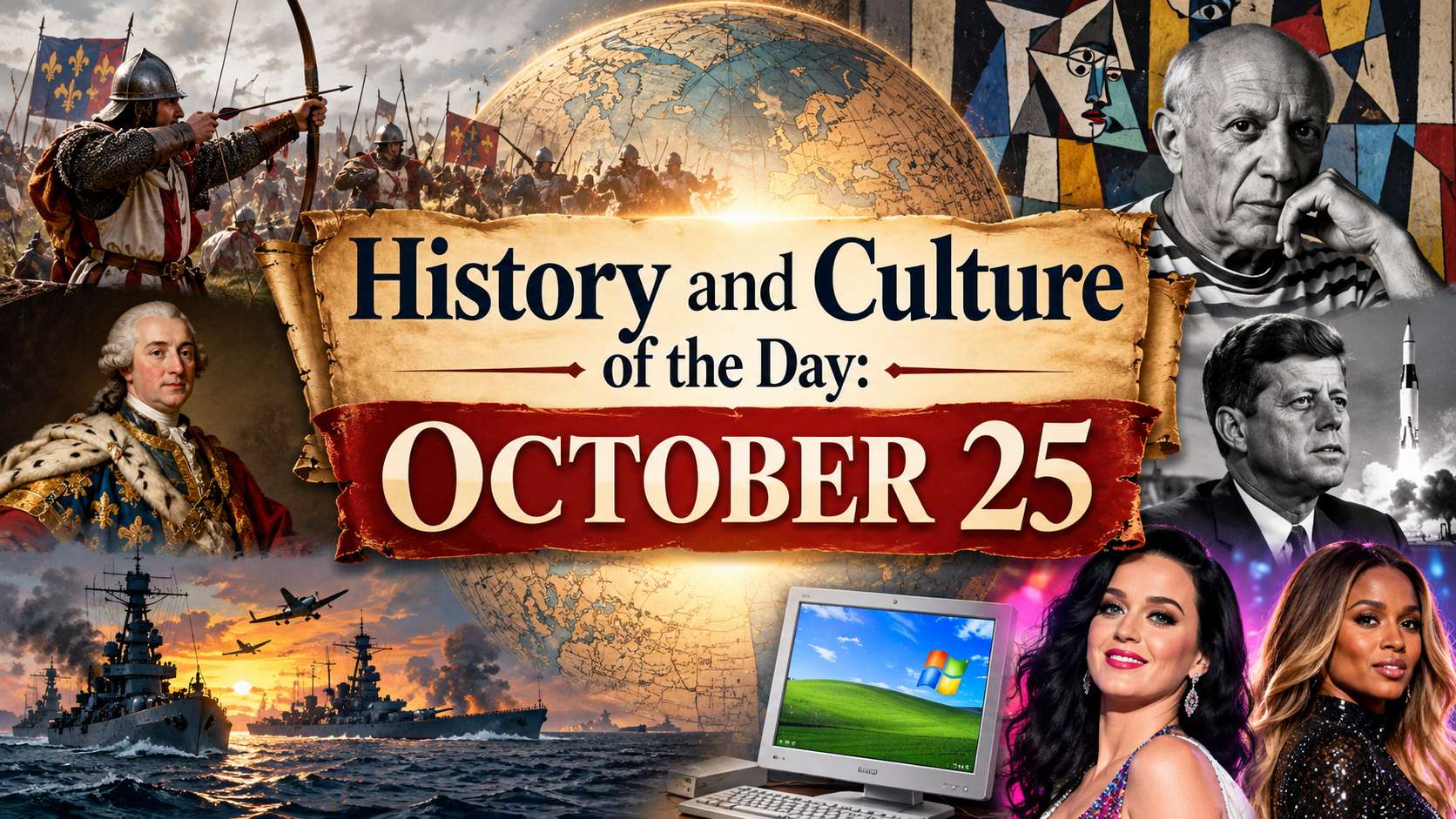
October 25 is a date filled with moments that have shaped history, culture, warfare, art, music, politics, and the way people understand the world around them. From one of the most famous battles of the Middle Ages to the birth of influential artists and entertainers, October 25 offers plenty to explore.
Every date on the calendar carries stories from generations before us. Some involve triumph and discovery. Others remind us of tragedy, conflict, courage, and sacrifice. Looking back at these events gives us a better understanding not only of what happened, but also of how the past continues to influence our lives today.
Here is a look at some of the most interesting historical and cultural moments connected to October 25.
1415 — The Battle of Agincourt
One of the most famous events associated with October 25 occurred in 1415 during the Hundred Years’ War between England and France.
The Battle of Agincourt was fought near the village of Agincourt in northern France. King Henry V of England led an English army against a considerably larger French force.
The English troops were exhausted, weakened by illness, and faced difficult conditions. Yet Henry’s army achieved a remarkable victory.
One of the keys to the English success was the longbow. English and Welsh archers were able to fire large numbers of arrows toward the advancing French forces.
The battlefield’s muddy conditions also created serious problems for heavily armored French soldiers. As the French attempted to advance, congestion and difficult terrain reduced their effectiveness.
The victory became one of the most celebrated military achievements in English history.
Centuries later, the battle became even more famous because of William Shakespeare.
In his play Henry V, Shakespeare dramatized the battle and gave King Henry one of literature’s most memorable speeches: the famous St. Crispin’s Day speech.
The speech emphasizes courage, brotherhood, loyalty, and the idea that those who fought together would forever share a special bond.
Because of Shakespeare, Agincourt became more than a historical battle. It became part of Western literature and popular culture.
October 25 Is St. Crispin’s Day
The Battle of Agincourt took place on St. Crispin’s Day, traditionally observed on October 25.
Saints Crispin and Crispinian were Christian martyrs traditionally associated with shoemakers, cobblers, and leatherworkers.
For many people today, however, the name St. Crispin’s Day is most familiar because of Shakespeare’s Henry V.
Shakespeare transformed the date into a literary symbol of courage and fellowship.
The famous speech describes the soldiers as a “band of brothers,” an expression that has continued to influence literature, military culture, movies, television, and popular language centuries later.
It is an excellent example of how history and culture often become intertwined.
A medieval battle inspired a playwright, and that playwright’s words influenced generations who had never seen the battlefield themselves.
1760 — King George III Becomes King
October 25, 1760, marked an important moment in British and American history when George III became king of Great Britain and Ireland following the death of his grandfather, George II.
George III would reign for nearly six decades.
His reign included some of the most significant political events of the 18th and early 19th centuries.
For Americans, George III is most closely connected with the American Revolution.
Tensions between Great Britain and its North American colonies increased over taxation, representation, trade restrictions, and political authority.
Those disputes eventually contributed to the colonies declaring independence in 1776.
Because of this, George III became one of the most recognizable British monarchs in American history.
His reign also included Britain’s conflicts with revolutionary and Napoleonic France, major changes brought by the Industrial Revolution, and enormous political and social transformations throughout the British Empire.
1854 — The Charge of the Light Brigade
Another famous military event took place on October 25, this time in 1854 during the Crimean War.
The Charge of the Light Brigade occurred during the Battle of Balaclava.
British cavalry soldiers were ordered to advance against Russian forces. Confusion surrounding the orders contributed to the Light Brigade charging directly into a heavily defended position.
The cavalry faced artillery fire from multiple directions.
The charge resulted in significant casualties and became one of history’s most famous examples of courage in the face of disastrous military communication.
The event quickly became part of popular culture.
English poet Alfred, Lord Tennyson immortalized it in his poem The Charge of the Light Brigade.
Once again, October 25 demonstrates how military history can become cultural history.
A battlefield event became poetry, and the poetry helped preserve the memory of the soldiers for generations.
1881 — Pablo Picasso Is Born
October 25 is also the birthday of one of the most influential artists in modern history.
Pablo Picasso was born on October 25, 1881, in Málaga, Spain.
Picasso became a painter, sculptor, printmaker, ceramicist, and one of the central figures in the development of modern art.
Along with Georges Braque, Picasso played a major role in developing Cubism.
Cubism challenged traditional ideas about perspective.
Instead of presenting an object from a single viewpoint, Cubist artists often broke subjects into geometric shapes and presented multiple perspectives within the same image.
Picasso’s work went through several recognizable periods, including his Blue Period and Rose Period.
Among his best-known works is Guernica, created in response to the bombing of the Spanish town of Guernica during the Spanish Civil War.
The enormous painting became an enduring artistic statement about war, suffering, and destruction.
Picasso’s influence can still be seen throughout painting, sculpture, graphic design, fashion, photography, and contemporary visual culture.
1944 — The Battle of Leyte Gulf Continues
October 25, 1944, was also a crucial day during the Battle of Leyte Gulf in World War II.
Fought in waters surrounding the Philippines, the battle involved major naval forces from the United States, its allies, and Imperial Japan.
The larger battle occurred from October 23 through October 26 and is commonly described as one of the largest naval battles in history.
October 25 included several critical engagements, including the Battle off Samar.
There, a relatively lightly armed American task group known as “Taffy 3” unexpectedly faced a powerful Japanese surface fleet.
American escort carriers, destroyers, destroyer escorts, aircraft, and their crews fought desperately against much heavier Japanese warships.
Their resistance became remembered as an extraordinary example of courage under overwhelming circumstances.
The Battle of Leyte Gulf severely weakened Japan’s ability to conduct major naval operations and helped support the Allied campaign to liberate the Philippines.
1962 — The Cuban Missile Crisis Reaches a Dangerous Stage
October 25, 1962, fell during one of the most dangerous periods of the Cuban Missile Crisis.
The United States and Soviet Union were locked in an intense confrontation after American reconnaissance discovered Soviet nuclear missile installations in Cuba.
President John F. Kennedy announced a naval quarantine around Cuba while demanding the removal of the missiles.
For nearly two weeks, the world faced the possibility that tensions could escalate into nuclear war.
On October 25, the crisis remained unresolved, and diplomatic and military pressure continued to increase.
The confrontation eventually eased after an agreement was reached.
The Soviet Union agreed to remove its missiles from Cuba, while the United States pledged not to invade Cuba. The United States also secretly agreed to remove Jupiter missiles from Turkey.
The crisis became one of the defining moments of the Cold War.
It demonstrated just how quickly political confrontation between nuclear powers could threaten millions of lives.
1971 — The United Nations Changes China’s Representation
On October 25, 1971, the United Nations General Assembly adopted Resolution 2758.
The resolution recognized representatives of the People’s Republic of China as China’s representatives at the United Nations and expelled the representatives of Chiang Kai-shek.
The decision significantly changed international diplomacy.
The People’s Republic of China subsequently occupied China’s permanent seat on the United Nations Security Council.
The vote reflected changing geopolitical realities and represented an important moment in China’s relationship with the international community.
Its consequences continue to influence international politics today.
1983 — The United States Invades Grenada
On October 25, 1983, the United States and forces from several Caribbean nations launched a military intervention in Grenada, an island nation in the Caribbean.
The operation followed a period of political instability and the killing of Grenadian Prime Minister Maurice Bishop.
The Reagan administration cited concerns including the safety of American citizens on the island.
The invasion was controversial internationally, and debates continued over its necessity and legality.
American combat operations quickly overwhelmed organized resistance.
The event became another notable chapter of Cold War history, illustrating how competition between the United States and Soviet-aligned movements extended far beyond Europe.
1994 — Susan Smith Reports Her Children Missing
October 25, 1994, also became associated with a heartbreaking American criminal case.
On that day, Susan Smith reported that her two young sons had been abducted during an alleged carjacking in South Carolina.
The story received enormous national media attention as authorities searched for the children.
Nine days later, Smith confessed that there had been no carjacking and that she had allowed her vehicle, with her sons inside, to roll into a lake.
The case shocked the United States.
Beyond the criminal investigation itself, the case became an example of how rapidly a missing-child story can dominate national news and how public understanding of a case can change as evidence emerges.
It remains one of the most widely remembered criminal cases of the 1990s.
2001 — Windows XP Is Released
Technology history also has an important October 25 anniversary.
On October 25, 2001, Microsoft released Windows XP for general retail availability.
For millions of computer users, Windows XP became one of the defining operating systems of the early internet era.
Its familiar interface appeared in homes, schools, businesses, libraries, and government offices around the world.
Windows XP combined Microsoft’s consumer and business Windows product lines around the Windows NT architecture.
It also became famous for its default desktop background, often known simply as Bliss, featuring a green hill beneath a bright blue sky.
The operating system remained widely used long after newer versions of Windows became available.
For people who grew up using computers in the 2000s, Windows XP can trigger considerable nostalgia.
It represents an era of desktop computers, early broadband internet, instant messaging, CD-ROM software, MP3 collections, and the rapidly expanding online world.
Katy Perry Was Born on October 25, 1984
October 25 is also the birthday of American singer and songwriter Katy Perry, born in 1984.
Perry became one of the biggest pop stars of the late 2000s and 2010s.
Her colorful music videos, elaborate stage performances, and highly recognizable pop songs helped make her an international celebrity.
Her album Teenage Dream became especially significant in pop history, producing multiple major hit singles.
Perry’s career reflects the transformation of the music industry during the rise of social media, YouTube, digital downloads, and streaming.
Artists were no longer reaching audiences primarily through radio, television, and physical albums. Digital platforms were becoming increasingly important in shaping global popular culture.
Ciara Was Born on October 25, 1985
Singer, songwriter, dancer, and performer Ciara was born on October 25, 1985.
She rose to prominence during the 2000s with a combination of R&B, pop, dance, and hip-hop influences.
Her career has been especially recognized for energetic choreography and performance.
Artists such as Ciara helped define an era when music videos remained a major cultural force while online video was beginning to transform the entertainment industry.
October 25 and the Connection Between History and Culture
Looking at the events associated with October 25 reveals something fascinating.
History does not remain confined to textbooks.
The Battle of Agincourt became Shakespeare.
The Charge of the Light Brigade became poetry.
Picasso transformed political violence into art.
World War II stories became books, documentaries, movies, memorials, and family histories.
The Cuban Missile Crisis became the subject of films and historical studies while influencing generations of thinking about nuclear weapons.
Windows XP became a piece of technological nostalgia.
Musicians born on this date became part of the soundtrack of millions of people’s lives.
That is why studying both history and culture is important.
History tells us what happened.
Culture helps show us what those events meant to people—and how their meaning changed over time.
Why Remembering History Matters
It can be easy to think of history as a collection of dates, names, battles, and political events.
But history is ultimately about people.
Every major historical event involved ordinary individuals living through extraordinary circumstances.
Soldiers at Agincourt did not know their battle would still be discussed more than six centuries later.
The sailors fighting near the Philippines in 1944 did not know exactly how future generations would remember their courage.
Families living through the Cuban Missile Crisis did not know whether the confrontation would end peacefully.
Artists such as Picasso could not completely know how future generations would interpret their work.
And people turning on their Windows XP computers in 2001 probably did not think that the technology they were using would someday become nostalgic.
We are living through history in exactly the same way.
Today’s ordinary experiences may eventually become tomorrow’s history.
A Day of Courage, Creativity, Conflict, and Change
October 25 connects remarkably different moments across centuries.
It includes medieval warfare and modern technology.
It includes kings and artists.
It includes naval battles and diplomatic confrontations.
It includes poetry, painting, music, computers, and international politics.
The Battle of Agincourt demonstrated how military strategy and circumstance can alter history.
The Charge of the Light Brigade became a lasting symbol of bravery and military tragedy.
Pablo Picasso helped revolutionize modern art.
The Battle of Leyte Gulf changed the course of the Pacific War.
The Cuban Missile Crisis reminded humanity of the terrifying consequences of nuclear confrontation.
The United Nations vote in 1971 changed international diplomacy.
Windows XP helped define an era of personal computing.
And entertainers born on October 25 helped shape modern popular culture.
Each event is different, but together they illustrate the enormous variety contained within a single day of history.
Final Thoughts
October 25 reminds us that history is constantly being written.
Centuries can separate two events that share the same date, yet each contributes something to the story of humanity.
Some moments should be celebrated.
Others should be remembered as warnings.
Some demonstrate remarkable courage and creativity, while others reveal the consequences of conflict, mistakes, and human suffering.
Studying them allows us to understand where we came from and, perhaps, make wiser decisions about where we are going.
Tomorrow’s history is being created by the choices people make today.
Which October 25 historical or cultural event do you find the most interesting—and why?



Leave a Reply