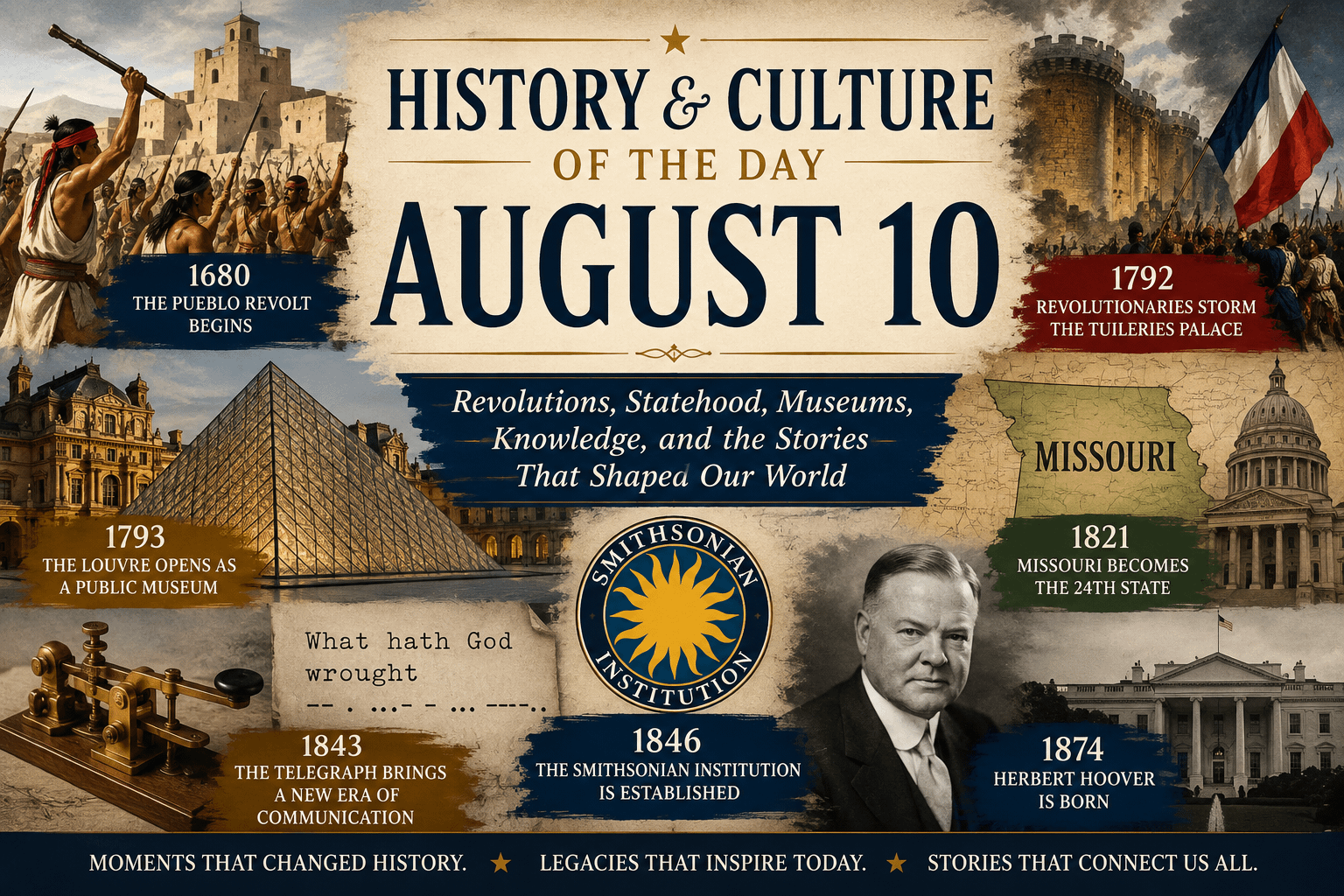
Every day on the calendar carries echoes of the past. Some dates are remembered for battles and revolutions. Others mark scientific breakthroughs, cultural achievements, political turning points, famous births, or the creation of institutions that continue to influence our lives generations later.
August 10 is one of those dates where history reaches across centuries and continents.
On August 10, Indigenous peoples in the American Southwest launched one of the most successful uprisings against European colonial rule in North American history. Missouri officially became a state. Revolutionaries in France attacked the royal palace and helped bring down a centuries-old monarchy. The Louvre opened its doors as a public museum. The Smithsonian Institution was established in the United States with a mission centered on spreading knowledge.
August 10 also connects us to presidents, actors, athletes, artists, inventors, and countless ordinary people whose lives contributed to the larger story of humanity.
When we explore the history and culture surrounding August 10, we discover something important: history is not simply a collection of dates. It is the ongoing story of people trying to build, survive, create, resist, discover, govern, communicate, and understand the world around them.
Let’s travel through some of the remarkable moments associated with August 10.
1680 – The Pueblo Revolt Begins
One of the most significant events in the history of the American Southwest began on August 10, 1680, when Pueblo peoples launched a coordinated uprising against Spanish colonial rule in present-day New Mexico.
The uprising became known as the Pueblo Revolt.
Spanish colonization of the region had brought enormous changes to Indigenous communities. Spanish officials and missionaries attempted to reshape Pueblo political, economic, and religious life.
Traditional religious practices were often suppressed, while Indigenous communities faced demands for labor and resources.
Over time, resentment grew.
A Tewa religious leader known as Po’pay, from Ohkay Owingeh, became one of the central organizers of the resistance.
Coordinating an uprising among communities separated by considerable distances was an extraordinary challenge in the 17th century. According to historical accounts, messengers traveled between Pueblo communities carrying knotted cords. Each day, another knot could be untied as communities counted down toward the planned uprising.
The revolt began on August 10.
Pueblo fighters attacked Spanish settlements and missions throughout the region. After days of fighting, Spanish colonists retreated from Santa Fe and eventually withdrew southward.
For approximately twelve years, much of the region remained outside Spanish control.
Spanish forces reconquered Santa Fe in 1692, but relations between colonial authorities and Pueblo communities changed afterward.
The Pueblo Revolt remains historically significant because it represents one of the most successful Indigenous uprisings against European colonial authority in what became the United States.
Its importance extends beyond military history.
It is also a story about cultural survival.
Pueblo peoples were defending communities, traditions, religious practices, identities, and ways of life that had existed long before European colonization.
That makes August 10 an important date not only in American history but also in the history of Indigenous resistance and cultural preservation.
1792 – Revolutionaries Storm the Tuileries Palace
More than a century later, August 10 became associated with another dramatic uprising—this time in France.
On August 10, 1792, revolutionary forces attacked the Tuileries Palace in Paris, where King Louis XVI and the royal family were residing.
The event became known as the Insurrection of August 10.
The French Revolution had begun in 1789 amid deep economic and political problems.
France faced enormous debt.
Food prices were high.
Many ordinary citizens struggled with poverty and hunger.
Meanwhile, the country’s social structure granted significant privileges to the monarchy, aristocracy, and clergy.
Calls for political reform became increasingly powerful.
The revolution initially attempted to create a constitutional monarchy, but trust in King Louis XVI deteriorated dramatically.
His attempted escape from France in 1791 intensified suspicions that the king opposed the revolution and hoped foreign powers would restore his authority.
By the summer of 1792, tensions had reached a breaking point.
Revolutionary groups and armed citizens moved against the Tuileries Palace.
Fierce fighting erupted.
The royal family sought refuge with the Legislative Assembly, and the king’s authority was soon suspended.
The event effectively ended the monarchy’s political power.
In September 1792, France officially abolished the monarchy and established a republic.
Louis XVI was later placed on trial and executed in January 1793.
Marie Antoinette was executed later that year.
Why the August 10 Insurrection Matters
The attack on the Tuileries represented more than the fall of a king.
It demonstrated how quickly political systems that appear permanent can collapse when public confidence disappears.
For generations, the French monarchy had seemed inseparable from the nation itself.
Yet revolutionary ideas about citizenship, equality, representation, and popular sovereignty fundamentally challenged that assumption.
Those ideas would influence political movements far beyond France.
The French Revolution remains one of history’s most studied examples of both the possibilities and dangers of revolutionary change.
Ideas of liberty and equality emerged alongside political violence, executions, warfare, and instability.
August 10, 1792 stands near the center of that complicated story.
1793 – The Louvre Opens as a Public Museum
Exactly one year after the attack on the Tuileries Palace, another event took place in Paris that would leave a very different cultural legacy.
On August 10, 1793, the Louvre opened as a public museum.
Today, the Louvre is one of the most recognizable cultural institutions in the world.
But its history stretches back centuries before it became a museum.
The site originally contained a medieval fortress constructed during the reign of King Philip II. Over generations, the complex was expanded and transformed into a royal palace.
French monarchs accumulated extensive collections of paintings, sculptures, decorative objects, and other treasures.
The French Revolution dramatically changed the idea of who should have access to those collections.
Instead of art belonging primarily to kings and aristocrats, revolutionaries promoted the idea that great works should become part of the nation’s cultural heritage.
When the museum opened in 1793, members of the public gained access to collections that had once been associated with royal privilege.
Over the following centuries, the Louvre’s collection expanded enormously.
Today, the museum is famous for works including:
- Leonardo da Vinci’s Mona Lisa
- The ancient Greek sculpture Venus de Milo
- The Winged Victory of Samothrace
- Ancient Egyptian artifacts
- Renaissance paintings
- Classical sculptures
- Decorative arts
- Historical objects representing civilizations from around the world
The Louvre’s transformation from royal palace to public museum represented a major cultural shift.
Art was increasingly viewed not simply as private property or royal decoration, but as something capable of educating and inspiring the public.
Millions of people now visit the museum each year, while millions more encounter its collections through books, documentaries, classrooms, and digital resources.
1821 – Missouri Becomes the 24th State
On August 10, 1821, Missouri officially entered the United States as the 24th state.
Missouri’s admission was not a simple matter of adding another star to the American flag.
It became part of one of the nation’s growing political conflicts: whether slavery would expand into new states and territories.
As the United States expanded westward, the political balance between free states and slave states became increasingly important.
When Missouri sought admission as a state where slavery would be permitted, a national debate erupted.
The resulting agreement became known as the Missouri Compromise.
Under the compromise, Maine entered the Union as a free state while Missouri was admitted as a slave state, helping maintain a temporary balance in the Senate.
The compromise also attempted to establish geographic restrictions concerning slavery in portions of the Louisiana Purchase territory.
For a time, the agreement reduced political tensions.
But it did not solve the underlying problem.
The question of slavery’s expansion returned repeatedly over the following decades.
Eventually, compromises could no longer hold the country together.
The United States descended into the Civil War in 1861.
Missouri’s Unique Role in American History
Missouri’s geographic position gave it enormous historical importance.
It became known as a gateway to western expansion.
Explorers, traders, settlers, soldiers, and migrants traveled through Missouri on their journeys westward.
St. Louis became especially important as a transportation and commercial center along the Mississippi River.
During the Civil War, Missouri’s position became even more complicated.
Although Missouri remained in the Union, the state contained strong Unionist and Confederate sympathies.
Communities and even families could find themselves divided by the conflict.
Today, August 10 is remembered as Missouri Statehood Day, recognizing the state’s entry into the Union.
1846 – The Smithsonian Institution Is Established
One of America’s most important cultural and educational institutions was formally established on August 10, 1846.
President James K. Polk signed legislation creating the Smithsonian Institution.
The story behind the Smithsonian is one of the most unusual stories in American cultural history.
A British scientist named James Smithson died in 1829.
In his will, Smithson left his fortune to the United States for the creation of an institution devoted to the increase and diffusion of knowledge.
There was one especially curious detail:
Smithson had never visited the United States.
Why he selected the United States for his extraordinary gift remains a subject of historical interest.
The inheritance eventually arrived in America, but Congress spent years debating what kind of institution should be created.
Should it become a university?
A research institution?
A library?
A museum?
Eventually, Congress created an institution that incorporated several educational and scientific purposes.
The Smithsonian Institution was officially established in 1846.
From One Gift to an American Cultural Treasure
The Smithsonian grew far beyond what anyone in the 1840s could have imagined.
Its museums and research facilities preserve artifacts covering an enormous range of human knowledge.
Visitors can encounter objects connected with:
American history.
Natural history.
Aviation and space exploration.
Science and technology.
Art and design.
African American history and culture.
Native American history and culture.
World civilizations.
Among the extraordinary objects preserved within Smithsonian collections are artifacts associated with defining moments of American history and scientific achievement.
One of the most famous is the enormous American flag that inspired Francis Scott Key to write the words that became “The Star-Spangled Banner.”
Another is the 1903 Wright Flyer, connected with the Wright brothers’ pioneering powered flight.
The Smithsonian also preserves objects associated with American presidents, military history, popular entertainment, technological innovation, transportation, exploration, and everyday life.
An object does not necessarily need to be made of gold or belong to a president to have historical value.
Sometimes ordinary objects tell extraordinary stories.
A lunchbox, uniform, photograph, musical instrument, protest sign, family possession, or piece of machinery can reveal how people lived during another era.
That is one of the Smithsonian’s greatest cultural contributions.
It preserves pieces of America’s collective memory.
1874 – Herbert Hoover Is Born
Future U.S. President Herbert Hoover was born on August 10, 1874, in West Branch, Iowa.
Hoover’s presidency would eventually become inseparable from one of the darkest economic periods in American history—the Great Depression.
But his life before becoming president was remarkable in its own right.
Hoover trained as a mining engineer and worked internationally.
He later became widely known for humanitarian relief efforts.
During World War I, he helped organize efforts to provide food to civilians facing severe shortages.
His administrative reputation eventually helped propel him into national politics.
Hoover served as U.S. Secretary of Commerce before winning the presidential election of 1928.
He took office in March 1929.
Only months later, the American stock market experienced its devastating crash.
The crash was followed by widespread bank failures, unemployment, business closures, homelessness, and economic hardship.
The Great Depression became the defining issue of Hoover’s presidency.
Many Americans believed the federal government’s response was inadequate.
In 1932, Hoover lost his reelection campaign to Franklin D. Roosevelt.
Despite the political damage to his reputation, Hoover lived for decades after leaving office and continued participating in public affairs and humanitarian work.
His life illustrates how historical reputations can be complicated.
A person may be remembered primarily for one crisis even though their life and career included many other achievements and failures.
1921 – Franklin D. Roosevelt’s Battle With Paralytic Illness
August 1921 was a life-changing period for future president Franklin D. Roosevelt.
While vacationing at Campobello Island, Roosevelt became seriously ill and experienced paralysis.
He was eventually diagnosed with poliomyelitis at the time, though later researchers have debated the precise diagnosis.
Roosevelt’s struggle with paralysis dramatically changed his personal and political life.
He underwent years of rehabilitation and worked intensely to regain strength.
Rather than ending his political career, Roosevelt eventually returned to public life.
He became governor of New York and later the 32nd president of the United States.
Elected in 1932 during the Great Depression, Roosevelt would serve more than twelve years as president and lead the country through both the Depression and most of World War II.
His experience with disability became an important part of his personal story, even though the extent of his paralysis was often carefully managed in public appearances.
August 10 in Entertainment and Popular Culture
History is not created only in government buildings, battlefields, and laboratories.
Culture is also shaped on movie screens, theater stages, concert halls, television sets, sports arenas, and eventually digital platforms.
Several notable figures associated with entertainment and popular culture were born on August 10.
Antonio Banderas – Born in 1960
Spanish actor Antonio Banderas was born on August 10, 1960, in Málaga, Spain.
Banderas became internationally recognized through a career spanning Spanish cinema, Hollywood movies, theater, voice acting, and musical performance.
His international success also reflected the increasingly global nature of entertainment during the late 20th and early 21st centuries.
Audiences were becoming more accustomed to actors, filmmakers, musicians, and stories crossing national and linguistic boundaries.
Rosanna Arquette – Born in 1959
American actress Rosanna Arquette was born on August 10, 1959.
Her career has included roles across film and television and places her among a well-known family of performers who became part of American popular culture.
Actors and filmmakers do more than entertain audiences.
Movies and television programs frequently become cultural time capsules.
Fashion, language, technology, social attitudes, music, architecture, and everyday behavior captured on screen can later help us understand the era in which a production was created.
Museums Are More Than Buildings Filled With Old Things
Two major August 10 anniversaries—the opening of the Louvre and establishment of the Smithsonian—invite us to consider why museums matter.
A museum can preserve things that might otherwise disappear.
Imagine how much history would be lost if nobody preserved photographs, documents, clothing, artwork, tools, machinery, letters, household objects, recordings, or personal possessions.
Museums help societies maintain a physical connection to the past.
Standing near an object created hundreds or thousands of years ago can make history feel remarkably immediate.
You are no longer simply reading about another time.
You are looking at something that survived it.
Museums also help tell stories that previous generations sometimes ignored.
Modern institutions increasingly work to include perspectives from Indigenous communities, enslaved people, immigrants, workers, women, minority communities, and ordinary families whose experiences were historically underrepresented.
Preserving history is therefore not only about protecting objects.
It is also about asking:
Whose story is being remembered?
Whose story has been forgotten?
Who gets to decide what deserves preservation?
Those questions continue to influence museums and cultural institutions today.
The Importance of Preserving Cultural Heritage
Culture can disappear surprisingly quickly.
Languages can fade.
Historic buildings can be destroyed.
Family photographs can be lost.
Traditional recipes can vanish when nobody writes them down.
Songs can disappear when nobody teaches them to another generation.
Stories can be forgotten when the people who remember them are gone.
Preserving cultural heritage does not mean refusing to change.
Instead, it means maintaining a connection between past, present, and future.
Sometimes cultural preservation happens inside enormous institutions such as the Louvre or Smithsonian.
But it also happens inside ordinary homes.
Every time someone saves a grandparent’s photograph, records a family story, prepares a traditional recipe, researches their ancestry, visits a historic site, or teaches a child about where their family came from, they are participating in cultural preservation.
Technology Changed How We Experience History
For most of human history, experiencing distant cultural treasures required physically traveling to them.
Today, technology has dramatically changed access to history.
A person sitting thousands of miles away can explore digitized museum collections.
Historic newspapers can be searched online.
Old maps can be examined in extraordinary detail.
Historical photographs can be preserved digitally.
Researchers can compare documents stored on different continents without leaving their desks.
Students can watch virtual tours of places they may never have the opportunity to visit.
The digital age has created unprecedented access to historical information.
But it has also created new challenges.
Digital misinformation can spread quickly.
Historical photographs can be presented without context.
False quotations can circulate widely.
Artificially generated content can make it more difficult to distinguish authentic historical evidence from fabricated material.
That makes historical literacy increasingly important.
Learning history should include learning how we know what we know.
Reliable historical understanding depends on evidence, primary sources, archaeology, scholarly research, preserved objects, photographs, government records, newspapers, diaries, oral histories, and careful comparison of sources.
What August 10 Teaches Us About Freedom
Another theme running through August 10 is the meaning of freedom.
The Pueblo Revolt involved Indigenous communities resisting colonial control and defending cultural and religious independence.
The French Revolution challenged monarchy and inherited political privilege.
Missouri’s statehood became entangled with America’s contradiction between democratic ideals and human slavery.
Museums such as the Louvre reflected the idea that cultural treasures should become more accessible to ordinary citizens.
The Smithsonian reflected the belief that knowledge should be increased and shared.
These stories show that freedom has never had one simple definition.
Political freedom.
Religious freedom.
Cultural freedom.
Freedom from oppression.
Freedom to learn.
Freedom to participate in government.
Different generations have struggled over each of these ideas.
Those struggles continue to shape modern societies.
The People Behind Historical Events
History books often focus on famous individuals.
Kings.
Presidents.
Generals.
Scientists.
Explorers.
Artists.
Revolutionaries.
But every major historical event involved thousands—or sometimes millions—of people whose names never entered textbooks.
When Missouri became a state, ordinary families were building communities and livelihoods.
During the French Revolution, ordinary workers, merchants, soldiers, farmers, and families experienced enormous uncertainty.
During the Pueblo Revolt, entire communities participated in resistance and cultural survival.
When the Smithsonian opened its collections, generations of curators, researchers, preservationists, educators, craftspeople, and visitors helped turn it into the institution we know today.
History belongs to them too.
In fact, much of history is created by people who never realize they are making it.
History Is Happening Right Now
One of the most fascinating things about studying dates such as August 10 is realizing that history never stops.
The people living through the events of 1680, 1792, 1793, 1821, or 1846 did not know exactly how future generations would remember them.
They were simply living through their present.
We are doing the same thing today.
Our technology, music, politics, businesses, communities, celebrations, photographs, social media posts, family traditions, and everyday experiences will eventually become evidence of life in the early 21st century.
Future historians may study things we consider completely ordinary.
The smartphones we use.
The foods we eat.
The clothes we wear.
The websites we visit.
The slang we speak.
The photographs we share.
The challenges our communities face.
The way families communicate.
Today’s ordinary life eventually becomes tomorrow’s cultural history.
Why Learning History Still Matters
History cannot tell us exactly what will happen tomorrow.
But it can show us what human beings have done before.
It shows us the consequences of decisions.
It reveals patterns.
It challenges myths.
It helps explain why borders, governments, traditions, institutions, and conflicts exist.
Most importantly, history reminds us that today’s world was not inevitable.
People made choices.
Some choices expanded opportunity and knowledge.
Others caused enormous suffering.
Some institutions survived.
Others disappeared.
Some ideas once considered impossible became normal.
And some ideas once considered permanent eventually vanished.
Understanding that can change how we view our own time.
The world can change because it always has.
August 10: A Day Connecting Revolution, Culture, and Knowledge
Few dates illustrate the diversity of history better than August 10.
On this date across different centuries, Pueblo communities rose against colonial rule.
French revolutionaries attacked a royal palace and helped bring down a monarchy.
The Louvre transformed a former royal palace into a public cultural institution.
Missouri entered the United States during a growing national struggle over slavery.
The Smithsonian Institution was established with a mission centered on increasing and sharing knowledge.
A future American president was born.
Artists and entertainers who would later influence popular culture entered the world.
None of these stories happened in isolation.
Each became part of something larger.
The Pueblo Revolt became part of the continuing story of Indigenous survival.
The French Revolution influenced political movements around the world.
Missouri statehood became part of America’s westward expansion and its unresolved struggle over slavery.
The Louvre became a symbol of humanity’s artistic heritage.
The Smithsonian became one of America’s great institutions of history, science, research, and culture.
Together, these events remind us why exploring history one day at a time can be so fascinating.
Final Thoughts: Every Date Has a Story
August 10 reminds us that history is everywhere.
It exists in museums and monuments, but also in neighborhoods and family photo albums.
It lives inside famous paintings and handwritten letters.
It can be found in government documents, old newspapers, traditional recipes, songs, clothing, architecture, photographs, religious traditions, and stories passed from grandparents to grandchildren.
History tells us where we have been.
Culture tells us who we have been.
Together, they help us understand who we are becoming.
The people who lived through the great events of August 10 could not fully know how their actions would influence future generations.
Neither can we.
That is what makes history so powerful.
Every generation inherits a world shaped by the people who came before it—and every generation leaves something behind for those who come next.
So as we remember the revolutions, cultural achievements, statehood milestones, institutions, leaders, artists, and ordinary people connected with August 10, we can also remember one simple truth:
We are not merely observers of history. We are living in it.
History & Culture Question of the Day
If you could travel back in time and witness one August 10 event firsthand—the Pueblo Revolt, the French Revolution, the opening of the Louvre, Missouri becoming a state, or the creation of the Smithsonian—which would you choose, and what would you want to see or learn?
Leave a Reply