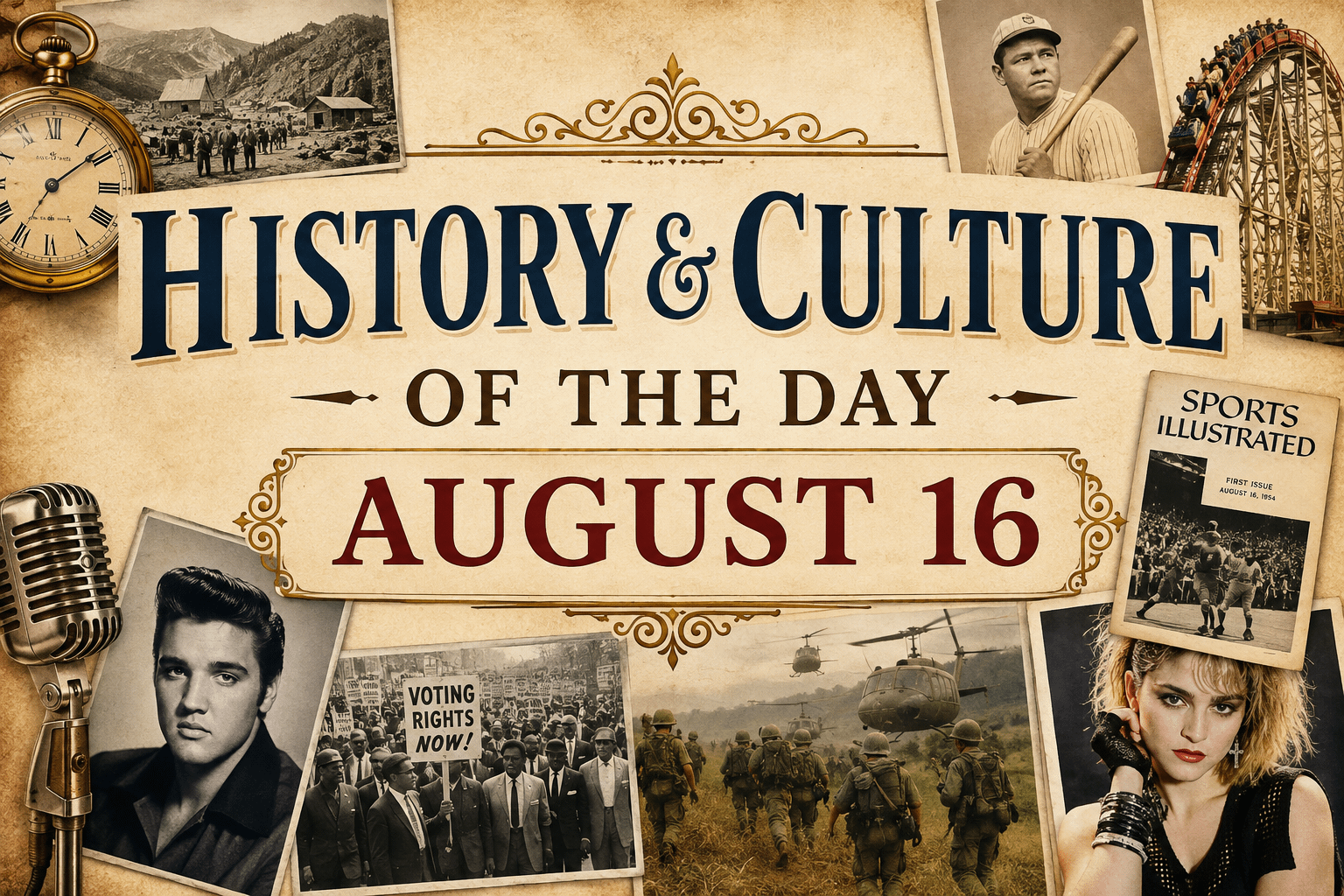
August 16 is a day where history and culture meet in fascinating ways. Across different centuries, this date has been connected to gold discoveries, technological innovation, legendary athletes, unforgettable musicians, major social changes, and moments that influenced how people lived, worked, traveled, entertained themselves, and understood the world around them.
Some historical dates are remembered because of one enormous event. August 16 is different. Its significance comes from a collection of stories that stretch across exploration, entertainment, sports, civil rights, music, and popular culture.
The Klondike Gold Rush was sparked by a discovery associated with this date. Babe Ruth, one of America’s first true sports superstars, died on August 16. Sports Illustrated published its first issue. Elvis Presley died at Graceland. Madonna was born. And the date sits within one of the most turbulent periods of the 1960s, when America was experiencing dramatic changes involving civil rights, racial inequality, the Vietnam War, youth culture, and popular music.
Together, these stories make August 16 a remarkable date to explore.
Gold Is Discovered in the Klondike – 1896
One of the most important events connected to August 16 happened far from America’s largest cities.
On August 16, 1896, gold was discovered in the Klondike region of Canada’s Yukon Territory.
The discovery is commonly associated with George Carmack, Skookum Jim Mason, Dawson Charlie, and Kate Carmack. Gold was found along Rabbit Creek, which would later become famous under a much more exciting name: Bonanza Creek.
At first, the discovery received little attention outside the region.
The Yukon was extremely remote. Communication with major cities was slow, transportation was difficult, and the world had no instant news networks capable of spreading the story within minutes.
That would soon change.
When successful prospectors eventually reached cities such as Seattle and San Francisco carrying gold and stories of riches in the north, newspapers enthusiastically reported the discovery.
Suddenly, thousands of people believed their fortunes might be waiting in the wilderness.
The Klondike Gold Rush Begins
The Klondike Gold Rush became one of the most famous gold rushes in North American history.
An estimated 100,000 people attempted to reach the Klondike region during the rush, although only a fraction actually made it all the way to the goldfields.
These prospectors became known as stampeders.
They came from different backgrounds.
Some were experienced miners.
Others were farmers, clerks, businessmen, laborers, sailors, and professionals who knew almost nothing about mining.
Many simply believed they had been given a once-in-a-lifetime opportunity.
The dream was simple:
Get to the Yukon. Find gold. Become rich.
Reality was far more complicated.
The Dangerous Journey North
Getting to the Klondike was an enormous challenge.
Prospectors traveled by ship to Alaska before attempting difficult overland routes into Canada’s Yukon.
Two of the most famous routes involved the Chilkoot Pass and White Pass.
The journey was brutal.
Travelers faced freezing temperatures, steep mountains, deep snow, dangerous waterways, exhaustion, disease, and shortages of supplies.
Canadian authorities also required prospectors entering the Yukon to carry enough provisions to survive for an extended period. That meant transporting enormous amounts of food and equipment.
A person might have to travel the same section of trail repeatedly, carrying a portion of their supplies each time.
For many, simply reaching the Klondike became a greater challenge than searching for gold.
Some gave up.
Others ran out of money.
Some became sick.
A few died along the journey.
And many who finally reached the goldfields discovered an unfortunate truth:
Much of the best land had already been claimed.
Still, the Klondike Gold Rush became part of the mythology of the North American frontier.
It represented adventure, opportunity, determination, risk, greed, courage, and the powerful belief that one discovery could completely transform a person’s life.
The Gold Rush Changes Cities
The Klondike story wasn’t limited to the Yukon.
Cities hundreds of miles away benefited from the rush.
Seattle became an important supply center for prospectors heading north. Businesses sold mining tools, clothing, food, tents, transportation services, and other equipment.
San Francisco also became connected to the excitement as prospectors and news of gold moved through the city.
The rush demonstrated something that remains true today:
When a major economic opportunity appears, entire industries often grow around it.
Not everyone who became wealthy during a gold rush found gold.
Sometimes the people selling supplies, providing transportation, offering lodging, or operating businesses made more reliable profits than the prospectors themselves.
Roller Coaster Innovation – 1898
August 16 also has an interesting connection to amusement history.
On August 16, 1898, inventor Edwin Prescott received a U.S. patent related to a looping roller coaster.
The concept seems ordinary today.
Modern amusement parks feature roller coasters that twist riders upside down repeatedly. Some launch riders from zero to highway speeds within seconds. Others climb hundreds of feet before sending riders down enormous drops.
But in the late 1800s, roller coasters were still relatively new attractions.
Inventors were experimenting with what was possible.
Prescott’s looping design represented the growing desire to make rides more thrilling.
How Roller Coasters Became Cultural Icons
Roller coasters eventually became symbols of amusement parks themselves.
Think about some of America’s most famous amusement destinations and one image almost always appears:
A roller coaster.
The rides represent excitement, fear, adrenaline, summer vacations, family outings, and childhood memories.
Modern roller coaster design combines physics, engineering, computer technology, safety systems, and psychology.
Designers intentionally build anticipation.
The slow climb up the first hill.
The pause near the top.
The view below.
Then the drop.
Those few seconds create an emotional experience that millions of people willingly stand in long lines to experience.
What began as relatively simple rides eventually developed into a global entertainment industry.
Babe Ruth Dies – 1948
August 16, 1948, marked the end of the life of one of the most recognizable athletes in American history.
George Herman “Babe” Ruth died at the age of 53.
Even people who have never watched an entire baseball game often recognize the name Babe Ruth.
That demonstrates the size of his cultural impact.
Ruth wasn’t simply an outstanding baseball player.
He became one of America’s earliest sports celebrities.
Babe Ruth Changes Baseball
Ruth began his Major League Baseball career as an exceptional pitcher.
But his hitting ability eventually became impossible to ignore.
He could hit baseballs farther and more frequently than most players of his era.
As Ruth began hitting enormous numbers of home runs, baseball itself started changing.
The sport had traditionally emphasized strategies such as bunting, stealing bases, moving runners forward, and relying heavily on pitching and defense.
Ruth demonstrated the entertainment value of power.
Fans wanted to see home runs.
They wanted dramatic moments.
They wanted to see Babe Ruth step to the plate.
Stadium crowds grew.
Newspapers followed his performances.
Children imitated his batting stance.
Ruth became a celebrity whose fame extended far beyond baseball.
The Birth of the Superstar Athlete
Today, superstar athletes appear everywhere.
They sign endorsement contracts.
They appear in commercials.
They launch brands.
They become social media personalities.
They star in documentaries.
They influence fashion and culture.
Babe Ruth lived long before social media, but he helped establish the idea of the athlete as a national celebrity.
His personality was enormous.
So was his reputation.
Stories about his life became almost legendary.
Some were true.
Others were exaggerated.
But that hardly mattered.
The legend of Babe Ruth became almost as important as the player himself.
His death on August 16, 1948, was therefore more than the death of a retired baseball player.
America had lost one of its first sports icons.
Sports Illustrated Publishes Its First Issue – 1954
Six years after Ruth’s death, August 16 once again became connected to American sports history.
On August 16, 1954, the first issue of Sports Illustrated was published.
The timing was significant.
American sports culture was rapidly expanding.
Television was entering more homes.
Professional sports leagues were growing.
College athletics were becoming increasingly popular.
Athletes were becoming national celebrities.
Fans wanted more than scores.
They wanted stories.
They wanted photographs.
They wanted profiles of athletes.
They wanted analysis.
They wanted to understand what happened behind the scenes.
Sports Illustrated helped meet that demand.
Sports Become Part of Popular Culture
Sports journalism increasingly became storytelling.
The greatest sports stories weren’t always about who won.
Sometimes they were about an athlete overcoming adversity.
Sometimes they involved rivalries.
Sometimes they captured cultural change.
Sometimes they revealed controversy.
And sometimes a single photograph could tell the story better than thousands of words.
Over the decades, Sports Illustrated became especially known for its photography.
Images of championship celebrations, Olympic victories, dramatic plays, legendary athletes, and heartbreaking defeats helped preserve important moments in sports history.
Sports weren’t simply games anymore.
They had become part of America’s cultural identity.
Madonna Is Born – 1958
August 16 connects two of the most recognizable entertainers in modern popular music.
On August 16, 1958, Madonna Louise Ciccone was born in Bay City, Michigan.
Few people could have predicted that the child born that day would eventually become one of the most influential pop performers in the world.
Madonna rose to prominence during the early 1980s.
Her music quickly became popular, but her cultural influence went far beyond songs.
She understood something that would become increasingly important in modern entertainment:
Music was also visual.
Madonna and the MTV Generation
The rise of Madonna occurred during the early years of MTV.
Music videos were transforming how artists connected with audiences.
A successful performer no longer needed only a great song.
Image mattered.
Fashion mattered.
Dance mattered.
Video mattered.
Personality mattered.
Madonna mastered that environment.
Songs including “Like a Virgin,” “Material Girl,” “Into the Groove,” “Papa Don’t Preach,” “Like a Prayer,” and “Vogue” became major parts of popular culture.
Her clothing and hairstyles were copied by fans.
Her videos attracted enormous attention.
Her performances generated conversation and controversy.
Most importantly, Madonna continually reinvented herself.
Reinvention Becomes Part of Celebrity Culture
Madonna’s career demonstrated that an artist didn’t have to maintain the same image forever.
She changed.
Her fashion changed.
Her sound changed.
Her performances changed.
Her public identity changed.
Today, reinvention is almost expected from major pop stars.
Artists frequently introduce new visual styles and musical eras with each album.
Madonna helped establish that model.
Her influence can still be seen in generations of performers who followed.
Elvis Presley Dies – 1977
August 16 has another extraordinary connection to music history.
On August 16, 1977, Elvis Presley died at Graceland in Memphis, Tennessee.
He was only 42 years old.
The news shocked fans around the world.
Elvis had become so famous that simply saying his first name was usually enough.
There was only one Elvis.
The Rise of Elvis Presley
Elvis emerged during the 1950s, when American music was undergoing a dramatic transformation.
His sound combined influences from several musical traditions, including:
- Blues
- Gospel
- Country
- Rhythm and blues
- Rockabilly
- Early rock and roll
His music reached young audiences at exactly the right moment.
Teenagers were becoming a powerful cultural and economic force.
They had their own music.
Their own fashion.
Their own slang.
Their own celebrities.
And Elvis became one of their biggest stars.
Elvis and Cultural Change
Elvis’ performances caused controversy.
His movements were considered too provocative by some adults.
His appearance challenged traditional expectations.
His music reflected influences that crossed racial and cultural boundaries during an era when America remained deeply segregated.
Young fans loved him.
Some parents didn’t understand him.
That generational conflict became part of the Elvis phenomenon.
Rock and roll wasn’t simply a new type of music.
It represented change.
From Singer to Cultural Icon
Elvis expanded into movies and became one of Hollywood’s most recognizable stars.
He served in the United States Army.
He later returned to performing.
His 1968 television comeback special reminded audiences of his abilities as a live performer.
During the 1970s, Elvis became closely associated with Las Vegas performances.
His jumpsuits, sideburns, stage movements, voice, and personality became instantly recognizable.
Eventually, Elvis became more than a musician.
He became an American cultural symbol.
The Day Elvis Died
When Elvis died on August 16, 1977, thousands of fans gathered near Graceland.
Millions more mourned from around the world.
Radio stations played his songs.
Television networks reported on his death.
Newspapers published tributes.
For fans who had grown up listening to Elvis, his death represented the end of an era.
Yet his cultural influence continued.
New generations discovered his music.
Graceland became a major tourist destination.
Elvis impersonators became a unique part of entertainment culture.
His songs continued appearing in movies, television shows, commercials, and celebrations.
Decades later, Elvis remains one of the most recognizable figures in popular music.
Elvis and Madonna: An Extraordinary August 16 Connection
One of the most interesting cultural coincidences associated with August 16 involves Elvis Presley and Madonna.
Elvis died on August 16, 1977.
Madonna was born on August 16, 1958.
The two represent different generations of pop superstardom.
Elvis helped define the rock-and-roll celebrity of the 1950s and 1960s.
Madonna helped define the music-video-driven pop celebrity of the 1980s and beyond.
Both understood the power of performance.
Both influenced fashion.
Both generated controversy.
Both attracted enormous fan bases.
And both became cultural figures whose influence extended far beyond the songs they recorded.
That makes August 16 a particularly meaningful day in popular music history.
August 1965: America in the Middle of Change
To understand the historical atmosphere surrounding August 16, it is worth looking at America in August 1965.
The country was experiencing extraordinary change.
The Civil Rights Movement was transforming American law and society.
The Vietnam War was escalating.
Young people were challenging older cultural expectations.
Rock music was becoming increasingly influential.
Television was changing politics and entertainment.
Race relations remained deeply troubled.
America was simultaneously experiencing progress, conflict, optimism, fear, and cultural transformation.
Few months demonstrate that complicated reality better than August 1965.
The Watts Uprising Comes to an End – 1965
The Watts uprising began in Los Angeles on August 11, 1965, following a traffic stop involving a Black motorist.
But the immediate incident existed within much deeper tensions.
Black residents of Los Angeles had experienced discrimination involving housing, employment, policing, education, and economic opportunity.
Anger had been building.
The unrest spread through the Watts neighborhood and surrounding areas.
For several days, Los Angeles experienced violence, fires, looting, clashes with law enforcement, injuries, and deaths.
By August 16, the uprising was largely coming to an end.
Thirty-four people had been killed.
Hundreds had been injured.
Thousands had been arrested.
Large areas had suffered significant property damage.
Watts Revealed a Larger American Problem
The Watts uprising occurred during what might otherwise have appeared to be a triumphant moment for the Civil Rights Movement.
Only days earlier, President Lyndon B. Johnson had signed the Voting Rights Act of 1965.
Major civil rights legislation had been achieved.
Yet Watts demonstrated that legal progress did not instantly erase inequality.
Discrimination in housing remained.
Economic inequality remained.
Tensions involving policing remained.
Many communities still felt excluded from America’s growing prosperity.
The events forced Americans to confront the difference between changing laws and changing everyday life.
The Voting Rights Act and the Fight for Equality
President Lyndon B. Johnson signed the Voting Rights Act on August 6, 1965—only ten days before August 16.
The legislation became one of the most significant achievements of the Civil Rights Movement.
For decades, Black Americans, particularly in the South, had faced numerous obstacles designed to prevent them from voting.
These included literacy tests, intimidation, discriminatory registration practices, economic retaliation, and violence.
Civil rights activists fought against these barriers.
They marched.
They organized.
They registered voters.
They challenged discriminatory laws.
Many were arrested.
Some were beaten.
Others lost their lives.
The Voting Rights Act represented an enormous federal effort to protect access to the ballot.
Its passage demonstrated how organized activism could force political change.
Vietnam and a Changing America
At the same time America was confronting civil rights issues at home, the country’s involvement in Vietnam was expanding.
By 1965, large numbers of American combat troops were being deployed.
On August 18, only two days after August 16, U.S. Marines launched Operation Starlite, one of the first major American ground operations against Viet Cong forces.
The Vietnam War would eventually affect nearly every part of American society.
Families watched young men leave for military service.
Television brought images of combat into American homes.
College campuses became centers of protest.
Musicians wrote songs about war and peace.
Politicians debated strategy.
Veterans returned to a divided country.
The conflict helped create one of the most politically turbulent periods in modern American history.
Music Becomes the Soundtrack of Social Change
The 1960s demonstrated the enormous cultural power of music.
Songs were no longer simply entertainment.
Music became connected to identity, politics, protest, fashion, and generational change.
Folk singers wrote about civil rights and war.
Rock musicians experimented with new sounds.
Soul music became a major force in American culture.
Motown produced hit after hit.
Young people increasingly viewed music as part of how they expressed who they were.
Few groups represented that transformation more clearly than The Beatles.
The Beatles at Shea Stadium – August 1965
On August 15, 1965—one day before August 16—The Beatles performed one of the most famous concerts in music history at Shea Stadium in New York.
More than 55,000 people attended.
The size of the audience was remarkable for the time.
Today, major artists regularly perform in enormous stadiums.
In 1965, stadium rock concerts were still a relatively new idea.
The Beatles demonstrated that a rock band could attract crowds comparable to major sporting events.
The screaming from fans was famously intense.
The band had difficulty hearing themselves perform.
Modern concert sound systems did not yet exist at anything close to today’s scale.
But culturally, the message was clear:
Rock music had become enormous.
Beatlemania and Youth Culture
Beatlemania represented more than excitement about four musicians.
The Beatles influenced:
- Hairstyles
- Clothing
- Language
- Songwriting
- Album production
- Concert culture
- Youth identity
- Popular attitudes toward creativity
Young fans wanted Beatles haircuts.
Teenagers bought records.
Bands formed in garages.
Musicians studied their songwriting.
The Beatles’ influence would grow as their music became increasingly experimental.
The phenomenon demonstrated the growing power of young consumers to shape popular culture.
August 16 and the Evolution of Celebrity
Looking across the stories associated with August 16 reveals another important historical theme:
The evolution of celebrity.
Babe Ruth represented an early era of mass-media sports celebrity.
Elvis represented the rise of television and rock-and-roll celebrity.
The Beatles represented global youth-driven celebrity.
Madonna represented the MTV era of visual celebrity.
Each generation used the technology available to reach larger audiences.
Newspapers helped build Babe Ruth.
Radio, records, movies, and television helped build Elvis.
International television and mass-produced records fueled Beatlemania.
Music videos helped make Madonna a global icon.
Today, social media allows entertainers and athletes to communicate directly with hundreds of millions of people.
The technology changes.
The human fascination with celebrity remains.
From Gold Rushes to Viral Fame
There is even an interesting connection between the Klondike Gold Rush and modern culture.
In 1897, newspapers helped create enormous excitement around the discovery of gold.
People heard stories about sudden wealth.
They saw headlines.
They imagined opportunity.
Thousands rushed north.
Today, information moves much faster.
A new technology, investment trend, social platform, product, or celebrity can become globally famous overnight.
Human psychology hasn’t changed as much as technology has.
People still chase opportunity.
People still fear missing out.
People still dream of discovering something that will transform their lives.
The Klondike prospectors would probably understand today’s viral culture better than we might imagine.
What August 16 Teaches Us About History
August 16 reminds us that history isn’t one single story.
It is millions of stories happening at the same time.
While someone was discovering gold, another person was inventing something.
While an athlete was becoming famous, families were living ordinary lives.
While musicians were changing popular culture, activists were demanding political change.
While wars were being fought overseas, social conflicts were unfolding at home.
History becomes easier to understand when we stop viewing events as isolated facts and begin looking at how they connect.
Politics influences music.
Technology influences entertainment.
Economic opportunity influences migration.
Sports influence identity.
Social movements influence laws.
And cultural changes influence future generations.
Culture Is History Happening in Real Time
People sometimes think of history as something that happened long ago.
But history is happening every day.
Today’s music will eventually become someone’s classic music.
Today’s athletes will become tomorrow’s legends.
Today’s technology will eventually appear outdated.
Today’s social debates will become chapters in history books.
Today’s popular trends may become symbols of an era.
People living through the Klondike Gold Rush probably didn’t think of themselves as characters in history.
Fans watching Babe Ruth probably didn’t know how legendary he would become.
Teenagers screaming for Elvis weren’t thinking about music historians studying him decades later.
Fans attending The Beatles’ Shea Stadium concert weren’t thinking about its future place in concert history.
They were simply living their lives.
That is how history happens.
Remembering August 16
August 16 gives us an opportunity to remember how many different forces shape civilization.
Discovery.
Innovation.
Ambition.
Entertainment.
Sports.
Music.
Politics.
Conflict.
Activism.
Technology.
Every generation contributes something to the story.
Some contributions are enormous and immediately recognizable.
Others seem small until decades later.
History gives us the advantage of looking backward and understanding how those moments fit together.
History & Culture Reflection of the Day
The stories surrounding August 16 remind us that the world can change in ways people never expect.
A few people discovering gold beside a creek can trigger a massive migration.
An inventor experimenting with an amusement ride can contribute to an industry enjoyed by millions.
A baseball player can transform how an entire sport is played and marketed.
A young singer from Mississippi can become known around the world simply as Elvis.
A girl born in Michigan can grow up to become one of pop music’s most influential performers.
A group of musicians can step onto a baseball field and help redefine what a concert can look like.
And ordinary citizens demanding equal rights can help change the laws of a nation.
History isn’t created only by presidents, generals, kings, or governments.
It is created by inventors, musicians, athletes, activists, workers, dreamers, entrepreneurs, families, and ordinary people responding to extraordinary circumstances.
Some chase gold.
Some chase records.
Some chase dreams.
Some chase justice.
And occasionally, their stories become part of the history and culture we continue talking about generations later.
August 16 reminds us that today’s moments may become tomorrow’s history—and that every generation has the opportunity to leave something meaningful behind.
Leave a Reply