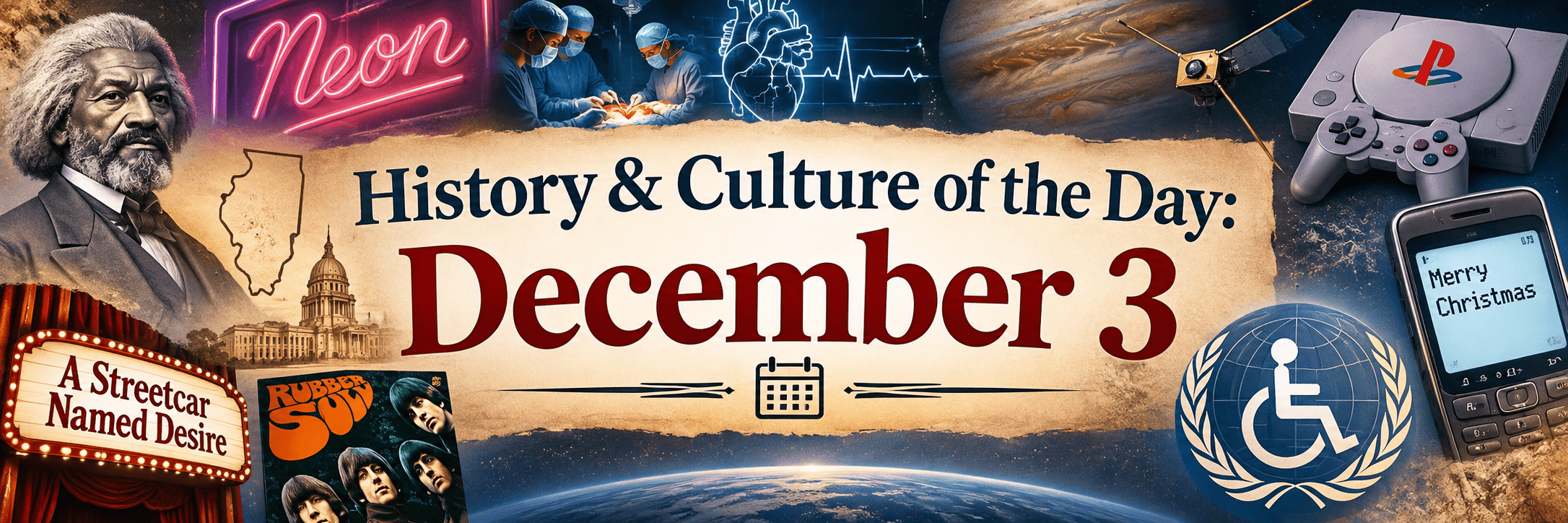
December 3 is a day filled with remarkable moments in world history, cultural achievements, scientific discoveries, and events that helped shape modern society. From the first successful human heart transplant to the birth of influential artists and the recognition of disability rights, December 3 reminds us how human determination, creativity, and compassion can change the world.
Throughout history, this date has witnessed groundbreaking medical advancements, political transformations, artistic milestones, and moments that continue to influence how people live, communicate, and understand one another.
As the holiday season begins and another year approaches its conclusion, December 3 offers an opportunity to look beyond the present and explore the people, traditions, and historical events that have shaped our shared human experience.
Major Historical Events That Happened on December 3
1818 – Illinois Becomes the 21st State
On December 3, 1818, Illinois officially entered the United States as the 21st state.
Originally inhabited by Indigenous peoples, including communities belonging to the Illinois Confederation, the region later became an important area of French exploration, settlement, and trade.
As American settlers moved westward, Illinois developed into a major agricultural and commercial center. Its fertile farmland, rivers, and transportation routes helped establish its importance in the growing nation.
Chicago eventually became one of America’s largest cities and an international center for commerce, architecture, music, and cultural diversity.
Illinois also played an important role in the political career of Abraham Lincoln, who lived and worked in the state before becoming the 16th president of the United States.
The anniversary of Illinois statehood highlights the expansion of the United States and the complicated history of westward settlement, including its consequences for Native American communities.
1828 – Andrew Jackson Wins the Presidential Election
On December 3, 1828, the results of the United States presidential election became official through the selection of presidential electors, marking Andrew Jackson’s victory over incumbent President John Quincy Adams.
The election represented a significant transformation in American politics.
Jackson’s campaign appealed to many white male voters who believed the federal government had become too closely connected to wealthy and powerful interests.
His victory helped establish a new political era associated with expanded political participation among white men and the development of modern political campaigning.
However, Jackson’s presidency also became associated with deeply controversial policies, particularly the forced removal of Native American nations from their ancestral lands.
The election of 1828 remains an important turning point in understanding American democracy, political parties, and the contradictions of the nation’s early political development.
1910 – The First Public Demonstration of Neon Lighting
On December 3, 1910, French inventor Georges Claude demonstrated neon lighting at the Paris Motor Show.
His invention transformed the possibilities of commercial lighting and advertising.
Neon signs eventually became defining features of urban landscapes, particularly in cities such as Las Vegas, New York, Tokyo, and Hong Kong.
The colorful illuminated signs represented excitement, entertainment, nightlife, and technological progress.
Beyond their commercial applications, neon lights became important artistic and cultural symbols, appearing in photography, cinema, architecture, and modern visual design.
Today, neon-inspired lighting continues to influence interior decoration, digital art, and contemporary advertising.
1967 – The First Successful Human Heart Transplant
One of the most important medical achievements in history occurred on December 3, 1967, when South African surgeon Dr. Christiaan Barnard performed the world’s first successful human-to-human heart transplant.
The operation took place at Groote Schuur Hospital in Cape Town, South Africa.
The recipient, Louis Washkansky, was a 53-year-old man suffering from severe heart disease. The donor was Denise Darvall, a young woman who had suffered fatal injuries in a traffic accident.
Although Washkansky survived only 18 days after the operation, dying from pneumonia, the procedure demonstrated that transplanting a human heart was surgically possible.
The achievement opened a new chapter in medicine.
Over the following decades, advances in surgical techniques, organ preservation, immunosuppressive medications, and patient care dramatically improved transplant survival rates.
Today, heart transplantation offers hope to people living with advanced heart failure.
The December 3 milestone remains a powerful reminder of the importance of medical research, organ donation, and the willingness to pursue treatments once considered impossible.
1973 – Pioneer 10 Makes Its Historic Encounter With Jupiter
On December 3, 1973, NASA’s Pioneer 10 spacecraft made its closest approach to Jupiter, becoming the first spacecraft to explore the giant planet at close range.
Launched in March 1972, Pioneer 10 traveled hundreds of millions of miles through space to reach the largest planet in our solar system.
During its historic encounter, the spacecraft collected valuable information about Jupiter’s atmosphere, magnetic field, radiation environment, and surrounding space.
The mission helped scientists better understand the challenges of traveling through the outer solar system.
Pioneer 10 also carried a famous plaque designed to communicate information about humanity and Earth’s location to any intelligent civilization that might someday encounter the spacecraft.
Its journey became a symbol of humanity’s curiosity and desire to explore the unknown.
1984 – The Bhopal Gas Disaster Shocks the World
During the night of December 2–3, 1984, a deadly chemical leak occurred at a pesticide manufacturing facility in Bhopal, India.
A toxic cloud of methyl isocyanate gas spread into surrounding neighborhoods, exposing hundreds of thousands of residents.
Thousands of people died, and many survivors experienced serious long-term health problems.
The Bhopal disaster became one of the deadliest industrial accidents in history.
It exposed major concerns about industrial safety, corporate accountability, environmental protection, and the responsibility of governments to protect vulnerable communities.
The tragedy also inspired international discussions about chemical manufacturing regulations and emergency preparedness.
December 3 remains an important date for remembering the victims and recognizing the importance of workplace and environmental safety.
AP News+1
1989 – The Malta Summit Signals the End of the Cold War
On December 3, 1989, American President George H. W. Bush and Soviet leader Mikhail Gorbachev concluded their historic Malta Summit.
The meeting took place shortly after the fall of the Berlin Wall, when political transformations were sweeping across Eastern Europe.
Although the Cold War did not officially end through a single agreement at Malta, the summit represented a dramatic improvement in relations between the United States and the Soviet Union.
The leaders discussed arms control, political reform, international cooperation, and the changing global balance of power.
Their conversations helped symbolize the movement away from decades of hostility between two nuclear superpowers.
The Malta Summit remains an important milestone in modern diplomatic history.
1992 – The World’s First SMS Text Message Is Sent
On December 3, 1992, British engineer Neil Papworth sent the world’s first SMS text message.
The message traveled from a computer to a mobile phone on the Vodafone network.
Its contents were simple: “Merry Christmas.”
Although the message contained only two words, it helped introduce a communication technology that would eventually transform everyday life.
Text messaging became one of the most widely used forms of communication worldwide.
It changed how people maintained friendships, coordinated plans, shared information, and communicated across long distances.
Modern messaging applications, group chats, and mobile notifications all developed within a communication landscape influenced by the rise of SMS technology.
What began as a short holiday greeting became a major milestone in digital culture.
1994 – Sony Launches the Original PlayStation in Japan
On December 3, 1994, Sony released the original PlayStation gaming console in Japan.
The launch helped transform the video game industry.
The PlayStation introduced millions of players to increasingly sophisticated three-dimensional graphics, cinematic storytelling, and immersive gaming experiences.
Its success helped expand gaming beyond its traditional audience and establish video games as a major entertainment industry.
Over time, the PlayStation brand became closely associated with technological innovation, influential game franchises, and global gaming culture.
The original console’s Japanese release is remembered as a turning point in entertainment history.
Important Cultural Milestones on December 3
1847 – Frederick Douglass Publishes The North Star
On December 3, 1847, abolitionist Frederick Douglass published the first issue of his influential newspaper, The North Star, in Rochester, New York.
Douglass, who had escaped slavery, became one of the most powerful voices advocating for abolition, equality, education, and human rights.
His newspaper challenged slavery and racial discrimination while promoting social reform.
The publication’s name referenced the North Star, which symbolized freedom for enslaved people seeking escape.
Through journalism, public speaking, and political activism, Douglass demonstrated how the written word could challenge injustice and inspire social change.
His work helped establish a lasting tradition of African American journalism and advocacy.
1947 – A Streetcar Named Desire Opens on Broadway
On December 3, 1947, Tennessee Williams’s groundbreaking play A Streetcar Named Desire premiered on Broadway.
The production starred Jessica Tandy, Marlon Brando, and Kim Hunter.
Set in New Orleans, the play explored themes of desire, class conflict, psychological vulnerability, family tension, and the struggle between illusion and reality.
Its emotional intensity and complex characters helped redefine modern American theater.
Marlon Brando’s performance became especially influential, contributing to the growing popularity of naturalistic acting styles.
The play later inspired the celebrated 1951 film adaptation.
Today, A Streetcar Named Desire remains one of the most studied and performed works in American dramatic literature.
1965 – The Beatles Release Rubber Soul in the United Kingdom
On December 3, 1965, Rubber Soul was released in the United Kingdom.
The album represented an important stage in the Beatles’ artistic development.
Moving beyond the straightforward romantic themes of many earlier recordings, the band explored more reflective songwriting, unusual instrumentation, and increasingly sophisticated musical arrangements.
Songs such as “Norwegian Wood,” “In My Life,” and “Nowhere Man” demonstrated the group’s expanding creative ambitions.
The album helped influence the development of rock music as a serious artistic medium.
Its release contributed to the cultural transformation of popular music during the 1960s.
International Day of Persons with Disabilities – December 3
One of the most meaningful annual observances on December 3 is the International Day of Persons with Disabilities.
Established by the United Nations in 1992, the observance promotes dignity, accessibility, inclusion, and equal opportunities for people with disabilities.
The day encourages governments, organizations, businesses, and communities to recognize the barriers that people with disabilities may encounter.
These barriers can include inaccessible buildings, limited employment opportunities, discrimination, inadequate transportation, and exclusion from educational or cultural activities.
The observance emphasizes that accessibility is not simply a matter of convenience. It is essential to meaningful participation in society.
Why This Observance Matters
International Day of Persons with Disabilities reminds us that a strong society creates opportunities for everyone to participate.
It encourages improvements in accessible technology, inclusive education, workplace accommodations, public transportation, and community support.
The observance also recognizes the contributions of people with disabilities in science, athletics, politics, literature, entertainment, and countless other fields.
Its central message is that disability inclusion benefits society as a whole.
Creating communities built around dignity, understanding, and equal opportunity helps ensure that more people can pursue their goals and contribute their talents.
InternationalDayEDIT.doc+1
Famous People Born on December 3
December 3 is the birthday of several influential figures whose achievements helped shape literature, music, film, and intellectual history.
Joseph Conrad – Born December 3, 1857
Joseph Conrad was a Polish-born novelist who became one of the most influential English-language writers of his era.
His novels explored morality, imperialism, psychological conflict, and the complexities of human nature.
Among his most famous works are Heart of Darkness and Lord Jim.
Conrad’s writing influenced generations of novelists and contributed to the development of modern literary storytelling.
Anna Freud – Born December 3, 1895
Anna Freud was a pioneering psychoanalyst and the daughter of Sigmund Freud.
She made important contributions to child psychology and the understanding of psychological defense mechanisms.
Her work helped expand the study of childhood emotional development and influenced modern approaches to psychological treatment.
Jean-Luc Godard – Born December 3, 1930
French filmmaker Jean-Luc Godard became one of the leading figures of the French New Wave movement.
His experimental approach to filmmaking challenged traditional storytelling conventions.
Films such as Breathless influenced generations of directors and helped establish cinema as a medium for artistic experimentation and social commentary.
Ozzy Osbourne – Born December 3, 1948
Ozzy Osbourne was a British musician best known as the lead vocalist of Black Sabbath and for his successful solo career.
He became one of the defining figures in heavy metal music.
His theatrical performances, distinctive voice, and influence on rock culture earned him worldwide recognition.
Osbourne died in July 2025, leaving behind a lasting musical legacy.
Julianne Moore – Born December 3, 1960
Academy Award-winning actress Julianne Moore is known for her emotionally complex performances in film and television.
Her work includes Still Alice, Boogie Nights, and Far from Heaven.
Her career has earned widespread critical acclaim and recognition throughout the entertainment industry.
Brendan Fraser – Born December 3, 1968
Actor Brendan Fraser became internationally recognized through adventure films, comedies, and dramatic performances.
He is particularly known for The Mummy and his Academy Award-winning performance in The Whale.
His career reflects both the changing nature of Hollywood entertainment and the possibility of artistic reinvention.
Notable Historical Figures Who Died on December 3
Robert Louis Stevenson – Died December 3, 1894
Scottish author Robert Louis Stevenson is remembered for his adventure stories and psychological fiction.
His most famous works include Treasure Island and Strange Case of Dr Jekyll and Mr Hyde.
His storytelling helped influence adventure literature, mystery fiction, and popular culture.
Pierre-Auguste Renoir – Died December 3, 1919
French painter Pierre-Auguste Renoir was a major figure in the Impressionist movement.
His paintings frequently portrayed everyday life, social gatherings, landscapes, and human relationships.
Renoir’s use of light and color helped define Impressionist art.
His paintings remain among the most recognizable works of nineteenth-century European art.
Gwendolyn Brooks – Died December 3, 2000
American poet Gwendolyn Brooks became the first African American to receive a Pulitzer Prize, winning the Pulitzer Prize for Poetry in 1950.
Her poetry explored everyday life, racial inequality, identity, family, and the experiences of African American communities.
Brooks helped expand the influence of Black literature and inspired generations of poets and writers.
Her legacy remains an important part of American literary history.
How December 3 Reflects Changes in World Culture
The events associated with December 3 reveal several important patterns in human history.
Scientific Progress Can Transform Lives
The first human heart transplant demonstrated how medical innovation could challenge what once seemed impossible.
The Pioneer 10 mission showed humanity’s growing ability to explore distant worlds.
Both achievements illustrate the importance of curiosity, research, and perseverance.
Technology Changes How People Connect
The introduction of neon lighting, the first SMS message, and the original PlayStation each influenced daily life in different ways.
Neon lighting transformed city landscapes and advertising.
Text messaging revolutionized personal communication.
Video games became a major form of entertainment and shared cultural experience.
These innovations demonstrate how technological breakthroughs can reshape society far beyond their original purpose.
Art Helps Society Understand Itself
The works of Tennessee Williams, Joseph Conrad, Gwendolyn Brooks, and Jean-Luc Godard explored human experiences through different artistic forms.
Their contributions remind us that literature, theater, poetry, and film are more than entertainment.
They preserve cultural memory, challenge assumptions, and encourage people to examine the world from different perspectives.
Remembering Tragedy Encourages Responsibility
The Bhopal disaster remains a reminder that technological and industrial progress must be accompanied by ethical responsibility.
Remembering tragedies helps communities recognize past failures and advocate for safer conditions.
Historical remembrance also honors those whose lives were lost or permanently changed.
Interesting Facts About December 3
-
December 3 is the 337th day of the year, or the 338th in a leap year.
-
There are 28 days remaining in the calendar year after December 3.
-
Illinois became the 21st American state on this date in 1818.
-
The first issue of Frederick Douglass’s The North Star appeared on December 3, 1847.
-
The first public demonstration of neon lighting occurred on this date in 1910.
-
Tennessee Williams’s A Streetcar Named Desire opened on Broadway on December 3, 1947.
-
The first human-to-human heart transplant took place on December 3, 1967.
-
Pioneer 10 made its closest approach to Jupiter on December 3, 1973.
-
The first SMS text message was sent on December 3, 1992.
-
Sony released its original PlayStation in Japan on December 3, 1994.
Why Learning About History and Culture Matters
History is more than a collection of dates, names, and events.
It is the record of human decisions, struggles, accomplishments, and experiences.
Understanding history helps explain why modern societies function as they do, how cultural traditions developed, and why certain values remain important.
Cultural history also helps us appreciate the diversity of human expression.
Music, literature, architecture, theater, scientific discoveries, and social movements all contribute to the shared story of humanity.
By studying historical events, we gain perspective on present-day challenges and opportunities.
We also discover that meaningful change often begins with individuals who are willing to question established ideas, pursue difficult goals, or stand up for what they believe is right.
Lessons We Can Learn From December 3
The historical events of December 3 offer several lasting lessons.
Innovation requires courage. The surgeons who performed the first heart transplant demonstrated the importance of pursuing medical advancements despite enormous challenges.
Communication connects humanity. The first text message represented a small technological achievement that eventually changed relationships and everyday interactions worldwide.
Art preserves human experience. Writers, musicians, actors, and filmmakers help future generations understand the emotions, conflicts, and values of earlier times.
Human dignity matters. International Day of Persons with Disabilities reminds us that inclusion and accessibility should be fundamental parts of community life.
History carries responsibility. Remembering industrial disasters, political conflicts, and social injustices helps encourage greater accountability and compassion.
Perhaps the most important lesson is that individual actions can have consequences that extend far beyond a single lifetime.
Frequently Asked Questions About December 3
What major historical event happened on December 3?
One of the most significant events was the first human-to-human heart transplant, performed by Dr. Christiaan Barnard in South Africa on December 3, 1967.
What is celebrated internationally on December 3?
December 3 is recognized as the International Day of Persons with Disabilities, promoting accessibility, equal opportunities, and human rights.
What technological invention is associated with December 3?
The world’s first SMS text message was sent on December 3, 1992. The date also marks the first public demonstration of neon lighting in 1910.
What famous cultural event happened on December 3, 1947?
Tennessee Williams’s play A Streetcar Named Desire premiered on Broadway, becoming an important milestone in American theater.
Which famous musicians were born on December 3?
Ozzy Osbourne, born in 1948, and American singer Andy Williams, born in 1927, are among the notable musicians associated with this birthday.
Why is December 3 important in video game history?
Sony released the original PlayStation in Japan on December 3, 1994, helping usher in a new era of home video game entertainment.
Final Thoughts: Remembering the History and Culture of December 3
December 3 brings together stories of scientific achievement, artistic creativity, technological innovation, political transformation, and human resilience.
It is a date that reminds us how much the world can change through determination, imagination, and the pursuit of knowledge.
From the operating rooms of Cape Town to the stages of Broadway, from the exploration of Jupiter to the beginning of modern text messaging, the events of December 3 have left lasting marks on civilization.
The day also reminds us that progress must be balanced with responsibility, compassion, and respect for human dignity.
Every generation inherits the achievements and mistakes of those who came before it. Learning about history allows us to appreciate those achievements, recognize those mistakes, and make more informed decisions about the future.
History is not simply about remembering what happened. It is about understanding how yesterday continues to shape the world we live in today.

Leave a Reply