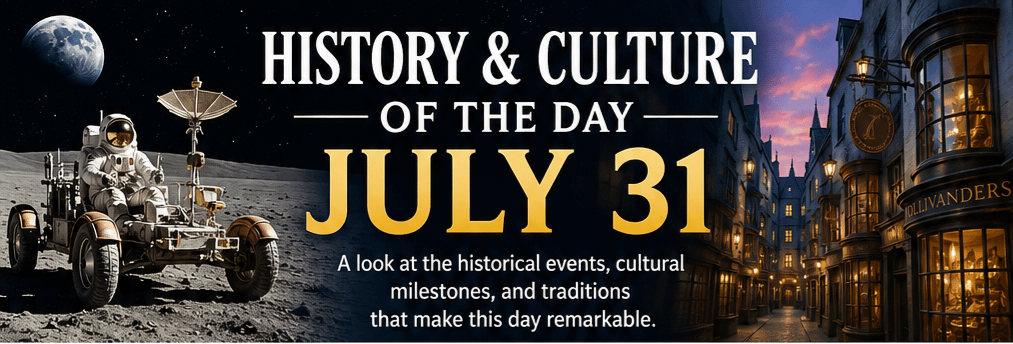
History is more than a timeline of dates—it is the story of humanity’s journey. Every day offers an opportunity to reflect on moments that changed nations, inspired innovation, sparked creativity, and influenced cultures around the globe. July 31 is one of those days, marked by groundbreaking achievements in space exploration, memorable moments in literature, significant historical events, and traditions that continue to unite communities.
Whether you’re passionate about history, fascinated by science, or simply enjoy learning something new each day, July 31 reminds us that the past continues to shape our present and inspire our future.
Apollo 15 and the First Drive on the Moon (1971)
One of the greatest achievements associated with July 31 occurred in 1971, when NASA’s Apollo 15 astronauts David Scott and James Irwin became the first humans to drive a vehicle on another world.
The Lunar Roving Vehicle (LRV), often called the “Moon Buggy,” represented a major leap forward in space exploration. Previous Apollo astronauts had been limited to walking relatively short distances from their lunar landers. The Lunar Rover expanded that range dramatically, allowing scientists to explore previously unreachable regions of the Moon.
The rover traveled nearly 17 miles during the mission and enabled astronauts to collect approximately 170 pounds of lunar rocks and soil samples, many of which continue to be studied today.
Why Apollo 15 Was Different
Apollo 15 was considered the first of NASA’s “J Missions,” designed to maximize scientific exploration. The mission included:
- Longer stays on the Moon
- More scientific equipment
- Greater travel distances
- More extensive geological studies
- Improved photography and mapping
The success of Apollo 15 helped scientists better understand the Moon’s volcanic history, surface composition, and geological evolution.
Today, modern lunar exploration programs—including NASA’s Artemis missions—continue to build upon the discoveries made during Apollo 15.
Harry Potter’s Birthday: A Global Celebration of Imagination
For millions of readers, July 31 is instantly recognizable as the birthday of Harry Potter, the beloved wizard created by author J.K. Rowling.
Interestingly, Rowling chose to give Harry the same birthday she shares herself.
Since the first novel debuted in 1997, the Harry Potter series has become one of the most successful literary franchises in history.
The books have:
- Sold more than 600 million copies worldwide.
- Been translated into over 80 languages.
- Inspired eight blockbuster films.
- Created award-winning stage productions.
- Led to theme parks on multiple continents.
- Sparked fan conventions around the world.
Every July 31, libraries, bookstores, schools, and fans celebrate with costume contests, reading marathons, trivia competitions, themed parties, and charitable events that encourage literacy.
More Than Magic
While the stories center around witches and wizards, the series resonates because of its universal themes:
- Friendship
- Courage
- Loyalty
- Sacrifice
- Love
- Choosing kindness over hatred
- Standing up against injustice
The books have encouraged countless young readers to discover a lifelong love of literature.
The End of July: A Time of Transition
Throughout history, the final day of July has symbolized transition.
In many countries, July 31 marks the closing chapter of summer before schools reopen in August or early September. Families begin shifting from vacations and outdoor adventures toward classrooms, sports seasons, and new routines.
This seasonal transition has become its own cultural tradition.
Many families spend the day:
- Shopping for school supplies
- Planning family dinners
- Taking final summer trips
- Visiting amusement parks
- Hosting neighborhood barbecues
- Enjoying one last beach outing
These traditions create lasting memories while preparing children for a new academic year.
County Fairs and Agricultural Traditions
Across North America, late July represents the height of county fair season.
Agricultural fairs have existed for more than two centuries, originally serving as gatherings where farmers exchanged knowledge about livestock, crops, and farming techniques.
Today, county fairs celebrate both agriculture and community through:
- Livestock competitions
- Homegrown produce displays
- Local crafts
- Carnival rides
- Concerts
- Rodeos
- Pie contests
- Classic car shows
These events preserve rural traditions while bringing together people of all ages.
Many families have attended the same county fairs for generations, making them an important part of local culture.
Milwaukee’s Brewing Heritage
July often highlights the rich brewing traditions that helped shape Milwaukee, Wisconsin, into one of America’s most famous beer cities.
During the late nineteenth century, German immigrants transformed Milwaukee into a brewing powerhouse.
Companies such as Schlitz, Pabst, Miller, and Blatz became household names while employing thousands of workers.
The brewing industry influenced nearly every aspect of Milwaukee’s development:
- Economic growth
- Immigration
- Architecture
- Transportation
- Community festivals
- Culinary traditions
Even today, brewery tours and beer gardens remain major attractions that celebrate this historic heritage.
Summer Festivals Around the World
The final days of July are among the busiest festival periods of the year.
Communities worldwide celebrate culture through music, food, dance, and local traditions.
Popular celebrations during this season often include:
Music Festivals
Outdoor concerts bring together internationally known artists and local performers, creating memorable summer experiences.
Food Festivals
Communities showcase regional specialties while supporting local farms and restaurants.
Art Festivals
Artists display paintings, sculptures, photography, and handcrafted goods, encouraging creativity and cultural appreciation.
Cultural Heritage Events
Many cities celebrate their immigrant communities through traditional music, dance performances, clothing, and cuisine.
These festivals strengthen community bonds while preserving traditions passed down through generations.
The Importance of Storytelling
History survives because people tell stories.
Whether passed through books, museums, documentaries, oral traditions, or family conversations, storytelling connects us with previous generations.
Stories teach us:
- Where we came from.
- What previous generations experienced.
- How societies overcame challenges.
- Why traditions matter.
- How innovation changes the world.
Without storytellers, many remarkable achievements would be forgotten.
Innovation That Changed Daily Life
The twentieth century saw enormous technological progress, and many breakthroughs reached the public during the busy summer months.
Advances in transportation, communication, medicine, and computing transformed everyday life.
Consider how dramatically life has changed in just a few generations:
- Air travel became common.
- Personal computers entered homes.
- The internet connected the globe.
- Smartphones placed information in every pocket.
- GPS navigation changed how we travel.
- Space exploration expanded our understanding of the universe.
Each innovation built upon the work of earlier pioneers.
Why Space Exploration Still Matters
The Apollo missions were about more than reaching the Moon.
They inspired advances in:
- Engineering
- Telecommunications
- Computer technology
- Medical equipment
- Materials science
- Satellite communications
Many everyday technologies trace their origins to research conducted during the Space Race.
Even decades later, images of astronauts driving across the Moon continue to inspire children to dream about careers in science, engineering, and exploration.
Books That Shape Generations
Literature has always played an important role in culture.
Certain books transcend entertainment and become cultural landmarks.
Stories like Harry Potter encourage readers to imagine new possibilities while exploring timeless human values.
Libraries around the world often use July 31 to promote literacy initiatives because reading helps develop:
- Critical thinking
- Creativity
- Empathy
- Vocabulary
- Lifelong learning
A single book can inspire someone to become a scientist, teacher, artist, writer, or explorer.
Preserving Our Shared Heritage
Museums, historical societies, archives, and cultural organizations work tirelessly to preserve artifacts that tell humanity’s story.
Everything from ancient manuscripts to spacecraft, family photographs, and historical buildings helps future generations understand where they came from.
Preservation reminds us that history belongs to everyone—not just historians.
Every family has stories worth remembering.
Every community has traditions worth celebrating.
Every generation contributes another chapter to humanity’s ongoing story.
Lessons We Can Learn from July 31
Reflecting on July 31 offers several meaningful lessons:
- Curiosity leads to discovery.
- Innovation changes the future.
- Stories inspire generations.
- Communities grow stronger through shared traditions.
- Education opens new possibilities.
- Preserving history helps shape tomorrow.
These lessons remain just as relevant today as they were decades ago.
Looking Toward the Future
History is constantly being written.
Tomorrow’s historians will study today’s discoveries, inventions, cultural movements, and acts of kindness just as we examine the achievements of previous generations.
Each of us contributes to history through the choices we make, the people we help, and the legacy we leave behind.
Whether inspiring others, preserving family traditions, exploring new ideas, or simply learning something new each day, we all play a role in shaping the future.
Final Thoughts
July 31 is a remarkable day that celebrates human achievement, imagination, and cultural heritage. From the historic drive across the Moon during Apollo 15 to the worldwide celebration of Harry Potter’s birthday, this day reminds us that exploration and creativity have the power to change the world.
It also highlights the importance of community traditions, education, storytelling, and preserving our shared history. Every milestone—whether a scientific breakthrough, a beloved book, or a cherished local festival—adds another thread to the rich tapestry of human culture.
As we commemorate July 31, let it inspire us to remain curious, honor the past, embrace the present, and look toward the future with optimism. History is not only something we study—it is something we create every single day.
Leave a Reply