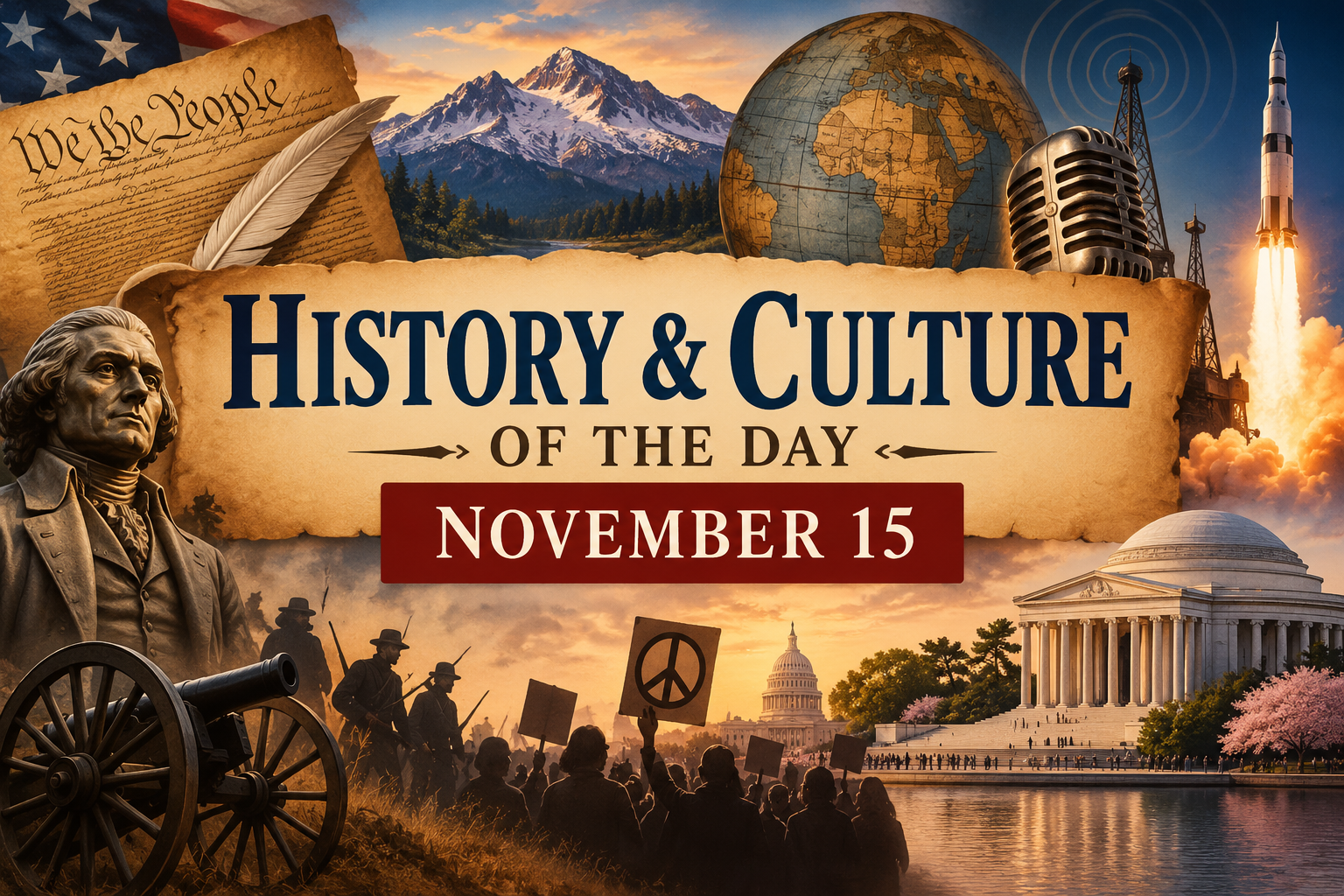
November 15 is a day filled with remarkable moments in history, from the foundations of American government to major military campaigns, political revolutions, technological achievements, and cultural milestones. Throughout the centuries, events occurring on this date have helped shape nations, influence societies, and change how people understand the world.
History is more than a collection of dates. It tells the stories of people who challenged authority, fought for independence, pursued discoveries, and helped create the world we know today.
On November 15, several events changed the course of American and world history. Some represented progress and innovation, while others reflected the devastating consequences of war and political conflict.
Let’s explore the most significant historical events, fascinating facts, and cultural achievements associated with November 15.
1777 – The Articles of Confederation Are Adopted
One of the most important events in American history occurred on November 15, 1777, when the Second Continental Congress adopted the Articles of Confederation.
The Articles established the framework for the first national government of the United States.
At the time, the American colonies were fighting for independence from Great Britain. Revolutionary leaders recognized that the newly independent states needed a system that would allow them to cooperate while preserving their individual authority.
The Articles of Confederation created a national Congress, but most governmental powers remained with the states.
Under this arrangement:
- Each state received one vote in Congress.
- Congress could conduct foreign affairs and declare war.
- The national government could request money from states but could not directly impose taxes.
- Major decisions required substantial agreement among the states.
- Amendments required unanimous state approval.
Although the Articles represented an important achievement, their weaknesses eventually became apparent.
The national government struggled to raise money, regulate commerce, and respond effectively to national challenges.
The Articles officially took effect on March 1, 1781, after all thirteen states ratified them.
They remained in force until the United States Constitution replaced them in 1789.
Why It Matters: The Articles of Confederation were America’s first attempt at establishing a national government. Their successes and failures influenced the creation of the Constitution and the federal system that exists today.
1806 – Zebulon Pike Sees the Mountain Later Named Pikes Peak
On November 15, 1806, American explorer Zebulon Pike observed a towering mountain in what is now Colorado.
The mountain would eventually become known as Pikes Peak.
Pike was leading an expedition through territories that were still unfamiliar to many Americans of European descent, although Indigenous peoples had known and inhabited these lands for generations.
His expedition was intended to explore portions of the Louisiana Purchase and gather geographic information about the western frontier.
Pike attempted to reach the mountain but was unsuccessful.
Despite never reaching its summit, his name became permanently associated with the landmark.
Today, Pikes Peak stands at approximately 14,115 feet above sea level and is one of Colorado’s most recognizable mountains.
It has become an important destination for tourism, outdoor recreation, and American cultural history.
Why It Matters: Pike’s expedition contributed to American geographic knowledge and westward exploration, while the mountain’s history also reminds us of the Indigenous communities whose connections to the region long predated his arrival.
1864 – General Sherman Begins His March to the Sea
November 15, 1864, marked the beginning of one of the most significant military campaigns of the American Civil War.
Union General William Tecumseh Sherman departed Atlanta, Georgia, with his troops and began what became known as Sherman’s March to the Sea.
The campaign aimed to weaken the Confederacy’s ability to continue fighting.
Rather than concentrating exclusively on Confederate armies, Sherman’s forces targeted transportation networks, supply lines, infrastructure, and resources supporting the Confederate war effort.
Railroads were destroyed, supplies were seized, and extensive property damage occurred throughout Georgia.
The campaign also had serious consequences for civilians.
Sherman’s troops reached Savannah in December 1864, and the city came under Union control.
The march demonstrated how military strategy could extend beyond battlefield confrontations to undermine an opponent’s economic and logistical resources.
It also became an enduring example of the destructive nature of modern warfare.
Why It Matters: Sherman’s March to the Sea helped weaken the Confederacy and contributed to the Union’s eventual victory in 1865, while leaving a complicated legacy of military effectiveness and civilian suffering.
1884 – The Berlin Conference Begins
On November 15, 1884, representatives of European powers gathered in Berlin for a conference that would have profound consequences for Africa.
The Berlin Conference was organized during a period of increasing European competition for African territory and resources.
The participating powers sought agreements governing colonial expansion and commercial activities.
African representatives were not given meaningful participation in decisions affecting their own lands.
The conference continued into February 1885.
Its agreements helped accelerate the European colonization of Africa, although the continent’s territorial divisions developed through numerous subsequent occupations, treaties, and conflicts.
Colonial rule disrupted existing political systems, divided communities, exploited resources, and imposed foreign authority over millions of people.
The consequences of this period remain important to discussions of African history, political boundaries, economic development, and cultural identity.
Why It Matters: The Berlin Conference represents a major turning point in imperial history and illustrates the lasting consequences of decisions made without the consent of affected populations.
1889 – Brazil Becomes a Republic
On November 15, 1889, Brazil underwent a dramatic political transformation when a military coup ended the country’s monarchy.
Emperor Pedro II was removed from power, and Brazil was proclaimed a republic.
Marshal Deodoro da Fonseca emerged as the leader of the provisional government.
Brazil had been an independent empire since 1822, but political tensions gradually weakened support for the monarchy.
Disagreements involving the military, political elites, and the future direction of the country contributed to the overthrow.
The abolition of slavery in 1888 also transformed Brazilian society and contributed to political realignments.
The establishment of the republic introduced a new era in Brazilian government.
Today, November 15 is observed in Brazil as Republic Proclamation Day.
Why It Matters: The proclamation of the republic ended Brazil’s imperial system and became one of the country’s most important national historical milestones.
1920 – The League of Nations Holds Its First Assembly
On November 15, 1920, the first Assembly of the League of Nations opened in Geneva, Switzerland.
The League had been established following World War I, a conflict that devastated Europe and caused millions of deaths.
Its purpose was to encourage international cooperation, resolve disputes peacefully, and reduce the likelihood of another global war.
Representatives from member countries gathered to discuss international problems and the future of diplomacy.
The League represented an ambitious attempt to create a permanent international organization devoted to collective security.
However, it faced serious limitations.
The United States never joined, major powers sometimes acted independently of the organization, and the League lacked effective means of enforcing many of its decisions.
It ultimately failed to prevent World War II.
Nevertheless, its experiences influenced the establishment of the United Nations in 1945.
Why It Matters: The League of Nations helped establish the idea that countries should work through international institutions to address conflicts and shared global challenges.
1926 – NBC Launches Its National Radio Network
November 15, 1926, was a significant day in American broadcasting history.
The National Broadcasting Company, commonly known as NBC, launched its radio network with a major program carried by stations across the United States.
During the 1920s, radio was becoming one of the most influential forms of mass communication.
Before widespread television ownership, families gathered around radios to listen to music, news, comedy, drama, and sporting events.
NBC’s development helped establish network broadcasting as a central feature of American media.
Radio networks made it possible for audiences in different cities to experience the same programming.
This transformed advertising, entertainment, political communication, and popular culture.
Radio also helped create nationally recognized entertainers and personalities.
Why It Matters: Network radio broadcasting helped connect Americans through shared entertainment and information, laying the groundwork for modern television and broadcasting industries.
1939 – The Jefferson Memorial Cornerstone Is Laid
On November 15, 1939, President Franklin D. Roosevelt participated in the cornerstone-laying ceremony for the Jefferson Memorial in Washington, D.C.
The memorial honors Thomas Jefferson, the third president of the United States and principal author of the Declaration of Independence.
Its neoclassical architecture reflects Jefferson’s interest in classical design.
The memorial was dedicated in 1943, on the 200th anniversary of Jefferson’s birth.
Today, it remains one of Washington’s most recognizable landmarks.
It also encourages reflection on Jefferson’s complicated legacy, including his advocacy of liberty and his ownership of enslaved people.
Why It Matters: The Jefferson Memorial preserves an important part of American history while inviting ongoing discussion about the nation’s founding ideals and historical contradictions.
1966 – Gemini 12 Completes Its Space Mission
On November 15, 1966, NASA’s Gemini 12 spacecraft successfully returned to Earth.
Astronauts James Lovell and Buzz Aldrin completed the final mission of NASA’s Gemini program.
The mission helped demonstrate techniques that would become essential to future lunar exploration.
During the flight, Aldrin conducted spacewalks that showed astronauts could perform useful tasks outside a spacecraft when properly trained and supported.
Gemini 12 also contributed to NASA’s understanding of spacecraft operations and human performance in space.
These accomplishments helped prepare the United States for the Apollo program.
Less than three years later, Apollo 11 would successfully land astronauts on the Moon.
Why It Matters: Gemini 12 helped solve practical challenges of human spaceflight and contributed to the achievements of the Apollo era.
1969 – Americans Gather for a Massive Antiwar Demonstration
On November 15, 1969, hundreds of thousands of people gathered in Washington, D.C., to protest the Vietnam War.
The demonstration was part of the broader antiwar movement that had grown throughout the 1960s.
Students, veterans, religious leaders, families, and activists participated in calls for an end to American military involvement.
The demonstration became one of the largest antiwar gatherings in American history.
It reflected increasing public disagreement over the war, government policy, and the human costs of prolonged military conflict.
The protests also highlighted the role of public demonstrations in American political culture.
Why It Matters: The November 1969 demonstration became a defining moment in the history of American activism and public debate over military intervention.
1988 – The Palestinian Declaration of Independence
On November 15, 1988, the Palestinian National Council proclaimed the independence of the State of Palestine during a meeting in Algiers, Algeria.
The declaration was presented by Palestine Liberation Organization chairman Yasser Arafat.
It became a major milestone in the Palestinian national movement.
The declaration expressed Palestinian aspirations for national independence and self-determination.
However, proclaiming statehood did not resolve the longstanding Israeli-Palestinian conflict or establish full Palestinian sovereignty over the territories claimed.
The political, territorial, and diplomatic questions surrounding Palestinian statehood have remained subjects of international negotiation and disagreement.
Why It Matters: The declaration became an important event in Palestinian political history and international discussions about statehood, recognition, and self-determination.
Famous People Born on November 15
November 15 is also the birthday of several influential figures in entertainment, music, and public life.
Georgia O’Keeffe – Born in 1887
Georgia O’Keeffe was an American artist celebrated for her distinctive paintings of flowers, landscapes, and natural forms.
Her work helped shape American modernism.
O’Keeffe became especially associated with the landscapes of New Mexico, where she found inspiration in the desert environment.
Her artistic independence and recognizable style made her one of the most influential American painters of the twentieth century.
Petula Clark – Born in 1932
Petula Clark is a British singer and actress whose career spans decades.
She became internationally famous for songs such as “Downtown.”
Her music helped define an era of popular entertainment and earned her audiences around the world.
Sam Waterston – Born in 1940
Sam Waterston is an American actor known for his extensive work in film, television, and theater.
He is especially recognized for portraying Jack McCoy on the television series Law & Order.
His career has made him a familiar figure in American entertainment.
Shailene Woodley – Born in 1991
Shailene Woodley is an American actress known for roles in television and film.
Her performances in The Fault in Our Stars, the Divergent series, and Big Little Lies helped establish her as a prominent contemporary performer.
Interesting Historical Facts About November 15
Several fascinating connections make November 15 particularly memorable.
1. America’s first constitution was adopted on this date. The Articles of Confederation preceded the Constitution used today.
2. Brazil celebrates an important national holiday. Republic Proclamation Day commemorates the end of the monarchy in 1889.
3. A famous American mountain received its name from an explorer who never reached its summit. Zebulon Pike’s expedition helped popularize the landmark later named Pikes Peak.
4. November 15 connects two different eras of communication. The League of Nations represented international diplomatic cooperation, while NBC’s network launch transformed mass broadcasting.
5. The date is significant in space exploration. Gemini 12’s successful return helped prepare NASA for future missions to the Moon.
6. November 15 has witnessed both military conflict and peace movements. Sherman’s March to the Sea began on this date in 1864, while a major demonstration against the Vietnam War took place in 1969.
How November 15 Reflects Changes in History and Culture
Looking at these events together reveals several important themes.
The Evolution of Government
The adoption of the Articles of Confederation and Brazil’s proclamation of a republic show how nations have struggled to determine the best forms of government.
Political systems evolve as societies respond to changing circumstances, competing interests, and demands for representation.
The Impact of War
Sherman’s March to the Sea and the anti-Vietnam War demonstrations reveal different aspects of military conflict.
One illustrates how warfare can transform nations through destruction, while the other demonstrates how citizens can challenge government decisions through organized protest.
The Power of Communication
The creation of national radio networks changed how people received information and experienced entertainment.
Today, digital communication continues that transformation, connecting audiences across borders almost instantly.
The Importance of Exploration and Discovery
From nineteenth-century geographic expeditions to twentieth-century space missions, exploration has expanded human knowledge.
These achievements also remind us that discoveries often build upon generations of earlier knowledge and experience.
The Continuing Pursuit of Independence
Events in Brazil, the United States, and Palestine demonstrate how questions of independence, sovereignty, and national identity have shaped world history.
Although the circumstances differ greatly, each illustrates the importance of political self-determination in historical movements.
Why Learning About November 15 Matters
Studying historical events associated with a particular date offers more than interesting trivia.
It provides opportunities to understand the decisions, conflicts, innovations, and cultural changes that shaped modern society.
November 15 reminds us that progress is rarely simple.
The creation of governments can involve difficult compromises. Military victories can come with devastating human costs. Technological achievements often require years of experimentation, and movements for political change can continue across generations.
History also helps us recognize connections between the past and present.
Debates over government authority, international cooperation, freedom, communication, and national identity remain relevant today.
By learning about these events, we develop a deeper appreciation for the complexity of the world around us.
Final Thoughts: Remembering November 15 in History
November 15 stands out as a date connected to major turning points in American and world history.
From the adoption of the Articles of Confederation in 1777 to the beginning of Sherman’s March to the Sea in 1864, the proclamation of Brazil’s republic in 1889, the first League of Nations Assembly in 1920, and the successful completion of Gemini 12 in 1966, this date reflects centuries of transformation.
It also reminds us that history is not simply about famous leaders or major events.
It is about the experiences of ordinary people whose lives were affected by political decisions, wars, cultural developments, and scientific discoveries.
Every generation contributes another chapter to the historical record.
Understanding the past allows us to appreciate how much the world has changed while recognizing the challenges that continue to shape humanity.
History is not only about remembering what happened. It is about understanding how those events helped create the world we live in today.
Which historical event from November 15 do you find the most interesting, and why do you think its impact is still important today?


Leave a Reply