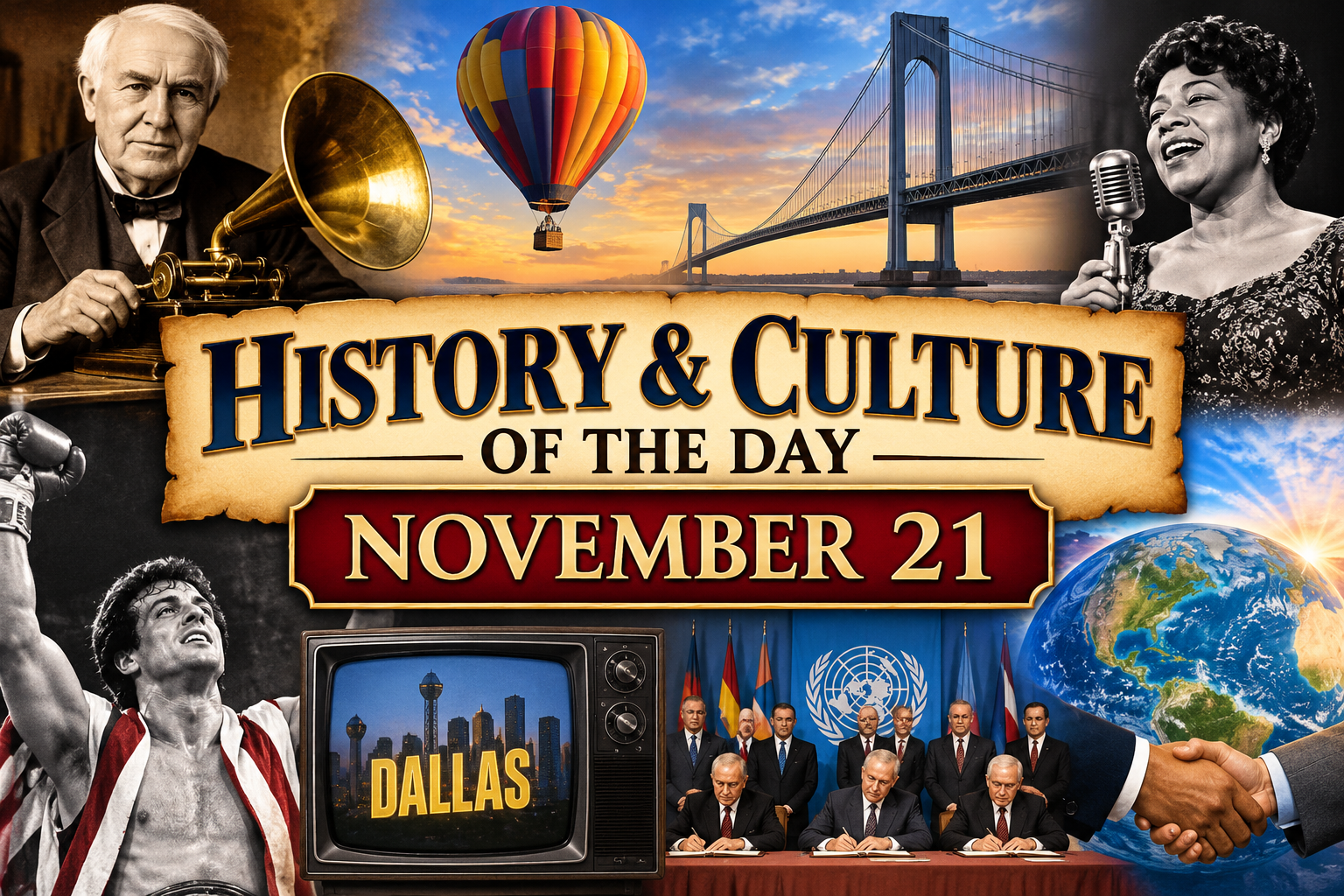
November 21 is a fascinating date in world history, filled with moments that helped shape modern technology, entertainment, international relations, and cultural traditions. From one of the most important inventions in recorded history to the development of popular television and the celebration of global communication, this day reminds us how human creativity and determination can influence generations.
History is more than a collection of dates and events. It is the story of people who challenged established ideas, introduced new possibilities, and created traditions that continue to influence our lives.
November 21 offers an opportunity to explore those stories, appreciate cultural achievements, and understand how events from centuries ago still connect to the world we experience today.
1. November 21, 1877 – Thomas Edison Announces the Phonograph
One of the most significant technological milestones associated with November 21 occurred in 1877, when American inventor Thomas Edison announced his invention of the phonograph.
Before the phonograph, sound existed only in the moment. People could enjoy live music, listen to speeches, and hear the voices of loved ones, but they had no practical way to record those sounds and play them back.
Edison’s invention changed that.
The phonograph used a recording mechanism to capture sound vibrations and reproduce them. Early versions recorded sound on cylinders covered with tin foil.
Although primitive compared with modern recording technology, the invention introduced an extraordinary possibility: preserving the human voice.
The phonograph eventually helped inspire the development of recorded music, commercial audio recordings, and the entertainment industry.
Today, everything from vinyl records and digital music to podcasts and audiobooks can trace part of its technological heritage to the early development of sound recording.
Cultural significance: The phonograph transformed music from an experience that required a live performance into something people could preserve, share, and enjoy repeatedly.
2. November 21, 1783 – The First Free Human Balloon Flight
On November 21, 1783, Jean-François Pilâtre de Rozier and François Laurent d’Arlandes made history by completing the first untethered human flight in a hot-air balloon.
The flight took place over Paris, France, using a balloon developed by the Montgolfier brothers.
For centuries, human beings had dreamed of flying like birds. Stories, drawings, and imaginative inventions reflected humanity’s fascination with the skies.
The balloon flight demonstrated that controlled human travel through the air was possible, even though early balloonists had limited control over their direction.
The achievement captured the public imagination and encouraged further experiments in aviation.
Over time, the dream of flight would lead to gliders, airplanes, helicopters, and eventually spacecraft.
Cultural significance: The first free balloon flight represented humanity’s willingness to challenge what once seemed impossible. It also helped establish aviation as an important field of scientific exploration.
3. November 21, 1964 – The Verrazzano-Narrows Bridge Opens
November 21, 1964, marked the opening of the Verrazzano-Narrows Bridge in New York City.
Connecting Staten Island and Brooklyn, the suspension bridge became an important transportation link between two New York City boroughs.
At the time of its opening, it held the distinction of having the world’s longest main suspension span.
The bridge represented a major achievement in American engineering and urban development.
Beyond its practical transportation benefits, the structure became a recognizable part of New York City’s landscape.
It also became associated with the New York City Marathon, whose starting route crosses the bridge.
Cultural significance: Major bridges do more than connect physical locations. They connect communities, support economic development, and become lasting symbols of the cities they serve.
4. November 21, 1934 – Ella Fitzgerald Makes Her Breakthrough at the Apollo Theater
On November 21, 1934, a young Ella Fitzgerald stepped onto the stage of Harlem’s Apollo Theater during its famous Amateur Night competition.
Originally planning to dance, Fitzgerald decided to sing instead.
Her performance impressed the audience and helped launch one of the most celebrated careers in American music.
Fitzgerald would become known as the First Lady of Song, admired for her remarkable vocal range, precise phrasing, and extraordinary ability to improvise.
Her interpretations of jazz standards helped introduce generations of listeners to the Great American Songbook.
She also became an important figure in breaking racial barriers within the entertainment industry.
Cultural significance: Fitzgerald’s breakthrough demonstrates how a single opportunity can change someone’s future. Her contributions helped establish jazz as one of America’s most influential cultural achievements.
5. November 21, 1976 – Rocky Makes Its New York Debut
On November 21, 1976, the film Rocky premiered in New York City.
Starring Sylvester Stallone, the film tells the story of Rocky Balboa, a struggling Philadelphia boxer who receives an unexpected opportunity to fight heavyweight champion Apollo Creed.
The movie became an international success and won the Academy Award for Best Picture.
More importantly, Rocky became a lasting symbol of determination, perseverance, and the courage to pursue a dream despite overwhelming obstacles.
The film’s themes resonated with audiences because its central message extended beyond boxing.
Rocky’s story was about self-respect, personal growth, and refusing to surrender when circumstances seemed impossible.
The movie inspired numerous sequels and helped establish one of cinema’s most recognizable characters.
Cultural significance: Rocky demonstrated the power of storytelling to inspire people across different backgrounds, generations, and cultures.
6. November 21, 1980 – The Television Mystery That Captivated America
On November 21, 1980, millions of television viewers tuned in to the popular American drama Dallas to discover the answer to one of television’s most famous questions: Who shot J.R.?
The mystery surrounded J.R. Ewing, the wealthy and manipulative oil businessman portrayed by Larry Hagman.
The storyline had become a cultural phenomenon following the previous season’s dramatic cliffhanger.
Viewers discussed possible suspects at work, in schools, and around dinner tables.
When the mystery was finally resolved, the episode became one of the most-watched television broadcasts of its era.
The revelation that Kristin Shepard had shot J.R. helped cement the episode’s place in television history.
Cultural significance: The Dallas phenomenon showed how television could create a shared cultural experience, bringing millions of people together around one fictional story.
Long before social media, television programs could dominate national conversations and become major events in popular culture.
7. November 21, 1995 – The Dayton Peace Agreement Brings Hope to Bosnia
On November 21, 1995, negotiators reached and initialed the Dayton Peace Agreement at Wright-Patterson Air Force Base near Dayton, Ohio.
The agreement established the framework for ending the devastating Bosnian War, which had caused widespread destruction, displacement, and loss of life.
Representatives of Bosnia and Herzegovina, Croatia, and Serbia participated in the negotiations, with significant involvement from American diplomats.
The formal peace agreement was signed in Paris on December 14, 1995.
Although the agreement did not eliminate every political or ethnic division, it ended the large-scale war and established a new political framework for Bosnia and Herzegovina.
Cultural significance: The Dayton negotiations demonstrated the importance of diplomacy, compromise, and international cooperation in resolving violent conflicts.
They also remind us that peace is not simply the absence of fighting. Lasting peace requires continued efforts toward stability, reconciliation, and understanding.
8. November 21 – World Television Day
November 21 is recognized internationally as World Television Day, an observance established by the United Nations General Assembly in 1996.
The date commemorates the first World Television Forum, held at United Nations Headquarters on November 21 and 22, 1996.
World Television Day recognizes television’s influence on public awareness, communication, education, and culture.
Television has transformed dramatically over the decades.
Early broadcasts were limited by technology and geography. Today, television content can reach audiences around the world through traditional broadcasting, satellite services, and internet streaming.
Television has helped people witness historic events, learn about distant cultures, and experience major sporting and entertainment moments.
It has also played an important role in raising awareness about humanitarian crises, scientific discoveries, and international affairs.
Cultural significance: World Television Day encourages reflection on the responsibilities of media organizations and the importance of providing reliable, informative, and meaningful programming.
9. November 21 – World Hello Day
World Hello Day is an informal international observance celebrated annually on November 21.
It began in 1973 as an effort to encourage peaceful communication during a period of heightened international tension.
The observance was created by Brian and Michael McCormack following the Yom Kippur War.
Its central idea is remarkably simple: greet ten people as a demonstration of the importance of personal communication.
Although saying hello might seem insignificant, the observance emphasizes that peaceful relationships often begin with basic human interaction.
A greeting can open the door to conversation, understanding, friendship, and reconciliation.
World Hello Day encourages individuals to recognize the value of kindness and respectful communication across cultural, religious, and national differences.
Cultural significance: The observance reminds us that meaningful social change can begin with ordinary acts of human connection.
10. Famous People Born on November 21
November 21 is also the birthday of several influential figures who contributed to philosophy, music, sports, and entertainment.
Voltaire (1694–1778)
The French philosopher and writer became one of the leading figures of the Enlightenment. His writings challenged intolerance, criticized abuses of authority, and helped advance discussions about freedom of thought and expression.
Coleman Hawkins (1904–1969)
The American jazz musician was one of the most influential tenor saxophonists in history. His innovative approach helped establish the saxophone as a major solo instrument in jazz.
Goldie Hawn (1945–present)
The American actress became widely recognized for her comedic performances and successful film career. Her work helped establish her as one of Hollywood’s enduring entertainers.
Björk (1965–present)
The Icelandic singer and songwriter is known for her experimental approach to music, distinctive voice, and imaginative artistic presentation. Her work blends electronic, alternative, and orchestral influences.
These individuals demonstrate how creative expression and original thinking can influence culture across generations.
11. How November 21 Reflects the Evolution of Human Culture
Looking at the historical events associated with November 21 reveals several important themes.
Innovation Changes Everyday Life
The phonograph and hot-air balloon demonstrated how technological breakthroughs could transform society.
Both inventions began as extraordinary experiments, but their influence extended far beyond their original purposes.
Sound recording reshaped entertainment and communication, while early balloon flights helped establish the foundations of aviation.
Entertainment Creates Shared Experiences
Ella Fitzgerald’s Apollo Theater performance, the success of Rocky, and the Dallas television phenomenon demonstrate the influence of entertainment on cultural identity.
Music, movies, and television provide more than recreation.
They preserve memories, inspire dreams, and create connections among people who might otherwise have little in common.
Communication Encourages Understanding
World Television Day and World Hello Day both highlight the importance of communication.
Whether through international broadcasting or a simple personal greeting, communication allows people to exchange ideas and develop relationships.
Understanding begins when individuals are willing to listen as well as speak.
Peace Requires Commitment
The Dayton Peace Agreement demonstrates that resolving conflict requires patience, negotiation, and difficult decisions.
History repeatedly shows that political agreements are only the beginning of rebuilding communities affected by violence.
12. Interesting Facts About November 21
-
The first untethered human hot-air balloon flight in 1783 lasted approximately 25 minutes.
-
Thomas Edison’s phonograph helped lay the groundwork for the modern recording industry.
-
Ella Fitzgerald’s appearance at the Apollo Theater helped launch her legendary singing career.
-
The Verrazzano-Narrows Bridge was the world’s longest suspension bridge by main span when it opened.
-
Rocky became one of the most influential underdog stories in American cinema.
-
The Dallas mystery surrounding J.R. Ewing became an international television phenomenon.
-
World Television Day recognizes television’s importance in global communication.
-
World Hello Day encourages people to greet ten individuals as a symbol of peaceful interaction.
Each of these facts represents a different part of humanity’s continuing story, from scientific exploration to the importance of everyday relationships.
13. What November 21 Can Teach Us Today
History becomes most valuable when we consider what past events can teach us about the present.
November 21 reminds us that progress often begins with curiosity.
Inventors experiment because they believe something better is possible. Artists perform because they have something meaningful to express. Diplomats negotiate because they recognize the human cost of continued conflict.
The achievements remembered on this date also demonstrate that influence does not always begin with fame, wealth, or extraordinary circumstances.
Sometimes it begins with a young singer taking a chance onstage.
Sometimes it begins with an inventor experimenting with an unfamiliar idea.
And sometimes it begins with two people choosing to communicate rather than remain divided.
The common thread is the willingness to take action.
History is shaped by people who recognize possibilities and choose to pursue them.
Conclusion: Remembering the Past, Appreciating the Present
November 21 brings together remarkable stories of invention, courage, creativity, entertainment, and international cooperation.
From humanity’s early journey into the skies to the preservation of recorded sound, from unforgettable musical performances to moments of global diplomacy, this date illustrates the extraordinary diversity of human achievement.
It also reminds us that culture is constantly evolving.
Every invention changes how people live. Every artistic achievement adds something to our shared heritage. Every peaceful conversation creates another opportunity for understanding.
As we reflect on November 21, we can appreciate the individuals whose ideas and actions helped shape our world while recognizing that the history of tomorrow is being created by the choices we make today.
History is not only about remembering what happened. It is about understanding how the past can inspire a better future.
Which historical event or cultural milestone from November 21 do you find most fascinating, and why?

Leave a Reply