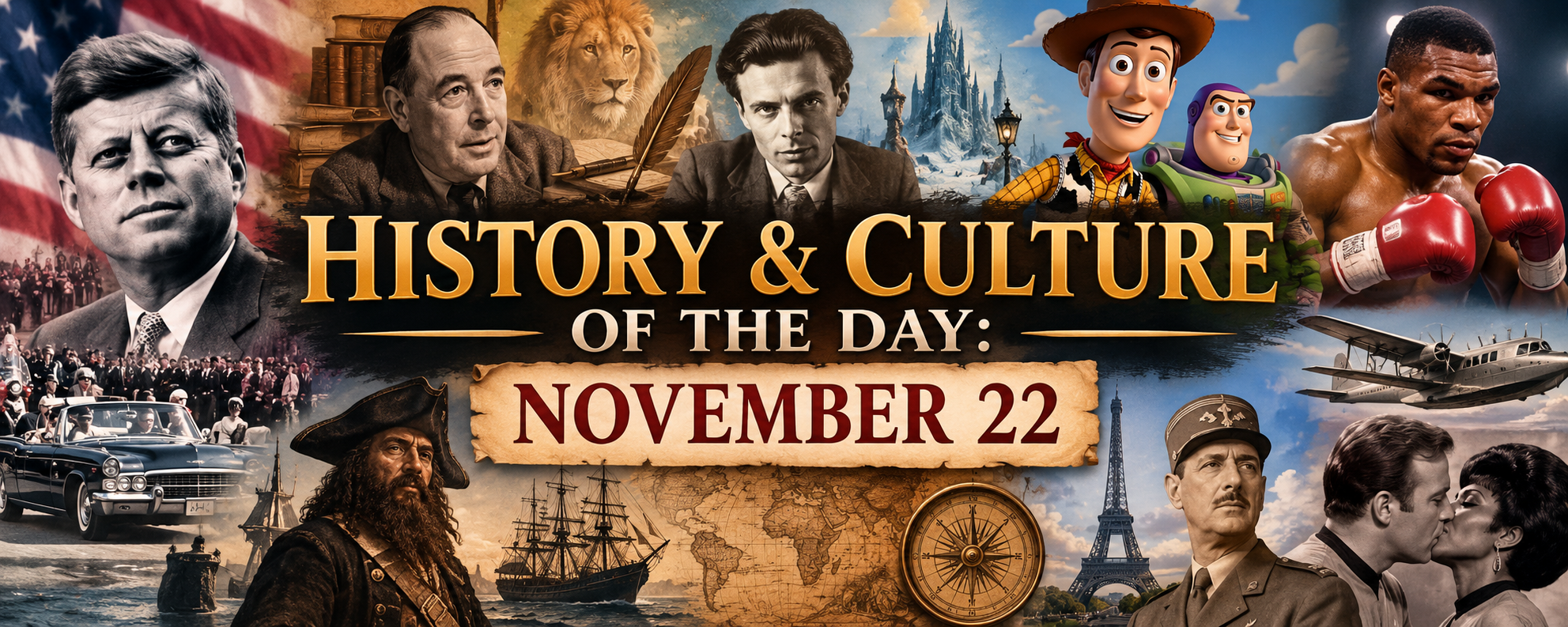
November 22 is a date filled with powerful moments in history, cultural milestones, remarkable achievements, and events that continue to influence the world today. From presidential history and groundbreaking music to important scientific discoveries and the evolution of popular culture, this day reminds us how individual moments can leave lasting marks on generations.
History is more than a collection of dates and names. It tells the stories of people who changed society, challenged traditions, inspired others, and helped shape the world we know today.
As we explore November 22, we discover a day marked by tragedy, innovation, creativity, and transformation.
November 22, 1963: The Assassination of President John F. Kennedy
One of the most significant events associated with November 22 occurred in 1963, when President John F. Kennedy was assassinated in Dallas, Texas.
Kennedy, the 35th president of the United States, was traveling through downtown Dallas in a presidential motorcade when he was shot.
His assassination shocked the nation and the world.
Millions of Americans remember where they were when they heard the news. Television and radio broadcasts brought the tragedy into homes across the country, creating a shared moment of national mourning.
Kennedy had represented a new generation of American leadership. His presidency emphasized public service, space exploration, civil rights, and international cooperation.
His famous call for Americans to consider what they could do for their country became one of the defining messages of his presidency.
Following his death, Vice President Lyndon B. Johnson took the presidential oath of office aboard Air Force One.
The assassination marked a turning point in American political history and profoundly affected the nation’s sense of security and optimism.
More than six decades later, Kennedy’s legacy remains an important subject of historical study, public discussion, and cultural remembrance.
November 22, 1963: The Death of Author C. S. Lewis
On the same day President Kennedy was assassinated, the world also lost one of its most influential Christian writers and literary thinkers.
C. S. Lewis died on November 22, 1963, at the age of 64.
Lewis was a British author, scholar, and Christian apologist best known for The Chronicles of Narnia, a beloved fantasy series that has inspired generations of readers.
His writing explored themes of courage, sacrifice, forgiveness, morality, faith, and the struggle between good and evil.
Among his other notable works were Mere Christianity, The Screwtape Letters, and The Problem of Pain.
Lewis had a remarkable ability to communicate complicated philosophical and spiritual ideas through accessible language and memorable storytelling.
His influence extended far beyond religious literature. His works helped shape modern fantasy writing and inspired numerous adaptations for film, television, theater, and radio.
Although his death received relatively limited attention amid the overwhelming coverage of Kennedy’s assassination, his literary and spiritual legacy has endured.
November 22, 1963: The Death of Aldous Huxley
November 22, 1963, also marked the death of another important literary figure, Aldous Huxley.
The English novelist and philosopher died in Los Angeles at the age of 69.
Huxley is best remembered for his 1932 novel Brave New World, a dystopian story exploring technology, social control, consumerism, and the potential consequences of sacrificing individuality for comfort and stability.
His work raised questions about freedom, human identity, scientific advancement, and the responsibilities that accompany technological progress.
These themes remain relevant in modern conversations about artificial intelligence, surveillance, biotechnology, and the influence of mass media.
The fact that Kennedy, Lewis, and Huxley all died on the same date makes November 22, 1963, an especially remarkable and somber day in twentieth-century history.
Three very different figures left behind legacies that continue to influence politics, literature, philosophy, and culture.
November 22, 1995: Toy Story Changes Animation Forever
November 22 is also associated with a major turning point in entertainment history.
On November 22, 1995, Pixar’s Toy Story was released in theaters across the United States.
The film became the first feature-length movie created entirely through computer animation.
Directed by John Lasseter, Toy Story introduced audiences to Woody, Buzz Lightyear, and a memorable collection of toys that came to life when humans were not watching.
Its innovative animation represented a technological breakthrough, but its emotional storytelling made it a cultural phenomenon.
The film explored friendship, jealousy, loyalty, belonging, and the fear of being replaced.
These universal themes helped it connect with children and adults alike.
Toy Story also demonstrated that computer-generated animation could support full-length theatrical storytelling and commercial success.
Its achievements helped transform the animation industry and opened the door for a new generation of animated films.
The movie eventually became the foundation of one of the most recognizable entertainment franchises in the world.
November 22, 1995, therefore represents a major milestone in the relationship between technology and artistic creativity.
November 22, 1986: Mike Tyson Becomes the Youngest Heavyweight Champion
Sports history also has an important connection to November 22.
On November 22, 1986, Mike Tyson defeated Trevor Berbick in Las Vegas to win the World Boxing Council heavyweight championship.
At just 20 years and 145 days old, Tyson became the youngest boxer ever to win a recognized world heavyweight title.
His speed, punching power, and aggressive fighting style quickly made him one of the most talked-about athletes in the world.
The victory established Tyson as a major figure in professional boxing and helped launch a period of extraordinary public attention.
His career would later include both remarkable achievements and serious controversies.
Nevertheless, his historic championship victory remains one of boxing’s most memorable milestones.
Tyson’s achievement also illustrates how athletic accomplishments can become part of broader popular culture, influencing fashion, media, entertainment, and public conversation.
November 22, 1718: The Death of Blackbeard the Pirate
Long before modern politics, film, and professional sports, November 22 was connected to one of history’s most notorious pirates.
On November 22, 1718, Edward Teach, better known as Blackbeard, was killed during a battle with British naval forces near Ocracoke Island, off the coast of North Carolina.
Blackbeard had become one of the most feared pirates operating along the Atlantic coast during the early eighteenth century.
His dramatic appearance, intimidating reputation, and command of the ship Queen Anne’s Revenge helped establish his legendary status.
Stories describe him using his appearance and theatrical intimidation to frighten opponents into surrendering.
Although popular culture often portrays pirates as adventurous rebels, piracy involved violence, theft, and serious threats to maritime commerce.
Blackbeard’s death became a symbolic moment in the campaign against piracy during the Golden Age of Piracy.
Over time, his story inspired novels, films, television programs, historical attractions, and countless fictional pirate characters.
His legacy demonstrates how historical figures can evolve into enduring cultural legends.
November 22, 1890: Charles de Gaulle Is Born
November 22 also marks the birthday of Charles de Gaulle, born in Lille, France, in 1890.
De Gaulle became one of the most influential political and military leaders in modern French history.
During World War II, he emerged as a leading figure of the Free French movement after France’s defeat by Nazi Germany in 1940.
He encouraged continued resistance and became an important symbol of French national independence.
After the war, de Gaulle remained central to French political life and later became the first president of France’s Fifth Republic in 1959.
His leadership influenced France’s constitutional structure, foreign policy, and national identity.
Today, de Gaulle is remembered as a defining figure in twentieth-century European history.
His birthday provides an opportunity to reflect on leadership, national sovereignty, resistance, and the political consequences of global conflict.
November 22, 1906: The SOS Distress Signal Is Adopted Internationally
Another important historical milestone associated with November 22 involves maritime safety.
On November 22, 1906, the International Radiotelegraph Convention was signed in Berlin.
The convention established international rules for wireless communication and adopted SOS as a standard maritime distress signal, with the relevant provisions taking effect in 1908.
SOS was selected because its Morse code pattern—three dots, three dashes, and three dots—was simple and recognizable.
Contrary to popular belief, SOS was not originally an abbreviation for phrases such as “Save Our Ship” or “Save Our Souls.”
Those interpretations developed later.
The adoption of a standardized distress signal represented an important advancement in international cooperation and communication safety.
It helped ships communicate emergencies more effectively across national and linguistic boundaries.
The history of SOS reminds us that even seemingly small technological standards can save lives and shape global practices.
The Cultural Significance of November 22
What makes November 22 particularly interesting is the diversity of events connected to this date.
It represents moments of national grief, literary achievement, technological innovation, military history, athletic excellence, and international cooperation.
The assassination of President Kennedy changed American political culture.
The deaths of C. S. Lewis and Aldous Huxley marked the passing of two influential literary minds.
The release of Toy Story transformed the possibilities of animated filmmaking.
Mike Tyson’s championship victory created a defining moment in sports history.
Blackbeard’s death became part of the mythology of piracy.
Charles de Gaulle’s birth marked the beginning of a life that would help shape modern France.
And the international adoption of SOS helped establish a lasting standard for emergency communication.
Together, these events reveal that history is not limited to one country, one profession, or one type of achievement.
It is a collection of human experiences that continue to shape the present.
Why Learning About History and Culture Matters
Studying history helps us understand the origins of modern institutions, traditions, beliefs, and technologies.
It also encourages us to examine the choices made by previous generations.
Some historical events demonstrate courage and innovation. Others reveal tragedy, conflict, and the consequences of human decisions.
Cultural history adds another dimension by showing how literature, film, sports, and storytelling influence the way societies understand themselves.
A movie can change an industry.
A book can inspire generations.
A political leader can transform a nation.
A technological standard can improve safety around the world.
And a single tragic event can permanently change how people remember a particular day.
Understanding these connections allows us to appreciate the complexity of the past while recognizing its influence on our everyday lives.
November 22, 1968: Star Trek Makes Television History
On November 22, 1968, the television series Star Trek aired an episode titled Plato’s Stepchildren.
The episode featured a kiss between Captain James T. Kirk, played by William Shatner, and Lieutenant Nyota Uhura, played by Nichelle Nichols.
The scene became one of the most famous interracial kisses in American television history.
Although it was not the first interracial kiss ever broadcast on television, it represented an important cultural moment during a period when the United States was confronting racial inequality and the legacy of segregation.
Star Trek was known for presenting a future in which people from different racial, cultural, and national backgrounds worked together.
Its diverse crew reflected creator Gene Roddenberry’s vision of a more cooperative humanity.
The episode became part of the show’s broader legacy of challenging social expectations through science fiction.
November 22, 1935: The China Clipper Begins a Historic Flight
On November 22, 1935, Pan American Airways’ China Clipper departed Alameda, California, on a historic trans-Pacific airmail flight.
The flying boat carried mail across the Pacific Ocean toward Manila in the Philippines, making scheduled stops along the way.
At a time when international air travel was still developing, the flight represented a major achievement in aviation.
It demonstrated the growing possibility of connecting distant parts of the world through commercial air transportation.
The China Clipper became a symbol of technological progress, adventure, and expanding international communication.
Its journey helped establish the foundation for later commercial air routes across the Pacific.
Famous Birthdays on November 22
November 22 is also the birthday of several influential figures in literature, entertainment, sports, and politics.
George Eliot (1819): Born Mary Ann Evans, Eliot became one of the most respected English novelists of the nineteenth century. Her works, including Middlemarch, explored relationships, morality, ambition, and society.
Charles de Gaulle (1890): The French military and political leader became a central figure in the Free French movement during World War II and later served as president of France.
Rodney Dangerfield (1921): The American comedian became famous for his self-deprecating humor and memorable performances in film and stand-up comedy.
Billie Jean King (1943): The American tennis champion became a pioneering advocate for gender equality in sports and helped transform opportunities for women athletes.
Scarlett Johansson (1984): The American actress became widely recognized for her performances in dramatic films and major Hollywood franchises.
These individuals demonstrate how people born on the same calendar date can make lasting contributions across very different fields.
Final Thoughts: November 22 and the Stories That Shape Our World
November 22 reminds us that history is filled with moments that deserve to be remembered.
Some events bring sorrow and reflection. Others celebrate creativity, courage, progress, and achievement.
The assassination of John F. Kennedy reminds us how quickly history can change.
The lives of C. S. Lewis and Aldous Huxley demonstrate the enduring influence of literature and ideas.
The release of Toy Story shows how imagination and technology can transform entertainment.
The achievements of athletes, inventors, explorers, and leaders reveal the extraordinary possibilities of human determination.
Every generation contributes something to history, whether through major accomplishments, everyday acts of courage, or ideas that inspire future generations.
History is not simply about remembering what happened. It is about understanding why those moments mattered and how their influence continues today.
As we reflect on November 22, we are reminded that the world we live in was shaped by the lives, choices, struggles, and accomplishments of those who came before us.
And just as their stories became part of history, the choices we make today will help shape the stories told tomorrow.
Which historical event from November 22 do you believe had the greatest impact on the world, and why?

Leave a Reply