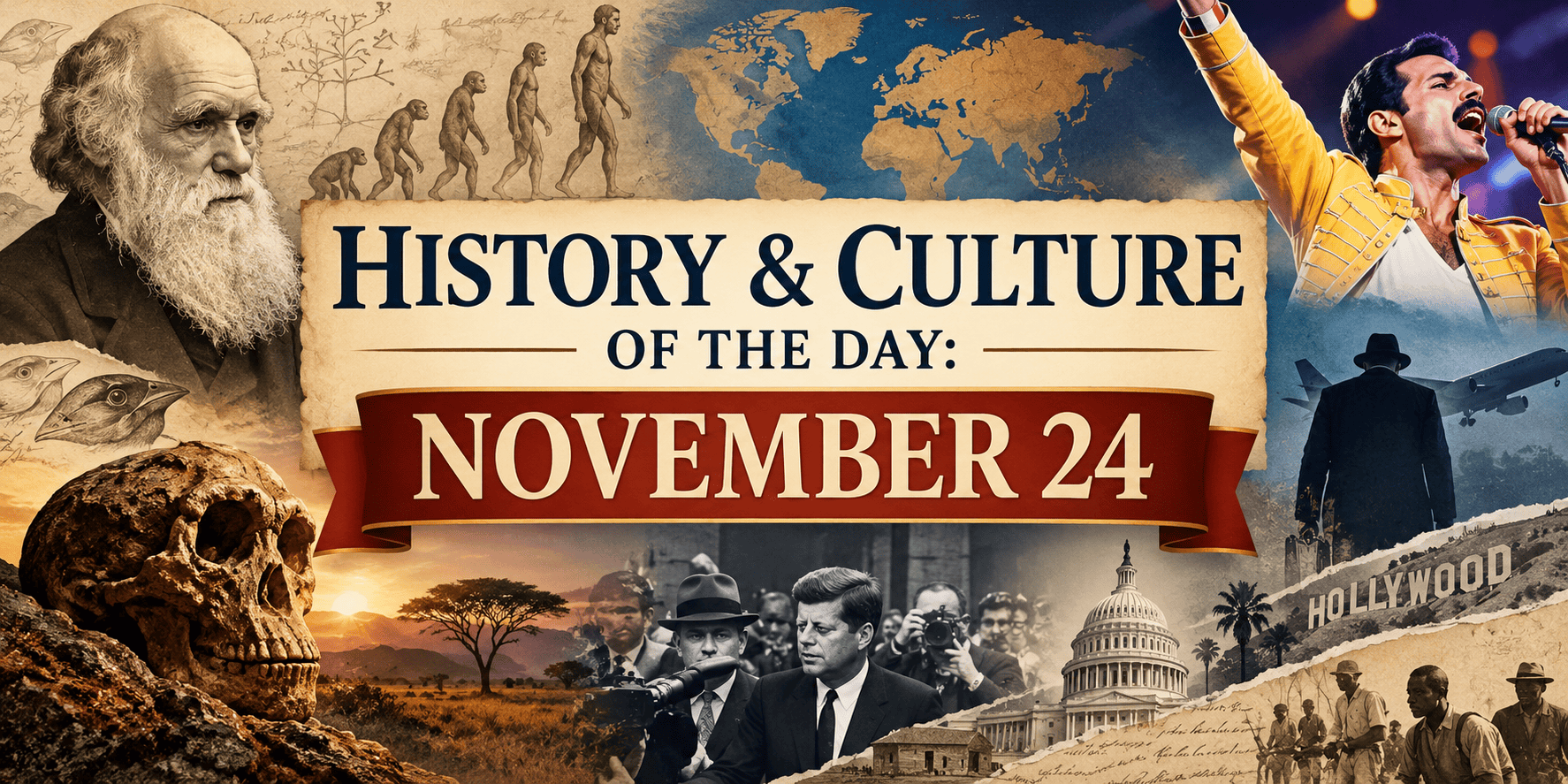
November 24 holds a fascinating place in world history. Throughout the centuries, this date has witnessed important scientific discoveries, groundbreaking ideas, cultural transformations, and events that helped shape the modern world.
From the publication of Charles Darwin’s revolutionary theory of evolution to the discovery of an ancient human ancestor in Ethiopia, November 24 reminds us that history is not simply a collection of dates. It is the story of human curiosity, courage, creativity, and the constant pursuit of knowledge.
Every generation inherits a world shaped by those who came before it. Some individuals changed history through scientific discoveries, others through artistic expression, and still others by challenging the beliefs of their time.
Today, we explore the historical events, cultural milestones, and remarkable people connected to November 24.
November 24, 1859 – Charles Darwin Publishes On the Origin of Species
A Scientific Revolution That Changed How Humanity Understood Life
One of the most significant events associated with November 24 occurred in 1859, when British naturalist Charles Darwin published his groundbreaking book, On the Origin of Species.
Darwin introduced a detailed scientific explanation for how species change over generations through natural selection.
Before Darwin’s work, many people believed that species existed in essentially unchanging forms. His research challenged that understanding by demonstrating how inherited variations, competition, and environmental conditions could influence the survival and reproduction of living organisms.
His theory became a foundation of modern evolutionary biology.
The book generated intense debate among scientists, religious leaders, philosophers, and the public. Although Darwin’s ideas were controversial, they encouraged generations of researchers to investigate the natural world through observation and evidence.
Today, evolutionary theory remains central to biology, genetics, medicine, and the study of biodiversity.
Why It Matters: Darwin’s publication demonstrates how a single scientific work can transform humanity’s understanding of the natural world and inspire generations of discovery.
November 24, 1974 – The Discovery of Lucy Changes Human History
More than a century after Darwin published his theory of evolution, another remarkable discovery helped scientists better understand humanity’s ancient origins.
On November 24, 1974, paleoanthropologist Donald Johanson and researcher Tom Gray discovered fossilized remains of an early human relative in the Hadar region of Ethiopia.
The skeleton became known as Lucy, named after the Beatles song Lucy in the Sky with Diamonds, which researchers played while celebrating their discovery.
Lucy belonged to the species Australopithecus afarensis and lived approximately 3.2 million years ago.
Scientists recovered roughly 40 percent of her skeleton, an extraordinary find that provided important evidence about early human evolution.
One of the most significant discoveries was that Lucy’s species could walk upright despite having relatively small brains.
This challenged earlier assumptions about the sequence in which important human characteristics developed.
Lucy also received the Ethiopian name Dinkinesh, meaning “you are marvelous.”
Her discovery became a defining moment in anthropology and helped establish Africa’s central importance in understanding human origins.
Why It Matters: Lucy’s discovery revealed that humanity’s evolutionary story stretches back millions of years and that scientific discoveries can fundamentally change how we understand ourselves.
November 24, 1963 – A Nation Watches History Unfold on Television
November 24 also holds a significant place in American media and political history.
Two days after President John F. Kennedy was assassinated in Dallas, Texas, his accused assassin, Lee Harvey Oswald, was being transferred from police custody.
During the transfer, Dallas nightclub owner Jack Ruby approached Oswald and shot him.
The shooting occurred in front of television cameras, allowing Americans to witness the event as it unfolded.
The moment became one of the most shocking broadcasts in American television history.
For a nation already grieving the assassination of its president, Oswald’s death added another layer of uncertainty and confusion.
The event demonstrated the growing influence of television in documenting national tragedies.
By the early 1960s, television had become a powerful source of news, bringing major historical events directly into American homes.
The assassination and its aftermath helped define a new era in which millions of people could experience significant national events almost simultaneously.
Why It Matters: The events of November 24, 1963, illustrated how television was transforming public awareness, political communication, and the collective experience of history.
November 24, 1971 – The Mystery of D.B. Cooper Begins
Few unsolved mysteries in American history have captured public imagination quite like the disappearance of D.B. Cooper.
On November 24, 1971, a man identifying himself as Dan Cooper boarded Northwest Orient Airlines Flight 305 in Portland, Oregon.
During the flight to Seattle, he claimed to possess a bomb and demanded $200,000 and four parachutes.
After the aircraft landed in Seattle, Cooper received the ransom and parachutes and released the passengers.
The plane departed again with several crew members aboard.
Somewhere over the Pacific Northwest, Cooper parachuted from the aircraft into the darkness, carrying the ransom money.
He was never conclusively identified or located.
Over the decades, the mystery inspired books, documentaries, television programs, and countless theories.
The FBI investigated the case for many years before redirecting its investigative resources in 2016.
Although the crime itself was serious, the unanswered questions surrounding Cooper’s identity and disappearance transformed the case into a lasting piece of American popular culture.
Why It Matters: The D.B. Cooper case demonstrates how unresolved historical events can become enduring cultural mysteries that fascinate generations.
November 24, 1991 – The World Loses Freddie Mercury
Music history was forever changed on November 24, 1991, when Freddie Mercury, the legendary lead singer of Queen, died at age 45.
Mercury was celebrated for his extraordinary vocal range, commanding stage presence, and ability to connect with audiences around the world.
As Queen’s frontman, he helped create some of rock music’s most recognizable songs, including Bohemian Rhapsody, We Are the Champions, and Somebody to Love.
His performances combined theatrical creativity, emotional expression, and remarkable musical talent.
Mercury died from bronchopneumonia resulting from AIDS, just one day after publicly confirming that he had the disease.
His death brought additional international attention to the AIDS epidemic at a time when stigma, misinformation, and discrimination remained widespread.
His musical legacy continued through tribute concerts, recordings, films, and the ongoing popularity of Queen’s music.
Today, Mercury is remembered not only as an extraordinary performer but also as a cultural figure whose influence crossed generations, nationalities, and musical genres.
Why It Matters: Freddie Mercury’s legacy demonstrates how music can transcend cultural boundaries and how artists can continue inspiring people long after their deaths.
November 24, 1947 – The Hollywood Ten and the Fight Over Freedom of Expression
November 24, 1947, marked another important moment in American cultural history.
The United States House of Representatives voted to cite members of the Hollywood Ten for contempt of Congress after they refused to answer certain questions from the House Un-American Activities Committee.
The Hollywood Ten were writers, directors, and producers investigated during growing national fears about communist influence.
Their confrontation with Congress became a major event in the early Cold War era.
Following the hearings, Hollywood studios established policies that effectively prevented many accused or suspected individuals from working in the entertainment industry.
The resulting blacklist affected careers, families, and artistic expression for years.
The controversy raised fundamental questions about freedom of speech, political beliefs, government investigations, and the relationship between national security and individual rights.
It also revealed how political fear could influence the entertainment industry and the stories Americans were allowed to see on screen.
Why It Matters: The Hollywood Ten controversy remains an important chapter in discussions about civil liberties, artistic freedom, and the consequences of political blacklisting.
November 24, 1865 – Mississippi’s Black Codes Reveal the Struggle for Freedom
In the aftermath of the American Civil War, the United States faced the enormous challenge of rebuilding the nation and defining freedom for formerly enslaved people.
On November 24, 1865, Mississippi enacted restrictive laws known as the Black Codes.
These laws attempted to control the lives, labor, and movement of African Americans despite the abolition of slavery.
They included provisions that limited economic independence and exposed Black residents to discriminatory enforcement and punishment.
The Black Codes demonstrated that ending slavery did not automatically establish equality or protect civil rights.
Their implementation helped fuel debates over federal intervention, citizenship, and constitutional protections during Reconstruction.
These struggles contributed to the political environment in which the Fourteenth Amendment and later civil rights protections developed.
The history of the Black Codes serves as an important reminder that legal freedom and meaningful equality are not always achieved at the same time.
Why It Matters: Understanding Reconstruction helps explain the long struggle for civil rights in the United States and the importance of protecting constitutional freedoms.
How November 24 Reflects the Evolution of Human Culture
When we examine these events together, an interesting pattern emerges.
November 24 connects scientific discovery, political conflict, human rights, entertainment, and the mysteries that continue to capture our attention.
Darwin challenged humanity to reconsider the origins of life.
Lucy’s discovery expanded our understanding of human ancestry.
The Hollywood Ten controversy raised questions about freedom and political pressure.
The events surrounding President Kennedy’s assassination demonstrated television’s power to shape national memory.
D.B. Cooper’s disappearance became a lasting American mystery.
Freddie Mercury’s life and music showed how artistic expression can create a legacy that transcends generations.
Although these events occurred in different centuries and circumstances, they share a common connection: each influenced how people understand the world around them.
History is shaped not only by wars, governments, and major political decisions but also by scientists, artists, discoveries, and the ordinary human desire to understand what remains unknown.
Why Studying History and Culture Matters
History helps us recognize how societies change and why certain beliefs, traditions, and institutions exist today.
Culture gives those historical developments meaning through music, literature, art, language, and shared experiences.
Studying both allows us to better understand the relationship between past events and modern life.
Scientific progress reminds us to remain curious.
Political history teaches us to recognize the importance of rights and responsibilities.
Cultural achievements demonstrate the lasting influence of human creativity.
And unresolved mysteries remind us that even with modern technology, some questions remain unanswered.
Perhaps the greatest lesson of November 24 is that human understanding is never complete.
Each generation discovers something new, challenges established ideas, and contributes another chapter to the ongoing story of civilization.
Final Thoughts: Remembering November 24
November 24 is more than another date on the calendar. It represents moments when the world learned something new, experienced profound change, or witnessed events that would remain part of its collective memory.
From Darwin’s revolutionary scientific publication in 1859 to the discovery of Lucy in 1974, this date highlights humanity’s continuing search for answers.
From the struggles over civil liberties to the extraordinary cultural influence of Freddie Mercury, November 24 also reminds us that history is shaped by the choices, talents, and experiences of individuals.
The past cannot be changed, but it can be understood.
And the more we learn about the people and events that came before us, the better prepared we become to appreciate the present and shape the future.
History is not simply about remembering what happened. It is about understanding why it mattered and what it can still teach us today.
Which historical event from November 24 do you find most fascinating, and why do you believe its impact continues to be felt today?


Leave a Reply