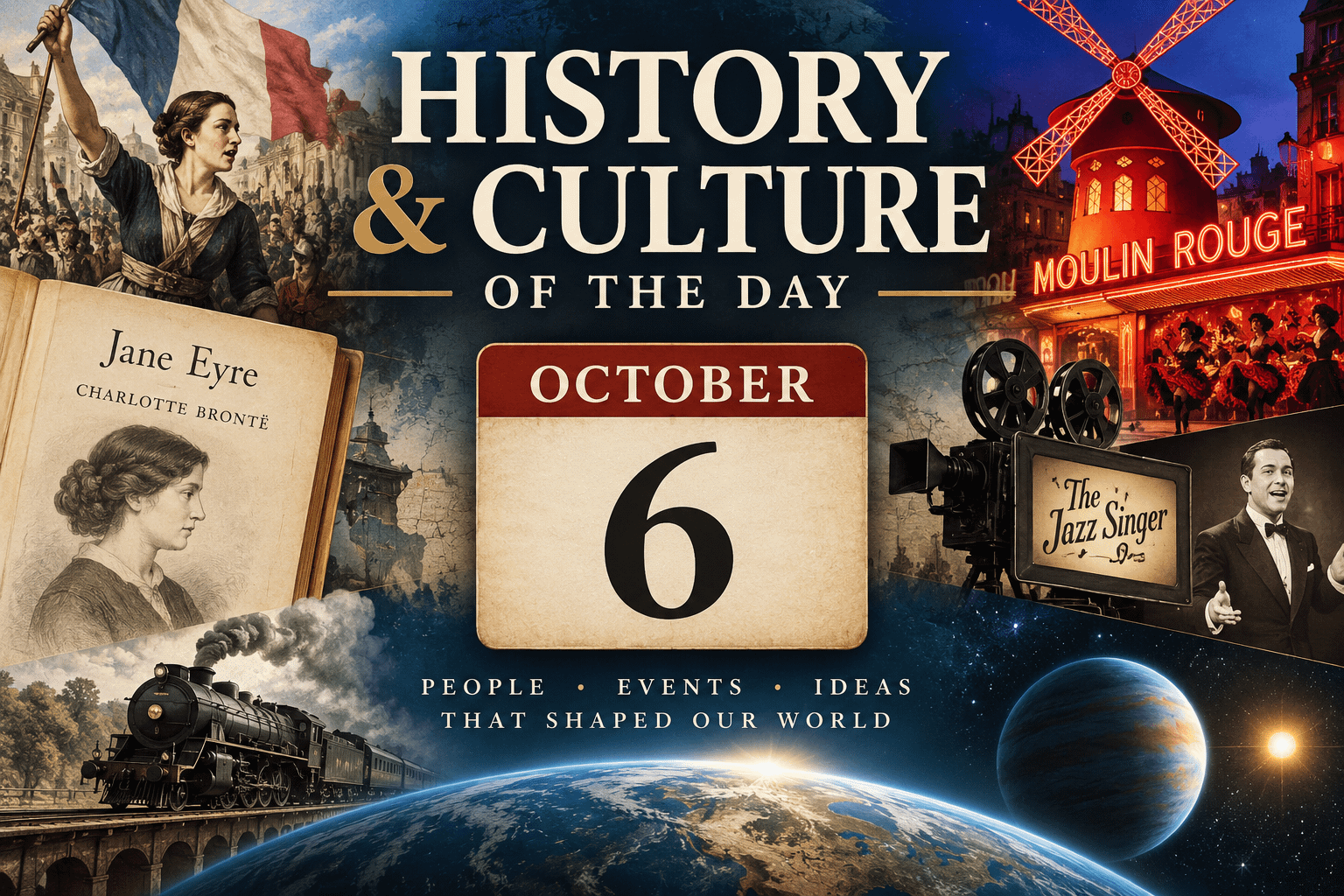
October 6 is a date filled with fascinating moments from history, cultural milestones, scientific achievements, exploration, war, entertainment, and events that helped shape the modern world.
From the opening of one of the world’s most famous theaters to the birth of influential figures and major moments in international history, October 6 reminds us that history isn’t simply a collection of dates. It is the story of people making decisions, taking risks, creating something new, and sometimes changing the direction of the world.
Here is a look back at some of the history and culture connected with October 6.
1683 — German Families Arrive in Pennsylvania
On October 6, 1683, a group of German-speaking settlers arrived in Pennsylvania aboard the Concord.
The settlers eventually established Germantown, near Philadelphia. Their arrival became an important chapter in the history of German immigration to North America.
German immigrants and their descendants would have an enormous influence on American culture. Their traditions contributed to American farming, craftsmanship, food, religion, music, festivals, and community life.
October 6 later became associated with German-American heritage and the recognition of the contributions German immigrants made to the United States.
Their story also represents a larger theme found throughout American history: generations of immigrants arriving with their own languages, traditions, skills, beliefs, recipes, and customs and gradually becoming part of the country’s cultural fabric.
1789 — The French Revolution Continues to Transform France
October 6, 1789, became an important date during the French Revolution.
After thousands of women and other demonstrators marched from Paris to Versailles demanding bread and political action, King Louis XVI and the royal family were compelled to leave Versailles and relocate to Paris.
The Women’s March on Versailles had begun the previous day amid high bread prices, shortages, and widespread frustration.
The events demonstrated the growing power of ordinary citizens during the French Revolution.
Moving the royal family to Paris also placed the monarchy much closer to the revolutionary population and government.
The French Revolution would ultimately reshape France while influencing political thought far beyond its borders.
Ideas surrounding citizenship, political representation, liberty, equality, and the relationship between governments and their people became subjects of intense debate across Europe and the wider world.
1847 — Jane Eyre Is Published
One of the most influential novels in English literature was published on October 6, 1847.
Charlotte Brontë’s Jane Eyre initially appeared under the pen name Currer Bell.
The novel follows Jane Eyre as she grows from a difficult childhood into an independent woman attempting to build a life while maintaining her dignity, principles, and sense of identity.
The book combined elements of romance, social criticism, Gothic fiction, and psychological storytelling.
Its central character was particularly significant.
Jane was intelligent, independent, emotionally complex, and determined to maintain her self-respect even when circumstances encouraged her to surrender it.
The novel became enormously influential and remains widely read nearly two centuries later.
Its publication is also a reminder of the obstacles female writers once faced. Charlotte Brontë and her sisters initially used masculine pen names partly because women writers were often treated differently by publishers, reviewers, and readers.
Today, Charlotte Brontë is recognized as one of the major figures of nineteenth-century literature.
1866 — The Reno Brothers Carry Out an Early Train Robbery
On October 6, 1866, members of the Reno Gang carried out a robbery involving an Ohio & Mississippi Railway train near Seymour, Indiana.
The crime is frequently described as the first peacetime train robbery in the United States involving a moving train.
Train robberies would eventually become deeply associated with the popular image of America’s Wild West.
Railroads were expanding rapidly across the country, carrying passengers, mail, payrolls, valuables, and commercial goods.
That made trains attractive targets for criminals.
During the following decades, names such as Jesse James, Butch Cassidy, and other outlaws would become connected with train robberies.
Hollywood later transformed these crimes into an enduring part of Western mythology.
The reality, however, was considerably less glamorous. Train robberies were dangerous crimes that threatened railroad employees, passengers, law enforcement officers, and surrounding communities.
1889 — The Moulin Rouge Opens in Paris
One of the world’s most recognizable entertainment venues opened its doors on October 6, 1889.
The Moulin Rouge opened in the Montmartre district of Paris during the Belle Époque.
With its famous red windmill and extravagant performances, the venue quickly became associated with Parisian nightlife.
It was also closely connected with the development and popularity of the can-can.
Artists, performers, wealthy visitors, working-class Parisians, tourists, and members of the city’s bohemian community crossed paths in Montmartre’s entertainment districts.
French artist Henri de Toulouse-Lautrec famously created posters and paintings depicting performers and nightlife at the Moulin Rouge.
More than a century later, the red windmill remains an internationally recognized symbol of Parisian entertainment.
1889 — Thomas Edison Shows His Motion-Picture Experiments
The late nineteenth century was also a period of extraordinary technological experimentation.
Thomas Edison and the researchers working with him became important contributors to the early development of motion-picture technology.
During this era, inventors were experimenting with ways to photograph rapid sequences of images and then display them in a way that created the illusion of movement.
Those experiments eventually contributed to the emergence of motion pictures.
What began as mechanical and photographic experimentation would grow into one of the most influential cultural industries in history.
Movies transformed entertainment, storytelling, journalism, advertising, celebrity culture, and eventually television and digital media.
1908 — Austria-Hungary Annexes Bosnia and Herzegovina
On October 6, 1908, Austria-Hungary announced the annexation of Bosnia and Herzegovina.
The decision triggered an international diplomatic confrontation known as the Bosnian Crisis.
The Balkans were already an area of intense political and ethnic tension involving Austria-Hungary, Serbia, Russia, the Ottoman Empire, and other European powers.
The annexation intensified resentment, particularly among Serbian nationalists.
Those tensions did not immediately cause a major European war, but they contributed to the increasingly unstable political environment of the early twentieth century.
Six years later, the assassination of Archduke Franz Ferdinand in Sarajevo would help trigger the chain of events leading to World War I.
History rarely turns on a single event. Major conflicts usually develop through years of competing interests, unresolved disputes, alliances, nationalism, and political decisions.
The events of 1908 provide an important example.
1927 — The Jazz Singer Premieres
October 6, 1927, became one of the most famous dates in movie history when The Jazz Singer, starring Al Jolson, premiered.
The film is widely remembered as a breakthrough in synchronized sound cinema.
Silent films did not disappear overnight, and experiments with synchronized sound had existed before The Jazz Singer. However, the movie’s commercial success demonstrated that audiences were enthusiastic about hearing synchronized voices, music, and sound alongside moving images.
Hollywood quickly responded.
Movie studios began converting theaters and production facilities for sound.
Actors suddenly had to worry about how their voices sounded.
Writers became increasingly important because dialogue could now be spoken.
Musicals became possible in an entirely new way.
Within only a few years, silent cinema had largely given way to the era of the “talkies.”
It was one of the fastest technological transformations in entertainment history.
The film is also viewed critically today because it includes blackface performance, reflecting racist entertainment traditions that were widespread in American popular culture during that era. Recognizing both its technological importance and its troubling racial imagery provides a fuller understanding of its place in film history.
1945 — Baseball’s World Series Captures America’s Attention
Baseball was deeply woven into American culture by the middle of the twentieth century, and October traditionally became one of the sport’s most celebrated periods.
The 1945 World Series between the Detroit Tigers and Chicago Cubs was underway during the first October after the end of World War II.
Millions of Americans were transitioning from wartime life toward peacetime.
Baseball offered a familiar national tradition during that transition.
The Tigers eventually defeated the Cubs in seven games.
For generations, October baseball has represented more than championship competition. It has become connected with family memories, radio broadcasts, ballparks, childhood heroes, hometown identity, and traditions passed from one generation to another.
1949 — American-Born Iva Toguri D’Aquino Is Convicted of Treason
The complicated aftermath of World War II also appears in October 6 history.
On October 6, 1949, Iva Toguri D’Aquino was sentenced after being convicted of treason in the United States.
She had been associated with Japanese wartime radio broadcasts and became popularly connected with the nickname “Tokyo Rose,” although that name was broadly applied to several female broadcasters.
Her case became controversial.
Decades later, questions about testimony and evidence surrounding the prosecution contributed to a reassessment of the case.
President Gerald Ford granted her a full presidential pardon in 1977.
Her story remains an example of how wartime fear, propaganda, public opinion, journalism, and the legal system can intersect in complicated ways.
1973 — The Yom Kippur War Begins
On October 6, 1973, Egyptian and Syrian forces launched coordinated attacks against Israel, beginning the conflict commonly known as the Yom Kippur War or October War.
The fighting occurred during Yom Kippur, the holiest day in Judaism, and during the Muslim holy month of Ramadan.
The conflict had major consequences throughout the Middle East and beyond.
The United States and Soviet Union became deeply involved diplomatically because of their relationships with countries in the region.
The war also became connected with an oil embargo by Arab oil-producing countries and the broader 1973 energy crisis.
Long lines at gas stations, higher energy prices, inflation, and economic uncertainty became part of everyday life in numerous countries.
The conflict eventually ended after cease-fire efforts, but its political consequences continued.
It helped create conditions that contributed to later diplomacy between Egypt and Israel, including negotiations that ultimately produced the 1978 Camp David Accords and the 1979 Egypt-Israel peace treaty.
1976 — Hua Guofeng Orders the Arrest of the Gang of Four
October 6, 1976, marked a major political turning point in China.
Less than a month after the death of Mao Zedong, Chinese authorities arrested members of the group that became known as the Gang of Four.
The group included Mao’s widow, Jiang Qing.
Their arrest became closely associated with the end of China’s Cultural Revolution, a turbulent period that had dramatically affected Chinese political, educational, economic, and cultural life.
China would undergo significant political and economic changes during the years that followed.
The country’s subsequent reforms would eventually transform China into one of the world’s largest economies.
1979 — Pope John Paul II Visits the White House
On October 6, 1979, Pope John Paul II met President Jimmy Carter at the White House during his visit to the United States.
The visit came relatively early in John Paul II’s papacy.
He had become pope the previous year and would eventually become one of the most internationally visible religious leaders of the twentieth century.
His travels around the world became a defining feature of his papacy.
His American visit drew enormous crowds and reflected the growing role of television in allowing millions of people to experience major religious and cultural events from their homes.
1981 — Egyptian President Anwar Sadat Is Assassinated
One of the most consequential events associated with October 6 occurred in Egypt in 1981.
Egyptian President Anwar Sadat was assassinated during a military parade in Cairo commemorating Egypt’s role in the 1973 war.
Sadat had played a central role in reshaping Middle Eastern diplomacy.
After years of conflict between Egypt and Israel, Sadat traveled to Jerusalem in 1977 and addressed the Israeli parliament.
That extraordinary diplomatic move helped pave the way for negotiations involving Sadat, Israeli Prime Minister Menachem Begin, and U.S. President Jimmy Carter.
The resulting Camp David Accords contributed to the Egypt-Israel peace treaty.
Sadat and Begin received the Nobel Peace Prize in 1978.
Sadat’s assassination demonstrated the intense political opposition his policies had generated among extremist opponents inside Egypt.
1995 — The Discovery of 51 Pegasi b Is Announced
October 6 also holds an important place in the history of astronomy.
In 1995, astronomers Michel Mayor and Didier Queloz announced the discovery of a planet orbiting the star 51 Pegasi.
Known as 51 Pegasi b, it became recognized as the first confirmed planet orbiting a Sun-like star outside our solar system.
The discovery changed astronomy.
For centuries, humans had wondered whether planets existed around other stars.
Now astronomers had compelling observational evidence.
Thousands of exoplanets have since been confirmed, ranging from enormous gas giants to rocky worlds and planets orbiting within regions where conditions might potentially allow liquid water.
The discovery of 51 Pegasi b helped open an entirely new chapter in humanity’s exploration of the universe.
Mayor and Queloz later shared part of the 2019 Nobel Prize in Physics for their contribution to understanding Earth’s place in the cosmos.
Born on October 6
October 6 is also the birthday of several notable people from history and popular culture.
George Westinghouse — 1846
American inventor and industrialist George Westinghouse helped develop technologies that transformed transportation and electrical power.
He invented an important railway air-brake system and became a major advocate of alternating-current electrical technology.
Le Corbusier — 1887
Swiss-French architect Charles-Édouard Jeanneret, better known as Le Corbusier, became one of the most influential architects of the twentieth century.
His ideas helped shape modern architecture and urban planning.
Thor Heyerdahl — 1914
Norwegian explorer Thor Heyerdahl became internationally famous for the 1947 Kon-Tiki expedition.
Heyerdahl and his crew sailed across the Pacific on a raft constructed using traditional materials to test ideas about ancient ocean travel.
Elisabeth Shue — 1963
American actress Elisabeth Shue became widely known for movies including The Karate Kid, Adventures in Babysitting, Cocktail, Back to the Future Part II, Back to the Future Part III, and Leaving Las Vegas.
October 6 in Culture
October 6 demonstrates how culture and history constantly influence each other.
Literature gave the world Jane Eyre.
Parisian nightlife gave us the enduring image of the Moulin Rouge.
Technological innovation helped transform silent movies into talking pictures.
Astronomers expanded humanity’s understanding of planets beyond our solar system.
Political decisions reshaped nations.
Wars changed international relationships.
Immigrants carried traditions across oceans and helped build new communities.
Each event belongs to a different time and place, yet together they demonstrate something important about history.
Human civilization is always changing.
Why Remember History?
It can be tempting to think of history as something finished.
It isn’t.
The world we live in today was built through millions of decisions made by people who came before us.
Technology we consider ordinary once seemed impossible.
Books we consider classics were once newly released.
Buildings that are landmarks were once construction projects.
Traditions that seem ancient were once new ideas.
Political borders changed.
Cultures mixed.
People migrated.
Wars began and ended.
Discoveries challenged what humanity thought it knew.
Understanding history allows us to see those connections.
It also reminds us that the present will eventually become someone else’s history.
Final Thought
October 6 has witnessed revolution, immigration, literature, entertainment, technological breakthroughs, war, diplomacy, exploration, and scientific discovery.
From the publication of Jane Eyre and the opening of the Moulin Rouge to the arrival of synchronized sound in Hollywood and the discovery of a planet orbiting another Sun-like star, October 6 shows just how varied a single date in history can be.
Every generation inherits a world shaped by those who came before it—and then adds another chapter to the story.
What moment from October 6 history did you find most interesting?
Leave a Reply