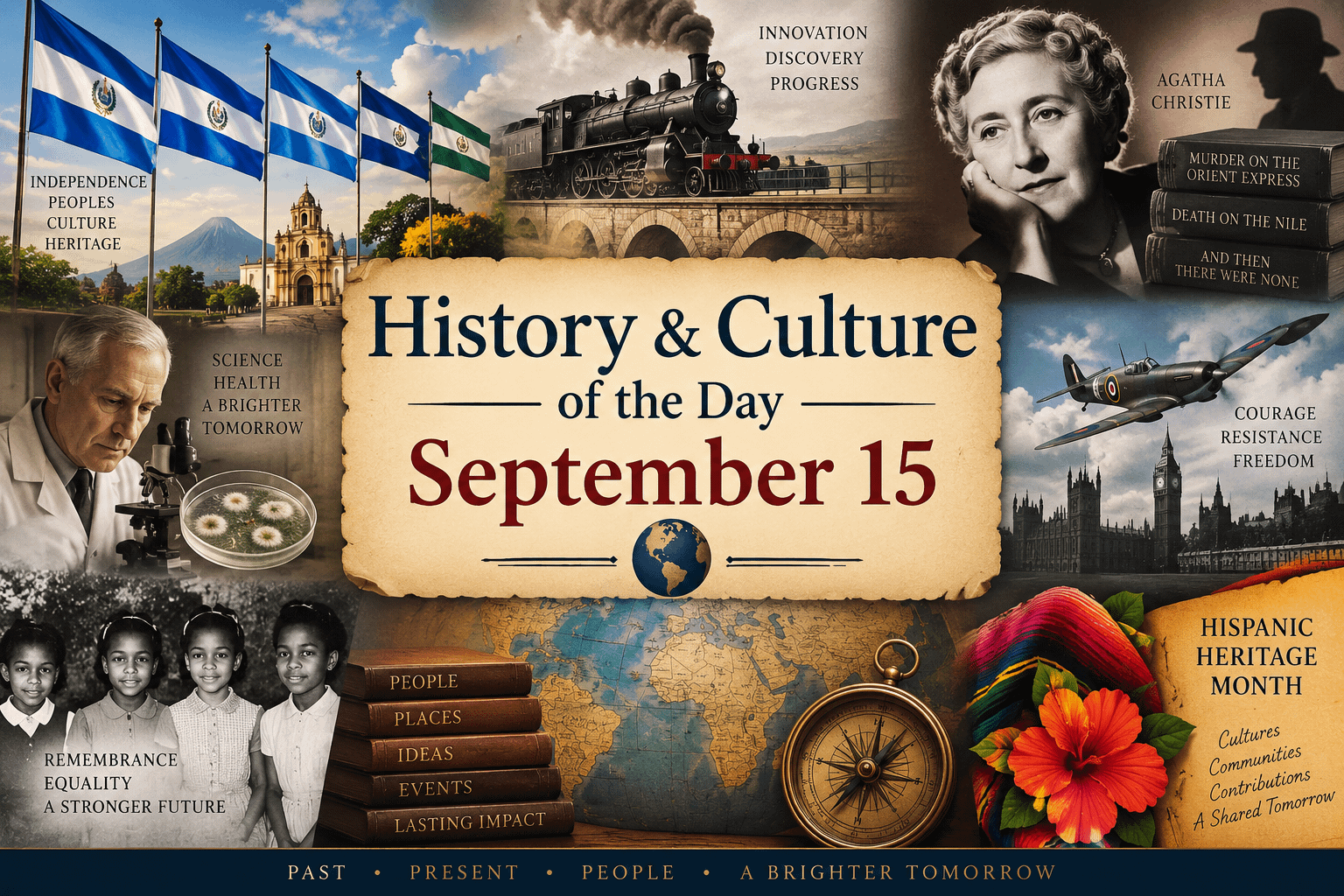
September 15 is a date filled with moments that have influenced nations, culture, science, entertainment, and the way people understand the world around them. From independence movements in Central America to the birth of an internationally celebrated writer, September 15 offers a fascinating look at how individual events can leave lasting marks on history.
It is also a day that reminds us that history is more than wars, governments, and famous leaders. History is created through books, music, inventions, social movements, exploration, traditions, and ordinary people whose actions eventually become part of a much larger story.
Here is a look back at some of the memorable events, cultural milestones, famous birthdays, and historical developments connected to September 15.
1821 – Central American Nations Declare Independence
One of the most important events associated with September 15 occurred in 1821, when much of Central America declared independence from Spanish rule.
The Act of Independence of Central America was signed in Guatemala City, beginning a major political transformation for the region.
Today, Costa Rica, El Salvador, Guatemala, Honduras, and Nicaragua all celebrate their independence on September 15.
The independence movement was part of a much larger transformation taking place throughout Latin America during the early 19th century. For centuries, Spain had controlled enormous territories in the Americas. Political unrest in Europe, changing economic conditions, Enlightenment ideas, and successful independence movements elsewhere encouraged people throughout Latin America to challenge colonial rule.
September 15 therefore represents much more than a historical date. Across Central America, it remains a celebration of national identity and heritage.
Independence Day celebrations often include parades, music, traditional clothing, dancing, patriotic ceremonies, food, flags, and community gatherings.
One particularly memorable tradition is the carrying of the Torch of Independence, which symbolizes the spread of the news of independence through Central America.
More than two centuries later, September 15 remains one of the most culturally significant dates in the region.
1830 – The Liverpool and Manchester Railway Opens
September 15, 1830, marked an important moment in transportation history with the formal opening of the Liverpool and Manchester Railway in England.
Railways existed before this event, but the Liverpool and Manchester line became an important milestone in the development of modern passenger and freight rail transportation.
The railway connected two major industrial cities and demonstrated how steam-powered transportation could move people and goods efficiently over significant distances.
The Industrial Revolution was already transforming Britain, and railroads accelerated those changes.
Factories could receive raw materials faster. Finished products could reach markets more efficiently. People could travel farther and more quickly than previous generations had imagined.
Railroads would eventually reshape entire countries.
Cities expanded around railway stations. New communities developed along transportation routes. Commerce accelerated, and travel became accessible to growing numbers of people.
The opening was also marked by tragedy. British politician William Huskisson was struck by George Stephenson’s locomotive Rocket during the opening ceremonies and later died from his injuries.
Despite the tragedy, the railway demonstrated the enormous potential of steam transportation.
Within decades, railroad networks would spread across Europe, North America, and other parts of the world.
1857 – William Howard Taft Is Born
William Howard Taft was born on September 15, 1857, in Cincinnati, Ohio.
Taft would eventually become the 27th president of the United States, serving from 1909 to 1913.
His place in history is particularly unusual because the presidency was not the only major national office he would hold.
Years after leaving the White House, Taft became Chief Justice of the United States, serving from 1921 until 1930.
He remains the only person in American history to have served both as president of the United States and as chief justice of the Supreme Court.
Taft’s career demonstrates how public service can take many different forms. Although presidents often dominate historical discussions, Taft reportedly felt more comfortable in the legal world than in electoral politics.
His life therefore connects two of America’s most powerful institutions: the presidency and the Supreme Court.
1890 – Agatha Christie Is Born
One of the world’s most famous mystery writers was born on September 15, 1890.
Agatha Christie was born in Torquay, England, and would eventually become one of the most successful authors in literary history.
Christie’s stories introduced readers to legendary fictional detectives including Hercule Poirot and Miss Marple.
Her novels became famous for carefully constructed mysteries, unexpected clues, suspicious characters, and endings that often surprised readers.
Among her best-known works are:
- Murder on the Orient Express
- Death on the Nile
- The Murder of Roger Ackroyd
- And Then There Were None
- The ABC Murders
Her influence extended beyond novels.
Christie’s stage play The Mousetrap became famous for its extraordinarily long theatrical run in London’s West End.
Her work has also inspired countless movies, television adaptations, radio productions, stage performances, and modern mystery writers.
The popularity of Agatha Christie demonstrates something important about culture: a great story can survive long after the era in which it was written.
Generations continue discovering her mysteries and trying to solve them before the final pages reveal the truth.
1916 – Tanks Enter Battle
September 15, 1916, became a significant date in military history when tanks were used in battle during the Battle of the Somme in World War I.
The battlefield of World War I had become dominated by trenches, machine guns, barbed wire, and artillery.
Military leaders searched for ways to break through heavily defended enemy positions.
The tank represented a new approach.
Early tanks were slow, mechanically unreliable, uncomfortable, and extremely difficult to operate. Many broke down or became stuck.
Yet their appearance suggested how warfare was beginning to change.
Over the following decades, armored vehicles became increasingly important to military strategy.
By World War II, tanks had become central to major land campaigns.
The first battlefield appearance of tanks on September 15 therefore represents an early stage in a technological transformation that would dramatically influence modern warfare.
1928 – Alexander Fleming and the Discovery That Led to Penicillin
September 1928 is closely associated with one of the most important medical discoveries of the modern era.
Scottish scientist Alexander Fleming returned to his laboratory after time away and noticed something unusual in a dish containing bacteria.
Mold had contaminated the dish.
Instead of simply throwing it away, Fleming observed that bacteria surrounding the mold were being destroyed.
The mold belonged to the Penicillium genus.
Fleming’s observation eventually contributed to the development of penicillin, the world’s first widely effective antibiotic.
The discovery would eventually transform medicine.
Before antibiotics, bacterial infections that are routinely treated today could become deadly. Pneumonia, infected wounds, and many other infections posed enormous risks.
Penicillin eventually saved countless lives, particularly after methods were developed to manufacture it on a large scale.
The story has also become an enduring example of scientific curiosity.
An unexpected observation became important because someone stopped to investigate it.
1935 – The Nuremberg Laws Are Announced
Not every historical anniversary represents progress.
September 15, 1935, is associated with one of the darkest developments in Nazi Germany.
During the Nazi Party rally in Nuremberg, the regime introduced laws that stripped German Jews of important citizenship rights and prohibited marriages and certain relationships between Jews and people classified as being of “German or related blood.”
These measures became known as the Nuremberg Laws.
They helped transform antisemitic ideology into government policy.
The laws demonstrate how discrimination can become increasingly dangerous when prejudice is supported and enforced by institutions.
In the years that followed, persecution intensified dramatically, eventually contributing to the systematic murder of six million Jews during the Holocaust.
Remembering events like this is an essential part of studying history.
History does not exist only to celebrate human achievement. It also provides warnings about what can happen when hatred, dehumanization, authoritarianism, and discrimination are allowed to grow unchecked.
1940 – The Battle of Britain Reaches a Critical Day
September 15, 1940, became one of the most famous days of the Battle of Britain during World War II.
German forces launched major air attacks against Britain, and the Royal Air Force responded.
The fighting that day became so significant that September 15 is now commemorated as Battle of Britain Day in the United Kingdom.
The broader battle was crucial because Nazi Germany hoped to gain air superiority over Britain.
British resistance prevented Germany from achieving that goal.
The Battle of Britain became a powerful cultural symbol of endurance and national determination.
It also highlighted the growing importance of aircraft, radar, intelligence, communications, and coordinated air defense in modern warfare.
1949 – The Lone Ranger Comes to Television
On September 15, 1949, The Lone Ranger premiered on American television.
The masked Western hero had already become popular through radio, but television introduced the character to a new audience.
With his horse Silver and his companion Tonto, the Lone Ranger became one of the recognizable heroes of early American television.
The character’s famous cry of “Hi-Yo, Silver!” became part of popular culture.
Western programs would become enormously popular during television’s early decades.
Cowboys, frontier towns, sheriffs, outlaws, horses, and open landscapes filled American television screens.
Although modern audiences often examine older Westerns more critically—particularly their portrayals of Native Americans and the mythology surrounding westward expansion—the genre remains an important part of American entertainment history.
1963 – Birmingham Church Bombing
September 15, 1963, became one of the most heartbreaking dates of the American Civil Rights Movement.
A bomb exploded at the 16th Street Baptist Church in Birmingham, Alabama.
Four Black girls were killed:
Addie Mae Collins, Cynthia Wesley, Carole Robertson, and Denise McNair.
The church had served as an important gathering place for civil rights activists.
The bombing shocked the country and became a devastating example of the racist violence faced by Black Americans and those fighting segregation.
Rather than stopping the movement, the tragedy increased national attention on racial injustice.
The bombing remains an important part of American history because it reminds us that major social changes often come with enormous human costs.
The four girls are remembered not simply as names in a history book, but as children whose lives were taken by hatred.
Their memory became intertwined with the continuing struggle for equality and civil rights.
1971 – Greenpeace Begins Its First Major Protest Voyage
September 15, 1971, is closely associated with the beginnings of Greenpeace.
A group of activists sailed from Vancouver aboard a vessel called the Phyllis Cormack, hoping to protest a planned U.S. nuclear test near Amchitka Island in Alaska.
The group originally operated under the name “Don’t Make a Wave Committee,” but the idea of combining environmental concern with peace activism helped inspire the Greenpeace identity.
The voyage helped create an organization that would later become internationally known for environmental activism.
Over the decades, environmental movements have influenced public discussions about nuclear testing, pollution, wildlife conservation, climate change, forests, oceans, and energy.
Whatever one’s views on individual environmental organizations or campaigns, the rise of environmental activism became a major cultural and political development during the second half of the 20th century.
September 15 and Hispanic Heritage Month
September 15 also holds major cultural importance in the United States because it marks the beginning of National Hispanic Heritage Month, which runs from September 15 through October 15.
The starting date was deliberately chosen because September 15 is the independence anniversary of Costa Rica, El Salvador, Guatemala, Honduras, and Nicaragua.
Mexico celebrates its independence on September 16, while Chile celebrates on September 18.
Hispanic Heritage Month recognizes the history, cultures, achievements, and contributions of Americans whose families have roots in Spain, Mexico, the Caribbean, Central America, and South America.
The month celebrates contributions in countless areas, including:
music, art, literature, science, sports, military service, business, education, government, agriculture, entertainment, food, and community leadership.
Hispanic and Latino cultures have profoundly influenced American life.
You can hear that influence in music.
You can taste it in food.
You can see it in architecture and art.
You can find it in language, festivals, neighborhoods, literature, family traditions, and everyday American culture.
The observance is therefore not simply about looking backward at history.
It is also about recognizing living cultures that continue shaping the United States.
Famous People Born on September 15
September 15 has also been the birthday of numerous influential figures from politics, literature, entertainment, sports, and other areas.
William Howard Taft – 1857
The 27th president of the United States and later Chief Justice of the United States.
Agatha Christie – 1890
Legendary British mystery writer and creator of Hercule Poirot and Miss Marple.
Roy Acuff – 1903
American country music performer who became one of the influential figures associated with the Grand Ole Opry.
Fay Wray – 1907
Actress remembered especially for her role in the 1933 film King Kong.
Jackie Cooper – 1922
Actor whose career stretched from childhood stardom into decades of film and television work.
Cannonball Adderley – 1928
Influential American jazz saxophonist known for his energetic performances and important contributions to jazz.
Tommy Lee Jones – 1946
Academy Award-winning American actor known for films including The Fugitive, Men in Black, No Country for Old Men, and Lincoln.
Oliver Stone – 1946
American filmmaker known for movies including Platoon, Wall Street, Born on the Fourth of July, and JFK.
Dan Marino – 1961
Legendary NFL quarterback best known for his career with the Miami Dolphins.
Tom Hardy – 1977
English actor known for roles in Inception, The Dark Knight Rises, Mad Max: Fury Road, The Revenant, and Venom.
Prince Harry – 1984
Born on September 15, 1984, the younger son of King Charles III and Diana, Princess of Wales.
A Day of Independence, Discovery, Culture, and Remembrance
Looking across the centuries, September 15 tells several very different stories.
It is a story of independence, as Central American nations celebrate freedom from Spanish colonial rule.
It is a story of innovation, represented by the development of rail transportation and the scientific observations that helped lead to penicillin.
It is a story of culture, through writers such as Agatha Christie and entertainers who shaped literature, television, film, jazz, country music, and sports.
It is a story of courage and resistance, from the Battle of Britain to the American Civil Rights Movement.
And it is also a story of warning and remembrance, particularly when we look back at the Nuremberg Laws and the bombing of Birmingham’s 16th Street Baptist Church.
History contains moments worth celebrating and moments that should never be forgotten.
Both matter.
The achievements of previous generations can inspire us, while their mistakes can warn us.
That is one of the reasons learning about history remains so important.
Why September 15 Still Matters
A date on a calendar can appear ordinary until we begin exploring what happened on it.
September 15 connects us with independence celebrations throughout Central America, the beginning of Hispanic Heritage Month in the United States, advances in transportation and medicine, unforgettable cultural figures, and defining moments in struggles for freedom and equality.
These events happened in different countries, centuries, and circumstances, yet they share something important.
Each became part of the world inherited by later generations.
History is not simply a collection of old dates.
It is the accumulated story of decisions, discoveries, struggles, creativity, courage, tragedy, and change.
Every generation adds another chapter.
And when we take a few minutes to look back, we gain a better understanding of how the world we know today came to be.
Which September 15 moment do you think had the greatest impact on history or culture—and why?
Leave a Reply