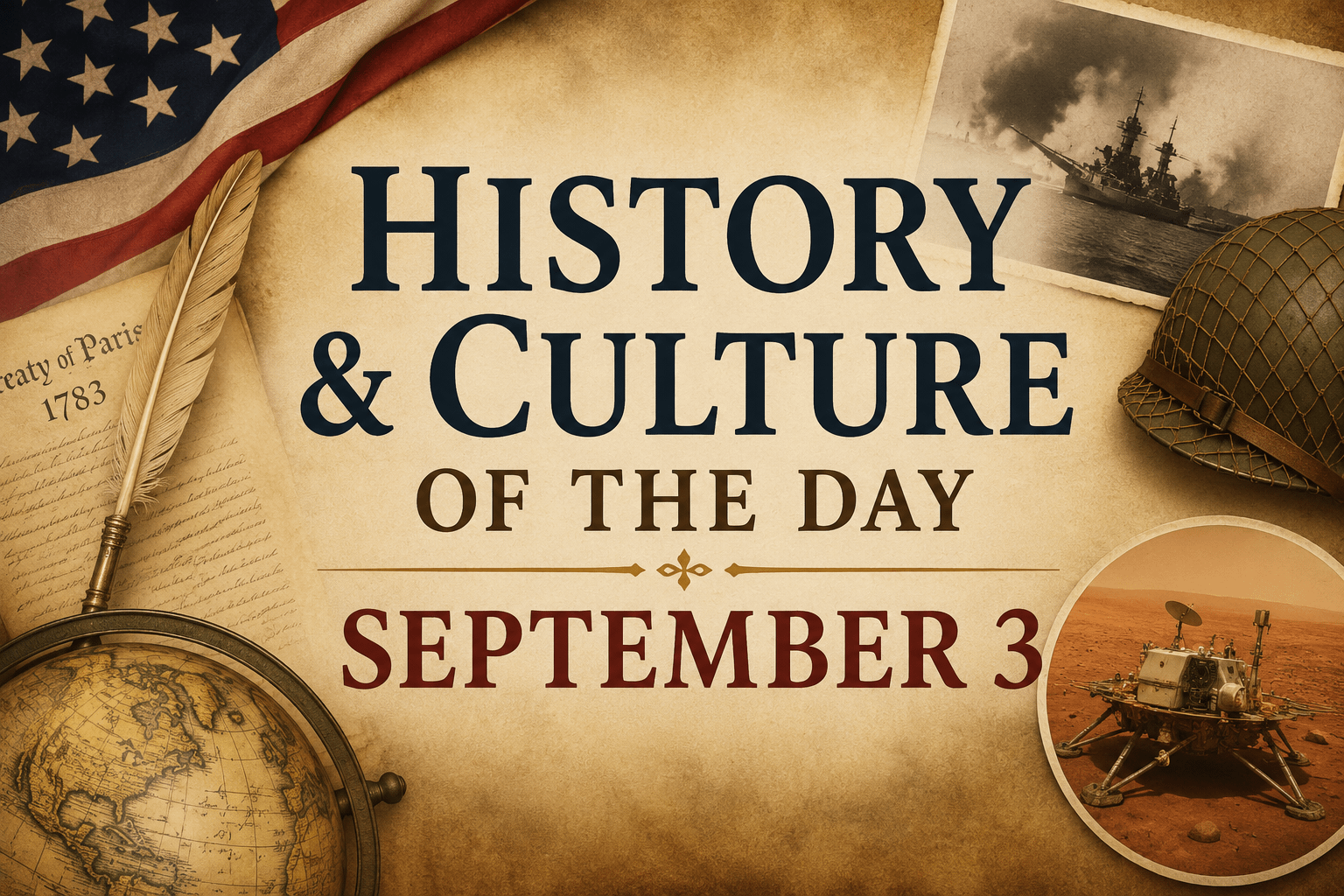
September 3 is a date filled with moments that have shaped nations, challenged injustice, advanced science, and influenced the way generations understand freedom and human achievement. From the signing of a treaty that formally ended the American Revolutionary War to Frederick Douglass’s courageous escape from slavery, the beginning of a devastating chapter in World War II, and humanity’s exploration of Mars, September 3 connects several remarkable stories across history.
History is more than a collection of dates. It is the story of people making decisions, taking risks, confronting uncertainty, and sometimes changing the direction of the world. Culture grows alongside those events, carrying their lessons forward through books, monuments, traditions, education, music, art, and shared memory.
On September 3, we can look back at moments of independence, courage, conflict, discovery, and transformation.
1783 – The Treaty of Paris Formally Ends the American Revolutionary War
One of the most important events associated with September 3 occurred in 1783, when representatives of the United States and Great Britain signed the Treaty of Paris.
The agreement formally ended the American Revolutionary War.
Although major fighting had largely concluded after the British surrender at Yorktown in 1781, the political and diplomatic process of ending the war continued for nearly two more years. The Treaty of Paris finally provided formal international recognition of the independence of the United States.
For Americans, this was an extraordinary moment.
What had begun as resistance by British colonies had resulted in the creation of a new nation.
The treaty recognized the United States as free, sovereign, and independent. It also established boundaries for the new country and addressed several unresolved issues between Britain and its former colonies.
Benjamin Franklin, John Adams, and John Jay were among the American representatives involved in negotiating the agreement.
The treaty represented much more than the conclusion of a military conflict. It marked the beginning of an enormous political experiment.
The United States now had to prove that it could govern itself.
Winning independence was one challenge. Building a functioning nation would be another.
The years following the Revolution would eventually lead to the Constitutional Convention, the adoption of the United States Constitution, the creation of a federal government, and the development of political institutions that continue to shape the country today.
September 3, 1783, therefore stands as an important milestone in American history.
The Revolution was formally over.
The difficult work of building the United States was beginning.
The Cultural Legacy of the American Revolution
The American Revolution also created a powerful cultural legacy.
Ideas about liberty, representation, individual rights, and government by consent became central parts of American identity. Those ideals would repeatedly be tested throughout the country’s history.
The Declaration of Independence had proclaimed that “all men are created equal,” yet millions of people remained enslaved. Women lacked many political and legal rights. Indigenous nations faced displacement and violence as the United States expanded.
The contradiction between America’s ideals and its realities would become one of the defining struggles of the nation’s history.
Future generations would repeatedly return to the language of the Revolution when demanding greater equality.
Abolitionists used America’s founding principles to challenge slavery.
Women’s rights advocates invoked them while demanding political equality.
Civil rights leaders later appealed to the promises contained in America’s founding documents.
The cultural significance of the Revolution therefore extends far beyond the eighteenth century.
Its promises became standards against which Americans continued to measure their country.
1838 – Frederick Douglass Escapes From Slavery
Another extraordinary event connected to September 3 occurred in 1838.
On this day, Frederick Douglass successfully escaped slavery.
Born into slavery in Maryland around 1818, Douglass endured the cruelty and injustice of a system that treated human beings as property.
Despite laws and customs designed to prevent enslaved people from gaining education, Douglass learned to read and write.
Literacy became one of the most powerful tools in his journey toward freedom.
Douglass eventually understood that knowledge could challenge the system attempting to control him. Education expanded his understanding of the world and strengthened his determination to become free.
After an earlier escape attempt failed, Douglass tried again on September 3, 1838.
Disguised as a sailor and carrying identification documents that helped him avoid detection, he traveled north by train and steamboat.
The journey was extremely dangerous.
If discovered, he could have been captured and returned to slavery.
Yet Douglass continued.
Within roughly a day, he reached New York City and freedom.
His escape transformed not only his own life but eventually American history.
Frederick Douglass Becomes a Voice for Freedom
Freedom did not cause Douglass to remain silent about what he had experienced.
Instead, he became one of the most influential abolitionists, writers, speakers, and reformers of the nineteenth century.
Douglass spoke publicly about the realities of slavery at a time when defenders of the institution attempted to justify or minimize its brutality.
His intelligence, eloquence, and personal testimony challenged racist assumptions.
In 1845, he published his famous autobiography, Narrative of the Life of Frederick Douglass, an American Slave.
The book became an important work of American literature and the abolitionist movement.
Douglass would continue writing and speaking throughout his life.
He advocated not only for the abolition of slavery but also for women’s rights, equal citizenship, education, voting rights, and broader human freedom.
His life demonstrated the extraordinary power of literacy, communication, courage, and persistence.
September 3 is therefore an especially meaningful date in the story of Frederick Douglass.
It was the day when a man who had been denied his freedom took an enormous risk to claim it.
He would spend much of the rest of his life fighting so that others could experience freedom as well.
1939 – Britain and France Declare War on Germany
September 3 also marks one of the most consequential days of the twentieth century.
On September 1, 1939, Nazi Germany invaded Poland.
Britain and France had pledged support for Poland and demanded that Germany withdraw its forces.
When Germany failed to do so, Britain declared war on Germany on September 3.
France followed the same day.
Europe was now entering World War II.
The conflict would grow into the deadliest war in human history.
Countries across Europe, Asia, Africa, and eventually the Americas became involved. Tens of millions of people would die as a result of combat, genocide, bombing, starvation, disease, occupation, and other consequences of the war.
The Holocaust resulted in the systematic murder of approximately six million Jews by Nazi Germany and its collaborators. Millions of other victims were also persecuted and murdered.
The war transformed nearly every aspect of society.
Families were separated.
Cities were destroyed.
Millions entered military service.
Industries were redirected toward wartime production.
Women entered areas of the workforce in unprecedented numbers in several countries.
Food, fuel, clothing, and other materials were rationed.
Technology advanced rapidly as governments invested enormous resources into aviation, medicine, communications, weapons, and transportation.
The world that emerged after 1945 would be profoundly different from the one that existed before the war.
The Cultural Impact of World War II
World War II continues to influence global culture more than eight decades later.
Books, movies, museums, memorials, documentaries, photographs, diaries, and oral histories preserve the experiences of those who lived through the conflict.
Entire generations grew up with stories about wartime sacrifice and survival.
The conflict also reshaped international politics.
The United Nations was established in 1945 in an effort to promote international cooperation and prevent future global conflicts.
The United States and Soviet Union emerged as competing superpowers, leading to decades of Cold War tension.
Colonial empires weakened, contributing to independence movements throughout Asia, Africa, and elsewhere.
The war also forced societies to confront difficult questions about genocide, human rights, racism, authoritarianism, propaganda, and the responsibilities of governments toward their citizens.
September 3, 1939, reminds us how quickly political crises can become global catastrophes.
1976 – Viking 2 Lands on Mars
September 3 is not remembered only for wars and political struggles.
It also represents human curiosity and scientific exploration.
On September 3, 1976, NASA’s Viking 2 lander successfully touched down on Mars.
The mission was part of NASA’s Viking program, which consisted of two spacecraft: Viking 1 and Viking 2.
Each mission included an orbiter and a lander.
Viking 1 had already successfully landed on Mars in July 1976. Viking 2 followed several weeks later, landing in the region known as Utopia Planitia.
The successful landing represented a remarkable technological achievement.
Mars has fascinated human beings for centuries.
Long before spacecraft could travel there, people looked toward the reddish object in the night sky and wondered what might exist on its surface.
As astronomy developed, Mars became one of the most closely studied planets.
By the twentieth century, scientists were no longer limited to observing Mars from Earth.
Humanity could send machines across millions of miles of space to investigate another world directly.
Seeing Another World
The Viking missions provided detailed images of the Martian surface and collected valuable scientific information about the planet’s atmosphere, soil, weather, and geology.
For people watching from Earth, the photographs were extraordinary.
Humans were looking at landscapes on another planet.
The images showed rocky terrain beneath an alien sky, offering a perspective that previous generations could only imagine.
The Viking landers also conducted experiments designed to search for possible signs of microbial life.
The results generated scientific debate, and the question of whether Mars ever supported life remains one of the most fascinating subjects in planetary science.
Later missions would build upon the knowledge gained from Viking.
Orbiters, landers, and rovers have continued exploring Mars, dramatically expanding our understanding of the planet.
Today’s Mars exploration programs owe part of their scientific heritage to missions such as Viking.
September 3, 1976, therefore represents another important step in humanity’s journey beyond Earth.
September 3 and the Story of Human Courage
Although the events associated with September 3 are very different, several common themes connect them.
The Treaty of Paris represents a nation attempting to establish independence.
Frederick Douglass’s escape represents an individual risking everything for personal freedom.
The declarations of war in 1939 remind us of the terrible consequences of aggression, dictatorship, and international conflict.
The Viking 2 landing demonstrates humanity’s determination to explore beyond familiar boundaries.
Each story involves people facing uncertainty.
Some moments brought hope.
Others brought suffering.
Some changed political boundaries.
Others expanded the boundaries of human knowledge.
Together, they demonstrate why studying history matters.
History reveals what human beings are capable of creating, enduring, destroying, rebuilding, and discovering.
Culture Keeps History Alive
Historical events do not disappear when the people who experienced them are gone.
Culture carries their stories forward.
We remember the American Revolution through historic battlefields, preserved documents, museums, monuments, Independence Day traditions, books, and classrooms.
We remember Frederick Douglass through his writings, speeches, historic sites, biographies, and continuing discussions about equality and civil rights.
We remember World War II through memorials, museums, veterans’ stories, films, literature, photographs, and ceremonies honoring those who served and those who were lost.
We remember the Viking missions through scientific archives, spacecraft imagery, museums, documentaries, and the Mars missions that followed.
This is one reason history and culture are inseparable.
History records what happened.
Culture influences how those events are remembered, interpreted, discussed, and passed from one generation to another.
Remembering the People Behind the Dates
It is easy to view history as a timeline filled with famous names and major events.
But every historical moment was experienced by ordinary people.
When the Treaty of Paris was signed, families who had endured years of revolution wondered what life in the new United States would become.
When Frederick Douglass traveled toward freedom, he experienced the fear of possible capture and the hope of beginning a new life.
When Britain and France entered World War II, millions of ordinary citizens realized their lives might soon change dramatically.
When Viking 2 landed on Mars, engineers, scientists, technicians, and researchers watched years of work culminate in a historic achievement.
Behind every date are human stories.
Parents.
Children.
Workers.
Soldiers.
Scientists.
Writers.
Leaders.
Dreamers.
Survivors.
History becomes much more meaningful when we remember that the people who experienced it did not know what would happen next.
They were living through their present just as we are living through ours.
Why September 3 Matters
September 3 offers a remarkable cross-section of human history.
In 1783, diplomacy formally ended a revolution and recognized the independence of a new nation.
In 1838, Frederick Douglass escaped slavery and began a new chapter that would eventually make him one of America’s most powerful voices for freedom.
In 1939, Britain and France declared war on Nazi Germany as Europe descended into World War II.
In 1976, Viking 2 landed on Mars and expanded humanity’s understanding of another planet.
Freedom, war, courage, exploration, and discovery all intersect on this single date.
These events remind us that history is never one simple story.
Human progress can exist alongside terrible injustice.
Scientific achievements can occur within generations still confronting ancient conflicts.
Nations can celebrate freedom while struggling to fully extend that freedom to everyone.
History asks us to recognize those contradictions rather than ignore them.
A Day to Learn From the Past
September 3 gives us an opportunity to think about what earlier generations experienced and what their stories can teach us today.
The Treaty of Paris demonstrates that political independence carries responsibilities as well as opportunities.
Frederick Douglass reminds us that freedom is worth defending and that one determined voice can influence generations.
The events of 1939 remind us that peace should never be taken for granted.
Viking 2 reminds us that curiosity can carry humanity farther than previous generations believed possible.
Perhaps that is one of the greatest lessons history offers.
Human beings are always writing the next chapter.
The people who lived through the events of September 3 could not completely predict how their actions would influence the future.
Neither can we.
The decisions made today may someday become the history studied by generations yet to come.
History & Culture of the Day
September 3 is a powerful reminder of how much can happen on a single date.
A war for independence formally ended.
A man escaped slavery and began a journey that would help change a nation.
Europe entered a conflict that would transform the world.
A spacecraft touched down on another planet.
Each moment tells a different story, yet together they reflect some of the strongest forces in human history: the desire for freedom, the consequences of conflict, the courage to challenge injustice, and the endless curiosity that pushes humanity toward discovery.
History is not simply about remembering yesterday.
It is about understanding how yesterday created today.
And when we study the triumphs, tragedies, mistakes, sacrifices, and achievements of those who came before us, we gain something valuable: perspective.
September 3 reminds us that history is being made every day—and that the choices people make today can echo far beyond their own lifetime.
Which September 3 moment do you believe has had the greatest impact on the world we live in today?
Leave a Reply