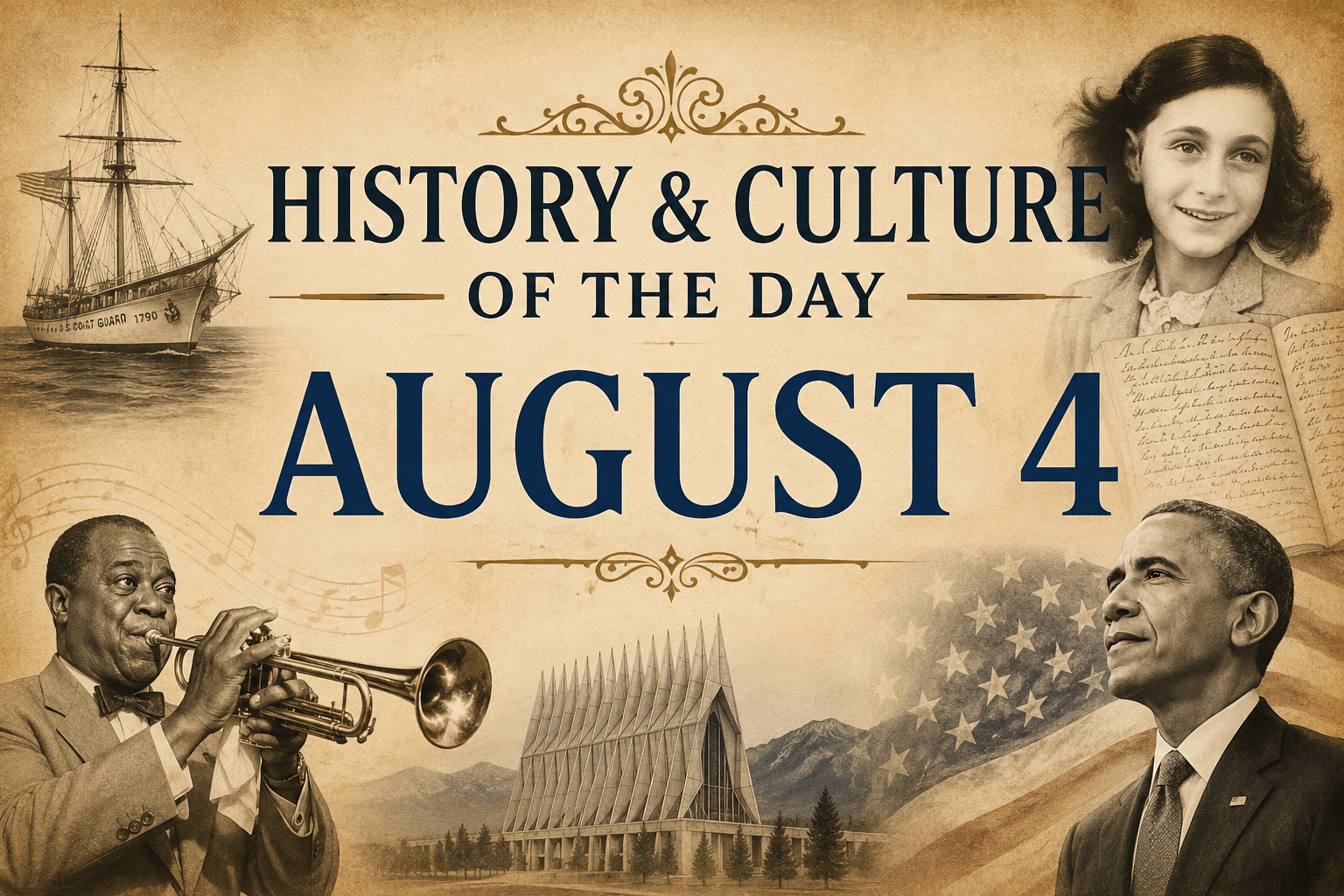
Category: History & Culture

  • History & Culture of the Day – August 4

    History & Culture of the Day – August 4

    Advertisements

    Exploring the History & Culture of August 4: Moments That Shaped the World

    Every day on the calendar carries stories that have influenced the course of history. Some dates are remembered for groundbreaking discoveries, while others are marked by moments of courage, tragedy, celebration, or innovation. August 4 stands as a remarkable day filled with events that have left lasting impressions on nations, cultures, and generations.

    From the establishment of institutions that continue protecting millions of people to powerful stories that remind us of humanity’s resilience, August 4 offers an opportunity to reflect on both the triumphs and hardships that have shaped our world.

    History is far more than names and dates in a textbook. It is the story of ordinary and extraordinary people whose actions changed lives forever. Understanding these moments helps us appreciate where we have come from while inspiring us to build a better future.


    The Birth of the United States Coast Guard (1790)

    One of the most significant events associated with August 4 occurred in 1790, when Congress approved legislation authorizing the construction of ten revenue cutters. Treasury Secretary Alexander Hamilton recognized that the young United States desperately needed a way to enforce customs laws, collect tariffs, and combat smuggling along its vast coastline.

    At the time, customs duties provided the federal government’s primary source of income. Without an organized maritime service, illegal trade threatened the nation’s financial stability.

    The newly created Revenue Cutter Service eventually evolved into what we know today as the United States Coast Guard.

    Over more than two centuries, the Coast Guard has grown into one of America’s most respected military services. Its responsibilities include:

    • Search and rescue operations
    • Maritime law enforcement
    • Drug interdiction
    • Homeland security
    • Icebreaking missions
    • Environmental protection
    • Commercial shipping safety
    • Disaster relief and emergency response

    Unlike many military branches, the Coast Guard often works directly with civilians during emergencies. Every year, Coast Guard crews rescue thousands of people from storms, floods, boating accidents, and maritime disasters.

    Their unofficial motto, “Semper Paratus,” meaning “Always Ready,” reflects their commitment to serving whenever and wherever they are needed.


    Anne Frank’s Arrest Remains One of History’s Most Powerful Lessons (1944)

    Few stories have touched as many hearts as that of Anne Frank.

    On August 4, 1944, after more than two years hiding from Nazi persecution in a secret annex above her father’s business in Amsterdam, Anne, her family, and the others living with them were discovered and arrested.

    The arrest marked the beginning of the final chapter in Anne’s life, but it also ensured that her words would live forever.

    Anne’s diary, preserved after the war, became one of history’s most important firsthand accounts of life during the Holocaust.

    Throughout her writings, Anne documented:

    • Fear
    • Hope
    • Family relationships
    • Dreams for the future
    • The emotional challenges of living in hiding
    • Her belief in the goodness of people despite overwhelming darkness

    One of her most famous reflections reads:

    “In spite of everything, I still believe that people are really good at heart.”

    Those words continue to inspire readers around the world decades later.

    Schools across the globe use her diary not only to teach about World War II but also to promote empathy, tolerance, and the importance of standing against discrimination and hatred.


    The United States Air Force Academy Begins a New Chapter (1958)

    Another important August 4 milestone came in 1958, when the United States Air Force Academy officially opened its permanent campus near Colorado Springs, Colorado.

    The academy was created to educate and develop future officers who would combine academic excellence with military leadership.

    Cadets receive rigorous training in:

    • Engineering
    • Science
    • Military strategy
    • Aviation
    • Leadership
    • Ethics
    • Physical fitness

    Since opening, graduates have gone on to become:

    • Military commanders
    • Fighter pilots
    • Astronauts
    • Scientists
    • Engineers
    • Government leaders

    The academy symbolizes America’s continuing investment in leadership, innovation, and national service.


    Celebrating the Birthday of Barack Obama

    August 4 is also the birthday of Barack Obama, born in Honolulu, Hawaii, in 1961.

    Obama made history in 2008 when he became the first African American elected President of the United States.

    His presidency focused on several significant initiatives, including:

    • The Affordable Care Act
    • Economic recovery after the Great Recession
    • Expansion of renewable energy
    • Financial reform
    • International diplomacy

    Beyond policy, Obama’s election represented a historic milestone in the ongoing story of American democracy and civil rights.

    His emphasis on hope, civic engagement, and public service inspired millions both inside and outside the United States.


    Louis Armstrong: A Musical Legend Born on August 4

    August 4 is also celebrated as the birthday of jazz icon Louis Armstrong, officially recognized as being born in 1901.

    Known affectionately as “Satchmo,” Armstrong transformed jazz from regional entertainment into an international art form.

    His achievements include:

    • Revolutionary trumpet performances
    • Groundbreaking jazz improvisation
    • Iconic vocal recordings
    • Worldwide cultural influence

    Songs like:

    • What a Wonderful World
    • Hello, Dolly!
    • La Vie En Rose
    • When the Saints Go Marching In

    remain beloved by audiences decades after their release.

    Armstrong’s music crossed racial, cultural, and national boundaries, helping introduce jazz to millions around the globe.


    NASA’s Spirit of Exploration

    Although August 4 is not associated with a single defining NASA milestone every year, the date frequently falls during periods of important space exploration activities.

    Throughout history, August has often been a busy month for:

    • Spacecraft launches
    • Satellite deployments
    • Astronaut training
    • Planetary missions
    • Scientific discoveries

    The ongoing pursuit of space exploration reminds us that human curiosity continues pushing beyond Earth’s boundaries.

    Every generation builds upon the discoveries of those who came before.


    The Cultural Importance of Remembering History

    Culture is shaped not only by famous leaders but also by artists, educators, musicians, scientists, and ordinary citizens who leave extraordinary legacies.

    History gives us:

    • Lessons from success
    • Warnings from failure
    • Inspiration from courage
    • Hope during difficult times
    • Appreciation for diversity
    • Understanding of different cultures

    Each generation inherits stories from the past while creating new stories for the future.

    When we preserve history, we preserve identity.


    How August 4 Reflects Human Achievement

    Looking across the events associated with August 4 reveals several common themes.

    Service

    The founding of the Coast Guard reminds us that protecting others is one of society’s highest callings.

    Courage

    Anne Frank’s writings continue demonstrating incredible strength despite unimaginable circumstances.

    Leadership

    The Air Force Academy and President Barack Obama’s career illustrate the importance of preparing future leaders.

    Creativity

    Louis Armstrong changed music forever through innovation, talent, and passion.

    Hope

    Whether through public service, education, literature, or music, each story connected with August 4 reminds us that one person’s contributions can influence generations.


    Why History Still Matters Today

    In today’s fast-moving digital world, it can be easy to overlook the importance of history. Yet many of the freedoms, institutions, technologies, and cultural traditions we enjoy today exist because of decisions made decades—or even centuries—ago.

    Studying history helps us:

    • Understand current events through historical context.
    • Recognize the progress society has made while acknowledging the work still ahead.
    • Appreciate the sacrifices of those who came before us.
    • Preserve traditions and stories that shape our identity.
    • Inspire future generations to lead with integrity, creativity, and compassion.

    History is not simply about remembering the past—it is about using the lessons of yesterday to make wiser choices tomorrow.


    Honoring the Legacy of August 4

    The events remembered on August 4 remind us that history is woven from countless individual stories. A government decision to protect a young nation, the heartfelt words of a teenage girl during one of history’s darkest periods, the opening of an academy dedicated to leadership, and the music of a legendary jazz artist all continue to influence the world in meaningful ways.

    As we reflect on this day, we are reminded that every act of service, every expression of creativity, and every voice raised in hope has the power to shape the future. The legacy of August 4 encourages us to learn from the past, celebrate human achievement, and strive to leave a positive mark on our own communities.

    Whether through leadership, kindness, innovation, or perseverance, each of us has the opportunity to become part of tomorrow’s history.


    Final Thoughts

    August 4 is a day rich with stories of courage, service, resilience, and cultural achievement. From the founding of the United States Coast Guard in 1790 to the enduring legacy of Anne Frank, the inspiring music of Louis Armstrong, the leadership represented by the United States Air Force Academy, and the historic significance of Barack Obama’s birthday, this date offers a meaningful snapshot of humanity’s journey.

    By taking time to reflect on the people and events connected to August 4, we gain a greater appreciation for the values that continue to shape our world—service, hope, creativity, justice, and perseverance. History reminds us that while we cannot change the past, we can learn from it, honor those who came before us, and contribute to a brighter future for generations yet to come.

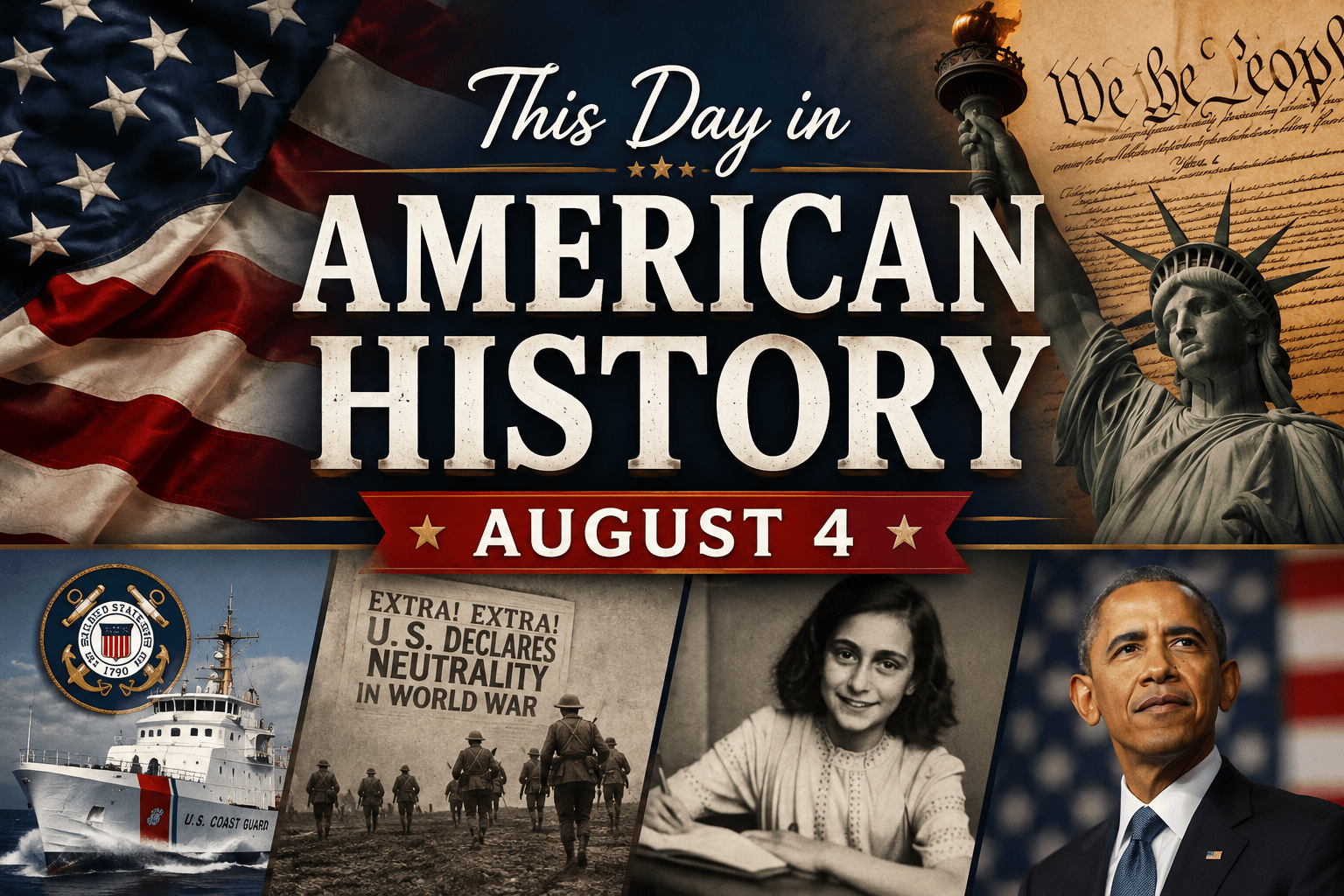
  • This Day in American History – August 4

    Advertisements

    History is more than a collection of dates—it is the story of the people, ideas, and events that have shaped the United States into the nation it is today. Every day on the calendar offers an opportunity to look back at defining moments that influenced America’s government, military, economy, culture, and values.

    August 4 has witnessed milestones that span more than two centuries. From the birth of one of America’s oldest military services to pivotal political decisions and influential cultural events, this date reminds us that history is continually being written.

    Join us as we explore some of the most significant events that happened on August 4 in American history.


    1790 – The Foundation of the United States Coast Guard

    One of the most important events associated with August 4 occurred in 1790 when President George Washington signed legislation authorizing the construction of ten revenue cutters.

    At the time, the United States was still a young nation recovering from the Revolutionary War. The federal government depended heavily on customs duties and tariffs collected at American ports. Smuggling threatened those revenues, making maritime law enforcement an urgent national priority.

    Congress responded by creating the Revenue Cutter Service, whose vessels patrolled the coastline, intercepted smugglers, enforced customs laws, and protected American commerce.

    For many years, these cutters represented the nation’s only armed ships because the U.S. Navy had not yet been reestablished.

    Evolution into Today’s Coast Guard

    The Revenue Cutter Service eventually merged with the U.S. Life-Saving Service in 1915 to become the modern United States Coast Guard.

    Today’s Coast Guard performs an extraordinary range of responsibilities, including:

    • Search and rescue operations
    • Maritime law enforcement
    • Drug interdiction
    • Environmental protection
    • Icebreaking missions
    • Port security
    • Homeland security
    • Disaster response
    • Military operations during wartime

    Whether rescuing stranded boaters during hurricanes or intercepting illegal trafficking operations, Coast Guard personnel continue a tradition that began more than 230 years ago.

    Every August 4, the Coast Guard proudly celebrates its birthday, honoring generations of men and women who have protected America’s waterways.


    1914 – America Declares Neutrality as World War I Begins

    As Europe erupted into war during the summer of 1914, Americans watched the growing conflict with concern.

    On August 4, Germany invaded Belgium, prompting Great Britain to enter what would become World War I.

    That same day, President Woodrow Wilson proclaimed America’s neutrality, urging citizens to remain impartial despite the strong cultural ties many Americans had to the nations involved.

    Wilson famously appealed for Americans to be:

    “Neutral in fact as well as in name.”

    The United States hoped to avoid becoming involved in another European conflict.

    Why Neutrality Didn’t Last

    Remaining neutral proved increasingly difficult.

    American businesses traded extensively with Allied nations.

    German submarine attacks on civilian and merchant vessels heightened tensions.

    Public opinion gradually shifted as reports of the war’s destruction spread.

    The sinking of the RMS Lusitania in 1915, unrestricted submarine warfare, and the Zimmermann Telegram ultimately convinced Congress to declare war on Germany in April 1917.

    America’s participation helped shape the outcome of World War I and marked the country’s emergence as a major world power.


    1944 – Anne Frank Is Discovered

    Although this event occurred in Nazi-occupied Amsterdam, its impact on American education and historical awareness has been profound.

    On August 4, 1944, Anne Frank, her family, and the others hiding in the Secret Annex were arrested after more than two years in hiding.

    Anne later died in the Bergen-Belsen concentration camp, but her diary survived thanks to Miep Gies, who preserved Anne’s writings until after the war.

    Published by Anne’s father, Otto Frank, The Diary of Anne Frank has become one of the world’s most widely read books.

    For generations of American students, Anne’s diary has served as a powerful lesson about:

    • Human rights
    • Religious freedom
    • Courage
    • Compassion
    • The dangers of hatred and discrimination

    The diary continues to inspire readers around the world to defend freedom and human dignity.


    1961 – The Birth of Barack Obama

    On August 4, 1961, Barack Hussein Obama II was born in Honolulu, Hawaii.

    Nearly five decades later, he would make history by becoming the first African American elected President of the United States.

    His election in 2008 represented a historic milestone in American politics and inspired millions of people across the nation and around the world.

    Highlights of His Presidency

    During Obama’s presidency:

    • The Affordable Care Act expanded health insurance coverage.
    • The nation continued recovering from the Great Recession.
    • Osama bin Laden was killed during a U.S. military operation in 2011.
    • New environmental and energy initiatives were introduced.
    • Diplomatic efforts reshaped several international relationships.

    Regardless of political perspective, Obama’s election remains one of the defining moments in modern American history.


    1987 – A Turning Point in American Broadcasting

    On August 4, 1987, the Federal Communications Commission (FCC) voted to eliminate the Fairness Doctrine, a long-standing policy that had encouraged broadcasters to present contrasting viewpoints on controversial public issues.

    The decision represented a significant shift in federal broadcast policy.

    Lasting Effects

    In the decades that followed, American media experienced dramatic changes.

    Talk radio expanded rapidly.

    Opinion-driven programming became increasingly popular.

    Cable news networks evolved into major sources of political commentary.

    Many historians and media scholars point to this period as a pivotal moment in the development of today’s broadcasting landscape.


    Other Noteworthy August 4 Moments

    Throughout American history, August has often been a month of preparation, exploration, and innovation.

    Some interesting observations include:

    • August is one of the busiest travel months in the United States.
    • National parks experience millions of visitors during late summer.
    • Schools across many states prepare to welcome students back for a new academic year.
    • Farmers throughout the country harvest many summer crops, including sweet corn, tomatoes, peaches, and melons.
    • Professional football teams begin training camps, signaling the approach of a new sports season.

    Although these traditions are modern rather than historic milestones, they help define what early August feels like across America.


    Remembering the People Behind History

    History is ultimately about people.

    The sailors who protected America’s coastline.

    The leaders who faced difficult decisions during times of war.

    The young girl whose diary revealed the horrors of intolerance.

    The presidents who broke barriers and inspired future generations.

    Their stories remind us that ordinary individuals often make extraordinary contributions.


    Why Looking Back Matters

    Understanding history helps us better understand the present.

    Many of the debates Americans have today about leadership, freedom, security, immigration, economics, media, and civil rights have deep historical roots.

    Learning about the past encourages thoughtful citizenship and helps preserve the lessons earned through sacrifice and perseverance.

    History also reminds us that progress rarely happens overnight. Every generation builds upon the work of those who came before it.


    Final Thoughts

    August 4 serves as a reminder that America’s story is one of resilience, innovation, and continual growth. From safeguarding the nation’s shores in 1790 to moments that reshaped politics, media, and culture, this day reflects the many paths that have shaped the United States.

    Whether you’re honoring the service of the Coast Guard, reflecting on the lessons of World War I and the Holocaust, or celebrating milestones in American leadership, August 4 offers an opportunity to appreciate the people and events that continue to influence our nation.

    History is more than something we read in books—it is the foundation upon which tomorrow is built. By remembering the past, we become better prepared to shape the future.

    Read More History & Culture

  • History & Culture of the Day – August 3

    Advertisements

    Exploring the Historic Events, Cultural Traditions, and Remarkable People That Shaped This Day

    History is more than a timeline of dates and events—it is the story of humanity’s journey. Every day on the calendar has witnessed moments of courage, discovery, creativity, triumph, and even tragedy that have influenced generations. August 3 stands as a day filled with remarkable milestones that span exploration, politics, labor movements, science, entertainment, and culture.

    From one of the most famous voyages in world history to significant turning points in American labor relations, August 3 reminds us that even a single day can leave an enduring mark on civilization. Looking back at these events not only helps us understand the past but also offers valuable lessons for the present and future.


    Christopher Columbus Begins His Historic Voyage (1492)

    One of the most influential journeys in world history began on the morning of August 3, 1492, when Christopher Columbus departed from the Spanish port of Palos de la Frontera.

    His expedition consisted of three ships:

    • Santa María
    • Niña
    • Pinta

    Columbus believed he could reach Asia by sailing west across the Atlantic Ocean. Although his calculations underestimated the Earth’s size, the voyage ultimately led to European awareness of the Americas.

    The expedition was funded by King Ferdinand II and Queen Isabella I of Spain after years of lobbying by Columbus. His proposal had previously been rejected by Portugal and other European rulers before Spain agreed to support the venture.

    Why the Voyage Changed History

    Few journeys have had greater historical consequences.

    The voyage eventually led to:

    • European exploration of the Americas
    • Expansion of international trade
    • Exchange of crops, animals, and technologies between continents
    • Colonization of the Western Hemisphere
    • Profound cultural transformation
    • Conflict and displacement affecting Indigenous peoples

    Historians today often discuss Columbus’s voyage through multiple perspectives. While it opened new global connections and accelerated exploration, it also marked the beginning of centuries of colonization, disease, and suffering for many native civilizations.

    Understanding both perspectives allows us to appreciate history in a more complete and balanced way.


    The Columbian Exchange

    Following Columbus’s arrival, the world entered a period historians call the Columbian Exchange.

    This global exchange permanently transformed life on nearly every continent.

    Foods introduced to Europe

    The Americas provided crops such as:

    • Potatoes
    • Tomatoes
    • Corn
    • Peanuts
    • Chocolate
    • Vanilla
    • Pumpkins
    • Peppers

    These foods revolutionized diets across Europe, Africa, and Asia.

    Animals brought to the Americas

    Europe introduced:

    • Horses
    • Cattle
    • Sheep
    • Chickens
    • Pigs

    These animals dramatically changed agriculture, transportation, and daily life throughout the Americas.

    The Columbian Exchange remains one of the most significant periods of cultural and biological interaction in human history.


    The PATCO Air Traffic Controllers Strike (1981)

    On August 3, 1981, approximately 13,000 members of the Professional Air Traffic Controllers Organization (PATCO) walked off the job.

    The controllers argued that they faced:

    • Long hours
    • High stress
    • Outdated equipment
    • Unsafe working conditions
    • Insufficient pay

    Federal law prohibited government employees from striking.

    President Ronald Reagan gave the workers 48 hours to return to work.

    When most refused, over 11,000 controllers were dismissed.

    Lasting Impact

    The strike became one of the defining labor events of the twentieth century.

    Its effects included:

    • Reshaping union-government relations
    • Influencing private-sector labor negotiations
    • Changing hiring practices
    • Affecting labor policy for decades

    Economists and historians continue to study the PATCO strike as a pivotal moment in American labor history.


    Advances in Naval Technology

    Early August is associated with several milestones in naval innovation, particularly surrounding the nuclear-powered submarine USS Nautilus.

    Commissioned in 1954, Nautilus demonstrated that submarines no longer needed to surface frequently.

    This innovation allowed vessels to:

    • Travel farther
    • Stay submerged for months
    • Cross beneath Arctic ice
    • Operate more quietly
    • Transform Cold War strategy

    In 1958, Nautilus became the first submarine to travel beneath the North Pole, proving the remarkable capabilities of nuclear propulsion.

    Modern submarines continue to build upon technologies pioneered during this era.


    Famous Birthdays on August 3

    Many influential individuals share August 3 as their birthday.

    Tony Bennett (1926)

    Legendary singer Tony Bennett became one of America’s greatest vocalists.

    His career spanned more than seventy years.

    Known for timeless classics such as:

    • I Left My Heart in San Francisco
    • Because of You
    • The Way You Look Tonight

    Bennett introduced jazz and traditional pop music to multiple generations while collaborating with artists decades younger than himself.


    Martha Stewart (1941)

    Businesswoman Martha Stewart transformed homemaking into a global lifestyle brand.

    Her influence includes:

    • Television
    • Publishing
    • Cooking
    • Gardening
    • Interior decorating
    • Entrepreneurship

    She helped redefine home entertaining and inspired millions to become more creative in their kitchens and homes.


    Tom Brady (1977)

    Widely considered one of football’s greatest quarterbacks, Tom Brady’s achievements include:

    • Seven Super Bowl championships
    • Five Super Bowl MVP awards
    • Numerous NFL passing records
    • More than two decades of elite performance

    His dedication, discipline, and longevity have made him one of sports’ most recognizable figures.


    August Traditions Around the World

    August marks an important seasonal period across many cultures.

    Agricultural Celebrations

    Communities celebrate harvests with:

    • County fairs
    • Farmers markets
    • Food festivals
    • Agricultural exhibitions
    • Community picnics

    These gatherings recognize the hard work of farmers and the importance of food production.


    Cultural Festivals

    Throughout the world, August hosts celebrations featuring:

    • Music
    • Dance
    • Local cuisine
    • Folk traditions
    • Art exhibitions
    • Historic reenactments

    These festivals strengthen community bonds while preserving cultural heritage.


    A Month of Summer Adventure

    In many countries, August represents the height of summer vacations.

    Families travel to:

    • National parks
    • Beaches
    • Mountains
    • Historic landmarks
    • Museums
    • Cultural festivals

    These seasonal traditions create lasting memories while supporting local tourism and preserving historic sites.


    Innovation Throughout History

    Human progress rarely happens overnight.

    Every breakthrough builds upon generations of curiosity.

    August reminds us of innovations that have shaped society, including advances in:

    • Transportation
    • Aviation
    • Medicine
    • Engineering
    • Communications
    • Computing
    • Space exploration

    The technologies we rely upon today exist because countless inventors refused to stop asking, “What if?”


    Why Preserving History Matters

    Studying history allows us to:

    • Learn from past mistakes
    • Celebrate human achievement
    • Understand cultural diversity
    • Appreciate scientific progress
    • Protect historical landmarks
    • Preserve stories for future generations

    Museums, archives, libraries, and historic sites play an essential role in keeping these stories alive.

    When we preserve history, we preserve the lessons that help shape a better future.


    What August 3 Teaches Us

    Looking across centuries, several common themes emerge from August 3:

    Exploration requires courage. Columbus’s voyage demonstrated the willingness to venture into the unknown, even if history later revealed both extraordinary achievements and profound consequences.

    Innovation transforms society. Advances in transportation, engineering, and technology have continually reshaped how people live, work, and communicate.

    Workers shape history. The PATCO strike illustrates how labor disputes can influence government policy, workplace standards, and future employment practices.

    Culture connects generations. Through music, art, literature, food, and celebrations, every generation contributes to a shared cultural legacy.

    Every individual can make a difference. Whether through leadership, creativity, athletic excellence, or entrepreneurship, the people born on this day demonstrate how one life can inspire millions.


    Looking Ahead While Remembering the Past

    History is not simply about memorizing dates. It is about understanding the people, choices, discoveries, and events that created the world we know today.

    Every August 3 offers an opportunity to pause and reflect on explorers who expanded horizons, innovators who challenged conventional thinking, workers who sought change, artists who inspired audiences, and communities that continue to celebrate their traditions.

    By learning something new each day, we deepen our appreciation for the richness of human history and culture. Today’s events will one day become tomorrow’s history, making each day an opportunity to contribute positively to the story that future generations will inherit.

    As we observe August 3, let it serve as a reminder that history is still being written—and each of us has the chance to leave our own meaningful mark on the world.

    Read More History & Culture

  • This Day in American History – August 3

    Advertisements

    Every date on the calendar represents another chapter in the American story. Some days are remembered for bold acts of exploration, while others are marked by moments of political leadership, scientific achievement, military innovation, or athletic greatness. August 3 is one of those dates that has witnessed events that helped shape not only the United States but, in many cases, the world.

    From the departure of Christopher Columbus on his historic voyage to Jesse Owens’ unforgettable Olympic triumph and the groundbreaking journey of the USS Nautilus, August 3 reminds us that history is often made by people willing to venture into the unknown, stand up for their beliefs, or strive for excellence.

    Let’s take a closer look at some of the most significant events that occurred on August 3 throughout American history.


    1492 – Christopher Columbus Begins His Historic Voyage

    On August 3, 1492, Christopher Columbus departed from the Spanish port of Palos aboard three ships—the Niña, Pinta, and Santa María—with the goal of finding a westward sea route to Asia.

    Although Columbus never reached Asia and did not land on what is now the continental United States, his voyage forever changed the course of history. His arrival in the Americas opened the door to centuries of European exploration, trade, colonization, and cultural exchange that would eventually lead to the establishment of the American colonies and, later, the United States.

    Today, historians recognize that Columbus’ expedition had both profound achievements and devastating consequences for Indigenous peoples. Studying this event provides an opportunity to better understand the complexity of history and the lasting impact exploration had on the Western Hemisphere.


    1914 – America Chooses Neutrality as World War I Begins

    Europe erupted into war during the summer of 1914 following the assassination of Archduke Franz Ferdinand.

    On August 3, President Woodrow Wilson publicly called upon Americans to remain neutral as European nations declared war on one another. Wilson urged citizens to remain “impartial in thought as well as in action.”

    At the time, many Americans believed the conflict would remain a European problem. The nation focused on maintaining peace while continuing international trade with various countries.

    However, maintaining neutrality became increasingly difficult as unrestricted submarine warfare, diplomatic tensions, and attacks on American shipping gradually pushed the United States toward involvement.

    Three years later, America entered World War I, forever changing its role in world affairs and emerging as one of the leading global powers.


    1923 – Calvin Coolidge Becomes America’s 30th President

    One of the most unusual presidential successions in American history occurred during the early morning hours of August 3, 1923.

    Following the sudden death of President Warren G. Harding while on a cross-country speaking tour, Vice President Calvin Coolidge was awakened at his family’s modest farmhouse in Plymouth Notch, Vermont.

    Because no federal judge was immediately available, Coolidge’s father—John Calvin Coolidge Sr., a local notary public and justice of the peace—administered the presidential oath by the light of a kerosene lamp.

    It remains one of the most memorable presidential inaugurations in American history.

    Coolidge became known for his quiet personality, earning the nickname “Silent Cal.” His administration emphasized:

    • Limited government
    • Lower taxes
    • Fiscal responsibility
    • Business growth
    • Economic prosperity during much of the Roaring Twenties

    His belief that “the chief business of the American people is business” became one of the defining political philosophies of the decade.


    1936 – Jesse Owens Shocks the World at the Berlin Olympics

    Few athletic performances have carried as much historical significance as Jesse Owens’ victories during the 1936 Olympic Games in Berlin, Germany.

    On August 3, Owens captured the 100-meter gold medal, defeating the world’s fastest runners in front of Adolf Hitler and a global audience.

    The victory was about far more than sports.

    Nazi Germany had promoted the Olympics as a showcase for its ideology of racial superiority. Owens’ remarkable achievements directly contradicted those claims and demonstrated that talent, determination, and hard work transcend prejudice.

    During the Games, Owens won:

    • Gold in the 100 meters
    • Gold in the 200 meters
    • Gold in the long jump
    • Gold in the 4 × 100-meter relay

    His four gold medals made him one of the greatest Olympians of all time and transformed him into a lasting symbol of courage, dignity, and equality.

    Nearly a century later, Jesse Owens remains one of the most respected athletes in American history.


    1958 – USS Nautilus Reaches the North Pole Beneath the Arctic Ice

    The Cold War produced remarkable technological advances, and one of the greatest occurred on August 3, 1958.

    The nuclear-powered submarine USS Nautilus became the first vessel in history to travel beneath the geographic North Pole.

    Unlike traditional diesel-powered submarines, Nautilus could remain submerged for extended periods because its nuclear reactor generated continuous power.

    Its successful voyage demonstrated:

    • The reliability of nuclear propulsion
    • America’s growing technological leadership
    • New possibilities for Arctic navigation
    • Strategic military capabilities during the Cold War

    The mission captured worldwide attention and was celebrated as one of the greatest engineering accomplishments of the twentieth century.

    Its famous radio message simply stated:

    “Nautilus 90 North.”

    Those three words marked a historic milestone in naval exploration.


    1981 – The PATCO Strike Changes American Labor History

    On August 3, 1981, approximately 13,000 members of the Professional Air Traffic Controllers Organization (PATCO) walked off the job seeking:

    • Better working conditions
    • Higher wages
    • Reduced work hours

    Federal law prohibited government employees from striking, and President Ronald Reagan ordered controllers to return to work within 48 hours.

    When thousands refused, more than 11,000 controllers were dismissed from federal employment and banned from federal service for years.

    The strike became one of the defining labor disputes in American history.

    Its consequences reshaped:

    • Public-sector unions
    • Federal labor negotiations
    • Air traffic control operations
    • Labor-management relations across the country

    Many historians consider the PATCO strike one of the most influential labor events of the late twentieth century.


    Other Noteworthy Moments on August 3

    America’s Expanding Spirit of Innovation

    Throughout American history, August 3 has frequently coincided with periods of technological advancement and exploration. From early voyages across the Atlantic to nuclear submarines navigating beneath Arctic ice, the date reflects America’s continual pursuit of new frontiers.

    Leadership During Times of Change

    Whether it was Calvin Coolidge unexpectedly assuming the presidency or Woodrow Wilson guiding the nation through the uncertainty surrounding World War I, August 3 reminds us that leadership often emerges during moments of crisis.


    Famous Americans Born on August 3

    Several influential Americans celebrate birthdays on this day.

    Tony Bennett (1926)

    One of America’s most beloved singers, Tony Bennett enjoyed a remarkable career spanning more than seven decades. His timeless performances, including classics such as I Left My Heart in San Francisco, earned multiple Grammy Awards and introduced generations to traditional pop and jazz.

    Martha Stewart (1941)

    Businesswoman, author, and television personality Martha Stewart transformed home entertaining into a global lifestyle brand. Her influence extends across cooking, gardening, decorating, publishing, and entrepreneurship.

    Tom Brady (1977)

    Widely regarded as one of the greatest quarterbacks in NFL history, Tom Brady built an extraordinary career defined by discipline, preparation, leadership, and consistent excellence. His record-setting number of Super Bowl victories has made him one of the most accomplished athletes in American sports.


    Lessons We Can Learn from August 3

    History is valuable because it allows us to learn from the successes, struggles, and decisions of those who came before us.

    August 3 teaches us several enduring lessons:

    • Exploration begins with curiosity.
    • Great leadership is often tested during uncertainty.
    • Excellence requires preparation and perseverance.
    • Innovation can redefine what is possible.
    • Courage can inspire generations.

    Whether those lessons come from explorers crossing oceans, presidents assuming unexpected responsibility, engineers pushing technological boundaries, or athletes overcoming prejudice, they continue to resonate today.


    Why Remembering History Matters

    Understanding history helps us appreciate how today’s opportunities were shaped by yesterday’s decisions.

    Every generation inherits the achievements, mistakes, and sacrifices of those who came before. By reflecting on important dates like August 3, we gain perspective on America’s ongoing journey and recognize the individuals whose actions influenced the nation’s development.

    History is not simply a record of the past—it is a guide for the future.


    Final Thoughts

    August 3 is a day that reflects the American spirit of discovery, determination, resilience, and progress. From historic voyages and presidential transitions to Olympic triumphs and technological breakthroughs, the events remembered on this date continue to inspire new generations.

    As we look back on these milestones, we are reminded that ordinary days can become extraordinary through vision, courage, and perseverance. The history we celebrate today encourages us to contribute positively to the story that future generations will one day remember.

    Read More History & Culture

  • History & Culture of the Day – August 2

    Advertisements

    From the Signing of America’s Declaration of Independence to World-Changing Scientific Discoveries

    History is more than a collection of dates—it is the story of humanity. Every day on the calendar represents moments when ordinary people made extraordinary decisions, discoveries reshaped civilization, and cultures evolved through triumphs and challenges. August 2 is one of those remarkable dates. It marks significant milestones in American history, world politics, science, literature, and cultural traditions that continue to influence our lives today.

    Whether you’re a history enthusiast or simply curious about the past, exploring the events of August 2 offers valuable insight into how yesterday continues to shape tomorrow.


    The Declaration of Independence Receives Its Famous Signatures (1776)

    Although Americans celebrate Independence Day on July 4, one of the most enduring moments of the Revolutionary era actually occurred on August 2, 1776.

    After approving the Declaration of Independence in July, members of the Second Continental Congress gathered to sign the engrossed parchment copy. While not every delegate signed on that day, August 2 became the date most associated with the formal signing of one of the most important documents in American history.

    The Declaration, written primarily by Thomas Jefferson, boldly proclaimed that the thirteen colonies were free and independent states, no longer subject to British rule. Its opening words remain among the most recognized in history:

    “We hold these truths to be self-evident, that all men are created equal…”

    Signing the document required tremendous courage. The delegates understood that if the American Revolution failed, they could be charged with treason and face execution.

    Benjamin Franklin reportedly captured the seriousness of the moment by saying:

    “We must all hang together, or assuredly we shall all hang separately.”

    Their signatures represented more than ink on parchment—they symbolized complete commitment to liberty, self-government, and the belief that citizens possess fundamental rights that governments must protect.

    Today, the Declaration continues to inspire democratic movements around the world and remains one of the defining documents of human freedom.


    Warren G. Harding Dies While Serving as President (1923)

    On August 2, 1923, President Warren G. Harding died unexpectedly in San Francisco while traveling across the country on what became known as the “Voyage of Understanding.”

    The president had spent weeks visiting Alaska, Canada, and the western United States, hoping to strengthen relationships with Americans following World War I. During the trip, however, his health declined rapidly.

    Harding suffered what physicians believed was either a heart attack or stroke, passing away at the age of 57.

    His death shocked the nation.

    Vice President Calvin Coolidge, vacationing at his family home in Vermont, was awakened during the night with the news. In one of the most unique moments in presidential history, Coolidge was sworn into office by his father, John Calvin Coolidge Sr., a local notary public and justice of the peace.

    A simple oil lamp illuminated the room as the oath of office was administered in the family’s farmhouse.

    Although Harding’s presidency would later be overshadowed by scandals involving several members of his administration, historians generally agree that he personally sought stability after World War I during a rapidly changing era known as the Roaring Twenties.


    Einstein Signs a Letter That Changes the World (1939)

    Few scientific documents have had greater historical impact than the famous letter signed by Albert Einstein on August 2, 1939.

    Drafted largely by physicist Leo Szilard, the letter warned President Franklin D. Roosevelt that Nazi Germany might be developing atomic weapons.

    Einstein urged the United States to begin serious research into nuclear chain reactions.

    The letter eventually contributed to the creation of the Manhattan Project, America’s top-secret effort to develop the world’s first atomic bomb.

    While the project helped bring World War II to an end, it also introduced the nuclear age, forever changing international relations, military strategy, diplomacy, energy production, and ethical debates surrounding scientific advancement.

    Ironically, Einstein himself never worked directly on the Manhattan Project and later expressed concern about the destructive potential of nuclear weapons.

    The events surrounding August 2, 1939, remind us that scientific discoveries often carry both incredible promise and profound responsibility.


    The Gulf of Tonkin Incident Alters American History (1964)

    Another pivotal event associated with August 2 occurred during the Cold War.

    On August 2, 1964, the USS Maddox, an American destroyer operating in the Gulf of Tonkin off the coast of North Vietnam, exchanged fire with North Vietnamese patrol boats.

    Two days later, reports of a second attack led Congress to approve the Gulf of Tonkin Resolution, granting President Lyndon B. Johnson broad authority to expand U.S. military involvement in Vietnam without a formal declaration of war.

    Over the following years:

    • More than 500,000 American troops would serve in Vietnam.
    • Millions of Vietnamese civilians and soldiers would be affected.
    • American society would experience deep political and cultural divisions.
    • Public protests would become one of the defining characteristics of the 1960s.

    Later historical investigations questioned aspects of the reported second attack, making the Gulf of Tonkin Incident one of the most examined events in modern American history.

    It serves as an important reminder of how quickly international events can influence national policy and reshape history.


    The Evolution of Television and Popular Culture

    By the middle of the twentieth century, television had become one of the most influential inventions in modern history.

    Throughout early August during the 1950s and 1960s, networks continued expanding color television broadcasting, transforming the way families experienced entertainment.

    Color broadcasts changed everything:

    • Sporting events became more immersive.
    • News coverage felt more immediate.
    • Advertisements became increasingly persuasive.
    • Hollywood productions reached wider audiences.
    • Family life began centering around the living room television.

    Television helped create shared cultural experiences where millions of people watched historic moments simultaneously—from moon landings to presidential debates to championship sporting events.

    Few technologies have influenced popular culture as dramatically.


    Famous Birthdays on August 2

    Many notable individuals celebrate birthdays on August 2, each leaving a lasting mark on history and culture.

    James Baldwin (1924)

    One of America’s greatest writers and social critics, James Baldwin used novels, essays, and speeches to examine race, identity, religion, and justice.

    His works, including Go Tell It on the Mountain and The Fire Next Time, continue to influence discussions about equality and civil rights around the world.


    Peter O’Toole (1932)

    Known for his unforgettable performance in Lawrence of Arabia, Peter O’Toole became one of the most respected actors of his generation.

    His remarkable stage presence and film career earned multiple Academy Award nominations and international acclaim.


    Mary-Louise Parker (1964)

    An accomplished actress on stage and screen, Mary-Louise Parker has received numerous awards for performances in theater, television, and film.

    Her versatility has made her one of Hollywood’s most respected performers.


    Sam Worthington (1976)

    Australian actor Sam Worthington gained worldwide recognition through blockbuster films such as Avatar.

    His work helped define a new era of motion-capture filmmaking and visual storytelling.


    August: A Month of Transition

    Historically, August has always represented change.

    For many people across the Northern Hemisphere, August marks:

    • The final stretch of summer.
    • Preparations for a new school year.
    • Harvest season for many crops.
    • Community fairs and celebrations.
    • Family vacations coming to an end.

    Long before modern calendars, agricultural societies viewed August as a time of gratitude for successful harvests while also preparing for the colder months ahead.

    This balance between celebration and preparation remains part of August’s cultural identity today.


    Harvest Traditions Around the World

    Throughout history, communities have celebrated the abundance of late summer with festivals honoring food, family, and faith.

    Examples include:

    Agricultural Festivals

    Many farming communities hold annual fairs featuring livestock competitions, fresh produce, handmade crafts, and local traditions.

    These events preserve rural heritage while strengthening community bonds.

    Music Festivals

    Outdoor concerts and cultural festivals are especially popular during August, taking advantage of warm weather and longer daylight hours.

    These celebrations often showcase local artists while bringing together diverse communities.

    Religious Celebrations

    Various cultures observe important religious feast days during August, honoring saints, historical figures, or seasonal blessings.

    Many of these traditions have been celebrated for centuries.


    Lessons History Teaches

    History is far more than memorizing dates.

    Every historical event carries lessons that remain relevant today.

    Courage Changes Nations

    The men who signed the Declaration of Independence risked everything for principles they believed would outlive them.

    Scientific Discovery Brings Responsibility

    Einstein’s letter reminds us that innovation can create tremendous benefits while also presenting serious ethical questions.

    Political Decisions Have Long-Term Consequences

    The Gulf of Tonkin Incident demonstrates how government decisions can influence generations of people.

    Culture Connects Communities

    Art, literature, music, film, and shared traditions preserve history while bringing people together across generations.


    Why We Should Remember the Past

    Studying history helps us:

    • Appreciate the freedoms many people sacrificed to secure.
    • Learn from past mistakes.
    • Celebrate remarkable achievements.
    • Preserve traditions for future generations.
    • Better understand today’s world.

    History isn’t simply about remembering famous names.

    It is about understanding how millions of individual choices shaped the society we now enjoy.


    Reflection

    August 2 serves as a remarkable reminder that history is written by individuals willing to make difficult choices, pursue bold ideas, and stand by their convictions. From the courageous delegates who signed the Declaration of Independence to the scientists whose discoveries transformed the modern world, this date reflects the power of human determination and the lasting influence of pivotal moments.

    Culture, too, evolves through these milestones. Every book written, every invention created, every tradition celebrated, and every act of courage contributes to the story of humanity. As we observe the events connected to August 2, we are reminded that history is not confined to museums or textbooks—it lives in our values, our communities, and the decisions we make every day.

    Perhaps the greatest lesson of August 2 is that each generation inherits the past but also has the opportunity to shape the future. The actions we take today may become the history and culture that future generations look back upon with curiosity, gratitude, and inspiration.

    Read More History & Culture

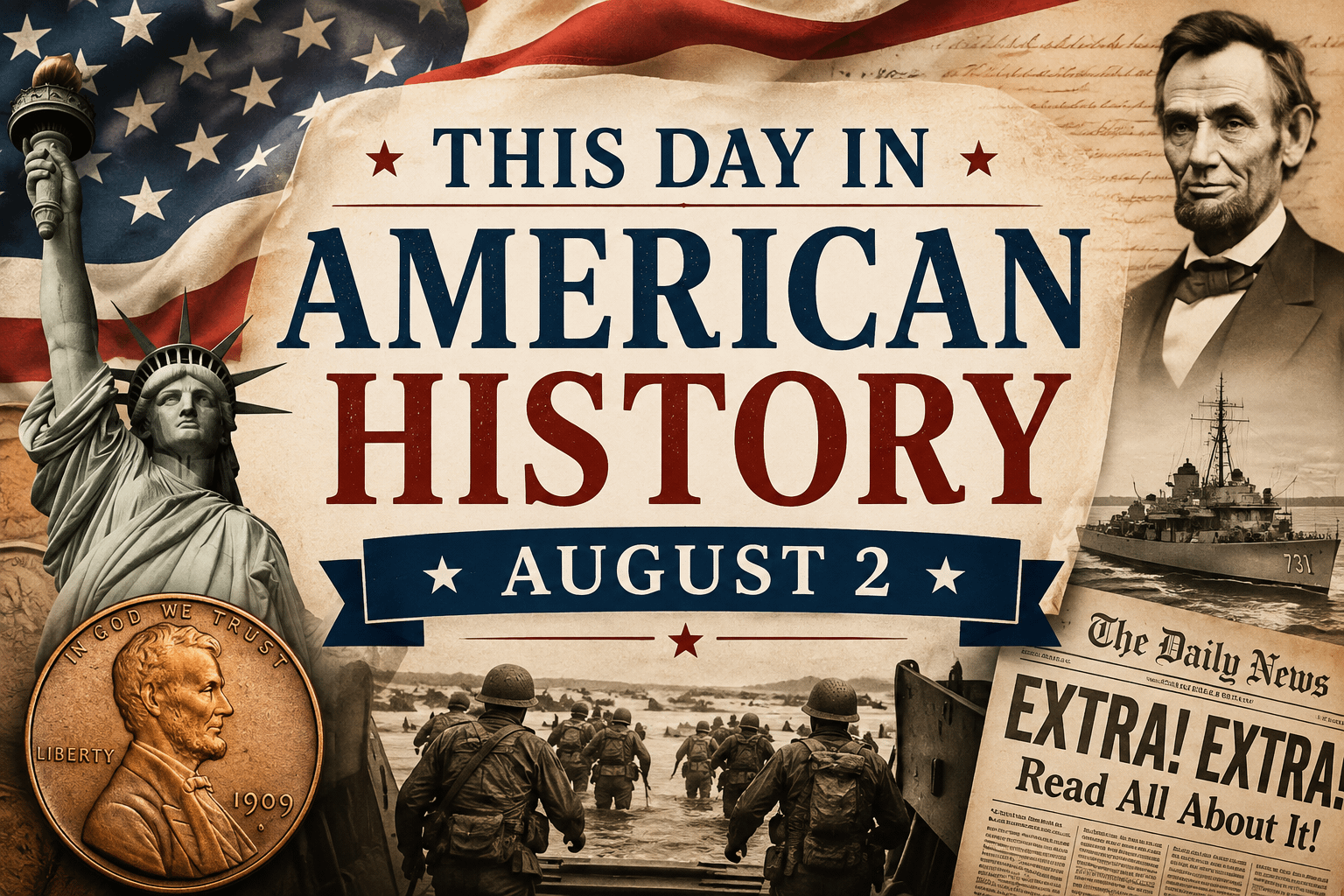
  • This Day in American History – August 2

    Advertisements

    History is more than a collection of dates and events—it is the story of people whose choices, discoveries, courage, and sacrifices shaped the nation we know today. Every day on the calendar offers an opportunity to reflect on moments that changed the course of American history, and August 2 is filled with events that span politics, science, military service, transportation, and the American frontier.

    From the nation’s very first census to acts of heroism during World War II, from the birth of one of America’s most recognizable coins to decisions that influenced international conflict, August 2 reminds us that history is often made through both ordinary government actions and extraordinary human courage.

    Let’s explore some of the most significant events that occurred on this day in American history.


    August 2, 1790 – The First United States Census Begins

    One of the most important responsibilities assigned by the U.S. Constitution officially began on August 2, 1790, when the first federal census was conducted.

    Following the nation’s independence, leaders understood that a growing country needed an accurate count of its people. Article I, Section 2 of the Constitution required that every resident be counted every ten years to determine representation in the House of Representatives and the distribution of federal taxes.

    At the time, the United States consisted of only thirteen states stretching along the Atlantic coast. Vast portions of what is now the Midwest and West had yet to become states.

    Federal marshals traveled on horseback, by wagon, and on foot to visit households individually. There were no computers, telephones, or digital records. Every response had to be written by hand.

    The census recorded approximately 3.9 million residents, including:

    • Free white males
    • Free white females
    • Other free persons
    • Enslaved individuals

    While today’s census reflects a much broader and more inclusive population count, the first census established an institution that continues to influence congressional representation, federal funding, community planning, emergency services, schools, hospitals, and transportation infrastructure.

    Every ten years, Americans continue participating in a tradition that began more than 230 years ago.


    August 2, 1876 – The Death of Wild Bill Hickok

    The American West lost one of its greatest legends when James Butler “Wild Bill” Hickok was shot and killed in Deadwood, Dakota Territory.

    Hickok had earned fame as a scout, lawman, gambler, Civil War veteran, and gunslinger. Stories of his remarkable shooting ability spread throughout newspapers and dime novels, making him one of the first celebrities of the American frontier.

    On the afternoon of August 2, Hickok entered Nuttal & Mann’s Saloon to play poker. Normally, he preferred sitting with his back against the wall, allowing him to watch the room. That day, the preferred seat was unavailable.

    Jack McCall approached Hickok from behind and shot him in the back of the head.

    According to legend, Hickok was holding two black aces and two black eights—a poker hand forever remembered as the Dead Man’s Hand.

    Although historians debate the exact cards he held, the story became deeply rooted in American folklore.

    Wild Bill Hickok’s life and death inspired countless Western novels, films, documentaries, and television series, helping shape America’s enduring fascination with the Old West.


    August 2, 1909 – The Lincoln Penny Is Released

    Few objects pass through American hands as often as the Lincoln penny.

    On August 2, 1909, the United States Mint officially released the new one-cent coin honoring President Abraham Lincoln.

    The release celebrated the 100th anniversary of Lincoln’s birth and marked a historic first for American currency. Until then, U.S. coins typically featured symbolic figures such as Lady Liberty rather than actual people.

    Designed by sculptor Victor David Brenner, the coin featured Lincoln’s profile on the front and two wheat stalks on the reverse.

    Americans immediately embraced the new design.

    Over the decades, the reverse side evolved from wheat ears to the Lincoln Memorial and later to the Union Shield, while Lincoln’s portrait remained.

    Today, billions of Lincoln cents have been produced, making it one of the most recognized and collected coins in U.S. history.


    August 2, 1923 – President Warren G. Harding Dies

    President Warren G. Harding, the 29th President of the United States, died unexpectedly on August 2, 1923, while traveling across the country.

    Harding had embarked on what became known as the “Voyage of Understanding,” hoping to reconnect with Americans after World War I and discuss national priorities.

    During a stop in San Francisco, Harding suddenly became ill and passed away at the age of 57.

    The nation was shocked.

    Because air travel was still in its infancy, news spread primarily through newspapers and radio bulletins.

    Vice President Calvin Coolidge, who was visiting his family in rural Vermont, learned of Harding’s death late that evening.

    In one of the most unusual presidential transitions in American history, Coolidge was sworn into office by his own father, John Calvin Coolidge Sr., a notary public.

    Coolidge would later win election in his own right and become one of the defining leaders of the Roaring Twenties.


    August 2, 1939 – Albert Einstein Signs a Historic Letter

    Although Albert Einstein was not an American citizen when he first arrived in the United States, his influence on American history became enormous.

    On August 2, 1939, Einstein signed a letter addressed to President Franklin D. Roosevelt.

    The letter warned that Nazi Germany might be capable of developing an atomic bomb using uranium.

    Physicists feared that if Adolf Hitler obtained such a weapon first, the consequences would be catastrophic.

    Einstein urged Roosevelt to support American research into nuclear physics.

    While Einstein himself did not participate in building the atomic bomb, his letter helped encourage the federal government to begin research that ultimately led to the Manhattan Project.

    The project transformed modern science, warfare, international diplomacy, and global politics for generations.

    Few letters in American history have had such far-reaching consequences.


    August 2, 1943 – The Heroism of PT-109

    One of the most remarkable stories of bravery during World War II occurred on August 2, 1943.

    Lieutenant John F. Kennedy, then serving in the U.S. Navy, commanded Patrol Torpedo Boat 109 (PT-109) in the Solomon Islands.

    During a nighttime mission, the Japanese destroyer Amagiri struck PT-109, cutting the small vessel in half.

    Two crew members were killed instantly.

    The remaining sailors found themselves stranded in dangerous waters surrounded by enemy forces.

    Despite suffering injuries himself, Kennedy refused to abandon his crew.

    He famously towed an injured sailor through the ocean by gripping the strap of the man’s life jacket with his teeth while swimming toward safety.

    For several days Kennedy and his surviving crew struggled to survive before finally being rescued.

    The story became national news after the war and played an important role in Kennedy’s rise to the presidency two decades later.

    His leadership under extraordinary circumstances remains one of the most celebrated military stories in American history.


    August 2, 1964 – The Gulf of Tonkin Incident

    On August 2, 1964, the destroyer USS Maddox encountered North Vietnamese patrol boats in the Gulf of Tonkin.

    The resulting confrontation became one of the most consequential military incidents of the twentieth century.

    Two days later, reports of a second attack—later the subject of significant historical debate—led Congress to pass the Gulf of Tonkin Resolution.

    The resolution granted President Lyndon B. Johnson broad authority to expand American military operations in Southeast Asia without a formal declaration of war.

    The conflict eventually grew into the Vietnam War as most Americans remember it, involving more than 2.7 million U.S. service members over the following years.

    Historians continue studying the incident because of its enormous political and military consequences.


    August 2, 1985 – Delta Flight 191 Changes Aviation Safety

    Modern aviation safety has often advanced because investigators carefully studied tragic accidents.

    On August 2, 1985, Delta Air Lines Flight 191 encountered a powerful microburst while approaching Dallas/Fort Worth International Airport.

    The sudden and intense downdraft caused the aircraft to lose altitude rapidly before crashing short of the runway.

    The accident claimed 137 lives.

    The tragedy prompted extensive research into wind shear and microbursts.

    As a result, airports installed advanced Doppler weather radar systems, airlines enhanced pilot training, and aircraft manufacturers improved warning technologies.

    Millions of airline passengers have benefited from the safety improvements that followed.

    The legacy of Flight 191 continues to save lives today.


    Other Notable August 2 Moments

    Throughout history, August 2 has also been associated with numerous milestones in American life, including:

    • Scientific advancements that influenced medicine and engineering.
    • Military operations that shaped global conflicts.
    • Political decisions affecting generations of Americans.
    • Cultural developments reflected in literature, film, sports, and entertainment.
    • Innovations in transportation that made travel safer and more efficient.

    Every generation adds new chapters to the story of America, making each August 2 another opportunity to contribute to history.


    Why Remember This Day?

    Studying daily history offers more than interesting trivia.

    It helps us understand:

    • How government institutions developed.
    • Why certain laws exist.
    • The sacrifices made by military service members.
    • The importance of scientific discovery.
    • Lessons learned through tragedy.
    • The courage displayed by ordinary people facing extraordinary circumstances.

    History provides perspective. It reminds us that today’s challenges will someday become tomorrow’s lessons.


    Final Thoughts

    August 2 reflects the remarkable diversity of the American story. On this date, Americans counted a young nation’s population for the first time, honored one of its greatest presidents on a coin that remains in circulation today, witnessed acts of extraordinary wartime courage, experienced moments that reshaped foreign policy, and learned difficult lessons that made aviation safer for future generations.

    Each event represents a different thread woven into the fabric of the United States. Some are stories of innovation. Others are tales of sacrifice, leadership, or resilience. Together, they remind us that history is never confined to the past—it continues to shape the present and inspire the future.

    As we remember August 2, we honor those who helped build, protect, and transform America. Their stories encourage us to appreciate our shared history and to consider how our own actions today may become part of tomorrow’s historical record.

    Read More History & Culture

  • History & Culture of the Day – August 1

    Advertisements

    History is more than a collection of dates—it is the story of humanity’s greatest achievements, hardest struggles, and most inspiring moments. Every day on the calendar carries events that have shaped nations, influenced cultures, and changed the course of civilization. August 1 is one of those remarkable days, marked by groundbreaking scientific discoveries, milestones in the fight for human freedom, moments of extraordinary courage, and cultural events that continue to influence our lives today.

    From the discovery of oxygen that revolutionized science to the launch of a television channel that forever changed the music industry, August 1 reminds us that a single day can alter history in ways people could never have imagined at the time.

    Let’s explore some of the most significant events that make August 1 an unforgettable chapter in world history.


    The Discovery That Changed Science Forever

    Joseph Priestley Isolates Oxygen (1774)

    One of the most important scientific breakthroughs in history occurred on August 1, 1774, when English chemist and theologian Joseph Priestley successfully isolated oxygen gas during an experiment.

    Using a magnifying glass to focus sunlight onto mercury oxide, Priestley collected a gas unlike anything he had previously encountered. He noticed that candles burned brighter in it and that mice survived longer when breathing it compared to ordinary air.

    Although Priestley called it “dephlogisticated air” because of the scientific theories of his day, later scientists—especially Antoine Lavoisier—recognized it as oxygen and correctly explained its role in combustion and respiration.

    The discovery transformed nearly every field of science, including:

    • Medicine
    • Biology
    • Chemistry
    • Environmental science
    • Aerospace research

    Today, oxygen supports everything from hospitals and scuba diving to space exploration and industrial manufacturing. One scientific experiment performed more than 250 years ago continues to influence billions of lives.


    A Monumental Step Toward Human Freedom

    Slavery Is Abolished Across the British Empire (1834)

    Perhaps the most historically significant event associated with August 1 occurred in 1834, when the Slavery Abolition Act officially came into effect across much of the British Empire.

    For centuries, millions of enslaved Africans had endured unimaginable suffering under the transatlantic slave trade. Families were separated, cultures were disrupted, and generations lived without freedom.

    Although some formerly enslaved people were forced into temporary “apprenticeship” systems before gaining full freedom, August 1 represented a monumental shift toward justice.

    Today, many nations—including Jamaica, Trinidad and Tobago, Barbados, Guyana, and others throughout the Caribbean—celebrate Emancipation Day each August 1.

    These celebrations often include:

    • Cultural festivals
    • Historical reenactments
    • Traditional music
    • Storytelling
    • Community gatherings
    • Educational programs
    • Ceremonies honoring ancestors

    Emancipation Day serves as both a remembrance of painful history and a celebration of resilience, courage, and the enduring pursuit of equality.


    Colorado Joins the United States

    The Centennial State Is Born (1876)

    On August 1, 1876, Colorado officially became the 38th state in the United States.

    The timing earned Colorado the nickname “The Centennial State,” because it entered the Union during America’s centennial year.

    Originally known for mining during the Gold Rush, Colorado eventually became famous for much more:

    • The Rocky Mountains
    • National parks
    • Ski resorts
    • Outdoor recreation
    • Ranching
    • Aerospace industries
    • Renewable energy
    • Technology innovation

    Today millions of visitors travel to Colorado each year to experience its breathtaking landscapes, making it one of America’s premier destinations for hiking, skiing, camping, and wildlife viewing.


    Europe Moves Toward World War

    Germany Declares War on Russia (1914)

    On August 1, 1914, tensions that had been building across Europe for years finally erupted when Germany declared war on Russia.

    Only days earlier, the assassination of Archduke Franz Ferdinand had triggered a diplomatic crisis among Europe’s powerful nations.

    Complex alliances quickly transformed what could have been a regional conflict into World War I, eventually involving dozens of countries across Europe, Africa, Asia, and the Middle East.

    The war introduced:

    • Modern trench warfare
    • Tanks
    • Chemical weapons
    • Military aviation
    • Massive industrial warfare

    More than 16 million people lost their lives before the conflict ended in 1918.

    The effects of World War I continue to influence international politics, borders, and diplomacy more than a century later.


    Extraordinary Courage During World War II

    The Warsaw Uprising Begins (1944)

    One of history’s most inspiring acts of resistance began on August 1, 1944, when thousands of members of the Polish Home Army launched the Warsaw Uprising against German occupation.

    Their goal was to liberate the city before Soviet forces arrived.

    For 63 days, resistance fighters—many of them young men and women with limited supplies—held off one of the world’s strongest military forces.

    Civilians also played remarkable roles by:

    • Delivering food
    • Carrying medical supplies
    • Constructing barricades
    • Providing intelligence
    • Sheltering resistance fighters

    Although the uprising ultimately failed militarily, it became an enduring symbol of patriotism, sacrifice, and the determination to fight for freedom regardless of the odds.

    Every year, Poland pauses at exactly 5:00 p.m. on August 1 to honor those who participated.


    MTV Revolutionizes Entertainment

    Music Videos Become a Global Phenomenon (1981)

    On August 1, 1981, television changed forever when MTV (Music Television) officially launched in the United States.

    Its first broadcast featured “Video Killed the Radio Star” by The Buggles—a fitting introduction to a new era in music.

    Before MTV, artists primarily relied on:

    • Radio
    • Concerts
    • Albums
    • Television variety shows

    MTV transformed musicians into visual storytellers.

    Music videos soon became major cultural events, helping launch or elevate the careers of artists including:

    • Michael Jackson
    • Madonna
    • Prince
    • Bon Jovi
    • Whitney Houston
    • Guns N’ Roses
    • Janet Jackson

    Michael Jackson’s Thriller became one of the most influential music videos ever produced, demonstrating that music videos could become artistic masterpieces rather than simple promotional tools.

    MTV also influenced fashion, language, youth culture, advertising, and eventually reality television.


    August 1 Around the World

    Many nations celebrate important observances on August 1.

    Emancipation Day

    Several Caribbean countries commemorate emancipation from slavery with parades, educational events, concerts, and cultural festivals celebrating African heritage.


    Swiss National Day

    Switzerland celebrates Swiss National Day on August 1, commemorating the founding of the Swiss Confederation in 1291.

    Communities celebrate with:

    • Fireworks
    • Bonfires
    • Traditional music
    • Speeches
    • Family gatherings
    • Local festivals

    The day emphasizes unity, independence, and centuries of Swiss history.


    Yorkshire Day

    In England, Yorkshire Day celebrates the history, traditions, and culture of Yorkshire.

    Residents celebrate with:

    • Local food
    • Historical ceremonies
    • Community festivals
    • Traditional music
    • Regional pride

    Famous People Born on August 1

    Throughout history, August 1 has welcomed influential people from many different fields.

    Yves Saint Laurent (1936)

    One of the greatest fashion designers in history, Yves Saint Laurent revolutionized haute couture by creating elegant styles that empowered women and influenced generations of designers.


    Jerry Garcia (1942)

    Best known as the lead guitarist and vocalist of the Grateful Dead, Garcia became one of the most influential musicians in American rock history.


    Coolio (1963)

    The Grammy Award-winning rapper achieved worldwide fame with the hit song “Gangsta’s Paradise,” one of the defining songs of the 1990s.


    Jason Momoa (1979)

    The actor has become internationally recognized through roles including Aquaman and Khal Drogo, earning acclaim for both film and television performances.


    Interesting Facts About August 1

    • August is named after Roman Emperor Augustus Caesar.
    • The Perseid meteor shower begins increasing in activity during early August.
    • Many ancient agricultural societies viewed early August as the beginning of harvest celebrations.
    • August often represents one of the busiest travel months worldwide.
    • Schools in many regions begin preparing for a new academic year during August.

    Why Preserving History Matters

    History is much more than remembering names and dates.

    It teaches us:

    • How scientific discoveries improve everyday life.
    • Why freedom should never be taken for granted.
    • The importance of standing against injustice.
    • How culture shapes identity.
    • The value of perseverance during difficult times.

    By understanding the past, we become better equipped to make thoughtful decisions for the future.


    Lessons We Can Learn from August 1

    The stories associated with August 1 share several powerful themes:

    Curiosity changes the world. Joseph Priestley’s experiments remind us that asking questions and exploring the unknown can lead to discoveries that benefit humanity for centuries.

    Freedom is worth pursuing. The abolition of slavery across the British Empire and the continued celebration of Emancipation Day demonstrate the enduring human desire for dignity, equality, and justice.

    Courage often comes with sacrifice. The Warsaw Uprising stands as a testament to ordinary people who risked everything for their country and their beliefs.

    Culture has lasting influence. From Swiss National Day traditions to MTV’s transformation of music and entertainment, cultural milestones shape how societies express themselves and connect across generations.


    Looking Back While Moving Forward

    August 1 reminds us that history is created one day at a time. Whether through scientific breakthroughs, the pursuit of freedom, acts of incredible bravery, or cultural innovations that redefine entertainment, today’s date reflects humanity’s remarkable ability to learn, adapt, and inspire.

    Every generation inherits the achievements and lessons of those who came before. By remembering the events of August 1, we honor the scientists who expanded our understanding of the world, the individuals who fought for justice and equality, the heroes who stood against oppression, and the creators whose work enriched our culture.

    As we write the next chapter of history, may these stories encourage us to value knowledge, protect freedom, celebrate diverse cultures, and leave a positive legacy for those who follow.

    History is not just about the past—it is a guide that helps illuminate the future.

    Read More History & Culture

  • This Day in American History – August 1

    Advertisements

    History is more than a collection of dates—it is the story of people, discoveries, struggles, and triumphs that continue to influence the nation today. Every day on the calendar carries moments that have helped define the United States, and August 1 is filled with events that showcase the country’s spirit of innovation, expansion, resilience, and cultural transformation.

    From the admission of a new state into the Union to scientific breakthroughs, military advancements, entertainment milestones, and lessons learned through tragedy, August 1 reminds us that history is constantly unfolding. Looking back on these events allows us to better understand where America has been and where it continues to go.

    Let’s explore some of the most significant moments that occurred on August 1 in American history.


    1774 – Joseph Priestley Discovers Oxygen

    On August 1, 1774, English scientist Joseph Priestley conducted an experiment that led to one of the greatest scientific discoveries in history—the isolation of oxygen gas.

    Using a burning glass to heat mercuric oxide, Priestley released a gas unlike any he had previously observed. Candles burned brighter in it, and laboratory mice lived longer when breathing it. Although Priestley did not fully understand oxygen’s role in respiration or combustion at the time, his work laid the foundation for modern chemistry.

    Years later, Priestley immigrated to the United States after facing religious persecution in England. He settled in Pennsylvania, where he continued his scientific research and became an influential figure among America’s early intellectuals.

    His work influenced generations of American scientists and educators, helping establish the nation’s growing appreciation for scientific inquiry.

    Today, oxygen remains central to nearly every field of science, medicine, and biology, making Priestley’s discovery one of history’s most important breakthroughs.


    1876 – Colorado Becomes the Centennial State

    One of the most celebrated events in American history occurred on August 1, 1876, when President Ulysses S. Grant signed legislation admitting Colorado as the 38th state.

    Colorado earned the nickname “The Centennial State” because it entered the Union exactly one hundred years after the signing of the Declaration of Independence in 1776.

    Why Colorado Was Important

    Colorado’s admission reflected America’s continued westward expansion following the Civil War. Rich mineral deposits, especially gold and silver, attracted thousands of settlers during the Colorado Gold Rush beginning in 1859.

    The state’s dramatic landscapes quickly became known throughout the country.

    Today Colorado is famous for:

    • Rocky Mountain National Park
    • Pikes Peak
    • Mesa Verde National Park
    • Ski resorts including Aspen, Vail, and Breckenridge
    • Outdoor recreation
    • Aerospace industries
    • Technology companies
    • Military installations

    Colorado has since become one of America’s fastest-growing states while maintaining its historic connection to exploration and the frontier spirit.


    1893 – Shredded Wheat Receives Its Patent

    Breakfast in America changed forever when inventor Henry Perky received a patent for the manufacturing process behind Shredded Wheat on August 1, 1893.

    Perky originally believed whole wheat could improve digestion and overall health. His innovative machinery transformed cooked wheat into thin strands before compressing them into biscuit-shaped servings.

    The cereal became one of America’s earliest health-focused breakfast foods.

    Shredded Wheat helped launch an entirely new food industry that eventually included brands such as:

    • Kellogg’s
    • Post
    • General Mills
    • Quaker

    Today breakfast cereal remains a multibillion-dollar industry with roots tracing back to inventions like Perky’s.


    1944 – The Warsaw Uprising Begins

    Although the Warsaw Uprising occurred in Nazi-occupied Poland, its significance reached far beyond Europe.

    On August 1, 1944, approximately 40,000 members of the Polish resistance launched an effort to free Warsaw before Soviet forces entered the city.

    The United States supported the resistance through dangerous long-range supply missions. American and Allied pilots flew hundreds of miles over hostile territory to deliver food, ammunition, medicine, and supplies.

    The uprising ultimately failed after more than two months of fighting, but it became one of the greatest symbols of courage during World War II.

    The sacrifices made by both Polish resistance fighters and Allied aircrews remain an important reminder of America’s role in supporting freedom around the world.


    1957 – NORAD Is Created

    The Cold War dramatically changed American defense strategy.

    On August 1, 1957, the United States and Canada officially established the North American Air Defense Command (NORAD).

    Its mission was to detect incoming bombers and missiles that could threaten North America.

    During the Cold War, NORAD became one of the world’s most sophisticated defense organizations by combining radar systems, fighter aircraft, satellites, and command centers into one coordinated defense network.

    Today NORAD continues to:

    • Monitor North American airspace
    • Detect missile launches
    • Coordinate aerospace defense
    • Track aircraft approaching U.S. and Canadian borders
    • Support national security missions

    Millions of families also recognize NORAD each December for its famous Santa Tracker, which began as a happy accident after a child mistakenly called a military operations center asking for Santa’s location.


    1981 – MTV Launches and Changes Entertainment Forever

    On August 1, 1981, a brand-new cable television channel forever changed American music and popular culture.

    MTV (Music Television) officially began broadcasting shortly after midnight.

    Its first words were:

    “Ladies and gentlemen, rock and roll.”

    The very first music video shown was:

    “Video Killed the Radio Star” by The Buggles.

    The timing proved symbolic, representing a new era in entertainment.

    Throughout the 1980s and 1990s MTV helped launch or expand the careers of artists including:

    • Michael Jackson
    • Madonna
    • Bon Jovi
    • Aerosmith
    • Guns N’ Roses
    • Britney Spears
    • Nirvana

    Music videos quickly became an essential part of the recording industry.

    MTV later expanded into reality television, news, documentaries, and award shows, becoming one of the most influential cable networks in American history.


    2007 – Interstate 35W Bridge Collapse

    One of the most tragic infrastructure failures in recent American history occurred on August 1, 2007.

    During the evening rush hour, the Interstate 35W bridge crossing the Mississippi River in Minneapolis, Minnesota, suddenly collapsed.

    More than one hundred vehicles fell into the river or onto the roadway below.

    The disaster claimed:

    • 13 lives
    • More than 140 injuries

    Investigators later determined that undersized steel gusset plates, combined with the weight of construction materials on the bridge, contributed to the collapse.

    The tragedy sparked nationwide inspections of thousands of aging bridges and accelerated discussions about investing in America’s transportation infrastructure.

    Many engineering standards and bridge inspection practices have since been strengthened because of lessons learned from this heartbreaking event.


    Famous Americans Born on August 1

    Several influential individuals celebrate birthdays on August 1.

    Jerry Garcia (1942)

    Best known as the lead guitarist and vocalist for the Grateful Dead, Jerry Garcia became one of the defining musicians of American rock history. His improvisational style and loyal fan base helped create one of music’s most enduring cultural movements.

    Coolio (1963)

    Grammy Award-winning rapper Coolio gained worldwide fame with “Gangsta’s Paradise,” one of the defining songs of the 1990s. His music helped bring hip-hop further into mainstream American culture.


    August 1 by the Numbers

    • 1774 – Oxygen isolated by Joseph Priestley
    • 1876 – Colorado becomes the 38th state
    • 1893 – Shredded Wheat patent awarded
    • 1944 – Warsaw Uprising begins
    • 1957 – NORAD officially established
    • 1981 – MTV launches
    • 2007 – Interstate 35W bridge collapses

    Why August 1 Still Matters

    Each of these events tells a different story about America.

    Scientific discoveries improve our understanding of the world.

    New states strengthen the nation.

    Military cooperation protects future generations.

    Entertainment shapes culture.

    Engineering tragedies inspire safer designs.

    Together these moments remind us that history is built from both extraordinary achievements and difficult lessons.

    As Americans continue writing new chapters in the nation’s story, remembering these milestones helps us appreciate the resilience, creativity, and determination that have defined the United States for centuries.


    Final Thoughts

    August 1 offers a remarkable snapshot of American history. From groundbreaking scientific discoveries and the admission of Colorado into the Union to the birth of modern music television and advancements in national defense, this date reflects the innovation and perseverance that have long characterized the United States.

    History connects us to those who came before us. It reminds us that every discovery, every decision, and every challenge leaves a legacy for future generations. Whether celebrating achievements, honoring sacrifices, or learning from tragedy, August 1 encourages us to reflect on the events that continue to shape our nation.

    As we remember these milestones, we also recognize that today’s actions will become tomorrow’s history. By learning from the past, we gain a greater appreciation for the freedoms, opportunities, and responsibilities that come with being part of the American story.

    Read More History & Culture

  • History & Culture of the Day – July 31

    Advertisements

    History is more than a timeline of dates—it is the story of humanity’s journey. Every day offers an opportunity to reflect on moments that changed nations, inspired innovation, sparked creativity, and influenced cultures around the globe. July 31 is one of those days, marked by groundbreaking achievements in space exploration, memorable moments in literature, significant historical events, and traditions that continue to unite communities.

    Whether you’re passionate about history, fascinated by science, or simply enjoy learning something new each day, July 31 reminds us that the past continues to shape our present and inspire our future.


    Apollo 15 and the First Drive on the Moon (1971)

    One of the greatest achievements associated with July 31 occurred in 1971, when NASA’s Apollo 15 astronauts David Scott and James Irwin became the first humans to drive a vehicle on another world.

    The Lunar Roving Vehicle (LRV), often called the “Moon Buggy,” represented a major leap forward in space exploration. Previous Apollo astronauts had been limited to walking relatively short distances from their lunar landers. The Lunar Rover expanded that range dramatically, allowing scientists to explore previously unreachable regions of the Moon.

    The rover traveled nearly 17 miles during the mission and enabled astronauts to collect approximately 170 pounds of lunar rocks and soil samples, many of which continue to be studied today.

    Why Apollo 15 Was Different

    Apollo 15 was considered the first of NASA’s “J Missions,” designed to maximize scientific exploration. The mission included:

    • Longer stays on the Moon
    • More scientific equipment
    • Greater travel distances
    • More extensive geological studies
    • Improved photography and mapping

    The success of Apollo 15 helped scientists better understand the Moon’s volcanic history, surface composition, and geological evolution.

    Today, modern lunar exploration programs—including NASA’s Artemis missions—continue to build upon the discoveries made during Apollo 15.


    Harry Potter’s Birthday: A Global Celebration of Imagination

    For millions of readers, July 31 is instantly recognizable as the birthday of Harry Potter, the beloved wizard created by author J.K. Rowling.

    Interestingly, Rowling chose to give Harry the same birthday she shares herself.

    Since the first novel debuted in 1997, the Harry Potter series has become one of the most successful literary franchises in history.

    The books have:

    • Sold more than 600 million copies worldwide.
    • Been translated into over 80 languages.
    • Inspired eight blockbuster films.
    • Created award-winning stage productions.
    • Led to theme parks on multiple continents.
    • Sparked fan conventions around the world.

    Every July 31, libraries, bookstores, schools, and fans celebrate with costume contests, reading marathons, trivia competitions, themed parties, and charitable events that encourage literacy.

    More Than Magic

    While the stories center around witches and wizards, the series resonates because of its universal themes:

    • Friendship
    • Courage
    • Loyalty
    • Sacrifice
    • Love
    • Choosing kindness over hatred
    • Standing up against injustice

    The books have encouraged countless young readers to discover a lifelong love of literature.


    The End of July: A Time of Transition

    Throughout history, the final day of July has symbolized transition.

    In many countries, July 31 marks the closing chapter of summer before schools reopen in August or early September. Families begin shifting from vacations and outdoor adventures toward classrooms, sports seasons, and new routines.

    This seasonal transition has become its own cultural tradition.

    Many families spend the day:

    • Shopping for school supplies
    • Planning family dinners
    • Taking final summer trips
    • Visiting amusement parks
    • Hosting neighborhood barbecues
    • Enjoying one last beach outing

    These traditions create lasting memories while preparing children for a new academic year.


    County Fairs and Agricultural Traditions

    Across North America, late July represents the height of county fair season.

    Agricultural fairs have existed for more than two centuries, originally serving as gatherings where farmers exchanged knowledge about livestock, crops, and farming techniques.

    Today, county fairs celebrate both agriculture and community through:

    • Livestock competitions
    • Homegrown produce displays
    • Local crafts
    • Carnival rides
    • Concerts
    • Rodeos
    • Pie contests
    • Classic car shows

    These events preserve rural traditions while bringing together people of all ages.

    Many families have attended the same county fairs for generations, making them an important part of local culture.


    Milwaukee’s Brewing Heritage

    July often highlights the rich brewing traditions that helped shape Milwaukee, Wisconsin, into one of America’s most famous beer cities.

    During the late nineteenth century, German immigrants transformed Milwaukee into a brewing powerhouse.

    Companies such as Schlitz, Pabst, Miller, and Blatz became household names while employing thousands of workers.

    The brewing industry influenced nearly every aspect of Milwaukee’s development:

    • Economic growth
    • Immigration
    • Architecture
    • Transportation
    • Community festivals
    • Culinary traditions

    Even today, brewery tours and beer gardens remain major attractions that celebrate this historic heritage.


    Summer Festivals Around the World

    The final days of July are among the busiest festival periods of the year.

    Communities worldwide celebrate culture through music, food, dance, and local traditions.

    Popular celebrations during this season often include:

    Music Festivals

    Outdoor concerts bring together internationally known artists and local performers, creating memorable summer experiences.

    Food Festivals

    Communities showcase regional specialties while supporting local farms and restaurants.

    Art Festivals

    Artists display paintings, sculptures, photography, and handcrafted goods, encouraging creativity and cultural appreciation.

    Cultural Heritage Events

    Many cities celebrate their immigrant communities through traditional music, dance performances, clothing, and cuisine.

    These festivals strengthen community bonds while preserving traditions passed down through generations.


    The Importance of Storytelling

    History survives because people tell stories.

    Whether passed through books, museums, documentaries, oral traditions, or family conversations, storytelling connects us with previous generations.

    Stories teach us:

    • Where we came from.
    • What previous generations experienced.
    • How societies overcame challenges.
    • Why traditions matter.
    • How innovation changes the world.

    Without storytellers, many remarkable achievements would be forgotten.


    Innovation That Changed Daily Life

    The twentieth century saw enormous technological progress, and many breakthroughs reached the public during the busy summer months.

    Advances in transportation, communication, medicine, and computing transformed everyday life.

    Consider how dramatically life has changed in just a few generations:

    • Air travel became common.
    • Personal computers entered homes.
    • The internet connected the globe.
    • Smartphones placed information in every pocket.
    • GPS navigation changed how we travel.
    • Space exploration expanded our understanding of the universe.

    Each innovation built upon the work of earlier pioneers.


    Why Space Exploration Still Matters

    The Apollo missions were about more than reaching the Moon.

    They inspired advances in:

    • Engineering
    • Telecommunications
    • Computer technology
    • Medical equipment
    • Materials science
    • Satellite communications

    Many everyday technologies trace their origins to research conducted during the Space Race.

    Even decades later, images of astronauts driving across the Moon continue to inspire children to dream about careers in science, engineering, and exploration.


    Books That Shape Generations

    Literature has always played an important role in culture.

    Certain books transcend entertainment and become cultural landmarks.

    Stories like Harry Potter encourage readers to imagine new possibilities while exploring timeless human values.

    Libraries around the world often use July 31 to promote literacy initiatives because reading helps develop:

    • Critical thinking
    • Creativity
    • Empathy
    • Vocabulary
    • Lifelong learning

    A single book can inspire someone to become a scientist, teacher, artist, writer, or explorer.


    Preserving Our Shared Heritage

    Museums, historical societies, archives, and cultural organizations work tirelessly to preserve artifacts that tell humanity’s story.

    Everything from ancient manuscripts to spacecraft, family photographs, and historical buildings helps future generations understand where they came from.

    Preservation reminds us that history belongs to everyone—not just historians.

    Every family has stories worth remembering.

    Every community has traditions worth celebrating.

    Every generation contributes another chapter to humanity’s ongoing story.


    Lessons We Can Learn from July 31

    Reflecting on July 31 offers several meaningful lessons:

    • Curiosity leads to discovery.
    • Innovation changes the future.
    • Stories inspire generations.
    • Communities grow stronger through shared traditions.
    • Education opens new possibilities.
    • Preserving history helps shape tomorrow.

    These lessons remain just as relevant today as they were decades ago.


    Looking Toward the Future

    History is constantly being written.

    Tomorrow’s historians will study today’s discoveries, inventions, cultural movements, and acts of kindness just as we examine the achievements of previous generations.

    Each of us contributes to history through the choices we make, the people we help, and the legacy we leave behind.

    Whether inspiring others, preserving family traditions, exploring new ideas, or simply learning something new each day, we all play a role in shaping the future.


    Final Thoughts

    July 31 is a remarkable day that celebrates human achievement, imagination, and cultural heritage. From the historic drive across the Moon during Apollo 15 to the worldwide celebration of Harry Potter’s birthday, this day reminds us that exploration and creativity have the power to change the world.

    It also highlights the importance of community traditions, education, storytelling, and preserving our shared history. Every milestone—whether a scientific breakthrough, a beloved book, or a cherished local festival—adds another thread to the rich tapestry of human culture.

    As we commemorate July 31, let it inspire us to remain curious, honor the past, embrace the present, and look toward the future with optimism. History is not only something we study—it is something we create every single day.

    Read More History & Culture

  • This Day in American History – July 31

    Advertisements

    American history is filled with defining moments that have shaped the nation we know today. Some dates are remembered for a single monumental event, while others showcase a collection of milestones that reflect the country’s spirit of courage, innovation, perseverance, and progress. July 31 is one of those remarkable days.

    From the arrival of a young French aristocrat who would help secure American independence to the first U.S. patent, groundbreaking achievements in space exploration, and one of the nation’s greatest unsolved mysteries, July 31 reminds us that history is built through the actions of ordinary and extraordinary people alike.

    Let’s explore some of the most significant events that occurred on this day in American history.


    1777 – Marquis de Lafayette Joins the Fight for American Independence

    One of the most important foreign allies in American history officially joined the Continental Army on July 31, 1777.

    At only 19 years old, Marquis de Lafayette, a wealthy French nobleman, volunteered his military service to the struggling American colonies. Remarkably, he refused a salary and accepted the rank of major general without pay.

    Lafayette believed deeply in the ideals of liberty and self-government. Although France had not yet officially entered the Revolutionary War, he secretly sailed across the Atlantic despite orders from King Louis XVI to stay home.

    General George Washington quickly recognized Lafayette’s intelligence, bravery, and loyalty. Their friendship became one of the defining relationships of the American Revolution.

    Lafayette fought courageously in several major battles, including:

    • Brandywine
    • Monmouth
    • Yorktown

    Perhaps his greatest contribution came off the battlefield. Through his influence in France, Lafayette helped convince the French government to provide troops, naval support, weapons, and financial assistance that proved essential to America’s victory over Great Britain.

    Today, Lafayette remains one of the few foreign-born individuals honored as an honorary U.S. citizen, and communities across America proudly bear his name.


    1790 – America Issues Its First Patent

    Innovation has always been at the heart of the American dream.

    On July 31, 1790, the United States granted its very first patent to Samuel Hopkins of Vermont.

    The patent covered a new process for producing potash and pearl ash, materials widely used in making:

    • Soap
    • Glass
    • Fertilizer
    • Industrial chemicals

    What made this patent especially historic was that it bore the signatures of:

    • President George Washington
    • Secretary of State Thomas Jefferson
    • Attorney General Edmund Randolph

    In the nation’s earliest years, these leaders personally reviewed patent applications before approval.

    Although Hopkins’ invention may sound modest today, the creation of the U.S. patent system laid the groundwork for centuries of American innovation.

    Since that first patent, the United States has issued millions of patents covering inventions ranging from the telephone and airplane to lifesaving medicines, computers, smartphones, renewable energy technologies, and artificial intelligence.

    America’s culture of invention began with this simple but historic document.


    1946 – Norma Jean Signs Her First Movie Contract

    On July 31, 1946, a young model named Norma Jean Dougherty signed her first movie contract with 20th Century Fox.

    She earned just $150 per week, but few could have imagined that she would soon become one of the most recognizable women in history.

    The studio encouraged her to adopt a new stage name:

    Marilyn Monroe

    Throughout the 1950s, Monroe became a global icon through films including:

    • Gentlemen Prefer Blondes
    • How to Marry a Millionaire
    • The Seven Year Itch
    • Some Like It Hot

    Her influence extended far beyond Hollywood.

    Marilyn Monroe helped shape:

    • American fashion
    • Popular culture
    • Advertising
    • Photography
    • Entertainment marketing

    Even decades after her passing, she remains one of the most recognizable symbols of American cinema.


    1964 – Ranger 7 Changes Space Exploration Forever

    The 1960s were defined by America’s race to reach the Moon.

    One major breakthrough occurred on July 31, 1964, when NASA’s Ranger 7 spacecraft successfully completed its mission.

    Unlike previous lunar probes that had failed, Ranger 7 transmitted more than 4,300 close-up photographs of the Moon before intentionally crashing into its surface.

    These detailed images allowed scientists to study:

    • Craters
    • Rocks
    • Surface texture
    • Potential landing sites

    The success of Ranger 7 restored confidence in America’s lunar exploration program after years of disappointing failures.

    The information gathered directly supported planning for the Apollo missions.

    Only five years later, astronauts Neil Armstrong and Buzz Aldrin would safely land on the Moon—a milestone made possible in part by Ranger 7’s groundbreaking work.


    1975 – Jimmy Hoffa Vanishes Without a Trace

    Few mysteries have captured the American imagination like the disappearance of Jimmy Hoffa.

    On July 31, 1975, Hoffa was scheduled to meet several associates at a restaurant near Detroit, Michigan.

    He never returned.

    Hoffa had served as president of the International Brotherhood of Teamsters, one of America’s largest labor unions. He was both admired for fighting for workers’ rights and criticized for alleged ties to organized crime.

    When he disappeared, the nation became fascinated.

    Over the decades, investigators searched:

    • Farms
    • Warehouses
    • Rivers
    • Backyards
    • Empty buildings
    • Stadium construction sites

    Countless theories have suggested what happened, but no definitive answers have ever emerged.

    In 1982, Hoffa was legally declared dead, yet the mystery continues to inspire documentaries, books, films, podcasts, and television specials.

    His disappearance remains one of the greatest unsolved cases in American criminal history.


    1991 – START I Marks a Turning Point in the Cold War

    Although the Cold War was nearing its end, the United States and the Soviet Union still possessed enormous nuclear arsenals.

    On July 31, 1991, President George H. W. Bush and Soviet President Mikhail Gorbachev signed the Strategic Arms Reduction Treaty (START I).

    The agreement required both nations to dramatically reduce:

    • Long-range nuclear missiles
    • Strategic bombers
    • Nuclear warheads
    • Delivery systems

    It became the largest nuclear arms reduction agreement ever negotiated.

    START I represented far more than military policy.

    It symbolized growing trust between former adversaries and demonstrated that diplomacy could reduce the threat of nuclear conflict.

    Many historians view the treaty as one of the defining achievements that helped close the Cold War era.


    Other Interesting Events on July 31

    Throughout history, July 31 has also witnessed several other noteworthy moments:

    1961 – Mercury Astronaut Training Advances

    NASA continued preparing America’s first astronauts for human spaceflight, conducting extensive testing that would soon lead to the Mercury missions.

    1987 – The Last Ford Model A Club Gathering

    Collectors and automotive enthusiasts celebrated one of America’s most beloved classic automobiles, highlighting the nation’s enduring automotive heritage.

    Baseball History

    Throughout Major League Baseball history, numerous milestone home runs, no-hitters, Hall of Fame performances, and memorable pennant races have unfolded on July 31 as teams pushed toward postseason competition.


    The Lasting Legacy of July 31

    When viewed together, the events of July 31 reveal recurring themes that define the American experience.

    Courage

    Lafayette risked everything to fight for freedom in a country that was not his own.

    Innovation

    Samuel Hopkins’ patent marked the beginning of a system that continues to reward creativity and invention.

    Creativity

    Marilyn Monroe became a cultural icon whose influence stretched beyond movies into fashion, photography, and popular culture.

    Exploration

    NASA’s Ranger 7 mission brought humanity one step closer to walking on the Moon.

    Justice and Mystery

    Jimmy Hoffa’s disappearance reminds us that even in modern America, some questions remain unanswered.

    Peace Through Diplomacy

    The START Treaty demonstrated that negotiation can be as powerful as military strength in shaping world history.


    Why Learning History Matters

    History connects us to the people who came before us. Every invention, battle, discovery, and decision has contributed to the freedoms, opportunities, and challenges we experience today.

    Studying history helps us:

    • Understand how America has evolved.
    • Appreciate the sacrifices made for liberty.
    • Learn from past successes and mistakes.
    • Recognize the importance of innovation and leadership.
    • Inspire future generations to build upon the achievements of those who came before them.

    Every day on the calendar offers lessons worth remembering, and July 31 is filled with stories that continue to influence our nation.

    Final Thoughts

    July 31 may not be as widely recognized as Independence Day or Constitution Day, but its historical significance is undeniable. From a young French volunteer who became one of America’s greatest heroes to the birth of the U.S. patent system, from Hollywood legends to lunar exploration, and from Cold War diplomacy to enduring mysteries, this day reflects the diverse threads that weave together the American story.

    As we remember these milestones, we gain a deeper appreciation for the individuals whose vision, courage, and determination helped shape the United States. History is not simply about looking backward—it is about understanding how the past continues to influence our present and inspire our future.

    Read More History & Culture

Exit mobile version