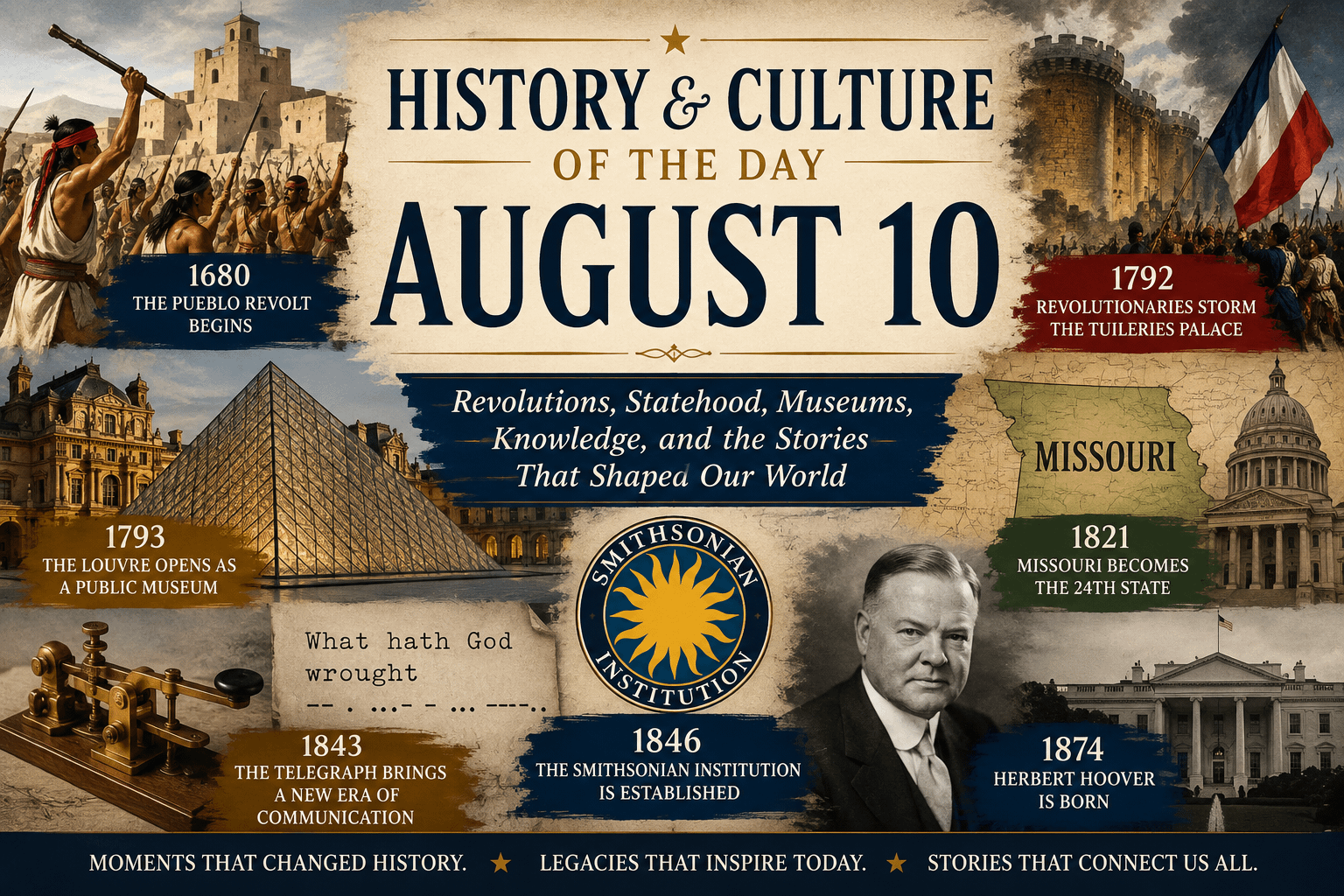
Category: History & Culture

  • History & Culture of the Day – August 10

    History & Culture of the Day – August 10

    Advertisements

    Every day on the calendar carries echoes of the past. Some dates are remembered for battles and revolutions. Others mark scientific breakthroughs, cultural achievements, political turning points, famous births, or the creation of institutions that continue to influence our lives generations later.

    August 10 is one of those dates where history reaches across centuries and continents.

    On August 10, Indigenous peoples in the American Southwest launched one of the most successful uprisings against European colonial rule in North American history. Missouri officially became a state. Revolutionaries in France attacked the royal palace and helped bring down a centuries-old monarchy. The Louvre opened its doors as a public museum. The Smithsonian Institution was established in the United States with a mission centered on spreading knowledge.

    August 10 also connects us to presidents, actors, athletes, artists, inventors, and countless ordinary people whose lives contributed to the larger story of humanity.

    When we explore the history and culture surrounding August 10, we discover something important: history is not simply a collection of dates. It is the ongoing story of people trying to build, survive, create, resist, discover, govern, communicate, and understand the world around them.

    Let’s travel through some of the remarkable moments associated with August 10.

    1680 – The Pueblo Revolt Begins

    One of the most significant events in the history of the American Southwest began on August 10, 1680, when Pueblo peoples launched a coordinated uprising against Spanish colonial rule in present-day New Mexico.

    The uprising became known as the Pueblo Revolt.

    Spanish colonization of the region had brought enormous changes to Indigenous communities. Spanish officials and missionaries attempted to reshape Pueblo political, economic, and religious life.

    Traditional religious practices were often suppressed, while Indigenous communities faced demands for labor and resources.

    Over time, resentment grew.

    A Tewa religious leader known as Po’pay, from Ohkay Owingeh, became one of the central organizers of the resistance.

    Coordinating an uprising among communities separated by considerable distances was an extraordinary challenge in the 17th century. According to historical accounts, messengers traveled between Pueblo communities carrying knotted cords. Each day, another knot could be untied as communities counted down toward the planned uprising.

    The revolt began on August 10.

    Pueblo fighters attacked Spanish settlements and missions throughout the region. After days of fighting, Spanish colonists retreated from Santa Fe and eventually withdrew southward.

    For approximately twelve years, much of the region remained outside Spanish control.

    Spanish forces reconquered Santa Fe in 1692, but relations between colonial authorities and Pueblo communities changed afterward.

    The Pueblo Revolt remains historically significant because it represents one of the most successful Indigenous uprisings against European colonial authority in what became the United States.

    Its importance extends beyond military history.

    It is also a story about cultural survival.

    Pueblo peoples were defending communities, traditions, religious practices, identities, and ways of life that had existed long before European colonization.

    That makes August 10 an important date not only in American history but also in the history of Indigenous resistance and cultural preservation.

    1792 – Revolutionaries Storm the Tuileries Palace

    More than a century later, August 10 became associated with another dramatic uprising—this time in France.

    On August 10, 1792, revolutionary forces attacked the Tuileries Palace in Paris, where King Louis XVI and the royal family were residing.

    The event became known as the Insurrection of August 10.

    The French Revolution had begun in 1789 amid deep economic and political problems.

    France faced enormous debt.

    Food prices were high.

    Many ordinary citizens struggled with poverty and hunger.

    Meanwhile, the country’s social structure granted significant privileges to the monarchy, aristocracy, and clergy.

    Calls for political reform became increasingly powerful.

    The revolution initially attempted to create a constitutional monarchy, but trust in King Louis XVI deteriorated dramatically.

    His attempted escape from France in 1791 intensified suspicions that the king opposed the revolution and hoped foreign powers would restore his authority.

    By the summer of 1792, tensions had reached a breaking point.

    Revolutionary groups and armed citizens moved against the Tuileries Palace.

    Fierce fighting erupted.

    The royal family sought refuge with the Legislative Assembly, and the king’s authority was soon suspended.

    The event effectively ended the monarchy’s political power.

    In September 1792, France officially abolished the monarchy and established a republic.

    Louis XVI was later placed on trial and executed in January 1793.

    Marie Antoinette was executed later that year.

    Why the August 10 Insurrection Matters

    The attack on the Tuileries represented more than the fall of a king.

    It demonstrated how quickly political systems that appear permanent can collapse when public confidence disappears.

    For generations, the French monarchy had seemed inseparable from the nation itself.

    Yet revolutionary ideas about citizenship, equality, representation, and popular sovereignty fundamentally challenged that assumption.

    Those ideas would influence political movements far beyond France.

    The French Revolution remains one of history’s most studied examples of both the possibilities and dangers of revolutionary change.

    Ideas of liberty and equality emerged alongside political violence, executions, warfare, and instability.

    August 10, 1792 stands near the center of that complicated story.

    1793 – The Louvre Opens as a Public Museum

    Exactly one year after the attack on the Tuileries Palace, another event took place in Paris that would leave a very different cultural legacy.

    On August 10, 1793, the Louvre opened as a public museum.

    Today, the Louvre is one of the most recognizable cultural institutions in the world.

    But its history stretches back centuries before it became a museum.

    The site originally contained a medieval fortress constructed during the reign of King Philip II. Over generations, the complex was expanded and transformed into a royal palace.

    French monarchs accumulated extensive collections of paintings, sculptures, decorative objects, and other treasures.

    The French Revolution dramatically changed the idea of who should have access to those collections.

    Instead of art belonging primarily to kings and aristocrats, revolutionaries promoted the idea that great works should become part of the nation’s cultural heritage.

    When the museum opened in 1793, members of the public gained access to collections that had once been associated with royal privilege.

    Over the following centuries, the Louvre’s collection expanded enormously.

    Today, the museum is famous for works including:

    • Leonardo da Vinci’s Mona Lisa
    • The ancient Greek sculpture Venus de Milo
    • The Winged Victory of Samothrace
    • Ancient Egyptian artifacts
    • Renaissance paintings
    • Classical sculptures
    • Decorative arts
    • Historical objects representing civilizations from around the world

    The Louvre’s transformation from royal palace to public museum represented a major cultural shift.

    Art was increasingly viewed not simply as private property or royal decoration, but as something capable of educating and inspiring the public.

    Millions of people now visit the museum each year, while millions more encounter its collections through books, documentaries, classrooms, and digital resources.

    1821 – Missouri Becomes the 24th State

    On August 10, 1821, Missouri officially entered the United States as the 24th state.

    Missouri’s admission was not a simple matter of adding another star to the American flag.

    It became part of one of the nation’s growing political conflicts: whether slavery would expand into new states and territories.

    As the United States expanded westward, the political balance between free states and slave states became increasingly important.

    When Missouri sought admission as a state where slavery would be permitted, a national debate erupted.

    The resulting agreement became known as the Missouri Compromise.

    Under the compromise, Maine entered the Union as a free state while Missouri was admitted as a slave state, helping maintain a temporary balance in the Senate.

    The compromise also attempted to establish geographic restrictions concerning slavery in portions of the Louisiana Purchase territory.

    For a time, the agreement reduced political tensions.

    But it did not solve the underlying problem.

    The question of slavery’s expansion returned repeatedly over the following decades.

    Eventually, compromises could no longer hold the country together.

    The United States descended into the Civil War in 1861.

    Missouri’s Unique Role in American History

    Missouri’s geographic position gave it enormous historical importance.

    It became known as a gateway to western expansion.

    Explorers, traders, settlers, soldiers, and migrants traveled through Missouri on their journeys westward.

    St. Louis became especially important as a transportation and commercial center along the Mississippi River.

    During the Civil War, Missouri’s position became even more complicated.

    Although Missouri remained in the Union, the state contained strong Unionist and Confederate sympathies.

    Communities and even families could find themselves divided by the conflict.

    Today, August 10 is remembered as Missouri Statehood Day, recognizing the state’s entry into the Union.

    1846 – The Smithsonian Institution Is Established

    One of America’s most important cultural and educational institutions was formally established on August 10, 1846.

    President James K. Polk signed legislation creating the Smithsonian Institution.

    The story behind the Smithsonian is one of the most unusual stories in American cultural history.

    A British scientist named James Smithson died in 1829.

    In his will, Smithson left his fortune to the United States for the creation of an institution devoted to the increase and diffusion of knowledge.

    There was one especially curious detail:

    Smithson had never visited the United States.

    Why he selected the United States for his extraordinary gift remains a subject of historical interest.

    The inheritance eventually arrived in America, but Congress spent years debating what kind of institution should be created.

    Should it become a university?

    A research institution?

    A library?

    A museum?

    Eventually, Congress created an institution that incorporated several educational and scientific purposes.

    The Smithsonian Institution was officially established in 1846.

    From One Gift to an American Cultural Treasure

    The Smithsonian grew far beyond what anyone in the 1840s could have imagined.

    Its museums and research facilities preserve artifacts covering an enormous range of human knowledge.

    Visitors can encounter objects connected with:

    American history.

    Natural history.

    Aviation and space exploration.

    Science and technology.

    Art and design.

    African American history and culture.

    Native American history and culture.

    World civilizations.

    Among the extraordinary objects preserved within Smithsonian collections are artifacts associated with defining moments of American history and scientific achievement.

    One of the most famous is the enormous American flag that inspired Francis Scott Key to write the words that became “The Star-Spangled Banner.”

    Another is the 1903 Wright Flyer, connected with the Wright brothers’ pioneering powered flight.

    The Smithsonian also preserves objects associated with American presidents, military history, popular entertainment, technological innovation, transportation, exploration, and everyday life.

    An object does not necessarily need to be made of gold or belong to a president to have historical value.

    Sometimes ordinary objects tell extraordinary stories.

    A lunchbox, uniform, photograph, musical instrument, protest sign, family possession, or piece of machinery can reveal how people lived during another era.

    That is one of the Smithsonian’s greatest cultural contributions.

    It preserves pieces of America’s collective memory.

    1874 – Herbert Hoover Is Born

    Future U.S. President Herbert Hoover was born on August 10, 1874, in West Branch, Iowa.

    Hoover’s presidency would eventually become inseparable from one of the darkest economic periods in American history—the Great Depression.

    But his life before becoming president was remarkable in its own right.

    Hoover trained as a mining engineer and worked internationally.

    He later became widely known for humanitarian relief efforts.

    During World War I, he helped organize efforts to provide food to civilians facing severe shortages.

    His administrative reputation eventually helped propel him into national politics.

    Hoover served as U.S. Secretary of Commerce before winning the presidential election of 1928.

    He took office in March 1929.

    Only months later, the American stock market experienced its devastating crash.

    The crash was followed by widespread bank failures, unemployment, business closures, homelessness, and economic hardship.

    The Great Depression became the defining issue of Hoover’s presidency.

    Many Americans believed the federal government’s response was inadequate.

    In 1932, Hoover lost his reelection campaign to Franklin D. Roosevelt.

    Despite the political damage to his reputation, Hoover lived for decades after leaving office and continued participating in public affairs and humanitarian work.

    His life illustrates how historical reputations can be complicated.

    A person may be remembered primarily for one crisis even though their life and career included many other achievements and failures.

    1921 – Franklin D. Roosevelt’s Battle With Paralytic Illness

    August 1921 was a life-changing period for future president Franklin D. Roosevelt.

    While vacationing at Campobello Island, Roosevelt became seriously ill and experienced paralysis.

    He was eventually diagnosed with poliomyelitis at the time, though later researchers have debated the precise diagnosis.

    Roosevelt’s struggle with paralysis dramatically changed his personal and political life.

    He underwent years of rehabilitation and worked intensely to regain strength.

    Rather than ending his political career, Roosevelt eventually returned to public life.

    He became governor of New York and later the 32nd president of the United States.

    Elected in 1932 during the Great Depression, Roosevelt would serve more than twelve years as president and lead the country through both the Depression and most of World War II.

    His experience with disability became an important part of his personal story, even though the extent of his paralysis was often carefully managed in public appearances.

    August 10 in Entertainment and Popular Culture

    History is not created only in government buildings, battlefields, and laboratories.

    Culture is also shaped on movie screens, theater stages, concert halls, television sets, sports arenas, and eventually digital platforms.

    Several notable figures associated with entertainment and popular culture were born on August 10.

    Antonio Banderas – Born in 1960

    Spanish actor Antonio Banderas was born on August 10, 1960, in Málaga, Spain.

    Banderas became internationally recognized through a career spanning Spanish cinema, Hollywood movies, theater, voice acting, and musical performance.

    His international success also reflected the increasingly global nature of entertainment during the late 20th and early 21st centuries.

    Audiences were becoming more accustomed to actors, filmmakers, musicians, and stories crossing national and linguistic boundaries.

    Rosanna Arquette – Born in 1959

    American actress Rosanna Arquette was born on August 10, 1959.

    Her career has included roles across film and television and places her among a well-known family of performers who became part of American popular culture.

    Actors and filmmakers do more than entertain audiences.

    Movies and television programs frequently become cultural time capsules.

    Fashion, language, technology, social attitudes, music, architecture, and everyday behavior captured on screen can later help us understand the era in which a production was created.

    Museums Are More Than Buildings Filled With Old Things

    Two major August 10 anniversaries—the opening of the Louvre and establishment of the Smithsonian—invite us to consider why museums matter.

    A museum can preserve things that might otherwise disappear.

    Imagine how much history would be lost if nobody preserved photographs, documents, clothing, artwork, tools, machinery, letters, household objects, recordings, or personal possessions.

    Museums help societies maintain a physical connection to the past.

    Standing near an object created hundreds or thousands of years ago can make history feel remarkably immediate.

    You are no longer simply reading about another time.

    You are looking at something that survived it.

    Museums also help tell stories that previous generations sometimes ignored.

    Modern institutions increasingly work to include perspectives from Indigenous communities, enslaved people, immigrants, workers, women, minority communities, and ordinary families whose experiences were historically underrepresented.

    Preserving history is therefore not only about protecting objects.

    It is also about asking:

    Whose story is being remembered?

    Whose story has been forgotten?

    Who gets to decide what deserves preservation?

    Those questions continue to influence museums and cultural institutions today.

    The Importance of Preserving Cultural Heritage

    Culture can disappear surprisingly quickly.

    Languages can fade.

    Historic buildings can be destroyed.

    Family photographs can be lost.

    Traditional recipes can vanish when nobody writes them down.

    Songs can disappear when nobody teaches them to another generation.

    Stories can be forgotten when the people who remember them are gone.

    Preserving cultural heritage does not mean refusing to change.

    Instead, it means maintaining a connection between past, present, and future.

    Sometimes cultural preservation happens inside enormous institutions such as the Louvre or Smithsonian.

    But it also happens inside ordinary homes.

    Every time someone saves a grandparent’s photograph, records a family story, prepares a traditional recipe, researches their ancestry, visits a historic site, or teaches a child about where their family came from, they are participating in cultural preservation.

    Technology Changed How We Experience History

    For most of human history, experiencing distant cultural treasures required physically traveling to them.

    Today, technology has dramatically changed access to history.

    A person sitting thousands of miles away can explore digitized museum collections.

    Historic newspapers can be searched online.

    Old maps can be examined in extraordinary detail.

    Historical photographs can be preserved digitally.

    Researchers can compare documents stored on different continents without leaving their desks.

    Students can watch virtual tours of places they may never have the opportunity to visit.

    The digital age has created unprecedented access to historical information.

    But it has also created new challenges.

    Digital misinformation can spread quickly.

    Historical photographs can be presented without context.

    False quotations can circulate widely.

    Artificially generated content can make it more difficult to distinguish authentic historical evidence from fabricated material.

    That makes historical literacy increasingly important.

    Learning history should include learning how we know what we know.

    Reliable historical understanding depends on evidence, primary sources, archaeology, scholarly research, preserved objects, photographs, government records, newspapers, diaries, oral histories, and careful comparison of sources.

    What August 10 Teaches Us About Freedom

    Another theme running through August 10 is the meaning of freedom.

    The Pueblo Revolt involved Indigenous communities resisting colonial control and defending cultural and religious independence.

    The French Revolution challenged monarchy and inherited political privilege.

    Missouri’s statehood became entangled with America’s contradiction between democratic ideals and human slavery.

    Museums such as the Louvre reflected the idea that cultural treasures should become more accessible to ordinary citizens.

    The Smithsonian reflected the belief that knowledge should be increased and shared.

    These stories show that freedom has never had one simple definition.

    Political freedom.

    Religious freedom.

    Cultural freedom.

    Freedom from oppression.

    Freedom to learn.

    Freedom to participate in government.

    Different generations have struggled over each of these ideas.

    Those struggles continue to shape modern societies.

    The People Behind Historical Events

    History books often focus on famous individuals.

    Kings.

    Presidents.

    Generals.

    Scientists.

    Explorers.

    Artists.

    Revolutionaries.

    But every major historical event involved thousands—or sometimes millions—of people whose names never entered textbooks.

    When Missouri became a state, ordinary families were building communities and livelihoods.

    During the French Revolution, ordinary workers, merchants, soldiers, farmers, and families experienced enormous uncertainty.

    During the Pueblo Revolt, entire communities participated in resistance and cultural survival.

    When the Smithsonian opened its collections, generations of curators, researchers, preservationists, educators, craftspeople, and visitors helped turn it into the institution we know today.

    History belongs to them too.

    In fact, much of history is created by people who never realize they are making it.

    History Is Happening Right Now

    One of the most fascinating things about studying dates such as August 10 is realizing that history never stops.

    The people living through the events of 1680, 1792, 1793, 1821, or 1846 did not know exactly how future generations would remember them.

    They were simply living through their present.

    We are doing the same thing today.

    Our technology, music, politics, businesses, communities, celebrations, photographs, social media posts, family traditions, and everyday experiences will eventually become evidence of life in the early 21st century.

    Future historians may study things we consider completely ordinary.

    The smartphones we use.

    The foods we eat.

    The clothes we wear.

    The websites we visit.

    The slang we speak.

    The photographs we share.

    The challenges our communities face.

    The way families communicate.

    Today’s ordinary life eventually becomes tomorrow’s cultural history.

    Why Learning History Still Matters

    History cannot tell us exactly what will happen tomorrow.

    But it can show us what human beings have done before.

    It shows us the consequences of decisions.

    It reveals patterns.

    It challenges myths.

    It helps explain why borders, governments, traditions, institutions, and conflicts exist.

    Most importantly, history reminds us that today’s world was not inevitable.

    People made choices.

    Some choices expanded opportunity and knowledge.

    Others caused enormous suffering.

    Some institutions survived.

    Others disappeared.

    Some ideas once considered impossible became normal.

    And some ideas once considered permanent eventually vanished.

    Understanding that can change how we view our own time.

    The world can change because it always has.

    August 10: A Day Connecting Revolution, Culture, and Knowledge

    Few dates illustrate the diversity of history better than August 10.

    On this date across different centuries, Pueblo communities rose against colonial rule.

    French revolutionaries attacked a royal palace and helped bring down a monarchy.

    The Louvre transformed a former royal palace into a public cultural institution.

    Missouri entered the United States during a growing national struggle over slavery.

    The Smithsonian Institution was established with a mission centered on increasing and sharing knowledge.

    A future American president was born.

    Artists and entertainers who would later influence popular culture entered the world.

    None of these stories happened in isolation.

    Each became part of something larger.

    The Pueblo Revolt became part of the continuing story of Indigenous survival.

    The French Revolution influenced political movements around the world.

    Missouri statehood became part of America’s westward expansion and its unresolved struggle over slavery.

    The Louvre became a symbol of humanity’s artistic heritage.

    The Smithsonian became one of America’s great institutions of history, science, research, and culture.

    Together, these events remind us why exploring history one day at a time can be so fascinating.

    Final Thoughts: Every Date Has a Story

    August 10 reminds us that history is everywhere.

    It exists in museums and monuments, but also in neighborhoods and family photo albums.

    It lives inside famous paintings and handwritten letters.

    It can be found in government documents, old newspapers, traditional recipes, songs, clothing, architecture, photographs, religious traditions, and stories passed from grandparents to grandchildren.

    History tells us where we have been.

    Culture tells us who we have been.

    Together, they help us understand who we are becoming.

    The people who lived through the great events of August 10 could not fully know how their actions would influence future generations.

    Neither can we.

    That is what makes history so powerful.

    Every generation inherits a world shaped by the people who came before it—and every generation leaves something behind for those who come next.

    So as we remember the revolutions, cultural achievements, statehood milestones, institutions, leaders, artists, and ordinary people connected with August 10, we can also remember one simple truth:

    We are not merely observers of history. We are living in it.

    History & Culture Question of the Day

    If you could travel back in time and witness one August 10 event firsthand—the Pueblo Revolt, the French Revolution, the opening of the Louvre, Missouri becoming a state, or the creation of the Smithsonian—which would you choose, and what would you want to see or learn?

  • This Day in American History – August 10

    Advertisements

    Every day on the calendar holds a piece of the American story, and August 10 is no exception.

    Across more than two centuries of United States history, August 10 has witnessed events involving statehood, education, national defense, civil rights, exploration, culture, and the continuing effort to define what America represents.

    Some events associated with this date helped build institutions that remain important today. Others reveal the complicated nature of America’s past and remind us that history includes both remarkable achievements and painful mistakes.

    On August 10, Missouri officially joined the Union. The Smithsonian Institution was established. Work associated with one of America’s most recognizable monuments began. The nation’s modern Department of Defense took shape. And more than four decades after Japanese Americans were forcibly incarcerated during World War II, the federal government formally apologized for that injustice.

    Taken together, these moments reveal something important about studying history: America has always been a work in progress.

    Let’s travel back through time and explore some of the significant events that make August 10 an important day in American history.


    1821 – Missouri Becomes the 24th State

    On August 10, 1821, Missouri officially became the 24th state of the United States.

    Missouri’s admission to the Union represented another major step in America’s westward expansion, but the political battle surrounding its statehood revealed a growing national crisis.

    The issue was slavery.

    As the United States expanded westward, political leaders repeatedly confronted a difficult question: Would slavery be permitted in newly admitted states and territories?

    At the time, maintaining the political balance between free states and slave states had become extremely important in Congress.

    Missouri’s request for admission as a slave state threatened that balance.

    The disagreement became one of the first major national political battles over the expansion of slavery.

    The Missouri Compromise

    Congress eventually reached an agreement known as the Missouri Compromise of 1820.

    Under the compromise, Missouri would eventually enter the Union as a slave state while Maine would be admitted as a free state.

    The agreement also attempted to restrict slavery in portions of the Louisiana Purchase located north of latitude 36°30′, except for Missouri.

    For a time, the compromise reduced tensions.

    But it did not solve the fundamental disagreement over slavery.

    Instead, it postponed the conflict.

    During the following decades, arguments over slavery’s expansion would return repeatedly through events such as the Kansas-Nebraska Act, the Dred Scott decision, violence in Kansas, and eventually the Civil War.

    Missouri’s statehood therefore represents much more than the addition of another star to the American flag.

    It illustrates how America’s territorial growth became deeply connected to one of the greatest moral and political struggles in the nation’s history.

    Missouri and America’s Westward Expansion

    Missouri would also become extremely important during the country’s movement west.

    St. Louis became widely known as the “Gateway to the West.”

    Thousands of settlers, traders, explorers, and travelers passed through Missouri as they headed toward western territories.

    Major routes associated with westward expansion began in or passed through the region, including the Oregon Trail, Santa Fe Trail, and California Trail.

    Missouri’s geographic position made it a crossroads between the established eastern United States and the rapidly expanding western frontier.


    1846 – The Smithsonian Institution Is Established

    Another major milestone occurred on August 10, 1846, when President James K. Polk signed legislation establishing the Smithsonian Institution.

    Today, millions of people associate the Smithsonian with museums in Washington, D.C.

    But the story behind its creation is one of the most unusual in American history.

    The Gift of James Smithson

    The Smithsonian began with James Smithson, an English scientist who had never visited the United States.

    Smithson died in 1829.

    His will contained an extraordinary provision.

    If his nephew died without heirs, Smithson’s fortune would eventually go to the United States for the creation of an institution dedicated to the “increase and diffusion of knowledge.”

    His nephew later died without children, triggering the unusual bequest.

    The United States accepted the gift.

    Smithson’s estate was transferred to the American government, but Congress then faced a difficult question:

    What exactly should the United States do with the money?

    Ideas included establishing a university, scientific research organization, national library, museum, observatory, and other educational institutions.

    After years of debate, Congress finally approved legislation creating the Smithsonian Institution.

    President Polk signed the legislation on August 10, 1846.

    From One Gift to a National Treasure

    The Smithsonian grew dramatically over the generations.

    Its collections eventually came to include objects connected to nearly every aspect of American and world history.

    Today, the Smithsonian is associated with museums, research facilities, libraries, archives, education programs, scientific research, conservation projects, and cultural preservation.

    Its collections contain millions of objects and specimens.

    Visitors can explore subjects including:

    • American history
    • Aviation
    • Space exploration
    • Natural history
    • Art
    • African American history and culture
    • Native American history
    • Science
    • Technology
    • Animals and ecosystems
    • World cultures

    Objects preserved by the Smithsonian help connect modern Americans with people and events from earlier generations.

    The institution demonstrates how preserving history allows future generations to experience pieces of the past rather than simply reading about them.

    A gift from a man who never visited America ultimately helped create one of the country’s greatest centers of learning.


    1927 – The Mount Rushmore Project Moves Forward

    On August 10, 1927, ceremonies involving President Calvin Coolidge marked an important moment in the beginning of work on what would become one of America’s most recognizable monuments: Mount Rushmore.

    Located in the Black Hills of South Dakota, the enormous sculpture eventually featured the faces of four presidents:

    George Washington

    Thomas Jefferson

    Abraham Lincoln

    Theodore Roosevelt

    The monument was designed by sculptor Gutzon Borglum.

    Why These Four Presidents?

    Each president was selected to symbolize a different chapter in the American story.

    George Washington – The Birth of the Nation

    Washington represented America’s founding.

    As commander of the Continental Army during the Revolutionary War and the country’s first president, Washington played a central role in establishing the United States.

    Thomas Jefferson – Expansion

    Jefferson represented the country’s territorial expansion.

    During his presidency, the United States completed the Louisiana Purchase in 1803, dramatically increasing the nation’s territory.

    Abraham Lincoln – Preservation

    Lincoln represented the preservation of the Union.

    His presidency was dominated by the Civil War, during which the United States faced the possibility of permanent division.

    Lincoln also became permanently associated with emancipation and the destruction of legalized slavery.

    Theodore Roosevelt – Development

    Roosevelt represented America’s development into a modern industrial and increasingly influential world power.

    His presidency was associated with economic reform, conservation, infrastructure, and America’s growing international presence.

    Building Mount Rushmore

    Creating the monument required enormous effort.

    Workers operated high above the ground using cables, drills, explosives, and specialized equipment.

    Dynamite removed huge amounts of rock.

    Workers then used drills and other tools to shape the granite into recognizable faces.

    Construction continued from 1927 until 1941.

    Gutzon Borglum died in March 1941, before the project was completely finished.

    His son, Lincoln Borglum, helped oversee the final stages of construction.

    Although Borglum had envisioned additional details beyond the presidential heads, funding limitations contributed to the project ending in 1941.

    The monument that remained would become internationally recognizable.


    The Complicated History of Mount Rushmore

    Mount Rushmore also represents one of the reasons historical context matters.

    The Black Hills are sacred to the Lakota and other Indigenous peoples.

    The region became the subject of intense conflict between Native nations and the United States government during America’s westward expansion.

    The Treaty of Fort Laramie of 1868 recognized Lakota rights involving the Black Hills and surrounding territory.

    After gold was discovered in the region, however, pressure from miners and settlers increased dramatically.

    The United States eventually took control of the Black Hills despite treaty obligations.

    Because of that history, Mount Rushmore carries very different meanings for different Americans.

    For many people, it represents American leadership, democracy, and national achievement.

    For many Native Americans, its location represents broken treaties, lost land, and the consequences of American expansion.

    Understanding both perspectives does not diminish history.

    It makes our understanding of history more complete.


    1949 – The Department of Defense Takes Its Modern Name

    The years immediately following World War II transformed America’s role in the world.

    The United States emerged from the war as one of the world’s dominant military and economic powers.

    At the same time, tensions with the Soviet Union were creating what would become known as the Cold War.

    American leaders believed the country’s military and intelligence organizations needed to be reorganized for this new era.

    The National Security Act of 1947 had already made major changes to America’s national security system.

    Among other developments, it created the National Military Establishment and established the United States Air Force as a separate military service.

    Further reforms came two years later.

    On August 10, 1949, amendments reorganizing the national security structure took effect, and the National Military Establishment became known as the Department of Defense.

    The changes strengthened the authority of the Secretary of Defense and helped establish a more centralized structure for America’s armed forces.

    The Department of Defense would play an enormous role throughout the Cold War and beyond.

    American military forces would soon become involved in conflicts including Korea and Vietnam, while the United States maintained military alliances and installations around the world.

    The modern Department of Defense remains one of the central institutions responsible for American national security.


    1988 – America Formally Apologizes for Japanese American Incarceration

    One of the most meaningful events associated with August 10 happened in 1988.

    On that day, President Ronald Reagan signed the Civil Liberties Act of 1988.

    The law represented an official federal acknowledgment of the injustice experienced by Japanese Americans during World War II.

    What Happened During World War II?

    Following Japan’s attack on Pearl Harbor on December 7, 1941, fear and suspicion spread throughout the United States.

    On February 19, 1942, President Franklin D. Roosevelt signed Executive Order 9066.

    The order provided the framework that led to the forced removal of people from designated military areas.

    Approximately 120,000 people of Japanese ancestry were ultimately removed from their homes on the West Coast and incarcerated during the war.

    Most were American citizens.

    Families were forced to leave homes, businesses, farms, communities, schools, and possessions behind.

    Many had little time to prepare.

    They were sent to detention and incarceration facilities located in remote areas of the country.

    Families lived behind fences and under armed guard despite the absence of individualized evidence that they posed a threat.

    Decades of Effort for Recognition

    After the war ended, Japanese American families returned to communities where many discovered that their lives had been permanently changed.

    Homes and businesses had been lost.

    Careers had been interrupted.

    Communities had been disrupted.

    The emotional consequences lasted for generations.

    Eventually, activists, survivors, families, historians, lawmakers, and civil rights advocates pushed the federal government to examine what had happened.

    A federal commission investigated the wartime incarceration.

    Its findings concluded that the policy resulted from factors including racial prejudice, wartime hysteria, and failures of political leadership.

    That historical reassessment eventually contributed to the Civil Liberties Act.

    The Civil Liberties Act of 1988

    When President Reagan signed the legislation on August 10, 1988, the United States formally apologized for the government’s actions.

    The law also authorized financial payments to eligible surviving Japanese Americans who had been incarcerated.

    No payment could restore the years that had been taken from families.

    But the legislation represented something historically important:

    The government formally acknowledged that it had committed an injustice.

    The event remains a powerful reminder that constitutional rights can be placed under tremendous pressure during moments of national fear.

    It also demonstrates why remembering difficult chapters of history matters.


    1990 – The Magellan Spacecraft Reaches Venus

    August 10 also holds an important place in the history of American space exploration.

    On August 10, 1990, NASA’s Magellan spacecraft entered orbit around Venus.

    Venus had long fascinated scientists.

    Although sometimes called Earth’s planetary neighbor or sister planet because of similarities in size, Venus has an extremely hostile environment.

    Its thick atmosphere creates an intense greenhouse effect, producing extraordinarily high surface temperatures.

    Dense clouds also make it difficult to observe the planet’s surface using ordinary visible-light instruments.

    Magellan helped change scientists’ understanding of Venus.

    Using radar, the spacecraft mapped much of the planet’s surface in remarkable detail.

    Its observations revealed enormous volcanoes, mountains, plains, valleys, impact craters, and other geological features.

    The mission became another chapter in America’s long history of planetary exploration.

    From the Mercury and Apollo programs to robotic missions traveling throughout the solar system, space exploration has continually expanded humanity’s understanding of worlds beyond Earth.


    August 10 and the Continuing American Story

    What makes August 10 particularly interesting is the diversity of the events connected with it.

    Consider the historical journey represented by just a handful of these moments.

    In 1821, the United States was still expanding westward as Missouri entered the Union.

    In 1846, the federal government created an institution dedicated to knowledge and education.

    In 1927, workers began transforming a South Dakota mountain into a monument that would become known around the world.

    In 1949, America’s military institutions were reorganized as the country adjusted to its new global responsibilities.

    In 1988, the federal government formally acknowledged a major civil rights injustice committed during World War II.

    And in 1990, an American spacecraft arrived at another planet to expand humanity’s understanding of the solar system.

    Together, these moments tell stories about expansion, knowledge, power, remembrance, exploration, rights, and responsibility.


    History Is More Than Dates

    It can be tempting to think of history as a collection of dates that students memorize for a test.

    But history becomes far more interesting when we ask what those dates actually meant to the people who lived through them.

    When Missouri entered the Union, Americans were already debating questions that would eventually tear the country apart.

    When the Smithsonian was created, few people could have imagined the massive educational institution it would eventually become.

    When workers began carving Mount Rushmore, they were creating something that would become both a national symbol and a focal point for conversations about Indigenous history.

    When Japanese American families were incarcerated during World War II, they could not know that decades later the federal government would formally apologize.

    And when scientists sent Magellan toward Venus, they were continuing humanity’s ancient desire to understand what exists beyond our own world.

    History becomes meaningful when we connect dates with people, decisions, consequences, and lessons.


    Why We Should Remember the Difficult Parts of History

    American history contains extraordinary achievements.

    It includes revolutions in science and technology, democratic institutions, exploration, cultural achievements, economic development, and generations of people working to create better lives.

    But American history also contains slavery, discrimination, forced removal, broken treaties, war, political conflict, and violations of civil liberties.

    Both sides belong in the story.

    Remembering difficult history is not about refusing to recognize America’s accomplishments.

    It is about understanding the full journey of the nation.

    Countries, like individuals, can learn from mistakes only when those mistakes are remembered.

    The Civil Liberties Act of 1988 is a powerful example.

    The law did not erase what happened to Japanese Americans during World War II.

    Instead, it acknowledged that what happened was wrong.

    That acknowledgment became part of the historical record and created another lesson for future generations.


    What Can August 10 Teach Us?

    Looking at these events together reveals several lessons.

    Knowledge deserves to be preserved.

    The Smithsonian demonstrates the enormous value of collecting, studying, and sharing knowledge with future generations.

    Growth can create difficult consequences.

    Missouri’s statehood and America’s westward expansion reveal how territorial growth became connected with slavery, Indigenous displacement, and political conflict.

    National symbols can have complicated histories.

    Mount Rushmore demonstrates that a monument can represent patriotism to some people while representing loss and injustice to others.

    Institutions evolve with the country.

    The creation of the modern Department of Defense reflects how America’s government changed as the country’s responsibilities expanded internationally.

    Governments must be accountable for injustice.

    The Civil Liberties Act demonstrates the importance of acknowledging historical wrongdoing.

    Human curiosity has few boundaries.

    The Magellan mission reminds us that America’s story is not limited to events happening on Earth. Exploration has become part of the country’s scientific legacy.


    Looking Back at August 10

    From statehood and national museums to civil rights and planetary exploration, August 10 has played a fascinating role in American history.

    The events connected with this date span nearly two centuries.

    Some transformed the country’s political structure.

    Others expanded knowledge.

    Some created national symbols.

    Others forced Americans to reconsider painful chapters from the past.

    Together, they demonstrate why studying history remains important.

    History helps explain why our institutions exist.

    It helps explain why certain conflicts continue.

    It preserves stories that might otherwise disappear.

    Most importantly, history provides lessons.

    Every generation has the opportunity to examine the choices made by previous generations and decide which achievements should be continued, which mistakes should be avoided, and which unfinished challenges still require attention.


    This Day in American History – August 10

    As we remember August 10, we are reminded that American history is not one single story.

    It is millions of interconnected stories.

    It is the story of settlers and Indigenous peoples, presidents and ordinary citizens, scientists and soldiers, activists and lawmakers, immigrants and generations of families building communities across the country.

    It includes moments of pride and moments of regret.

    It includes progress and setbacks.

    It includes discoveries that changed what humanity knows about the universe and political decisions that changed the lives of millions of people.

    From Missouri becoming the 24th state in 1821 to the establishment of the Smithsonian Institution in 1846, the development of Mount Rushmore beginning in 1927, the emergence of the modern Department of Defense in 1949, the signing of the Civil Liberties Act in 1988, and the Magellan spacecraft reaching Venus in 1990, August 10 offers a remarkable snapshot of the American experience.

    And tomorrow, another date will bring another collection of stories worth remembering.

    Because when we take time to understand the past, we gain something valuable:

    A better understanding of the present and a greater appreciation for the responsibility we have in shaping the future.

  • History & Culture of the Day – August 9

    Advertisements

    Every day on the calendar contains pieces of the human story. Some dates are remembered for victories and celebrations, while others carry memories of tragedy, conflict, discovery, courage, and transformation.

    August 9 is one of those dates.

    Across centuries, August 9 has witnessed events involving architecture, literature, war, independence, sports, politics, entertainment, and social change. Some of these moments happened in a matter of seconds. Others unfolded over years or decades. Yet their influence continued long after the day itself ended.

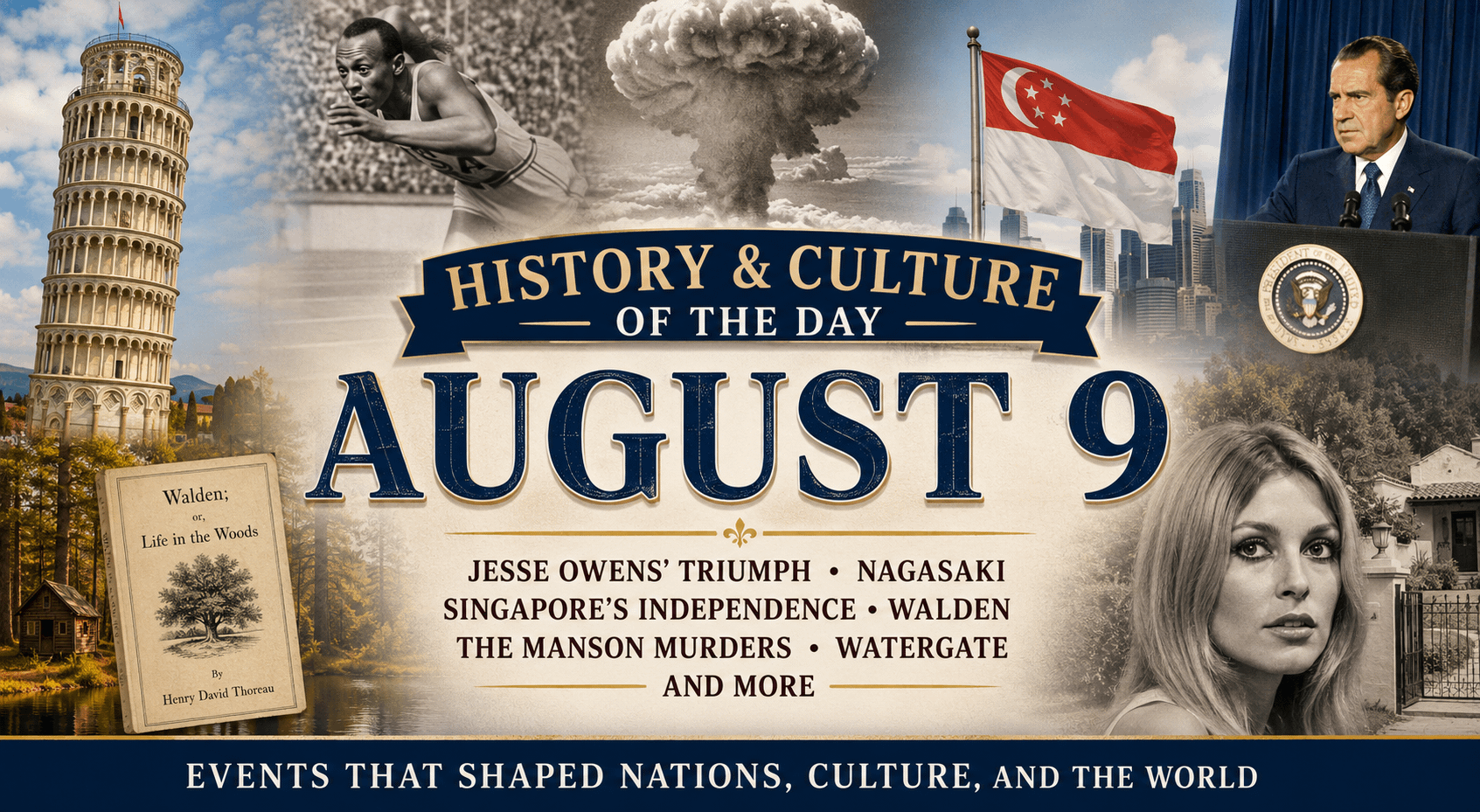
    On August 9, construction began on what would become one of the world’s most recognizable towers. Henry David Thoreau published a book that challenged generations to reconsider what makes life meaningful. Jesse Owens completed one of the greatest performances in Olympic history. Nagasaki experienced the devastating power of an atomic bomb. Singapore began its journey as an independent nation. America experienced one of its most extraordinary presidential transitions.

    Taken together, these stories demonstrate something important:

    History isn’t simply about what happened. It is about what happened next.

    Here is a deeper look at the history and culture connected with August 9.


    1173 – Construction Begins on the Leaning Tower of Pisa

    On August 9, 1173, construction traditionally is said to have begun on the bell tower of the cathedral complex in Pisa, Italy.

    Today, almost everyone knows it by another name:

    The Leaning Tower of Pisa.

    The tower was intended to demonstrate the wealth and prestige of medieval Pisa. During this period, Pisa was an important maritime power, and impressive religious and civic architecture helped communities display their prosperity.

    The tower was designed as a freestanding bell tower for Pisa Cathedral.

    But construction soon encountered a problem that would ultimately make the building far more famous than its creators could ever have imagined.

    The Tower Begins to Lean

    The ground beneath the tower consisted of relatively soft soil that could not adequately support the enormous weight of the structure.

    As construction progressed, the foundation began settling unevenly.

    The tower started leaning.

    For most buildings, such a structural problem would be considered a disaster. Builders attempted to compensate for the tilt as construction continued, creating the unusual curved appearance visible today.

    Work on the tower stretched across generations, interrupted partly by periods of warfare and political instability.

    Ironically, those interruptions may have helped prevent the tower from collapsing because the soil had additional time to settle.

    Eventually, the structure was completed.

    And the flaw that might have destroyed its reputation became its defining characteristic.

    When Imperfection Becomes Identity

    Today, the Leaning Tower of Pisa is one of the world’s most recognizable architectural landmarks.

    Visitors travel from around the world to see it—and, of course, take photographs pretending to hold the tower upright.

    Its cultural legacy provides an interesting reminder that perfection isn’t always what makes something memorable.

    Sometimes the unexpected becomes the story.

    Sometimes a flaw becomes an identity.

    And sometimes something created centuries ago continues bringing people together through curiosity, history, and wonder.


    1854 – Henry David Thoreau Publishes Walden

    August 9 also holds an important place in American literary history.

    On August 9, 1854, Henry David Thoreau’s Walden; or, Life in the Woods was published.

    The book was inspired by the period Thoreau spent living in a small cabin near Walden Pond outside Concord, Massachusetts.

    Beginning in 1845, Thoreau attempted to simplify his life.

    He wanted to examine what people truly needed to live meaningfully.

    Instead of chasing wealth, status, possessions, and social expectations, he focused on nature, observation, reflection, work, and independence.

    What Does It Mean to Truly Live?

    Walden was much more than a book about living in the woods.

    Thoreau used his experience to explore deeper questions.

    What do people actually need?

    How much of life is spent pursuing things that don’t truly make us happy?

    How often do people follow society’s expectations without questioning them?

    What happens when we slow down long enough to examine our lives?

    Those questions helped make Walden one of the most influential works in American literature.

    Why Walden Still Matters

    The world Thoreau lived in was very different from ours.

    There were no smartphones.

    No social media.

    No 24-hour news cycle.

    No endless stream of notifications.

    Yet his central concern may be even more relevant today.

    Modern culture constantly competes for our attention.

    Advertising encourages us to purchase more.

    Social media encourages comparison.

    Technology keeps us connected almost constantly.

    Thoreau’s work challenges readers to ask whether having more necessarily means living better.

    That is one reason Walden continues to be read more than 170 years after its publication.


    1936 – Jesse Owens Wins His Fourth Olympic Gold Medal

    One of the most extraordinary athletic performances of the 20th century reached its conclusion on August 9, 1936.

    American track-and-field athlete Jesse Owens competed in the 4×100-meter relay at the Summer Olympics in Berlin.

    Owens and his American teammates won the gold medal.

    For Owens, it was his fourth gold medal of the Games.

    He had already won the:

    • 100-meter sprint
    • 200-meter sprint
    • Long jump

    The relay victory completed an Olympic performance that would become legendary.

    More Than an Athletic Achievement

    Owens’ victories carried enormous symbolism because of where the Olympics were being held.

    Germany was controlled by Adolf Hitler and the Nazi regime.

    Nazi ideology promoted racist theories about supposed Aryan superiority, and the government hoped the Olympics would showcase the strength of Nazi Germany.

    Then Jesse Owens stepped onto the track.

    A Black American athlete became one of the greatest stars of the Berlin Olympics.

    Owens didn’t need to deliver a political speech.

    His performance spoke for itself.

    He ran.

    He jumped.

    He won.

    Again and again.

    The Complicated Reality Owens Returned Home To

    There is another important part of Jesse Owens’ story.

    Despite being celebrated internationally as an Olympic champion, Owens returned to a United States where racial segregation and discrimination remained widespread.

    His Olympic medals could not protect him from racism.

    That contradiction remains an important part of understanding his legacy.

    Owens demonstrated what Black Americans could achieve on the world’s largest athletic stage while living in a society that often denied Black Americans equal treatment.

    His accomplishments became part of a larger cultural history involving sports, race, equality, and opportunity.

    The Cultural Power of Sports

    Sports can sometimes accomplish something politics cannot.

    They create moments that millions of people witness together.

    For a few seconds on a track, an athlete can challenge stereotypes that have existed for generations.

    Jesse Owens did exactly that.

    His four gold medals remain among the most iconic accomplishments in Olympic history.


    1945 – Nagasaki and the Atomic Age

    August 9, 1945, represents one of the darkest moments in human history.

    World War II had devastated countries across Europe, Asia, Africa, and the Pacific.

    Germany had already surrendered in Europe, but fighting continued between Japan and the Allied powers.

    Three days earlier, on August 6, the United States had dropped an atomic bomb on Hiroshima.

    Then, on August 9, another atomic bomb was dropped on Nagasaki.

    A City Changed in Seconds

    The bomb exploded over Nagasaki with catastrophic force.

    Buildings were destroyed.

    Fires spread.

    Families were separated.

    Thousands of people died almost immediately.

    Many others later died from burns, injuries, radiation exposure, and illnesses connected with the bombing.

    For the people who survived, life would never return to what it had been before that morning.

    Homes disappeared.

    Families disappeared.

    Neighborhoods disappeared.

    The destruction demonstrated a terrifying reality:

    Humanity had developed weapons capable of destroying cities almost instantly.

    Japan Surrenders

    Within days, Japan announced its intention to surrender.

    World War II was ending.

    For people who had lived through years of global warfare, the surrender brought enormous relief.

    Soldiers could return home.

    Families could begin rebuilding.

    Countries could attempt to recover.

    But the way the war ended created historical questions that remain debated today.

    A Debate That Continues

    Historians have spent decades debating the decision to use atomic weapons against Japan.

    Supporters of the bombings have argued that they accelerated Japan’s surrender and prevented an invasion that could have resulted in enormous casualties among American, Allied, and Japanese forces and civilians.

    Critics have questioned whether the bombings—particularly the second attack on Nagasaki—were necessary.

    They point to the devastating civilian casualties and the unprecedented destructive power of nuclear weapons.

    These debates continue because history rarely provides simple answers.

    What is undeniable is the human suffering experienced by the people of Hiroshima and Nagasaki.

    The Beginning of the Nuclear Age

    The consequences of August 1945 stretched far beyond World War II.

    The atomic bomb changed international politics.

    Soon other nations developed nuclear weapons.

    The United States and Soviet Union entered a nuclear arms race during the Cold War.

    For generations, millions of people lived with the possibility that nuclear conflict could destroy entire cities—or potentially civilization itself.

    Nuclear anxiety entered popular culture.

    Movies imagined nuclear destruction.

    Schools conducted emergency drills.

    Families built fallout shelters.

    Political leaders negotiated arms agreements.

    Peace movements demanded disarmament.

    Scientists debated their responsibility for creating powerful technologies.

    The world had entered the nuclear age, and there was no going back.


    1965 – Singapore Becomes an Independent Nation

    August 9 carries a very different meaning in Singapore.

    On August 9, 1965, Singapore became an independent country after separating from Malaysia.

    Independence did not immediately guarantee prosperity.

    Singapore faced enormous uncertainty.

    The country had limited natural resources, unemployment problems, housing challenges, ethnic tensions, and concerns about security.

    Its future was uncertain.

    Building a Nation

    Under Prime Minister Lee Kuan Yew and successive governments, Singapore pursued aggressive economic development.

    The country invested heavily in:

    education,
    housing,
    transportation,
    infrastructure,
    international trade,
    manufacturing,
    technology,
    and financial services.

    Over the following decades, Singapore experienced extraordinary economic growth.

    A small island nation developed into one of the world’s most important commercial and financial centers.

    National Day

    Today, August 9 is celebrated as Singapore’s National Day.

    The celebration often includes ceremonies, performances, military displays, fireworks, and expressions of national pride.

    For Singaporeans, August 9 is more than another historical anniversary.

    It represents the beginning of their independent national story.


    1969 – The Murder of Sharon Tate and Four Others

    August 9, 1969, became associated with one of the most infamous crimes in American history.

    Actress Sharon Tate, who was pregnant, and four other people were murdered at a Los Angeles residence by followers of Charles Manson.

    The killings shocked America.

    Additional murders connected with Manson’s followers followed the next night.

    Eventually, Manson and several members of his group were arrested, prosecuted, and convicted.

    The End of an Era?

    The murders became deeply embedded in American popular culture.

    The late 1960s had been associated with enormous cultural change.

    Young Americans challenged traditional ideas about music, politics, relationships, fashion, war, and authority.

    The counterculture movement promoted peace and personal freedom.

    But the Manson murders presented something far darker.

    For some observers, the crimes symbolically represented the darker conclusion of the idealism associated with parts of the 1960s counterculture.

    Books, movies, documentaries, podcasts, and television programs have continued examining the case decades later.

    That continuing fascination demonstrates how certain crimes become more than criminal cases.

    They become cultural events.


    1974 – Richard Nixon Leaves the Presidency

    American political history changed dramatically in August 1974.

    The Watergate scandal had consumed the presidency of Richard Nixon.

    The scandal began with the June 1972 break-in at the Democratic National Committee headquarters inside Washington’s Watergate complex.

    Investigations gradually uncovered attempts to conceal connections to the Nixon administration.

    Journalists investigated.

    Congress held hearings.

    Court battles followed.

    Secret White House recordings became central evidence.

    Public confidence in the presidency deteriorated.

    Eventually, Nixon’s political position became impossible to maintain.

    On August 8, 1974, Nixon announced that he would resign.

    The resignation took effect the following day.


    August 9, 1974 – Gerald Ford Becomes President

    At noon on August 9, Vice President Gerald Ford became the 38th president of the United States.

    The moment was historically unique.

    Ford became president without having been elected either president or vice president by the American electorate.

    He had been appointed vice president after Vice President Spiro Agnew resigned in 1973.

    Less than a year later, Nixon resigned.

    Suddenly, Ford was president.

    America’s Constitutional System Is Tested

    Watergate represented one of the greatest political crises in American history.

    Yet the transfer of power occurred peacefully.

    There were no tanks surrounding government buildings.

    There was no military takeover.

    The Constitution determined what happened next.

    Ford took the oath of office and assumed the presidency.

    During remarks following the ceremony, Ford told Americans that their “long national nightmare” was over.

    His immediate challenge was enormous:

    Restore trust in government.

    Ford Pardons Nixon

    Approximately one month later, Ford made one of the most controversial decisions of his presidency.

    He granted Nixon a full presidential pardon for federal crimes Nixon might have committed while president.

    Ford believed the pardon would allow the country to move beyond Watergate.

    Many Americans strongly disagreed.

    Critics believed Nixon should have faced possible prosecution.

    The decision damaged Ford politically and may have contributed to his defeat in the 1976 presidential election.

    Historians continue debating whether Ford’s decision helped the nation heal or denied the country accountability.


    1974 – Philippe Petit Walks Between the Twin Towers

    August 9 also sits close to one of the most remarkable cultural spectacles of the 1970s.

    On August 7, 1974, French high-wire artist Philippe Petit illegally stretched a wire between the towers of New York City’s World Trade Center and walked approximately 1,350 feet above the ground.

    Although the walk occurred two days before August 9, its anniversary week remains closely associated with early-August cultural history.

    Petit crossed the wire repeatedly while crowds gathered below.

    Police eventually arrested him.

    But his stunt became legendary.

    After the September 11, 2001 terrorist attacks destroyed the Twin Towers, photographs of Petit’s walk gained an entirely different emotional meaning.

    Images that once represented daring and adventure also became reminders of buildings that no longer existed.

    History can change the meaning of photographs.


    The Cultural Meaning of August 9

    Looking at these events together reveals how broad the word history really is.

    History isn’t limited to presidents and wars.

    It includes:

    architecture,
    books,
    sports,
    technology,
    national identity,
    crime,
    politics,
    art,
    science,
    and ordinary people living through extraordinary circumstances.

    The Leaning Tower of Pisa shows how human creations can survive for centuries.

    Walden demonstrates how ideas can continue speaking to generations long after an author dies.

    Jesse Owens shows how athletic excellence can challenge powerful prejudices.

    Nagasaki reminds humanity of the devastating consequences of warfare.

    Singapore demonstrates how nations can transform themselves.

    Watergate demonstrates both the vulnerability and resilience of democratic institutions.

    Each story contributes something different to our understanding of humanity.


    August 9 and the Power of Human Decisions

    One theme connects many events associated with August 9:

    Decisions have consequences.

    Architects make decisions.

    Writers make decisions.

    Athletes make decisions.

    Presidents make decisions.

    Military leaders make decisions.

    Citizens make decisions.

    Sometimes those choices affect only a few people.

    Sometimes they influence millions.

    And occasionally, a decision changes the direction of history.

    Studying history gives us the advantage of seeing consequences that the people making those decisions could not always see.

    That is one reason history matters.


    Remembering Both Triumph and Tragedy

    Not every historical anniversary should be celebrated.

    Some should be remembered.

    There is a difference.

    Jesse Owens’ Olympic achievements deserve celebration.

    Singapore’s independence is celebrated nationally.

    The destruction of Nagasaki requires remembrance and reflection.

    The Manson murders remind us of victims whose lives were taken.

    Watergate reminds Americans of the importance of accountability and constitutional government.

    History includes humanity’s greatest accomplishments and its darkest failures.

    Ignoring either side gives us an incomplete picture of the past.


    What August 9 Can Teach Us Today

    The events connected with August 9 happened in different countries, different centuries, and dramatically different circumstances.

    Yet they continue offering lessons.

    Greatness can appear where prejudice says it shouldn’t.

    Jesse Owens demonstrated that in Berlin.

    Technology without wisdom can become terrifying.

    Nagasaki demonstrated that in 1945.

    A country’s future is not always determined by its difficult beginning.

    Singapore demonstrated that after independence.

    Institutions matter during moments of crisis.

    America’s presidential transition demonstrated that during Watergate.

    Ideas can outlive the people who wrote them.

    Walden demonstrates that more than a century and a half after publication.

    And perhaps the Leaning Tower of Pisa offers the most unexpected lesson of all:

    Something doesn’t always have to be perfect to become extraordinary.


    History Is Still Being Written

    It is easy to imagine history as something that exists only in old books.

    But everyone currently alive is participating in history.

    The conversations happening today will someday be studied.

    The technologies being developed today may reshape future civilizations.

    Today’s political decisions may affect generations.

    Today’s cultural movements may eventually define our era.

    People living through major historical moments rarely know exactly how those events will ultimately be remembered.

    The people watching Jesse Owens race in Berlin couldn’t fully know what his victories would represent generations later.

    Residents of Singapore in 1965 couldn’t know exactly what their country would become.

    Americans watching Gerald Ford take the presidential oath couldn’t know how historians would eventually evaluate the Watergate era.

    History becomes clearer with distance.

    But history begins in the present.


    Final Thoughts: Why August 9 Matters

    August 9 contains an extraordinary mixture of human history.

    It reminds us of creativity through architecture.

    It reminds us of reflection through literature.

    It reminds us of courage and excellence through Jesse Owens.

    It reminds us of the horrifying consequences of war through Nagasaki.

    It reminds us of national determination through Singapore’s independence.

    It reminds us of the darkness that can exist within society through infamous crimes.

    And it reminds us through Watergate that even powerful leaders remain subject to institutions, laws, and consequences.

    Some August 9 stories inspire us.

    Some challenge us.

    Some should make us uncomfortable.

    Some should never be forgotten.

    Together, they demonstrate why studying history is about much more than remembering dates.

    History helps us understand how we arrived where we are today.

    Every generation inherits a world shaped by decisions made before it.

    Every generation then makes decisions that will shape the world inherited by those who come next.

    That is why looking back matters.

    When we understand the achievements, mistakes, sacrifices, courage, failures, and lessons of those who came before us, we become better equipped to understand our own place in the human story.

    August 9 reminds us that history is not simply behind us.

    It surrounds us.

    It influences us.

    And every day, whether we realize it or not, we are adding another chapter.

    Read More History & Culture

  • This Day in American History – August 9

    Advertisements

    Every day carries a piece of America’s story. Some dates are remembered for a single defining event, while others connect several moments that reveal how the United States has changed politically, socially, culturally, and technologically.

    August 9 is one of those dates.

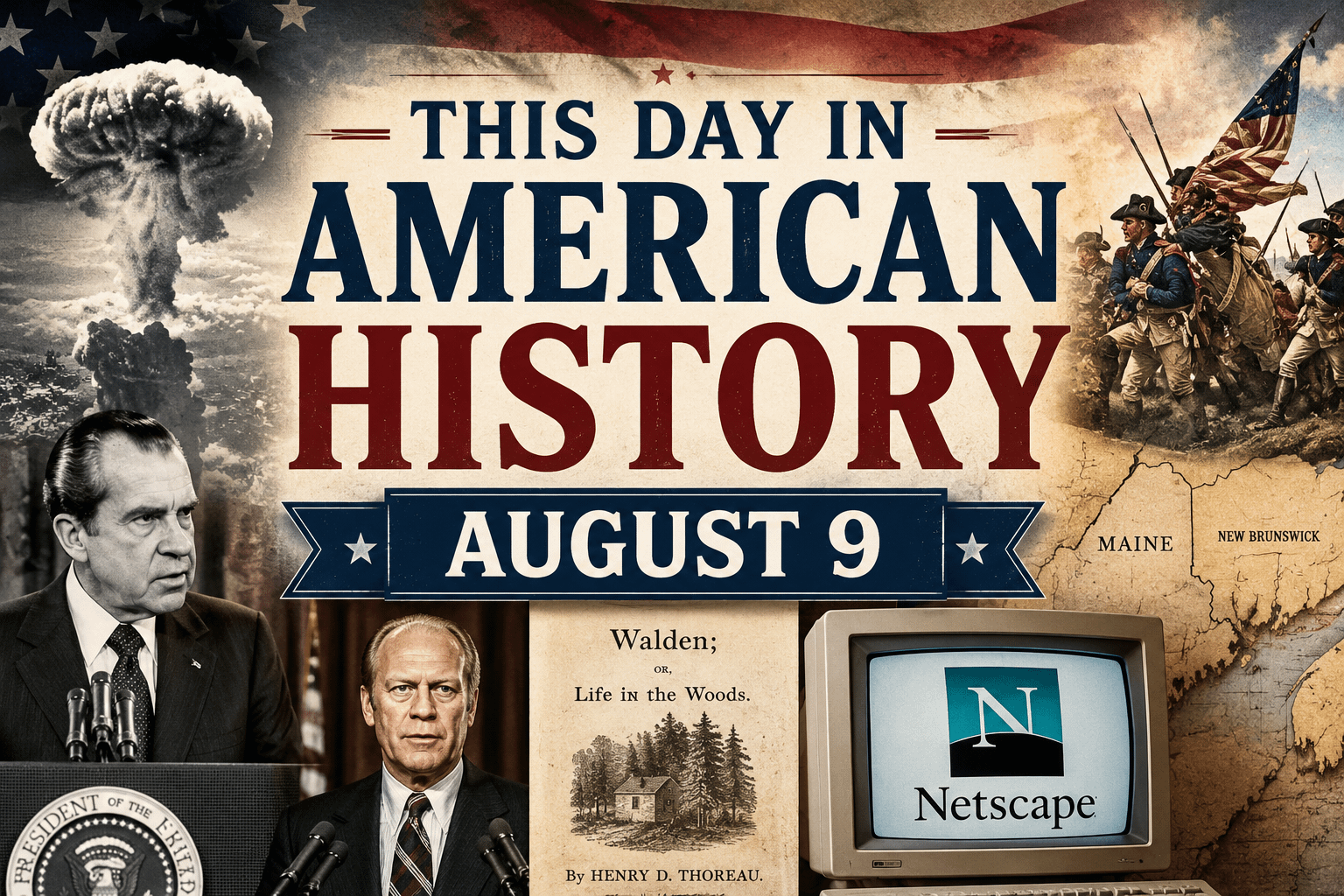
    Across different generations, August 9 has been associated with the American Revolution, an important diplomatic agreement with Great Britain, one of the great works of American literature, the final days of World War II, one of the country’s most infamous crimes, the resignation of a president, the peaceful transfer of presidential power, and the beginning of the commercial internet era.

    Some of these moments deserve celebration. Others require reflection and remembrance. Together, however, they show why studying history is about much more than memorizing names and dates.

    History helps us understand how decisions create consequences that can continue for decades—or even centuries.

    Here is a deeper look at what happened on August 9 in American history.


    1778 – American Forces Move Against the British in Rhode Island

    During the summer of 1778, the American Revolution was entering a new and important phase.

    The war had begun more than three years earlier, and the Continental Army was still fighting to secure American independence from Great Britain.

    But the international situation had changed.

    Following the American victory at Saratoga in 1777, France formally entered the war as an ally of the United States in 1778.

    French participation dramatically changed the conflict.

    Great Britain was no longer fighting only rebellious colonies. It was now involved in a broader international war against one of Europe’s major powers.

    One of the earliest attempts at major military cooperation between American and French forces took place around Newport, Rhode Island.

    British troops had occupied Newport since 1776, making the city an important British military position.

    American leaders wanted it back.

    Major General John Sullivan commanded American forces preparing to attack the British position, while French naval and military forces were expected to provide support.

    On August 9, 1778, American troops crossed onto Aquidneck Island as the operation moved forward.

    The campaign did not unfold as planned.

    Communication problems, severe weather, changing military circumstances, and disagreements complicated cooperation between the American and French forces.

    The campaign eventually culminated in the Battle of Rhode Island on August 29, 1778.

    Although American forces failed to capture Newport, the campaign became an important learning experience for the young Franco-American alliance.

    That alliance would later prove essential.

    Three years later, French troops and naval forces played a crucial role in the American victory at Yorktown in 1781, helping force the surrender of British General Charles Cornwallis.

    The events surrounding Rhode Island therefore represent more than an unsuccessful military operation.

    They were part of the development of an international partnership that helped make American independence possible.


    1842 – The Webster-Ashburton Treaty Resolves a Dangerous Border Dispute

    Not every important moment in American history happened on a battlefield.

    Sometimes diplomacy changed the country’s future just as dramatically.

    On August 9, 1842, representatives of the United States and Great Britain signed the Webster-Ashburton Treaty.

    The agreement addressed several disputes between the two countries, including disagreements concerning portions of the border between the United States and British North America.

    One particularly contentious area involved the boundary between Maine and what is now the Canadian province of New Brunswick.

    Tensions had become serious enough that the dispute contributed to a confrontation known as the Aroostook War.

    Despite the dramatic name, it was largely a bloodless boundary dispute rather than a conventional war.

    Still, the possibility of a larger conflict between the United States and Britain was real enough to make a diplomatic settlement important.

    U.S. Secretary of State Daniel Webster negotiated with British diplomat Lord Ashburton, Alexander Baring.

    Their negotiations produced a compromise.

    The treaty helped establish portions of the modern U.S.-Canada border and settled several other disagreements between the two nations.

    The Webster-Ashburton Treaty offers an important lesson from American history:

    Not every national conflict has to end through military force.

    Negotiation and compromise can sometimes accomplish what armies cannot.


    1854 – Henry David Thoreau Publishes Walden

    On August 9, 1854, one of the most influential books in American literature was published.

    Henry David Thoreau released:

    Walden; or, Life in the Woods.

    The book grew out of Thoreau’s experience living near Walden Pond outside Concord, Massachusetts.

    Beginning in 1845, Thoreau spent more than two years living in a small cabin he constructed near the pond.

    His goal was not simply to escape civilization.

    He wanted to experiment with a simpler way of living.

    Thoreau questioned whether people were spending too much of their lives pursuing money, possessions, status, and unnecessary comforts.

    He wanted to examine what a person actually needed to live a meaningful life.

    That idea became one of the central themes of Walden.

    Thoreau encouraged readers to examine their priorities, appreciate nature, think independently, and live deliberately rather than simply following society’s expectations.

    His observations became part philosophy, part autobiography, part social criticism, and part celebration of the natural world.

    Although Walden was not an immediate blockbuster by modern standards, its influence grew tremendously over time.

    Today, Thoreau is considered one of America’s most important writers and thinkers.

    His broader writings about individual conscience and civil disobedience also influenced future political and social movements.

    The publication of Walden on August 9 reminds us that American history is not only created by presidents, generals, and politicians.

    Writers and thinkers can change a nation too.


    1945 – The Atomic Bombing of Nagasaki

    One of the darkest and most consequential events connected with August 9 occurred during the closing days of World War II.

    By the summer of 1945, Nazi Germany had already surrendered.

    The war in Europe was over.

    But fighting continued in the Pacific.

    American and Allied forces had spent years advancing across the Pacific toward Japan, often experiencing extremely intense combat.

    Battles such as Iwo Jima and Okinawa demonstrated just how costly an invasion of the Japanese home islands could potentially become.

    Meanwhile, the United States had secretly developed a new weapon through the Manhattan Project.

    The atomic bomb represented a destructive power unlike anything previously used in warfare.

    On August 6, 1945, the United States dropped an atomic bomb nicknamed “Little Boy” on Hiroshima.

    Three days later, on August 9, 1945, another American B-29 bomber, Bockscar, carried a plutonium bomb nicknamed “Fat Man.”

    The original primary target was Kokura, but conditions prevented the bombing there.

    The aircraft proceeded to Nagasaki.

    The bomb exploded over the city.

    The destruction was enormous.

    Tens of thousands of people were killed, and many others suffered burns, injuries, radiation exposure, and long-term health consequences.

    Families disappeared.

    Neighborhoods were destroyed.

    Survivors lived with physical and emotional consequences for decades.

    The Soviet Union had also entered the war against Japan, adding further pressure on the Japanese government.

    Within days, Japan announced its intention to surrender.

    World War II was coming to an end.


    The Debate Over the Atomic Bombings Continues

    Few decisions in American military history have generated more debate than the atomic bombings of Hiroshima and Nagasaki.

    Supporters of President Harry Truman’s decision have argued that using the bombs accelerated Japan’s surrender and prevented a costly Allied invasion of the Japanese home islands.

    American military planners expected that an invasion could produce enormous casualties.

    From this perspective, the bombings helped end a brutal global war that had already killed millions.

    Critics have raised different questions.

    Was Japan already approaching surrender?

    Could the bomb have been demonstrated somewhere unpopulated?

    Was the second bombing necessary?

    How should civilian casualties be weighed against military objectives?

    Historians continue debating these questions.

    What cannot be debated is the enormous human cost.

    August 9 therefore serves as both a historical milestone and a day of remembrance.

    The atomic age changed warfare forever.

    For the first time, humanity possessed weapons capable of destroying cities almost instantly.

    That reality continues to influence international diplomacy and military strategy today.


    1969 – The Tate Murders Shock Los Angeles and America

    The morning of August 9, 1969, brought news of a horrifying crime in Los Angeles.

    Members of the group associated with Charles Manson murdered five people at a home on Cielo Drive.

    The victims included:

    • Actress Sharon Tate, who was pregnant
    • Celebrity hairstylist Jay Sebring
    • Coffee heiress Abigail Folger
    • Writer Wojciech Frykowski
    • Steven Parent, who had been visiting the property’s caretaker

    The brutality of the killings stunned the country.

    Another set of murders followed the next night when Leno and Rosemary LaBianca were killed.

    Investigators eventually connected the crimes to members of Manson’s group.

    The resulting investigation and trials became a national media spectacle.

    Charles Manson became one of the most infamous criminals in American history, even though he did not personally carry out the Tate murders.

    The crimes became culturally significant for another reason.

    For some Americans, they symbolized the darker side of the late 1960s.

    The decade had been associated with enormous cultural change, youth movements, antiwar activism, civil rights struggles, experimentation, and the counterculture.

    The Manson murders became part of a broader sense that the optimism associated with parts of that era had begun to disappear.


    1974 – Richard Nixon Leaves the Presidency

    Few dates in American political history compare with August 9, 1974.

    That morning, Richard Nixon prepared to leave the White House.

    The Watergate scandal had consumed his administration.

    What began with a burglary at Democratic National Committee headquarters in Washington’s Watergate complex eventually developed into a national crisis involving political espionage, obstruction, abuse of power, secret recordings, congressional investigations, court battles, and questions about presidential accountability.

    The break-in occurred on June 17, 1972.

    Five men were arrested inside Democratic headquarters.

    Initially, the White House attempted to distance itself from the incident.

    But journalists, investigators, prosecutors, congressional committees, and courts continued examining what had happened.

    Slowly, the scandal moved closer to the president.

    One of the biggest revelations came when investigators learned that Nixon had secretly recorded conversations in the White House.

    Those recordings became crucial evidence.

    The Supreme Court eventually ruled in United States v. Nixon that the president had to turn over subpoenaed recordings.

    A recording known as the “smoking gun” tape seriously damaged Nixon’s remaining political support.

    Impeachment appeared increasingly unavoidable.

    On the evening of August 8, Nixon addressed the nation and announced that he would resign.

    His resignation became effective at noon on August 9, 1974.

    Richard Nixon became the first president in American history to resign from office.

    To this day, he remains the only U.S. president to have done so.


    Nixon’s Final Departure From the White House

    Before leaving Washington, Nixon gave an emotional farewell to members of his administration and staff.

    He then walked with his family toward the presidential helicopter.

    Photographs and television footage captured Nixon turning and raising his arms with his familiar victory gesture before boarding.

    Marine One carried him away from the White House.

    It was an extraordinary image.

    A man who had won reelection in 1972 by one of the largest Electoral College landslides in American history was leaving office less than two years later.

    Watergate permanently changed how many Americans viewed the presidency.

    It strengthened public skepticism toward government and produced renewed debates about executive power, campaign practices, government transparency, journalism, and political accountability.

    The scandal also reinforced an important constitutional principle:

    No president is supposed to be above the law.


    1974 – Gerald Ford Becomes the 38th President

    As one presidency ended, another began.

    At noon on August 9, 1974, Vice President Gerald Rudolph Ford became the 38th president of the United States.

    Chief Justice Warren Burger administered the presidential oath of office in the East Room of the White House.

    Ford then addressed the American people.

    His speech contained one of the most memorable statements ever delivered by an incoming president:

    “Our long national nightmare is over.”

    The words captured the exhaustion many Americans felt after years of Watergate investigations and political conflict.

    Ford faced an unusual situation.

    He had never been elected president.

    He had never even been elected vice president.


    How Gerald Ford Reached the White House

    Ford’s path to the presidency was unlike that of any previous American president.

    In October 1973, Vice President Spiro Agnew resigned amid a corruption investigation unrelated to Watergate.

    Under the 25th Amendment, President Nixon nominated Gerald Ford to become the new vice president.

    Congress confirmed him.

    Then Nixon resigned.

    That meant Ford became president without having been elected nationally to either the presidency or vice presidency.

    His rise demonstrated the importance of the 25th Amendment, which had been ratified only a few years earlier in 1967.

    The amendment established procedures for dealing with presidential disability and vacancies in the office of vice president.

    The constitutional system was tested.

    It worked.


    A Peaceful Transfer During a Constitutional Crisis

    The transfer of power on August 9, 1974, deserves attention beyond the personalities involved.

    The United States had experienced an unprecedented presidential crisis.

    A sitting president was leaving office under the threat of impeachment and possible removal.

    Yet the constitutional transition happened peacefully.

    Government agencies continued operating.

    The military remained under civilian command.

    The courts continued functioning.

    Congress continued meeting.

    The vice president took the presidential oath.

    The country moved forward.

    The moment demonstrated one of the central principles of American government:

    The office of the presidency is greater than the individual occupying it.

    Presidents come and go.

    The constitutional system is designed to continue.


    1995 – Netscape’s IPO Helps Launch the Internet Boom

    August 9 is also connected to a completely different type of American revolution.

    A technological one.

    On August 9, 1995, Netscape Communications held its initial public offering.

    Netscape was closely associated with one of the most important technologies of the early World Wide Web: the web browser.

    Its Netscape Navigator browser helped make the internet accessible to millions of ordinary computer users.

    Before browsers became easy to use, navigating the internet could require specialized technical knowledge.

    Graphical web browsers changed that.

    People could click links, view images, explore websites, and move from page to page with relative ease.

    Netscape became one of the most recognizable names of the early internet era.

    Its stock market debut attracted enormous attention and became a symbol of investor excitement surrounding internet companies.

    The IPO is often remembered as an important moment in the beginning of the dot-com boom.


    How the Internet Changed American Life

    The significance of Netscape becomes clearer when we consider what followed.

    Within a generation, the internet transformed nearly every part of American life.

    People began using the web to:

    communicate with friends and family,

    read news,

    shop,

    manage finances,

    watch videos,

    listen to music,

    find jobs,

    operate businesses,

    attend classes,

    publish their own writing,

    share photographs,

    and communicate instantly with people around the world.

    Entire industries were created.

    Others were disrupted or transformed.

    The modern world of social media, streaming entertainment, e-commerce, smartphones, online publishing, remote work, and digital entrepreneurship grew from the technological transformation occurring during this period.

    Netscape itself would eventually decline as Microsoft’s Internet Explorer became dominant during the browser wars.

    But Netscape’s place in internet history remains important.

    Its August 9, 1995 IPO symbolized the moment when Wall Street—and much of America—began recognizing that the World Wide Web could become an enormous economic and cultural force.


    2001 – President George W. Bush Announces a Stem Cell Research Policy

    On August 9, 2001, President George W. Bush addressed the nation about one of the most complicated scientific and ethical debates of the period: embryonic stem cell research.

    Stem cells attracted enormous interest because of their potential usefulness in understanding and potentially treating serious diseases and injuries.

    Researchers believed stem cell science might someday contribute to treatments for conditions affecting the nervous system, heart, pancreas, and other parts of the human body.

    But embryonic stem cell research also raised significant ethical questions because obtaining certain cells involved human embryos.

    The debate therefore involved science, medicine, religion, ethics, politics, and public policy.

    Bush announced that federal funding would be available for research using certain existing embryonic stem cell lines but restricted funding involving newly created ones under the policy.

    The decision did not end the debate.

    Instead, stem cell research remained an important political and scientific issue throughout the following years.

    The August 9 announcement demonstrates another recurring theme in American history:

    Technological and scientific progress often creates ethical questions that society must decide how to address.


    August 9 Shows the Many Sides of American History

    Looking across these events reveals just how broad the American story really is.

    August 9 takes us from the battlefields of the Revolution to diplomatic negotiations along the northern border.

    It takes us into the woods with Henry David Thoreau.

    It takes us into the devastating final days of World War II.

    It brings us to a horrifying crime scene in 1969 Los Angeles.

    It places us inside the White House as one president resigns and another takes office.

    And it brings us to Silicon Valley at the beginning of an internet revolution that would eventually transform the world.

    These events may seem unrelated.

    In many ways, they are.

    But together they reveal several recurring themes throughout American history:

    Freedom.

    Power.

    War.

    Accountability.

    Innovation.

    Diplomacy.

    Individual thought.

    Constitutional government.

    Technological change.

    And perhaps most importantly, consequences.


    What Can We Learn From August 9?

    History becomes more meaningful when we move beyond asking, “What happened?”

    We should also ask:

    Why did it happen?

    What changed because of it?

    What can we learn from it today?

    The Revolutionary War reminds us that American independence required international alliances as well as courage on the battlefield.

    The Webster-Ashburton Treaty reminds us that diplomacy can prevent conflict.

    Henry David Thoreau reminds us that ideas can survive long after the person who first expressed them is gone.

    Nagasaki reminds us of the devastating human consequences of war and the enormous responsibility that comes with technological power.

    Watergate reminds us why government accountability matters.

    Gerald Ford’s inauguration reminds us of the importance of peaceful constitutional succession.

    Netscape reminds us that technologies that appear new or experimental can eventually transform everyday life.

    The stem cell debate reminds us that scientific possibilities often arrive faster than society can answer the ethical questions surrounding them.


    History Is More Than the Past

    One of the greatest mistakes we can make is thinking history is finished.

    It isn’t.

    The people who lived through August 9, 1778, did not know exactly how the American Revolution would end.

    People reading Walden in 1854 could not know how influential Thoreau’s ideas would eventually become.

    The crew flying toward Japan in 1945 was participating in the beginning of an entirely new era of warfare.

    Americans watching Richard Nixon leave Washington in 1974 were witnessing something that had never happened before.

    Investors buying Netscape shares in 1995 could not fully imagine a future in which billions of people would carry internet-connected computers in their pockets.

    People rarely know when they are living through history.

    Usually, they are simply living through another day.

    Only later do we recognize the moments that changed everything.


    Remembering August 9 in American History

    August 9 reminds us that America’s history is not one simple story.

    It contains courage and controversy.

    Triumph and tragedy.

    Leadership and failure.

    War and diplomacy.

    Crime and justice.

    Innovation and uncertainty.

    Some historical events make us proud.

    Others make us uncomfortable.

    Some require celebration.

    Others demand remembrance.

    But all of them can teach us something.

    Understanding American history does not require pretending the past was perfect. It requires examining what happened, understanding the people and circumstances involved, and learning from both the nation’s accomplishments and its failures.

    From the American Revolution to Watergate and from Walden to the birth of the internet age, August 9 has witnessed events whose effects reached far beyond a single day.

    Tomorrow will bring another date.

    Another collection of stories.

    Another opportunity to look backward so we can better understand the world we live in today.

    Because American history isn’t simply something that happened long ago.

    Its consequences surround us every day.

    And right now, somewhere in America, another chapter is already being written.

    Read More History & Culture

  • History & Culture of the Day – August 8

    Advertisements

    Every day on the calendar carries pieces of the human story. Some dates are remembered for wars and political turning points. Others mark scientific breakthroughs, cultural achievements, exploration, social movements, or extraordinary human accomplishments.

    August 8 brings together all of these themes.

    Across the centuries, this date has witnessed dramatic battles, groundbreaking exploration, technological innovation, struggles for independence, political upheaval, international sporting celebrations, and the births of people who left lasting marks on science, entertainment, politics, and sports.

    From the defeat of the Spanish Armada in the 16th century to the first successful ascent of Mont Blanc, from the final months of World War I to India’s independence movement, and from the Watergate era to the spectacular opening of the Beijing Olympics, August 8 offers a fascinating journey through world history and culture.

    Here is a deeper look at the people, events, achievements, and cultural moments connected to August 8.


    1588 – The Spanish Armada and the Battle of Gravelines

    One of the most famous naval campaigns in European history unfolded during the summer of 1588.

    King Philip II of Spain assembled a massive fleet known as the Spanish Armada as part of an effort against England under Queen Elizabeth I.

    Religious, political, and economic tensions had been growing between Protestant England and Catholic Spain. English support for Dutch rebels fighting Spanish rule and English attacks against Spanish shipping added to the conflict.

    The Armada sailed toward the English Channel with plans connected to transporting an invasion force from the Netherlands to England.

    English ships repeatedly challenged the Spanish fleet.

    During the night of August 7–8, English forces sent fireships toward the anchored Spanish vessels near Calais. The Spanish fleet scattered to avoid them.

    The disruption contributed to the circumstances surrounding the Battle of Gravelines, fought on August 8 according to the modern Gregorian calendar.

    English ships attacked the Spanish fleet, taking advantage of their maneuverability and naval tactics.

    The Armada survived the engagement but could no longer effectively continue its original mission.

    With its route south blocked, the Spanish fleet attempted to return home by sailing north around Scotland and Ireland.

    Storms, difficult navigation, shortages, disease, and shipwrecks inflicted additional losses.

    The Armada’s failure became one of the defining events of Elizabethan England.

    Although Spain remained a major European power afterward, the campaign became deeply embedded in English national history and contributed to the growing mythology surrounding Elizabeth I’s reign.


    1786 – Humans Reach the Summit of Mont Blanc

    On August 8, 1786, two men accomplished something that helped change the way people viewed mountains.

    Jacques Balmat and physician Michel-Gabriel Paccard successfully reached the summit of Mont Blanc.

    Rising approximately 15,770 feet above sea level, Mont Blanc is the highest mountain in the Alps.

    At the time, high mountains were not generally viewed as recreational destinations.

    They were dangerous, mysterious, difficult environments that relatively few people had any reason to explore.

    But scientific curiosity and adventure were beginning to change attitudes.

    Naturalist Horace-Bénédict de Saussure had encouraged attempts to reach the summit and offered a reward for discovering a route.

    Balmat and Paccard ultimately succeeded.

    Their journey required extraordinary endurance and determination at a time when climbers did not have modern mountaineering equipment, weather forecasts, insulated clothing, GPS devices, or established routes.

    Their ascent is frequently regarded as a foundational moment in the history of modern mountaineering.

    Today, millions of people around the world participate in hiking, climbing, backpacking, and mountaineering.

    The adventure culture surrounding mountains can trace part of its history back to pioneers willing to explore places that once seemed unreachable.


    1876 – Thomas Edison and the Changing World of Printing

    The late 19th century was an age of rapid technological development.

    Industrialization was transforming transportation, communication, manufacturing, business, and everyday life.

    Among the era’s most famous inventors was Thomas Edison.

    On August 8, 1876, Edison received a patent related to his autographic printing system.

    The technology contributed to developments associated with stencil duplication and what would eventually become widely known through mimeograph-style reproduction.

    That may seem relatively ordinary from today’s perspective.

    We live in a world where a document can be duplicated thousands of times, emailed across the planet, uploaded to the internet, or shared through social media almost instantly.

    But efficient document reproduction once represented a major technological improvement.

    Businesses could distribute information more easily.

    Schools could reproduce educational materials.

    Churches and community organizations could distribute newsletters.

    Political organizations could spread messages.

    Offices could create multiple copies of documents without manually rewriting every page.

    Technologies like these were early steps toward the information-sharing world we now take for granted.


    1908 – Wilbur Wright Shows Europe the Future of Flight

    Five years after the Wright brothers’ historic 1903 flight at Kitty Hawk, powered aviation was still new and unfamiliar to much of the world.

    Many people remained skeptical about what airplanes could actually accomplish.

    That began changing rapidly.

    On August 8, 1908, Wilbur Wright made an important public flight demonstration near Le Mans, France.

    European aviation enthusiasts and observers watched closely.

    What impressed them was not simply that Wright’s aircraft could leave the ground.

    It could be controlled.

    Wilbur demonstrated turns and maneuverability that showed aviation was developing beyond short experimental flights.

    The demonstrations strengthened the Wright brothers’ international reputation.

    Within a remarkably short period, airplanes would change civilization.

    Aircraft would become tools of war.

    They would carry mail.

    They would transport passengers.

    They would connect continents.

    They would assist exploration and emergency response.

    Eventually, aviation would make it possible for ordinary travelers to cross oceans in hours rather than spending weeks aboard ships.

    The early flights of aviation pioneers such as Wilbur and Orville Wright helped open the door to that future.


    1918 – The Battle of Amiens Begins

    August 8 became one of the most important dates during the final year of World War I.

    By 1918, Europe had endured nearly four years of devastating warfare.

    Millions had been killed or wounded.

    The Western Front had become associated with trenches, artillery bombardments, machine guns, barbed wire, mud, and enormous casualties.

    But the military situation began changing dramatically during the summer of 1918.

    On August 8, Allied forces launched the Battle of Amiens in France.

    British, Australian, Canadian, French, and other Allied forces participated in the offensive.

    The attack combined infantry, artillery, tanks, and aircraft in a coordinated operation.

    Surprise played an important role.

    Instead of relying on an extended preliminary bombardment that might warn the enemy, Allied planners attempted to conceal their intentions.

    The offensive achieved significant gains.

    Thousands of German soldiers were captured, and Allied forces advanced several miles in places.

    German military commander Erich Ludendorff famously referred to August 8 as the “black day of the German Army.”

    The phrase reflected more than battlefield losses.

    German morale was deteriorating.

    After years of warfare, shortages, casualties, and exhaustion, the ability of Germany to continue fighting was weakening.

    The Battle of Amiens helped launch what became known as the Hundred Days Offensive.

    Over the following months, Allied armies continued pushing German forces backward.

    On November 11, 1918, an armistice ended the fighting on the Western Front.

    August 8 therefore represents an important turning point during the final chapter of one of history’s deadliest conflicts.


    1942 – Gandhi and the Quit India Movement

    August 8 also holds enormous importance in the history of India’s struggle for independence.

    For generations, India had been governed under British colonial rule.

    By the early 20th century, demands for independence had become increasingly powerful.

    One of the most influential leaders of the movement was Mahatma Gandhi, who promoted nonviolent resistance as a method of political struggle.

    On August 8, 1942, the All India Congress Committee adopted the Quit India Resolution in Bombay, now Mumbai.

    The resolution demanded an end to British rule.

    During this period, Gandhi delivered his famous call to “Do or Die.”

    The message represented determination to continue the independence struggle despite repression.

    British authorities responded quickly.

    Gandhi and other major leaders were arrested.

    However, their arrests did not eliminate the movement.

    Demonstrations, strikes, resistance, and political unrest spread.

    The Quit India Movement did not immediately bring independence, but it became one of the major episodes in the final years of British colonial rule.

    Five years later, in 1947, India achieved independence.

    Today, the events surrounding August 8, 1942 remain an important part of the history of India’s independence movement.


    1945 – The Soviet Union Declares War on Japan

    August 8, 1945 occurred during one of the most dramatic weeks in modern history.

    World War II had already ended in Europe following Nazi Germany’s surrender in May.

    But fighting continued in Asia and the Pacific.

    On August 6, the United States dropped an atomic bomb on Hiroshima.

    Then, on August 8, the Soviet Union declared war on Japan.

    Shortly afterward, Soviet forces launched a massive military offensive against Japanese forces in Manchuria.

    The Soviet entry into the war dramatically changed Japan’s strategic situation.

    Japan was now facing enormous pressure from multiple directions.

    On August 9, the United States dropped a second atomic bomb on Nagasaki.

    Days later, Emperor Hirohito announced Japan’s acceptance of Allied surrender terms.

    World War II was coming to an end.

    Historians continue to examine and debate the relative influence of the atomic bombings, Soviet entry into the war, Japan’s military position, diplomatic calculations, and other factors in the decision to surrender.

    What is certain is that August 1945 transformed world history.

    The war ended, but a new geopolitical era was beginning.

    The United States and Soviet Union would emerge as competing superpowers, setting the stage for decades of Cold War rivalry.


    1963 – Britain’s Great Train Robbery

    Not every historical event involves governments, wars, or revolutions.

    Some become famous because they capture the public imagination.

    During the early hours of August 8, 1963, a Royal Mail train traveling from Glasgow toward London was stopped in Buckinghamshire.

    A gang carried out what became known as the Great Train Robbery.

    The criminals escaped with approximately £2.6 million, an extraordinary sum at the time.

    The robbery immediately became a national sensation.

    The scale of the theft, planning involved, police investigation, arrests, trials, escapes, and later lives of those involved fascinated the British public.

    The crime eventually became more than a police case.

    It entered popular culture.

    Books were written about it.

    Television documentaries examined it.

    Movies and dramatizations revisited the story.

    Decades later, the Great Train Robbery remains one of Britain’s most famous crimes.


    1974 – Richard Nixon Announces His Resignation

    On the evening of August 8, 1974, millions of Americans watched television as President Richard Nixon announced that he would resign from office.

    The announcement followed the long-running Watergate scandal.

    What began with the June 1972 break-in at the Democratic National Committee headquarters in Washington’s Watergate complex developed into a sprawling political scandal involving attempts to conceal wrongdoing and questions about presidential power.

    Investigative journalists, congressional committees, prosecutors, courts, and eventually the Supreme Court all played roles in uncovering information related to the scandal.

    By the summer of 1974, Nixon’s political support had collapsed.

    Facing the strong possibility of impeachment and removal, he announced his resignation.

    His presidency officially ended the following day.

    Vice President Gerald Ford became president.

    Nixon remains the only U.S. president to resign from office.

    The consequences of Watergate reached far beyond Nixon’s presidency.

    The scandal influenced journalism, campaign laws, government ethics rules, congressional oversight, political language, and public attitudes toward government.

    Even the suffix “-gate” became widely used to describe later scandals.

    Few political events have had such a lasting effect on American political vocabulary and culture.


    1988 – The Cultural Fascination With 8/8/88

    Sometimes a date becomes memorable because of its appearance.

    August 8, 1988 could be written as:

    8/8/88

    The repetition made it visually distinctive.

    But the number eight also has deep cultural significance, particularly in Chinese culture.

    Eight is commonly associated with prosperity, success, and good fortune.

    Because of those associations, dates containing multiple eights may be considered especially desirable for important events.

    Couples may seek wedding dates containing the number.

    Businesses may prefer phone numbers, addresses, or opening dates featuring eights.

    The symbolic importance of the number would become particularly visible twenty years later.


    2008 – The Beijing Olympics Begin on 8/8/08

    On August 8, 2008, the world’s attention turned toward Beijing, China.

    The opening ceremony of the 2008 Summer Olympic Games began at approximately 8:08 p.m. local time on 8/8/08.

    The timing reflected the positive cultural associations surrounding the number eight.

    The ceremony was an enormous production involving thousands of performers.

    Directed by acclaimed filmmaker Zhang Yimou, it incorporated elements of Chinese history, philosophy, music, art, calligraphy, technology, and performance.

    Mass choreography created spectacular visual displays.

    Fireworks illuminated Beijing.

    Historical themes were blended with modern technology.

    For many international viewers, the ceremony became one of the defining cultural spectacles of the decade.

    The Beijing Olympics were also significant beyond sports.

    They represented China’s growing international presence and offered the country an enormous global stage.


    Michael Phelps Makes Olympic History

    One of the biggest stories to emerge from the Beijing Games involved American swimmer Michael Phelps.

    Phelps arrived with an extraordinarily ambitious goal.

    He attempted to win eight gold medals.

    And he succeeded.

    Phelps captured eight gold medals, surpassing Mark Spitz’s previous record of seven gold medals at a single Olympic Games.

    Some victories were dominant.

    Others came down to incredibly small margins.

    His performance became one of the most celebrated achievements in Olympic history.

    The number eight therefore became even more closely connected with the 2008 Games.

    The Olympics opened on 8/8/08—and one of their greatest stars left Beijing with eight gold medals.


    Usain Bolt Electrifies the World

    Another athlete who became an international superstar during the Beijing Olympics was Jamaican sprinter Usain Bolt.

    Bolt’s combination of speed, confidence, personality, and apparent ease captivated audiences.

    He won the men’s 100-meter and 200-meter titles in world-record performances.

    His achievements helped usher in a new era of global interest in sprinting.

    Bolt eventually became one of the most recognizable athletes on the planet.

    The Beijing Games therefore became more than a collection of competitions.

    They produced sporting moments and personalities that became part of global popular culture.


    Famous People Born on August 8

    August 8 is also the birthday of influential figures from politics, science, entertainment, music, and sports.

    Emiliano Zapata – Born August 8, 1879

    Emiliano Zapata became one of the most famous leaders of the Mexican Revolution.

    He championed agrarian reform and became strongly associated with the struggles of rural farmers.

    His name and image remain powerful symbols in Mexican history and political culture.

    More than a century later, Zapata continues to appear in murals, books, political movements, artwork, and popular culture.


    Paul Dirac – Born August 8, 1902

    British theoretical physicist Paul Dirac became one of the most important scientists involved in the development of quantum mechanics.

    His mathematical work contributed significantly to humanity’s understanding of particles and atomic physics.

    Dirac shared the 1933 Nobel Prize in Physics with Erwin Schrödinger.

    His work helped lay foundations that remain important in modern physics.


    Dustin Hoffman – Born August 8, 1937

    Actor Dustin Hoffman became one of the most celebrated performers in American cinema.

    His breakthrough role in The Graduate helped establish him as a major star.

    He later appeared in acclaimed films including Midnight Cowboy, Kramer vs. Kramer, Tootsie, and Rain Man.

    Hoffman’s career reflected changes occurring in Hollywood during the late 1960s and 1970s, when unconventional leading actors and more complicated characters became increasingly prominent.


    The Edge – Born August 8, 1961

    Guitarist David Howell Evans, better known as The Edge, was born on August 8, 1961.

    As a founding member of U2, he helped create one of the most distinctive guitar sounds in modern rock.

    His atmospheric use of delay and effects became an important part of U2’s musical identity.

    The band’s albums, tours, activism, and cultural influence helped make U2 one of the most internationally recognized rock groups of its generation.


    Roger Federer – Born August 8, 1981

    Swiss tennis champion Roger Federer was born on August 8, 1981.

    Federer’s graceful playing style, longevity, sportsmanship, and extraordinary success made him one of tennis’s most celebrated figures.

    His rivalries with Rafael Nadal and Novak Djokovic helped define an extraordinary era in men’s tennis.

    Together, they pushed one another to increasingly remarkable levels of achievement and attracted millions of new fans to the sport.


    The Number Eight Across Cultures

    The date August 8 also offers an opportunity to explore how numbers can develop cultural meanings.

    Numbers are mathematical symbols, but human societies frequently give them additional significance.

    The number eight is particularly important in Chinese culture.

    Its pronunciation is associated with words and sounds connected to prosperity and wealth, contributing to its reputation as an auspicious number.

    This can influence real-world decisions.

    People may pay premiums for phone numbers containing multiple eights.

    Businesses may choose dates containing eights for openings.

    Couples may seek wedding dates involving the number.

    Addresses, license plates, and other number combinations can sometimes become desirable because of their symbolic value.

    The Beijing Olympics’ use of 8/8/08 at 8:08 p.m. demonstrated how ancient cultural symbolism could become part of a modern global event watched by billions of people.


    August 8 Shows How Quickly the World Can Change

    One fascinating aspect of studying a date across different centuries is seeing how dramatically civilization changes.

    Imagine comparing August 8, 1588 with August 8, 2008.

    In 1588, wooden sailing ships fought with cannons in the English Channel.

    In 1786, reaching the summit of Mont Blanc was an extraordinary expedition into a largely unexplored environment.

    In 1908, spectators were amazed simply to see a controlled airplane flight.

    In 1918, armies fought across devastated European battlefields.

    In 1942, independence movements challenged colonial empires.

    In 1945, the world entered the atomic age.

    In 1974, television carried a president’s resignation directly into American homes.

    By 2008, billions of people around the planet could watch an Olympic ceremony unfold nearly instantaneously.

    And today, people can hold a device in their hands capable of accessing more information than entire libraries once contained.

    History is not only about what happened.

    It is also about how dramatically human life changes between generations.


    History Is Made by Ordinary People Too

    Historical timelines naturally focus on presidents, kings, generals, inventors, athletes, explorers, and celebrities.

    But most history was created by people whose names never appeared in textbooks.

    Soldiers standing on the battlefield at Amiens had families waiting for them.

    Workers helped construct early airplanes.

    Ordinary Indians participated in demonstrations for independence.

    Sailors struggled to survive dangerous voyages.

    Engineers, laborers, artists, teachers, farmers, parents, children, immigrants, shopkeepers, nurses, and countless others lived through these moments.

    Their experiences formed the fabric of history.

    Every famous historical event contains millions of smaller human stories.

    That is one reason history remains so meaningful.

    It is ultimately the story of people.


    What August 8 Can Teach Us

    Looking across the events associated with August 8 reveals several recurring themes.

    Courage can change what people believe is possible.

    Balmat and Paccard climbed a mountain that many considered unreachable.

    The Wright brothers challenged assumptions about human flight.

    Political movements can reshape nations.

    India’s independence movement demonstrated how determined people could challenge one of the world’s largest empires.

    Wars can change direction quickly.

    The Battle of Amiens showed how the military situation in World War I could shift dramatically after years of stalemate.

    Technology changes culture.

    From printing systems to airplanes to global television broadcasts, inventions alter how people communicate, travel, work, and experience the world.

    Sports can become cultural history.

    The Olympic achievements of Michael Phelps and Usain Bolt were more than athletic victories. They became shared global experiences remembered by millions.

    And perhaps most importantly:

    People living through history rarely know exactly how important their moment will become.


    Imagine Witnessing August 8 Through the Centuries

    Imagine standing near the English Channel in 1588 and watching ships disappear into smoke and cannon fire.

    Imagine climbing through snow and ice toward the summit of Mont Blanc in 1786 without modern climbing equipment.

    Imagine standing in France in 1908 and watching an airplane maneuver through the sky when powered flight was still almost unbelievable.

    Imagine hearing the artillery at Amiens in 1918.

    Imagine standing among crowds demanding independence in India in 1942.

    Imagine sitting beside a radio in 1945 as news arrived that the Soviet Union had entered the war against Japan.

    Imagine watching Richard Nixon announce his resignation on television in 1974.

    Then imagine sitting in front of a high-definition television in 2008 as thousands of performers filled Beijing’s Olympic stadium.

    Each generation experiences events that seem ordinary, frightening, exciting, confusing, or astonishing at the time.

    Only later do we recognize which moments became history.


    Why Learning History Still Matters

    History does more than tell us what happened.

    It helps explain why the world looks the way it does today.

    Modern borders, political systems, technologies, cultural traditions, languages, social movements, conflicts, alliances, and institutions all have histories behind them.

    Understanding those histories gives us context.

    It also reminds us that societies are constantly changing.

    Ideas once considered impossible can become normal.

    Technologies once considered miraculous can become everyday objects.

    Powerful governments can rise and fall.

    Cultural attitudes can shift.

    Records can be broken.

    New movements can emerge.

    History teaches us that the world we know today is not permanent.

    Future generations will look back on our own era exactly as we look back on 1588, 1786, 1918, 1945, or 2008.


    August 8: One Date, Centuries of Stories

    From naval battles and mountaintop triumphs to independence movements, presidential resignations, technological breakthroughs, and Olympic glory, August 8 has witnessed an extraordinary range of human experiences.

    The Spanish Armada struggled against England.

    Jacques Balmat and Michel-Gabriel Paccard stood atop Mont Blanc.

    Wilbur Wright demonstrated the possibilities of aviation.

    Allied soldiers launched the Battle of Amiens.

    Mahatma Gandhi’s independence movement entered a critical phase.

    World War II moved closer to its conclusion.

    Britain experienced one of its most famous robberies.

    Richard Nixon announced his resignation.

    And Beijing welcomed the world to an unforgettable Olympic Games.

    Separated by centuries, these events share the same place on the calendar.

    That is one of the fascinating things about history.

    Every date contains layers of stories.

    Some involve triumph.

    Some involve tragedy.

    Some represent courage.

    Some represent conflict.

    Some change nations.

    Others change culture.

    And together, they remind us that the story of humanity is still being written.

    Final Thought

    August 8 reminds us that history is not simply something buried in the past.

    Every invention began as someone’s idea.

    Every movement began with people who believed change was possible.

    Every record began with someone willing to test their limits.

    Every historical moment was once simply today.

    The people who experienced the events of August 8 did not know how future generations would remember them.

    And the same is true for us.

    The decisions, discoveries, struggles, achievements, and stories happening around the world today are creating the history that someone else may read about generations from now.

    History happened yesterday. Culture surrounds us today. And together, they help shape tomorrow.

    Read More History & Culture

  • This Day in American History – August 8

    Advertisements

    Every day has a history.

    Behind an ordinary date on the calendar are stories of people who made difficult decisions, inventions that changed everyday life, political victories and scandals, wars that altered the direction of nations, and moments that became permanently connected to American culture.

    August 8 is one of those dates.

    Throughout American history, August 8 has been associated with developments involving the Civil War, Thomas Edison, the United States Congress, World War II, the United Nations, Richard Nixon, the Gulf War, Civil War archaeology, and other memorable events.

    Perhaps no American political figure is more closely connected with August 8 than Richard Nixon.

    On August 8, 1968, Nixon accepted the Republican presidential nomination as he attempted one of the greatest political comebacks in American history.

    Exactly six years later, on August 8, 1974, Nixon appeared before the nation and announced that he would resign the presidency because of the Watergate scandal.

    The same calendar date captured both his political rise and his historic downfall.

    But Nixon’s story is only one chapter.

    Let’s travel through history and explore some of the people, events, discoveries, and turning points connected with August 8 in American history.


    August 8, 1815 – Napoleon Bonaparte Begins His Journey Into Final Exile

    Although Napoleon Bonaparte was a European leader, the Napoleonic era had enormous consequences for the young United States.

    On August 8, 1815, Napoleon departed aboard the British warship HMS Northumberland for the remote island of St. Helena in the South Atlantic.

    His defeat ended one of the most turbulent periods in European history.

    But why does Napoleon matter when discussing American history?

    Because his ambitions helped reshape North America.

    In the early 1800s, Napoleon controlled Louisiana, an enormous territory stretching across much of the central portion of North America.

    France’s plans for rebuilding its colonial empire became increasingly difficult because of war, financial pressures, and events in the Caribbean.

    Napoleon ultimately agreed to sell the Louisiana Territory to the United States.

    The result was the Louisiana Purchase of 1803.

    For approximately $15 million, the United States acquired around 828,000 square miles of territory.

    The acquisition dramatically expanded the country’s geographic reach and opened the way for generations of westward expansion.

    By the time Napoleon sailed toward his final exile in 1815, the United States had already benefited enormously from the geopolitical struggles surrounding his empire.


    August 8, 1863 – Robert E. Lee Offers to Resign After Gettysburg

    The summer of 1863 represented one of the most important turning points of the American Civil War.

    In early July, Union and Confederate forces fought the enormous Battle of Gettysburg in Pennsylvania.

    The battle lasted from July 1 through July 3 and resulted in tens of thousands of casualties.

    Confederate General Robert E. Lee had hoped his invasion of the North might change the direction of the war.

    Instead, his army suffered a devastating defeat.

    After retreating back toward Virginia, Lee accepted responsibility for what had happened.

    On August 8, 1863, he wrote to Confederate President Jefferson Davis and offered to resign his command.

    Lee expressed concerns about his ability to continue leading the army and believed another commander might be better suited for the responsibility.

    Davis rejected the resignation.

    Lee therefore continued commanding the Army of Northern Virginia.

    The moment reveals something important about the aftermath of Gettysburg.

    The battle wasn’t simply another military engagement. It represented a serious psychological and strategic blow to the Confederacy.

    Lee’s army would continue fighting for nearly two more years, but the Confederacy would never again launch an invasion of the North on the same scale.


    The Civil War Was Entering a New Phase

    Gettysburg wasn’t the only major Union victory during the summer of 1863.

    On July 4, Confederate forces surrendered Vicksburg, Mississippi, to Union General Ulysses S. Grant.

    That victory gave the Union control of the Mississippi River and effectively divided the Confederacy.

    Within days of each other, Gettysburg and Vicksburg changed the momentum of the war.

    By August 1863, both sides understood that the conflict had entered another phase.

    The war would continue until 1865, but Confederate hopes of achieving independence were becoming increasingly difficult to sustain.

    Lee’s August 8 resignation offer reflected the tremendous pressure surrounding Confederate leadership following those defeats.


    August 8, 1876 – Thomas Edison Receives a Patent for Autographic Printing

    The late 19th century was an extraordinary period of American invention.

    Few inventors became more famous than Thomas Edison.

    On August 8, 1876, Edison received U.S. Patent No. 180,857 for an “Improvement in Autographic Printing.”

    The process helped contribute to the development of technologies associated with the mimeograph.

    Today, copying information is almost effortless.

    We can print hundreds of pages, scan documents, duplicate files, send emails, upload photographs, and share information around the world almost instantly.

    The world of the 1870s was very different.

    Producing multiple copies of a document could require significant time and labor.

    Duplicating technologies helped businesses, schools, churches, organizations, and government offices distribute information more efficiently.

    Eventually, mimeograph machines became familiar equipment throughout American offices and classrooms.

    For generations of students and office workers, mimeographed pages were simply part of everyday life.


    Thomas Edison and America’s Age of Invention

    Edison’s work on document duplication represented only a small portion of his enormous career.

    He became associated with inventions and developments involving the phonograph, electric lighting, motion pictures, electrical power distribution, telecommunications, and sound recording.

    Edison eventually accumulated more than a thousand U.S. patents.

    His career represented the rapid technological transformation occurring in America during the late 1800s and early 1900s.

    Factories expanded.

    Cities grew.

    Electricity transformed homes and businesses.

    Communication became faster.

    Transportation improved.

    Mass-produced goods became increasingly common.

    America was moving toward becoming one of the world’s leading industrial powers.


    August 8, 1911 – The House of Representatives Is Set at 435 Members

    The United States Constitution created a House of Representatives whose membership would be based on population.

    As America’s population grew, the House grew as well.

    By the early 20th century, lawmakers were confronting an important question:

    How large should the House of Representatives become?

    On August 8, 1911, President William Howard Taft signed the Apportionment Act of 1911.

    The legislation established a House consisting of 435 members, based on the results of the 1910 census.

    The number temporarily increased after Arizona and New Mexico became states, but subsequent legislation eventually fixed the House at 435 voting members.

    More than a century later, the number remains 435.


    Why Congressional Apportionment Matters

    Every ten years, the United States conducts a national census.

    The population totals are then used to determine how the 435 House seats are divided among the states.

    Every state receives at least one representative.

    States with larger populations receive more.

    Because America’s population constantly changes, congressional representation shifts over time.

    Some states gain seats.

    Others lose them.

    The process affects political influence, congressional districts, presidential elections, and the Electoral College.

    A law signed on August 8, 1911 therefore remains connected to the structure of American democracy today.


    August 8, 1942 – Six German Saboteurs Are Executed

    World War II wasn’t fought only on distant battlefields.

    Americans also feared enemy espionage and sabotage inside the United States.

    In June 1942, eight German agents secretly entered the country as part of a Nazi mission known as Operation Pastorius.

    They landed in two groups.

    One group came ashore on Long Island, New York.

    Another landed in Florida.

    Their mission was to sabotage strategically important American infrastructure and industrial facilities.

    Potential targets included transportation networks, factories, power facilities, and other locations important to America’s war effort.

    The operation collapsed before the planned attacks were carried out.

    One of the agents, George John Dasch, contacted American authorities and revealed the plot.

    All eight men were eventually arrested.


    The Military Tribunal

    President Franklin D. Roosevelt ordered the captured saboteurs tried before a military commission rather than an ordinary civilian court.

    The case raised important constitutional questions about wartime powers and the legal rights of enemy agents.

    Six of the men received death sentences.

    On August 8, 1942, they were executed in Washington, D.C.

    Dasch and another conspirator who cooperated with authorities received prison sentences instead.

    The case remains an important chapter in the history of national security, military tribunals, presidential wartime authority, and constitutional law.


    August 8, 1945 – America Moves Toward the United Nations

    World War II had devastated much of Europe and Asia.

    Millions of people had died.

    Cities had been destroyed.

    Entire populations had been displaced.

    World leaders increasingly understood that another global conflict of the same magnitude could be catastrophic.

    The United Nations was created in response to that reality.

    Representatives from nations around the world gathered in San Francisco in 1945 to develop the United Nations Charter.

    The U.S. Senate overwhelmingly approved American participation.

    On August 8, 1945, President Harry S. Truman signed the instrument of ratification for the United Nations Charter.

    The United States became one of the organization’s founding members.


    America’s Changing Role in the World

    The creation of the United Nations represented a significant change in American foreign policy.

    After World War I, the United States had declined to join the League of Nations.

    After World War II, American leaders took a much more active role in building international institutions.

    The United States became one of the five permanent members of the United Nations Security Council.

    The other permanent members were China, France, the Soviet Union—whose seat is now held by Russia—and the United Kingdom.

    The United Nations officially came into existence on October 24, 1945.

    America’s participation demonstrated that the United States had emerged from World War II as one of the world’s leading powers.


    August 8, 1968 – Richard Nixon Accepts the Republican Presidential Nomination

    The United States was experiencing tremendous turmoil in 1968.

    The Vietnam War was dividing the country.

    Civil rights struggles continued.

    Protests were occurring across the nation.

    Martin Luther King Jr. had been assassinated in April.

    Senator Robert F. Kennedy was assassinated in June.

    Riots and civil unrest affected numerous American cities.

    Against this backdrop, Republicans gathered in Miami Beach, Florida, for their national convention.

    On August 8, Richard Nixon accepted the Republican nomination for president.


    Richard Nixon’s Political Comeback

    Nixon’s nomination represented a remarkable political comeback.

    He had served as vice president under President Dwight D. Eisenhower from 1953 until 1961.

    Nixon then ran for president in 1960 but narrowly lost to John F. Kennedy.

    Two years later, he lost the California governor’s race.

    Many observers believed Nixon’s political career was finished.

    They were wrong.

    By 1968, Nixon had rebuilt his political standing and secured the Republican presidential nomination.

    He went on to defeat Democratic nominee Hubert Humphrey and third-party candidate George Wallace.

    Nixon became the 37th president of the United States on January 20, 1969.


    August 8, 1974 – Richard Nixon Announces His Resignation

    Exactly six years after accepting his party’s presidential nomination, Nixon experienced one of the most dramatic falls in American political history.

    On the evening of August 8, 1974, President Richard Nixon addressed the American people from the White House.

    He announced that he would resign the presidency.

    The resignation became effective at noon on August 9.

    Vice President Gerald Ford then became president.

    Nixon remains the only president in United States history to resign from office.


    What Was Watergate?

    The Watergate scandal began with a burglary.

    On June 17, 1972, five men were arrested after breaking into the Democratic National Committee headquarters at the Watergate complex in Washington, D.C.

    Investigators eventually uncovered connections between the burglars and Nixon’s reelection campaign.

    But the scandal became much larger than the original break-in.

    Questions emerged involving political espionage, campaign activities, obstruction of justice, abuse of presidential power, and attempts to conceal information.

    Journalists, congressional investigators, prosecutors, judges, and eventually the Supreme Court all became involved.


    The White House Tapes

    One of the most important developments was the discovery that Nixon had secretly recorded conversations inside the White House.

    Investigators wanted access to those recordings.

    Nixon resisted.

    The dispute eventually reached the U.S. Supreme Court.

    In United States v. Nixon, the Court unanimously ruled that the president had to turn over the requested recordings.

    One recording became particularly damaging because it indicated that Nixon had participated in efforts to interfere with the Watergate investigation shortly after the burglary.

    Political support for the president collapsed.

    Facing almost certain impeachment in the House and the possibility of conviction in the Senate, Nixon decided to resign.


    One Date, Two Very Different Nixon Moments

    The coincidence is extraordinary.

    August 8, 1968: Richard Nixon accepts the Republican nomination for president.

    August 8, 1974: Richard Nixon announces his resignation from the presidency.

    Exactly six years separated those moments.

    One represented political rebirth.

    The other represented political collapse.

    Few dates in American history illustrate the rise and fall of a political leader so dramatically.


    August 8, 1990 – President George H. W. Bush Addresses the Nation About Iraq

    On August 2, 1990, Iraqi forces under Saddam Hussein invaded neighboring Kuwait.

    The invasion created an international crisis.

    There were immediate concerns that Iraqi forces might continue south toward Saudi Arabia.

    The United States responded by deploying military forces to the region as part of Operation Desert Shield.

    On August 8, 1990, President George H. W. Bush addressed the American people and explained the deployment.

    Bush outlined several objectives, including the withdrawal of Iraqi forces from Kuwait and the protection of Saudi Arabia.


    From Desert Shield to Desert Storm

    Over the following months, the United States helped assemble a large international coalition.

    Diplomatic pressure and economic sanctions failed to convince Saddam Hussein to withdraw from Kuwait.

    In January 1991, coalition military operations began.

    Operation Desert Shield transitioned into Operation Desert Storm.

    A massive air campaign was followed by a short ground offensive.

    Coalition forces liberated Kuwait.

    The Gulf War became one of the defining international events of the early 1990s and demonstrated the enormous military capabilities the United States possessed following the Cold War.


    August 8, 2000 – The H. L. Hunley Is Raised From the Ocean

    More than 130 years after disappearing during the Civil War, one of America’s most fascinating historical artifacts returned to the surface.

    The H. L. Hunley was a Confederate submarine.

    On February 17, 1864, the Hunley attacked the Union warship USS Housatonic outside Charleston Harbor.

    The submarine successfully sank the ship.

    It was an extraordinary technological achievement.

    The Hunley became the first combat submarine in history to sink an enemy warship.

    But the submarine never returned from the mission.

    Its eight-man crew disappeared with it.


    Finding the Hunley

    For generations, historians searched for the submarine.

    Its wreck was eventually located off the South Carolina coast.

    Recovering the vessel required years of planning because archaeologists wanted to preserve both the submarine and the historical evidence contained inside it.

    On August 8, 2000, the Hunley was carefully raised from the ocean.

    The recovery became a major archaeological event.

    Researchers were able to examine the submarine, study its crew, investigate its construction, and continue searching for answers about why it sank.

    The Hunley remains an extraordinary reminder that archaeology can reveal new information about events that happened generations ago.


    A Quick August 8 American History Timeline

    Here are some of the notable events connected with August 8:

    1815 – Napoleon Bonaparte departs aboard HMS Northumberland for his final exile on St. Helena.

    1863 – Confederate General Robert E. Lee offers his resignation following the defeat at Gettysburg.

    1876 – Thomas Edison receives a patent for an autographic printing process that contributed to later document-duplicating technology.

    1911 – President William Howard Taft signs legislation establishing 435 seats in the U.S. House of Representatives.

    1942 – Six German saboteurs captured during Operation Pastorius are executed in Washington, D.C.

    1945 – President Harry S. Truman signs the United States’ instrument of ratification for the United Nations Charter.

    1968 – Richard Nixon accepts the Republican presidential nomination.

    1974 – President Richard Nixon announces that he will resign because of the Watergate scandal.

    1990 – President George H. W. Bush addresses the nation regarding Iraq’s invasion of Kuwait and the deployment of American forces to Saudi Arabia.

    2000 – The Confederate submarine H. L. Hunley is raised from the waters off South Carolina.


    Notable Americans Born on August 8

    August 8 is also the birthday of several people who became part of American entertainment, sports, and cultural history.

    Esther Williams – Born August 8, 1921

    Esther Williams became one of Hollywood’s most distinctive stars.

    A competitive swimmer before entering the movie industry, Williams became famous for elaborate aquatic musical productions during Hollywood’s Golden Age.

    Her films combined swimming, choreography, music, romance, and spectacular water sequences.

    She became one of the era’s most recognizable performers.


    Dustin Hoffman – Born August 8, 1937

    Actor Dustin Hoffman was born on August 8, 1937.

    His long career has included performances in some of America’s most memorable films, including The Graduate, Midnight Cowboy, Kramer vs. Kramer, Tootsie, and Rain Man.

    Hoffman became known for taking on complex and unconventional roles and emerged as one of the most influential American actors of his generation.


    Connie Stevens – Born August 8, 1938

    Actress and singer Connie Stevens was born on August 8, 1938.

    She became particularly popular during the late 1950s and 1960s through television, movies, and music.

    Her career reflected the rapidly expanding influence of television and youth-oriented popular entertainment in postwar America.


    August 8 and the Larger American Story

    When we examine all these events together, August 8 becomes more than another date.

    It connects several major themes in American history.

    Leadership

    Robert E. Lee’s resignation offer, Richard Nixon’s nomination and resignation, and presidential decisions during international crises demonstrate the enormous pressures placed on national leaders.

    Innovation

    Thomas Edison’s printing technology represents America’s long history of experimentation and invention.

    Democracy

    The Apportionment Act demonstrates how America’s political institutions have evolved as the population has grown.

    War and National Security

    The Civil War, World War II, and Gulf War events connected with August 8 remind us how military conflict has repeatedly shaped American society.

    International Leadership

    America’s participation in the United Nations reflected the country’s transformation into a global power following World War II.

    Preserving History

    The recovery of the H. L. Hunley demonstrates how historians, archaeologists, scientists, and preservationists continue discovering new information about America’s past.


    Why Studying American History Matters

    History isn’t simply a collection of dates.

    It is the story of decisions and consequences.

    Political leaders make choices.

    Inventors experiment with new ideas.

    Soldiers fight wars.

    Citizens demand change.

    Journalists uncover wrongdoing.

    Scientists and archaeologists discover evidence.

    Communities grow.

    Institutions evolve.

    Each generation inherits the consequences of what previous generations decided to do.

    Understanding those events helps us understand why America looks the way it does today.


    History Can Also Serve as a Warning

    The Watergate scandal is one example.

    It demonstrates the importance of accountability and checks and balances within government.

    The Operation Pastorius case raises continuing questions about how democracies balance constitutional protections with national security during wartime.

    The Civil War demonstrates the catastrophic consequences of national division over slavery and the future of the country.

    World War II demonstrates the consequences of global aggression and the importance of international cooperation.

    History does not always provide simple answers.

    But it often provides important lessons.


    History Is Still Being Written

    One fascinating thing about studying history is realizing that people living through historic moments don’t always know how important those moments will become.

    Someone reading a newspaper in August 1876 might have barely noticed another Thomas Edison patent.

    Few could have imagined how dramatically technology would transform communication during the next century.

    Americans watching Richard Nixon accept the Republican nomination on August 8, 1968 could not have known that exactly six years later they would watch him announce his resignation.

    People watching the H. L. Hunley disappear in 1864 could never have imagined that 136 years later the submarine would be lifted from the ocean and studied using modern scientific technology.

    History changes how we understand the past because new information, new evidence, and new perspectives continue emerging.


    Final Thoughts: Remembering August 8 in American History

    August 8 has witnessed moments of war, innovation, political ambition, presidential scandal, international diplomacy, archaeology, entertainment, and technological progress.

    It reminds us that America’s story isn’t defined by a single person or event.

    It is built from millions of individual stories connected across generations.

    Thomas Edison was experimenting with technology.

    Robert E. Lee was confronting the consequences of Gettysburg.

    American officials were dealing with enemy sabotage during World War II.

    Harry Truman was helping establish a new international order.

    Richard Nixon experienced both political triumph and historic disgrace on the same calendar date.

    George H. W. Bush prepared the country for another major international confrontation.

    And generations after the Civil War, researchers raised the H. L. Hunley from the ocean and brought a piece of America’s past back into the light.

    Each event represents another chapter in the complicated, fascinating, and continuing story of the United States.

    Tomorrow will bring another date.

    Another collection of stories.

    Another opportunity to remember where America has been, recognize the people who helped shape it, learn from its successes and failures, and understand how the past continues to influence the country today.

    Because history isn’t only about what happened yesterday.

    History helps us understand the America we live in today.

    Read More History & Culture

  • History & Culture of the Day – August 7

    Advertisements

    History is a collection of stories that shape who we are, where we come from, and where we’re headed. Every date on the calendar carries its own unique legacy, and August 7 is no exception. This day has witnessed moments of courage, innovation, exploration, and cultural development that continue to influence our lives today.

    From military honors and groundbreaking achievements to the importance of preserving history and celebrating the arts, August 7 offers an opportunity to appreciate the people and events that helped build our modern world. Whether you’re a history enthusiast or simply enjoy learning something new each day, today’s historical reflections remind us that every generation leaves its mark on the future.


    George Washington Creates the Badge of Military Merit (1782)

    One of the most significant events associated with August 7 occurred in 1782, when General George Washington established the Badge of Military Merit during the American Revolutionary War.

    At the time, military decorations were generally reserved for officers or members of the nobility. Washington believed that exceptional service should be recognized regardless of rank. His decision was revolutionary because it acknowledged the bravery and dedication of ordinary soldiers who fought for American independence.

    The Badge of Military Merit featured a purple cloth heart edged with silver and was awarded to soldiers who demonstrated extraordinary courage, fidelity, or meritorious service. Only three soldiers are known to have received the original award before it fell out of use after the Revolutionary War.

    In 1932, on the 200th anniversary of George Washington’s birth, the United States revived the award as the Purple Heart. Today it is presented to military personnel who have been wounded or killed while serving in combat, making it one of America’s most recognized and respected military honors.

    The Purple Heart serves as a powerful reminder that freedom often comes at a tremendous personal cost, and it continues to honor the sacrifices made by generations of service members.


    America’s Tradition of Honoring Service

    The creation of the Badge of Military Merit established a tradition that continues today through numerous military awards recognizing courage, sacrifice, leadership, and heroism.

    Military honors represent more than medals—they symbolize gratitude from an entire nation. Behind every decoration is a story of individuals who placed duty above personal safety.

    Throughout American history, countless men and women have served during times of conflict, humanitarian missions, disaster response, and peacekeeping operations. Their service has helped shape not only American history but global history as well.

    August 7 provides an opportunity to remember veterans, active-duty military members, and their families whose sacrifices often go unnoticed.


    The Golden Age of Exploration Continues

    Human curiosity has always driven exploration, and August is filled with anniversaries connected to scientific expeditions, mountaineering, and discoveries.

    One of the greatest achievements celebrated during this time is the successful ascent of the Matterhorn, one of Europe’s most iconic mountains. Towering above the Alps, the Matterhorn had challenged climbers for decades before it was finally conquered.

    The climb represented more than reaching a summit—it demonstrated the determination, teamwork, planning, and resilience required to overcome seemingly impossible obstacles.

    Today the Matterhorn continues attracting climbers, photographers, hikers, and tourists from around the world. It stands as a symbol of perseverance and reminds us that many of humanity’s greatest accomplishments begin with a willingness to attempt what others believe cannot be done.


    NASA and America’s Spirit of Discovery

    August has long been an important month in the history of American space exploration.

    Throughout the decades, NASA has launched numerous missions during the summer months that expanded our understanding of space and inspired millions of people around the world.

    From the Mercury astronauts who first ventured into orbit to the Apollo moon landings, the Space Shuttle era, the International Space Station, Mars rovers, and the James Webb Space Telescope, each mission has demonstrated humanity’s desire to learn more about the universe.

    Space exploration has also produced technologies that improve everyday life, including:

    • GPS navigation
    • Advanced medical imaging
    • Water purification systems
    • Improved weather forecasting
    • Fire-resistant materials
    • Wireless communication technologies
    • Satellite mapping
    • Miniaturized electronics

    Every generation of scientists and engineers builds upon the discoveries of those who came before, proving that exploration never truly ends.


    Innovation That Changed Everyday Life

    History is often remembered through wars and politics, but innovation has shaped civilization just as profoundly.

    America’s history includes inventors whose ideas transformed daily life. Throughout the Industrial Revolution and beyond, engineers developed machines that increased productivity, improved transportation, and connected people across vast distances.

    Consider how dramatically life has changed over the past century:

    • Telephones evolved into smartphones.
    • Horses gave way to automobiles and electric vehicles.
    • Printed maps became GPS navigation.
    • Letters evolved into instant messaging.
    • Film cameras transformed into digital photography.
    • Local news expanded into global communication through the internet.

    Innovation continues at an incredible pace through artificial intelligence, renewable energy, biotechnology, robotics, and space exploration.

    Each breakthrough begins with someone asking a simple question:

    “What if we could do this better?”


    Preserving Our Nation’s History

    History survives because people choose to preserve it.

    Museums, archives, historical societies, libraries, and national parks work tirelessly to protect artifacts, photographs, journals, newspapers, letters, and personal stories that might otherwise disappear.

    Across America, volunteers restore historic buildings, preserve battlefields, digitize old records, and record oral histories from older generations.

    Without these efforts, many important lessons and stories would be lost forever.

    Visiting historical sites provides a unique opportunity to experience history firsthand rather than simply reading about it.


    The Role of Libraries in American Culture

    Libraries have always been among America’s greatest public resources.

    Far more than places to borrow books, today’s libraries offer:

    • Educational programs
    • Digital learning resources
    • Genealogy research
    • Community events
    • Historical archives
    • Technology access
    • Children’s literacy programs
    • Career assistance

    Libraries preserve knowledge while making education accessible to everyone regardless of income or background.

    As students prepare to return to school each August, libraries become even more valuable as centers of lifelong learning.


    Music as a Reflection of History

    Music tells the story of every generation.

    Throughout history, songs have documented celebrations, hardships, social movements, wars, triumphs, and personal experiences.

    American music has influenced cultures around the world through genres such as:

    • Jazz
    • Blues
    • Gospel
    • Country
    • Rock and Roll
    • Soul
    • Hip-Hop
    • Bluegrass
    • Folk
    • Pop

    Each style reflects the people, communities, and historical moments that inspired it.

    Music often becomes the soundtrack of history, helping future generations understand how people felt during important events.


    The Importance of Family History

    History doesn’t only exist in textbooks.

    Every family has stories worth preserving.

    Photographs, handwritten recipes, journals, military records, old letters, family Bibles, and newspaper clippings all become valuable historical documents over time.

    Interviewing grandparents, recording family memories, and organizing old photographs ensures future generations understand where they came from.

    Personal history strengthens family connections while preserving traditions that might otherwise disappear.


    Local History Matters

    National events receive the headlines, but local history shapes our daily lives.

    Communities across America have unique stories involving:

    • Founding families
    • Historic businesses
    • Schools
    • Churches
    • Railroads
    • Farms
    • Immigrant communities
    • Veterans
    • Local heroes
    • Cultural festivals

    Learning about your hometown often reveals fascinating stories hidden in plain sight.

    Historical walking tours, local museums, and community archives provide excellent opportunities to discover these forgotten treasures.


    Why History Still Matters Today

    Some people wonder why studying history is important in the modern world.

    The answer is simple.

    History helps us:

    • Learn from past mistakes.
    • Appreciate freedoms we often take for granted.
    • Understand different cultures.
    • Recognize patterns that continue today.
    • Inspire future innovation.
    • Preserve traditions.
    • Strengthen communities.
    • Honor those who came before us.

    Without history, society loses valuable lessons that can help guide future decisions.


    Ways to Celebrate August 7

    You don’t have to be a historian to appreciate history. Here are a few meaningful ways to celebrate today:

    • Visit a local museum or historical landmark.
    • Read a biography of an influential historical figure.
    • Thank a veteran for their service.
    • Explore your family tree.
    • Watch a documentary about American history.
    • Visit your local library.
    • Listen to music from another era.
    • Preserve old family photographs.
    • Share a historical fact with friends or family.
    • Support organizations that preserve historical sites.

    Small actions like these help keep history alive for future generations.


    Quote of the Day

    “A people without the knowledge of their past history, origin, and culture is like a tree without roots.”
    — Marcus Garvey

    These timeless words remind us that understanding history gives us perspective, identity, and appreciation for the generations who helped shape the world we enjoy today.


    Final Thoughts

    History is more than a timeline of dates and events—it is the shared story of humanity. Every invention, act of courage, work of art, scientific discovery, and personal sacrifice contributes to the world we know today. August 7 encourages us to reflect on those contributions and to recognize that the choices we make today may become tomorrow’s history.

    Whether it’s honoring the brave soldiers recognized through the Purple Heart, celebrating the explorers who dared to venture into the unknown, appreciating the innovators whose ideas transformed society, or preserving our own family stories, every effort to remember the past strengthens our future.

    Take a moment today to learn something new, visit a place with historical significance, or ask a family member to share a memory from years gone by. History lives through stories, and by passing those stories on, we ensure they continue to inspire generations to come.

    Read More History & Culture

  • This Day in American History – August 7

    Advertisements

    History is made one day at a time. Every date on the calendar tells stories of courage, sacrifice, innovation, and perseverance that have shaped the United States into the nation it is today. August 7 is a day marked by remarkable moments in military history, international affairs, and the enduring spirit of the American people.

    As we look back on this day, we honor the men and women whose actions changed the course of history and continue to inspire future generations.


    The Birth of the Badge of Military Merit (1782)

    One of the earliest military honors in American history traces its roots to August 7, 1782, when General George Washington established the Badge of Military Merit during the Revolutionary War.

    At a time when military recognition was generally reserved for officers and nobility, Washington believed enlisted soldiers who displayed exceptional bravery and faithful service deserved public recognition. His decision reflected one of America’s founding ideals—that character and sacrifice matter more than social status.

    The badge, made of purple cloth shaped like a heart, was awarded to only a handful of soldiers during the Revolutionary War. Although it eventually fell out of use after the war, its significance was never forgotten.

    Washington’s creation of the award established a tradition of honoring individual sacrifice that continues more than two centuries later.


    The Purple Heart Is Reborn (1932)

    Exactly 150 years after the Badge of Military Merit was created, the United States War Department revived the award on August 7, 1932, renaming it the Purple Heart.

    The revival coincided with the 200th anniversary of George Washington’s birth and expanded the award to recognize military members wounded or killed while serving in combat.

    Since then, hundreds of thousands of American service members have received the Purple Heart for injuries sustained while defending the nation.

    Unlike many military decorations that recognize acts of heroism or achievement, the Purple Heart honors sacrifice itself. It represents the physical and emotional cost of protecting freedom.

    For many veterans and military families, receiving a Purple Heart carries profound meaning. It serves as a lasting reminder that liberty has often required extraordinary personal sacrifice.


    World War II: Fighting Through France (1944)

    During the summer of 1944, Allied forces were pushing inland following the successful D-Day invasion of Normandy.

    On August 7, American troops continued fierce operations across northern France, including fighting along the route that later became known as Purple Heart Lane.

    The nickname reflected the enormous number of casualties suffered while advancing through flooded fields, narrow roads, and heavily defended German positions.

    Despite the difficult conditions, American soldiers demonstrated incredible courage and determination. Their perseverance helped secure strategic positions that eventually contributed to the liberation of Paris later that month.

    The Normandy campaign remains one of the defining chapters of American military history, illustrating teamwork, resilience, and unwavering commitment to freedom.


    Remembering the U.S. Embassy Bombings (1998)

    One of the most tragic events remembered on August 7 occurred in 1998, when coordinated terrorist attacks targeted the United States embassies in Nairobi, Kenya, and Dar es Salaam, Tanzania.

    Powerful truck bombs exploded outside both embassies within minutes of one another.

    The attacks claimed the lives of 224 people, including 12 Americans, while more than 4,000 people were injured.

    Most of those killed and wounded were local citizens working near the embassies or simply going about their daily lives.

    The attacks shocked the world and highlighted the growing threat of international terrorism aimed at American interests abroad.

    In the years that followed, the United States significantly increased embassy security, expanded counterterrorism operations, and strengthened intelligence cooperation with allies around the globe.

    Today, August 7 serves as a solemn reminder of the lives lost and the importance of remaining vigilant against threats to peace and security.


    Honoring Military Service Throughout American History

    Military service has played a central role in the story of the United States.

    From the Revolutionary War to modern peacekeeping missions, millions of Americans have answered the call to serve.

    August 7 is especially meaningful because of its connection to the Purple Heart—a decoration that symbolizes courage under fire and the willingness to sacrifice for something greater than oneself.

    Behind every Purple Heart recipient is a story of service, family, resilience, and love of country.

    These stories remind us that history is not simply about famous names in textbooks. It is about ordinary men and women who faced extraordinary circumstances with remarkable bravery.


    Lessons We Can Learn from August 7

    Looking back on this day offers valuable lessons that remain relevant today.

    Courage Often Comes at a Cost

    The Purple Heart reminds us that true courage frequently requires personal sacrifice. The freedoms Americans enjoy today have been preserved by generations willing to place themselves in harm’s way.

    Leadership Shapes History

    George Washington’s decision to recognize enlisted soldiers established an enduring tradition of honoring merit and sacrifice rather than privilege.

    Unity Is Essential

    Whether during wartime or following acts of terrorism, Americans have repeatedly demonstrated that unity and resilience help the nation overcome difficult moments.

    Remembering Prevents Forgetting

    History allows us to honor those who came before us while ensuring their sacrifices are never forgotten. Every generation has a responsibility to preserve these stories for those who follow.


    Why This Day Still Matters

    History is more than dates and events—it is the story of people.

    The events remembered on August 7 reflect America’s ongoing commitment to freedom, service, and perseverance. They remind us that progress often comes through hardship and that the strength of a nation is found in the character of its people.

    As we pause to reflect on this day, we honor Revolutionary War soldiers who first received recognition for their bravery, World War II heroes who fought across Europe, diplomats and civilians who lost their lives in acts of terrorism, and every American who has served with honor.

    Their stories continue to inspire courage, gratitude, and hope.

    Final Thoughts

    Every page of American history contains examples of determination, resilience, and sacrifice. August 7 stands as a powerful reminder that freedom has always required brave individuals willing to serve something greater than themselves.

    Whether remembering George Washington’s vision for recognizing military merit, honoring Purple Heart recipients, reflecting on the sacrifices made during World War II, or paying tribute to those lost in the 1998 embassy bombings, this day encourages us to appreciate the freedoms we often take for granted.

    History connects us to the past while guiding us toward a better future. By remembering the events of August 7, we ensure that the courage and sacrifice of those who came before us continue to inspire generations to come.

    Read More History & Culture

  • History & Culture of the Day – August 6

    Advertisements

    Reflecting on a Day That Changed the World

    History is filled with dates that remind us of humanity’s greatest triumphs and its deepest tragedies. August 6 is one of those days. It is a date that encourages reflection, learning, and appreciation for the many events that have shaped civilizations, inspired innovation, and influenced cultures around the globe.

    From one of the most significant moments of World War II to the birthdays of influential artists and writers, August 6 offers countless opportunities to learn about our shared past. Understanding history helps us recognize how today’s world was formed while reminding us that every generation has the power—and responsibility—to shape the future.

    Whether you’re passionate about world history, literature, art, science, or cultural traditions, August 6 serves as a meaningful reminder that the past continues to influence the present in countless ways.


    Hiroshima: A Day the World Will Never Forget

    The event most closely associated with August 6 occurred in 1945, when the United States dropped the atomic bomb known as “Little Boy” on the Japanese city of Hiroshima during World War II.

    Within moments, much of the city was destroyed. Tens of thousands of people lost their lives instantly, while many others suffered severe injuries and long-term illnesses caused by radiation exposure. Entire neighborhoods disappeared, families were forever changed, and the world entered the nuclear age.

    Three days later, another atomic bomb was dropped on Nagasaki. Shortly afterward, Japan announced its surrender, bringing World War II to an end.

    While historians continue to debate the military and political decisions surrounding the bombings, there is broad agreement that the human cost was enormous. Today, Hiroshima has transformed itself into an international symbol of peace, reconciliation, and hope.

    Each year on August 6, people from around the world gather for memorial ceremonies honoring those who died and reaffirming the importance of preventing nuclear war.

    The Hiroshima Peace Memorial Park, the Atomic Bomb Dome, and the Peace Memorial Museum stand as lasting reminders of both tragedy and resilience. Visitors leave with a deeper understanding of the importance of diplomacy, compassion, and international cooperation.


    The Beginning of the Nuclear Age

    The bombing of Hiroshima marked more than the closing chapter of World War II—it also marked the beginning of a new era.

    For the first time in history, humanity possessed weapons capable of destroying entire cities within seconds. Nations suddenly faced questions unlike any before:

    • How could such powerful weapons be controlled?
    • Could lasting peace exist in a nuclear world?
    • What responsibilities come with scientific discovery?

    These questions remain relevant today as countries continue discussing nuclear security, arms reduction, and global peace initiatives.

    The events of August 6 remind us that technological progress must always be guided by ethics, wisdom, and respect for human life.


    Learning From the Past

    One reason history matters is because it teaches lessons that textbooks alone cannot.

    The events of August 6 encourage us to think about:

    • The cost of war
    • The value of diplomacy
    • The importance of international cooperation
    • The resilience of communities recovering from tragedy
    • The need for responsible scientific advancement

    History gives us the opportunity to examine difficult moments honestly so future generations can make better decisions.


    The Power of Human Resilience

    Although Hiroshima experienced unimaginable devastation, its recovery remains one of the most remarkable examples of resilience in modern history.

    Today, the city is home to more than one million people and has become a thriving center of education, commerce, technology, and culture.

    Its transformation demonstrates that even after profound loss, hope can return through determination, unity, and a commitment to rebuilding.

    Communities around the world often look to Hiroshima as an example of how healing, while never easy, is possible.


    Celebrating the World’s Diverse Cultures

    History isn’t only about wars and political events.

    Culture is equally important because it tells the story of how people live, celebrate, create, and connect with one another.

    Every civilization contributes traditions that enrich our shared human experience.

    These include:

    • Traditional music
    • Dance
    • Art
    • Literature
    • Architecture
    • Cuisine
    • Clothing
    • Festivals
    • Storytelling
    • Religious practices
    • Family customs

    Learning about different cultures encourages understanding, appreciation, and respect among people from every background.

    When we explore cultures beyond our own, we discover that while customs may differ, many human values—love, family, hope, kindness, and perseverance—remain universal.


    Literature That Continues to Inspire

    August 6 is also the birthday of Alfred, Lord Tennyson, born in 1809.

    As one of Britain’s greatest poets, Tennyson explored themes of love, courage, grief, hope, and perseverance. His writing continues to be studied around the world because it captures timeless human emotions.

    Many readers still find inspiration in his famous works, including The Charge of the Light Brigade and Ulysses, which encourage resilience and determination in the face of life’s challenges.

    Literature allows every generation to learn from voices of the past while discovering truths that remain meaningful today.


    Lucille Ball Changed Television Forever

    Born on August 6, 1911, Lucille Ball became one of television’s greatest pioneers.

    Her groundbreaking sitcom I Love Lucy revolutionized television production, introduced innovative filming techniques, and became one of the most influential comedy series in history.

    Beyond acting, Ball became one of Hollywood’s first successful female studio executives, opening doors for countless women in the entertainment industry.

    Her legacy continues to influence comedians, actors, writers, and producers decades after her career began.


    Andy Warhol and the Pop Art Revolution

    Another famous August 6 birthday belongs to Andy Warhol, born in 1928.

    Warhol transformed modern art by turning everyday objects into cultural icons.

    His colorful works featuring soup cans, celebrities, and consumer products challenged traditional ideas about what art could be.

    Today, his influence can still be seen in advertising, fashion, graphic design, photography, and digital media.

    His work reminds us that creativity often comes from seeing ordinary things in extraordinary ways.


    Scientific Progress That Shapes Everyday Life

    History celebrates not only famous individuals but also scientific discoveries that quietly improve our lives.

    Every generation builds upon the knowledge of those before it.

    Advances in:

    • Medicine
    • Engineering
    • Communications
    • Agriculture
    • Transportation
    • Computing
    • Space exploration

    have dramatically increased life expectancy, connected continents, and created opportunities that previous generations could scarcely imagine.

    Innovation rarely happens overnight. Instead, it is the result of countless researchers, inventors, teachers, and dreamers working together over decades.


    Preserving History for Future Generations

    Museums, libraries, monuments, archives, and historical societies play an important role in protecting our collective memory.

    Without preservation efforts, valuable stories could be lost forever.

    Historic landmarks allow us to experience the places where important events occurred, while museums preserve artifacts that help tell the stories of previous generations.

    Every community has its own history worth protecting.

    Whether it’s an old church, a family farmhouse, a veterans memorial, or a local museum, preserving history strengthens our connection to those who came before us.


    Why History and Culture Matter Today

    Understanding history isn’t about memorizing dates.

    It’s about understanding people.

    History helps explain:

    • Why nations developed differently.
    • How cultures evolved.
    • Why traditions continue.
    • How societies overcome hardship.
    • What mistakes should never be repeated.
    • How innovation changes the world.

    Likewise, culture reminds us that humanity’s diversity is one of its greatest strengths.

    When we learn about other people and their traditions, we become more compassionate, informed, and connected.


    Final Thoughts

    August 6 is a day of remembrance, reflection, and appreciation. It calls us to honor the lives affected by one of history’s most devastating events while also celebrating the artists, writers, innovators, and cultural traditions that continue to enrich our world.

    History is not merely a record of what happened long ago—it is a guide for the future. The lessons of courage, resilience, creativity, and peace found throughout history inspire us to build stronger communities, value cultural diversity, and leave a positive legacy for the generations that follow.

    As we observe August 6, may we remember the past with honesty, learn from its lessons with humility, and move forward with hope for a more peaceful and united world.

    Read More History & Culture

  • This Day in American History – August 6

    Advertisements

    History is made one day at a time, and every date on the calendar carries stories that have shaped the United States. Some moments inspire hope through incredible achievements, while others serve as solemn reminders of the difficult decisions and sacrifices that have influenced the nation’s path.

    August 6 is a date marked by innovation, civil rights, athletic triumph, military history, and world-changing events. From groundbreaking accomplishments to moments that forever altered the course of history, the events of this day continue to teach valuable lessons about courage, leadership, resilience, and responsibility.

    Let’s explore some of the most significant moments in American history that occurred on August 6.


    1890 – The First Execution by Electric Chair

    On August 6, 1890, William Kemmler became the first person executed using the electric chair at Auburn Prison in New York.

    During the late 1800s, states began searching for alternatives to hanging, believing there might be a more humane form of capital punishment. Electricity was rapidly transforming American life, powering homes, businesses, and industries. Some officials believed it could also provide a quicker and less painful method of execution.

    The first execution, however, was anything but smooth. Witnesses reported that the initial electrical current failed to kill Kemmler, requiring a second, much stronger shock. Newspapers across the country described the event in disturbing detail, and many questioned whether the new method was truly more humane.

    The execution sparked nationwide debate about capital punishment, government authority, and medical ethics. Over time, the electric chair became the primary execution method in many states before eventually being replaced in most jurisdictions by lethal injection.

    More than a century later, the first use of the electric chair remains one of the most controversial moments in American legal history.


    1926 – Gertrude Ederle Makes History

    On August 6, 1926, Gertrude Ederle became the first woman to successfully swim across the English Channel.

    Born in New York City, Ederle had already won Olympic medals before attempting one of the world’s most difficult endurance challenges. At the time, only a handful of swimmers—every one of them men—had successfully crossed the Channel.

    Facing cold water, rough currents, changing tides, and unpredictable weather, Ederle swam approximately 21 miles in just under 15 hours.

    Her accomplishment was remarkable not only because she became the first woman to complete the crossing, but because she finished faster than every man who had previously done it.

    When she returned home, New York City celebrated her with a ticker-tape parade attended by millions of people. She became an international symbol of determination and helped challenge outdated beliefs about what women could accomplish in sports.

    Today, Gertrude Ederle is remembered as one of America’s greatest athletes and a pioneer for women in competitive athletics.


    1945 – The United States Drops the Atomic Bomb on Hiroshima

    One of the most significant dates in both American and world history occurred on August 6, 1945.

    During the final months of World War II, the United States released the atomic bomb known as “Little Boy” over Hiroshima, Japan.

    The explosion devastated much of the city, causing massive destruction and tremendous loss of life. Thousands died immediately, while many others suffered injuries and long-term effects from radiation exposure.

    President Harry S. Truman stated that the bombing was intended to force Japan’s surrender and avoid what American leaders feared would be an even deadlier invasion of the Japanese mainland. Supporters have argued that the bombings helped bring World War II to a quicker end and ultimately saved lives that might have been lost in a prolonged conflict.

    Others have questioned the necessity and morality of using nuclear weapons against populated cities, making the Hiroshima bombing one of the most debated military decisions in modern history.

    Three days later, a second atomic bomb was dropped on Nagasaki. On August 15, Japan announced its surrender, effectively bringing World War II to an end.

    The events of August 1945 ushered in the Nuclear Age, changing international politics forever. The Cold War, nuclear deterrence, arms-control treaties, and decades of geopolitical strategy were all shaped by the reality that nuclear weapons now existed.

    Even today, Hiroshima serves as a powerful reminder of both the destructive potential of war and the importance of pursuing peace.


    1962 – Jamaica Becomes an Independent Nation

    On August 6, 1962, Jamaica officially gained independence from the United Kingdom after more than 300 years of British colonial rule.

    While this milestone occurred outside the United States, it had important implications for American foreign policy.

    As many former colonies gained independence during the 1950s and 1960s, the United States sought to strengthen diplomatic relationships throughout the Caribbean. Jamaica quickly became an important regional partner through trade, tourism, education, and security cooperation.

    Millions of Americans have Jamaican heritage, and Jamaican culture—including music, athletics, cuisine, and literature—has had a lasting influence across the United States.


    1965 – President Lyndon B. Johnson Signs the Voting Rights Act

    One of the defining achievements of the Civil Rights Movement became law on August 6, 1965, when President Lyndon B. Johnson signed the Voting Rights Act.

    Although the Fifteenth Amendment had guaranteed voting rights nearly a century earlier, many African Americans—particularly in the South—continued to face barriers such as literacy tests, intimidation, discriminatory registration practices, and other obstacles that prevented them from voting.

    The Civil Rights Movement brought national attention to these injustices through peaceful protests, court challenges, and courageous activism. Events such as the Selma to Montgomery marches helped build public support for stronger federal protections.

    The Voting Rights Act prohibited many discriminatory practices and authorized federal oversight in jurisdictions with histories of voter discrimination.

    The law dramatically increased voter registration and political participation among African Americans and remains one of the most significant civil rights laws in United States history.

    Its legacy continues to influence conversations about election laws, voter access, and equal participation in democracy.


    Americans Born on August 6

    Several influential Americans celebrate birthdays on August 6.

    Lucille Ball (1911)

    Lucille Ball revolutionized television comedy through her starring role in I Love Lucy. Her groundbreaking performances helped define the sitcom format and influenced generations of comedians, actors, writers, and producers.

    She also became one of the first women to successfully lead a major television production company, breaking barriers in the entertainment industry.

    Andy Warhol (1928)

    Artist Andy Warhol transformed modern American art through the Pop Art movement.

    His colorful images of everyday consumer products, celebrities, and popular culture challenged traditional ideas about art and creativity.

    Warhol’s influence extends far beyond painting, impacting advertising, fashion, photography, filmmaking, and contemporary design.

    M. Night Shyamalan (1970)

    Filmmaker M. Night Shyamalan became known for suspenseful storytelling and memorable plot twists in films such as The Sixth Sense, Signs, and Unbreakable.

    His work has made a lasting impact on modern American cinema.


    Other Noteworthy Events on August 6

    Throughout history, August 6 has also seen numerous developments in science, military affairs, politics, sports, and exploration. While some events receive greater attention than others, each contributes to the larger story of America’s growth and evolution.

    History reminds us that progress often comes through the combined efforts of innovators, activists, public servants, athletes, scientists, military personnel, and ordinary citizens whose actions leave lasting effects for future generations.


    Why This Day Matters

    Looking back at August 6 reveals several common themes.

    Innovation transformed technology and even influenced the justice system.

    Determination allowed athletes like Gertrude Ederle to overcome barriers that many believed were impossible.

    Freedom and equality advanced through landmark legislation protecting voting rights.

    Military decisions demonstrated both the immense power of scientific discovery and the profound responsibility that comes with it.

    Together, these events illustrate the complexity of American history. It includes remarkable achievements worthy of celebration alongside difficult moments that encourage reflection and thoughtful discussion.


    Lessons We Can Learn

    Studying history is about more than remembering dates—it is about understanding people, choices, and consequences.

    The events of August 6 encourage us to:

    • Appreciate the courage of pioneers who challenge expectations.
    • Protect the rights and freedoms that generations fought to secure.
    • Learn from difficult chapters in history to help prevent future tragedies.
    • Recognize how scientific advancements can improve lives while also requiring ethical responsibility.
    • Celebrate individuals whose perseverance inspires future generations.

    History provides perspective. It reminds us that every generation faces important decisions that shape the future.


    Remembering August 6

    Every day in American history contains stories of perseverance, innovation, sacrifice, and hope. August 6 stands as a powerful example of how one date can include moments of extraordinary achievement alongside events that forever changed the course of the nation and the world.

    By remembering these milestones, we honor those who came before us, gain a deeper understanding of our country’s journey, and better prepare ourselves to build a stronger future. History is not simply a record of the past—it is a guide that helps us understand the present and inspires us to shape tomorrow.

    Read More History & Culture

Exit mobile version