Category: History & Culture

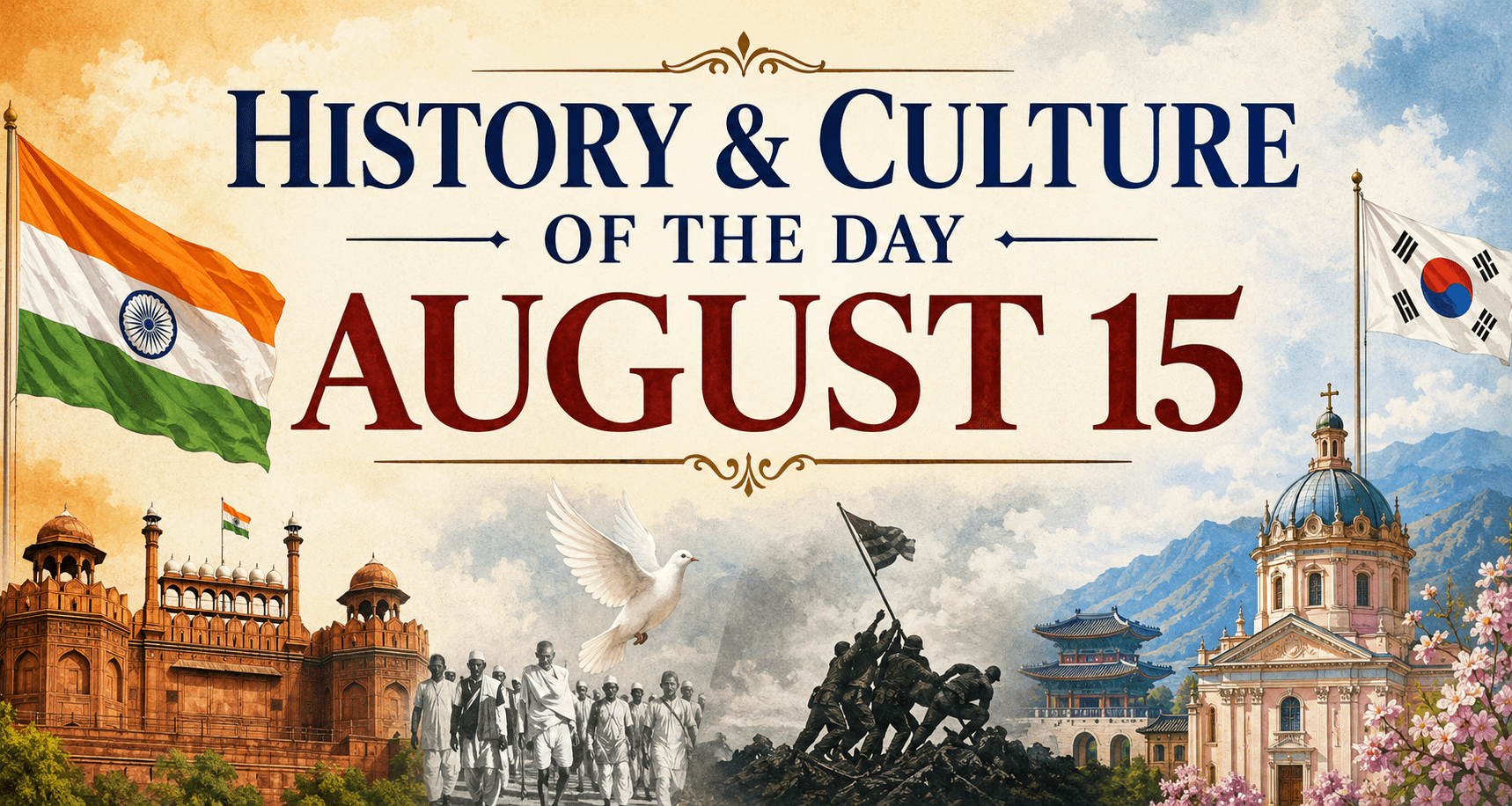
  • History & Culture of the Day – August 15

    History & Culture of the Day – August 15

    Advertisements

    Every date on the calendar carries stories from the past, but August 15 is especially rich in history and cultural significance. Across continents and centuries, this date has become associated with independence, liberation, the end of war, religious faith, ancient traditions, national identity, and remembrance.

    For hundreds of millions of people, August 15 is not simply another summer day.

    It is Independence Day in India, commemorating the end of British colonial rule in 1947. It is associated with Korea’s liberation from Japanese colonial rule in 1945. The Republic of the Congo celebrates its independence from France on this date. In Europe and elsewhere, Christians observe the Assumption of the Blessed Virgin Mary. In Italy, August 15 is also Ferragosto, a major summer celebration whose origins reach back to ancient Rome.

    The date is also inseparable from the final chapter of World War II, as Japan’s announcement accepting Allied surrender terms on August 15, 1945, signaled that the world’s deadliest conflict was finally coming to an end.

    Together, these events make August 15 a remarkable day for examining how history becomes culture—and how events from decades or even centuries ago continue to shape modern identities and traditions.


    🇮🇳 August 15, 1947 – India Becomes Independent

    One of the defining events associated with August 15 occurred in 1947, when India achieved independence from British rule.

    British influence on the Indian subcontinent stretched back centuries, initially through commercial activity associated with the British East India Company and eventually through direct colonial government.

    Resistance to British rule developed over generations.

    By the late nineteenth and early twentieth centuries, organized political movements increasingly demanded greater self-government and eventually complete independence.

    The Indian National Congress, founded in 1885, became one of the major organizations involved in the independence movement.

    Over time, numerous political leaders, activists, writers, students, workers, religious figures, and ordinary citizens became involved.

    Among the most internationally recognized was Mahatma Gandhi.


    Mahatma Gandhi and Nonviolent Resistance

    Gandhi became famous for promoting nonviolent resistance, or satyagraha, as a way of confronting injustice.

    Rather than attempting to defeat British authority primarily through armed conflict, Gandhi encouraged mass participation in peaceful demonstrations, boycotts, marches, strikes, and civil disobedience.

    One of the most famous examples occurred in 1930 with the Salt March.

    British colonial laws restricted Indians from freely producing salt and imposed taxes on it. Gandhi and his followers walked hundreds of miles to the Arabian Sea, where he symbolically produced salt in defiance of British law.

    The event attracted international attention and demonstrated the power of organized nonviolent protest.

    Gandhi’s philosophy later influenced civil-rights and social-justice movements far beyond India.

    His ideas became particularly influential to leaders such as Martin Luther King Jr., who studied Gandhi’s methods while developing strategies for the American Civil Rights Movement.

    But India’s independence movement was larger than any single person.

    Jawaharlal Nehru, Vallabhbhai Patel, Subhas Chandra Bose, B. R. Ambedkar, Muhammad Ali Jinnah, Sarojini Naidu and countless lesser-known activists all played roles in the complicated political transformation of the subcontinent.


    “A Tryst With Destiny”

    As British rule approached its end, India prepared for a historic transition.

    Near midnight on August 14–15, 1947, Jawaharlal Nehru addressed India’s Constituent Assembly.

    His famous speech became known as “Tryst with Destiny.”

    Nehru spoke about India’s emergence into independence after years of struggle and sacrifice.

    As August 15 began, a new chapter in Indian history opened.

    Nehru became the country’s first prime minister, and the Indian national flag became one of the central symbols of the newly independent nation.

    Today, India’s Independence Day remains one of the country’s most important national holidays.


    How India Celebrates Independence Day Today

    Every August 15, celebrations take place throughout India.

    The Indian tricolor is displayed prominently on homes, schools, government buildings, businesses, and public spaces.

    A major national ceremony takes place at the historic Red Fort in Delhi, where India’s prime minister raises the national flag and addresses the country.

    Schools frequently organize patriotic programs, speeches, performances, songs, and flag ceremonies.

    Communities hold celebrations highlighting India’s history and cultural diversity.

    The holiday is therefore about more than remembering the transfer of political power in 1947.

    It has become an annual celebration of Indian identity, democracy, sacrifice, culture, and national pride.


    The Other Side of 1947: Partition

    Independence brought tremendous celebration, but the events of 1947 also produced one of the most traumatic migrations in modern history.

    British India was divided primarily into two new independent dominions: India and Pakistan.

    Pakistan marks its independence on August 14, while India celebrates on August 15.

    Partition resulted largely from complicated political and religious tensions surrounding the future of the subcontinent.

    The creation of new borders suddenly placed millions of people on what they considered the “wrong” side of the boundary.

    Muslims migrated toward Pakistan, while many Hindus and Sikhs moved toward India.

    Millions were displaced.

    Families abandoned homes where generations had lived.

    Communities that had existed together for decades or centuries were separated.

    Violence erupted across several regions, resulting in enormous loss of life.

    The exact number of deaths remains debated, but historians generally agree that the human cost was staggering.

    For survivors and their descendants, Partition became an enduring part of family memory.

    This makes August 15 historically complex.

    It represents extraordinary freedom and national achievement while also reminding us that major political transformations can carry painful human consequences.


    🇯🇵 August 15, 1945 – Japan Announces Its Surrender

    Two years before India’s independence, August 15 became associated with another enormous historical turning point.

    In 1945, World War II had devastated much of Europe and Asia.

    Germany had surrendered in May, ending the war in Europe, but fighting continued in the Pacific.

    By the summer of 1945, Japan faced devastating military losses, widespread destruction, naval blockades, and bombing campaigns.

    Then came two events that would forever remain among the most debated and consequential moments of the war.

    The United States dropped an atomic bomb on Hiroshima on August 6, 1945, followed by another atomic bomb on Nagasaki on August 9.

    The Soviet Union also entered the war against Japan in August.

    Faced with a rapidly deteriorating situation, Japan moved toward accepting the Allied surrender terms.

    On August 15 in Japan, Emperor Hirohito’s recorded announcement was broadcast to the Japanese people, communicating acceptance of the Potsdam Declaration.

    The war was effectively ending.


    Victory Celebrations Across the Allied World

    The news produced extraordinary scenes of celebration.

    After nearly six years of global warfare—and almost four years of direct American involvement—millions of people finally believed peace was returning.

    Crowds gathered in cities throughout the United States and other Allied nations.

    People danced in streets.

    Church bells rang.

    Flags appeared everywhere.

    Strangers hugged one another.

    Families began imagining their loved ones returning from overseas.

    For those who had spent years following casualty reports and worrying about soldiers, sailors, Marines, and airmen, the announcement represented tremendous relief.

    The celebrations became associated with Victory over Japan Day, often shortened to V-J Day.


    The Famous Times Square Photograph

    One of the most recognizable photographs connected with the end of World War II was taken amid the celebrations in Times Square in New York City.

    The photograph shows a sailor kissing a woman dressed in white while crowds celebrate around them.

    Photographer Alfred Eisenstaedt captured the famous image for Life magazine.

    Another photographer, Victor Jorgensen, photographed the same moment from a different angle.

    The image became one of the most recognizable photographs of the twentieth century and came to symbolize the spontaneous excitement surrounding the end of the war.

    Modern discussion of the photograph has also examined the circumstances of the kiss and questions of consent, demonstrating how cultural interpretations of historical images can change over time.

    History does not remain frozen. Later generations often reconsider famous moments through new social and cultural perspectives.


    September 2, 1945 – The Formal Surrender

    Although August 15 is closely associated with Japan’s surrender announcement, the formal surrender ceremony occurred several weeks later.

    On September 2, 1945, Japanese representatives boarded the American battleship USS Missouri in Tokyo Bay.

    Representatives of Japan and the Allied powers signed the official surrender documents.

    World War II was formally over.

    The conflict had transformed nearly every aspect of international politics.

    Tens of millions of people had died.

    Cities had been destroyed.

    Entire populations had been displaced.

    The Holocaust had murdered six million Jews along with millions of other victims of Nazi persecution and warfare.

    The atomic age had begun.

    And the international balance of power had dramatically changed.

    August 15 therefore represents both celebration and remembrance.


    A New World Emerges After World War II

    The end of World War II did not simply restore the world that existed before 1939.

    It created something new.

    The United States and Soviet Union emerged as rival superpowers.

    Their ideological and political competition soon developed into the Cold War.

    Europe began the long process of rebuilding.

    The United Nations, established in 1945, attempted to create a new international framework for diplomacy, security, development, and human rights.

    Colonial empires increasingly faced demands for independence.

    Nationalist movements expanded throughout Asia, Africa, the Middle East, and elsewhere.

    Within only a few decades, dozens of new nations would emerge.

    The postwar world also witnessed tremendous technological advancement.

    Aviation expanded.

    Television entered millions of homes.

    Nuclear technology transformed military strategy.

    Medicine advanced.

    Space exploration began.

    Computers eventually transformed society.

    The world after August 1945 would never be the same.


    🇰🇷 August 15 – Korea’s National Liberation Day

    August 15 also holds extraordinary significance for the Korean people.

    From 1910 until 1945, Korea was under Japanese colonial rule.

    Korean language, political activity, economic life, education, and cultural identity were heavily affected by colonial policies.

    Resistance movements developed both inside and outside Korea.

    When Japan surrendered in August 1945, decades of colonial rule ended.

    August 15 became a symbol of liberation.

    In South Korea, the holiday is known as Gwangbokjeol, commonly translated as “Restoration of Light Day.”

    The name itself is powerful.

    It represents the idea that national sovereignty and identity had returned after a long period of foreign domination.


    Korea After Liberation

    Liberation did not immediately create a unified independent Korean state.

    After Japan’s surrender, Korea was divided into occupation zones.

    Soviet forces occupied the north while American forces occupied the south.

    Political tensions increased as the Cold War developed.

    In 1948, separate governments emerged.

    The Republic of Korea, commonly called South Korea, was established on August 15, 1948.

    The Democratic People’s Republic of Korea, commonly called North Korea, was established shortly afterward.

    Only a few years later, the Korean War began in 1950.

    The conflict devastated the peninsula and reinforced the division between North and South.

    No comprehensive peace treaty has ever formally ended the Korean War; the large-scale fighting stopped with an armistice in 1953.

    This makes August 15 particularly meaningful in Korean history.

    It represents liberation and national pride, but it also sits at the beginning of a complicated postwar period that ultimately produced the divided Korean Peninsula that exists today.


    🇨🇬 August 15, 1960 – Independence for the Republic of the Congo

    Another important independence anniversary falls on August 15.

    On August 15, 1960, the Republic of the Congo gained independence from France.

    The country, sometimes called Congo-Brazzaville to distinguish it from the neighboring Democratic Republic of the Congo, had been part of French colonial Africa.

    Its independence came during one of the greatest periods of political transformation in African history.


    1960 – The “Year of Africa”

    The year 1960 is frequently called the “Year of Africa.”

    Seventeen African countries gained independence during that single year.

    Across the continent, colonial systems that European powers had established during the nineteenth and early twentieth centuries were rapidly changing.

    New national flags were raised.

    New governments formed.

    Political leaders faced the enormous challenge of building institutions, economies, education systems, diplomatic relationships, and national identities after colonial rule.

    The Republic of the Congo was part of this historic transformation.

    Its August 15 independence anniversary remains an important celebration of national sovereignty.


    ⛪ August 15 – The Assumption of the Blessed Virgin Mary

    Long before the political events of the twentieth century, August 15 already held major religious importance.

    For Roman Catholics and some other Christian traditions, August 15 is associated with the Assumption of the Blessed Virgin Mary.

    Catholic teaching holds that Mary, the mother of Jesus Christ, was taken body and soul into heavenly glory at the end of her earthly life.

    The belief has ancient roots in Christian tradition.

    In 1950, Pope Pius XII formally defined the Assumption as a dogma of the Roman Catholic Church.

    But celebrations connected with Mary’s departure from earthly life existed many centuries before the formal declaration.


    A Celebration Across Cultures

    The Assumption is particularly interesting because the same religious observance can look very different depending on local culture.

    In some communities, people attend special Masses.

    Elsewhere there are elaborate processions carrying statues or images of Mary.

    Church bells may ring.

    Flowers decorate churches.

    Families gather for meals.

    Towns organize festivals.

    Music, dancing, fireworks, and local foods may accompany the religious observance.

    In several traditionally Catholic countries, August 15 is also a public holiday.

    The result is a fascinating combination of faith, family, community, and cultural tradition.


    🇮🇹 Ferragosto – Italy’s Great August Holiday

    Few countries embrace August 15 quite like Italy.

    The Italian celebration known as Ferragosto combines ancient Roman history, Christian tradition, family gatherings, travel, food, and summer vacation.

    Its origins stretch back more than two thousand years.

    The name Ferragosto is derived from the Latin Feriae Augusti, or the “rest of Augustus.”

    The holiday was associated with Roman Emperor Augustus, whose reign began an important period in Roman history.

    Ancient festivities offered a period of rest after demanding agricultural labor.

    Workers, farmers, and animals could receive relief from work while communities participated in celebrations.


    From Ancient Rome to Christian Italy

    As Christianity became dominant within the Roman world, older cultural traditions were often transformed or incorporated into Christian calendars.

    Over the centuries, Ferragosto became closely connected with the Feast of the Assumption on August 15.

    The result is a holiday with layers of history.

    Its roots reach into ancient Roman civilization.

    Its religious meaning comes from Christianity.

    Its modern form reflects contemporary Italian culture.

    That combination demonstrates something important about culture: traditions rarely remain unchanged.

    Instead, societies reinterpret customs generation after generation.


    What Ferragosto Looks Like Today

    Modern Ferragosto is one of the highlights of the Italian summer.

    For many Italians, mid-August means vacation.

    Cities can become noticeably quieter as residents travel to coastal towns, mountain communities, countryside destinations, lakes, or family homes.

    Beaches fill with vacationers.

    Families organize large meals.

    Restaurants and resorts may host special events.

    Communities hold festivals and concerts.

    Fireworks often illuminate summer skies.

    Friends gather outdoors.

    Food naturally plays an important role.

    Regional dishes vary dramatically because Italian cuisine is strongly connected with local traditions.

    Ferragosto is therefore more than a single holiday.

    It represents the Italian appreciation of family, food, leisure, community, tradition, and summer life.


    Why National Holidays Matter

    The events associated with August 15 demonstrate why national holidays are about more than taking a day off from work.

    National celebrations help societies tell stories about themselves.

    They answer questions such as:

    Who are we?

    Where did we come from?

    What struggles shaped our country?

    Which sacrifices should we remember?

    What values do we want future generations to preserve?

    Independence celebrations frequently include flags, monuments, speeches, songs, parades, military ceremonies, traditional clothing, and historical reenactments because these symbols reinforce a shared national story.

    But those stories can also be complicated.

    Independence for one group may have coincided with displacement for another.

    Military victory can be remembered alongside devastating civilian suffering.

    Liberation may be followed by political division.

    Good historical understanding requires making room for those complexities.


    History Is More Than Dates and Names

    When people think about history, they sometimes imagine memorizing dates from textbooks.

    But history becomes much more meaningful when we examine the people behind those dates.

    Imagine being an Indian family waking up on August 15, 1947, realizing British colonial rule had ended.

    Imagine being a Korean family in August 1945 hearing that decades of Japanese colonial rule were over.

    Imagine being an American parent learning that the Pacific War was ending and hoping a son or daughter serving overseas would soon return home.

    Imagine living in the Republic of the Congo in 1960 as your country became independent.

    Or imagine an Italian family continuing a summer tradition whose origins reach back through generations and ultimately to ancient Rome.

    Those human experiences are what turn historical dates into living memory.


    Culture Keeps History Alive

    Culture is one of the primary ways societies preserve their past.

    People tell stories.

    They cook traditional foods.

    They sing songs.

    They raise flags.

    They attend religious services.

    They visit monuments.

    They gather with relatives.

    They teach children why certain dates matter.

    Eventually, an event that happened decades or centuries ago becomes part of a community’s identity.

    That is why history and culture are so closely connected.

    History records what happened. Culture helps determine how people remember it.


    Different Countries, Similar Human Themes

    India, Korea, the Republic of the Congo, Italy, Japan, and the United States have very different histories.

    Yet the August 15 stories associated with these places reveal several shared human themes.

    Freedom

    People throughout history have struggled for the ability to determine their own political futures.

    Identity

    Language, religion, customs, food, music, clothing, and shared memories help communities understand who they are.

    Sacrifice

    Major historical transformations frequently come at enormous human cost.

    Remembrance

    Societies create holidays and memorials so important events are not forgotten.

    Faith

    Religious traditions connect people not only with their beliefs but also with generations who practiced those traditions before them.

    Community

    Celebrations bring people together and transform historical memory into a shared experience.

    Renewal

    Many August 15 observances involve the beginning of something new—independence, liberation, peace, sovereignty, or spiritual hope.


    August 15 Through the Generations

    Perhaps the most fascinating part of August 15 is how dramatically its meaning changes depending on where you are standing.

    A child in India may associate the day with flags, school celebrations, patriotic songs, and stories about independence.

    Someone in South Korea may think about liberation and national identity.

    A family in Italy may associate August 15 with Mass, Ferragosto, vacation, the beach, and a large family meal.

    A World War II historian may immediately think about Japan’s surrender announcement.

    A family whose relative served in the Pacific may think about an old photograph, military uniform, medal, or story passed down from a grandparent.

    History becomes personal in this way.

    A date on a calendar can connect global events with individual family stories.


    Preserving History for Future Generations

    As the people who personally witnessed events such as World War II and Indian independence grow fewer, preserving historical memory becomes increasingly important.

    Documents, photographs, oral histories, letters, newspapers, museums, monuments, recordings, and family stories allow future generations to understand events they never personally experienced.

    But preserving history requires more than keeping artifacts.

    We must also continue asking questions.

    What happened?

    Why did it happen?

    Who was affected?

    Whose voices were overlooked?

    How did the event change society?

    What can we learn from it today?

    Those questions transform history from memorization into understanding.


    What August 15 Can Teach Us

    August 15 demonstrates that history rarely fits neatly into categories of celebration or tragedy.

    Sometimes both exist together.

    India’s independence brought freedom while Partition brought tremendous suffering.

    Japan’s surrender brought relief and peace after a devastating war while leaving nations to confront enormous destruction and loss.

    Korea’s liberation ended colonial rule but was followed by political division and eventually war.

    African independence created sovereign nations while newly independent governments faced enormous political and economic challenges.

    Even ancient cultural traditions such as Ferragosto demonstrate change, adaptation, and continuity over thousands of years.

    History is complicated because human beings are complicated.

    Recognizing that complexity does not diminish celebrations. It gives them greater meaning.


    August 15: A Day of Independence, Liberation, Faith, and Remembrance

    Few dates bring together as many different chapters of human history as August 15.

    It is a day when India celebrates independence.

    It is a day when Koreans remember liberation.

    It is the independence anniversary of the Republic of the Congo.

    It is deeply connected with the end of World War II.

    It is the Christian Feast of the Assumption.

    And throughout Italy, it is Ferragosto, one of the most beloved celebrations of the summer.

    These traditions developed in different places and for very different reasons, yet they share powerful themes.

    Freedom.

    Faith.

    Identity.

    Sacrifice.

    Family.

    Community.

    Remembrance.

    Hope.

    The stories of August 15 remind us that history is not simply something that happened long ago.

    History continues to live through the traditions we practice, the stories we tell, the people we remember, and the lessons we choose to carry forward.

    Every generation inherits the stories of those who came before it.

    Our responsibility is to learn those stories, preserve them, understand their complexities, and pass them along.

    That is why August 15 is more than another date on the calendar.

    It is a remarkable window into the struggles, celebrations, beliefs, and traditions that have shaped our shared human story.

  • This Day in American History – August 15

    Advertisements

    Every date on the calendar carries pieces of America’s story, and August 15 is no exception. Across generations, this day has been connected to extraordinary achievements, heartbreaking losses, military turning points, and cultural moments that continue to influence how we understand the United States today.

    On August 15, the Panama Canal officially opened to shipping, two celebrated Americans died together in an aviation accident, the world reacted to Japan’s surrender at the end of World War II, Woodstock began in New York, and American combat operations in Southeast Asia reached an important conclusion.

    Together, these moments demonstrate something important about studying history: history isn’t simply about memorizing dates. It’s about understanding the people, decisions, challenges, and consequences behind them.

    Let’s travel through the years and explore some of the notable events associated with August 15 in American history.


    1914 – The Panama Canal Officially Opens

    One of the greatest engineering accomplishments of the early 20th century reached a historic milestone on August 15, 1914, when the Panama Canal officially opened to shipping. The Library of Congress records the opening on that date, while the National Archives notes that the canal’s larger official celebration was postponed because World War I had just erupted in Europe.

    The steamship SS Ancon made the historic official passage through the canal.

    It was the beginning of a new era in global transportation.

    Why the Panama Canal Mattered

    Before the canal existed, ships traveling between America’s Atlantic and Pacific coasts often faced an enormously long voyage around the southern tip of South America.

    The Panama Canal provided a shortcut across Central America.

    Instead of navigating thousands of additional miles around South America, ships could cross through Panama and move between the Atlantic and Pacific oceans far more efficiently.

    Its importance extended well beyond convenience.

    The canal influenced:

    • International trade
    • American commerce
    • Naval strategy
    • Military planning
    • Global shipping
    • America’s influence in the Western Hemisphere

    The ability to move naval vessels between oceans was particularly important to the United States.

    At a time when America was becoming increasingly involved in international affairs, the canal gave the country an enormous strategic advantage.

    An Extraordinary Engineering Challenge

    Building the canal was anything but easy.

    Workers faced tropical heat, dangerous terrain, landslides, difficult construction conditions, and diseases such as yellow fever and malaria.

    Entire landscapes had to be transformed.

    Massive locks had to be constructed to raise and lower ships as they traveled through the canal system.

    The project required engineering on a scale rarely attempted before.

    The National Archives notes that the American Society of Civil Engineers has recognized the Panama Canal as one of the great civil-engineering wonders of the world.

    When the canal opened on August 15, 1914, it represented years of difficult work and dramatically changed global transportation.


    1935 – America Loses Will Rogers and Wiley Post

    August 15 also carries a tragic chapter in American history.

    On August 15, 1935, humorist and entertainer Will Rogers and famous aviator Wiley Post died when their airplane crashed near Point Barrow, Alaska.

    Both men were enormously admired during their lifetimes, although for very different reasons.

    Will Rogers – America’s Beloved Humorist

    Will Rogers became one of the most recognizable entertainers in America.

    He was an actor, newspaper columnist, radio personality, performer, and political humorist.

    Rogers had an unusual ability to comment on politics and society while remaining relatable to ordinary Americans.

    His humor often pointed out the absurdities of politics without becoming unnecessarily cruel.

    During difficult periods, including the Great Depression, his observations offered Americans both laughter and perspective.

    Rogers became much more than an entertainer.

    For many Americans, he felt like a familiar friend.

    Wiley Post – Aviation Pioneer

    Wiley Post represented another side of the rapidly changing America of the early 20th century.

    He was an aviation pioneer during an era when flying remained dangerous and experimental.

    Post became internationally famous for his long-distance flights and aviation records. In 1933, he completed the first solo flight around the world.

    His achievements helped demonstrate what aircraft and pilots might eventually accomplish.

    Post also experimented with high-altitude flight and technologies that contributed to the future development of aviation.

    A Nation Mourns

    Rogers and Post were traveling through Alaska together when their aircraft crashed shortly after takeoff.

    Both men were killed.

    The accident shocked the United States.

    America had lost two highly recognizable figures at once—one who helped the country laugh and another who helped push aviation toward the future.

    Their deaths remain one of the notable American tragedies associated with August 15.


    1945 – Japan Announces Its Surrender to Its People

    Perhaps the most historically significant August 15 event came in 1945, during the final days of World War II.

    By the summer of 1945, the war in Europe had already ended.

    Germany had surrendered in May.

    But the war against Japan continued.

    American forces had endured devastating battles across the Pacific, including Iwo Jima and Okinawa, and military planners were preparing for the possibility of an invasion of the Japanese home islands.

    Then the final phase of the war unfolded rapidly.

    The United States dropped an atomic bomb on Hiroshima on August 6.

    The Soviet Union entered the war against Japan.

    A second atomic bomb was dropped on Nagasaki on August 9.

    Japanese leaders faced a decision that would determine the future of their country.

    Emperor Hirohito eventually intervened in favor of accepting the Allied surrender terms.

    Japan accepted those terms on August 14, 1945, U.S. time. President Harry S. Truman announced the news that evening, sending Americans into the streets to celebrate.

    Because of the international time difference, an equally important moment occurred the following day.

    At noon in Japan on August 15, Hirohito’s recorded announcement was broadcast to the Japanese people, telling them that the government would accept the terms of the Potsdam Declaration.

    For many Japanese citizens, it was the first time they had ever heard their emperor’s voice.


    Americans Celebrate the End of World War II

    News of Japan’s surrender produced scenes of extraordinary celebration throughout the United States.

    People poured into streets.

    Strangers hugged.

    Car horns sounded.

    Flags appeared everywhere.

    Newspapers rushed out special editions announcing that the war was ending.

    In New York City, enormous crowds gathered in Times Square.

    The celebration produced one of the most famous photographs in American history—a sailor kissing a woman amid the jubilant crowd.

    Similar celebrations occurred throughout the country.

    The National WWII Museum describes parades, fireworks, confetti and spontaneous celebrations occurring in communities large and small.

    For families who had spent years worrying about loved ones serving overseas, the announcement brought extraordinary relief.

    Perhaps their sons, husbands, fathers, brothers and friends would finally come home.

    But the celebrations were also bittersweet.

    Hundreds of thousands of Americans had died during World War II, while the global death toll reached into the tens of millions. Victory couldn’t erase the enormous human cost of the conflict.

    Was August 15 Officially V-J Day in America?

    The answer requires an important historical distinction.

    Japan accepted the Allied surrender terms on August 14 in the United States, while Hirohito’s announcement was broadcast in Japan on August 15.

    The formal surrender had not yet been signed.

    President Truman specifically waited to officially proclaim V-J Day until the formal surrender occurred.

    That happened aboard the battleship USS Missouri in Tokyo Bay on September 2, 1945.

    Representatives of Japan and the Allied powers signed the surrender documents, formally bringing World War II to an end.

    That’s why different countries and historical accounts sometimes associate V-J Day with August 14, August 15, or September 2.

    Regardless of the exact commemorative date, August 15 remains deeply connected to the ending of World War II.


    1969 – Woodstock Begins

    Twenty-four years after the dramatic events surrounding the end of World War II, another very different moment in American history began on August 15.

    On August 15, 1969, the Woodstock Music and Art Fair began near Bethel, New York.

    Few could have predicted how deeply the event would become embedded in American culture.

    What began as a music festival ultimately became a symbol of an entire generation.

    Hundreds of Thousands Arrive

    Organizers expected a large crowd.

    What they received was overwhelming.

    Hundreds of thousands of people traveled to the site.

    Roads became hopelessly congested.

    Cars were abandoned.

    People walked long distances to reach the festival.

    Food and supplies became difficult to manage.

    Rain transformed parts of the festival grounds into mud.

    Yet the festival continued.

    Over several days, some of the most influential musicians of the era performed before the enormous crowd.

    The lineup included legendary names such as:

    • Jimi Hendrix
    • Janis Joplin
    • The Who
    • Santana
    • Jefferson Airplane
    • Creedence Clearwater Revival
    • Joe Cocker
    • Crosby, Stills, Nash & Young

    Many of those performances became part of rock-and-roll history.

    More Than a Music Festival

    Woodstock happened during one of America’s most turbulent decades.

    The country had experienced:

    The Vietnam War.

    The Civil Rights Movement.

    Political assassinations.

    Antiwar protests.

    Generational conflict.

    Changing attitudes toward race, relationships, authority, music, fashion, and personal freedom.

    For many young Americans, Woodstock represented their generation’s desire for something different.

    The festival became associated with the counterculture movement and ideas about peace, music, community, and opposition to war.

    The reality of Woodstock was certainly messier than the legend.

    There were logistical problems, shortages, rain, mud, overcrowding, and other challenges.

    But the cultural image survived.

    Decades later, simply saying “Woodstock” immediately brings to mind the late 1960s and the enormous cultural transformation America was experiencing.


    1973 – U.S. Combat Operations in Southeast Asia End

    Only four years after Woodstock, another chapter connected to the Vietnam era reached an important turning point.

    On August 15, 1973, American bombing operations in Cambodia stopped.

    The bombing halt effectively marked the end of direct U.S. combat operations in Southeast Asia.

    The moment came after years of American military involvement that had transformed both Southeast Asia and the United States.

    America’s Long Vietnam Era

    American involvement in Vietnam had grown gradually.

    During the 1960s, the number of American military personnel in Vietnam increased dramatically.

    By the height of the conflict, hundreds of thousands of American troops were serving there.

    The war became increasingly controversial at home.

    Television brought images of combat into American living rooms.

    Families worried about loved ones overseas.

    College campuses became centers of antiwar activism.

    Protests grew.

    Political divisions deepened.

    The conflict affected American elections and changed how many citizens viewed their government.

    By the early 1970s, the United States was trying to reduce its direct involvement.

    The Paris Peace Accords were signed in January 1973, and American combat troops withdrew from Vietnam.

    But American bombing operations continued in Cambodia.

    Congress eventually required those operations to stop.

    On August 15, the bombing ceased.

    For the United States, it marked the effective end of roughly a dozen years of direct American combat operations in Southeast Asia.

    The Vietnam War Wasn’t Over

    It’s important to distinguish the end of American combat operations from the end of the war itself.

    Fighting continued after American forces withdrew.

    In April 1975, North Vietnamese forces captured Saigon.

    South Vietnam collapsed.

    Vietnam was eventually reunified under communist rule.

    For Americans, the war left lasting questions about military intervention, presidential authority, foreign policy, patriotism, protest, and the treatment of returning veterans.

    Those debates continued long after the fighting ended.


    What August 15 Tells Us About America

    Looking at these events together creates a remarkable snapshot of the American experience.

    1914 brought engineering and expansion.

    The Panama Canal demonstrated what enormous infrastructure projects could accomplish while strengthening America’s economic and military reach.

    1935 brought tragedy.

    America mourned Will Rogers and Wiley Post, two men who represented entertainment, exploration, innovation, and optimism.

    1945 brought victory and relief.

    After years of sacrifice, Americans learned that Japan would surrender and the most destructive war in human history was finally ending.

    1969 brought cultural revolution.

    Woodstock became a defining image of a generation questioning established ideas and expressing itself through music and counterculture.

    1973 brought the ending of an American military era.

    Direct U.S. combat operations in Southeast Asia concluded after years of warfare and intense political division.

    Few individual dates demonstrate the diversity of American history quite like August 15.


    The People Behind the History

    One of the easiest mistakes to make when studying history is reducing enormous events to dates and statistics.

    History becomes more meaningful when we remember the people living through those moments.

    Imagine being aboard a ship approaching the Panama Canal in 1914 and witnessing an engineering achievement many people once believed impossible.

    Imagine opening the newspaper in 1935 and discovering that Will Rogers and Wiley Post had died.

    Imagine being the parent of an American serviceman in August 1945 and hearing that Japan had surrendered.

    Imagine being a young person walking toward a farm in New York in 1969 without realizing the concert you were attending would become legendary.

    Imagine being an American service member or veteran watching the country’s long military involvement in Southeast Asia finally wind down.

    To us, these moments are history.

    To them, they were simply today.

    That’s what makes history so fascinating.

    The people experiencing these events didn’t know exactly how future generations would remember them.


    Why This Day in American History Matters

    Studying history gives us more than facts.

    It gives us perspective.

    America’s story contains incredible achievements and painful mistakes, moments of unity and periods of division, celebrations and tragedies.

    Understanding all of them helps us better understand the country today.

    The opening of the Panama Canal demonstrates the power of engineering and infrastructure to reshape commerce and geopolitics.

    The deaths of Will Rogers and Wiley Post remind us of the individuals whose personalities and accomplishments helped define their eras.

    The events of August 1945 remind us of both the extraordinary relief that came with the end of World War II and the staggering human cost of global conflict.

    Woodstock shows how culture can become part of history just as surely as wars, elections, and political decisions.

    And August 15, 1973, reminds us that military conflicts continue shaping nations long after the final American bombs fall or troops return home.


    Remembering August 15

    From the enormous locks of the Panama Canal to the muddy fields of Woodstock, August 15 connects moments that seem almost impossible to place on the same calendar page.

    Yet that is the remarkable thing about history.

    One date can contain stories of invention, tragedy, victory, music, war, peace, courage, controversy, and change.

    On August 15, 1914, ships began passing through a canal that transformed global transportation.

    On August 15, 1935, America mourned Will Rogers and Wiley Post.

    On August 15, 1945, Emperor Hirohito’s surrender announcement was heard across Japan while the world celebrated the approaching end of World War II.

    On August 15, 1969, Woodstock began and became one of the defining cultural events of the era.

    And on August 15, 1973, American bombing in Cambodia ended, marking the conclusion of direct U.S. combat operations in Southeast Asia.

    Different generations.

    Different struggles.

    Different versions of America.

    But all connected by one date.

    A Thought for Today

    History is being created every day.

    The people who witnessed the Panama Canal open, celebrated the end of World War II, attended Woodstock, or watched America’s involvement in Southeast Asia come to a close were experiencing events whose significance wasn’t always immediately clear.

    Years later, we can see how those moments helped shape the world that followed.

    That’s why remembering history matters.

    When we understand where we’ve been, we gain a better understanding of where we are—and perhaps a little more wisdom about where we’re going.

    Engagement Question

    Which August 15 moment would you most want to witness in person—the opening of the Panama Canal, the celebrations at the end of World War II, Woodstock in 1969, or another historic event from this date? Why?

  • History & Culture of the Day – August 14

    Advertisements

    Every day on the calendar carries stories from the past, but August 14 is particularly rich in history and culture. Across the centuries, this date has witnessed political change, technological progress, international conflict, independence, social reform, cultural transformation, and moments that continue to influence our world.

    August 14 takes us from medieval Scotland to the birth of modern printing, across the American frontier, through the Great Depression and World War II, into the creation of a new nation, and eventually into the age of professional sports, popular music, and interconnected technology.

    Some of these events were celebrated. Others were born from conflict or tragedy. Together, however, they demonstrate something important: history is the accumulated story of human choices and their consequences.

    When we study history and culture, we aren’t simply memorizing dates. We’re discovering how people before us lived, what they believed, what they fought for, what they created, and how their decisions helped shape the world inherited by later generations.

    Let’s travel through time and explore some of the fascinating events connected to August 14.


    1040 – Macbeth Defeats King Duncan I of Scotland

    One of the earliest significant events associated with August 14 occurred in medieval Scotland.

    On August 14, 1040, King Duncan I was killed in battle against forces led by Macbeth. Macbeth subsequently became King of Scots.

    If the name Macbeth sounds familiar, there is a good reason.

    More than five centuries later, playwright William Shakespeare transformed Macbeth’s story into one of the most famous tragedies in Western literature.

    Shakespeare’s Macbeth tells the story of an ambitious Scottish nobleman whose desire for power ultimately destroys him.

    However, the historical Macbeth was considerably different from Shakespeare’s character.

    The real Macbeth ruled Scotland for approximately 17 years. Shakespeare dramatically altered historical events and personalities to create a compelling theatrical story.

    That difference between the historical person and the literary character provides a fascinating lesson about the relationship between history and culture.

    Historical events frequently become legends.

    Legends become stories.

    Stories become books, plays, movies, songs, and traditions.

    Eventually, the cultural version of a person or event can become better known than the actual history.

    More than 900 years after Duncan’s death, people around the world still recognize the name Macbeth—not necessarily because they have studied medieval Scottish history, but because literature kept the story alive.


    1457 – The Mainz Psalter Marks a Milestone in Printing History

    August 14 also holds an important place in the history of the printed word.

    On August 14, 1457, the Mainz Psalter was completed in Mainz, in what is now Germany.

    Produced by Johann Fust and Peter Schöffer, it was one of the remarkable early achievements of European movable-type printing.

    The book was notable for several reasons, including its elaborate printing and its inclusion of a printed publication date.

    That might sound ordinary today.

    We expect books, newspapers, magazines, websites, and articles to tell us when they were published.

    But during the earliest years of European printing, these standards were still developing.

    The broader printing revolution fundamentally changed civilization.

    Before mechanical printing became widespread, books had to be copied by hand or produced through labor-intensive methods. Books could be expensive, rare, and difficult for ordinary people to obtain.

    Printing gradually changed that.

    Books could be produced in larger numbers.

    Ideas could travel farther.

    Scientific discoveries could be shared more efficiently.

    Political arguments could reach wider audiences.

    Religious texts could circulate among growing populations.

    Education and literacy could expand.

    Eventually, printed newspapers helped create mass public communication.

    Today we live in another information revolution.

    Instead of waiting for a printed book to cross continents, information can travel around the world in seconds.

    A person can publish an article, photograph, video, or opinion and potentially reach millions of people almost instantly.

    Yet the basic human desire remains the same: we want to record our thoughts and share them with others.


    1848 – The United States Creates the Oregon Territory

    On August 14, 1848, the United States formally organized the Oregon Territory.

    The territory initially covered a vast portion of the Pacific Northwest.

    During the 19th century, increasing numbers of American settlers traveled west along routes such as the Oregon Trail, often enduring months of difficult travel.

    Families packed their belongings into wagons and traveled enormous distances hoping to find farmland, opportunity, and a new beginning.

    The journey became one of the defining stories of American westward expansion.

    But this chapter of American history must also include the experiences of the Indigenous peoples who had lived throughout these lands for countless generations.

    Native nations had their own governments, communities, languages, spiritual traditions, trade networks, and cultures long before American settlers arrived.

    Westward expansion brought enormous disruption.

    Indigenous communities faced displacement, violence, disease, loss of land, forced treaties, and government policies designed to alter or suppress traditional cultures.

    Understanding history means recognizing these different experiences.

    For some Americans, westward expansion represented opportunity.

    For many Indigenous communities, it represented devastating loss.

    Both realities belong in the historical record.


    1885 – Japan’s First Patents and the Growth of Innovation

    August 14 also has an important connection to technological development in Japan.

    In 1885, Japan issued its first patents under its newly established patent system.

    Patent systems are designed to encourage innovation by giving inventors temporary legal protection for their creations.

    The significance of this early milestone becomes even more interesting when viewed through the history that followed.

    During the 20th century, Japan became internationally recognized for advances in manufacturing, engineering, automobiles, electronics, cameras, entertainment technology, robotics, and countless consumer products.

    Japanese companies and inventors helped transform everyday life around the world.

    Innovation rarely happens overnight.

    Technological progress usually develops through generations of experimentation, investment, education, competition, and creativity.

    The patent milestone of 1885 therefore represents part of a much larger story about Japan’s transformation into a major industrial and technological power.


    1935 – Franklin D. Roosevelt Signs the Social Security Act

    One of the most important pieces of American social legislation became law on August 14, 1935.

    President Franklin D. Roosevelt signed the Social Security Act during the Great Depression.

    The economic situation facing the United States at the time was devastating.

    The stock market crash of 1929 had been followed by years of severe economic hardship.

    Businesses failed.

    Banks collapsed.

    Millions of Americans lost jobs.

    Families struggled to afford food and housing.

    Older Americans were particularly vulnerable because many had little or no retirement savings.

    The Social Security Act was part of Roosevelt’s broader New Deal, a collection of programs and reforms intended to provide relief, encourage economic recovery, and reshape parts of the country’s economic system.

    The law established a federal system of old-age benefits and included provisions involving unemployment and public assistance.

    Social Security would evolve considerably over the decades.

    Today, the program remains deeply connected to retirement and financial security for millions of Americans.

    Whether people debate its funding, benefits, future, or structure, there is little question that Social Security became one of the most influential federal programs in modern American history.


    1941 – Roosevelt and Churchill Announce the Atlantic Charter

    The world was already engulfed in World War II when another important August 14 event occurred.

    President Franklin D. Roosevelt and British Prime Minister Winston Churchill met aboard warships in the North Atlantic in August 1941.

    Their discussions resulted in a declaration of shared principles that became known as the Atlantic Charter, announced on August 14.

    Among the principles expressed were ideas involving self-determination, international economic cooperation, improved living standards, freedom of the seas, and hopes for lasting peace.

    The timing is especially interesting because the United States had not yet officially entered World War II.

    That would change dramatically on December 7, 1941, when Japan attacked Pearl Harbor.

    The United States entered the war shortly afterward.

    The Atlantic Charter became significant beyond the immediate conflict because some of its principles influenced discussions about the postwar international order.

    Those ideas would later be connected to the creation and development of international institutions, including the United Nations.


    August 14, 1945 – The World Learns That World War II Is Ending

    Perhaps no event connected to August 14 carries greater global significance than what happened in 1945.

    World War II had devastated much of the planet.

    Tens of millions of people had died.

    Cities had been destroyed.

    Families had been separated.

    Entire populations had experienced occupation, persecution, starvation, imprisonment, and displacement.

    Nazi Germany had surrendered in May 1945, ending the war in Europe.

    But fighting continued in the Pacific.

    Then came a series of dramatic events.

    The United States dropped an atomic bomb on Hiroshima on August 6, 1945.

    A second atomic bomb was dropped on Nagasaki on August 9.

    The Soviet Union also entered the war against Japan.

    Japan’s government then moved toward accepting the Allied terms of surrender.

    On August 14 in the United States, news spread that Japan had accepted the terms.

    For millions of people, the announcement meant something they had desperately hoped to hear:

    The war was ending.


    Celebrations Erupt Across America

    News traveled quickly.

    People poured into the streets.

    Church bells rang.

    Car horns sounded.

    Newspapers rushed to publish special editions.

    Strangers hugged and celebrated together.

    For families with loved ones serving overseas, the announcement meant soldiers, sailors, Marines, and airmen might finally be coming home.

    For servicemen preparing for possible future battles, it meant they might not have to fight another invasion.

    The relief was enormous.

    Cities across the United States experienced spontaneous celebrations.

    Few locations became more famous than Times Square in New York City.

    Thousands gathered as the news spread.

    Photographs captured streets filled with people celebrating the anticipated end of years of war.


    The Famous Times Square Kiss

    One image from those celebrations became one of the most recognizable photographs of the 20th century.

    Photographer Alfred Eisenstaedt photographed a sailor kissing a woman dressed in white amid the Times Square celebration.

    The image became widely known as “V-J Day in Times Square.”

    For decades, it was often presented as a symbol of spontaneous joy at the end of World War II.

    The photograph appeared in books, documentaries, exhibitions, magazines, and historical retrospectives.

    However, cultural interpretations can change over time.

    More recent discussions have examined the circumstances of the kiss, including questions about consent.

    That changing interpretation demonstrates an important aspect of culture.

    A photograph can remain exactly the same while society’s understanding of it evolves.

    Historical artifacts don’t merely tell us about the moment when they were created.

    They can also reveal how later generations understand the past.


    The Formal End of World War II

    Although the surrender announcement sparked celebrations in August, the formal surrender ceremony occurred several weeks later.

    On September 2, 1945, Japanese representatives signed surrender documents aboard the USS Missouri in Tokyo Bay.

    World War II was officially over.

    The consequences of the conflict would reshape global politics for generations.

    The United States and Soviet Union emerged as superpowers.

    Europe began rebuilding.

    Germany was divided.

    Japan underwent major political and social changes.

    The United Nations emerged as an international organization intended to encourage cooperation and prevent another catastrophic global conflict.

    The war also accelerated technological developments involving aviation, medicine, communications, rocketry, computing, and nuclear science.

    The world after 1945 would never be exactly the same.


    August 14 – Pakistan Independence Day

    While August 14 carries memories of World War II in the United States and elsewhere, the date has another enormous meaning for millions of people.

    Pakistan celebrates Independence Day on August 14.

    In 1947, British colonial rule over the Indian subcontinent came to an end, and Pakistan emerged as an independent country.

    Muhammad Ali Jinnah became Pakistan’s first governor-general and remains one of the central figures in the country’s national history.

    Independence represented the beginning of a new national chapter.

    But it also occurred alongside one of the most dramatic and painful population movements of modern history.


    The Partition of British India

    The end of British rule resulted in the partition that created predominantly Hindu-majority India and Muslim-majority Pakistan.

    Millions of people suddenly found themselves living on what they believed was the wrong side of newly established borders.

    Muslims traveled toward Pakistan.

    Hindus and Sikhs traveled toward India.

    Entire families abandoned homes where their ancestors had lived for generations.

    Trains carried refugees across borders.

    Communities changed almost overnight.

    Communal violence resulted in enormous loss of life.

    Estimates vary, but the human consequences were staggering.

    Independence therefore carries complicated memories.

    There was freedom and celebration.

    There was also displacement, fear, violence, and grief.

    History often contains these contradictions.

    A moment that represents national triumph can simultaneously represent personal tragedy for countless families.


    How Pakistan Celebrates August 14 Today

    Pakistan Independence Day has developed into an important cultural celebration.

    Pakistani flags appear on homes, buildings, vehicles, and streets.

    Public ceremonies commemorate independence.

    Patriotic songs are played.

    Families gather.

    Government leaders deliver speeches.

    Cities are decorated.

    People wear green and white, reflecting the colors of the national flag.

    Pakistani communities around the world also celebrate their heritage through festivals, cultural gatherings, music, food, and community events.

    The celebration demonstrates how national history becomes part of cultural identity.


    1959 – The American Football League Takes Shape

    August 14 also has an interesting connection to American sports culture.

    In 1959, plans for the American Football League, or AFL, were announced.

    At the time, the National Football League already dominated professional football.

    The AFL created competition.

    New teams entered professional football markets.

    Players gained additional opportunities.

    Fans gained new rivalries.

    The competition between the AFL and NFL eventually led to an agreement to merge.

    One of the most important developments resulting from that rivalry was the creation of a championship game between the leagues.

    That game eventually became known as the Super Bowl.

    Today, the Super Bowl extends far beyond football.

    It has become a major American cultural event involving elaborate halftime performances, celebrity appearances, advertising campaigns, food traditions, parties, and enormous television audiences.

    Something that began as competition between professional football leagues eventually helped create one of America’s biggest annual entertainment events.


    August 1962 – The Beatles Stand on the Edge of History

    August 1962 was a crucial period in the early history of The Beatles.

    On August 14, drummer Pete Best performed one of his final shows with the group before being replaced shortly afterward by Ringo Starr.

    At that moment, The Beatles were not yet the worldwide cultural phenomenon they would soon become.

    But everything was about to change.

    John Lennon.

    Paul McCartney.

    George Harrison.

    Ringo Starr.

    Together, the four musicians would become one of the most famous groups in popular music history.


    Beatlemania Changes Popular Culture

    When The Beatles exploded into international popularity during the 1960s, their influence extended far beyond music.

    Their hairstyles became fashionable.

    Their clothing influenced youth culture.

    Their interviews demonstrated a playful style that audiences loved.

    Their songwriting became increasingly sophisticated.

    Their studio experimentation pushed recording technology in new directions.

    Albums began to be viewed not simply as collections of songs but as complete artistic works.

    The Beatles influenced countless musicians who followed them.

    Rock music changed.

    Popular culture changed.

    Youth identity changed.

    The recording industry changed.

    Their story reminds us that major cultural revolutions sometimes begin quietly.

    In August 1962, few people watching the group perform could have known they were witnessing the early days of musicians who would soon become global icons.


    1969 – British Troops Are Sent to Northern Ireland

    On August 14, 1969, British troops were deployed to Northern Ireland as violence escalated.

    The deployment occurred during the early period of the conflict known as the Troubles.

    The conflict involved complicated political, national, social, and religious divisions.

    Broadly speaking, unionists and loyalists generally supported Northern Ireland remaining part of the United Kingdom, while nationalists and republicans generally supported a united Ireland.

    But the conflict cannot be understood simply through one political disagreement.

    Generations of history, discrimination, identity, religion, policing, political representation, and competing national loyalties all contributed to tensions.

    Violence would continue for decades.

    Thousands of people were killed.

    Families and communities lived with fear and division.

    The Good Friday Agreement of 1998 became a major milestone in the peace process.

    The history of the Troubles offers a powerful reminder of how difficult reconciliation can be—and how important political dialogue becomes when societies are deeply divided.


    2003 – The Northeast Blackout Leaves Millions Without Electricity

    Modern society depends on electricity so completely that most of us rarely think about it—until it disappears.

    On August 14, 2003, a massive power outage affected portions of the northeastern and midwestern United States and Ontario, Canada.

    Approximately 50 million people lost electrical power.

    Major cities were affected, including New York City, Detroit, Cleveland, and Toronto.

    Suddenly, everyday systems stopped working normally.

    Traffic lights went dark.

    Subways stopped.

    Elevators became unusable.

    Businesses closed.

    Transportation became difficult.

    People walked long distances home.

    Communication networks experienced problems.

    For many people, the blackout transformed an ordinary summer afternoon into an unforgettable experience.


    What the 2003 Blackout Taught Us

    The blackout demonstrated just how interconnected modern infrastructure had become.

    Electricity wasn’t simply powering lamps and televisions.

    It was supporting transportation, communications, businesses, hospitals, water systems, refrigeration, banking, and countless other essential services.

    A problem in one portion of a highly connected system could potentially affect millions of people elsewhere.

    The event encouraged further examination of electrical grid reliability and infrastructure management.

    It also revealed something surprisingly human.

    During the blackout, many communities experienced unusual moments of cooperation.

    People directed traffic.

    Neighbors checked on one another.

    Restaurants gave away food that would otherwise spoil.

    Strangers helped strangers.

    Even during technological failure, human connection remained important.


    August 14 Through the Lens of Culture

    History isn’t created only in government buildings or on battlefields.

    It also develops through books, photographs, music, sports, traditions, technology, and ordinary life.

    August 14 demonstrates this beautifully.

    A medieval Scottish king became the inspiration for one of literature’s greatest tragedies.

    An early printed book represented the beginning of a communications revolution.

    American social legislation changed retirement security.

    A wartime declaration helped express ideas about a future international order.

    The announcement of Japan’s surrender sent millions into the streets.

    Pakistan’s independence created a national celebration observed by generations.

    A competing football league helped lay the groundwork for the Super Bowl.

    A lineup change helped complete one of music’s most famous bands.

    A massive blackout reminded modern society how dependent it had become on technology.

    Each event is different.

    Yet each became part of the larger cultural story.


    The Connection Between History and Everyday Life

    Sometimes history can feel distant.

    A date such as 1040 or 1457 may seem disconnected from our lives.

    But look closer.

    If you have ever read Shakespeare, you have encountered the cultural legacy of medieval Scottish history.

    If you have ever read a printed book, you have benefited from centuries of printing innovation.

    If you receive Social Security—or know someone who does—you are connected to legislation signed in 1935.

    If you listen to modern popular music, you are hearing an industry heavily influenced by artists such as The Beatles.

    If you watch the Super Bowl, you are participating in a sporting tradition partly shaped by the rivalry between the AFL and NFL.

    If you depend on electricity, smartphones, internet access, refrigeration, traffic systems, or electronic payments, the lessons of the 2003 blackout remain relevant.

    History surrounds us because the present was built from the past.


    What Can August 14 Teach Us?

    Looking across these events reveals several recurring themes.

    Change Can Happen Faster Than We Expect

    Countries can emerge.

    Wars can end.

    Technology can transform communication.

    Unknown musicians can become global icons.

    Entire industries can change within a generation.

    History repeatedly demonstrates that the world is never as permanent as it appears.

    Progress Often Comes With Complicated Consequences

    Westward expansion created opportunities for settlers while devastating Indigenous communities.

    The partition of British India created independent nations while causing enormous displacement and violence.

    Technological development improves lives but also creates new vulnerabilities.

    Understanding history requires recognizing complexity rather than reducing events to simple stories.

    Culture Keeps History Alive

    Most people alive today never witnessed World War II.

    They never saw The Beatles perform in Liverpool clubs.

    They never traveled the Oregon Trail.

    They never witnessed medieval Scotland.

    Yet photographs, music, books, museums, family stories, monuments, recordings, and historical documents allow those experiences to remain part of cultural memory.

    Ordinary People Are Part of History Too

    History books often focus on presidents, kings, generals, inventors, and celebrities.

    But history is also made by ordinary people.

    The factory worker.

    The soldier.

    The immigrant.

    The refugee.

    The parent waiting for a child to return from war.

    The family traveling west.

    The musician playing in a small club.

    The neighbor helping during a blackout.

    The person celebrating independence.

    Their experiences are part of history even when their names never appear in textbooks.


    Remembering the Past While Looking Toward the Future

    One of the greatest benefits of studying history is perspective.

    Every generation faces moments when the future feels uncertain.

    People living through the Great Depression didn’t know how quickly the economy would recover.

    People experiencing World War II didn’t know when the fighting would end.

    Families caught in the partition of India couldn’t know what their new lives would look like.

    People living through political violence in Northern Ireland couldn’t know when peace would become possible.

    And people standing in a powerless city during the 2003 blackout didn’t immediately know when electricity would return.

    We know what happened next because we are looking backward.

    They didn’t.

    That is one of history’s most powerful lessons.

    The people of the past were living their lives forward just as we are today.

    They experienced uncertainty, hope, fear, grief, ambition, love, disappointment, and determination without knowing how their stories would end.


    Final Thoughts: August 14 Is Another Chapter in the Human Story

    From medieval Scotland in 1040 to the massive North American blackout of 2003, August 14 connects more than nine centuries of human history.

    It reminds us of the power of literature.

    It shows us how communication technology can transform civilization.

    It reveals the complicated consequences of territorial expansion.

    It marks major developments in social policy.

    It recalls the enormous sacrifices and destruction of World War II.

    It celebrates Pakistan’s independence while remembering the human cost of partition.

    It connects us to professional football and the cultural phenomenon of the Super Bowl.

    It brings us to the early days of The Beatles before they became global legends.

    And it reminds us how dependent modern civilization has become on complex technological systems.

    Some August 14 stories are inspiring.

    Some are painful.

    Some changed governments.

    Others changed culture.

    But all of them remind us that history is ultimately the story of people.

    People create.

    People fight.

    People migrate.

    People celebrate.

    People rebuild.

    People make mistakes.

    People discover new possibilities.

    And generation after generation, humanity continues writing the next chapter.

    The events we call “history” were once simply someone’s present day.

    And the choices we make today will someday become history for someone else.

    That may be the greatest lesson August 14 can offer us: appreciate the past, learn from it, and remember that we are living through tomorrow’s history right now.

  • This Day in American History – August 14

    Advertisements

    August 14 has been the date of several important turning points in the history of the United States. Some were moments of celebration, while others exposed deep divisions and painful realities within the country. From the creation of the Oregon Territory and the struggle for civil rights to the birth of Social Security and the announcement that World War II was ending, August 14 offers a remarkable look at the many different forces that have shaped America.

    History is rarely a simple story of progress. It is filled with triumph and tragedy, courage and injustice, hope and sacrifice. Looking back at what happened on August 14 gives us an opportunity to remember the people who lived through these moments and to better understand how their experiences continue to influence the nation today.

    1848 – Congress Establishes the Oregon Territory

    On August 14, 1848, Congress officially created the Oregon Territory, establishing a territorial government over a vast region of the Pacific Northwest.

    At the time, the territory included present-day Oregon, Washington, and Idaho, along with portions of what would later become Montana and Wyoming.

    The establishment of the Oregon Territory was part of the larger story of America’s westward expansion during the 19th century.

    For years, the Pacific Northwest had attracted explorers, fur traders, missionaries, Native communities, settlers, and representatives of competing nations. The United States and Great Britain both claimed portions of the region until the Oregon Treaty of 1846 established the boundary between British and American territory at the 49th parallel for much of the region.

    As American migration increased, pressure grew to create a formal territorial government.

    The Oregon Trail and Westward Migration

    The creation of the Oregon Territory cannot be separated from the famous Oregon Trail.

    During the 1840s and 1850s, thousands of settlers traveled approximately 2,000 miles west from communities near the Missouri River toward Oregon Country.

    The journey was difficult and dangerous.

    Families packed their possessions into covered wagons and traveled for months across plains, deserts, mountains, and rivers. Disease, accidents, harsh weather, food shortages, and exhaustion were constant threats.

    Many never reached their destination.

    For those who completed the journey, Oregon represented the possibility of farmland, opportunity, and a new beginning.

    The migration became part of the broader American belief in Manifest Destiny, the idea that the United States was destined to expand across the North American continent.

    However, westward expansion also had devastating consequences for Native American nations whose people had lived throughout the region for generations.

    The Other Side of Westward Expansion

    American history often celebrates westward expansion as a story of exploration and opportunity, but it is equally important to recognize its consequences.

    Long before settlers arrived along the Oregon Trail, Indigenous peoples had established communities, trade networks, cultures, and governments throughout the Pacific Northwest.

    As more settlers moved into the region, Native communities experienced increasing pressure on their lands and resources.

    Treaties, forced removals, disease, warfare, and government policies dramatically changed their lives.

    Remembering the establishment of Oregon Territory therefore requires looking at more than territorial maps and congressional decisions.

    It also means recognizing the human cost that accompanied America’s expansion.

    Oregon Eventually Becomes a State

    The Oregon Territory would not remain unchanged for long.

    As the population grew, the region was gradually divided into smaller territories.

    In 1853, the northern portion became the Washington Territory.

    Oregon officially entered the Union as the 33rd state on February 14, 1859.

    Other areas that had once been part of the enormous Oregon Territory would eventually become portions of Washington, Idaho, Montana, and Wyoming.

    The establishment of the territory on August 14, 1848, was therefore an important step in shaping the political geography of the modern American Northwest.


    1908 – The Springfield Race Riot Begins

    August 14 also marks one of the most painful events in the history of racial violence in the United States.

    On August 14, 1908, racial violence erupted in Springfield, Illinois.

    The location made the violence especially shocking.

    Springfield was the hometown of Abraham Lincoln, the president who had issued the Emancipation Proclamation and led the nation through the Civil War.

    Yet more than four decades after the end of slavery, Black Americans living in Lincoln’s hometown faced brutal racial violence.

    How the Violence Began

    Tensions grew after accusations were made against two Black men.

    A white mob gathered outside the Sangamon County Jail intending to seize and lynch the prisoners.

    Authorities secretly moved the men from the jail to protect them.

    When the mob discovered that the prisoners were gone, anger turned toward Springfield’s wider Black community.

    Homes and businesses were attacked.

    Property was burned and destroyed.

    Black residents were assaulted.

    Some were killed.

    Many families fled the city in fear.

    The violence continued into the following day.

    A National Shock

    Racial violence was tragically common in the United States during this period, particularly across the South.

    But the fact that such violence occurred in Springfield, Illinois, attracted significant national attention.

    This was not some distant town with no connection to America’s most famous struggle against slavery.

    This was Abraham Lincoln’s hometown.

    The contradiction was impossible to ignore.

    The country that celebrated Lincoln’s legacy had still failed to provide equal protection and security to millions of Black Americans.

    A Catalyst for the NAACP

    The Springfield violence helped inspire civil rights activists to organize on a national level.

    In the months that followed, reformers, journalists, educators, and civil rights advocates began working together to confront racial violence and discrimination.

    Their efforts contributed to the creation of the National Association for the Advancement of Colored People, better known as the NAACP, in 1909.

    The organization would go on to become one of the most influential civil rights organizations in American history.

    Over the following decades, the NAACP fought segregation, discrimination, voter suppression, lynching, and unequal treatment under the law.

    The Springfield Race Riot therefore became more than a local tragedy.

    It became one of the events that helped strengthen the national movement for civil rights.

    Remembering Difficult History

    It can be uncomfortable to revisit episodes of racial violence.

    But difficult history is still history.

    Remembering these events honors the victims and helps future generations understand why the civil rights movement became necessary.

    It also reminds us that progress often begins when people refuse to ignore injustice.


    1935 – Franklin D. Roosevelt Signs the Social Security Act

    On August 14, 1935, President Franklin D. Roosevelt signed the Social Security Act into law.

    The legislation became one of the most important domestic programs created during Roosevelt’s presidency.

    To understand why Social Security was created, it is necessary to understand the desperation caused by the Great Depression.

    America During the Great Depression

    The Great Depression began after the stock market crash of 1929 and became the worst economic crisis in modern American history.

    Banks failed.

    Businesses closed.

    Millions of workers lost their jobs.

    Families lost homes and savings.

    Older Americans were particularly vulnerable.

    Today, retirement programs and Social Security are familiar parts of American life, but during the early 1930s, many older people had few reliable sources of income.

    If they could no longer work, many depended on relatives, charities, local governments, or whatever savings they had managed to keep.

    The Depression wiped out much of that financial security.

    Roosevelt’s New Deal

    Franklin D. Roosevelt entered the presidency in 1933 promising a New Deal for the American people.

    His administration introduced a wide range of programs intended to provide relief, create jobs, stabilize the economy, reform financial institutions, and reduce the risk of future economic disasters.

    Social Security became one of the most lasting pieces of New Deal legislation.

    The program was designed to provide greater economic security, particularly for older Americans.

    The law also included provisions connected to unemployment compensation and assistance for certain vulnerable populations.

    A New Relationship Between Citizens and Government

    The Social Security Act represented an important change in the relationship between Americans and the federal government.

    Before the Great Depression, many people believed that retirement and economic hardship were primarily individual or family responsibilities.

    The severity of the Depression challenged that idea.

    The crisis demonstrated that even hardworking people could lose everything because of economic forces completely beyond their control.

    Social Security reflected the belief that society had a responsibility to create at least some level of protection against extreme economic insecurity.

    Social Security Evolves

    The Social Security system of 1935 was not identical to the system Americans know today.

    Congress expanded and modified the program numerous times.

    Benefits were broadened.

    New groups were added.

    Survivor and disability protections eventually became important parts of the system.

    Over generations, Social Security became one of the most recognizable federal programs in the United States.

    Millions of retired workers, people with disabilities, surviving spouses, and families have received benefits through the program.

    The signing ceremony on August 14, 1935, therefore represented the beginning of a system that would influence American life for generations.


    1945 – America Learns That Japan Will Surrender

    One of the most dramatic moments in American history occurred on August 14, 1945.

    After nearly four years of American involvement in World War II, the United States received the news millions had desperately hoped to hear:

    Japan had agreed to surrender.

    World War II was finally coming to an end.

    Years of Global War

    For Americans, World War II had officially begun after Japan attacked Pearl Harbor on December 7, 1941.

    The following day, the United States declared war on Japan.

    Germany and Italy soon declared war on the United States, placing America fully inside a conflict that stretched across Europe, Africa, Asia, and the Pacific.

    Millions of Americans entered military service.

    Millions more worked in factories, shipyards, farms, hospitals, government offices, and other jobs supporting the war effort.

    Families endured years of uncertainty.

    Letters from loved ones overseas became precious.

    Telegram deliveries could bring terrifying news.

    Casualty lists appeared regularly.

    Food, gasoline, rubber, and other goods were rationed.

    Entire communities reorganized themselves around the war effort.

    Victory in Europe Was Only Part of the Story

    Germany surrendered in May 1945, ending the war in Europe.

    Americans celebrated Victory in Europe Day, or V-E Day, on May 8.

    But the war against Japan continued.

    Fighting in the Pacific had been extraordinarily brutal.

    Battles on islands such as Iwo Jima and Okinawa demonstrated just how costly an invasion of Japan might become.

    American and Allied leaders searched for a way to bring the war to an end.

    The Atomic Bombings and Soviet Entry Into the War

    In August 1945, the United States used atomic bombs against the Japanese cities of Hiroshima and Nagasaki.

    Hiroshima was bombed on August 6.

    Nagasaki was bombed on August 9.

    The attacks caused catastrophic destruction and enormous loss of life.

    Around the same period, the Soviet Union entered the war against Japan.

    These developments created tremendous pressure on the Japanese government.

    Days later, Japan agreed to accept Allied surrender terms.

    The use of atomic weapons remains one of the most debated decisions in American and world history.

    Supporters of President Truman’s decision have argued that the bombings helped end the war quickly and avoided a potentially devastating invasion.

    Critics have questioned whether the bombings were necessary and have emphasized the enormous civilian suffering they caused.

    The debate continues decades later.

    Truman Announces the News

    On the evening of August 14, 1945, President Harry S. Truman announced that Japan had accepted the terms of surrender.

    Across the United States, the reaction was immediate.

    People ran into the streets.

    Church bells rang.

    Car horns sounded.

    Strangers hugged one another.

    People danced.

    Soldiers and sailors joined enormous celebrations.

    After years of fear, loss, sacrifice, and uncertainty, Americans finally believed the war was ending.

    Times Square Erupts in Celebration

    One of the largest celebrations occurred in New York City’s Times Square.

    Thousands upon thousands of people crowded into the streets.

    News signs announced Japan’s surrender.

    People cheered, embraced, and celebrated with strangers.

    Photographers captured unforgettable images from that day.

    Among them was the famous photograph showing a sailor kissing a woman dressed in white.

    The image became one of the most recognizable photographs associated with the end of World War II.

    Yet the importance of that evening went far beyond one photograph.

    Every person in the crowd had a story.

    Some were soldiers.

    Some had sons overseas.

    Some had lost brothers, husbands, fathers, or friends.

    Some had spent years working in factories.

    Others had lived every day wondering when the war would finally end.

    For them, August 14 was not simply another historic date.

    It was personal.

    V-J Day

    The celebration became associated with Victory over Japan Day, commonly called V-J Day.

    Because of international time differences, Japan’s surrender announcement is sometimes commemorated on August 15.

    In the United States, however, the dramatic public celebrations began on August 14.

    The official surrender ceremony occurred several weeks later.

    On September 2, 1945, Japanese representatives formally signed surrender documents aboard the USS Missouri in Tokyo Bay.

    World War II was officially over.


    What August 14 Tells Us About America

    The events associated with August 14 could hardly be more different.

    One involves westward expansion.

    Another reveals racial violence.

    Another represents economic reform.

    Another celebrates the conclusion of a devastating global war.

    Yet together they reveal something important about the study of American history.

    America’s story is not made from one type of event.

    It is shaped by millions of people responding to challenges, opportunities, conflicts, injustice, economic hardship, war, and social change.

    Expansion

    The creation of the Oregon Territory demonstrates how quickly the United States grew during the 19th century.

    Within only a few generations, the country expanded from states concentrated mainly along the Atlantic Coast to a nation stretching across the continent.

    That expansion created opportunity for many settlers while bringing displacement and hardship to many Native communities.

    Both parts of the story matter.

    Injustice and Civil Rights

    The Springfield Race Riot reminds us that the end of slavery did not bring an end to racism.

    Black Americans continued to face discrimination, segregation, intimidation, violence, and denial of basic rights.

    Yet this history is also a story of resistance.

    Civil rights organizations formed.

    Communities organized.

    Journalists exposed injustice.

    Lawyers challenged discriminatory laws.

    Ordinary citizens demanded change.

    The struggle would continue through the civil rights movement and beyond.

    Economic Security

    The Social Security Act demonstrates how national crises can change public policy.

    The Great Depression forced Americans to reconsider old assumptions about poverty, employment, retirement, and the role of government.

    Programs created during that period continue to influence American life today.

    War and Sacrifice

    The surrender announcement of August 14, 1945, reminds us of the extraordinary sacrifices Americans made during World War II.

    More importantly, it reminds us of the human cost of war.

    Behind every battlefield statistic was a person.

    Behind every military casualty was a family.

    Behind every celebration at the war’s end were years of uncertainty and grief.


    History Is About People

    It is easy to look at history as a collection of dates, presidents, wars, laws, and famous speeches.

    But history is ultimately about people.

    Imagine being a family traveling toward Oregon in 1848.

    You might spend months crossing dangerous territory without knowing whether you would ever reach your destination.

    Imagine being a Black resident of Springfield in 1908, watching violence spread through your neighborhood simply because of the color of your skin.

    Imagine being an older American during the Great Depression, wondering how you would survive after losing your savings.

    Imagine being the parent of a soldier stationed somewhere in the Pacific in August 1945.

    Then imagine hearing the radio announcement that the war was ending.

    These experiences cannot be fully captured by a date in a textbook.

    But remembering the people behind those dates helps history become more meaningful.


    The Importance of Remembering Both Triumph and Tragedy

    A complete understanding of American history requires remembering the moments that make us proud as well as the moments that make us uncomfortable.

    We can celebrate the end of World War II while also studying the enormous human suffering caused by the conflict.

    We can recognize the significance of westward expansion while acknowledging its impact on Native American communities.

    We can appreciate the creation of Social Security while understanding the desperation of the Great Depression that made such reform necessary.

    We can celebrate the progress of the civil rights movement while remembering the violence and discrimination that made that movement necessary.

    History becomes most useful when we refuse to oversimplify it.


    On This Day in American History – August 14 Timeline

    August 14, 1848

    Congress establishes the Oregon Territory, helping organize a huge portion of the Pacific Northwest under American territorial government.

    August 14, 1908

    Racial violence erupts in Springfield, Illinois, becoming one of the events that helps inspire the creation of the NAACP.

    August 14, 1935

    President Franklin D. Roosevelt signs the Social Security Act, creating the foundation for one of America’s most significant social insurance programs.

    August 14, 1945

    President Harry S. Truman announces Japan’s surrender, triggering celebrations across the United States as World War II approaches its official end.


    Why We Should Keep Learning About American History

    History gives us perspective.

    Many challenges Americans face today have roots that reach far into the past.

    Questions involving economic security, civil rights, immigration, government responsibility, military power, race relations, and national identity did not appear overnight.

    Generations before us wrestled with many of the same questions.

    Studying history does not automatically provide easy answers.

    But it helps us understand how previous decisions shaped the world we inherited.

    It also reminds us that the choices made today may eventually become the history studied by future generations.


    Final Thoughts

    August 14 is a powerful date in American history.

    It tells stories of people traveling west in search of opportunity.

    It remembers a community shaken by racial violence.

    It marks a major attempt to provide Americans with greater economic security.

    And it recalls the extraordinary moment when millions learned that World War II was finally coming to an end.

    Some of these stories inspire pride.

    Others demand reflection.

    All of them deserve to be remembered.

    The past cannot be changed, but it can be studied.

    Its achievements can inspire us.

    Its mistakes can warn us.

    Its sacrifices can humble us.

    And its lessons can help guide the choices we make today.

    Every date on the calendar contains stories.

    On August 14, those stories remind us that American history has always been shaped by ordinary people living through extraordinary moments.

    And perhaps that is one of history’s greatest lessons:

    The people living through history rarely know that they are making it.

    What we do today may one day become part of the story future generations tell about us.

  • History & Culture of the Day – August 13

    Advertisements

    Every date on the calendar carries stories from the past, but some days connect an especially fascinating collection of historical events and cultural milestones. August 13 is one of those dates.

    Across hundreds of years, August 13 has witnessed the collapse of a powerful Indigenous capital, dramatic changes during the French Revolution, breakthroughs for women in the military, an important moment in American music history, African independence, the construction of one of the Cold War’s most infamous barriers, and celebrations honoring humanity’s journey to the Moon.

    August 13 is also recognized for lighter cultural traditions, including International Left-Handers Day, which celebrates the millions of people who experience the world from a slightly different perspective.

    Taken together, these events reveal something important about history: human civilization is constantly changing.

    Empires rise and fall. Governments change. Borders appear and disappear. Music crosses cultural boundaries. Technology makes the impossible possible. People challenge traditions that once seemed permanent.

    Let’s travel through history and explore some of the people, events, and cultural moments that make August 13 a fascinating day to remember.


    1521 – The Fall of Tenochtitlan Changes the Americas

    One of the most significant events associated with August 13 occurred in 1521, when Tenochtitlan, capital of the Mexica, or Aztec, Empire, fell after a devastating siege.

    Tenochtitlan was an extraordinary city.

    Founded on islands in Lake Texcoco, it developed into one of the largest and most sophisticated urban centers in the Americas. Causeways connected the island city to the surrounding mainland, while canals allowed people and goods to move throughout the capital.

    The city contained enormous temples, marketplaces, palaces, neighborhoods, gardens, and public spaces.

    Agriculture was supported partly through chinampas, highly productive artificial agricultural plots sometimes described as “floating gardens.”

    When Spanish forces led by Hernán Cortés first encountered Tenochtitlan, they entered a complex political world containing many Indigenous nations with their own alliances, rivalries, and grievances.

    That complexity became crucial.

    The Conquest Was Not Spain Against the Aztecs Alone

    Older versions of the story sometimes portray the conquest as a small group of Spaniards defeating an enormous empire almost entirely on their own.

    The reality was far more complicated.

    Cortés relied heavily on thousands of Indigenous allies, including groups that had conflicts with or resented Mexica political power.

    European diseases, particularly smallpox, also devastated Indigenous populations and weakened resistance.

    After months of fighting, starvation, disease, and destruction, Tenochtitlan finally fell on August 13, 1521.

    The capture of the city became a major turning point in the history of the Americas.

    Spanish colonial rule expanded, Christianity spread through missionary activity and colonial institutions, and Indigenous political structures were transformed or destroyed.

    At the same time, Indigenous cultures did not simply disappear.

    Languages, foods, traditions, artistic practices, agricultural knowledge, and beliefs continued to influence Mexican society.

    Modern Mexico emerged through centuries of interaction among Indigenous, European, African, and other peoples.

    The fall of Tenochtitlan therefore represents not simply the end of one civilization, but the beginning of an enormously complicated new chapter.


    1792 – The French Monarchy Moves Toward Its End

    More than 270 years later, another dramatic political transformation was unfolding in Europe.

    On August 13, 1792, King Louis XVI and members of the French royal family were imprisoned in the Temple in Paris, following the revolutionary uprising that had overwhelmed the Tuileries Palace several days earlier.

    The event represented another major step toward the destruction of the French monarchy.

    The French Revolution, which began in 1789, had been fueled by a combination of economic hardship, political inequality, government debt, food shortages, Enlightenment ideas, and anger toward the privileges enjoyed by the aristocracy and clergy.

    French society had been organized under a system in which political power and social privilege were distributed very unevenly.

    Calls for reform eventually turned into demands for revolutionary change.

    The monarchy struggled to survive.

    By August 1792, the situation had become increasingly radical.

    Louis XVI’s imprisonment demonstrated that royal authority had effectively collapsed.

    France soon abolished the monarchy and declared itself a republic.

    In January 1793, Louis XVI was executed by guillotine.

    The Cultural Legacy of the French Revolution

    The French Revolution became one of the defining political events of the modern era.

    Its influence extended far beyond France.

    Ideas involving citizenship, equality before the law, representative government, secular authority, nationalism, and individual rights spread throughout Europe and beyond.

    But the Revolution also demonstrated the dangers of political instability and extremism.

    Violence increased, rival revolutionary factions fought for control, and France eventually entered the period known as the Reign of Terror.

    The French Revolution remains an important example of how movements seeking freedom and equality can transform society—but also how revolutions can become unpredictable once established institutions collapse.


    1918 – Opha May Johnson Makes U.S. Military History

    August 13 also holds an important place in the history of women serving in the United States military.

    On August 13, 1918, Opha May Johnson became the first woman to enlist in the United States Marine Corps.

    Her enlistment occurred during World War I, when the military needed additional personnel to perform administrative and support duties.

    By allowing women to fill certain positions, more male Marines could be assigned to overseas combat responsibilities.

    Johnson became the first of hundreds of women who joined the Marine Corps Reserve during the war.

    Her role may seem modest compared with the opportunities available to women in today’s military, but at the time it represented a significant cultural change.

    Breaking Barriers One Generation at a Time

    Women’s military service continued expanding throughout the 20th and early 21st centuries.

    During World War II, women served in enormous numbers throughout different branches of the armed forces.

    Later generations gained access to increasingly diverse military careers.

    Restrictions gradually disappeared.

    Women became pilots, commanders, intelligence specialists, engineers, military police officers, and eventually combat troops.

    Opha May Johnson could not have known exactly how far that transformation would eventually go when she enlisted in 1918.

    But someone had to be first.

    Her story demonstrates how major social changes sometimes begin with individual people quietly stepping into places where people like them had rarely—or never—been allowed before.


    1952 – Big Mama Thornton Records “Hound Dog”

    August 13 also holds an important place in American music history.

    In 1952, blues and rhythm-and-blues singer Willie Mae “Big Mama” Thornton recorded “Hound Dog,” written by the young songwriting team Jerry Leiber and Mike Stoller.

    Thornton’s recording became an R&B hit.

    Her powerful voice gave the song an attitude and intensity that helped make it memorable.

    Several years later, Elvis Presley recorded a dramatically different version of “Hound Dog,” which became one of the most famous songs of the early rock-and-roll era.

    Presley’s enormous popularity introduced the song to a much wider mainstream audience.

    But understanding the earlier history of “Hound Dog” reveals something important about American popular music.

    The Roots of Rock and Roll

    Rock and roll did not suddenly appear during the 1950s.

    Its development came through decades of musical interaction involving:

    • Blues
    • Rhythm and blues
    • Gospel
    • Jazz
    • Country
    • Boogie-woogie
    • Folk traditions

    Black American musicians played an especially important role in developing the rhythms, vocal styles, instrumentation, and performance traditions that helped shape rock music.

    Big Mama Thornton’s “Hound Dog” represents one piece of that larger cultural history.

    Her story also reminds us that popular culture sometimes remembers the most commercially successful version of a song while overlooking earlier artists who helped establish it.

    Exploring those earlier recordings gives us a richer understanding of where modern music came from.


    1960 – Independence for the Central African Republic

    Another important event associated with August 13 occurred in Africa.

    On August 13, 1960, the Central African Republic gained independence from France.

    The event was part of a much larger wave of decolonization sweeping across Africa.

    For generations, European powers had controlled enormous portions of the continent.

    Following World War II, independence movements became increasingly powerful.

    African political leaders, activists, intellectuals, workers, veterans, and ordinary citizens challenged colonial governments and demanded the right to govern themselves.

    1960 – The “Year of Africa”

    The year 1960 became especially important.

    Seventeen African nations gained independence that year, leading historians to sometimes call it the “Year of Africa.”

    The transformation dramatically changed the international political landscape.

    New nations entered the United Nations.

    Colonial boundaries became national borders.

    African governments faced the enormous challenge of building political institutions and economies after decades of colonial rule.

    Independence did not automatically solve every problem.

    Many newly independent nations inherited difficult borders, limited infrastructure, economic dependence, political divisions, and institutions originally designed to serve colonial governments.

    Nevertheless, independence represented something fundamental:

    the right of people to determine their own political future.

    For the Central African Republic, August 13 remains an important date in its national history.


    1961 – The Berlin Wall Begins to Divide a City

    One of the most recognizable events associated with August 13 occurred during the Cold War.

    During the early morning hours of August 13, 1961, East German authorities began closing the border separating East Berlin from West Berlin.

    Barbed wire was stretched across streets.

    Roads were blocked.

    Train connections were interrupted.

    Soldiers and police guarded crossing points.

    Berliners woke to discover that the geography of their everyday lives had suddenly changed.

    The operation became known as “Barbed Wire Sunday.”

    The temporary barriers eventually developed into the heavily fortified structure remembered as the Berlin Wall.


    Why Was Berlin Divided?

    To understand the Berlin Wall, we have to return to the end of World War II.

    After Nazi Germany surrendered in 1945, Germany was divided into occupation zones controlled by the victorious Allied powers.

    Berlin was also divided, even though the city was located deep inside the Soviet-controlled portion of Germany.

    As tensions between the Soviet Union and Western powers increased, Germany eventually became two separate countries.

    West Germany developed close ties with the United States and Western Europe.

    East Germany, officially known as the German Democratic Republic, became part of the Soviet-dominated communist bloc.

    Berlin became one of the most visible front lines of the Cold War.


    East Germans Were Leaving

    Before the wall was constructed, many East Germans were able to travel into East Berlin and then cross into West Berlin.

    From there, they could continue into West Germany.

    Millions left East Germany during the years following World War II.

    Among those leaving were young workers, doctors, engineers, teachers, professionals, and students.

    The loss created serious economic and political problems for the East German government.

    Rather than allowing the population movement to continue, authorities decided to close the border.

    The operation began on August 13.


    Families Were Separated Overnight

    Political history often focuses on presidents, governments, armies, and treaties.

    But the Berlin Wall reminds us that political decisions affect ordinary people.

    Imagine going to sleep knowing that your parents, children, grandparents, friends, or coworkers lived only a few streets away.

    Then imagine waking up and discovering that armed guards and barbed wire suddenly prevented you from reaching them.

    That became reality for countless Berliners.

    Some people could see family members across the barrier but could not visit them.

    Workers were separated from jobs.

    Students were separated from schools.

    Neighborhoods that had existed as connected communities became divided by politics.


    The Wall Becomes a Symbol of the Cold War

    The early barbed-wire barriers were gradually replaced with increasingly sophisticated fortifications.

    Concrete walls were built.

    Guard towers appeared.

    Additional fencing, lighting, patrol roads, and security systems were installed.

    East German authorities attempted to prevent people from escaping into West Berlin.

    Despite the enormous danger, escape attempts continued.

    People dug tunnels.

    Some hid inside vehicles.

    Others climbed, jumped, or used homemade devices in desperate attempts to reach the West.

    Some escaped successfully.

    Others were captured.

    Some died while trying.

    The Berlin Wall eventually became much more than a physical barrier.

    It became an international symbol of the ideological division between East and West.


    1989 – The Wall Finally Opens

    For nearly three decades, the Berlin Wall seemed permanent.

    But history rarely remains still.

    By the late 1980s, communist governments throughout Eastern Europe were facing increasing political and economic pressure.

    Demonstrations grew.

    Citizens demanded greater freedom.

    Then, on November 9, 1989, confusion surrounding new travel regulations resulted in enormous crowds gathering at Berlin border crossings.

    Guards eventually allowed people through.

    East and West Berliners celebrated together.

    People climbed onto the wall.

    Others began breaking pieces away with hammers and tools.

    Images of people celebrating on top of the Berlin Wall became some of the most unforgettable scenes of the 20th century.

    A structure that had begun appearing on August 13, 1961, was finally losing its power.

    Germany officially reunified the following year.


    1969 – Apollo 11 Astronauts Receive a Hero’s Welcome

    Only eight years after the Berlin Wall began dividing Berlin, August 13 became associated with a very different chapter of history.

    On August 13, 1969, Apollo 11 astronauts Neil Armstrong, Buzz Aldrin, and Michael Collins were honored during massive celebrations after returning from humanity’s first successful crewed Moon landing.

    Only weeks earlier, on July 20, 1969, Armstrong and Aldrin had landed the lunar module Eagle on the Moon.

    Armstrong became the first human to step onto another world.

    Aldrin followed him onto the lunar surface.

    Meanwhile, Collins remained aboard the command module Columbia, orbiting the Moon while his crewmates explored below.

    Their journey captured worldwide attention.


    A Celebration in New York City

    On August 13, the Apollo 11 crew received an enormous ticker-tape parade in New York City.

    Crowds packed streets and sidewalks.

    Paper filled the air as the astronauts traveled through the city.

    The celebration reflected the extraordinary excitement surrounding the Moon landing.

    Later that day, additional celebrations honored the astronauts elsewhere in the United States.

    For millions of people, Apollo 11 represented something greater than technological achievement.

    It represented possibility.


    The Space Age Changes Popular Culture

    The space race influenced much more than science.

    It transformed popular culture.

    Children dreamed of becoming astronauts.

    Science-fiction television programs and movies grew in popularity.

    Space-age design influenced furniture, architecture, automobiles, advertising, toys, fashion, and household products.

    Words such as rocket, space-age, lunar, orbit, and cosmic became part of marketing and everyday culture.

    The Moon itself changed in the public imagination.

    For thousands of years, humans had looked upward and wondered about it.

    In 1969, humans finally walked there.

    The August 13 celebration reflected humanity’s excitement at realizing that something once confined to imagination had become reality.


    International Left-Handers Day

    Not everything associated with August 13 involves wars, revolutions, political change, or space exploration.

    August 13 is also recognized as International Left-Handers Day.

    The observance celebrates left-handed people while drawing attention to the everyday challenges that can come from living in a world largely designed around right-handed users.

    Most people probably don’t think much about which hand they use.

    But design matters.

    Throughout history, many ordinary objects have been created primarily for right-handed people.

    These can include:

    • Scissors
    • School desks
    • Can openers
    • Kitchen utensils
    • Computer equipment
    • Musical instruments
    • Tools
    • Sports equipment
    • Notebooks and binders

    For a left-handed person, seemingly simple activities can sometimes require adjustment.

    International Left-Handers Day gives people an opportunity to recognize those differences.


    Changing Attitudes Toward Left-Handedness

    Left-handedness has also carried unusual cultural meanings throughout history.

    In some societies, left-handed people were treated with suspicion or encouraged to use their right hand instead.

    Some children were historically forced to write right-handed even when using their left hand felt natural.

    Modern attitudes have changed considerably.

    Today, left-handedness is generally understood as a normal variation among people.

    The observance therefore provides an interesting example of how cultural attitudes toward human differences can change over generations.


    What Connects the Events of August 13?

    At first glance, these events may seem unrelated.

    What could the fall of Tenochtitlan possibly have in common with Apollo 11?

    What connects the French Revolution with Big Mama Thornton?

    How does the Berlin Wall belong in the same historical conversation as International Left-Handers Day?

    The answer is change.

    August 13 repeatedly reminds us that human societies are never completely permanent.

    Political systems change.

    Borders change.

    Technology changes.

    Music changes.

    Cultural attitudes change.

    Ideas about who can serve, lead, create, explore, or participate change.

    Sometimes those changes happen gradually.

    Sometimes they happen overnight.


    History Is Experienced by Ordinary People

    One of the most valuable ways to study history is to imagine events from the perspective of the people who experienced them.

    Today we can look at August 13, 1961, and say:

    That was the day construction of the Berlin Wall began.

    But imagine being there.

    You wouldn’t know that the wall would remain for decades.

    You wouldn’t know that it would eventually fall.

    You would simply know that your city had suddenly been divided.

    The same is true throughout history.

    Someone living in Tenochtitlan in 1521 did not know how profoundly the conquest would reshape the Americas.

    A person living through the French Revolution could not know what political system would ultimately emerge.

    Opha May Johnson could not know how dramatically opportunities for women in the military would expand.

    Big Mama Thornton could not know exactly how much rock and roll would transform global popular culture.

    The Apollo 11 astronauts could not know how future generations would remember their journey.

    They were simply living their lives while history unfolded around them.


    The Past Was Once the Present

    That may be one of history’s most important lessons.

    Every historical event was once somebody’s present day.

    The photographs we study were once ordinary moments.

    The famous speeches we quote were once words being heard for the first time.

    The buildings we preserve were once new.

    The borders shown on old maps once determined where real people could travel.

    The people whose names appear in textbooks didn’t know exactly how future generations would judge them.

    And the same thing is happening today.

    We are living through history without knowing which moments future generations will consider important.


    Culture Gives History Its Human Side

    History is sometimes taught primarily through wars, presidents, kings, elections, treaties, and political events.

    Those things matter.

    But culture tells another part of the human story.

    Music tells us what people listened to.

    Food tells us how communities lived and interacted.

    Fashion reveals changing attitudes and technology.

    Movies show us what societies feared, admired, or dreamed about.

    Language demonstrates how ideas spread.

    Celebrations and observances show us what communities choose to remember.

    That is why a cultural milestone such as Big Mama Thornton recording “Hound Dog” deserves a place alongside political events.

    Music can influence generations just as political movements can.

    Culture helps explain not only what happened, but also what life felt like.


    Remembering History From Multiple Perspectives

    Another lesson from August 13 is the importance of examining history from more than one perspective.

    The conquest of Tenochtitlan can be viewed through Spanish accounts, Indigenous experiences, military strategy, disease, religion, politics, and colonial history.

    The French Revolution can be examined through revolutionaries, royalists, ordinary workers, women, political leaders, and neighboring nations.

    The Berlin Wall looks different depending on whether someone lived in East Berlin, West Berlin, East Germany, West Germany, the United States, or the Soviet Union.

    History becomes richer when we recognize that major events rarely have only one story.

    Different people can experience the same event in dramatically different ways.

    Understanding those perspectives doesn’t require ignoring facts.

    Instead, it helps us understand the human consequences behind those facts.


    Why August 13 Still Matters

    The events of August 13 may belong to different centuries, but many of their themes remain relevant.

    People still debate political freedom.

    Countries continue struggling with the consequences of colonialism.

    Women continue breaking barriers in traditionally male-dominated fields.

    Musicians continue building upon traditions created by earlier generations.

    Borders continue separating people.

    Technology continues challenging our understanding of what humans can accomplish.

    Societies continue learning how to recognize and respect individual differences.

    History doesn’t repeat itself perfectly, but human beings repeatedly face similar questions.

    Who has power?

    Who gets opportunities?

    Who controls borders?

    Who receives credit?

    How do societies respond to change?

    What freedoms are worth protecting?

    How far can human curiosity take us?

    Those questions connect yesterday with today.


    A Day of Contrasts

    Perhaps the most fascinating thing about August 13 is the contrast between its historical moments.

    1521: A great city falls.

    1792: A monarchy moves toward collapse.

    1918: A woman enters a new chapter of American military history.

    1952: A blues singer records a song that will become part of rock-and-roll history.

    1960: A nation celebrates independence.

    1961: A city is divided.

    1969: Astronauts who traveled to another world are welcomed home as heroes.

    And today, people also use August 13 to celebrate something as everyday and personal as being left-handed.

    Together, these stories show the enormous range of human experience.

    History can happen on battlefields.

    It can happen inside government buildings.

    It can happen inside recording studios.

    It can happen at military recruiting offices.

    It can happen along city streets.

    And sometimes history happens hundreds of thousands of miles away on the surface of the Moon.


    Final Thoughts: What August 13 Teaches Us

    August 13 is a remarkable day of history and culture filled with stories of conquest, revolution, independence, courage, division, creativity, exploration, and change.

    The fall of Tenochtitlan reminds us how civilizations can be transformed through conflict, alliances, disease, and conquest.

    The French Revolution reminds us that political systems that appear permanent can collapse when societies demand change.

    Opha May Johnson’s enlistment reminds us that progress often begins when someone becomes the first to cross a barrier.

    Big Mama Thornton’s recording of “Hound Dog” reminds us to look deeper into cultural history and recognize the artists whose influence helped shape later generations.

    The independence of the Central African Republic reminds us of the global struggle for self-determination that transformed the 20th century.

    The Berlin Wall reminds us of the human consequences of political division—and the extraordinary power of people who refuse to believe those divisions must last forever.

    Apollo 11 reminds us of what human imagination, science, courage, cooperation, and determination can accomplish.

    And International Left-Handers Day reminds us that history and culture aren’t only found in monumental events. They’re also found in the everyday differences that make people unique.

    Perhaps the greatest lesson of August 13 is simply this:

    The world can change more quickly than we imagine.

    A city can fall.

    A monarchy can disappear.

    A barrier can rise overnight.

    A barrier can eventually fall.

    A song can influence generations.

    Someone can become the first to open a door for others.

    A nation can declare its independence.

    And human beings who spent thousands of years staring at the Moon can eventually walk across its surface.

    History isn’t finished.

    Every generation inherits the consequences of what came before while adding another chapter to the human story.

    Today is tomorrow’s history.

    The choices we make, the people we help, the barriers we challenge, the traditions we preserve, and the dreams we pursue may become part of the story future generations tell about our time.

    So as we remember the history and culture of August 13, we aren’t simply looking backward.

    We’re also reminded that we are participating in history ourselves—and each new day gives us another opportunity to shape what comes next.

  • This Day in American History – August 13

    Advertisements

    Every date on the calendar holds pieces of America’s story, and August 13 is no exception. Across different generations, this day has been connected to groundbreaking military service, Cold War confrontation, the celebration of America’s journey to the Moon, and major changes in federal economic policy.

    Some of these events unfolded inside the United States. Others happened thousands of miles away but had enormous consequences for American foreign policy and national security.

    Together, they remind us that American history isn’t defined by a single type of event. It is shaped by ordinary people who step forward, leaders faced with difficult decisions, scientists and explorers pushing beyond known boundaries, and citizens debating what direction their country should take.

    On August 13, we remember a woman who helped open the doors of the Marine Corps to future generations, the beginning of one of the Cold War’s most recognizable symbols, an extraordinary national celebration for the Apollo 11 astronauts, and an economic decision that influenced American politics for decades.

    Here is a deeper look at this day in American history — August 13.


    1918 – Opha May Johnson Becomes the First Woman to Enlist in the U.S. Marine Corps

    On August 13, 1918, American military history changed when Opha May Johnson became the first woman to enlist in the United States Marine Corps.

    Her enlistment came during the final months of World War I, when the United States military needed additional personnel to support the enormous demands created by the war.

    Johnson was 40 years old when she joined the Marine Corps Reserve in Washington, D.C. She became the first of hundreds of women who entered the Marine Corps Reserve during World War I.

    These pioneering women were sometimes referred to as Marinettes.

    Many served in administrative and clerical positions. Their work allowed male Marines who had previously handled those responsibilities to become available for other wartime assignments.

    That might sound like a simple personnel decision today, but in 1918 it represented an extraordinary change.

    American women had not yet secured the constitutional right to vote nationwide. The 19th Amendment, guaranteeing women’s suffrage, would not be ratified until 1920.

    Women were challenging long-established expectations about what roles they could perform in American society, government, industry, and the military.

    Johnson became part of that transformation.

    More Than a Military Milestone

    Being “the first” carries a special place in history.

    The first person through a door often enters without knowing how many people will eventually follow.

    When Opha May Johnson enlisted, she could not have known what the Marine Corps would look like more than a century later.

    Women today serve throughout the Marine Corps and across the United States Armed Forces in positions ranging from aviation and intelligence to logistics, communications, engineering, medicine, leadership, and combat roles.

    The opportunities available today were built gradually over generations.

    Johnson’s enlistment represents one of those early steps.

    Her story also reminds us that progress often begins quietly.

    There was no way to know on August 13, 1918, just how meaningful her enlistment would eventually become.

    Yet more than a century later, her name remains permanently connected to Marine Corps history.


    Women and the American Military During World War I

    World War I changed American society in ways that extended far beyond the battlefield.

    When the United States entered the war in 1917, the nation mobilized on a massive scale. Millions of Americans entered military service, while factories, farms, transportation networks, government offices, and communities reorganized around the war effort.

    Women played an increasingly visible role.

    They worked in factories, served as nurses, supported relief organizations, filled administrative positions, raised funds, and contributed to wartime production.

    Their participation challenged assumptions about the limits of women’s work.

    The women who entered military service during this period helped demonstrate that national defense depended upon talents from throughout American society.

    Their service did not immediately eliminate inequality or guarantee permanent opportunities.

    But it helped establish precedents.

    Those precedents would become increasingly important during World War II and the decades that followed.


    1961 – Construction of the Berlin Wall Begins

    Another major historical event connected to August 13 occurred far from American soil.

    During the early hours of August 13, 1961, East German authorities began sealing the border between East and West Berlin.

    Roads were blocked.

    Barbed wire appeared.

    Transportation routes were interrupted.

    Families suddenly found themselves separated.

    What began as temporary-looking barriers would develop into one of the most recognizable structures of the twentieth century:

    the Berlin Wall.

    Although the wall stood in Germany, its construction immediately became a major issue for the United States.

    Berlin was one of the most dangerous flashpoints of the Cold War.


    Why Berlin Mattered to America

    After Nazi Germany surrendered in 1945, Germany was divided into occupation zones controlled by the United States, Great Britain, France, and the Soviet Union.

    Berlin, although located deep inside the Soviet occupation zone, was also divided among the four Allied powers.

    Over time, the differences between the Western Allies and the Soviet Union hardened.

    West Germany developed as a democratic nation aligned with the United States and Western Europe.

    East Germany became a communist state aligned with the Soviet Union.

    Berlin became a divided city at the center of this larger confrontation.

    West Berlin represented a Western democratic enclave surrounded by communist-controlled territory.

    For American leaders, maintaining access to West Berlin became both a strategic responsibility and a symbol of American commitment to its European allies.


    Why the Berlin Wall Was Built

    Before the wall was constructed, large numbers of East Germans had been leaving the communist-controlled East through Berlin.

    This population loss created serious political and economic problems for East Germany.

    On August 13, East German authorities moved to stop the flow.

    Initially, barriers consisted largely of barbed wire and guarded checkpoints.

    Eventually, those barriers developed into an extensive fortified border system.

    Concrete walls, watchtowers, patrol roads, fencing, security zones, and other defenses transformed Berlin’s division into a permanent-looking reality.

    People who had traveled between neighborhoods suddenly found their routes blocked.

    Families were divided.

    Friends were separated.

    Workers could no longer reach jobs on the opposite side.

    A political conflict between governments became something deeply personal for ordinary people.


    America’s Response to the Berlin Crisis

    The administration of President John F. Kennedy faced an extremely difficult situation.

    The United States was committed to defending West Berlin, but American leaders also understood that a direct military confrontation with the Soviet Union could escalate into a much larger war.

    This was the nuclear age.

    A miscalculation between the world’s two superpowers could have catastrophic consequences.

    The United States protested the restrictions and reinforced its commitment to West Berlin.

    American troops remained an important symbol of that commitment.

    The Berlin crisis became one of several Cold War confrontations that tested Kennedy’s presidency.

    Only a year later, the world would face the Cuban Missile Crisis, bringing the United States and Soviet Union frighteningly close to nuclear conflict.


    Kennedy’s Famous Visit to Berlin

    Two years after construction of the wall began, President Kennedy traveled to West Berlin.

    On June 26, 1963, he delivered one of the most memorable speeches of his presidency.

    Standing before an enormous crowd, Kennedy expressed American solidarity with the people of West Berlin.

    His famous declaration—

    “Ich bin ein Berliner”

    —became one of the defining phrases of the Cold War.

    The speech demonstrated that the Berlin Wall had become more than a German issue.

    It represented the larger ideological struggle between communist governments in Eastern Europe and democratic nations aligned with the West.


    Reagan and the Berlin Wall

    More than two decades later, another American president would use the wall as the backdrop for a historic message.

    On June 12, 1987, President Ronald Reagan spoke near the Brandenburg Gate.

    Addressing Soviet leader Mikhail Gorbachev, Reagan issued his famous challenge:

    “Mr. Gorbachev, tear down this wall!”

    At the time, few people could know how quickly circumstances would change.

    Just over two years later, on November 9, 1989, restrictions at the border began collapsing as crowds gathered at checkpoints.

    Berliners climbed onto the wall.

    People crossed between East and West.

    Families reunited.

    Images of citizens celebrating on top of the wall traveled around the world.

    The Cold War itself would soon draw toward its conclusion.

    Looking back at the celebration of 1989 makes the events of August 13, 1961 even more significant.

    That was the day the physical division of Berlin began.


    1969 – America Celebrates the Heroes of Apollo 11

    August 13 also represents one of the happiest moments in modern American history.

    On August 13, 1969, Americans gathered by the millions to celebrate the astronauts of Apollo 11:

    Neil Armstrong

    Buzz Aldrin

    and

    Michael Collins.

    Only weeks earlier, these three men had completed one of humanity’s greatest technological achievements.

    Humans had traveled to the Moon and returned safely to Earth.


    The Mission That Changed History

    Apollo 11 launched from Kennedy Space Center in Florida on July 16, 1969.

    Four days later, Armstrong and Aldrin descended toward the lunar surface aboard the lunar module Eagle.

    Collins remained in lunar orbit aboard the command module Columbia.

    When Eagle successfully landed, Armstrong transmitted the historic message:

    “Houston, Tranquility Base here. The Eagle has landed.”

    Several hours later, Armstrong stepped onto the lunar surface.

    Aldrin followed.

    For the first time in human history, people were walking on another world.

    The astronauts planted an American flag, conducted scientific experiments, photographed the lunar landscape, collected samples, and prepared for their return journey.

    Apollo 11 safely returned to Earth on July 24.

    But their journey wasn’t quite over.


    Quarantine After the Moon

    Scientists could not be completely certain whether the Moon might contain unknown microorganisms capable of posing a danger on Earth.

    As a precaution, the Apollo 11 astronauts entered quarantine following their return.

    They spent roughly three weeks isolated while scientists monitored them.

    After they were released, America was finally able to give them the enormous public celebration many had been waiting for.

    That celebration reached spectacular proportions on August 13.


    Millions Welcome Apollo 11 to New York City

    New York City welcomed the astronauts with one of its famous ticker-tape parades.

    Crowds packed the streets.

    People leaned from office windows.

    Paper and ticker tape filled the air as the astronauts traveled through Manhattan.

    NASA estimates that roughly four million people participated in the New York celebration.

    Imagine the atmosphere.

    Only weeks earlier, Americans had watched grainy television images transmitted from the surface of the Moon.

    Now the men they had watched accomplish the seemingly impossible were traveling directly through the streets of their city.

    It wasn’t simply a parade.

    It was a celebration of human achievement.


    Chicago Welcomes the Astronauts

    The celebration continued in Chicago, where another enormous crowd gathered.

    An estimated two million people participated in the festivities.

    Once again, streets were packed with Americans hoping to catch a glimpse of Armstrong, Aldrin, and Collins.

    The scale of these celebrations shows just how deeply Apollo 11 affected the public imagination.

    Americans had followed the space race for years.

    They had experienced setbacks, tragedies, uncertainty, and extraordinary technological progress.

    Now they could celebrate success.


    A Presidential Celebration in Los Angeles

    The extraordinary day eventually brought the astronauts to Los Angeles.

    President Richard Nixon hosted a state dinner honoring the Apollo 11 crew and their families.

    International dignitaries and prominent guests attended.

    The celebration reflected the worldwide significance of the Moon landing.

    Although Apollo 11 was an American mission, humanity as a whole had witnessed something unprecedented.

    People had left Earth, landed on another celestial body, walked across its surface, and returned home.


    The Space Race and American Determination

    To fully appreciate the celebrations of August 13, it helps to remember how uncertain America’s journey to the Moon once appeared.

    In 1957, the Soviet Union shocked the United States by launching Sputnik, the world’s first artificial satellite.

    The launch intensified concerns that America was falling behind technologically.

    The space race became deeply connected to Cold War competition.

    Then, in 1961, President Kennedy announced the ambitious goal of landing a man on the Moon and returning him safely to Earth before the end of the decade.

    At the time, the United States had only limited experience sending humans into space.

    The challenge was enormous.

    NASA and its partners had to develop new rockets, spacecraft, navigation systems, computers, spacesuits, communications networks, and countless other technologies.

    Thousands upon thousands of people contributed.

    Apollo 11 was therefore not simply the achievement of three astronauts.

    It represented years of work by engineers, scientists, technicians, mathematicians, contractors, administrators, support teams, and many others.

    The celebrations on August 13 honored all of them.


    1981 – Ronald Reagan Signs the Economic Recovery Tax Act

    On August 13, 1981, President Ronald Reagan signed one of the most significant pieces of economic legislation of his presidency.

    The Economic Recovery Tax Act of 1981 represented a major part of Reagan’s economic agenda.

    Reagan had entered the White House during a difficult economic period.

    Americans had experienced high inflation, high interest rates, unemployment, and sluggish economic growth.

    Confidence in the economy had been shaken.

    Reagan argued that reducing tax rates and limiting government intervention would encourage businesses and individuals to invest, work, save, and expand economic activity.


    The Rise of Reaganomics

    The economic philosophy associated with Reagan’s administration became popularly known as Reaganomics.

    Its major themes included reducing individual income tax rates, encouraging private investment, reducing certain government regulations, restraining some areas of domestic spending, and promoting economic growth through private enterprise.

    Supporters believed lower marginal tax rates would provide stronger incentives for investment and economic activity.

    Critics worried about reductions in government revenue, growing federal deficits, cuts to social programs, and the distribution of the benefits.

    Those arguments did not end in the 1980s.

    Many continue in American politics today.

    Questions about taxes, government spending, deficits, regulation, economic growth, and income inequality remain central to political debates.

    That makes the legislation signed on August 13, 1981, especially important when studying modern American economic history.


    August 13 Shows Different Sides of the American Story

    Few dates demonstrate the diversity of American history quite like August 13.

    Consider what these events represent.

    Courage

    Opha May Johnson stepped into a military institution where women had previously been excluded from enlisted service.

    Her action helped establish a precedent for generations who followed.

    Freedom

    The construction of the Berlin Wall reminded Americans that the Cold War was not merely an abstract political disagreement.

    For people living in Berlin, political division affected where they could live, work, travel, and visit family.

    Exploration

    Apollo 11 demonstrated humanity’s ability to accomplish something once confined to imagination.

    Americans looked toward the Moon and decided to attempt the seemingly impossible.

    Debate

    The economic legislation signed by Ronald Reagan illustrates another essential part of American history: disagreement.

    Democracy involves ongoing debates about what government should do, how taxes should work, how resources should be distributed, and what policies create prosperity.


    History Is Made by People

    When we study history, it can be tempting to focus entirely on presidents, wars, legislation, and famous speeches.

    But history ultimately comes down to people.

    Opha May Johnson was a person willing to step forward.

    Berlin families suddenly discovered that their loved ones were on the opposite side of a barricade.

    Engineers worked countless hours solving problems that had never been solved before.

    Astronauts climbed aboard a rocket knowing there were enormous risks.

    Millions of ordinary Americans stood along city streets celebrating their return.

    Voters and lawmakers debated competing visions of America’s economic future.

    History becomes much more meaningful when we remember the human experiences behind the dates.


    Imagine Living Through August 13, 1969

    The Apollo 11 celebrations provide an especially powerful example.

    Imagine standing in Manhattan that morning.

    You look down the street and see people filling nearly every available space.

    Windows above you are crowded with spectators.

    Then the motorcade approaches.

    Paper begins falling from the buildings.

    People cheer.

    American flags wave through the crowd.

    Inside one of those vehicles are three men who, less than a month earlier, had traveled nearly a quarter-million miles from Earth.

    Two of them had walked on the Moon.

    For generations of Americans, the Moon had been something people could only observe from Earth.

    Now there were human footprints on its surface.

    That realization must have been extraordinary.

    For many people in the crowd, Apollo 11 represented optimism about the future.

    If humanity could reach the Moon, what else might someday be possible?


    Imagine Berlin on August 13, 1961

    Now imagine an entirely different scene.

    Instead of celebration, there is confusion.

    You wake up and discover streets blocked by authorities.

    Barbed wire separates neighborhoods.

    Transportation routes are interrupted.

    Perhaps a relative lives on the other side.

    Perhaps your workplace is across the border.

    Yesterday, you could travel there.

    Today, you cannot.

    That was the reality facing many Berliners.

    This contrast demonstrates something important about history.

    On one August 13, barriers were being created.

    On another August 13, humanity was celebrating the breaking of an entirely different barrier — leaving Earth and walking on the Moon.

    History contains both.


    Progress Is Rarely a Straight Line

    Looking across these events also teaches another lesson.

    Progress rarely happens in a straight line.

    There are breakthroughs and setbacks.

    Doors open while other barriers rise.

    Societies move forward in some areas while struggling in others.

    The United States that celebrated Apollo 11 in 1969 was still dealing with deep political division, racial conflict, the Vietnam War, protests, and social unrest.

    The America that welcomed women into military service during World War I still denied women many political and professional opportunities.

    The United States that defended freedom in West Berlin was simultaneously confronting its own unresolved struggles over civil rights and equality at home.

    Understanding these contradictions does not diminish American achievements.

    It helps us understand history more completely.


    Why Studying American History Matters

    History gives us perspective.

    The political controversy that seems overwhelming today becomes part of a much larger story when viewed alongside generations of previous challenges.

    Americans before us lived through wars, economic crises, political upheaval, social transformation, technological revolutions, national tragedies, and extraordinary achievements.

    They often had no idea what would happen next.

    Neither do we.

    Studying their experiences can help us better understand our own time.

    History can teach us about courage.

    It can warn us about mistakes.

    It can show us how quickly societies can change.

    And it can remind us that today’s decisions eventually become tomorrow’s history.


    August 13: A Day of Barriers Broken and Barriers Built

    Perhaps one of the most interesting ways to remember August 13 is through the idea of barriers.

    In 1918, Opha May Johnson helped break a barrier for women in the United States Marine Corps.

    In 1961, East Germany constructed a barrier that physically divided Berlin.

    In 1969, Apollo 11 had just broken one of humanity’s greatest barriers by carrying people beyond Earth and onto another world.

    In 1981, Ronald Reagan attempted to break what his administration viewed as economic barriers to growth through sweeping tax legislation.

    Different generations.

    Different challenges.

    Different interpretations of freedom and progress.

    Yet each became part of the American story.


    The Importance of Remembering Ordinary Contributors

    We should also remember that major historical accomplishments rarely belong entirely to the famous names associated with them.

    Apollo 11 could not have succeeded without countless people working behind the scenes.

    American military history was shaped not only by generals but by ordinary service members.

    Cold War policy involved diplomats, intelligence officers, military personnel, government employees, journalists, and citizens.

    Economic policy affected families, workers, businesses, communities, and future generations.

    Behind every headline in history are countless stories that rarely make it into textbooks.

    Recognizing those people gives us a richer understanding of the past.


    What Can August 13 Teach Us Today?

    The history associated with August 13 offers several timeless lessons.

    Courage can create opportunities for others.

    Opha May Johnson’s place in history demonstrates how one person’s willingness to step forward can become part of something much larger.

    Freedom should never be taken for granted.

    The Berlin Wall reminds us how quickly political decisions can affect the everyday lives of ordinary people.

    Extraordinary achievements require teamwork.

    Apollo 11 was accomplished not by one person but by a massive network of people united around an ambitious goal.

    Public policy has long-term consequences.

    Economic decisions made decades ago can influence political debates and policy discussions for generations.

    And perhaps most importantly:

    History is still being written.


    Final Thoughts: This Day in American History – August 13

    August 13 offers a fascinating journey through several chapters of America’s past.

    On August 13, 1918, Opha May Johnson became the first woman to enlist in the United States Marine Corps, helping open a path for generations of women who would follow.

    On August 13, 1961, East German authorities began sealing the border in Berlin, creating the division that became the Berlin Wall and one of the most powerful symbols of the Cold War.

    On August 13, 1969, millions of Americans filled the streets of New York and Chicago to celebrate Apollo 11 astronauts Neil Armstrong, Buzz Aldrin, and Michael Collins after humanity’s historic first journey to the lunar surface.

    And on August 13, 1981, President Ronald Reagan signed major economic legislation that helped define his presidency and influenced American political debate for decades.

    Together, these moments show us that history isn’t one continuous story of victory or defeat.

    It is a collection of people, choices, challenges, discoveries, disagreements, and dreams.

    Some people break barriers.

    Others build them.

    Some look toward distant worlds.

    Others try to reshape life here at home.

    Every generation inherits the consequences of what came before while creating history of its own.

    That is why remembering days like August 13 matters.

    The past helps us understand where we’ve been, appreciate how far we’ve come, and think more carefully about where we’re going next.

  • History & Culture of the Day: August 12

    Advertisements

    Every day carries pieces of the human story. Some dates are remembered because of wars, political changes, discoveries, or inventions. Others become important because of music, movies, sports, literature, traditions, and cultural movements that influence generations.

    August 12 is a fascinating combination of all of these things.

    Across centuries, August 12 has been connected with ancient rulers, groundbreaking inventions, technological milestones, entertainment history, influential musicians, legendary athletes, and an international observance dedicated to the world’s young people.

    From the final days of Cleopatra’s rule in ancient Egypt to the arrival of the IBM Personal Computer, the events associated with August 12 demonstrate how dramatically human civilization has changed.

    Yet they also reveal something that has remained remarkably consistent: people have always searched for new ways to communicate, create, compete, lead, entertain, and improve their lives.

    Let’s explore the history and culture of August 12 and discover some of the people and events that helped make this date memorable.


    🌍 International Youth Day

    August 12 is recognized around the world as International Youth Day, an observance focused on young people and their role in society.

    The United Nations General Assembly endorsed August 12 as International Youth Day in 1999 following a recommendation from the World Conference of Ministers Responsible for Youth.

    The first International Youth Day was observed in 2000.

    Since then, the annual observance has provided an opportunity to recognize both the achievements of young people and the challenges they face.

    International Youth Day has highlighted subjects such as education, employment opportunities, poverty, civic participation, health, technology, environmental challenges, and social development.

    These issues matter because young people aren’t simply waiting to inherit the world.

    They are already shaping it.

    Young entrepreneurs launch businesses. Young scientists participate in important research. Young artists create music, films, and other forms of expression. Young volunteers strengthen their communities. Young activists bring attention to issues they believe deserve greater recognition.

    Throughout history, younger generations have also played major roles in cultural change.

    Music movements, fashion trends, technological adoption, political activism, and new forms of communication have frequently been driven by young people.

    International Youth Day reminds societies that listening to younger generations can provide insight into where the world may be heading next.


    🏺 Ancient History and August 12

    Some of the history associated with August 12 stretches back thousands of years.

    One of the most famous names connected with the date is a ruler whose life has fascinated historians, writers, artists, and filmmakers for centuries.

    👑 30 BC — The Death of Cleopatra VII

    According to the traditional chronology, Cleopatra VII died around August 12, 30 BC.

    Cleopatra was the final active ruler of Egypt’s Ptolemaic dynasty.

    Although popular culture often focuses heavily on her relationships with Julius Caesar and Mark Antony, Cleopatra’s historical importance extends much further.

    She was a monarch attempting to protect Egypt’s independence during an era when Rome was becoming increasingly powerful.

    Cleopatra was educated, politically ambitious, and reportedly capable of speaking several languages. Unlike many members of the Ptolemaic royal family, she is believed to have learned the Egyptian language.

    Her alliances with powerful Roman leaders placed her directly within the political struggles that ultimately transformed Rome.

    After Julius Caesar’s assassination, Cleopatra formed an alliance with Mark Antony.

    Their forces eventually confronted those of Octavian, Caesar’s adopted heir and the future Roman emperor Augustus.

    The decisive defeat of Antony and Cleopatra’s forces at the Battle of Actium in 31 BC dramatically weakened their position.

    The following year, Octavian’s forces entered Egypt.

    Antony died, followed shortly afterward by Cleopatra.

    Ancient accounts famously claimed Cleopatra died from the bite of an asp, although historians continue debating exactly how she died.

    Her death marked the end of Ptolemaic rule.

    Egypt became part of the Roman world, while Octavian eventually emerged as Augustus, Rome’s first emperor.

    Cleopatra’s story has survived for more than two thousand years through literature, theater, painting, opera, television, and film.

    William Shakespeare’s Antony and Cleopatra helped cement her place in Western literature, while numerous Hollywood productions transformed her into one of antiquity’s most recognizable figures.

    Her story demonstrates something important about history:

    The way people are remembered can become almost as influential as what actually happened during their lives.


    🧵 1851 — Isaac Singer and the Sewing Machine

    Jump forward nearly nineteen centuries and August 12 appears again in the history of technological innovation.

    On August 12, 1851, American inventor and entrepreneur Isaac Singer received a patent connected with improvements to the sewing machine.

    Singer did not invent the first sewing machine.

    Various inventors had worked on mechanical sewing technology before him.

    However, Singer’s improvements helped make sewing machines more practical and commercially successful.

    The sewing machine dramatically changed clothing production.

    Before mechanized sewing became widespread, producing clothing required enormous amounts of hand stitching.

    A machine could perform repetitive stitching much faster.

    This had consequences both inside households and across industry.

    Garment manufacturing became increasingly mechanized, while sewing machines eventually became common household tools.

    Singer’s company also became famous for innovative business strategies, including installment-payment arrangements that made expensive machines accessible to more consumers.

    Today, the sewing machine may seem like a relatively ordinary invention.

    During the nineteenth century, however, it represented an enormous technological change.

    It serves as another reminder that some of the inventions that most transform society aren’t necessarily the most glamorous.

    Sometimes they simply make everyday work faster and more efficient.


    📡 1960 — Echo 1 and the Future of Global Communication

    Communication underwent another transformation on August 12, 1960, when NASA launched Echo 1.

    Echo 1 looked dramatically different from modern communications satellites.

    It was essentially a huge metallic balloon placed into orbit.

    Rather than electronically receiving and retransmitting communications, Echo acted as a passive reflector.

    Signals transmitted from Earth could bounce off its surface and return to receivers at distant locations.

    The experiment helped scientists and engineers explore whether satellites could become useful tools for long-distance communication.

    The answer would eventually become obvious.

    Satellite technology developed rapidly.

    Today, satellites support television broadcasts, telecommunications, weather monitoring, navigation, mapping, scientific research, military operations, disaster response, and internet connectivity.

    Think about how extraordinary this transformation has been.

    For most of human history, sending information across great distances could take days, weeks, or months.

    Eventually came telegraphs and telephones.

    Then radio.

    Then satellites.

    Then digital networks.

    Today, a person can send a message, photograph, document, or video across the planet almost instantly.

    Echo 1 represents one of the experimental steps that helped humanity move toward that interconnected world.


    🎬 1939 — The Wizard of Oz Begins Enchanting Audiences

    Few movies have become as deeply embedded in popular culture as The Wizard of Oz.

    On August 12, 1939, audiences in Wisconsin were among those who attended an early preview of the film before its official Hollywood premiere later that month.

    Based on L. Frank Baum’s The Wonderful Wizard of Oz, the film starred Judy Garland as Dorothy Gale.

    The story follows Dorothy after a tornado carries her from Kansas into the magical world of Oz.

    Along the way she meets three unforgettable companions:

    the Scarecrow, who wants a brain;

    the Tin Man, who wants a heart;

    and the Cowardly Lion, who wants courage.

    Together they travel toward the Emerald City hoping the Wizard of Oz can help them.

    The movie’s transition from the muted appearance of Kansas into the brilliant Technicolor world of Oz became one of cinema’s most memorable visual transformations.

    But the movie’s cultural impact goes far beyond its visual style.

    Characters, phrases, songs, and images from The Wizard of Oz became part of popular culture.

    The song “Over the Rainbow” became especially famous and remains closely associated with Judy Garland.

    Interestingly, the film’s legendary reputation grew over time.

    Repeated television broadcasts introduced it to new generations, turning the movie into something families could rediscover together.

    More than eight decades later, the world of Oz continues inspiring books, stage productions, movies, merchandise, adaptations, and reinterpretations.

    That is cultural longevity few works of entertainment ever achieve.


    🎸 1964 — Beatlemania Reaches the Movie Theater

    Another major cultural moment associated with August 12 occurred during the height of Beatlemania.

    On August 12, 1964, The Beatles’ film A Hard Day’s Night opened widely in the United States.

    By then, John Lennon, Paul McCartney, George Harrison, and Ringo Starr had become international celebrities.

    Their appearance on The Ed Sullivan Show earlier in 1964 had helped fuel Beatlemania across America.

    A Hard Day’s Night allowed audiences to experience another side of the band.

    Rather than simply presenting concert footage, the movie offered a humorous fictionalized version of the musicians’ chaotic lives.

    The film was energetic, fast-paced, playful, and visually inventive.

    Its style influenced later music films and eventually the development of music-video aesthetics.

    The Beatles weren’t simply changing music.

    They influenced fashion, hairstyles, youth culture, songwriting, recording techniques, celebrity culture, and attitudes toward popular music.

    Their success also contributed to the British Invasion, when numerous British musicians found enormous audiences in the United States.

    Groups such as The Rolling Stones, The Who, The Animals, and others benefited from America’s growing fascination with British music.

    A Hard Day’s Night captured that cultural explosion as it was happening.


    💻 1981 — IBM Introduces the Personal Computer

    Perhaps one of the most consequential modern events connected with August 12 occurred in 1981.

    On that date, IBM introduced the IBM Personal Computer, commonly called the IBM PC.

    Computers already existed.

    Personal computers already existed.

    Companies such as Apple, Commodore, and others had been developing machines for individual users.

    But IBM’s entry into the market helped accelerate the personal computer’s acceptance in the business world.

    The original IBM PC used an Intel 8088 microprocessor and Microsoft’s PC DOS operating system.

    More importantly, the machine’s architecture became enormously influential.

    Other manufacturers began producing computers compatible with the IBM PC standard.

    Over time, the PC ecosystem expanded dramatically.

    Software companies created programs for business, education, entertainment, accounting, publishing, and countless other purposes.

    Computers gradually moved from specialized environments into offices, schools, and homes.

    Then came graphical interfaces.

    Then widespread internet access.

    Then laptops.

    Then wireless networking.

    Then smartphones, cloud computing, social media, streaming platforms, and artificial intelligence.

    The IBM PC didn’t create all of these technologies.

    But its arrival represents an important milestone in the evolution of personal computing.

    Imagine explaining today’s world to someone standing in a computer store in 1981.

    You could tell them that one day people would carry tiny computers in their pockets capable of taking photographs, recording video, providing driving directions, streaming movies, accessing libraries, conducting banking, making video calls, publishing articles, and communicating instantly with people around the world.

    It would have sounded like science fiction.

    Yet only a few decades later, it became ordinary life.


    🎸 1949 — Mark Knopfler Is Born

    August 12 also marks the birthday of Mark Knopfler, born in 1949.

    Knopfler became internationally famous as the guitarist, vocalist, and songwriter for Dire Straits.

    The band emerged during the late 1970s and developed a distinctive sound that stood apart from many musical trends of the era.

    Knopfler became particularly recognizable for his fingerstyle guitar technique.

    Dire Straits produced numerous memorable songs, including:

    “Sultans of Swing,”
    “Romeo and Juliet,”
    “Money for Nothing,”
    “Walk of Life,”
    and “Brothers in Arms.”

    The band’s 1985 album Brothers in Arms became enormously successful internationally.

    “Money for Nothing” also became closely associated with the rise of MTV and the growing importance of music videos during the 1980s.

    Knopfler later pursued extensive solo work and composed music for films.

    His career demonstrates how distinctive artistic style can make a musician recognizable almost immediately.


    🎤 1963 — Sir Mix-a-Lot Is Born

    Another musician born on August 12 is Sir Mix-a-Lot, born Anthony Ray in 1963.

    The Seattle rapper became internationally famous through the 1992 hit “Baby Got Back.”

    The song reached No. 1 on the Billboard Hot 100 and became one of the era’s most recognizable hip-hop recordings.

    Its influence continued for decades.

    The song has been referenced, sampled, parodied, and featured throughout popular culture.

    Sir Mix-a-Lot’s success also helped draw greater attention to hip-hop emerging outside traditional centers such as New York and Los Angeles.

    By the 1990s, rap had developed into a major cultural and commercial force.

    Its influence would continue expanding across music, fashion, advertising, movies, television, language, and youth culture.


    🎾 1971 — Tennis Legend Pete Sampras Is Born

    Tennis great Pete Sampras was born on August 12, 1971.

    During the 1990s, Sampras became one of professional tennis’s dominant players.

    His powerful serve earned him the nickname “Pistol Pete.”

    Sampras was especially successful at Wimbledon, where his serve-and-volley style worked brilliantly on the tournament’s grass courts.

    During his career, he won 14 Grand Slam men’s singles championships.

    That total was a men’s record when he retired.

    Records are eventually broken, but their historical importance remains.

    Sampras helped define an era of tennis and set a standard that later champions would pursue.

    His career reminds us that sports are also an important part of cultural history.

    Generations are often remembered partly through the athletes they watched and admired.


    🎬 1975 — Casey Affleck Is Born

    Actor Casey Affleck was born on August 12, 1975.

    His film career has included performances in movies such as Gone Baby Gone, The Assassination of Jesse James by the Coward Robert Ford, and Manchester by the Sea.

    His performance in Manchester by the Sea earned him the Academy Award for Best Actor.

    Film performances can become cultural snapshots of particular periods.

    The movies audiences watch—and the stories filmmakers choose to tell—often reveal the fears, hopes, values, conflicts, and conversations occurring within society.


    🔬 August 12 and the Story of Human Progress

    Looking across the events connected with August 12 reveals an interesting pattern.

    Many involve communication and creativity.

    The sewing machine changed how clothing could be produced.

    Echo 1 explored new possibilities for transmitting information across enormous distances.

    The IBM PC helped transform how people worked with information.

    Movies such as The Wizard of Oz demonstrated how technology and storytelling could combine to create unforgettable experiences.

    The Beatles demonstrated music’s ability to cross national borders and influence entire generations.

    Each development occurred in a different field, but all represent the human desire to create something new.


    🎵 Music as a Historical Record

    Music is one of the most powerful ways culture preserves memory.

    A song can instantly transport someone back to a particular decade—or even a particular moment in their own life.

    The music associated with August 12 demonstrates how dramatically popular sound has evolved.

    Mark Knopfler represents rock and guitar-driven songwriting.

    The Beatles represent one of popular music’s most transformative eras.

    Sir Mix-a-Lot represents hip-hop’s expanding cultural influence.

    Each musical generation builds upon what came before while creating something new.

    That process is part of cultural history.


    🎥 Movies Become Shared Memories

    Movies perform a similar role.

    When The Wizard of Oz appeared in 1939, audiences experienced something that would become part of generations of shared cultural memory.

    Decades later, families who had watched the film as children could introduce it to their own children.

    That ability to cross generations is one of culture’s most remarkable qualities.

    Stories survive because people continue sharing them.

    The technology used to watch them may change—from movie theaters to television to videotapes, DVDs, streaming services, and whatever comes next—but the emotional connection can remain.


    💻 From the IBM PC to the Connected World

    The technological transformation represented by the IBM PC is particularly striking.

    In 1981, personal computing was still relatively new.

    Today, digital technology touches almost every aspect of life.

    People work online.

    Students attend classes online.

    Families communicate through video calls.

    Artists distribute music digitally.

    Writers publish without traditional printing presses.

    Small businesses reach customers around the world.

    People share photographs instantly.

    Entire communities can form without their members ever meeting physically.

    The personal computer helped create an environment where individuals gained direct access to powerful digital tools.

    That transformation continues today.

    Artificial intelligence, virtual reality, robotics, automation, and other technologies may reshape society just as dramatically.

    Future historians may look at today’s technologies the same way we now look at the early personal computer.


    🌎 Why International Youth Day Fits August 12

    There is something fitting about International Youth Day sharing a date with milestones involving technology, music, film, and innovation.

    Young people have historically been among the earliest adopters of cultural change.

    They experiment with new technologies.

    They create new forms of language and communication.

    They introduce musical styles.

    They challenge traditions.

    They start businesses.

    They create art.

    They imagine futures previous generations may have considered impossible.

    Every generation inherits a world shaped by those who came before it.

    Then it changes that world before handing it to the next generation.

    That cycle is one of the great engines of history.


    📚 Why Learning History Matters

    History isn’t simply about memorizing names and dates.

    It helps explain why today’s world looks the way it does.

    When we study the IBM PC, we better understand the digital revolution.

    When we study Echo 1, we understand part of the journey toward global communications.

    When we study Cleopatra, we encounter the political struggles that transformed the ancient Mediterranean world.

    When we study musicians, movies, artists, and athletes, we understand how culture develops.

    History connects generations.

    It reminds us that people before us experienced uncertainty too.

    They faced wars, technological changes, political conflicts, economic problems, cultural transformations, and questions about what the future might bring.

    They didn’t know how their stories would end.

    Neither do we.


    ⏳ Imagine Living Through These Moments

    Imagine standing beneath the night sky in 1960 knowing a giant experimental communications balloon was orbiting high above Earth.

    Imagine sitting inside a theater in 1939 and seeing Dorothy step into the colorful world of Oz for the first time.

    Imagine being a teenager in 1964 watching The Beatles while Beatlemania swept across America.

    Imagine walking into an electronics store in 1981 and seeing IBM’s new personal computer.

    At the time, these were current events.

    Today, they are history.

    That distinction is worth remembering.

    Everything we call history was once somebody’s present day.

    People woke up, went to work, ate dinner, worried about bills, celebrated birthdays, listened to music, raised families, and wondered what tomorrow would bring.

    Meanwhile, the world around them was changing.

    The same thing is happening to us.


    🕰️ Today’s Ordinary Moments May Become Tomorrow’s History

    We often imagine historical moments as dramatic events accompanied by an immediate realization that something important has happened.

    Sometimes that is true.

    Often it isn’t.

    Many technological and cultural changes begin quietly.

    An engineer develops an idea.

    A musician writes a song.

    A filmmaker experiments with a new technique.

    A young entrepreneur launches a small business.

    A scientist asks a different question.

    A child becomes fascinated with something that eventually becomes a lifelong passion.

    History grows from countless decisions made by ordinary people.

    Most never know exactly how far their influence will travel.


    💭 Reflection for August 12

    August 12 reminds us how much can change within a relatively short period of human history.

    Ancient kingdoms disappeared.

    Industrial machines changed how products were manufactured.

    Satellites changed communication.

    Computers changed how information was created and shared.

    Musicians transformed popular culture.

    Movies created stories that survived generations.

    Athletes established records that inspired those who followed.

    And young people continue preparing to shape whatever comes next.

    History is not frozen in museums or locked inside textbooks.

    History is alive.

    It exists in our traditions, our technology, our music, our language, our communities, and our memories.

    Every generation receives a story already in progress.

    Then it adds another chapter.


    📜 History & Culture of the Day — August 12

    From Cleopatra and ancient Egypt to Isaac Singer and the sewing machine, from Echo 1 and satellite communication to The Wizard of Oz, The Beatles, and the IBM Personal Computer, August 12 offers a remarkable journey through history and culture.

    It is also a day to recognize young people through International Youth Day and consider the role future generations will play in shaping what comes next.

    The stories connected with August 12 span thousands of years, yet they share a common thread.

    People create.

    People discover.

    People compete.

    People communicate.

    People imagine something different.

    And gradually, the world changes.

    Perhaps the most important lesson from looking back at August 12 is realizing that we are participating in the same process today.

    Somewhere, someone is developing an idea that could transform technology.

    Someone is creating music people may remember decades from now.

    Someone is writing a story future generations may read.

    Someone is beginning a career that could eventually influence millions.

    And somewhere, a young person is imagining a future that doesn’t exist yet.

    One day, future generations will look back on our era and call it history.

    Until then, we continue writing it.

    Because the history of tomorrow is being created by the people living today.

  • This Day in American History – August 12

    Advertisements

    Every day on the calendar holds pieces of America’s story. Some dates are remembered for a single defining moment, while others connect events separated by decades or even centuries. August 12 is one of those dates where several very different chapters of American history come together.

    From the development of early sound-recording technology and the closing days of the Spanish-American War to the beginning of satellite communications, the rise of the personal computer, and the discovery of one of the world’s most famous dinosaur fossils, August 12 provides a fascinating journey through America’s past.

    These events may seem unrelated at first.

    What does Thomas Edison have in common with a giant communications satellite?

    What connects the Spanish-American War with the IBM personal computer?

    How does the discovery of a Tyrannosaurus rex skeleton fit alongside America’s technological achievements?

    Together, they demonstrate something important about history: America’s story has continually been shaped by innovation, conflict, exploration, discovery, and people willing to venture into the unknown.

    Let’s travel through time and explore some of the memorable events associated with August 12 in American history.

    1877 – Thomas Edison and the Development of the Phonograph

    Imagine living in a world where sound could not be recorded.

    You could hear someone sing, listen to a speech, attend a concert, or have a conversation with someone you loved—but when that moment ended, the sound disappeared.

    There were no recordings to replay.

    No albums.

    No podcasts.

    No recorded speeches.

    No audiobooks.

    No voice messages.

    That reality began to change during the late 19th century.

    American inventor Thomas Alva Edison was working on technology that would eventually become the phonograph, one of the most influential inventions in the history of recorded sound.

    August 12, 1877, has traditionally been associated with Edison’s completion of an early phonograph model, although historians have questioned the exact date. Evidence suggests the famous demonstration of Edison’s early phonograph likely occurred later in 1877.

    Regardless of the precise day on which the breakthrough occurred, the invention represented an extraordinary technological achievement.

    How Edison’s Phonograph Worked

    Edison’s early phonograph was surprisingly mechanical compared with the technology we use today.

    Sound vibrations caused a diaphragm and stylus to create impressions in material wrapped around a rotating cylinder. When the process was reversed, the recorded vibrations could be reproduced as audible sound.

    According to the famous story surrounding the invention, Edison recorded the nursery rhyme:

    “Mary had a little lamb.”

    Hearing a human voice reproduced by a machine must have seemed almost impossible to people experiencing it for the first time.

    Today, recording someone’s voice requires little thought. We can pull a smartphone from our pocket and begin recording within seconds.

    In Edison’s era, however, the idea that a machine could capture sound and reproduce it later was revolutionary.

    The Beginning of Recorded Sound

    The phonograph helped create an entirely new relationship between people and sound.

    Music no longer had to be experienced only through live performance.

    Speeches could potentially survive beyond the moment in which they were delivered.

    Voices could be preserved.

    Eventually, recorded sound developed into one of the largest entertainment industries in the world.

    The technology evolved from cylinders to records, then tapes, compact discs, digital files, and streaming platforms.

    Today’s world of Spotify, podcasts, audiobooks, digital recordings, and voice messages traces part of its technological ancestry back to pioneers experimenting with recorded sound during the 1800s.

    The story of the phonograph demonstrates something we repeatedly see throughout American history:

    An invention that initially appears unusual or experimental can eventually transform everyday life.

    1898 – Fighting Comes to an End in the Spanish-American War

    Twenty-one years after Edison’s phonograph experiments, America found itself involved in a very different historical moment.

    On August 12, 1898, the United States and Spain signed a peace protocol establishing a cease-fire and effectively bringing the major fighting of the Spanish-American War to an end.

    Although the conflict lasted only a few months, its consequences were enormous.

    Why Did the Spanish-American War Begin?

    During the late 1800s, Cuba was struggling for independence from Spanish colonial rule.

    Americans increasingly followed events in Cuba.

    Some sympathized strongly with Cuban independence fighters, while American newspapers published dramatic stories about Spanish actions on the island.

    Then came an event that dramatically intensified tensions.

    On February 15, 1898, the American battleship USS Maine exploded while anchored in Havana Harbor.

    More than 250 American sailors were killed.

    At the time, many Americans blamed Spain for the explosion, although later investigations raised serious questions about exactly what caused the disaster.

    The phrase “Remember the Maine!” became a rallying cry.

    Political pressure for intervention increased, and the United States declared war against Spain in April 1898.

    A Short but Transformative War

    The conflict was fought in multiple locations, including Cuba, Puerto Rico, and the Philippines.

    One of the most famous American military figures to emerge from the war was Theodore Roosevelt.

    Before becoming president, Roosevelt helped organize the First United States Volunteer Cavalry, better known as the Rough Riders.

    Their actions in Cuba, particularly during fighting associated with San Juan Heights, helped transform Roosevelt into a national celebrity.

    At sea, American naval forces achieved important victories against Spanish fleets.

    By the summer of 1898, Spain’s ability to continue the war had deteriorated significantly.

    August 12 Brings a Cease-Fire

    On August 12, representatives of Spain and the United States signed a peace protocol in Washington.

    The agreement suspended hostilities and established a framework for negotiations.

    The war would officially conclude through the Treaty of Paris, signed on December 10, 1898.

    Spain relinquished claims to Cuba and ceded Puerto Rico, Guam, and the Philippines to the United States under the terms of the settlement.

    America’s Role in the World Changes

    The consequences extended far beyond territorial changes.

    The Spanish-American War represented a major turning point in American foreign policy.

    The United States had increasingly become an industrial and economic power during the 19th century.

    Now it was emerging as a major international power as well.

    That transformation created considerable debate.

    Some Americans believed overseas expansion would strengthen the country and extend American influence.

    Others strongly opposed imperialism, arguing that controlling overseas territories contradicted America’s own traditions of independence and self-government.

    Those debates would continue into the 20th century.

    The events surrounding August 12, 1898, therefore represent more than the closing chapter of a short war.

    They mark an important moment in America’s changing relationship with the rest of the world.

    1960 – Echo 1 Helps Pioneer Satellite Communication

    Jump forward more than six decades.

    By 1960, the United States and Soviet Union were deeply engaged in the Cold War and the emerging Space Race.

    Only three years earlier, the Soviet Union had shocked the world by launching Sputnik 1, the first artificial satellite to orbit Earth.

    America responded by dramatically increasing investment in science, engineering, education, missile technology, and space exploration.

    NASA had been established in 1958.

    Then, on August 12, 1960, the United States launched an unusual spacecraft called Echo 1A, generally remembered simply as Echo 1.

    A Giant Balloon in Space

    Echo 1 looked very different from the satellites orbiting Earth today.

    It was essentially an enormous metallic balloon.

    Once deployed, the satellite expanded to roughly 100 feet in diameter.

    Instead of actively receiving, amplifying, and retransmitting signals like modern communications satellites, Echo worked as a passive reflector.

    Scientists could send radio signals toward the satellite.

    Those signals would bounce off its reflective surface and return toward another location on Earth.

    The concept was simple, but its implications were enormous.

    Testing Communications Across Great Distances

    Echo helped demonstrate that satellites could play an important role in long-distance communication.

    Experiments involving telephone, radio, and television signals showed what might eventually become possible through space-based communications systems.

    Imagine how extraordinary this idea must have seemed in 1960.

    Today, satellites are so deeply integrated into modern life that most people rarely think about them.

    They help provide:

    • Television broadcasts
    • Weather forecasting
    • Navigation and GPS services
    • Military communications
    • Scientific research
    • Emergency communications
    • Internet connectivity
    • Global telecommunications
    • Disaster monitoring

    The world depends heavily on objects orbiting hundreds or thousands of miles above Earth’s surface.

    Echo belonged to the pioneering era that demonstrated the possibilities.

    America Enters the Space Age

    Echo 1 also represented the rapidly changing ambitions of the United States.

    Only decades earlier, humans had barely mastered powered flight.

    Now engineers were launching enormous artificial objects into orbit and bouncing communications signals off them.

    Within nine years, American astronauts would walk on the Moon.

    Echo’s story reminds us that historic achievements are rarely isolated events.

    The Moon landing did not suddenly happen in 1969.

    It was built upon years of experiments, successes, failures, engineering breakthroughs, scientific discoveries, and projects like Echo.

    1981 – IBM Introduces the Personal Computer

    On August 12, 1981, another technological revolution took an important step forward.

    IBM introduced the IBM Personal Computer Model 5150.

    Computers already existed, of course.

    Governments, universities, research institutions, and major corporations had used computers for decades.

    But early computers were often enormous, expensive machines requiring specialized knowledge and facilities.

    By the late 1970s and early 1980s, that was beginning to change.

    Companies such as Apple, Commodore, and others were helping bring smaller computers into homes and workplaces.

    IBM’s entry into the market dramatically accelerated the transformation.

    The IBM PC Arrives

    IBM unveiled its personal computer at New York’s Waldorf Hotel.

    The basic system started at approximately $1,565.

    It included only 16 kilobytes of memory and did not include a disk drive in its basic configuration.

    By modern standards, those specifications sound almost unbelievable.

    Today’s smartphones contain vastly greater computing power.

    Yet in 1981, the machine represented a significant development.

    Microsoft and MS-DOS

    Another important piece of the IBM PC story involved a relatively young software company called Microsoft.

    IBM’s computer used an operating system marketed by IBM as PC-DOS and developed through Microsoft’s DOS work.

    That relationship would ultimately help Microsoft become one of the most influential technology companies in history.

    The success of IBM-compatible computers also helped establish a technology ecosystem that would dominate much of the personal computer market.

    Computers Move Into Everyday Life

    The personal computer changed how people worked.

    Businesses began using computers for:

    • Accounting
    • Word processing
    • Data management
    • Inventory
    • Financial calculations
    • Communications
    • Research
    • Record keeping

    Eventually computers moved deeper into homes.

    Children used them for education.

    Adults used them for work.

    People played games.

    Families began connecting to early online services.

    Then came the internet.

    Email followed.

    Websites became part of everyday life.

    Social media emerged.

    Streaming entertainment became normal.

    Online shopping transformed retail.

    Remote work became possible on an enormous scale.

    The personal computer became one of the defining technologies of modern civilization.

    The IBM PC wasn’t the first personal computer, but its introduction on August 12, 1981, helped accelerate the industry’s growth and establish standards that influenced computing for decades.

    1990 – Sue the Tyrannosaurus Rex Is Discovered

    Not every important event in history involves politics, war, or technology.

    Sometimes history begins with someone noticing something unusual sticking out of the ground.

    That is essentially what happened on August 12, 1990.

    Fossil hunter Susan Hendrickson was working with a team near Faith, South Dakota.

    After members of the group experienced vehicle trouble, Hendrickson used some free time to explore nearby cliffs.

    She noticed several large bones.

    Those bones belonged to a Tyrannosaurus rex.

    And not just any T. rex.

    The fossil would become one of the most famous dinosaur specimens ever discovered.

    Meet Sue

    The dinosaur was nicknamed Sue after Susan Hendrickson.

    Scientists eventually determined that the skeleton was remarkably complete.

    Tyrannosaurus rex fossils are valuable because complete skeletons are extremely rare.

    A dinosaur dying millions of years ago did not automatically become a fossil.

    Very specific environmental conditions were necessary for remains to survive decomposition, geological forces, erosion, and countless other processes over enormous periods of time.

    Finding so much of one T. rex skeleton together was extraordinary.

    A Window Into the Distant Past

    Sue provided researchers with valuable information about Tyrannosaurus rex anatomy.

    The bones also revealed evidence of injuries and disease the animal experienced during its lifetime.

    In this way, fossils can tell stories.

    Scientists can examine bones and ask questions such as:

    How did this animal move?

    How large was it?

    What injuries did it survive?

    What might it have eaten?

    How old was it when it died?

    What was the environment like when it lived?

    Each fossil becomes a small piece of a much larger puzzle about life on Earth.

    A Famous Fossil Finds a Home

    Sue eventually became involved in a complicated legal dispute over ownership.

    The skeleton was ultimately sold at auction in 1997 for $8.36 million, an extraordinary amount at the time.

    The Field Museum in Chicago acquired the fossil with financial assistance from several partners.

    Sue eventually became one of the museum’s most recognizable attractions.

    Millions of visitors have since encountered the enormous predator.

    The story demonstrates another fascinating side of American history.

    History does not always begin with documents or eyewitness accounts.

    Sometimes it stretches back millions of years before humans existed.

    The Technological Journey Hidden Within August 12

    When we examine August 12 across different periods, one pattern becomes especially interesting.

    Technology keeps appearing.

    Consider the progression.

    In the late 1800s, Edison and other inventors were learning how to preserve sound.

    By 1960, scientists were bouncing communications signals off an artificial satellite orbiting Earth.

    By 1981, powerful computers were beginning their journey into everyday workplaces and homes.

    Today, those technologies have converged.

    A smartphone can record audio.

    It can play millions of songs.

    It can communicate through satellite-connected networks.

    It can perform computing tasks that once required enormous machines.

    It can connect instantly to people on the other side of the planet.

    It can access more information than the world’s greatest libraries once contained.

    A person living during Edison’s era would probably struggle to imagine such technology.

    Yet today’s devices exist partly because generations of inventors kept building upon discoveries that came before them.

    History Is Built One Breakthrough at a Time

    We often remember history through its biggest moments.

    Wars.

    Presidential elections.

    Major inventions.

    National tragedies.

    Scientific breakthroughs.

    But history is actually built through millions of smaller decisions and discoveries.

    An inventor experiments with a machine.

    An engineer tests an idea.

    A scientist asks a question.

    A soldier follows an order.

    A diplomat negotiates an agreement.

    A fossil hunter walks toward a cliff.

    At the time, nobody knows exactly how important that moment may eventually become.

    History becomes clearer only when we look backward.

    Why Studying American History Still Matters

    History does more than tell us what happened.

    It helps explain why the world looks the way it does today.

    The Spanish-American War helps explain America’s expanding international role at the beginning of the 20th century.

    Early satellite experiments help explain the global communications infrastructure surrounding us.

    The rise of personal computing helps explain today’s digital economy.

    Edison’s work helps explain the evolution of recorded entertainment.

    Sue’s discovery demonstrates how science can reveal worlds that existed millions of years before our own.

    Understanding history allows us to recognize that today’s world was not inevitable.

    People built it.

    They made choices.

    They took risks.

    They made mistakes.

    They discovered things.

    They challenged existing assumptions.

    And each generation inherited what previous generations left behind.

    What Will Future Generations Remember About Today?

    Perhaps the most interesting question history asks is not about yesterday.

    It is about today.

    People living through August 12, 1898, could not fully know how the Spanish-American War would influence American foreign policy.

    People watching Echo 1 orbit Earth in 1960 could only imagine where satellite technology might lead.

    Someone purchasing an IBM PC in 1981 could not have predicted social media, smartphones, cloud computing, artificial intelligence, streaming services, or the modern internet.

    Susan Hendrickson could not have known when she spotted bones in South Dakota that the dinosaur she discovered would eventually become known around the world.

    We are living through the same process today.

    Some technologies being developed right now may reshape civilization.

    Some scientific discoveries may change medicine or energy.

    Some political decisions may influence generations.

    Some ordinary person may be working on an idea that eventually transforms the world.

    We simply do not yet know which moments will matter most.

    August 12: A Day of War, Innovation, Exploration, and Discovery

    Looking back at this day in American history – August 12 takes us across more than a century of change.

    We encounter Thomas Edison experimenting with the technology that helped make recorded sound possible.

    We witness the cease-fire that brought the fighting of the Spanish-American War toward its conclusion.

    We watch American scientists send a giant reflective balloon into orbit as they experiment with satellite communications.

    We see IBM introduce a personal computer that would help reshape the technology industry.

    And we follow Susan Hendrickson into the hills of South Dakota, where an unexpected discovery revealed the remains of one of Earth’s most legendary predators.

    These moments remind us that American history isn’t one single story.

    It is millions of stories connected across generations.

    It is the story of invention.

    It is the story of conflict.

    It is the story of exploration.

    It is the story of discovery.

    It is also the story of ordinary people whose actions sometimes produce extraordinary consequences.

    Final Thoughts

    August 12 reminds us how quickly the world can change.

    In the span of just over a century, Americans went from experimenting with mechanical sound recording to communicating through satellites and personal computers.

    Meanwhile, scientists continued looking backward—millions of years backward—to understand the prehistoric world that existed long before the United States, or humanity itself.

    That combination of looking backward while reaching forward is one of the reasons history remains so fascinating.

    The past shows us where we have been. Innovation shows us where we might go next.

    As we remember the events associated with August 12 in American history, we can appreciate the discoveries, struggles, inventions, and individuals that helped shape the nation.

    And perhaps years from now, future generations will look back at something happening today and say:

    That was the moment everything began to change.

  • History & Culture of the Day – August 11

    Advertisements

    Every day carries pieces of the human story, and August 11 is filled with moments that have influenced politics, music, sports, science, technology, exploration, and popular culture.

    Some historical dates are remembered because of a single monumental event. August 11 is different. Its history stretches across thousands of years and touches many different parts of civilization.

    On this date, we can explore the sophisticated calendar systems of the ancient Maya, the politics of Renaissance Europe, daring mountaineering achievements, the rise of one of America’s most infamous prisons, important moments in the Vietnam War, and milestones in American sports.

    But perhaps one of the greatest cultural legacies associated with August 11 comes from a relatively modest party held inside an apartment building in the Bronx in 1973.

    That party became closely associated with the birth of hip-hop, a cultural movement that would eventually influence music, fashion, language, dance, art, business, movies, television, and youth culture around the world.

    August 11 reminds us that history isn’t always created inside palaces, government buildings, or on battlefields.

    Sometimes history begins at a neighborhood party.

    Sometimes it happens on a baseball field.

    Sometimes it happens on the side of a mountain.

    And sometimes people don’t realize they are witnessing history until decades later.

    Let’s travel through time and explore some of the fascinating history and culture connected to August 11.


    Ancient History: The Maya Long Count Calendar

    One of the oldest historical connections associated with August 11 takes us thousands of years into the past.

    According to a commonly used correlation between the Maya calendar and the modern Gregorian calendar, August 11, 3114 BC corresponds to the beginning of the Maya Long Count.

    The Maya civilization developed one of the most sophisticated systems of timekeeping in the ancient world.

    Maya scholars carefully observed the movements of the Sun, Moon, planets, and stars. Their understanding of astronomy allowed them to create calendars capable of tracking both everyday events and enormous periods of time.

    The Long Count calendar was particularly important because it allowed dates to be recorded across periods far longer than a normal human lifetime.

    Rather than simply thinking of time as a straight line, Maya culture frequently viewed time through repeating cycles.

    These cycles were connected with religion, astronomy, agriculture, political authority, and ceremonial life.

    The Maya Were Extraordinary Astronomers

    The Maya civilization flourished across areas that are now part of Mexico, Guatemala, Belize, Honduras, and El Salvador.

    Their achievements included:

    • Advanced mathematics
    • Complex writing systems
    • Monumental architecture
    • Astronomy
    • Calendar development
    • Agricultural innovation
    • Art and sculpture
    • Large urban centers

    Maya astronomers carefully tracked celestial events without telescopes or modern technology.

    Their observations were recorded across generations.

    This allowed Maya scholars to calculate astronomical cycles with impressive accuracy.

    The Maya also developed a mathematical system that included the concept of zero, an achievement that demonstrates the sophistication of their mathematics.

    The 2012 Calendar Misunderstanding

    The Maya Long Count became famous in popular culture during the years leading up to December 21, 2012.

    Some modern interpretations claimed the calendar predicted that the world would end on that date.

    That idea spread through television programs, books, websites, movies, and social media.

    However, the end of that particular Long Count cycle did not represent the end of time.

    It was essentially the completion of one major calendar cycle and the beginning of another.

    The world obviously continued.

    What remains important is not the modern mythology surrounding 2012, but the extraordinary astronomical and mathematical knowledge developed by Maya civilization.


    1492 – Rodrigo Borgia Becomes Pope Alexander VI

    On August 11, 1492, Cardinal Rodrigo Borgia was elected pope and became Pope Alexander VI.

    His election came during one of the most transformative periods in European history.

    The Renaissance was reshaping art, philosophy, science, politics, and culture.

    Powerful families competed for influence throughout Italy.

    European kingdoms were expanding their political ambitions.

    And overseas exploration was beginning to change the world’s political and economic landscape.

    Only days before Alexander VI’s election, Christopher Columbus had departed Spain on the voyage that would bring Europeans into sustained contact with the Americas.

    The consequences of European exploration would eventually transform societies across the globe.

    The Powerful Borgia Family

    The Borgia family became one of the most famous—and controversial—families of Renaissance Europe.

    They accumulated significant political and religious influence.

    Stories surrounding the Borgias include political alliances, family rivalries, accusations of corruption, and struggles for power.

    Over the centuries, separating historical fact from later legend has sometimes been difficult.

    Nevertheless, the Borgias became cultural symbols of Renaissance political intrigue.

    Their story has inspired:

    • Historical novels
    • Movies
    • Television series
    • Documentaries
    • Academic studies
    • Historical biographies

    More than five centuries later, the Borgia name remains associated with the complicated politics of Renaissance Italy.


    1858 – The First Recorded Ascent of the Eiger

    On August 11, 1858, climbers Charles Barrington, Christian Almer, and Peter Bohren completed the first recorded ascent of the Eiger in Switzerland.

    The Eiger rises more than 13,000 feet in the Bernese Alps.

    Over time, it became one of the most famous mountains in European mountaineering.

    The mountain’s dramatic north face would eventually gain a particularly fearsome reputation.

    The Golden Age of Mountaineering

    The middle of the 19th century became known as an important period in the development of modern mountaineering.

    Explorers and climbers attempted to reach Alpine summits that had never previously been documented as climbed.

    Equipment was primitive compared with today’s standards.

    Early mountaineers did not have modern:

    • Synthetic insulated clothing
    • Lightweight climbing ropes
    • GPS devices
    • Satellite communication
    • Detailed weather forecasts
    • Modern climbing protection
    • Emergency helicopters

    Climbing required extraordinary endurance, judgment, teamwork, and courage.

    The first ascent of the Eiger became another milestone in humanity’s long fascination with reaching difficult and dangerous places.

    Mountaineering eventually developed its own international culture built around adventure, exploration, respect for nature, and personal challenge.


    1929 – Babe Ruth Hits His 500th Home Run

    On August 11, 1929, baseball history was made when Babe Ruth hit the 500th home run of his Major League Baseball career.

    He became the first player in MLB history to reach the milestone.

    Ruth wasn’t simply a successful baseball player.

    He helped transform the way baseball was played and watched.

    Baseball Before Babe Ruth

    During the early 20th century, baseball often emphasized strategy, stolen bases, bunting, pitching, and defensive play.

    Then came Babe Ruth.

    His enormous home runs captivated fans.

    People wanted to see the ball leave the stadium.

    The home run became one of baseball’s greatest spectacles.

    Ruth’s personality also made him ideal for America’s rapidly expanding newspaper culture.

    Stories about him appeared constantly.

    He became one of the first true American sports celebrities.

    The Meaning of 500 Home Runs

    Today, the 500-home-run club is considered one of baseball’s most prestigious groups.

    But before Ruth reached the milestone, no such club existed.

    He created the benchmark.

    His accomplishment helped establish standards future generations of baseball players would chase.

    Babe Ruth became part of American mythology.

    Even people who know very little about baseball often recognize his name.

    That is cultural influence far beyond statistics.


    1934 – Federal Prisoners Arrive at Alcatraz

    On August 11, 1934, the first group of federal prisoners arrived at Alcatraz Island in San Francisco Bay.

    Few prisons in American history have captured the public imagination like Alcatraz.

    Nicknamed “The Rock,” the prison became synonymous with isolation, maximum security, notorious criminals, and seemingly impossible escape attempts.

    Why Alcatraz?

    The federal government wanted a prison capable of holding inmates considered particularly dangerous, disruptive, or likely to escape.

    Alcatraz appeared ideal.

    The island was surrounded by the cold waters of San Francisco Bay.

    Strong currents added another obstacle.

    Even if someone escaped the prison buildings and reached the shoreline, they still faced a dangerous journey through the water.

    The psychological effect of seeing San Francisco across the bay may have made imprisonment even more difficult.

    Freedom looked close.

    But for the prisoners, it remained painfully out of reach.

    Famous Alcatraz Prisoners

    Over the years, Alcatraz housed some of America’s most notorious criminals.

    Among them were:

    Al Capone

    The Chicago gangster became one of the most famous organized-crime figures in American history.

    George “Machine Gun” Kelly

    A Prohibition-era gangster associated with kidnapping and organized crime.

    Robert Stroud

    Better known as the “Birdman of Alcatraz,” although much of his famous work studying birds occurred before he was transferred to Alcatraz.

    Alvin “Creepy” Karpis

    A prominent criminal associated with the Barker-Karpis gang.

    The Mystery of the 1962 Escape

    One story continues to fascinate people more than almost any other event connected to Alcatraz.

    In June 1962, prisoners Frank Morris and brothers John and Clarence Anglin escaped their cells.

    They used an elaborate plan involving widened ventilation openings, homemade tools, dummy heads, and a raft constructed from raincoats.

    They disappeared into the night.

    Authorities concluded that the men most likely drowned.

    However, their bodies were never definitively recovered.

    The mystery created decades of speculation.

    Did they survive?

    Did they reach shore?

    Did they quietly begin new lives somewhere else?

    The questions helped turn the escape into one of America’s greatest unsolved prison mysteries.

    Alcatraz Today

    The federal prison closed in 1963.

    Today, Alcatraz is preserved as a historic destination and remains one of the most recognizable landmarks in San Francisco Bay.

    Visitors travel to the island to walk through the cellblocks, learn about the prisoners and guards, explore the island’s military history, and hear stories about famous escape attempts.

    The island also has important history beyond its federal-prison years, including its military uses and the Native American occupation that began in 1969.

    Alcatraz demonstrates how a location can accumulate many different layers of history over time.


    1965 – The Watts Uprising Begins in Los Angeles

    On August 11, 1965, a traffic stop in Los Angeles escalated into days of unrest known as the Watts uprising, Watts rebellion, or Watts riots, depending on historical interpretation.

    California Highway Patrol officers arrested Marquette Frye, a young Black motorist suspected of driving while intoxicated.

    A crowd gathered.

    Tensions increased.

    The confrontation soon grew into widespread unrest that continued for several days.

    The Problems Went Far Beyond One Arrest

    The uprising cannot be understood simply by looking at the traffic stop.

    Black residents in Los Angeles had long experienced frustrations involving:

    • Housing discrimination
    • Employment inequality
    • Economic hardship
    • Segregation
    • Police-community tensions
    • Limited economic opportunities
    • Racial discrimination

    The unrest reflected deeper social problems.

    By the time it ended, 34 people had died, more than 1,000 had been injured, thousands had been arrested, and extensive property damage had occurred.

    A Turning Point in the Civil Rights Era

    The Watts uprising occurred during a complicated period in American history.

    The Civil Rights Act of 1964 had recently become law.

    The Voting Rights Act of 1965 had been signed only days before the Watts unrest began.

    Major legal victories were being achieved by the Civil Rights Movement.

    But passing laws did not immediately eliminate economic inequality, segregation, discrimination, or strained relationships between communities and police.

    Watts demonstrated that civil rights involved more than legislation.

    Questions involving economic opportunity, housing, education, policing, and community investment would continue shaping national debates.


    1972 – The Last U.S. Ground Combat Unit Leaves South Vietnam

    On August 11, 1972, the last American ground combat unit in South Vietnam departed the country.

    The withdrawal was part of the gradual reduction of U.S. forces during the Vietnam War.

    The conflict had become one of the most divisive events in modern American history.

    The Vietnam War Changed American Society

    The war affected millions of people.

    American service members fought thousands of miles from home.

    Families waited anxiously for letters and news.

    Television brought disturbing images of combat into living rooms.

    College campuses became centers of antiwar activism.

    Veterans returned to a nation deeply divided over the conflict.

    The experience also affected American trust in government and shaped political debates for decades.

    Although ground combat forces were leaving, America’s involvement did not immediately end.

    The Paris Peace Accords were signed in January 1973.

    Two years later, in April 1975, Saigon fell to North Vietnamese forces.

    The Vietnam War left lasting consequences for Vietnam, the United States, neighboring countries, veterans, refugees, and generations of families.


    August 11, 1973 – A Bronx Party Becomes Hip-Hop History

    One of the greatest cultural milestones connected to August 11 occurred in 1973.

    Inside the recreation room at 1520 Sedgwick Avenue in the Bronx, a back-to-school party was held.

    The party was organized by Cindy Campbell, and her brother Clive Campbell—better known as DJ Kool Herc—provided the music.

    The event has become widely recognized as a symbolic birthplace of hip-hop.

    What Did DJ Kool Herc Do Differently?

    Kool Herc noticed something important when playing funk and soul records.

    Dancers responded especially strongly to instrumental sections called breaks.

    Instead of simply letting the record continue, Herc used two turntables and copies of records to extend those break sections.

    That gave dancers more time to show their moves.

    The technique became a foundation of hip-hop DJ culture.

    The dancers who performed during the breaks became known as B-boys and B-girls.

    A new culture was developing.


    The Four Elements of Hip-Hop

    Hip-hop eventually became associated with several interconnected forms of creative expression.

    DJing

    DJs became musical innovators.

    They experimented with records, turntables, breaks, mixing, scratching, and sound systems.

    The DJ was originally the center of the hip-hop party.

    MCing and Rap

    MCs initially helped energize crowds and introduce DJs.

    Over time, their rhythmic speech became increasingly complex.

    Rhymes developed into stories, battles, social commentary, humor, and personal expression.

    Rap eventually became one of the world’s dominant forms of popular music.

    Breaking

    B-boys and B-girls developed athletic dance styles involving footwork, freezes, spins, and power moves.

    Breaking spread internationally and became a global dance culture.

    Graffiti

    Young artists transformed walls, trains, and other urban spaces into visual canvases.

    Graffiti became controversial because of its association with unauthorized public art, but its styles also influenced graphic design, fashion, advertising, and contemporary art.


    Hip-Hop Goes Global

    What began in neighborhoods of New York City became a worldwide cultural movement.

    Hip-hop eventually influenced nearly every area of popular culture.

    Its impact can be seen in:

    • Music
    • Fashion
    • Dance
    • Language
    • Film
    • Television
    • Advertising
    • Sports
    • Visual art
    • Politics
    • Social activism
    • Business
    • Technology

    Artists from countries around the world adapted hip-hop to their own languages and experiences.

    Rap became a tool for storytelling.

    Some artists discussed poverty.

    Others discussed racism.

    Others wrote about family, relationships, violence, ambition, neighborhoods, politics, success, grief, or everyday life.

    Hip-hop proved that powerful culture could emerge from communities often overlooked by mainstream institutions.

    Why August 11 Matters to Hip-Hop

    No cultural movement can truly be traced to a single moment or one individual.

    Hip-hop developed through the contributions of countless DJs, MCs, dancers, artists, promoters, and young people throughout New York City.

    Nevertheless, the August 11, 1973 party at 1520 Sedgwick Avenue has become a powerful historical symbol.

    Fifty years later, in 2023, hip-hop’s 50th anniversary was celebrated across the United States and around the world.

    A party created by young people in the Bronx had become part of global history.


    1984 – Ronald Reagan’s Cold War Microphone Joke

    On August 11, 1984, President Ronald Reagan was preparing for his weekly radio address when he made an off-the-record joke during a microphone test.

    He joked that he had signed legislation outlawing Russia and that bombing would begin shortly.

    The statement wasn’t intended for broadcast.

    But it became public.

    Why the Joke Became International News

    The United States and Soviet Union were locked in the Cold War.

    Both countries possessed enormous nuclear arsenals.

    The possibility of nuclear conflict was a genuine fear for millions of people.

    Children participated in nuclear preparedness exercises.

    Movies and television programs explored nuclear war.

    Political leaders constantly discussed arms control and international tensions.

    Against that background, even a joke involving bombing the Soviet Union could create controversy.

    The incident also demonstrated an important lesson that remains relevant in today’s digital world:

    Public figures are rarely completely off the record.

    Today, smartphones and social media can spread an accidental comment worldwide within minutes.

    In 1984, television, newspapers, and radio played that role.


    1992 – Mall of America Opens

    On August 11, 1992, the Mall of America opened in Bloomington, Minnesota.

    It became one of America’s most famous shopping destinations.

    The enormous complex represented the peak of America’s late-20th-century mall culture.

    When the Mall Was More Than Shopping

    For generations of Americans, malls were social centers.

    People didn’t necessarily visit only because they needed to buy something.

    Teenagers met friends there.

    Couples went on dates.

    Families ate at food courts.

    Children visited arcades.

    People went to movie theaters.

    Holiday shopping became a major seasonal tradition.

    The mall became part of suburban American life.

    Mall of America took the concept further by combining shopping with major entertainment attractions.

    It represented the idea that shopping could become an entire experience.

    How Shopping Culture Changed

    The rise of internet shopping later transformed retail.

    Consumers could suddenly buy products without leaving home.

    Online retailers grew.

    Traditional department stores struggled.

    Some shopping malls closed or were redeveloped.

    Yet Mall of America remains an important cultural symbol of the era when enormous shopping centers became community gathering places and entertainment destinations.


    1999 – Millions Watch a Total Solar Eclipse

    On August 11, 1999, millions of people looked toward the sky as a total solar eclipse crossed parts of Europe, the Middle East, and Asia.

    The path of totality traveled across a large portion of the Eastern Hemisphere.

    People gathered outdoors wearing protective eclipse glasses.

    Television networks broadcast the event.

    Scientists conducted observations.

    Families and travelers positioned themselves along the eclipse path.

    Then daylight briefly disappeared.

    Why Total Solar Eclipses Are Extraordinary

    A total solar eclipse occurs when the Moon passes directly between Earth and the Sun and completely blocks the Sun for observers within the path of totality.

    During totality, observers can experience:

    • Sudden darkness
    • Falling temperatures
    • Visible stars or planets
    • Changes in animal behavior
    • The Sun’s corona surrounding the Moon

    Although science can predict eclipses precisely, experiencing one can still feel mysterious and overwhelming.

    Eclipses Throughout History

    Ancient civilizations sometimes viewed eclipses as supernatural warnings.

    Some cultures believed mythical creatures were consuming the Sun.

    Others interpreted eclipses as messages involving kings or gods.

    Today, astronomy explains exactly what causes them.

    Yet the emotional experience remains powerful.

    Millions of strangers can stand together, look upward, and experience the same extraordinary natural event.


    Notable Birthdays on August 11

    History isn’t only about events.

    It is also shaped by people.

    August 11 is the birthday of several individuals who influenced literature, technology, sports, and entertainment.


    Alex Haley – Born August 11, 1921

    Writer Alex Haley became one of the most influential American authors of the 20th century.

    He collaborated with Malcolm X on The Autobiography of Malcolm X, one of the most widely read works connected to the civil rights era.

    Haley later became famous for Roots: The Saga of an American Family.

    The book traced a family’s history from Africa through slavery and later generations in America.

    Its television adaptation became a major cultural event in 1977.

    Millions watched.

    The success of Roots encouraged many Americans to explore their own ancestry.

    Genealogy became more than an academic pursuit.

    People began asking:

    Where did my family come from?

    Who were my ancestors?

    What did they experience?

    What stories have been lost?

    Those questions remain deeply meaningful today.


    Steve Wozniak – Born August 11, 1950

    Technology pioneer Steve Wozniak was born on August 11, 1950.

    Along with Steve Jobs, Wozniak co-founded Apple Computer.

    His engineering talent helped create early personal computers that made computing more accessible to ordinary consumers.

    Before the personal computer revolution, computers were often enormous machines associated with governments, universities, and corporations.

    Eventually, computers became household devices.

    Then came laptops.

    Smartphones.

    Tablets.

    Cloud computing.

    Social media.

    Streaming entertainment.

    Artificial intelligence.

    The digital world we live in today was built through decades of technological innovation, and Wozniak played an important role in the early personal-computer revolution.


    Hulk Hogan – Born August 11, 1953

    Professional wrestler Hulk Hogan, born Terry Bollea, became one of the biggest entertainment personalities of the 1980s wrestling boom.

    His enormous popularity helped professional wrestling expand beyond traditional wrestling audiences.

    “Hulkamania” became a cultural phenomenon.

    Children wore Hulk Hogan shirts.

    Fans imitated his poses.

    His matches filled arenas.

    He appeared in movies, television programs, commercials, and merchandise.

    Professional wrestling increasingly blended athletics, storytelling, music, celebrity culture, and theatrical entertainment.

    Hogan became one of the central figures in that transformation.


    Chris Hemsworth – Born August 11, 1983

    Australian actor Chris Hemsworth was born on August 11, 1983.

    He achieved worldwide fame portraying Thor in the Marvel Cinematic Universe.

    The role helped make him one of the most recognizable actors of his generation.

    His success also represents an interesting cultural transformation.

    Superheroes once primarily belonged to comic books.

    Today, superhero movies have become global entertainment events generating billions of dollars and attracting audiences around the world.

    Characters created decades earlier have found entirely new generations of fans through film, television, streaming, video games, and merchandise.


    August 11 Through the Lens of American Culture

    Looking at August 11 reveals something important about history.

    History isn’t limited to politics.

    Culture can shape generations just as powerfully.

    Consider what this single date represents.

    Babe Ruth helped transform sports celebrity culture.

    Alcatraz became part of America’s fascination with crime and punishment.

    The Watts uprising reflected unresolved struggles over race and inequality.

    The Vietnam War changed American politics and public trust.

    Hip-hop transformed global popular culture.

    The Mall of America represented a particular era of American consumer life.

    Steve Wozniak helped advance the personal-computer revolution.

    Each story represents a different side of human experience.

    Together, they create a richer understanding of the past.


    How Ordinary Moments Become History

    One of the greatest lessons from August 11 is that people rarely know when they are living through a historical moment.

    Imagine being at 1520 Sedgwick Avenue on August 11, 1973.

    You might simply think you were going to a neighborhood party.

    There would be music.

    Dancing.

    Friends.

    Conversation.

    Nobody could look 50 years into the future and see hip-hop dominating global music charts.

    Nobody could predict rap artists becoming international celebrities.

    Nobody could know breaking would eventually reach the Olympic stage.

    They were simply creating something.

    History recognized its significance later.

    That happens constantly.

    The inventions, ideas, conversations, songs, businesses, photographs, communities, and traditions being created today may someday become subjects historians study.


    History Is More Than Memorizing Dates

    Many people remember history classes as lists of names and dates.

    But history becomes much more interesting when we ask deeper questions.

    Why did something happen?

    What changed afterward?

    How did ordinary people experience it?

    What cultural effects remain today?

    Consider Alcatraz.

    The date prisoners arrived matters.

    But the larger story involves America’s ideas about crime, punishment, rehabilitation, security, and justice.

    Consider Watts.

    The date matters.

    But understanding the economic and racial conditions surrounding the uprising matters even more.

    Consider hip-hop.

    August 11, 1973 matters symbolically.

    But the larger story is about young people using creativity to build culture from the resources available to them.

    That is when history becomes meaningful.


    Did You Know? August 11 History & Culture Facts

    Here are a few interesting facts connected with today’s stories:

    Did you know? Babe Ruth was the first Major League Baseball player to hit 500 career home runs.

    Did you know? Alcatraz operated as a federal penitentiary for less than 30 years, from 1934 until 1963.

    Did you know? Alcatraz Island had important military and Native American history in addition to its famous prison years.

    Did you know? The August 11, 1973 party at 1520 Sedgwick Avenue is widely commemorated as a foundational moment in hip-hop history.

    Did you know? Hip-hop grew from local communities in New York City into a worldwide cultural movement.

    Did you know? The Mall of America opened in 1992 as shopping malls were major centers of American retail and social culture.

    Did you know? A total solar eclipse can turn daytime into near darkness for people standing within the narrow path of totality.

    Did you know? Maya civilizations developed advanced mathematical and astronomical systems centuries before modern scientific instruments.


    What August 11 Can Teach Us

    Looking across thousands of years of history reveals several recurring themes.

    Creativity Can Come From Anywhere

    Hip-hop did not begin because a major corporation decided to create a new cultural movement.

    Young people created something using music, turntables, dance, language, art, and imagination.

    Creativity often begins in unexpected places.

    Technology Changes Everyday Life

    From Maya astronomy to personal computers, humanity continually develops new ways to understand and interact with the world.

    Technology doesn’t simply change machines.

    It changes culture.

    Sports Can Become Cultural History

    Babe Ruth’s 500th home run was an athletic accomplishment, but its significance extended beyond baseball.

    Sports heroes become part of national culture.

    Their achievements become shared memories passed between generations.

    Difficult History Still Deserves to Be Remembered

    Not every historical event is inspiring.

    The Watts uprising and Vietnam War involved enormous suffering.

    History includes conflict, injustice, tragedy, mistakes, and disagreement.

    Remembering difficult history can help societies understand how problems developed and how their consequences continue.

    Ordinary People Shape History

    History books often focus on presidents, kings, generals, and celebrities.

    But cultural change frequently begins with ordinary people.

    Musicians.

    Artists.

    Workers.

    Families.

    Immigrants.

    Activists.

    Inventors.

    Students.

    Athletes.

    Entrepreneurs.

    Communities.

    Every generation contributes to history.


    History & Culture of the Day – August 11

    From ancient civilizations studying the heavens to DJs transforming music in the Bronx, August 11 connects thousands of years of human history.

    It is a date associated with exploration, political power, sports achievement, social unrest, war, technological innovation, retail culture, astronomy, and musical creativity.

    The stories couldn’t be more different.

    Yet they share something important.

    Each reminds us that the world we live in today was shaped by countless moments that came before us.

    Some were dramatic.

    Others appeared ordinary at the time.

    Some changed governments.

    Some changed technology.

    Some changed music.

    Some changed how people understood themselves.

    And some simply planted seeds that would grow for generations.


    Final Thoughts

    August 11 is a powerful reminder that history and culture are constantly being created.

    The ancient Maya looked toward the heavens and developed sophisticated ways of measuring time.

    Mountaineers challenged themselves against towering Alpine peaks.

    Babe Ruth changed baseball and helped define the modern sports superstar.

    Alcatraz became one of America’s most famous prisons.

    The Watts uprising exposed deep divisions in American society.

    The Vietnam War reshaped a generation.

    And in the Bronx, young people gathered around turntables and created the foundations of a cultural movement that would eventually influence the entire world.

    That may be the most important lesson of today’s journey through history.

    We don’t always recognize history when it is happening.

    A neighborhood gathering can become the symbolic birthplace of a global culture.

    A technological experiment can help launch a revolution in personal computing.

    A baseball swing can establish a milestone athletes chase for generations.

    And the events happening around us today will someday become the history future generations study.

    History isn’t simply something that happened long ago.

    History is yesterday’s life remembered today—and today’s world becoming tomorrow’s story.

    So on August 11, take a moment to look back, learn something new, and appreciate the people, cultures, struggles, discoveries, and creative ideas that helped shape our world.

    Because when we understand where we have been, we gain a better understanding of where we are—and perhaps where we are going next.

  • This Day in American History – August 11

    Advertisements

    Every day on the calendar holds a piece of the American story. Some dates are remembered for a single defining event, while others contain a collection of moments that reveal how the United States has changed over generations.

    August 11 is one of those dates.

    Across different periods of American history, August 11 has been connected to crime and punishment, the Civil Rights era, war, political change, technological advancement, and cultural transformation.

    On this date in 1934, the first group of federal civilian prisoners arrived at the newly established federal penitentiary on Alcatraz Island. More than three decades later, unrest erupted in the Watts neighborhood of Los Angeles, exposing deep racial and economic tensions. In 1972, the United States reached another milestone in the gradual withdrawal of American ground combat forces from Vietnam.

    Each event tells a different story, but together they provide a fascinating glimpse into America’s complicated past.

    Let’s travel through history and explore some of the events connected to August 11 in American history.


    1934 – Federal Prisoners Arrive at Alcatraz

    One of the most recognizable prisons in American history entered its federal penitentiary era on August 11, 1934, when the first group of federal civilian prisoners arrived at Alcatraz Island in San Francisco Bay.

    The island had already served military purposes for decades, including as a military prison. During the 1930s, however, federal officials transformed it into a maximum-security penitentiary.

    America was dealing with highly publicized organized crime and notorious criminals during this period. Gangsters, bank robbers, kidnappers, and other offenders had become national figures through newspaper coverage.

    Federal officials wanted a prison where particularly troublesome or escape-prone inmates could be held under extremely strict conditions.

    Alcatraz appeared to provide the answer.

    Why Alcatraz Was Considered Ideal

    Its location was one of its greatest security features.

    The prison stood on an island surrounded by the cold waters and powerful currents of San Francisco Bay. Even if an inmate managed to escape from the prison buildings themselves, reaching the mainland presented another enormous challenge.

    Life inside the institution was highly controlled.

    Alcatraz developed a reputation for strict discipline, limited privileges, constant supervision, and an environment designed to discourage escape attempts.

    The prison would eventually house some of the most notorious criminals of the era.

    Among its famous prisoners were:

    • Al Capone, the Chicago gangster whose name became synonymous with organized crime during Prohibition.
    • George “Machine Gun” Kelly, a gangster and kidnapper.
    • Alvin Karpis, a prominent criminal associated with the Barker-Karpis gang.
    • Robert Stroud, remembered popularly as the “Birdman of Alcatraz,” although much of his bird research actually occurred before his transfer to Alcatraz.

    Alcatraz became more than a prison. It became a symbol.

    The Escape Attempts That Became Legendary

    Despite the island’s intimidating reputation, prisoners repeatedly attempted to escape.

    The most famous attempt occurred in June 1962, when Frank Morris and brothers John and Clarence Anglin disappeared from their cells.

    They had carefully prepared their escape, using homemade tools and placing dummy heads in their beds to delay discovery.

    Their fate remains one of America’s great mysteries.

    Officials concluded that the men likely drowned, but definitive proof of what happened to them has never resolved all speculation surrounding the case.

    The End of the Federal Prison

    Alcatraz was expensive to operate.

    Because it was located on an island, supplies—including food, fuel, and fresh water—had to be transported there.

    The federal penitentiary eventually closed in 1963.

    Yet the story of Alcatraz did not end with the closing of the prison.

    The island later became the site of an important Native American occupation beginning in 1969, drawing national attention to Indigenous rights and federal policy.

    Today, Alcatraz is preserved as part of the Golden Gate National Recreation Area and attracts visitors from around the world.

    The arrival of federal prisoners on August 11, 1934, therefore began one of the most famous chapters in the island’s long and complicated history.


    1965 – The Watts Uprising Begins in Los Angeles

    Another defining event associated with August 11 occurred more than three decades later.

    On the evening of August 11, 1965, a traffic stop involving Marquette Frye in Los Angeles developed into a confrontation between police officers and residents.

    The situation escalated rapidly.

    Over the following days, the Watts area and surrounding neighborhoods experienced widespread unrest, including fires, property destruction, looting, confrontations with police, and violence.

    By the time order was restored, 34 people had died, many more had been injured, thousands had been arrested, and extensive property damage had occurred.

    But understanding Watts requires looking beyond the initial traffic stop.

    The Larger Conditions Behind the Unrest

    The uprising occurred during one of the most important periods in the struggle for civil rights in the United States.

    Major victories had already occurred.

    The Civil Rights Act of 1964 prohibited discrimination in many public accommodations and employment settings.

    The Voting Rights Act of 1965, signed only days before the Watts unrest began, attacked racial discrimination in voting.

    These were monumental achievements.

    Yet discrimination and inequality remained deeply embedded in many areas of American society.

    Black residents of Los Angeles and other cities continued to experience problems involving employment opportunities, housing discrimination, poverty, educational inequality, and strained relationships with law enforcement.

    Those conditions created frustrations that had accumulated over many years.

    The arrest on August 11 became the immediate spark, but the underlying tensions were much larger.

    The National Impact of Watts

    Images of burning buildings and confrontations filled television screens and newspapers.

    For many Americans, the unrest challenged the assumption that racial inequality was primarily a Southern issue.

    Los Angeles was thousands of miles from places such as Birmingham, Montgomery, and Selma, yet serious racial inequalities existed there as well.

    The Watts uprising forced Americans to confront the fact that civil rights involved more than eliminating explicitly discriminatory laws.

    Economic opportunity, policing, housing, education, and community investment were also becoming central parts of the national conversation.

    Government officials studied the causes of the unrest, while civil rights leaders debated what strategies were needed next.

    Watts became an important turning point in America’s discussion of race, poverty, policing, and urban inequality.


    1972 – America’s Ground Combat Role in Vietnam Winds Down

    On August 11, 1972, the United States reached another milestone in the long process of withdrawing American ground combat forces from the Vietnam War.

    The 3rd Battalion, 21st Infantry, one of the remaining U.S. Army ground combat units in South Vietnam, stood down as America’s direct ground combat presence continued to shrink.

    This moment was part of a much larger process.

    America’s Long Involvement in Vietnam

    American involvement in Vietnam had developed gradually.

    During the 1950s, the United States provided assistance and advisers to South Vietnam as Cold War tensions intensified.

    American leaders feared that the spread of communism in Southeast Asia could alter the global balance of power.

    During the 1960s, American involvement expanded dramatically.

    Following the Gulf of Tonkin incident and subsequent congressional authorization in 1964, President Lyndon B. Johnson greatly increased the American military presence.

    By the late 1960s, hundreds of thousands of American service members were stationed in Vietnam.

    The war became increasingly controversial at home.

    Television brought disturbing images of combat directly into American living rooms. Casualties increased. Anti-war demonstrations expanded. Americans increasingly debated whether the conflict could be won and whether U.S. involvement should continue.

    Vietnamization and Withdrawal

    When President Richard Nixon took office in 1969, his administration pursued a policy commonly known as Vietnamization.

    The objective was to increase the ability of South Vietnamese forces to carry the burden of combat while gradually reducing the number of American troops.

    Thousands of U.S. personnel returned home as the withdrawal progressed.

    The August 11, 1972, milestone represented another significant stage in that process.

    It did not mean American involvement in Vietnam had completely ended.

    American air operations continued, military personnel remained in the region, and diplomatic negotiations continued.

    The Paris Peace Accords were signed in January 1973.

    By March 1973, the withdrawal of U.S. forces required under the agreement was completed.

    But the war itself continued between North and South Vietnam.

    In April 1975, North Vietnamese forces captured Saigon, effectively bringing the conflict to an end.

    The Lasting Legacy of Vietnam

    The Vietnam War left deep scars on American society.

    More than 58,000 American service members died during the conflict.

    Many others returned home with physical wounds and psychological trauma.

    Families lost sons, daughters, husbands, fathers, brothers, sisters, and friends.

    The war also changed the relationship between Americans and their government.

    Questions about political leadership, military strategy, media coverage, presidential power, and public trust continued long after the fighting ended.

    Vietnam became one of the defining events of an entire generation.


    1973 – Hip-Hop’s Famous August 11 Origin Story

    August 11 also carries enormous significance in American cultural history.

    On August 11, 1973, a party organized by Cindy Campbell and featuring her brother, DJ Kool Herc, took place at 1520 Sedgwick Avenue in the Bronx, New York.

    The event has often been celebrated as a symbolic birthplace of hip-hop culture.

    Of course, no cultural movement truly begins at one precise moment. Hip-hop developed through the creativity of many people and communities.

    Still, the August 11 party became an important historical marker.

    DJ Kool Herc became known for extending the instrumental “break” portions of records, allowing dancers more time to perform.

    Over time, DJing, MCing, breakdancing, and graffiti art developed into major elements associated with hip-hop culture.

    What began as a local youth culture in New York eventually became a worldwide phenomenon.

    Hip-hop influenced music, fashion, language, dance, art, advertising, politics, and popular culture.

    By the 21st century, it had become one of America’s most influential cultural exports.

    The story reminds us that history is not created only in government buildings or on battlefields.

    Sometimes history begins at a neighborhood party.


    1984 – President Reagan’s Famous Microphone Joke

    August 11 also produced one of the better-known unscripted moments in modern presidential history.

    On August 11, 1984, President Ronald Reagan was preparing for his weekly radio address when he made a joke during a microphone test.

    Thinking he was speaking before the broadcast began, Reagan joked that he had signed legislation outlawing Russia and that bombing would begin shortly.

    The remark was not part of his official address, but recordings of it quickly became public.

    During the Cold War, when the possibility of nuclear conflict between the United States and Soviet Union was an extremely serious concern, the joke attracted international attention.

    Critics considered the comment inappropriate and potentially dangerous.

    The episode became another reminder of how even informal presidential remarks can have diplomatic consequences.


    What August 11 Tells Us About America

    Looking across the events associated with August 11 reveals just how broad American history really is.

    Alcatraz tells us about crime, punishment, federal power, and the fascination Americans have long had with notorious criminals.

    Watts tells us about racial inequality, urban America, policing, economic opportunity, and the unfinished struggle for civil rights.

    Vietnam tells us about war, sacrifice, foreign policy, political leadership, protest, and the consequences of military intervention.

    The Bronx party associated with hip-hop’s emergence demonstrates the extraordinary influence that local communities can have on American and global culture.

    Even Reagan’s microphone joke illustrates how Cold War tensions shaped everyday political life.

    These stories are radically different.

    Yet each became part of the same national history.


    History Is More Than Famous Names

    When we study American history, it is tempting to focus entirely on presidents, generals, politicians, inventors, and celebrities.

    But history has always been shaped by ordinary people as well.

    Prison guards and prisoners lived the daily reality of Alcatraz.

    Residents of Watts lived through the conditions that existed before, during, and after the 1965 uprising.

    American soldiers carried the burden of fighting in Vietnam, while families waited for them at home.

    Young people in the Bronx created new forms of music, dance, and artistic expression without knowing how dramatically their creativity would influence the world.

    History is ultimately the story of people.

    Some become famous.

    Most do not.

    But together, their experiences create the larger story of America.


    Why We Should Continue Learning From the Past

    Studying history is not simply about memorizing dates.

    Dates give us reference points, but understanding history requires asking questions.

    Why did an event happen?

    What conditions existed before it?

    Who benefited from the decisions that were made?

    Who suffered?

    What changed afterward?

    Could something similar happen again?

    These questions transform history from a collection of facts into something much more meaningful.

    The past cannot be changed, but it can be studied.

    Its successes can inspire us.

    Its failures can warn us.

    Its tragedies can remind us of the human cost of bad decisions.

    Its achievements can demonstrate what people are capable of accomplishing.


    Remembering August 11 in American History

    August 11 has witnessed moments of conflict, transformation, creativity, and change.

    On this date, federal prisoners arrived at one of America’s most infamous penitentiaries.

    Decades later, unrest in Los Angeles exposed racial and economic divisions that legislation alone had not solved.

    American ground combat involvement in Vietnam moved closer to its conclusion.

    A neighborhood party in the Bronx became associated with the beginnings of a cultural movement that would eventually influence the entire world.

    Each event represents a different piece of the American experience.

    Together, they remind us that America’s story has never followed a simple path.

    It contains triumph and tragedy.

    Progress and setbacks.

    Conflict and creativity.

    Sacrifice and opportunity.

    And every generation adds another chapter.

    That is why looking back matters.

    This Day in American History – August 11 is more than a collection of historical facts. It is an opportunity to remember the people who came before us, understand the events that shaped the nation, and consider what lessons from the past still matter today.

    Because history is not only about discovering what happened.

    It is about understanding why it happened, what changed because of it, and what we can learn from it today.

Exit mobile version