Category: History & Culture

  • This Day in American History – July 14

    This Day in American History – July 14

    Moments That Helped Shape the United States

    Every day in American history tells a story of courage, innovation, sacrifice, and progress. July 14 is no exception. While the date is often associated with Bastille Day in France, it also marks several important moments that influenced the history of the United States—from the expansion of the nation to military victories, technological breakthroughs, and unforgettable achievements in sports and science.

    Let’s take a look at some of the most notable events that happened on July 14.


    1798 – The Sedition Act Becomes Law

    One of the most controversial laws in early American history, the Sedition Act of 1798, was signed into law by President John Adams. It made it illegal to publish “false, scandalous, and malicious” statements against the federal government.

    The law was passed during a period of growing tensions with France, but many believed it violated the First Amendment’s protection of free speech and freedom of the press.

    Although the act expired in 1801, it remains an important reminder of the ongoing balance between national security and constitutional rights.

    Why It Matters

    • Sparked debates over free speech.
    • Influenced future interpretations of the First Amendment.
    • Helped shape American civil liberties.

    1865 – The Matterhorn Is First Climbed by an American Expedition Member

    On July 14, 1865, the famous Matterhorn in the Swiss Alps was successfully climbed for the first time.

    Among the climbers was American artist Francis Douglas, making the expedition significant in the history of American mountaineering.

    Although tragedy struck during the descent when several climbers fell to their deaths, the successful ascent became one of the greatest achievements in exploration during the nineteenth century.


    1881 – Billy the Kid Is Killed

    Legendary outlaw Billy the Kid was shot and killed by Sheriff Pat Garrett on July 14, 1881, in Fort Sumner, New Mexico Territory.

    Although much of Billy the Kid’s life has become myth and folklore, his story became one of the defining legends of the American Old West.

    His life inspired countless books, movies, television shows, and songs that continue to shape America’s fascination with frontier history.


    1933 – The First All-Star Game Inspires a Tradition

    Major League Baseball’s first All-Star Game had taken place just days earlier, and by July 14, excitement across America was still growing around what would become one of baseball’s greatest annual traditions.

    The event united the biggest stars from both leagues and became a showcase of America’s favorite pastime for generations.

    Today, the MLB All-Star Game remains one of the most celebrated events in professional sports.


    1942 – American Forces Continue the Fight During World War II

    Throughout July 1942, American troops were actively preparing for and participating in major operations across Europe and the Pacific during World War II.

    On July 14, military planning intensified as the United States continued building the forces that would eventually help secure Allied victory.

    American factories were operating around the clock, producing ships, aircraft, tanks, and supplies at unprecedented levels.

    This remarkable industrial effort earned the United States the nickname:

    “The Arsenal of Democracy.”


    1958 – NASA Continues Taking Shape

    During the summer of 1958, Congress continued advancing legislation that would soon create the National Aeronautics and Space Administration (NASA).

    July 14 marked another important period in America’s growing commitment to space exploration as lawmakers finalized details that would officially establish NASA later that month.

    This effort would eventually lead to:

    • Project Mercury
    • Gemini missions
    • Apollo moon landings
    • The Space Shuttle program
    • The International Space Station
    • Artemis missions

    America’s leadership in space exploration began taking shape during this remarkable summer.


    1965 – Mariner 4 Sends Historic Images from Mars

    One of the greatest achievements in American space exploration occurred on July 14, 1965, when NASA’s Mariner 4 spacecraft transmitted the first close-up photographs ever taken of Mars.

    The images stunned scientists around the world.

    Instead of canals or signs of civilization that many had imagined, Mariner 4 revealed a cold, cratered world unlike anything previously seen.

    The mission forever changed humanity’s understanding of the Red Planet and opened the door to future Mars exploration.


    1976 – Jimmy Carter Builds Momentum

    Following his victory in the Democratic primaries, Jimmy Carter continued building momentum toward winning the presidency during the summer of 1976.

    By mid-July, Carter had firmly established himself as the Democratic Party’s nominee heading into the general election.

    His election later that year reflected Americans’ desire for honesty and renewed trust in government following the Watergate scandal.


    2003 – The Nation Remembers the Northeast Blackout Preparations

    In the weeks leading up to the massive 2003 Northeast Blackout, government agencies were working to improve electrical reliability across the country.

    Although the blackout itself would occur one month later, July serves as a reminder of the importance of maintaining America’s electrical infrastructure and preparing for emergencies.

    The event ultimately affected more than 50 million people across the United States and Canada.


    Famous Americans Born on July 14

    Several notable Americans celebrate birthdays on July 14, including:

    • Gerald Ford (1913) – 38th President of the United States
    • Jane Lynch (1960) – Emmy Award-winning actress and comedian
    • Matthew Fox (1966) – Actor known for Lost
    • Dan Reynolds (1987) – Lead singer of Imagine Dragons

    July 14 in Military History

    America’s military legacy is also reflected on this date through:

    • Continued World War II operations.
    • Cold War defense planning.
    • Advancements in aviation and aerospace.
    • Ongoing support for military innovation and national defense.

    These efforts helped secure America’s place as a global leader throughout the twentieth century.


    Why July 14 Matters

    History is built one day at a time. July 14 reminds us that America’s story is shaped not only by wars and elections but also by scientific discoveries, technological breakthroughs, acts of courage, and the individuals whose achievements continue to inspire future generations.

    From defending constitutional freedoms and exploring distant planets to celebrating sports traditions and honoring remarkable leaders, July 14 reflects the determination, resilience, and innovation that define the American spirit.

    As we look back on this day, we gain a deeper appreciation for the events and people who helped shape the nation we know today.

  • This Day in American History – July 13

    This Day in American History – July 13

    From Revolutionary Resolve to Hollywood Significance and Historic Moments That Shaped the Nation

    Every day in American history carries stories of courage, innovation, conflict, and progress. July 13 is no exception. From the earliest days of the American Revolution to major milestones in transportation, entertainment, and sports, this date has witnessed events that helped define the United States.

    Let’s look back at some of the most significant moments that occurred on July 13.


    1787 – The Northwest Ordinance Is Enacted

    One of the most important laws in early American history was passed on July 13, 1787, when the Confederation Congress approved the Northwest Ordinance.

    The ordinance established how the Northwest Territory—which included present-day Ohio, Indiana, Illinois, Michigan, Wisconsin, and part of Minnesota—would be governed and eventually admitted to the Union.

    Its lasting impact included:

    • Creating a process for territories to become states.
    • Guaranteeing civil liberties such as freedom of religion and trial by jury.
    • Prohibiting slavery in the Northwest Territory.
    • Encouraging public education through land grants.

    The Northwest Ordinance became one of the foundational documents that guided America’s westward expansion while setting important precedents for future statehood.


    1863 – New York City Draft Riots Continue

    During the Civil War, the New York City Draft Riots reached their most violent point on July 13, 1863.

    The riots erupted after the federal government instituted military conscription. Many working-class citizens believed the draft unfairly favored wealthier Americans who could pay to avoid military service.

    Unfortunately, the protests quickly turned into widespread violence and racial attacks, particularly against African Americans.

    The riots lasted several days and remain among the deadliest episodes of civil unrest in American history, highlighting the deep social divisions that existed during the Civil War.


    1923 – The Hollywood Sign Is Dedicated

    One of America’s most recognizable landmarks made its debut on July 13, 1923.

    Originally reading “HOLLYWOODLAND,” the famous sign was erected as a temporary advertisement for a real estate development overlooking Los Angeles.

    The original plan was for the sign to remain for only about eighteen months. Instead, it became one of the world’s most iconic symbols of:

    • The American film industry
    • Entertainment
    • Dreams of success
    • Popular culture

    In 1949, the last four letters were removed, creating the famous HOLLYWOOD sign recognized around the globe today.


    1930 – The First FIFA World Cup Begins

    Although hosted in Uruguay, July 13, 1930, marked the beginning of the first FIFA World Cup, introducing what would become the world’s most popular sporting event.

    While soccer was not yet a major American sport, the tournament would eventually help grow interest in the game across the United States, culminating decades later with the successful hosting of the 1994 FIFA World Cup and the continued expansion of professional soccer in America.


    1960 – John F. Kennedy Receives the Democratic Nomination

    On July 13, 1960, Senator John F. Kennedy secured the Democratic nomination for President at the Democratic National Convention in Los Angeles.

    At only 43 years old, Kennedy represented a new generation of American leadership.

    His campaign inspired millions with themes of:

    • Public service
    • National strength
    • Scientific advancement
    • International leadership

    Kennedy would go on to win the presidency later that year and become one of America’s most remembered presidents.


    1977 – The New York City Blackout

    On July 13, 1977, lightning strikes caused a massive electrical failure that plunged New York City into darkness.

    The blackout lasted more than 24 hours and affected millions of residents.

    While many communities worked together during the outage, parts of the city experienced widespread looting, fires, and unrest.

    The event prompted significant improvements in:

    • Emergency preparedness
    • Utility infrastructure
    • Disaster response planning
    • Power grid reliability

    The blackout remains one of the most studied infrastructure failures in American history.


    1985 – Live Aid Unites America and the World

    On July 13, 1985, millions of Americans tuned in to watch Live Aid, one of the largest benefit concerts ever organized.

    Broadcast worldwide, the concert featured legendary performers including:

    • Queen
    • U2
    • David Bowie
    • Elton John
    • Madonna
    • Phil Collins
    • Led Zeppelin

    The event raised millions of dollars for famine relief in Ethiopia while demonstrating the power of music to unite people across national borders.

    American audiences played a major role in making the broadcast one of television’s largest global events.


    2016 – Tim Duncan Announces His Retirement

    Basketball legend Tim Duncan announced his retirement from the NBA on July 13, 2016.

    After spending his entire 19-year career with the San Antonio Spurs, Duncan retired as:

    • Five-time NBA Champion
    • Two-time NBA MVP
    • Fifteen-time NBA All-Star
    • Widely regarded as one of the greatest power forwards in basketball history

    His leadership, consistency, and humility made him one of the most respected athletes in American sports.


    Why July 13 Matters

    July 13 reflects many of the themes woven throughout American history:

    • Building a nation through visionary legislation.
    • Facing difficult challenges during times of war.
    • Celebrating innovation, entertainment, and culture.
    • Advancing sports and international influence.
    • Learning from moments of crisis and resilience.

    From the Northwest Ordinance helping shape America’s expansion to the Hollywood Sign becoming an international icon, the events of July 13 demonstrate how individual moments can leave lasting marks on history.

    History reminds us that every generation contributes another chapter to the American story. The decisions made yesterday continue to influence the freedoms, opportunities, and culture we experience today.

    Read More History & Culture

  • This Day in American History – July 12

    This Day in American History – July 12

    Every day in American history tells a story of courage, innovation, sacrifice, and transformation. July 12 has witnessed defining moments that influenced the nation’s military, legal system, politics, entertainment, and scientific achievements. From the birth of one of America’s greatest military leaders to milestones in civil rights and space exploration, July 12 serves as a reminder that history is built one day at a time.

    Let’s take a journey through the most significant events that occurred on this day.


    1804 – Alexander Hamilton Dies After His Duel with Aaron Burr

    One of the most dramatic moments in early American history reached its conclusion on July 12, 1804, when Alexander Hamilton died from wounds sustained during his famous duel with Aaron Burr.

    The duel took place the previous morning in Weehawken, New Jersey. Hamilton, America’s first Secretary of the Treasury and one of the nation’s Founding Fathers, had long been a political rival of Burr.

    Hamilton’s death shocked the young nation and forever changed American politics. Burr’s reputation never recovered, while Hamilton’s legacy continued to grow through his contributions to the U.S. financial system, including:

    • Establishing the national bank
    • Creating a stable national credit system
    • Developing the U.S. Mint
    • Laying the groundwork for modern American finance

    More than two centuries later, Hamilton’s life gained renewed attention through the award-winning Broadway musical bearing his name.


    1817 – Henry David Thoreau Is Born

    On July 12, 1817, American philosopher, writer, and naturalist Henry David Thoreau was born in Concord, Massachusetts.

    Thoreau became one of America’s most influential thinkers through works such as:

    • Walden
    • Civil Disobedience

    His writings promoted:

    • Simplicity
    • Individual freedom
    • Respect for nature
    • Peaceful resistance against unjust laws

    His philosophy later inspired leaders including Mahatma Gandhi and Martin Luther King Jr..


    1862 – The Medal of Honor Is Authorized

    During the Civil War, Congress authorized what would become America’s highest military decoration.

    On July 12, 1862, legislation expanded the Medal of Honor to include Army personnel after initially being established for the Navy.

    Today, the Medal of Honor recognizes extraordinary acts of valor above and beyond the call of duty.

    Recipients have represented every major American conflict, from the Civil War through modern military operations.


    1865 – George Washington Carver Is Born (Traditionally Observed)

    Although historians continue to debate the exact date of his birth, July 12 is widely observed as the birthday of George Washington Carver.

    Born into slavery, Carver overcame enormous obstacles to become one of America’s greatest agricultural scientists.

    His work revolutionized Southern farming by promoting crop rotation and developing hundreds of practical uses for crops such as:

    • Peanuts
    • Sweet potatoes
    • Soybeans
    • Pecans

    Carver’s research improved the lives of countless American farmers while helping restore depleted farmland.


    1917 – The Bisbee Deportation

    One of the darkest chapters in American labor history occurred on July 12, 1917.

    More than 1,000 striking copper miners in Bisbee, Arizona, were rounded up by armed deputies, loaded onto cattle cars, and abandoned in the New Mexico desert.

    Known as the Bisbee Deportation, the event highlighted tensions between labor unions, mining companies, and local governments during World War I.

    It remains one of the most controversial labor disputes in American history.


    1962 – The Rolling Stones Perform Their First Concert

    Although British, the first performance of The Rolling Stones on July 12, 1962, would profoundly influence American music.

    The band’s blend of blues and rock helped reshape the American music scene throughout the 1960s and beyond.

    Their success fueled the British Invasion, forever changing rock and roll in the United States.


    1979 – “Disco Demolition Night”

    One of baseball’s most infamous promotions took place on July 12, 1979, at Comiskey Park.

    Fans were encouraged to bring disco records that would be blown up between games of a doubleheader.

    The promotion spiraled into chaos as thousands of fans rushed the field, forcing officials to cancel the second game.

    The event became symbolic of the backlash against disco music and remains one of the most memorable nights in sports history.


    1984 – Geraldine Ferraro Makes History

    On July 12, 1984, Geraldine Ferraro became the first woman nominated for Vice President of the United States by a major political party.

    Chosen by Democratic presidential nominee Walter Mondale, Ferraro’s historic nomination inspired generations of women interested in public service and politics.

    Although the ticket lost the general election, her achievement marked a significant milestone in American political history.


    1993 – Missouri Floods Intensify

    During the historic Great Flood of 1993, rivers throughout the Midwest continued rising dramatically on July 12.

    Entire communities faced evacuation as the Mississippi and Missouri Rivers overflowed their banks.

    The floods caused:

    • Billions of dollars in damages
    • Massive crop losses
    • Thousands of displaced residents
    • Long-term changes in flood management

    It remains one of the worst natural disasters in modern American history.


    Notable Birthdays on July 12

    Several influential Americans celebrate birthdays on this day:

    • Henry David Thoreau (1817)
    • George Washington Carver (traditionally observed, c. 1864)
    • Bill Cosby (1937)
    • Cheryl Ladd (1951)
    • Kristen Connolly (1980)

    Why July 12 Matters

    July 12 reminds us that American history is shaped by remarkable individuals and defining moments.

    It is a day that reflects:

    • The sacrifices of the nation’s founders.
    • The courage of military heroes.
    • The pursuit of justice by workers and reformers.
    • Scientific innovation that changed agriculture.
    • Political breakthroughs that expanded opportunity.
    • Cultural moments that transformed music and entertainment.

    Each event contributes another chapter to America’s ongoing story.


    Final Thoughts

    History is more than a collection of dates—it is a record of the people whose choices shaped the nation we know today. July 12 highlights stories of leadership, perseverance, innovation, and change, from the tragic death of Alexander Hamilton to Geraldine Ferraro’s groundbreaking nomination and beyond.

    Reflecting on these moments helps us better understand the challenges and triumphs that have defined the United States across generations. Whether through sacrifice, discovery, public service, or cultural influence, the events of July 12 continue to leave a lasting imprint on American history.

  • This Day in American History – July 11

    This Day in American History – July 11

    Every day in American history tells a story of courage, innovation, sacrifice, and change. July 11 has witnessed moments that shaped the nation’s military, political, cultural, and technological landscape. From historic duels and military victories to groundbreaking achievements in space exploration and sports, this date reflects the diverse events that continue to influence the United States.

    Let’s take a journey through some of the most notable events that occurred on July 11.


    1804 – Alexander Hamilton Is Mortally Wounded in a Duel

    One of the most famous and tragic events in American political history occurred on July 11, 1804, when former U.S. Treasury Secretary Alexander Hamilton was shot during a duel with Vice President Aaron Burr in Weehawken, New Jersey.

    The bitter rivalry between the two men had simmered for years due to political disagreements and personal insults. During the duel, Hamilton was struck by Burr’s pistol shot and died the following day.

    Hamilton’s death shocked the young nation. As one of the Founding Fathers, he had played a pivotal role in creating America’s financial system, establishing the First Bank of the United States, and helping draft the Federalist Papers. Burr’s political career never recovered from the incident, and the duel remains one of the most infamous moments in U.S. history.


    1864 – Confederate Forces Repelled During the Atlanta Campaign

    During the American Civil War, Union forces under General William T. Sherman continued their advance toward Atlanta.

    On July 11, Confederate General Jubal Early also threatened Washington, D.C., as part of a campaign designed to divert Union troops from Georgia. The tension surrounding the nation’s capital reminded Americans that the Civil War reached far beyond the battlefields of the South.

    Sherman’s relentless campaign eventually led to the capture of Atlanta later that year, a turning point that greatly boosted Northern morale and helped secure President Abraham Lincoln’s re-election.


    1914 – Babe Ruth Makes His Professional Baseball Debut

    Before becoming the “Sultan of Swat,” Babe Ruth made his professional baseball debut on July 11, 1914, pitching for the Baltimore Orioles of the International League.

    Although he would soon become the greatest home-run hitter of his generation with the Boston Red Sox and later the New York Yankees, Ruth first entered professional baseball as a talented left-handed pitcher.

    His remarkable career transformed baseball into America’s pastime and changed how the game was played, emphasizing power hitting over small-ball strategies.


    1936 – The Triborough Bridge Opens in New York

    On July 11, 1936, the Triborough Bridge officially opened, connecting Manhattan, Queens, and the Bronx.

    The massive infrastructure project became one of the greatest engineering achievements of its era. Overseen by Robert Moses, the bridge dramatically improved transportation throughout New York City and remains a vital artery for millions of commuters each year.

    The bridge symbolizes America’s rapid growth during the early twentieth century and the importance of public works in strengthening the nation’s economy.


    1960 – Harper Lee’s To Kill a Mockingbird Is Published

    Although primarily remembered as a literary milestone, July 11, 1960, marked the publication of Harper Lee’s To Kill a Mockingbird.

    The novel quickly became one of America’s most influential books, exploring themes of racial injustice, morality, compassion, and courage through the eyes of young Scout Finch in Depression-era Alabama.

    The story continues to be required reading in schools across the country and has inspired generations to pursue equality and justice.


    1969 – Apollo 11 Begins Final Preparations

    Just five days before launch, NASA completed final preparations for the historic Apollo 11 Moon mission.

    Across America, anticipation reached extraordinary levels as astronauts Neil Armstrong, Buzz Aldrin, and Michael Collins prepared for humanity’s first attempt to land on the Moon.

    The excitement reflected America’s leadership during the Space Race and demonstrated the nation’s remarkable scientific and engineering capabilities.


    1979 – Skylab Reenters Earth’s Atmosphere

    America’s first space station, Skylab, reentered Earth’s atmosphere on July 11, 1979.

    Launched in 1973, Skylab hosted astronauts who conducted groundbreaking scientific experiments in medicine, astronomy, and Earth observation.

    Although portions of the station fell into the Indian Ocean and sparsely populated areas of Western Australia, the event captivated millions around the world and highlighted both the promise and challenges of space exploration.

    Skylab paved the way for future missions aboard the Space Shuttle and ultimately contributed to the creation of the International Space Station.


    1987 – Population Day Momentum Begins

    Growing concerns about world population growth led to increased international awareness around this period, eventually inspiring what would become World Population Day, officially observed beginning in 1989.

    The discussions taking place during July 11 emphasized sustainable development, healthcare, education, and responsible resource management—issues that continue to influence American public policy today.


    2021 – Richard Branson Reaches Space

    On July 11, 2021, entrepreneur Richard Branson flew aboard Virgin Galactic’s VSS Unity, becoming one of the first company founders to travel to the edge of space aboard his own spacecraft.

    The successful mission represented a major milestone for commercial spaceflight and demonstrated the growing role of private American companies in expanding access to space.

    The achievement marked the beginning of a new era in aerospace innovation and inspired renewed interest in scientific exploration and commercial space travel.


    Other Notable July 11 Events

    • 1798: The United States Marine Corps is formally re-established by Congress during a period of increasing international tensions.
    • 1804: Public reaction to the Hamilton-Burr duel reshapes political discourse in the young republic.
    • 1930s: New Deal-era infrastructure projects continue transforming cities and transportation across America.
    • 1962: NASA continues testing technologies that will ultimately make the Moon landing possible.
    • 1995: The Chicago heat wave intensifies, becoming one of the deadliest weather disasters in modern U.S. history over the following days.

    Why July 11 Matters

    History is more than a collection of dates—it is the story of people whose decisions continue to shape our lives. July 11 reminds us of:

    • The importance of leadership and integrity in public service.
    • The lasting consequences of personal conflict.
    • America’s drive for scientific discovery and innovation.
    • The transformative power of literature and education.
    • The role of infrastructure in building a stronger nation.
    • Humanity’s continuing desire to explore beyond Earth.

    Each July 11 serves as a reminder that today’s actions may become tomorrow’s history.


    Looking Back to Move Forward

    From the tragic duel that claimed Alexander Hamilton’s life to the launch of the commercial space age, July 11 illustrates the remarkable breadth of American history. It is a day filled with stories of ambition, sacrifice, innovation, and perseverance.

    Remembering these milestones helps us better appreciate the challenges overcome by previous generations and inspires us to contribute positively to the chapters of history still being written.

    Whether through public service, scientific discovery, literature, or everyday acts of courage, each generation has the opportunity to leave its own lasting mark on America.

    History isn’t just about the past—it is a guide for building a better future.

    Read More History & Culture

  • This Day in American History – July 10

    This Day in American History – July 10

    Looking Back at the Events That Helped Shape the United States

    Every day in American history tells a story of courage, innovation, leadership, and perseverance. July 10 is no exception. From the birth of one of America’s greatest inventors to significant military victories and groundbreaking scientific achievements, this date has witnessed moments that continue to influence the nation today.

    Let’s take a journey through some of the most notable events that occurred on July 10.


    1856 – Nikola Tesla Is Born

    Although born in the village of Smiljan, in what is now Croatia, Nikola Tesla would later become one of America’s most influential inventors after immigrating to the United States in 1884.

    Working alongside and later competing with Thomas Edison, Tesla revolutionized electrical engineering by developing the alternating current (AC) electrical system, which became the standard for delivering electricity across long distances. His inventions also contributed to radio technology, wireless communication, electric motors, and remote control devices.

    Many of Tesla’s groundbreaking ideas were decades ahead of their time. Today, he is celebrated as one of history’s greatest innovators, and his work continues to impact nearly every aspect of modern life.

    Why it matters: America’s rise as an industrial and technological powerhouse owes much to Tesla’s brilliant inventions and vision.


    1778 – France Officially Enters the American Revolution

    During the Revolutionary War, French forces began active military operations against Great Britain following the alliance formed earlier that year with the United States.

    France’s decision to support the American colonies dramatically changed the course of the war. French military assistance, naval power, financial aid, and supplies helped the Continental Army survive some of its darkest moments.

    Without French involvement, historians believe American independence would have been far more difficult to achieve.

    Why it matters: International alliances proved crucial to securing American freedom.


    1890 – Wyoming Becomes the 44th State

    On July 10, 1890, Wyoming officially entered the Union as the 44th state.

    Wyoming quickly earned the nickname “The Equality State” because it had granted women the right to vote in 1869 while still a territory—making it the first U.S. territory or state to do so.

    The state’s commitment to equal voting rights became an important milestone in the long struggle for women’s suffrage across America.

    Wyoming is also famous for:

    • Yellowstone National Park
    • Grand Teton National Park
    • Devils Tower National Monument
    • Vast ranchlands and western heritage

    Why it matters: Wyoming helped pave the way for equal voting rights in the United States.


    1925 – The Scopes “Monkey Trial” Begins

    One of America’s most famous courtroom battles began on July 10, 1925, in Dayton, Tennessee.

    High school teacher John T. Scopes was accused of violating state law by teaching Charles Darwin’s theory of evolution in a public school.

    The trial became a national media sensation.

    Representing the defense was legendary attorney Clarence Darrow, while three-time presidential candidate William Jennings Bryan argued for the prosecution.

    Although Scopes was found guilty and fined, the trial sparked a nationwide debate about education, religion, science, and academic freedom that continues in various forms today.

    Why it matters: The Scopes Trial became one of the most influential legal cases involving education and freedom of thought.


    1940 – The Battle of Britain Begins

    While primarily a European conflict during World War II, the Battle of Britain officially began on July 10, 1940.

    Although the United States had not yet entered the war, Americans closely followed the conflict as Britain defended itself against massive German air attacks.

    The battle demonstrated the importance of air power and radar technology and influenced America’s growing support for Allied nations before officially entering the war after the attack on Pearl Harbor.

    Why it matters: The Battle of Britain marked a turning point in World War II and shaped future American military strategy.


    1962 – Telstar Launches Into Space

    On July 10, 1962, Telstar 1, the world’s first active communications satellite capable of relaying television signals, telephone calls, and data, was launched into orbit.

    Developed through collaboration involving American engineers and communications companies, Telstar transformed global communications.

    For the first time, live television broadcasts crossed the Atlantic Ocean.

    The satellite ushered in the modern era of worldwide broadcasting, satellite television, and eventually the global communications network that supports today’s internet infrastructure.

    Why it matters: Telstar helped connect the world and laid the foundation for modern global communications.


    1973 – The Bahamas Gains Independence

    Although not an American event, the independence of The Bahamas from the United Kingdom strengthened diplomatic and economic relationships throughout the Western Hemisphere.

    The United States has maintained close ties with the island nation through tourism, trade, security cooperation, and disaster relief efforts.

    Why it matters: Strong relationships with neighboring nations remain an important part of American foreign policy.


    1985 – Greenpeace’s Rainbow Warrior Is Sunk

    On July 10, 1985, the environmental organization’s ship Rainbow Warrior was bombed in New Zealand by agents of the French intelligence service.

    The incident shocked the international community and drew widespread attention to environmental activism, nuclear testing, and international law.

    Americans followed the story closely, and it contributed to growing public discussions about environmental protection and government accountability.

    Why it matters: The event highlighted the global influence of environmental movements and international diplomacy.


    Notable Birthdays – July 10

    Nikola Tesla (1856–1943)

    One of history’s greatest inventors and a pioneer of modern electrical systems.

    Alice Munro (1931–2024)

    The Nobel Prize-winning author, widely admired by American readers for her masterful short stories exploring everyday life and human relationships.

    Arlo Guthrie (Born 1947)

    American folk singer and songwriter known for carrying on the musical legacy of his father, Woody Guthrie. His songs have become part of America’s folk music tradition.

    Jessica Simpson (Born 1980)

    American singer, actress, entrepreneur, and television personality who rose to fame in the late 1990s and built a successful fashion business.


    Why July 10 Matters

    History is built from countless moments—some celebrated around the world, others remembered quietly by those whose lives they changed. July 10 reflects America’s ongoing story of innovation, freedom, justice, scientific progress, and cultural influence.

    From Nikola Tesla’s revolutionary inventions to Wyoming’s leadership in women’s voting rights, from courtroom debates over education to the launch of the satellite age, this date reminds us that progress often comes through bold ideas and courageous decisions.

    Each July 10 offers an opportunity to appreciate the people who challenged convention, advanced knowledge, defended liberty, and helped shape the nation we know today.

    As we reflect on this day in American history, we are reminded that tomorrow’s history is being written by the choices we make today.

    Read More History & Culture

  • This Day in American History – July 9

    This Day in American History – July 9

    Every day in American history tells a story of courage, innovation, conflict, and progress. July 9 is no exception. From pivotal moments during the American Revolution to groundbreaking achievements in aviation and space exploration, this date has witnessed events that helped shape the United States into the nation it is today.

    Let’s take a look back at some of the most significant events that occurred on July 9 throughout American history.


    1755 – General Braddock Is Defeated During the French and Indian War

    One of the earliest major military events connected to America’s colonial history occurred on July 9, 1755, during the French and Indian War. British General Edward Braddock led nearly 1,500 troops toward Fort Duquesne, located where Pittsburgh, Pennsylvania, now stands.

    Instead of securing a decisive victory, Braddock’s forces were ambushed by French soldiers and their Native American allies. The British suffered heavy losses, and General Braddock was mortally wounded during the battle.

    Among Braddock’s officers was a young George Washington, whose bravery while organizing the retreat gained him widespread recognition. The experience helped shape Washington’s military leadership years before he would command the Continental Army during the American Revolution.


    1776 – The Declaration of Independence Is Read Publicly in New York City

    Only a few days after Congress officially adopted the Declaration of Independence, General George Washington ordered it to be read aloud to his troops and citizens gathered in New York City on July 9, 1776.

    The public reading energized American soldiers and strengthened support for independence from Great Britain. Following the reading, an enthusiastic crowd tore down the massive statue of King George III that stood in Bowling Green. Much of the lead from the statue was later melted down and turned into musket balls for the Continental Army.

    This symbolic act represented America’s commitment to breaking free from British rule and beginning a new chapter as an independent nation.


    1816 – Argentina Declares Independence

    While not an American event directly, July 9 marks Argentina’s declaration of independence from Spain. The occasion reminds us that the early nineteenth century was a period of democratic revolutions throughout the Americas, inspired in part by the success of the United States in achieving independence decades earlier.

    The American Revolution demonstrated that colonial governments could successfully challenge European powers, influencing independence movements across the Western Hemisphere.


    1868 – The Fourteenth Amendment Is Ratified

    On July 9, 1868, the necessary number of states ratified the Fourteenth Amendment to the United States Constitution, although certification followed later that month.

    The amendment became one of the most significant constitutional changes in American history. It established that anyone born or naturalized in the United States is a citizen and guaranteed equal protection under the law and due process for all citizens.

    The Fourteenth Amendment has served as the foundation for countless landmark Supreme Court decisions involving civil rights, equal opportunity, voting rights, education, and personal freedoms.

    Its influence continues to shape American law and society more than 150 years later.


    1896 – William Jennings Bryan Delivers the “Cross of Gold” Speech

    During the Democratic National Convention in Chicago, William Jennings Bryan delivered one of the most famous political speeches in American history.

    His passionate “Cross of Gold” speech argued against the gold standard and called for the free coinage of silver to help struggling farmers and working-class Americans.

    The speech electrified delegates and immediately secured Bryan the Democratic nomination for president. Even today, historians consider it one of the greatest speeches ever delivered at an American political convention.


    1918 – A Turning Point During World War I

    American forces continued fighting alongside Allied troops during the Second Battle of the Marne, one of the most important campaigns involving U.S. soldiers during World War I.

    The increasing effectiveness of American troops demonstrated that the United States had become a major military force capable of influencing the outcome of global conflicts.

    The contributions made during this period helped bring the war closer to its conclusion later that year.


    1955 – The Russell-Einstein Manifesto Is Released

    On July 9, 1955, philosopher Bertrand Russell released a statement co-authored by Albert Einstein just days before Einstein’s death. Although international in scope, the manifesto greatly influenced American scientific policy and public discussion during the Cold War.

    The document urged world leaders to avoid nuclear war and pursue peaceful cooperation. It later inspired international scientific conferences dedicated to reducing the threat of nuclear conflict.


    1962 – The United States Enters the Satellite Communications Age

    One day before the launch of Telstar, preparations reached their final stages for what would become a revolution in communications.

    The successful launch would soon allow television signals to cross the Atlantic via satellite for the first time, ushering in a new era of global broadcasting and modern telecommunications.

    American engineers and scientists played a leading role in developing the technology that transformed worldwide communication.


    1974 – Richard Nixon Faces Increasing Pressure

    As the Watergate scandal intensified during the summer of 1974, July 9 marked another day of mounting political pressure on President Richard Nixon.

    Congressional investigations continued gathering evidence related to the Watergate break-in and the subsequent cover-up. Public confidence in the presidency continued to decline, setting the stage for Nixon’s resignation exactly one month later on August 9, 1974—the first resignation by a U.S. president.

    The Watergate scandal permanently changed expectations regarding government transparency and accountability.


    1982 – The Pan Am Flight Attendant Strike Ends

    One of the largest labor disputes involving the airline industry concluded on July 9, 1982.

    The strike highlighted ongoing challenges facing commercial aviation during a period of economic uncertainty and industry transformation. Labor negotiations throughout the airline industry helped shape employee protections and workplace standards that continue today.


    Famous Americans Born on July 9

    Several notable Americans celebrate birthdays on July 9:

    • Tom Hanks (1956), Academy Award-winning actor known for films including Forrest Gump, Apollo 13, Saving Private Ryan, and Cast Away.
    • Courtney Love (1964), musician, songwriter, and actress.
    • Fred Savage (1976), actor and director best known for The Wonder Years.

    Their contributions have influenced American entertainment and popular culture for decades.


    Why July 9 Matters

    History is more than a collection of dates—it is the story of people making decisions that shaped future generations.

    July 9 reminds us of:

    • America’s continued journey toward independence.
    • Constitutional protections that expanded civil rights.
    • Advances in communication and technology.
    • Political accountability and democratic principles.
    • Leadership displayed during times of conflict and change.

    Every generation builds upon the accomplishments and lessons of those who came before. By remembering these events, we gain a greater appreciation for the freedoms, innovations, and institutions that continue to define the United States.

    Final Thoughts

    From the public reading of the Declaration of Independence in 1776 to the ratification of the Fourteenth Amendment and major moments in politics, science, and culture, July 9 has earned its place in American history.

    These milestones remind us that history is created one day at a time. The events of July 9 continue to influence the nation through the principles of liberty, equality, innovation, and perseverance that remain at the heart of the American story.

    Read More History & Culture

  • This Day in American History – July 8

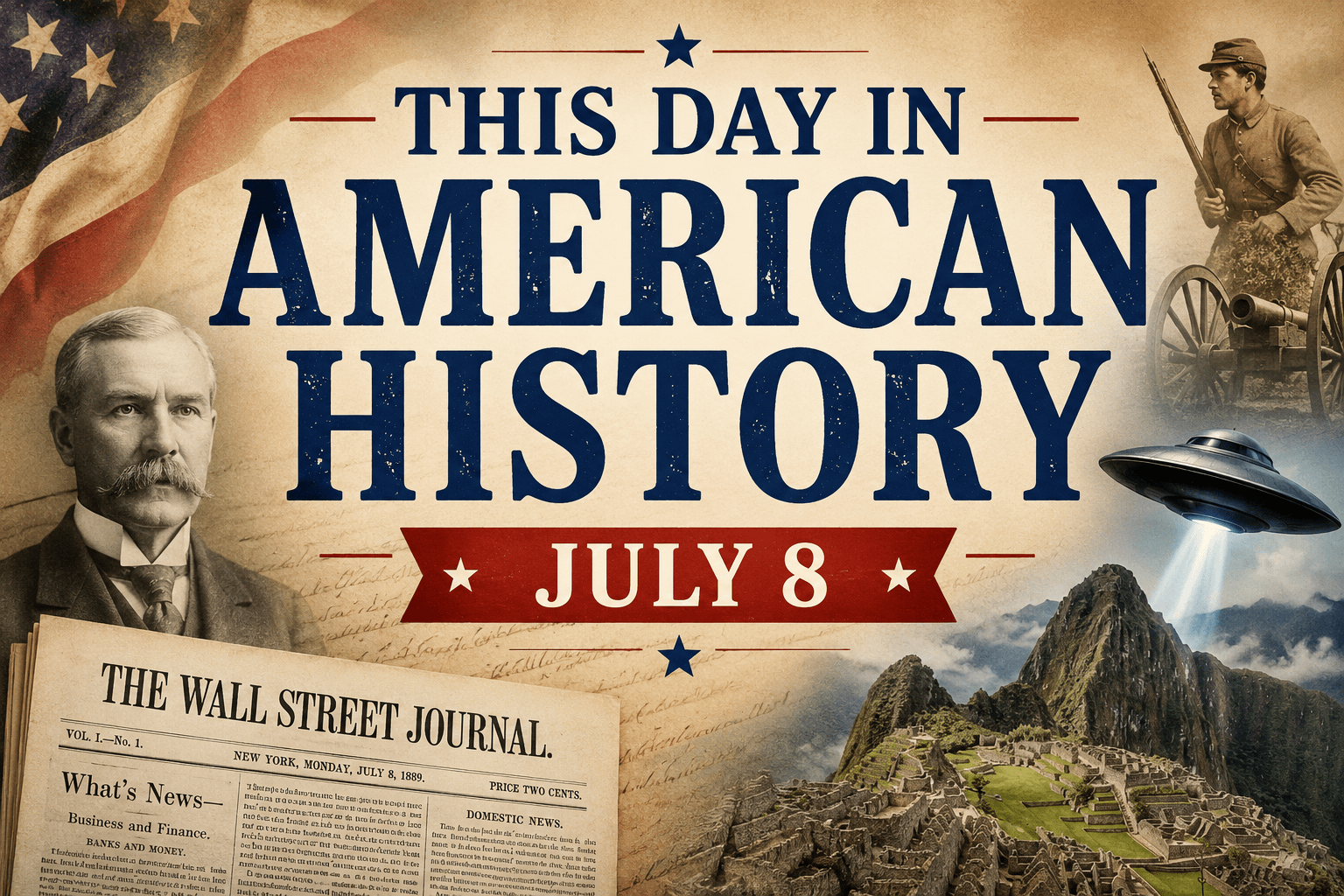
    This Day in American History – July 8

    Every day in American history tells a story of courage, innovation, leadership, and change. July 8 is no exception. From the birth of one of America’s greatest entrepreneurs to pivotal moments in military history and advances in exploration, this date reminds us how individual actions and historic events have shaped the nation.

    Let’s take a look at some of the most significant events that occurred on July 8.


    1889 – The Wall Street Journal Publishes Its First Issue

    On July 8, 1889, The Wall Street Journal published its very first edition. Founded by Charles Dow, Edward Jones, and Charles Bergstresser, the newspaper was created to provide reliable financial news and market information to investors.

    What began as a modest publication soon became one of the most respected newspapers in the world. It introduced readers to clear business reporting and helped make financial information more accessible to the public.

    Today, The Wall Street Journal remains one of America’s leading newspapers, covering business, politics, economics, technology, and world affairs while continuing its mission of informed journalism.


    1863 – The Siege of Port Hudson Ends

    One day after the fall of Vicksburg, Confederate forces at Port Hudson, Louisiana, officially surrendered on July 8, 1863, ending one of the longest sieges of the American Civil War.

    The Union victory gave the North complete control of the Mississippi River, effectively splitting the Confederacy in two. This strategic success severely limited the South’s ability to move troops and supplies between its eastern and western territories.

    The surrender at Port Hudson, combined with the victory at Vicksburg, marked a major turning point in the Civil War and strengthened the Union’s path toward eventual victory.


    1839 – John D. Rockefeller Is Born

    On July 8, 1839, John D. Rockefeller was born in Richford, New York.

    Rockefeller would go on to found Standard Oil and become one of the wealthiest individuals in American history. Through innovation, efficiency, and aggressive business practices, Standard Oil transformed the petroleum industry during the late 19th century.

    While Rockefeller’s business methods sparked debates that eventually led to antitrust laws and the breakup of Standard Oil, his philanthropy left an equally lasting legacy. He donated hundreds of millions of dollars to education, medicine, scientific research, and public health through organizations that continue to influence society today.


    1947 – The Roswell Army Air Field Announces Recovery of a “Flying Disc”

    On July 8, 1947, officials at Roswell Army Air Field in New Mexico issued a press release stating they had recovered a “flying disc” from a nearby ranch.

    Within hours, military officials clarified that the debris actually came from a weather balloon. Decades later, the U.S. government explained the materials were part of the highly classified Project Mogul, a Cold War program designed to detect Soviet nuclear tests.

    Despite those explanations, the Roswell incident became one of the most famous mysteries in American history, inspiring countless books, documentaries, movies, and debates about unidentified flying objects.


    1776 – Colonel John Nixon Publicly Reads the Declaration of Independence

    Just four days after the Continental Congress adopted the Declaration of Independence, Colonel John Nixon gave one of its earliest public readings on July 8, 1776, in Philadelphia.

    Citizens gathered to hear the document that formally announced the thirteen colonies’ separation from Great Britain.

    Public readings helped spread the revolutionary message throughout the colonies, inspiring support for independence and reinforcing the principles of liberty and self-government that would define the United States.


    1911 – Explorer Hiram Bingham Rediscovers Machu Picchu Preparations

    Although Hiram Bingham would officially reach Machu Picchu later that month, his expedition continued critical preparations and exploration activities on July 8, 1911, while searching Peru’s Andes Mountains.

    His work would soon introduce the ancient Incan city to much of the outside world, making it one of archaeology’s greatest discoveries. American-sponsored exploration helped increase global interest in preserving ancient civilizations and advancing archaeological research.


    1986 – The Space Shuttle Columbia Returns Successfully

    On July 8, 1986, planning continued for NASA’s return to human spaceflight following the Space Shuttle Challenger disaster earlier that year. During this period, engineers, astronauts, and investigators worked tirelessly to redesign critical systems and improve shuttle safety.

    The lessons learned during this difficult time ultimately strengthened NASA’s safety procedures and laid the groundwork for future shuttle missions that would deploy satellites, conduct scientific research, and help build the International Space Station.


    Famous Americans Born on July 8

    Several notable Americans celebrate birthdays on July 8, including:

    • John D. Rockefeller (1839) – Industrialist and philanthropist whose influence transformed American business and charitable giving.
    • Kevin Bacon (1958) – Award-winning actor known for decades of work in film and television.
    • Anjelica Huston (1951) – Academy Award-winning actress and director recognized for numerous iconic performances.

    Why July 8 Matters

    History is built one day at a time. July 8 reminds us of America’s remarkable journey through innovation, sacrifice, entrepreneurship, exploration, journalism, and the enduring pursuit of freedom.

    Whether it was the birth of a business titan, the public reading of America’s Declaration of Independence, decisive victories during the Civil War, or events that continue to capture the public imagination, this day reflects the many ways Americans have shaped history.

    Looking back helps us appreciate how each generation has contributed to the nation’s story—and inspires us to consider how today’s actions may become tomorrow’s history.

    Conclusion

    From the earliest days of the American Revolution to transformative moments in business, military strategy, journalism, and scientific exploration, July 8 occupies a unique place in American history. These events remind us that progress often comes through perseverance, bold ideas, and the willingness to face uncertainty. As we reflect on this day, we celebrate not only the milestones themselves but also the people whose vision, courage, and determination helped shape the United States into the nation it is today.

    Read More History & Culture

  • This Day in American History – July 7

    This Day in American History – July 7

    From groundbreaking discoveries to defining moments in politics, sports, and culture, July 7 has played an important role in shaping the story of the United States. While it may not be as widely recognized as Independence Day, this date has witnessed events that changed industries, inspired generations, and reflected the ever-evolving American spirit.

    Let’s take a look back at some of the most memorable moments that occurred on July 7 throughout American history.


    1898 – The United States Annexes Hawaii

    One of the most significant events to occur on July 7 happened in 1898, when President William McKinley signed the resolution formally annexing the Hawaii to the United States.

    At the time, Hawaii was an independent republic after the overthrow of Queen Liliʻuokalani in 1893. American business interests had played a major role in the political changes that led to annexation.

    The timing was influenced by the Spanish–American War, as military leaders recognized Hawaii’s strategic location in the Pacific Ocean. Its harbors became essential for supplying American naval forces traveling between the mainland and Asia.

    Although controversial at the time—and still debated today—the annexation paved the way for Hawaii to become the 50th state in 1959.


    1930 – Construction Begins on Hoover Dam

    On July 7, 1930, construction officially began on what would become one of America’s greatest engineering achievements: Hoover Dam.

    Built during the early years of the Great Depression, the project employed thousands of workers who desperately needed jobs. Towering more than 700 feet above the Colorado River, the dam transformed the American Southwest.

    Its impact included:

    • Flood control
    • Reliable hydroelectric power
    • Water storage for millions
    • Economic development across Nevada, Arizona, and California

    Even today, Hoover Dam remains a symbol of American engineering, determination, and innovation.


    1946 – Mother Frances Xavier Cabrini Becomes the First American Citizen Canonized

    On July 7, 1946, Frances Xavier Cabrini was canonized by the Catholic Church, becoming the first American citizen to be declared a saint.

    Known affectionately as Mother Cabrini, she devoted her life to serving immigrants, the poor, and orphaned children throughout the United States.

    She established:

    • Schools
    • Hospitals
    • Orphanages
    • Charitable organizations

    Her legacy continues through institutions that bear her name across America.


    1981 – Sandra Day O’Connor Is Nominated to the Supreme Court

    One of the most historic moments for gender equality occurred on July 7, 1981, when President Ronald Reagan nominated Sandra Day O’Connor to the Supreme Court of the United States.

    After confirmation by the Senate, O’Connor became:

    • The first woman to serve on the Supreme Court
    • A trailblazer for women in law
    • One of the Court’s most influential moderate voices

    Her appointment opened doors for future generations of women pursuing careers in law and public service.


    1985 – Boris Becker Wins Wimbledon at Just 17

    Although Germany’s Boris Becker claimed the title, his stunning victory at 1985 Wimbledon Championships captivated American sports fans.

    At only 17 years old, Becker became the youngest Wimbledon men’s singles champion in history.

    His victory helped spark renewed American interest in professional tennis during an era featuring stars like John McEnroe, Jimmy Connors, and later Andre Agassi.


    Famous Americans Born on July 7

    Several notable Americans celebrate birthdays on July 7:

    Ringo Starr (1940)

    Although born in England, Ringo Starr became one of the world’s most beloved musicians through The Beatles and later enjoyed a successful solo career with a massive American following.

    Michelle Kwan (1980)

    Born in California, Michelle Kwan became one of America’s greatest figure skaters, winning multiple World Championships and inspiring generations of young athletes.


    July 7 in American Culture

    Throughout history, early July has represented optimism and celebration in America.

    Families continue enjoying:

    • Summer vacations
    • Baseball season
    • County fairs
    • Outdoor concerts
    • Community festivals
    • Independence Day celebrations extending through the week

    The first week of July captures the spirit of American summers—warm evenings, backyard barbecues, road trips, and time spent with loved ones.


    Lasting Legacy of July 7

    Looking back at July 7 reminds us that American history is built not only on famous battles and elections but also on moments of innovation, opportunity, and progress.

    From the annexation of Hawaii to engineering marvels like Hoover Dam, from breaking barriers on the Supreme Court to inspiring achievements in sports, this date reflects the nation’s continual growth.

    History isn’t simply a record of the past—it’s a reminder that today’s decisions become tomorrow’s milestones.

    As we remember the events of July 7, we celebrate the resilience, ingenuity, and determination that continue to define the American story.

    Read More History & Culture

  • This Day in American History – July 6

    This Day in American History – July 6

    July 6 is a date marked by military victories, diplomatic achievements, technological milestones, and moments that helped shape the United States. From the founding era through the Space Age, July 6 reminds us that history is often built through perseverance, innovation, and determination.

    Here are some of the most notable events that occurred on this day in American history.


    1777 – The Siege of Fort Ticonderoga Begins

    During the American Revolutionary War, British General John Burgoyne forced American troops under General Arthur St. Clair to abandon Fort Ticonderoga in New York. Although the loss was a disappointment for the Continental Army, it prevented the Americans from becoming trapped and allowed them to regroup for future battles.

    Burgoyne’s campaign initially appeared successful, but his advance eventually ended in defeat at the Battle of Saratoga later that year. That American victory convinced France to formally ally with the United States, dramatically changing the course of the Revolutionary War.

    Why it matters:
    Sometimes a tactical retreat creates the opportunity for a greater victory. The events that began on July 6 ultimately helped lead to American independence.


    1785 – The Dollar Is Chosen as America’s Currency

    On July 6, 1785, the Confederation Congress officially adopted the United States dollar as the nation’s monetary unit. The United States became one of the first countries in the world to base its currency on a decimal system rather than pounds, shillings, and pence.

    This decision simplified trade and commerce while establishing a financial identity for the young nation.

    Why it matters:
    More than two centuries later, the U.S. dollar remains one of the world’s strongest and most influential currencies.


    1885 – Louis Pasteur Successfully Tests the Rabies Vaccine

    Although the breakthrough occurred in France, its impact on American medicine was enormous. On July 6, 1885, scientist Louis Pasteur administered the first successful rabies vaccination to a young boy who had been bitten by a rabid dog.

    American doctors quickly adopted Pasteur’s discoveries, leading to the establishment of Pasteur Institutes throughout the United States and saving countless American lives.

    Why it matters:
    Medical advances around the world often become life-saving innovations for Americans and people everywhere.


    1917 – American Forces Continue Arriving in Europe

    Following America’s entry into World War I earlier that year, thousands of U.S. soldiers continued arriving in France throughout July 1917. These early deployments marked the beginning of America’s emergence as a major military power on the world stage.

    The arrival of fresh American troops boosted Allied morale and helped shift momentum against Germany.

    Why it matters:
    World War I transformed the United States into an influential global leader both militarily and diplomatically.


    1933 – Major League Baseball’s First All-Star Game Inspires a Tradition

    Although played in Chicago, the inaugural Major League Baseball All-Star Game represented America’s growing love for its national pastime. The exhibition showcased the game’s greatest stars and became an annual celebration enjoyed by millions of fans.

    The tradition continues today, honoring baseball’s rich history while bringing together players from across the country.

    Why it matters:
    Sports have long served as a source of national pride and shared American culture.


    1942 – Anne Frank and Her Family Go Into Hiding

    On July 6, 1942, Anne Frank’s family entered the Secret Annex in Amsterdam to escape Nazi persecution. While this event occurred overseas, her diary would later become one of the most widely read books in American schools.

    Generations of American students have learned about the Holocaust through Anne’s powerful words.

    Why it matters:
    Remembering history helps protect future generations from repeating humanity’s darkest chapters.


    1945 – President Truman Prepares for the Final Phase of World War II

    As World War II entered its final weeks, President Harry S. Truman received crucial military updates concerning Japan and the newly completed Manhattan Project.

    The decisions made during this period would shape the end of the war and the beginning of the Atomic Age.

    Why it matters:
    Leadership during moments of crisis can alter the course of world history for generations.


    1947 – The AK-47 Begins Its Legacy

    On July 6, 1947, Mikhail Kalashnikov began work that would lead to the development of the AK-47 rifle. Although created in the Soviet Union, the weapon would later influence American military strategy, foreign policy, and decades of international conflicts involving U.S. forces.

    Why it matters:
    Global technological developments often have lasting consequences for American national security.


    1957 – Althea Gibson Wins Wimbledon

    Althea Gibson became the first African American to win the Wimbledon singles championship on July 6, 1957.

    Her historic victory broke racial barriers in international sports and inspired future generations of athletes, including many who would become legends themselves.

    Why it matters:
    Her achievement represented both athletic excellence and significant progress in the struggle for equal opportunity.


    1964 – Civil Rights Act Implementation Begins

    Just days after being signed into law, federal agencies began implementing the landmark Civil Rights Act throughout the United States.

    Businesses, schools, and government institutions started adapting to one of the most important civil rights laws in American history, prohibiting discrimination based on race, color, religion, sex, or national origin.

    Why it matters:
    The Civil Rights Act fundamentally reshaped American society and expanded equal protections under the law.


    1994 – Forrest Gump Opens in Theaters

    Forrest Gump premiered nationwide on July 6, 1994, becoming one of America’s most beloved films.

    Blending humor, history, and heartfelt storytelling, the movie follows one man’s remarkable journey through many defining moments of American history. It went on to win multiple Academy Awards and remains a cultural favorite.

    Why it matters:
    The film introduced millions of viewers to major historical events through an unforgettable story of kindness, perseverance, and hope.


    Quote of the Day

    “The history of America is the history of ordinary people doing extraordinary things when called upon.”

    Whether through courage in battle, groundbreaking scientific discoveries, or the pursuit of equality and justice, July 6 reminds us that progress is made one decision, one breakthrough, and one act of determination at a time.


    Final Thoughts

    History is more than a collection of dates—it is the story of people who faced uncertainty with courage, embraced innovation, and worked toward a better future. July 6 reflects many of the qualities that have shaped the American experience: resilience, leadership, discovery, and hope.

    As we remember these moments, we are reminded that today’s actions may become tomorrow’s history. Each generation has the opportunity to contribute something meaningful to the American story, just as countless others have done before us.

    Read More History & Culture

  • This Day in American History: July 5

    This Day in American History: July 5

    July 5 may fall in the shadow of Independence Day, but it has been the setting for remarkable moments that shaped the United States. From military victories and presidential milestones to legendary entertainers and groundbreaking achievements, this date reminds us that American history is written every day—not just on the holidays.

    Let’s take a journey through some of the most notable events that occurred on July 5.


    1811 – Venezuela Declares Independence

    Although not an American event, Venezuela’s declaration of independence from Spain on July 5, 1811, had a lasting influence throughout the Western Hemisphere. The movement for independence inspired democratic ideals across the Americas and strengthened the belief that people could govern themselves free from colonial rule.

    The United States closely watched these independence movements, recognizing that liberty was becoming a defining value throughout the New World.


    1863 – The Confederate Army Begins Retreat from Gettysburg

    Just one day after the conclusion of the historic Battle of Gettysburg, General Robert E. Lee began withdrawing the Confederate Army from Pennsylvania on July 5, 1863.

    The three-day battle had become the bloodiest conflict of the American Civil War, with more than 50,000 casualties. Lee’s retreat marked the end of his invasion of the North and represented a major turning point in the war.

    Combined with the Union victory at Vicksburg the day before, these events shifted momentum toward the Union and ultimately helped preserve the United States.


    1935 – President Franklin D. Roosevelt Signs the National Labor Relations Act

    On July 5, 1935, President Franklin D. Roosevelt signed the National Labor Relations Act, often called the Wagner Act.

    The law guaranteed many private-sector employees the right to organize labor unions, bargain collectively, and participate in strikes under federal protection. It also established the National Labor Relations Board (NLRB), which continues to oversee labor relations today.

    The act became one of the most influential labor laws in American history and permanently changed the relationship between workers, employers, and government.


    1946 – The Bikini Makes Its Public Debut

    French designer Louis Réard introduced the bikini on July 5, 1946.

    While the event took place in Paris, its impact on American culture was enormous. The swimsuit would become a fashion icon throughout the 1950s and 1960s, influencing Hollywood, beach culture, advertising, and popular entertainment across the United States.


    1947 – Larry Doby Breaks the American League Color Barrier

    On July 5, 1947, Larry Doby made his debut with the Cleveland Guardians, becoming the first African American player in the American League.

    Just weeks after Jackie Robinson integrated the National League, Doby’s achievement helped continue the dismantling of racial segregation in professional baseball.

    His courage opened additional opportunities for future generations of athletes and helped advance the broader Civil Rights Movement.


    1971 – The Voting Age Officially Becomes 18

    On July 5, 1971, the 26th Amendment to the U.S. Constitution officially took effect after certification.

    The amendment lowered the voting age from 21 to 18 nationwide.

    Driven largely by the Vietnam War-era slogan, “Old enough to fight, old enough to vote,” the amendment gave millions of young Americans a voice in the democratic process and remains one of the fastest constitutional amendments ever ratified.


    1975 – Arthur Ashe Wins Wimbledon

    On July 5, 1975, Arthur Ashe defeated Jimmy Connors to win the Wimbledon men’s singles championship.

    Ashe became the first—and still the only—African American man to win the prestigious title.

    Beyond his athletic achievements, Ashe became an advocate for education, human rights, and HIV/AIDS awareness, leaving a legacy that extended far beyond the tennis court.


    Famous Americans Born on July 5

    Several notable Americans celebrate birthdays on July 5:

    • Huey Lewis> (1950) – Rock musician and frontman of Huey Lewis and the News.
    • Edie Falco> (1963) – Emmy Award-winning actress known for The Sopranos and Nurse Jackie.
    • RZA> (1969) – Founder of the Wu-Tang Clan and influential music producer.
    • Eva Green> (1980) – International actress recognized for numerous film roles.

    Why July 5 Matters

    Although Americans often associate early July exclusively with Independence Day, July 5 has repeatedly marked moments of progress, resilience, and transformation.

    From the aftermath of Gettysburg to expanding voting rights, from protecting workers to breaking racial barriers in professional sports, the date reflects the nation’s continual effort to become stronger and more inclusive.

    History is not made only through grand celebrations. Sometimes it unfolds quietly the very next day—through difficult decisions, courageous pioneers, and laws that shape generations to come.

    As we remember July 5, we celebrate not only the birth of American independence but also the ongoing story of a nation striving toward greater freedom, equality, and opportunity.

    Final Thoughts

    Every day offers another chapter in America’s story, and July 5 reminds us that progress rarely ends with a single historic event. The victories, reforms, and milestones that occurred on this date continue to influence our lives today. By remembering these moments, we gain a deeper appreciation for those who helped build the country and for the responsibility each generation has to continue shaping its future.

    Read More History & Culture