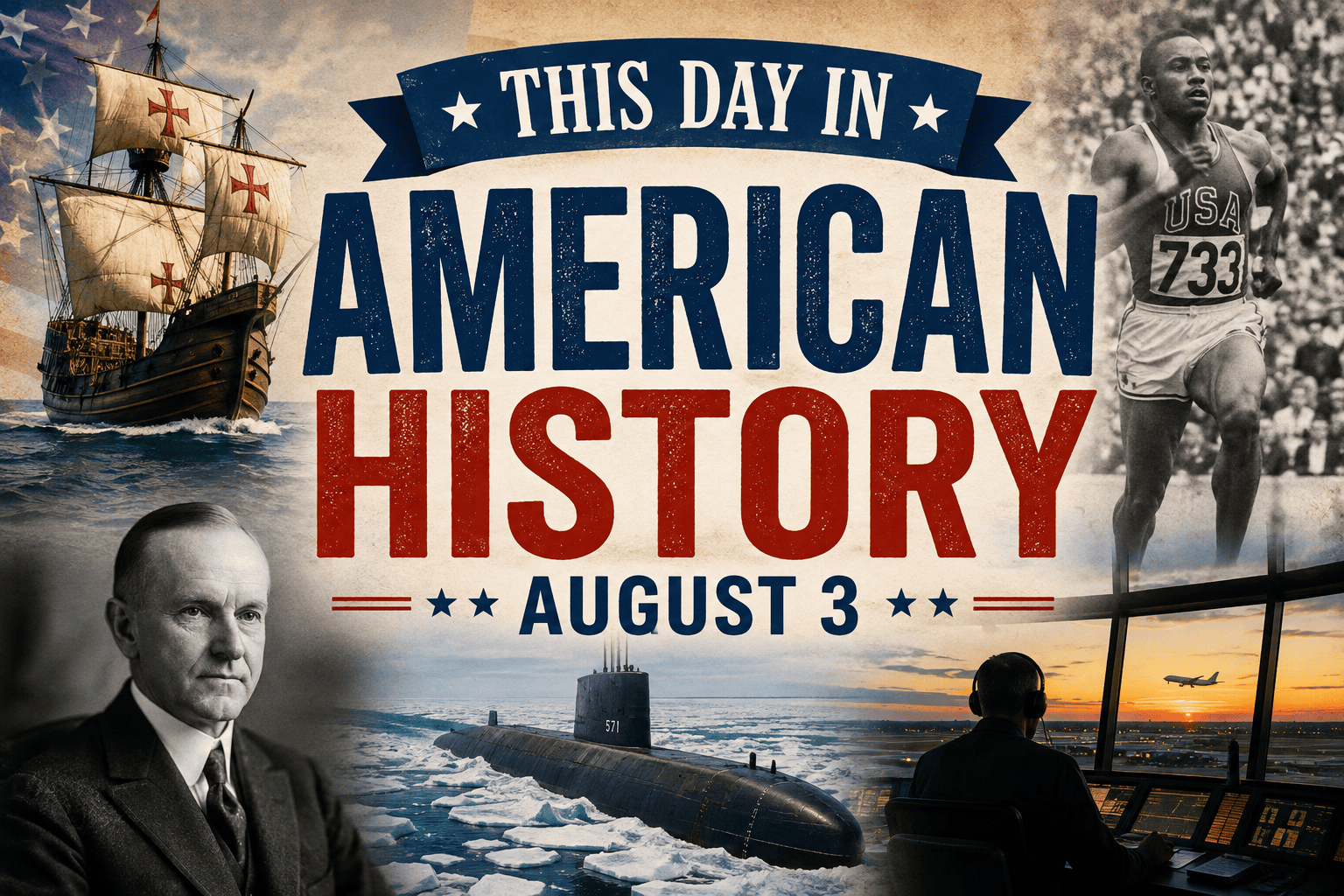
Every date on the calendar represents another chapter in the American story. Some days are remembered for bold acts of exploration, while others are marked by moments of political leadership, scientific achievement, military innovation, or athletic greatness. August 3 is one of those dates that has witnessed events that helped shape not only the United States but, in many cases, the world.
From the departure of Christopher Columbus on his historic voyage to Jesse Owens’ unforgettable Olympic triumph and the groundbreaking journey of the USS Nautilus, August 3 reminds us that history is often made by people willing to venture into the unknown, stand up for their beliefs, or strive for excellence.
Let’s take a closer look at some of the most significant events that occurred on August 3 throughout American history.
1492 – Christopher Columbus Begins His Historic Voyage
On August 3, 1492, Christopher Columbus departed from the Spanish port of Palos aboard three ships—the Niña, Pinta, and Santa María—with the goal of finding a westward sea route to Asia.
Although Columbus never reached Asia and did not land on what is now the continental United States, his voyage forever changed the course of history. His arrival in the Americas opened the door to centuries of European exploration, trade, colonization, and cultural exchange that would eventually lead to the establishment of the American colonies and, later, the United States.
Today, historians recognize that Columbus’ expedition had both profound achievements and devastating consequences for Indigenous peoples. Studying this event provides an opportunity to better understand the complexity of history and the lasting impact exploration had on the Western Hemisphere.
1914 – America Chooses Neutrality as World War I Begins
Europe erupted into war during the summer of 1914 following the assassination of Archduke Franz Ferdinand.
On August 3, President Woodrow Wilson publicly called upon Americans to remain neutral as European nations declared war on one another. Wilson urged citizens to remain “impartial in thought as well as in action.”
At the time, many Americans believed the conflict would remain a European problem. The nation focused on maintaining peace while continuing international trade with various countries.
However, maintaining neutrality became increasingly difficult as unrestricted submarine warfare, diplomatic tensions, and attacks on American shipping gradually pushed the United States toward involvement.
Three years later, America entered World War I, forever changing its role in world affairs and emerging as one of the leading global powers.
1923 – Calvin Coolidge Becomes America’s 30th President
One of the most unusual presidential successions in American history occurred during the early morning hours of August 3, 1923.
Following the sudden death of President Warren G. Harding while on a cross-country speaking tour, Vice President Calvin Coolidge was awakened at his family’s modest farmhouse in Plymouth Notch, Vermont.
Because no federal judge was immediately available, Coolidge’s father—John Calvin Coolidge Sr., a local notary public and justice of the peace—administered the presidential oath by the light of a kerosene lamp.
It remains one of the most memorable presidential inaugurations in American history.
Coolidge became known for his quiet personality, earning the nickname “Silent Cal.” His administration emphasized:
- Limited government
- Lower taxes
- Fiscal responsibility
- Business growth
- Economic prosperity during much of the Roaring Twenties
His belief that “the chief business of the American people is business” became one of the defining political philosophies of the decade.
1936 – Jesse Owens Shocks the World at the Berlin Olympics
Few athletic performances have carried as much historical significance as Jesse Owens’ victories during the 1936 Olympic Games in Berlin, Germany.
On August 3, Owens captured the 100-meter gold medal, defeating the world’s fastest runners in front of Adolf Hitler and a global audience.
The victory was about far more than sports.
Nazi Germany had promoted the Olympics as a showcase for its ideology of racial superiority. Owens’ remarkable achievements directly contradicted those claims and demonstrated that talent, determination, and hard work transcend prejudice.
During the Games, Owens won:
- Gold in the 100 meters
- Gold in the 200 meters
- Gold in the long jump
- Gold in the 4 × 100-meter relay
His four gold medals made him one of the greatest Olympians of all time and transformed him into a lasting symbol of courage, dignity, and equality.
Nearly a century later, Jesse Owens remains one of the most respected athletes in American history.
1958 – USS Nautilus Reaches the North Pole Beneath the Arctic Ice
The Cold War produced remarkable technological advances, and one of the greatest occurred on August 3, 1958.
The nuclear-powered submarine USS Nautilus became the first vessel in history to travel beneath the geographic North Pole.
Unlike traditional diesel-powered submarines, Nautilus could remain submerged for extended periods because its nuclear reactor generated continuous power.
Its successful voyage demonstrated:
- The reliability of nuclear propulsion
- America’s growing technological leadership
- New possibilities for Arctic navigation
- Strategic military capabilities during the Cold War
The mission captured worldwide attention and was celebrated as one of the greatest engineering accomplishments of the twentieth century.
Its famous radio message simply stated:
“Nautilus 90 North.”
Those three words marked a historic milestone in naval exploration.
1981 – The PATCO Strike Changes American Labor History
On August 3, 1981, approximately 13,000 members of the Professional Air Traffic Controllers Organization (PATCO) walked off the job seeking:
- Better working conditions
- Higher wages
- Reduced work hours
Federal law prohibited government employees from striking, and President Ronald Reagan ordered controllers to return to work within 48 hours.
When thousands refused, more than 11,000 controllers were dismissed from federal employment and banned from federal service for years.
The strike became one of the defining labor disputes in American history.
Its consequences reshaped:
- Public-sector unions
- Federal labor negotiations
- Air traffic control operations
- Labor-management relations across the country
Many historians consider the PATCO strike one of the most influential labor events of the late twentieth century.
Other Noteworthy Moments on August 3
America’s Expanding Spirit of Innovation
Throughout American history, August 3 has frequently coincided with periods of technological advancement and exploration. From early voyages across the Atlantic to nuclear submarines navigating beneath Arctic ice, the date reflects America’s continual pursuit of new frontiers.
Leadership During Times of Change
Whether it was Calvin Coolidge unexpectedly assuming the presidency or Woodrow Wilson guiding the nation through the uncertainty surrounding World War I, August 3 reminds us that leadership often emerges during moments of crisis.
Famous Americans Born on August 3
Several influential Americans celebrate birthdays on this day.
Tony Bennett (1926)
One of America’s most beloved singers, Tony Bennett enjoyed a remarkable career spanning more than seven decades. His timeless performances, including classics such as I Left My Heart in San Francisco, earned multiple Grammy Awards and introduced generations to traditional pop and jazz.
Martha Stewart (1941)
Businesswoman, author, and television personality Martha Stewart transformed home entertaining into a global lifestyle brand. Her influence extends across cooking, gardening, decorating, publishing, and entrepreneurship.
Tom Brady (1977)
Widely regarded as one of the greatest quarterbacks in NFL history, Tom Brady built an extraordinary career defined by discipline, preparation, leadership, and consistent excellence. His record-setting number of Super Bowl victories has made him one of the most accomplished athletes in American sports.
Lessons We Can Learn from August 3
History is valuable because it allows us to learn from the successes, struggles, and decisions of those who came before us.
August 3 teaches us several enduring lessons:
- Exploration begins with curiosity.
- Great leadership is often tested during uncertainty.
- Excellence requires preparation and perseverance.
- Innovation can redefine what is possible.
- Courage can inspire generations.
Whether those lessons come from explorers crossing oceans, presidents assuming unexpected responsibility, engineers pushing technological boundaries, or athletes overcoming prejudice, they continue to resonate today.
Why Remembering History Matters
Understanding history helps us appreciate how today’s opportunities were shaped by yesterday’s decisions.
Every generation inherits the achievements, mistakes, and sacrifices of those who came before. By reflecting on important dates like August 3, we gain perspective on America’s ongoing journey and recognize the individuals whose actions influenced the nation’s development.
History is not simply a record of the past—it is a guide for the future.
Final Thoughts
August 3 is a day that reflects the American spirit of discovery, determination, resilience, and progress. From historic voyages and presidential transitions to Olympic triumphs and technological breakthroughs, the events remembered on this date continue to inspire new generations.
As we look back on these milestones, we are reminded that ordinary days can become extraordinary through vision, courage, and perseverance. The history we celebrate today encourages us to contribute positively to the story that future generations will one day remember.



Leave a Reply