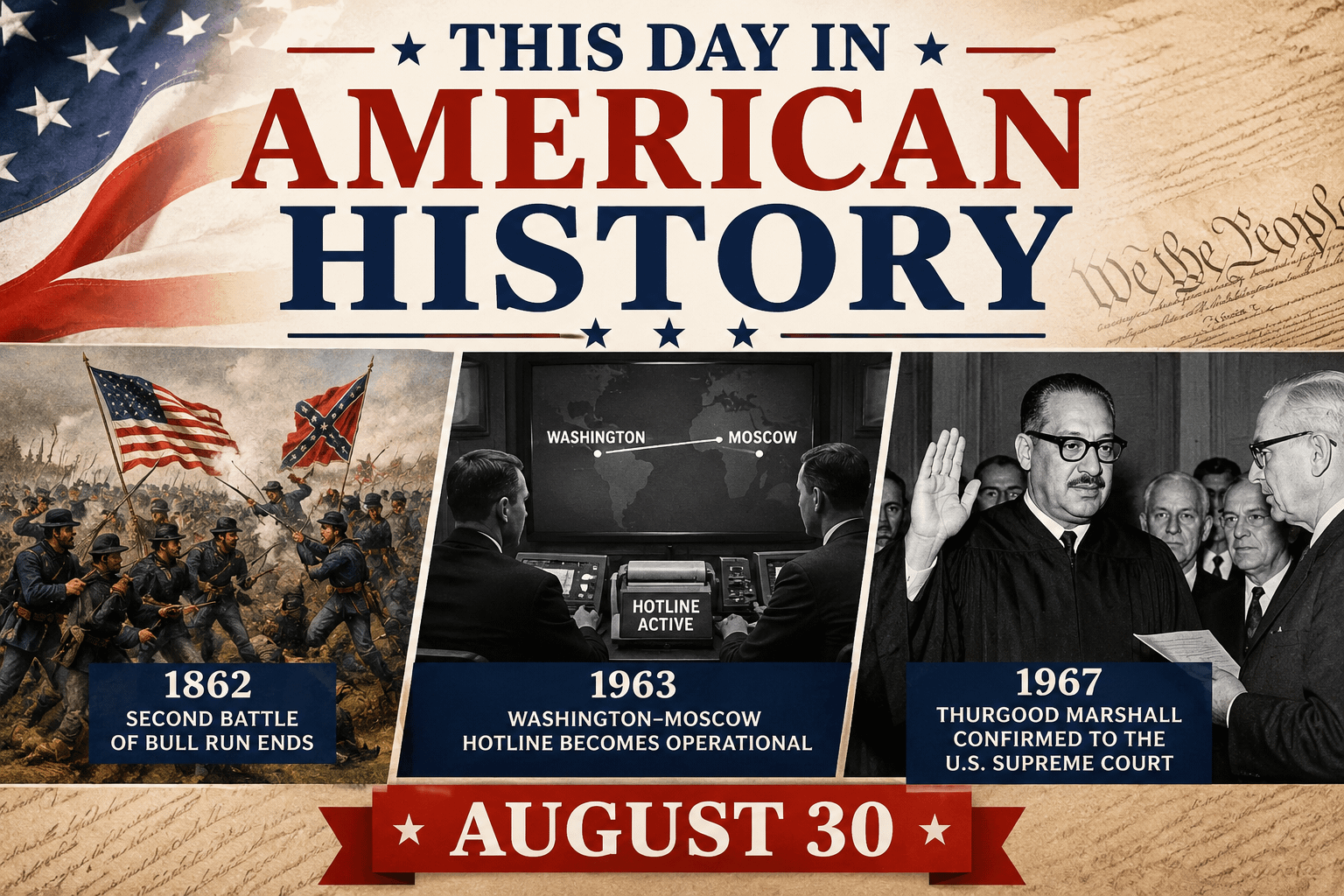
Every date on the calendar carries stories from America’s past, but August 30 stands out for several events that helped shape the nation’s military history, foreign policy, civil rights movement, and highest court.
From the bloody fields of the Civil War to the tense nuclear rivalry of the Cold War and the historic confirmation of the first African American Supreme Court justice, August 30 offers a fascinating look at how the United States has changed across generations.
Some moments were defined by conflict. Others demonstrated the importance of communication, diplomacy, persistence, and equality.
Here is a deeper look at what happened on August 30 in American history.
1862 – The Second Battle of Bull Run Reaches Its Climax
On August 30, 1862, one of the most significant battles of the American Civil War reached its dramatic conclusion.
The Second Battle of Bull Run, also known as the Second Battle of Manassas, had begun on August 28 near Manassas, Virginia.
It was fought only about 13 months after the First Battle of Bull Run had taken place across much of the same countryside.
But the second battle was considerably larger and bloodier. The National Park Service describes Second Manassas as four times larger and four times bloodier than the first battle.
By the summer of 1862, the Civil War had already become something far different from the relatively short conflict many Americans had initially imagined.
Both Union and Confederate armies had gained experience.
Their commanders understood the enormous stakes.
And the casualty lists were growing.
Robert E. Lee Takes the Initiative
Confederate General Robert E. Lee had assumed command of the Army of Northern Virginia earlier that summer.
Lee quickly demonstrated his willingness to take risks and seize the initiative.
His Confederate forces confronted the Union Army of Virginia commanded by Major General John Pope.
One of Lee’s most important commanders, Major General Thomas “Stonewall” Jackson, had moved behind Union positions and established a defensive line near an unfinished railroad.
Meanwhile, Lieutenant General James Longstreet’s forces arrived to strengthen Lee’s army.
Pope incorrectly believed that Jackson might be preparing to retreat.
That misunderstanding would prove costly.
August 30: The Union Attacks
On August 30, Pope ordered another major Union assault against Jackson’s position.
The attack initially placed pressure on Confederate troops, but the Union soldiers were attacking a strong defensive position.
Confederate artillery and infantry eventually stopped the assault.
Then the battle changed dramatically.
Lee and Longstreet launched a massive counterattack against the exposed Union left.
According to the American Battlefield Trust, Longstreet’s wing—reinforced by Lee and numbering nearly 30,000 men—swept eastward toward Henry Hill as Confederate commanders attempted to cut off Pope’s escape.
Union soldiers desperately attempted to slow the Confederate advance.
Fierce resistance on Chinn Ridge bought valuable time for Union forces to establish another defensive position around Henry Hill.
As darkness approached, the Confederate advance finally lost momentum.
Pope ordered his defeated army to retreat across Bull Run.
A Major Confederate Victory
The Second Battle of Bull Run became one of the most important Confederate victories of 1862.
The fighting had been devastating.
Historical estimates cited by the National Park Service place Federal losses during the Second Manassas campaign at more than 14,000 killed, wounded, captured, or missing, with thousands of Confederate casualties as well.
Beyond the human cost, the battle changed the strategic situation in the eastern theater of the Civil War.
Lee had pushed Union forces away from Richmond and toward Washington.
Confederate confidence was rising.
The victory helped open the way for Lee’s first major offensive campaign north of the Potomac River.
Within days, Lee’s army would begin moving into Maryland.
That campaign would eventually lead to another historic confrontation.
The Battle of Antietam would be fought on September 17, 1862.
1963 – The Washington–Moscow Hotline Becomes Operational
Jump forward almost exactly a century, and America faced an entirely different kind of threat.
Instead of armies confronting one another across a battlefield, two nuclear superpowers faced one another across the world.
The United States and Soviet Union were locked in the Cold War.
By the early 1960s, both countries possessed nuclear arsenals capable of causing destruction on a scale previously unimaginable.
Then came the Cuban Missile Crisis.
The World Comes Close to Nuclear War
In October 1962, American intelligence discovered Soviet nuclear missile installations being constructed in Cuba.
Cuba sits only about 90 miles from Florida.
President John F. Kennedy demanded that the missiles be removed and announced a naval quarantine around the island.
For nearly two weeks, the world watched as Washington and Moscow moved dangerously close to military confrontation.
One of the problems exposed during the crisis was surprisingly simple:
Communication was too slow.
Messages between Kennedy and Soviet Premier Nikita Khrushchev could take hours to transmit, translate, deliver, and answer.
When nuclear weapons were involved, hours mattered.
A delayed message, misunderstood statement, or military action taken without political approval could potentially trigger catastrophe.
A Better Way to Communicate
After the Cuban Missile Crisis, American and Soviet officials recognized the need for a faster method of communication during emergencies.
The two governments negotiated an agreement establishing a direct communications link between Washington and Moscow.
The agreement was signed in June 1963.
On August 30, 1963, the hotline became operational.
The U.S. State Department’s historical records identify August 30, 1963, as the date the hotline was established to provide rapid communication between American and Soviet leaders.
It Wasn’t Actually a Red Telephone
Popular culture often depicts the Cold War hotline as a bright red telephone sitting on the president’s desk.
That’s a memorable image.
But it isn’t how the original system worked.
The first Washington–Moscow hotline relied primarily on written communications transmitted electronically, rather than direct voice conversations between the president and Soviet premier.
There was an important reason for using written messages.
Written communication gave leaders time to carefully compose, translate, and review extremely sensitive messages without the possibility that an incorrectly heard word or poor telephone connection could create additional confusion.
The goal wasn’t casual conversation.
The hotline was designed for emergencies.
Why the Hotline Mattered
The hotline represented an important lesson learned from the Cuban Missile Crisis.
Sometimes preventing war requires something as basic as making sure opposing leaders can communicate quickly.
The system reduced the time required to exchange urgent messages and provided another safeguard against accidental escalation.
It was eventually used during later international crises.
The hotline became one of the enduring symbols of Cold War diplomacy—a reminder that even bitter rivals recognized the importance of maintaining communication when the consequences of misunderstanding could be catastrophic.
1967 – Thurgood Marshall Makes Supreme Court History
Only four years after the Washington–Moscow hotline became operational, another historic event occurred on August 30.
This time the story wasn’t about war or international diplomacy.
It was about civil rights, justice, and the changing face of America’s institutions.
On August 30, 1967, the United States Senate confirmed Thurgood Marshall as an associate justice of the Supreme Court.
The vote was 69–11.
Marshall became the first African American justice in the history of the United States Supreme Court.
It was an extraordinary milestone.
But Marshall’s journey to the Supreme Court had begun decades earlier.
Thurgood Marshall Before the Supreme Court
Marshall was born in Baltimore, Maryland, in 1908.
He developed an interest in law and eventually attended Howard University School of Law, where he studied under influential civil rights lawyer and educator Charles Hamilton Houston.
Marshall would become one of the most important civil rights attorneys in American history.
Rather than simply arguing that segregation was unfair, Marshall and other civil rights attorneys systematically challenged discriminatory laws through the American court system.
Their strategy required patience.
Case by case.
Court by court.
Precedent by precedent.
They worked to dismantle the legal structure supporting racial segregation.
Brown v. Board of Education
Marshall’s most famous legal victory came in Brown v. Board of Education of Topeka.
The case challenged racial segregation in America’s public schools.
In 1954, the Supreme Court unanimously ruled that state-mandated racial segregation in public education violated the Constitution.
The decision became one of the most important civil rights rulings in American history.
For Marshall, the victory represented years of legal work challenging segregation.
But his career was far from over.
From Advocate to Federal Judge
Marshall’s accomplishments eventually led him into federal service.
President John F. Kennedy nominated him to the United States Court of Appeals for the Second Circuit.
Marshall later became Solicitor General of the United States, representing the federal government before the Supreme Court.
Then President Lyndon B. Johnson nominated him to the Supreme Court on June 13, 1967.
The nomination itself was historic.
After Senate consideration, Marshall was confirmed on August 30.
The official Senate record lists his nomination date as June 13, his confirmation vote as 69–11, and his confirmation date as August 30, 1967.
A Powerful Symbol of Change
Marshall’s confirmation carried enormous historical significance.
For generations, African Americans had been denied equal protection under laws and institutions that were supposed to represent every American.
Now an African American lawyer who had spent much of his professional life challenging discrimination would sit on the country’s highest court.
Think about the historical transformation represented by that moment.
In 1862, Americans were fighting a Civil War deeply connected to slavery and the future of freedom in the United States.
In 1967, only 105 years later, Thurgood Marshall was confirmed as the first African American justice of the Supreme Court.
Those two August 30 events were separated by slightly more than a century.
Yet they belong to interconnected chapters of the American story.
Marshall’s Years on the Supreme Court
Marshall would serve on the Supreme Court for approximately 24 years.
Throughout his judicial career, he remained strongly associated with issues involving civil rights, constitutional protections, equality, criminal justice, and individual liberties.
His presence on the Court also carried significance beyond individual decisions.
For generations of Americans who had rarely seen African Americans represented in the country’s most powerful institutions, Marshall’s appointment demonstrated that change—however slow—was possible.
Three August 30 Events, Three Different Americas
Looking at the major events of August 30 together provides an unusual snapshot of American history.
August 30, 1862: A Nation Divided
The Second Battle of Bull Run represents one of America’s darkest periods.
Americans were fighting Americans.
Families were divided.
Communities were devastated.
Thousands of soldiers were killed, wounded, captured, or missing.
The survival and future character of the United States remained uncertain.
August 30, 1963: A World Facing Nuclear Danger
One hundred and one years later, America’s greatest military danger came not from another American army but from the possibility of nuclear confrontation with another superpower.
The Washington–Moscow hotline represented an attempt to prevent misunderstanding from turning political confrontation into nuclear war.
August 30, 1967: Breaking a Historic Barrier
Four years later, Thurgood Marshall’s confirmation represented another type of transformation.
An institution that had once issued decisions supporting racial inequality now welcomed its first African American justice.
History had not erased America’s racial divisions, but Marshall’s confirmation represented a significant milestone in the country’s long struggle toward equality under the law.
The Connections Between These Events
At first glance, a Civil War battle, a Cold War communications system, and a Supreme Court confirmation might seem completely unrelated.
But each tells us something about the challenges faced by the United States.
The Second Battle of Bull Run demonstrates the terrible consequences of national division.
The Washington–Moscow hotline demonstrates the importance of communication when conflict threatens to spiral beyond anyone’s control.
Thurgood Marshall’s confirmation demonstrates how people can challenge institutions and eventually help transform them.
Together, these events illustrate three recurring themes in American history:
Conflict. Communication. Change.
History Is More Than Dates
It can be easy to think of history as a collection of names, dates, presidents, battles, and court decisions.
But history becomes more meaningful when we consider the people living through those events.
Imagine being a Union soldier retreating across Bull Run on the night of August 30, 1862.
Imagine working inside the Kennedy administration only months after the Cuban Missile Crisis, knowing how close the world had come to nuclear confrontation.
Imagine being an African American child in 1967 and hearing that Thurgood Marshall had just become the first Black Supreme Court justice.
For the people living through those moments, these weren’t historical facts.
They were current events.
Nobody knew exactly what would happen next.
That is one of the most valuable lessons history can teach us.
The people of the past experienced uncertainty just as we do.
Why Studying American History Matters
Understanding history helps us recognize how the America of today was created.
Our laws did not appear overnight.
Our institutions evolved.
Our freedoms were debated, challenged, defended, and expanded.
Our foreign policy was shaped by moments when leaders made decisions under enormous pressure.
Our national identity developed through triumphs as well as tragedies.
Studying history doesn’t require believing that everything America has done was right.
Nor does it require viewing every historical event only through the mistakes that were made.
It means examining the past carefully enough to understand both achievement and failure.
That allows future generations to learn from both.
What August 30 Can Teach Us
The events associated with August 30 leave several lessons worth remembering.
Leadership matters.
The decisions made by commanders, presidents, diplomats, senators, attorneys, and judges can affect generations.
Communication matters.
The Washington–Moscow hotline demonstrated that sometimes keeping people talking can help prevent catastrophe.
Persistence matters.
Thurgood Marshall spent years challenging discriminatory laws before eventually joining the country’s highest court.
History is connected.
The Civil War, Reconstruction, segregation, the Civil Rights Movement, and Marshall’s confirmation were not isolated chapters. Each developed from circumstances created by what came before.
Progress is rarely simple.
American history contains advances and setbacks, victories and tragedies, moments of unity and periods of profound division.
Understanding all of them gives us a fuller picture of the country.
August 30 in American History: A Timeline
1862 — Second Battle of Bull Run:
Confederate forces under Robert E. Lee defeat Major General John Pope’s Union army in northern Virginia. The victory helps open the way for Lee’s Maryland Campaign.
1963 — Washington–Moscow Hotline:
A direct communications link between the governments of the United States and Soviet Union becomes operational following lessons learned during the Cuban Missile Crisis.
1967 — Thurgood Marshall Confirmed:
The U.S. Senate confirms Marshall to the Supreme Court by a 69–11 vote, making him the first African American justice in Supreme Court history.
Remembering August 30
August 30 demonstrates just how much American history can be contained within a single date.
On one August 30, soldiers fought desperately across the fields of Virginia.
On another, American and Soviet officials established a communications system designed to help prevent nuclear war.
And on another, Thurgood Marshall broke one of the most significant racial barriers in the American judiciary.
Different centuries.
Different challenges.
Different Americans.
Yet each moment became part of the same continuing national story.
Final Thoughts
August 30 is a day that reminds us how dramatically America can change across generations.
The soldiers fighting at Second Manassas in 1862 could never have imagined nuclear superpowers communicating instantly across continents a century later.
Americans living through the segregation era might have struggled to imagine an African American justice sitting on the Supreme Court.
And those of us studying these events today already know something the people living through them did not:
what happened next.
That perspective is one of history’s greatest gifts.
It allows us to look backward and see consequences that were invisible at the time.
It allows us to recognize turning points.
And perhaps most importantly, it reminds us that the events happening in our own time will someday become history too.
The decisions we make, the challenges we confront, and the lessons we pass to future generations all become part of the story.
Because American history isn’t merely a record of where we’ve been.
It is a continuing story of conflict, courage, change, and the ongoing effort to determine what America will become next.
Question of the Day
If you could witness one August 30 moment firsthand—the final day of the Second Battle of Bull Run, the opening of the Washington–Moscow hotline, or Thurgood Marshall’s historic Supreme Court confirmation—which would you choose, and why?
Leave a Reply