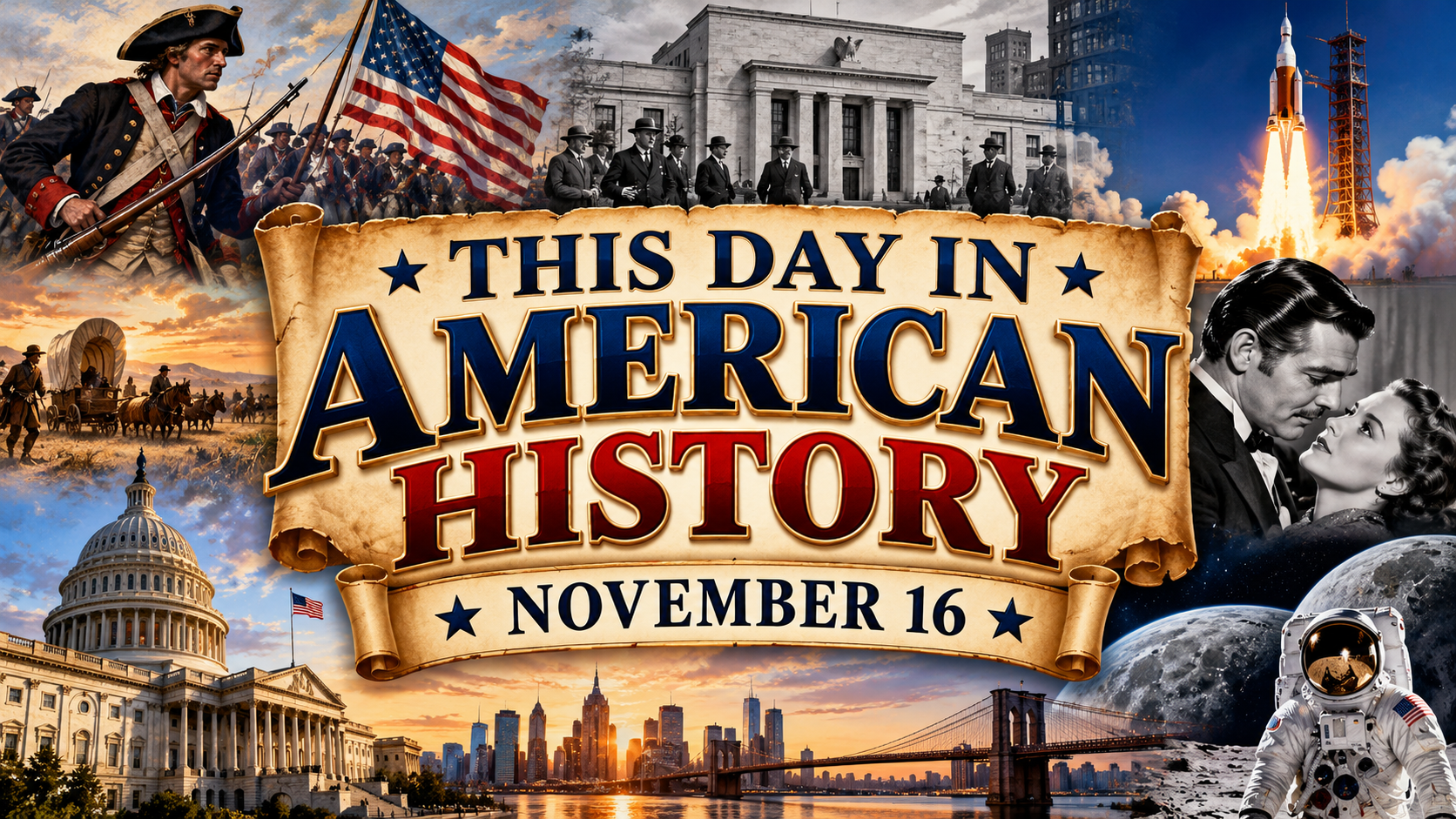
American history is filled with remarkable moments that helped shape the nation we know today. Every date on the calendar carries stories of courage, sacrifice, innovation, political change, and cultural achievement. November 16 is no exception.
From the Revolutionary War and the expansion of American territory to the establishment of the Federal Reserve and important developments in space exploration, November 16 has witnessed events that influenced the direction of the United States.
Some of these moments represent extraordinary accomplishments, while others remind us of the struggles, conflicts, and difficult decisions that shaped American society.
Today, we look back at the historical events, influential people, and significant milestones associated with November 16.
1776 – British Forces Capture Fort Washington During the American Revolution
On November 16, 1776, British and Hessian forces captured Fort Washington, an American stronghold located on Manhattan Island in New York.
The battle occurred during one of the most challenging periods of the American Revolutionary War.
General George Washington’s Continental Army had already suffered several defeats as British forces attempted to regain control of the rebellious colonies.
Fort Washington was considered an important defensive position because it overlooked the Hudson River. American troops hoped to use the fortification to interfere with British movements and maintain a strategic presence in New York.
However, British forces launched a coordinated assault that overwhelmed the American defenders.
Approximately 2,800 American soldiers were captured, making the defeat one of the Continental Army’s most devastating setbacks.
The loss demonstrated the enormous military challenges facing Washington and his inexperienced army.
Despite this defeat, the American Revolution continued, eventually leading to independence.
Historical significance: The Battle of Fort Washington revealed the weaknesses of American defenses and contributed to George Washington’s developing understanding of military strategy, particularly the importance of preserving his army rather than defending every position.
1821 – The Santa Fe Trail Opens a New Era of American Trade
On November 16, 1821, trader William Becknell arrived in Santa Fe, in what was then Mexican territory, helping establish one of the most important commercial routes in American history.
Becknell had traveled from Missouri with merchandise he hoped to sell in the Southwest.
His successful journey demonstrated the economic opportunities available through overland trade between Missouri and Santa Fe.
The route became known as the Santa Fe Trail.
During the following decades, merchants transported manufactured goods, textiles, tools, and other supplies along the trail.
The Santa Fe Trail became an important connection between different cultures, communities, and economies.
However, expanding American commerce and migration also contributed to increasing pressure on Native American lands and traditional ways of life.
Historical significance: The Santa Fe Trail encouraged westward commerce and helped connect the United States with the Southwest before the region became part of the country.
1863 – The Battle of Campbell’s Station During the Civil War
On November 16, 1863, Union and Confederate forces fought the Battle of Campbell’s Station near Knoxville, Tennessee.
The battle was part of the Knoxville Campaign during the American Civil War.
Union troops commanded by Major General Ambrose Burnside faced Confederate forces led by Lieutenant General James Longstreet.
The Confederates attempted to intercept and defeat Burnside’s army before it could reach the defenses surrounding Knoxville.
Union forces successfully resisted Confederate attacks and withdrew toward Knoxville.
The engagement helped Burnside preserve his army and establish a defensive position in the city.
Longstreet subsequently placed Knoxville under siege, but Confederate forces were unable to capture the city.
Historical significance: The Battle of Campbell’s Station helped the Union maintain its position in East Tennessee, a strategically important region during the Civil War.
1907 – Oklahoma Becomes the 46th State
November 16, 1907, marked a major milestone in American territorial expansion when Oklahoma officially became the 46th state admitted to the Union.
Before statehood, the region was divided into Oklahoma Territory and Indian Territory.
The history of these territories was deeply connected to Native American nations, including the Cherokee, Chickasaw, Choctaw, Muscogee (Creek), and Seminole peoples.
During the nineteenth century, the federal government forcibly relocated numerous Native American communities to Indian Territory.
The most infamous example was the Trail of Tears, during which thousands of Native Americans died as a result of forced removal.
Over time, settlement, railroad development, agriculture, and political changes transformed the region.
President Theodore Roosevelt signed the proclamation admitting Oklahoma to the Union on November 16, 1907.
Oklahoma’s statehood represented both the expansion of the United States and another chapter in the complicated history of federal policies toward Native American sovereignty.
Historical significance: Oklahoma’s admission expanded the Union while highlighting the lasting consequences of westward settlement and Native American displacement.
1914 – The Federal Reserve Banks Officially Open
On November 16, 1914, the twelve regional Federal Reserve Banks opened for business.
Their establishment followed the Federal Reserve Act of 1913, signed into law by President Woodrow Wilson.
Before the Federal Reserve System existed, the American banking system experienced repeated financial panics, including the devastating Panic of 1907.
These crises exposed weaknesses in the nation’s financial structure and demonstrated the need for a more coordinated banking system.
The Federal Reserve was created to provide a more stable monetary and financial framework.
The twelve regional banks were established in cities across the country, including New York, Chicago, Boston, Philadelphia, Atlanta, and San Francisco.
Over time, the Federal Reserve became responsible for important functions involving monetary policy, financial stability, and the nation’s banking system.
Its decisions can influence interest rates, borrowing costs, employment, and inflation.
Historical significance: The opening of the Federal Reserve Banks marked an important turning point in the development of America’s modern financial system.
1933 – The United States Establishes Diplomatic Relations With the Soviet Union
On November 16, 1933, President Franklin D. Roosevelt’s administration formally established diplomatic relations with the Soviet Union.
For years, the United States had refused to recognize the Soviet government following the Russian Revolution of 1917.
Political disagreements, concerns about communism, and international tensions contributed to the prolonged diplomatic separation.
By 1933, economic challenges and changing international circumstances encouraged both countries to reconsider their relationship.
The decision to establish formal relations opened the door to diplomatic communication and potential cooperation.
Although the United States and Soviet Union would become allies during World War II, their relationship later deteriorated into the Cold War.
The diplomatic relationship established in 1933 became an important foundation for decades of international negotiations, competition, and confrontation.
Historical significance: The agreement demonstrated how diplomacy can develop between countries with dramatically different political systems.
1959 – The Sound of Music Opens on Broadway
On November 16, 1959, the musical The Sound of Music opened on Broadway at the Lunt-Fontanne Theatre in New York City.
Created by Richard Rodgers and Oscar Hammerstein II, the musical was inspired by the story of Maria von Trapp and her family.
The production starred Mary Martin as Maria and Theodore Bikel as Captain Georg von Trapp.
Its memorable songs, family-centered storyline, and themes of love, courage, and resistance helped make it a major theatrical success.
The musical later inspired the famous 1965 film starring Julie Andrews and Christopher Plummer.
Songs such as My Favorite Things, Do-Re-Mi, and Climb Ev’ry Mountain became enduring favorites.
The production helped reinforce Broadway’s importance in American entertainment and musical theater.
Historical significance: The Sound of Music became one of the most recognizable musicals in American popular culture, influencing generations of performers and audiences.
1973 – NASA Launches the Skylab 4 Mission
On November 16, 1973, NASA launched three astronauts aboard the Skylab 4 mission from Kennedy Space Center in Florida.
The crew consisted of Gerald Carr, William Pogue, and Edward Gibson.
Their destination was Skylab, America’s first space station.
The mission lasted approximately 84 days, making it the longest American crewed spaceflight at that time.
During their time aboard the station, the astronauts conducted scientific experiments, observed the Sun, studied Earth, and investigated how extended periods in space affected the human body.
Their work provided valuable information about human endurance, weightlessness, and the challenges of living beyond Earth.
These discoveries helped prepare NASA for future long-duration missions and contributed to knowledge later used in space station programs.
Historical significance: Skylab 4 demonstrated that astronauts could live and work in space for extended periods, helping advance America’s ambitions in human space exploration.
1973 – President Nixon Authorizes the Trans-Alaska Pipeline
Also on November 16, 1973, President Richard Nixon signed the Trans-Alaska Pipeline Authorization Act.
The legislation helped clear the way for construction of an approximately 800-mile pipeline connecting Alaska’s North Slope oil fields with the port of Valdez.
The United States was facing serious energy concerns during the 1970s, particularly following disruptions in international oil supplies.
Supporters believed the pipeline would strengthen domestic energy production and reduce dependence on imported petroleum.
However, the project also raised significant environmental concerns.
Construction required extensive engineering to address Alaska’s harsh climate, permafrost, mountains, and earthquake risks.
The pipeline eventually began transporting oil in 1977.
Historical significance: The authorization represented a major development in American energy policy and highlighted the continuing debate between energy development and environmental protection.
1974 – The Arecibo Message Is Sent Into Space
On November 16, 1974, scientists transmitted a powerful radio message from the Arecibo Observatory in Puerto Rico.
The message was directed toward the globular star cluster Messier 13, thousands of light-years from Earth.
It contained encoded information about humanity, mathematics, DNA, the solar system, and the radio telescope itself.
The transmission was primarily a demonstration of technological capability rather than a realistic attempt to begin an immediate conversation with extraterrestrial life.
Nevertheless, it captured the public imagination.
The Arecibo Message represented humanity’s curiosity about the universe and the possibility that intelligent life might exist beyond Earth.
Historical significance: The transmission became a symbolic milestone in scientific exploration and the search for extraterrestrial intelligence.
2001 – The First Harry Potter Movie Opens in American Theaters
On November 16, 2001, Harry Potter and the Sorcerer’s Stone opened in theaters across the United States.
Based on J.K. Rowling’s bestselling novel, the film introduced audiences to the magical world of Hogwarts.
Daniel Radcliffe starred as Harry Potter, alongside Rupert Grint as Ron Weasley and Emma Watson as Hermione Granger.
The movie became an enormous commercial success and launched one of the most recognizable film franchises in entertainment history.
Its popularity also encouraged renewed interest in fantasy literature among younger readers.
Although the story originated in Britain, the film became a significant part of American popular culture.
Historical significance: The movie helped define a generation of family entertainment and demonstrated the powerful connection between literature and cinema.
2022 – NASA Launches Artemis I Toward the Moon
On November 16, 2022, NASA successfully launched Artemis I from Kennedy Space Center in Florida.
The uncrewed mission marked a major step in America’s effort to return astronauts to the Moon.
The Space Launch System rocket carried the Orion spacecraft into space, beginning a journey around the Moon and back to Earth.
The mission tested critical systems needed for future human lunar exploration.
Engineers evaluated the spacecraft’s performance, navigation capabilities, heat shield, and ability to operate far from Earth.
Artemis I represented the beginning of a new phase of lunar exploration, building upon the achievements of the Apollo program.
Historical significance: The launch demonstrated progress toward future crewed lunar missions and longer-term exploration beyond Earth.
Notable American Figures Remembered on November 16
November 16 is also associated with several influential individuals whose lives contributed to American entertainment, politics, and culture.
Clark Gable (1901–1960): The legendary Hollywood actor died on November 16, 1960. Best remembered for his role as Rhett Butler in Gone with the Wind, Gable became one of the defining stars of classic American cinema.
Sam Rayburn (1882–1961): The longtime Speaker of the United States House of Representatives died on November 16, 1961. His decades of congressional service made him one of the most influential legislative leaders in American history.
George S. Kaufman (1889–1961): Born on November 16, 1889, Kaufman became a celebrated American playwright, theater director, and humorist whose work helped shape Broadway comedy.
Pete Davidson (1993–): Born on November 16, 1993, Davidson became known for his work on Saturday Night Live, stand-up comedy, and film.
These individuals represent different generations of American achievement and the lasting influence of entertainment, public service, and creative expression.
What November 16 Teaches Us About American History
Looking back at November 16 reveals several important lessons.
America’s history has never followed a simple or predictable path.
The defeat at Fort Washington reminds us that the fight for independence included serious setbacks.
Oklahoma’s statehood demonstrates how national expansion often came with profound consequences for Native American communities.
The creation of the Federal Reserve illustrates how economic crises can lead to major institutional reforms.
The establishment of diplomatic relations with the Soviet Union shows the importance of communication even between competing nations.
Meanwhile, the achievements of NASA demonstrate the remarkable possibilities created by scientific research, innovation, and determination.
Together, these events remind us that history is shaped by decisions, discoveries, conflicts, and the people who experience them.
Final Thoughts: Remembering November 16 in American History
November 16 stands as another fascinating chapter in the American story.
From Revolutionary War battlefields to the distant reaches of space, the events associated with this date demonstrate how dramatically the United States has changed over the centuries.
Some moments brought progress and opportunity. Others involved loss, injustice, or uncertainty. Each deserves to be remembered with an understanding of its historical context.
Studying history allows us to recognize the achievements of previous generations while acknowledging the mistakes and struggles that also shaped our country.
The past cannot be changed, but understanding it can help us make better decisions for the future.
History is more than remembering dates. It is understanding the people, choices, sacrifices, and events that helped create the world we live in today.
Which November 16 historical event do you believe had the greatest impact on America, and why?


Leave a Reply