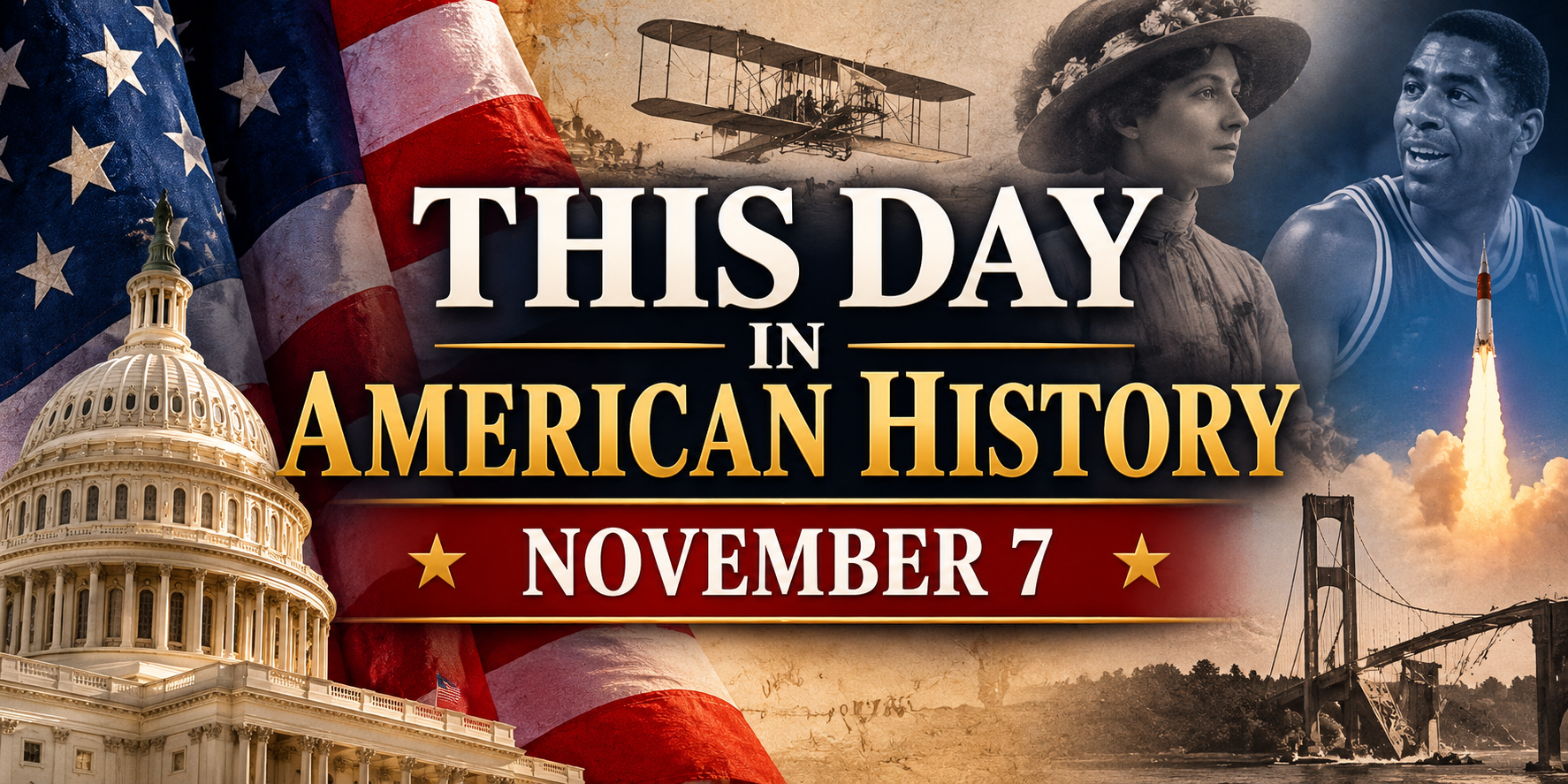
American history is filled with defining moments that have shaped the nation’s government, culture, communities, and future. Some of these events are remembered through major celebrations, while others represent turning points that continue to influence American life generations later.
November 7 is one of those dates that holds a remarkable collection of historical milestones. From presidential elections and breakthroughs in American politics to scientific achievements and the expansion of transportation, this day offers a fascinating look at how the United States has evolved.
Throughout history, November 7 has witnessed moments of leadership, innovation, determination, and change. Each event tells a different story about the American experience and reminds us that history is constantly being written.
Let’s explore some of the most significant events that occurred on November 7 in American history, the people who made them possible, and why they still matter today.
November 7, 1876 – One of America’s Most Controversial Presidential Elections
On November 7, 1876, Americans went to the polls in an election that would become one of the most disputed presidential contests in United States history.
The election featured Republican Rutherford B. Hayes of Ohio and Democrat Samuel J. Tilden of New York. Both candidates were competing to succeed President Ulysses S. Grant during a period of political uncertainty, economic difficulties, and growing tensions over Reconstruction.
Tilden won the popular vote and initially appeared to be the likely winner. However, disputed electoral votes from several states created a constitutional crisis.
The controversy centered on competing election results in Florida, Louisiana, and South Carolina, along with an electoral vote dispute in Oregon.
Congress eventually established a special Electoral Commission to resolve the disagreement. The commission awarded the disputed electoral votes to Hayes, giving him a narrow Electoral College victory of 185 to 184.
The political settlement associated with the election helped bring federal Reconstruction efforts in the South to an end in 1877. This had devastating consequences for the protection of Black Americans’ civil and political rights.
Why It Matters Today: The election of 1876 demonstrates the importance of electoral procedures, constitutional safeguards, and public confidence in democratic institutions. It also illustrates how political compromises can produce consequences that extend far beyond a single presidential administration.
November 7, 1910 – The First Commercial Air Freight Shipment
On November 7, 1910, aviation history took an important step forward when a shipment of silk was transported by airplane from Dayton to Columbus, Ohio.
The flight was made by aviator Philip Orin Parmelee in a Wright Model B aircraft.
At the time, airplanes were still relatively new inventions. Most Americans had never flown, and the idea of using aircraft to transport commercial merchandise was revolutionary.
The shipment demonstrated that airplanes could serve purposes beyond military experimentation, entertainment, and passenger transportation.
Although the flight covered a relatively short distance compared with modern aviation, it represented an early milestone in commercial air cargo.
Today, aircraft transport everything from medical supplies and emergency equipment to electronics, clothing, and food across the world.
Why It Matters Today: This pioneering flight helped establish the possibilities of air freight transportation, an industry that would eventually become essential to international commerce and modern supply chains.
November 7, 1916 – Jeannette Rankin Becomes the First Woman Elected to Congress
One of the most significant milestones in American political history occurred on November 7, 1916, when Jeannette Rankin of Montana became the first woman elected to the United States Congress.
Rankin’s victory came four years before the ratification of the 19th Amendment, which prohibited denying voting rights on the basis of sex.
A committed advocate for women’s suffrage, Rankin had spent years fighting for women’s political participation.
Her election challenged longstanding assumptions about women’s roles in government and opened a new chapter in American democracy.
When Rankin entered Congress in 1917, she became a national symbol of political progress.
She was also known for her opposition to war. During her congressional career, she voted against American participation in both World War I and World War II.
Her positions sometimes attracted intense criticism, but she remained committed to her convictions.
Rankin’s election inspired future generations of women to pursue careers in public service, political leadership, and government.
Why It Matters Today: Rankin’s historic victory helped break barriers that had excluded women from national political office. Her legacy remains an important part of the history of women’s representation in American democracy.
November 7, 1916 – Woodrow Wilson Wins Reelection
November 7, 1916, was also the date of a closely contested presidential election between incumbent Democratic President Woodrow Wilson and Republican challenger Charles Evans Hughes.
The election occurred while World War I was devastating much of Europe.
Although the United States had not yet entered the conflict, the war dominated political discussions and influenced voters’ concerns about national security and international involvement.
Wilson campaigned partly on his administration’s record of keeping America out of the European war.
Hughes, a former governor of New York and former Supreme Court justice, presented a strong challenge.
Wilson ultimately secured reelection by a narrow Electoral College margin.
However, America’s position would change dramatically just months later.
In April 1917, Wilson asked Congress to declare war against Germany, bringing the United States into World War I.
Why It Matters Today: The election of 1916 highlights how quickly international events can reshape presidential priorities and national policy. It also reminds Americans that campaign promises and governing decisions often face unpredictable circumstances.
November 7, 1932 – The Supreme Court Strengthens the Right to Legal Counsel
On November 7, 1932, the United States Supreme Court issued its decision in Powell v. Alabama, a landmark case involving the Scottsboro Boys.
The case began in 1931 when nine Black teenagers were accused of raping two white women aboard a train in Alabama.
The defendants faced trials in an atmosphere of intense racial hostility. Several received death sentences after proceedings in which they had not been given meaningful access to legal counsel.
The Supreme Court ruled that, under the circumstances of the case, the failure to provide effective access to legal representation violated the defendants’ constitutional right to due process.
The ruling was a major development in American criminal justice.
It helped establish the principle that defendants facing serious criminal charges must have a fair opportunity to obtain legal assistance.
The case also exposed the racial discrimination that shaped many criminal prosecutions during the Jim Crow era.
Why It Matters Today: Powell v. Alabama helped lay the foundation for stronger protections for criminal defendants, contributing to later decisions expanding the right to appointed counsel.
November 7, 1940 – The Tacoma Narrows Bridge Collapses
On November 7, 1940, one of the most famous engineering failures in American history occurred when the original Tacoma Narrows Bridge collapsed in Washington State.
The suspension bridge had opened only four months earlier, on July 1, 1940.
Connecting Tacoma with the Kitsap Peninsula region, the structure was considered an impressive engineering achievement.
However, the bridge soon became known for its unusual movements during windy conditions.
Drivers and observers noticed that the roadway could rise, fall, and twist dramatically.
The bridge earned the nickname “Galloping Gertie.”
On November 7, strong winds caused increasingly severe twisting motions. Eventually, large portions of the roadway broke apart and fell into the water below.
Fortunately, no human lives were lost in the collapse, although a dog trapped in a vehicle died.
Engineers later determined that the bridge’s design had failed to account adequately for complex aerodynamic forces.
The disaster transformed the study of suspension bridge design and wind-related structural behavior.
Why It Matters Today: The Tacoma Narrows Bridge collapse remains an important engineering lesson about testing, design limitations, and the importance of understanding how structures interact with natural forces.
November 7, 1944 – Franklin D. Roosevelt Wins an Unprecedented Fourth Term
On November 7, 1944, President Franklin D. Roosevelt achieved something no other American president had accomplished: election to a fourth term.
Roosevelt faced Republican candidate Thomas E. Dewey while the United States was deeply involved in World War II.
American forces were fighting in Europe and the Pacific, and voters were concerned about military leadership, economic stability, and the nation’s future after the war.
Roosevelt had already guided the country through much of the Great Depression and several years of global conflict.
His experience and wartime leadership contributed to his reelection.
However, Roosevelt’s health was deteriorating. He died on April 12, 1945, less than three months after beginning his fourth term.
Vice President Harry S. Truman succeeded him and would lead the United States through the final months of World War II.
Roosevelt’s unprecedented presidency later contributed to the adoption of the 22nd Amendment in 1951, which generally limits presidents to two elected terms.
Why It Matters Today: Roosevelt’s fourth election remains a unique moment in presidential history and helped shape the constitutional rules governing how long a president may serve.
November 7, 1972 – Richard Nixon Wins a Landslide Reelection
On November 7, 1972, President Richard Nixon won reelection in one of the largest Electoral College victories in American history.
Nixon defeated Democratic challenger George McGovern, carrying 49 states and winning 520 electoral votes.
The election took place during a period of major national challenges, including the Vietnam War, inflation, and changing American attitudes toward government.
Nixon’s administration emphasized foreign policy achievements, including improved relations with China and diplomatic efforts involving the Soviet Union.
Despite his overwhelming electoral victory, Nixon’s second term would be overshadowed by the Watergate scandal.
Investigations into the break-in at Democratic National Committee headquarters and the subsequent cover-up eventually led Nixon to resign on August 9, 1974.
He remains the only American president to have resigned from office.
Why It Matters Today: Nixon’s 1972 victory demonstrates that overwhelming electoral success does not eliminate the need for government accountability, transparency, and constitutional oversight.
November 7, 1989 – Historic Breakthroughs in American Politics
November 7, 1989, marked two major political milestones involving African American leadership.
In Virginia, L. Douglas Wilder was elected governor, becoming the first African American elected governor of a U.S. state.
His victory was particularly significant because Virginia had been a major center of slavery and segregation.
Wilder’s election represented an important step forward in political representation and civil rights.
On the same day, David Dinkins was elected mayor of New York City, becoming the city’s first Black mayor.
Dinkins’ victory reflected changing political dynamics in one of America’s largest and most diverse cities.
Both elections were historic achievements, but they also came with substantial expectations and challenges.
Their victories demonstrated that barriers once considered nearly impossible to overcome could be broken through political participation and public support.
Why It Matters Today: These elections represented important advances in African American political representation and helped inspire future generations of public officials and community leaders.
November 7, 1991 – Magic Johnson Announces His HIV Diagnosis
On November 7, 1991, basketball superstar Magic Johnson shocked the sports world when he publicly announced that he had tested positive for HIV.
At the time, Johnson was one of the most recognizable athletes in the United States.
He had helped lead the Los Angeles Lakers to multiple NBA championships and was widely admired for his talent, leadership, and personality.
During the early 1990s, HIV and AIDS were surrounded by widespread fear, misunderstanding, and stigma.
Johnson announced that he would retire from professional basketball, although he later returned to play.
His public disclosure brought enormous attention to HIV education, prevention, and medical research.
Johnson subsequently became a prominent advocate for HIV awareness and worked to challenge misconceptions about the virus.
His willingness to discuss his diagnosis publicly helped change the national conversation about HIV.
Why It Matters Today: Johnson’s announcement helped increase public awareness of HIV and reinforced the importance of education, prevention, medical treatment, and compassion toward people living with the virus.
November 7, 1996 – NASA Launches the Mars Global Surveyor
On November 7, 1996, NASA launched the Mars Global Surveyor spacecraft from Cape Canaveral, Florida.
The mission represented an important step in America’s renewed exploration of Mars.
Scientists wanted to gather detailed information about the planet’s surface, atmosphere, magnetic properties, and geological history.
After arriving at Mars in September 1997, the spacecraft began an extensive scientific investigation.
Its instruments helped produce detailed maps and images of the Martian surface.
The mission also provided valuable information about features that suggested water had influenced the planet’s geological development.
Although the spacecraft was originally designed for a shorter mission, it continued operating for years beyond its planned lifetime.
Communication with Mars Global Surveyor was lost in 2006.
The mission contributed important knowledge that helped scientists plan future Mars exploration projects.
Why It Matters Today: Mars Global Surveyor helped expand humanity’s understanding of another planet and demonstrated the value of long-term robotic exploration in advancing scientific discovery.
November 7, 2000 – A Presidential Election Without an Immediate Winner
On November 7, 2000, Americans voted in a presidential election that would become one of the most closely contested in modern history.
Republican George W. Bush faced Democratic Vice President Al Gore.
As election results arrived, the outcome increasingly depended on Florida.
The state’s extremely close vote totals triggered recounts, legal challenges, and widespread national uncertainty.
For weeks, Americans waited to learn who would become the next president.
The controversy eventually reached the United States Supreme Court.
On December 12, 2000, the Court issued its decision in Bush v. Gore, effectively ending the recount then underway.
Bush ultimately won Florida by a certified margin of 537 votes and secured the presidency with 271 electoral votes.
Gore won the nationwide popular vote but lost the Electoral College.
The election raised major questions about voting equipment, ballot design, recount procedures, and election administration.
Why It Matters Today: The 2000 election demonstrated how closely contested elections can test democratic institutions and highlighted the importance of reliable voting systems and clear election laws.
November 7, 2020 – Joe Biden Is Projected the Winner of the Presidential Election
On November 7, 2020, major American news organizations projected that former Vice President Joe Biden had won the presidential election against incumbent President Donald Trump.
The election itself had taken place on November 3, but counting continued in several closely contested states.
The race occurred during the COVID-19 pandemic, which significantly affected how Americans voted and how election officials processed ballots.
Record participation and widespread use of mail-in voting contributed to an extended vote-counting process.
After additional results from Pennsylvania became clear, news organizations projected Biden’s victory.
Biden eventually won 306 electoral votes to Trump’s 232.
His running mate, Kamala Harris, became the first woman, first Black American, and first person of South Asian descent elected vice president of the United States.
The election also led to legal challenges and disputes over its results. State certifications, recounts, and court proceedings upheld Biden’s victory.
Why It Matters Today: The 2020 election highlighted the importance of election administration, public trust, accurate vote counting, and the peaceful transfer of presidential power.
What November 7 Teaches Us About American History
Looking across these events, several important themes emerge.
1. Progress Often Begins With People Who Challenge Expectations
Jeannette Rankin, Douglas Wilder, and David Dinkins helped expand the possibilities of political leadership.
Their accomplishments demonstrate that individuals can challenge longstanding barriers and open opportunities for future generations.
2. Failure Can Become a Source of Progress
The Tacoma Narrows Bridge collapse was a major engineering disaster, but the lessons learned helped improve future bridge designs.
History reminds us that mistakes, when studied carefully, can lead to safer systems and better decisions.
3. Democracy Requires Constant Attention
The presidential elections of 1876 and 2000 illustrate how electoral disputes can create uncertainty and test constitutional processes.
They remind us that democratic institutions depend on clear rules, accountability, and public participation.
4. Courage Can Change Public Understanding
Magic Johnson’s announcement in 1991 helped bring greater public attention to HIV.
His example shows how speaking openly about difficult subjects can challenge stigma and encourage education.
5. Innovation Shapes the Future
From early air freight transportation to NASA’s exploration of Mars, November 7 includes achievements that expanded what people believed was possible.
These breakthroughs demonstrate how curiosity, persistence, and scientific discovery can transform society.
Interesting Facts About November 7 in American History
-
1910: An airplane carried a commercial shipment of silk between Dayton and Columbus, Ohio.
-
1916: Jeannette Rankin became the first woman elected to Congress, before women had nationwide constitutional protection of their voting rights.
-
1940: The original Tacoma Narrows Bridge collapsed only four months after opening.
-
1944: Franklin D. Roosevelt became the only American president elected to four terms.
-
1972: Richard Nixon carried 49 states in his reelection victory.
-
1989: Douglas Wilder and David Dinkins achieved historic electoral victories on the same day.
-
1991: Magic Johnson’s HIV announcement became a defining moment in public health awareness.
-
1996: NASA launched a spacecraft that would spend years studying Mars.
-
2000: Americans went to bed on election night without knowing who had won the presidency.
Final Thoughts: Remembering November 7 in American History
November 7 reminds us that American history is not simply a collection of dates and famous names. It is the story of people making decisions, overcoming challenges, confronting injustice, and creating opportunities for the future.
Some events represent tremendous achievements. Others reveal mistakes, divisions, or difficult lessons that the nation has had to confront.
Together, they illustrate the complexity of the American experience.
From Jeannette Rankin breaking barriers in Congress to the scientific achievements of NASA, November 7 offers examples of determination and progress. From disputed presidential elections to engineering disasters, it also provides reminders that institutions and innovations must be continually examined and improved.
Every generation inherits the accomplishments and challenges of those who came before it. Understanding history allows us to appreciate that inheritance while recognizing our responsibility to shape what comes next.
As we reflect on November 7, we can remember the individuals who made history, the lessons their experiences provide, and the importance of learning from the past.
History is more than remembering what happened yesterday. It is understanding how yesterday continues to influence tomorrow.
Which November 7 event do you believe had the greatest lasting impact on American history, and why?


Leave a Reply