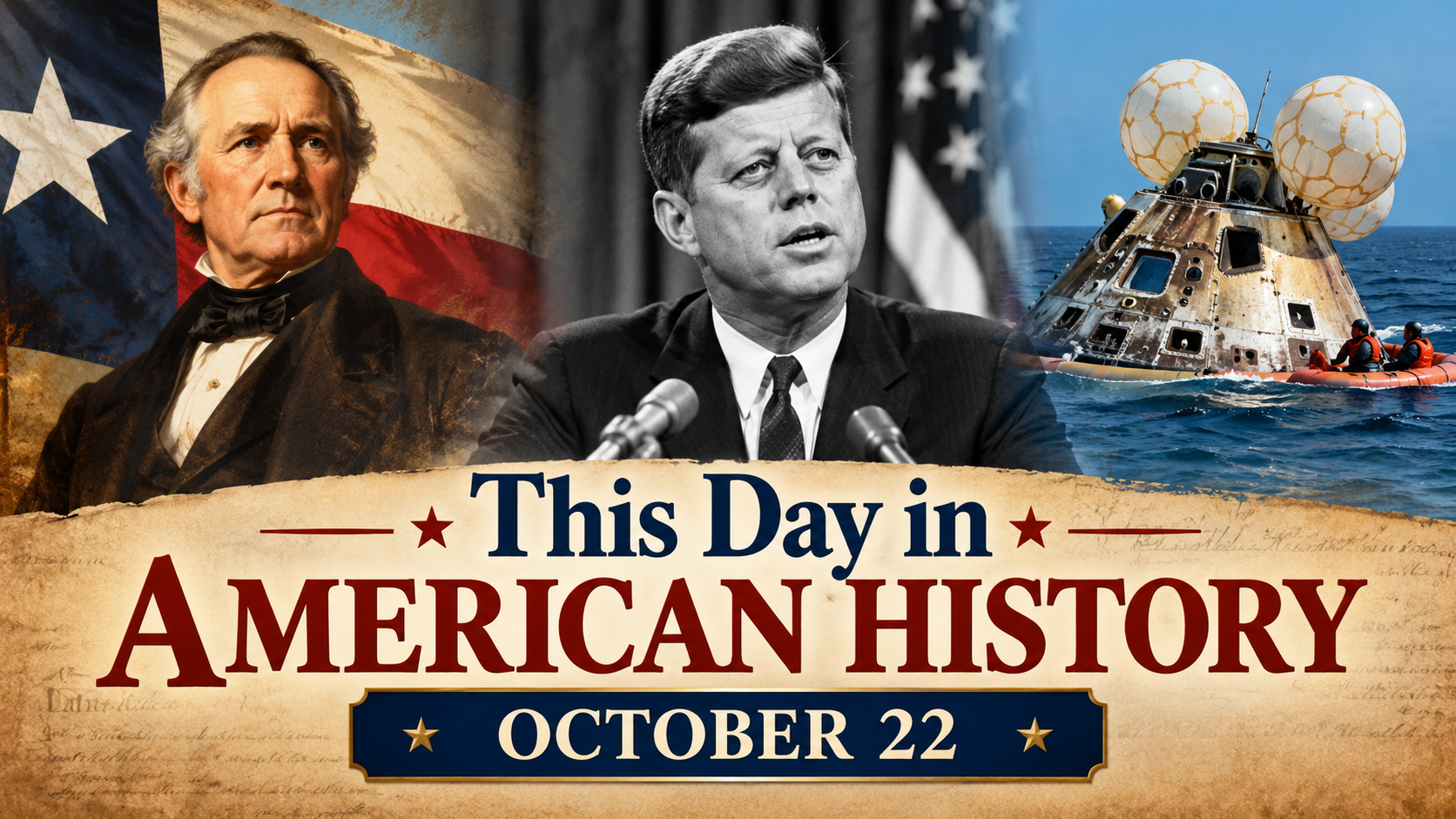
October 22 has witnessed several important moments in American history. From the birth of a new government in Texas to one of the most frightening confrontations of the Cold War and a successful mission that helped pave the way to the Moon, this date reminds us how individual days can become turning points.
Perhaps no October 22 event carried greater immediate danger for the United States—and the world—than President John F. Kennedy’s 1962 announcement about Soviet nuclear missiles in Cuba.
But that is only part of the story.
Here is a look back at some of the most significant events connected to October 22 in American history.
1836: Sam Houston Becomes President of the Republic of Texas
On October 22, 1836, Sam Houston took the oath of office as president of the Republic of Texas.
Texas had declared its independence from Mexico earlier that year. The struggle for independence included some of the most famous events in Texas history, including the Battle of the Alamo and the Battle of San Jacinto.
Houston had commanded the Texian forces at San Jacinto, where his army defeated the forces of Mexican General Antonio López de Santa Anna in April 1836.
That victory helped secure Texas independence.
Houston was elected president of the new republic on September 5, 1836. On October 22, he officially took office before a joint session of the Texas Congress. The temporary, or ad interim, government that had guided Texas during the revolution came to an end.
Houston faced enormous challenges.
The Republic of Texas had financial problems, security concerns, disputes involving Native peoples and continuing tensions with Mexico. Houston also hoped Texas would eventually become part of the United States.
That goal would take nearly another decade.
Texas was annexed by the United States in 1845 and became the 28th state.
Houston would remain one of the most recognizable figures in Texas and American history. He later represented Texas in the United States Senate and served as governor of the state.
His inauguration on October 22, 1836, therefore represents an important chapter in the long and complicated story of American expansion.
1962: President Kennedy Addresses the Nation During the Cuban Missile Crisis
October 22, 1962, became one of the most tense nights in American history.
At 7 p.m., President John F. Kennedy addressed Americans on television and radio.
His message was alarming.
American reconnaissance had discovered Soviet nuclear missile installations being constructed in Cuba, approximately 90 miles from Florida.
The discovery created an extraordinary national-security crisis.
The United States and Soviet Union were already locked in the Cold War, and both possessed nuclear weapons capable of causing unimaginable destruction.
Suddenly, Soviet nuclear missiles were being positioned extremely close to American territory.
Kennedy and his advisers considered several possible responses, including military strikes against the missile sites and a potential invasion of Cuba.
Instead, Kennedy initially chose another approach.
He announced what the administration called a naval “quarantine” of Cuba designed to prevent additional offensive weapons from reaching the island. He also demanded the removal of the Soviet missiles already there.
For millions of Americans listening that evening, the possibility of nuclear war no longer seemed theoretical.
It felt frighteningly real.
America Learns About the Missiles
The Cuban Missile Crisis had already been developing behind closed doors before Kennedy’s October 22 speech.
A U-2 reconnaissance aircraft photographed Soviet missile installations in Cuba on October 14.
The photographs were analyzed, and Kennedy was informed about the discovery.
For several days, the president and a small group of advisers secretly debated what the United States should do.
Then came the public announcement.
Kennedy told Americans that evidence had established the presence of offensive missile sites in Cuba and explained the government’s planned response.
The announcement immediately transformed a secret confrontation into an international crisis.
Families across America wondered what would happen next.
Would Soviet ships challenge the quarantine?
Would the United States attack Cuba?
Would the Soviet Union retaliate?
Could a confrontation escalate into nuclear war?
No one could confidently answer those questions.
The World Moves Dangerously Close to Nuclear War
The Cuban Missile Crisis lasted 13 tense days, from October 16 through October 28, 1962.
Kennedy’s October 22 announcement was one of its defining moments.
The United States increased its military readiness while American naval forces prepared to enforce the quarantine.
Soviet Premier Nikita Khrushchev condemned the American action, and Soviet ships continued toward Cuba.
The danger increased as both governments attempted to determine how far the other side was willing to go.
The confrontation eventually became one of the closest moments the world has ever come to nuclear war.
Yet diplomacy continued.
Messages moved between Kennedy and Khrushchev as both sides searched for a solution that could prevent war.
Eventually, an agreement emerged.
The Soviet Union agreed to dismantle and remove its nuclear missiles from Cuba. The United States publicly pledged not to invade Cuba. The United States also later removed Jupiter missiles from Turkey as part of the broader resolution reached through private diplomacy.
On October 28, Khrushchev publicly announced that the Soviet missiles in Cuba would be dismantled and removed.
The immediate crisis was ending.
Why October 22, 1962 Still Matters
The Cuban Missile Crisis became one of the defining events of the Cold War because it demonstrated how quickly competition between nuclear powers could threaten millions of lives.
It also revealed the importance of communication.
Both Kennedy and Khrushchev faced enormous political and military pressure. Misunderstanding the intentions of the other side could have produced catastrophic consequences.
One lasting result of the crisis was improved direct communication between Washington and Moscow. A direct communications link between the two governments—the famous Washington-Moscow “hotline”—was established afterward.
The confrontation also contributed to renewed efforts to control the nuclear arms race, including movement toward the Limited Nuclear Test Ban Treaty of 1963.
October 22 therefore represents more than the night Kennedy announced the discovery of missiles.
It represents a lesson about leadership, diplomacy, restraint and the extraordinary consequences that can follow decisions made during a crisis.
1968: Apollo 7 Returns Safely to Earth
Six years after Kennedy’s Cuban Missile Crisis address, October 22 became significant for a very different reason.
On October 22, 1968, Apollo 7 successfully returned to Earth.
The spacecraft carried astronauts Walter Schirra Jr., Donn Eisele and Walter Cunningham.
Apollo 7 had launched on October 11 and was the first crewed mission of the Apollo program. It was also the first American spaceflight carrying a three-person crew and featured the first live television transmission from an American spacecraft.
After nearly 11 days in space, Apollo 7 splashed down in the Atlantic Ocean southeast of Bermuda on October 22.
NASA considered the mission highly successful.
All major mission objectives were accomplished, and the spacecraft systems performed essentially as expected.
That success was especially important because NASA was still recovering from tragedy.
Rebuilding Confidence After Apollo 1
The Apollo program had suffered a devastating setback on January 27, 1967.
Astronauts Virgil “Gus” Grissom, Edward White and Roger Chaffee were killed when a fire broke out inside the Apollo 1 command module during a launch-pad test.
NASA spent the following months investigating the disaster and making extensive changes to the spacecraft.
Apollo 7 represented the first crewed Apollo flight after that tragedy.
That made the mission about much more than testing equipment.
NASA needed to demonstrate that the redesigned Apollo spacecraft could safely carry astronauts into space and return them to Earth.
Apollo 7 accomplished that mission.
The crew spent more than 260 hours in space and completed 163 Earth orbits before returning safely on October 22.
The successful flight helped clear the way for one of NASA’s boldest decisions.
Just two months later, Apollo 8 carried astronauts Frank Borman, Jim Lovell and William Anders around the Moon.
Then, in July 1969, Apollo 11 landed humans on the lunar surface.
The famous first steps of Neil Armstrong and Buzz Aldrin did not happen in isolation.
They were built upon earlier missions that tested spacecraft, equipment, procedures and people.
Apollo 7 was one of those essential steps.
October 22: A Day of Leadership Under Pressure
Looking at these events together reveals an interesting connection.
October 22 has repeatedly been associated with moments when Americans faced uncertainty and enormous challenges.
In 1836, Sam Houston assumed leadership of the young Republic of Texas.
In 1962, John F. Kennedy addressed the nation as the United States confronted Soviet nuclear missiles in Cuba.
In 1968, Apollo 7 safely returned to Earth after proving that NASA’s redesigned Apollo spacecraft could support a crew in orbit.
The circumstances could hardly have been more different.
One involved the establishment of a government.
Another involved the possibility of nuclear war.
The third involved America’s effort to explore space.
Yet all three demonstrate how history is shaped by decisions made when the outcome is uncertain.
From Texas Independence to the Space Age
The span between 1836 and 1968 also shows just how dramatically the United States changed.
In Houston’s time, the country was still expanding across North America.
By Kennedy’s presidency, the United States had become one of two global superpowers capable of nuclear destruction.
Only six years after the Cuban Missile Crisis, American astronauts were orbiting Earth in a spacecraft designed to support the effort to reach another world.
And less than a year after Apollo 7’s October 22 splashdown, Americans would walk on the Moon.
That progression—from frontier expansion to nuclear superpower to space exploration—covers only a little more than a century.
It is a remarkable reminder of how quickly nations, technology and society can change.
Remembering October 22
History is often remembered through its biggest dates: declarations of war, presidential elections, assassinations, major battles and national tragedies.
But looking at history one day at a time reveals something different.
Every date contains stories.
October 22 gives us several.
It tells the story of Sam Houston taking responsibility for a newly established republic.
It tells the story of Americans gathering around televisions and radios as President Kennedy explained that Soviet nuclear missiles had been discovered in Cuba.
And it tells the story of three astronauts splashing safely into the Atlantic after successfully testing the spacecraft that would help carry America toward the Moon.
These events remind us that history isn’t simply a collection of facts and dates.
It is the story of people confronting uncertainty.
Sometimes they make decisions knowing that millions of lives could depend on what happens next.
Sometimes they climb aboard spacecraft to test technology that has never carried humans before.
Sometimes they take responsibility for governments whose futures remain uncertain.
And years later, we can look back and recognize those moments as turning points.
Final Thoughts
October 22 holds an important place in American history.
The inauguration of Sam Houston in 1836 represented a new stage for the Republic of Texas and a story that would eventually become intertwined with the expansion of the United States.
President Kennedy’s October 22, 1962 address brought the Cuban Missile Crisis directly into American homes and marked one of the most dangerous moments of the Cold War.
Apollo 7’s successful return on October 22, 1968 demonstrated that NASA’s Apollo spacecraft was ready for more ambitious missions and helped move the United States closer to landing astronauts on the Moon.
Different generations faced different challenges.
But each story carries a similar lesson: the future is often shaped during moments when no one yet knows how the story will end.
That is one reason studying history matters.
We already know what happened next.
The people living through these events did not.
Which October 22 event do you believe had the greatest impact on American history—the rise of Sam Houston and the Republic of Texas, Kennedy’s Cuban Missile Crisis address, or the successful return of Apollo 7?


Leave a Reply