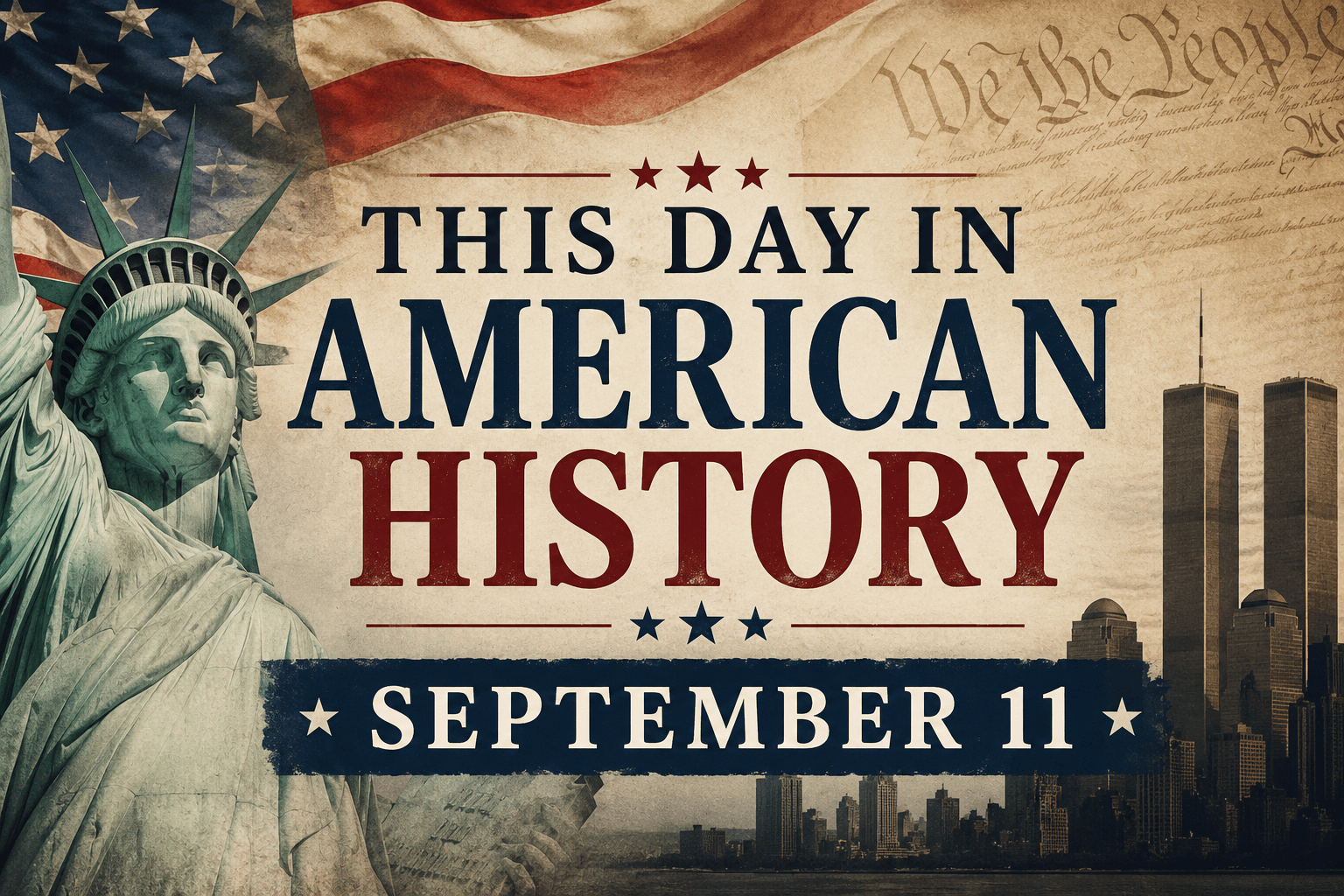
September 11 is one of the most solemn and unforgettable dates in American history. While many significant events have taken place on this date over the centuries, September 11 will forever be most closely associated with the terrorist attacks of 2001, when nearly 3,000 people were killed in New York City, at the Pentagon, and aboard United Airlines Flight 93.
The date is now observed as Patriot Day, a time to remember those who lost their lives, honor the courage of first responders and ordinary citizens, and reflect on the resilience demonstrated by Americans in the aftermath of tragedy.
But September 11 also has a broader place in the American story. From events during the American Revolution to milestones in transportation and American culture, this date offers several moments worth remembering.
September 11, 1777 – The Battle of Brandywine
During the American Revolutionary War, American and British forces fought the Battle of Brandywine on September 11, 1777.
The battle took place near Chadds Ford, Pennsylvania, as British General Sir William Howe attempted to capture Philadelphia, which was then serving as the American capital.
General George Washington commanded the Continental Army.
The British successfully maneuvered around the American position and eventually forced Washington’s troops to retreat. Although the Americans were defeated, the Continental Army remained intact and continued fighting.
The British later entered Philadelphia, but capturing the city did not bring the Revolution to an end.
The Battle of Brandywine was one of the largest battles of the Revolutionary War and demonstrated the enormous challenges Washington and the Continental Army faced while fighting one of the world’s most powerful military forces.
September 11, 1789 – Alexander Hamilton Becomes Secretary of the Treasury
On September 11, 1789, Alexander Hamilton became the first Secretary of the Treasury of the United States.
President George Washington selected Hamilton for the position during the earliest days of the new federal government.
Hamilton would become one of the most influential figures in shaping America’s financial system.
He advocated for the federal government to assume state Revolutionary War debts, supported the creation of a national bank, and worked to establish confidence in the young nation’s credit.
Hamilton believed that a strong financial system was essential to America’s long-term economic and political stability.
Many of the debates surrounding federal power, taxation, banking, debt, and economic development that emerged during Hamilton’s tenure would continue throughout American history.
His appointment on September 11, 1789, therefore represents an important moment in the development of the United States government and economy.
September 11, 1814 – The Battle of Lake Champlain
Another important military event occurred on September 11, 1814, during the War of 1812.
American and British forces fought the Battle of Lake Champlain, also known as the Battle of Plattsburgh.
A British invasion force moved south from Canada toward Plattsburgh, New York. Control of Lake Champlain was essential because the lake provided an important transportation and supply route.
American naval forces commanded by Thomas Macdonough confronted the British fleet.
The Americans won a decisive naval victory.
Without control of the lake, British ground forces could not safely maintain their supply lines and withdrew toward Canada.
The victory strengthened the American negotiating position as diplomats worked toward ending the War of 1812.
The conflict officially ended several months later with the ratification of the Treaty of Ghent.
September 11, 1857 – The Mountain Meadows Massacre
September 11 is also connected to one of the darker episodes in the history of the American West.
In September 1857, a wagon train known as the Baker-Fancher party was traveling through Utah Territory toward California.
Following several days of siege at Mountain Meadows, approximately 120 members of the wagon train were killed on September 11.
The massacre was carried out by members of a local Mormon militia with involvement from some Native American participants.
Only young children considered too small to describe what had happened were spared.
The Mountain Meadows Massacre remains one of the most disturbing episodes associated with America’s westward expansion and the tensions that existed in Utah Territory during the 1850s.
Today, historians continue to study the massacre, the motivations of those involved, and the efforts that followed to determine responsibility.
September 11, 1906 – Gandhi Begins a Movement That Would Influence America
On September 11, 1906, Mohandas Gandhi participated in a mass meeting in Johannesburg, South Africa, that became an important moment in the development of his philosophy of nonviolent resistance.
Although the event did not occur in the United States, its influence would eventually become deeply connected to American history.
Gandhi’s methods of peaceful resistance later influenced leaders of the American Civil Rights Movement, particularly Dr. Martin Luther King Jr.
King studied Gandhi’s philosophy and incorporated nonviolent resistance into campaigns against segregation and racial discrimination.
This historical connection demonstrates how events occurring far beyond America’s borders can eventually influence social and political movements within the United States.
September 11, 1941 – Construction Begins on the Pentagon
On September 11, 1941, construction began on one of America’s most recognizable government buildings: the Pentagon.
The massive building in Arlington, Virginia, was constructed to consolidate offices of the U.S. War Department, which had been spread among numerous buildings.
Construction moved extraordinarily quickly as the United States prepared for the possibility of entering World War II.
Just months later, the Japanese attack on Pearl Harbor on December 7, 1941, brought the United States directly into the war.
The Pentagon eventually became the headquarters of the United States Department of Defense.
Exactly 60 years after construction began, the building would become one of the targets of the September 11 terrorist attacks.
That coincidence gives September 11 an especially striking connection to the Pentagon’s history.
September 11, 1954 – The Miss America Pageant Makes Television History
September 11 also includes moments from American popular culture.
On September 11, 1954, the Miss America pageant was televised nationally and attracted an enormous television audience.
The pageant had existed for decades, but television transformed it into a nationally watched cultural event.
The broadcast demonstrated the rapidly growing influence of television during the 1950s.
Television was becoming a central part of American family life, changing entertainment, advertising, politics, news, sports, and popular culture.
Events that previously attracted regional audiences could suddenly be watched by millions of Americans simultaneously.
September 11, 1967 – The Carol Burnett Show Premieres
American television history reached another milestone on September 11, 1967, when The Carol Burnett Show premiered on CBS.
Starring Carol Burnett, the variety and sketch comedy program became one of the most celebrated television shows of its era.
The series combined comedy sketches, musical performances, guest stars, and Burnett’s distinctive interaction with her studio audience.
The show remained on television for 11 seasons and earned numerous awards.
Its comedy sketches continued to be watched and celebrated long after the original series ended.
September 11, therefore, also marks the beginning of an influential chapter in American entertainment history.
September 11, 2001 – A Day America Will Never Forget
Everything associated with September 11 changed on the morning of Tuesday, September 11, 2001.
Nineteen terrorists associated with al-Qaeda hijacked four commercial airplanes in a coordinated attack against the United States.
At 8:46 a.m., American Airlines Flight 11 crashed into the North Tower of the World Trade Center in New York City.
Initially, many watching the unfolding disaster believed that a terrible aviation accident had occurred.
Then, at 9:03 a.m., United Airlines Flight 175 crashed into the South Tower.
The second impact made it clear that the United States was under attack.
Millions of Americans watched the events unfold live on television.
The Attack on the Pentagon
A third hijacked aircraft, American Airlines Flight 77, was flown toward Washington, D.C.
At 9:37 a.m., the plane crashed into the Pentagon in Arlington, Virginia.
The impact caused severe destruction and fires inside the building.
Military personnel and civilian employees immediately began helping one another escape while emergency crews rushed toward the Pentagon.
The fact that construction on the Pentagon had begun exactly 60 years earlier—on September 11, 1941—became a remarkable historical coincidence attached to the tragedy.
The Collapse of the World Trade Center Towers
Back in New York City, firefighters, police officers, emergency medical personnel, Port Authority officers, and other responders entered the World Trade Center complex.
Thousands of people attempted to evacuate the buildings.
At 9:59 a.m., the South Tower collapsed.
Less than half an hour later, at 10:28 a.m., the North Tower collapsed.
The images of the towers falling became some of the most recognizable and heartbreaking images in modern American history.
Entire neighborhoods of Lower Manhattan were covered in smoke, ash, and debris.
Yet even amid the destruction, countless acts of courage occurred.
First responders ran toward danger while others were trying to escape.
Coworkers helped coworkers.
Strangers helped strangers.
People carried injured individuals away from the disaster.
Some sacrificed their lives attempting to save people they had never met.
United Airlines Flight 93
The fourth hijacked aircraft was United Airlines Flight 93.
Passengers and crew members learned through phone calls that other hijacked airplanes had already been used as weapons.
Realizing that their aircraft was likely part of the same attack, passengers and crew members decided to fight back against the hijackers.
The plane crashed into a field near Shanksville, Pennsylvania, at approximately 10:03 a.m.
Everyone aboard was killed.
Investigators concluded that the hijackers intended to strike another target in Washington, D.C.
The actions of the passengers and crew prevented the aircraft from reaching its intended destination.
Their courage became one of the defining stories of September 11.
Nearly 3,000 Lives Lost
Nearly 3,000 people were killed in the September 11 attacks.
The victims came from many backgrounds, occupations, communities, and countries.
They were office workers.
Firefighters.
Police officers.
Military personnel.
Flight crews.
Travelers.
Parents.
Children.
Brothers.
Sisters.
Husbands.
Wives.
Friends.
Coworkers.
Every number represented a person whose absence would be carried by family members and loved ones for years to come.
Thousands more were injured, and many survivors, first responders, recovery workers, and residents later developed serious illnesses associated with exposure to hazardous materials at the attack sites.
The human consequences of September 11 did not end when the smoke cleared.
For many families, September 11 became a permanent dividing line between life before the attacks and life afterward.
The Heroism of First Responders
One of the most enduring memories of September 11 is the extraordinary courage demonstrated by first responders.
While thousands of people evacuated the World Trade Center, firefighters climbed stairwells carrying heavy equipment toward the burning floors.
Police officers helped direct people away from danger.
Paramedics treated the injured.
Port Authority officers assisted with evacuations.
Many responders knew the danger was enormous, yet they continued their efforts to help others.
Hundreds of first responders died that day.
Their sacrifice became a powerful symbol of courage and service.
In the years that followed, additional responders and recovery workers died from illnesses connected to their work at Ground Zero and other affected locations.
Remembering September 11 means remembering not only those who died that morning but also those whose health and lives were permanently changed by the rescue and recovery effort.
America Comes Together
In the immediate aftermath of the attacks, Americans experienced something that many still remember vividly: an extraordinary sense of national unity.
People donated blood.
Volunteers traveled to New York to help.
Communities organized vigils.
American flags appeared outside homes, businesses, schools, fire stations, and along highways.
Churches and houses of worship opened their doors.
People checked on neighbors.
Strangers comforted one another.
Political disagreements temporarily seemed less important than the shared realization that the country had experienced an enormous tragedy.
The phrase “United We Stand” became visible across the nation.
For many Americans who lived through September 11, the unity that followed remains one of the most powerful memories associated with those difficult days.
How September 11 Changed America
The attacks transformed American life in ways that continue to be felt decades later.
Airport security changed dramatically.
The federal government created the Transportation Security Administration (TSA) and later established the Department of Homeland Security.
Security procedures were strengthened at government buildings, transportation centers, major public events, and other potential targets.
American foreign policy also changed dramatically.
The United States launched military operations in Afghanistan after the Taliban government refused American demands concerning al-Qaeda and Osama bin Laden.
The broader War on Terror would shape American foreign and domestic policy for years.
Thousands of American service members would serve in Afghanistan and other military operations connected to the post-9/11 era.
The consequences of September 11 extended far beyond the attack sites themselves.
September 11 Becomes Patriot Day
September 11 is officially observed in the United States as Patriot Day.
Each year, Americans are encouraged to remember those who died and honor those who responded.
Flags are flown at half-staff.
Memorial ceremonies take place across the country.
Names of victims are read aloud.
Families gather at memorial sites.
Communities hold moments of silence.
At the National September 11 Memorial & Museum in New York City, the footprints of the former Twin Towers have been transformed into memorial pools surrounded by the names of those who died.
The Flight 93 National Memorial in Pennsylvania honors the passengers and crew members who fought back against the hijackers.
The Pentagon Memorial honors those killed at the Pentagon and aboard Flight 77.
These memorials ensure that future generations have places where they can learn, remember, and reflect.
September 11 National Day of Service and Remembrance
September 11 has also become a National Day of Service and Remembrance.
The idea carries an important message.
Remembering tragedy does not have to mean remembering only destruction.
It can also mean choosing to help someone.
Americans participate in volunteer projects, food drives, community cleanups, blood donations, charitable programs, and other acts of service.
Service provides a meaningful way to honor people whose lives were taken.
It reflects one of the strongest lessons to emerge from that terrible day: when people are hurting, helping one another matters.
Teaching September 11 to New Generations
One of the challenges America now faces is teaching September 11 to generations who were not alive when it happened.
For people who experienced the attacks, September 11 is a memory.
They may remember where they were when they first heard the news.
They may remember watching television coverage.
They may remember calling relatives.
They may remember the silence of grounded airplanes or the American flags that appeared everywhere afterward.
For younger Americans, however, September 11 is history.
That makes education increasingly important.
Future generations should understand what happened, who was lost, how people responded, and how the attacks changed the country.
History remains alive when its stories continue to be told.
Remembering the People, Not Just the Tragedy
When discussing September 11, it is easy to focus entirely on collapsing buildings, burning wreckage, and terrorism.
But remembrance should also focus on people.
People went to work that morning expecting an ordinary Tuesday.
Passengers boarded airplanes expecting to reach their destinations.
Firefighters began their shifts.
Police officers reported for duty.
Families said goodbye without realizing those words would become their final conversations.
Thousands of individual stories became connected forever to one historic day.
Remembering those stories keeps September 11 from becoming simply another date in a history book.
A Date With Many Chapters in American History
September 11 had a long history before 2001.
It witnessed battles during the American Revolution and War of 1812.
It marked Alexander Hamilton’s appointment as America’s first Treasury secretary.
It marked the beginning of construction on the Pentagon.
It witnessed moments in American television and popular culture.
But the events of 2001 permanently transformed the meaning of the date.
Today, when Americans hear “September 11,” there is little confusion about what it means.
It means remembrance.
It means sacrifice.
It means courage.
It means grief.
It means service.
And it means honoring people whose lives were forever connected to one of America’s darkest days.
We Will Never Forget
September 11, 2001 demonstrated humanity at its worst through the deliberate murder of innocent people.
But it also revealed humanity at its best.
Firefighters climbed stairs toward danger.
Police officers guided people to safety.
Passengers aboard Flight 93 fought back.
Medical professionals treated the injured.
Volunteers arrived from across the country.
Neighbors helped neighbors.
Strangers comforted strangers.
Families carried the memories of those they lost.
America mourned together.
More than two decades later, the responsibility to remember belongs not only to those who witnessed September 11 but also to the generations that follow.
Remember the innocent people who went to work or boarded airplanes that morning and never returned home.
Remember the first responders who ran toward danger.
Remember the passengers and crew of Flight 93.
Remember the families who received devastating phone calls.
Remember the survivors.
Remember those who spent months searching through the rubble.
Remember the service members whose lives were changed by the wars that followed.
Remember the moments of kindness and unity that emerged from unimaginable tragedy.
History is not only about remembering what happened.
It is about remembering the people who lived it.
On September 11, we remember the lives lost, honor the heroes who answered the call, and carry forward a promise that has echoed across America for generations: We will never forget.
Where were you on September 11, 2001, and what do you remember most about that day?
Leave a Reply