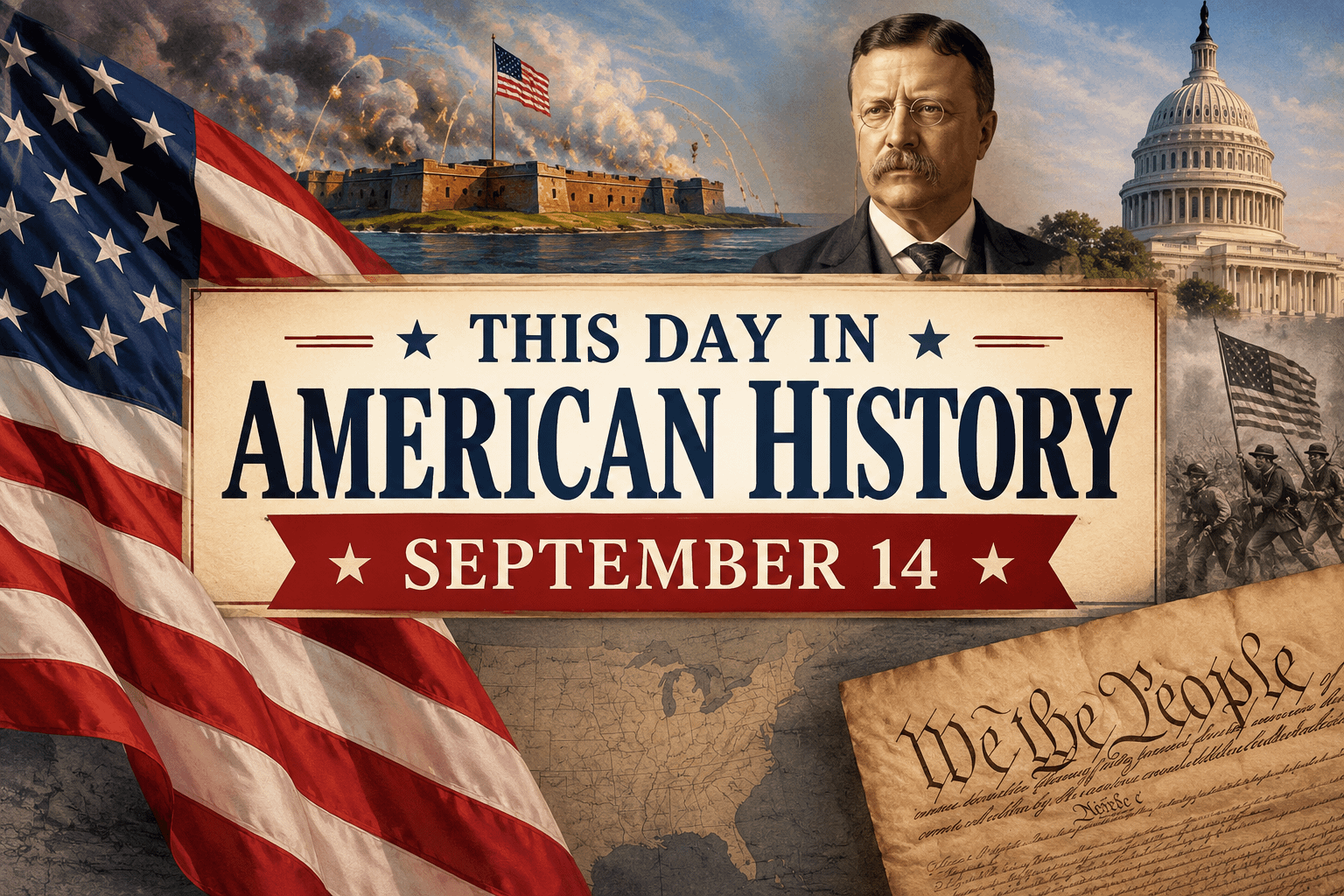
September 14 holds a special place in American history. It is a date connected to one of the nation’s most recognizable patriotic symbols, the transition of presidential power after an assassination, an important Civil War battle, the Mexican-American War, and events that helped shape American culture and foreign policy.
Most notably, September 14, 1814, gave the United States the words that would eventually become its national anthem.
September 14, 1814 – Francis Scott Key Writes “The Star-Spangled Banner”
The most famous American event associated with September 14 happened during the War of 1812.
British forces had been attacking Baltimore, Maryland, and during the night of September 13 into the morning of September 14, British warships bombarded Fort McHenry for roughly 25 hours.
Watching the attack from aboard a vessel in Baltimore Harbor was Washington-area attorney and amateur poet Francis Scott Key.
Key had traveled with American prisoner-exchange official John Stuart Skinner to negotiate the release of Dr. William Beanes, an American civilian who had been taken prisoner by the British. After securing Beanes’ release, Key and the others were temporarily prevented from returning to shore because they had learned details about the planned British attack.
That placed Key in a remarkable position to witness the bombardment of Fort McHenry.
The Flag Was Still Flying
Throughout the night, Key could see flashes from rockets, cannon fire, and explosions around Fort McHenry.
When daylight arrived on the morning of September 14, 1814, he saw something that would become one of the most famous images in American history: an American flag was still flying above the fort.
Major George Armistead ordered a large American flag raised over Fort McHenry that morning to signal that the Americans had successfully resisted the British attack. The flag had been made the previous year by Baltimore flagmaker Mary Pickersgill and her assistants.
The sight inspired Key to begin writing a poem.
Originally titled “Defence of Fort M’Henry,” the four-stanza poem was eventually paired with the melody of the popular tune “Anacreon in Heaven.” It became widely known as “The Star-Spangled Banner.”
From Battlefield Poem to National Anthem
Key could not have known that the words he wrote in 1814 would eventually become part of American life for generations.
The song became increasingly popular at patriotic ceremonies, military occasions, sporting events, and other public gatherings.
More than a century later, Congress officially designated “The Star-Spangled Banner” as the national anthem of the United States on March 3, 1931.
The original Fort McHenry flag that inspired Key survives today and is preserved by the Smithsonian’s National Museum of American History.
For Americans, September 14 therefore marks more than a military victory. It marks the moment when an event witnessed during wartime produced words that would eventually represent the country itself.
September 14, 1847 – American Forces Capture Mexico City
Another major American military event occurred on September 14 during the Mexican-American War.
American troops commanded by General Winfield Scott entered Mexico City following a series of battles surrounding the Mexican capital.
Scott’s campaign had begun months earlier with an amphibious landing near Veracruz. His army then fought its way inland toward Mexico City.
By September 1847, American troops had overcome Mexican defenses around the capital. On September 14, U.S. forces entered Mexico City and raised the American flag there.
The capture effectively demonstrated that Mexico could no longer prevent American forces from occupying its capital.
The war formally ended the following year with the Treaty of Guadalupe Hidalgo in 1848.
The territorial consequences were enormous. Mexico ceded a vast region to the United States encompassing present-day California, Nevada, Utah, and portions of several other western states.
The Mexican-American War therefore played an enormous role in shaping the modern map of the United States, while also intensifying political arguments over whether slavery would expand into newly acquired western territories.
Those arguments would become one of the major forces pushing the nation toward the Civil War.
September 14, 1862 – The Battle of South Mountain
September 14 was also an important day during the American Civil War.
On September 14, 1862, Union and Confederate troops fought the Battle of South Mountain in Maryland.
Confederate General Robert E. Lee had launched an invasion of Maryland after victories in Virginia. His campaign presented a potentially historic opportunity for the Confederacy.
A major Confederate victory on Northern soil could have damaged Northern morale, influenced upcoming elections, and possibly encouraged European governments to consider recognizing the Confederacy.
But Lee’s army had been divided.
Union commander Major General George B. McClellan gained an extraordinary advantage after Union soldiers discovered a lost copy of Lee’s Special Order 191, which revealed information about Confederate troop movements.
Union forces moved toward passes through South Mountain, where Confederate soldiers attempted to slow them.
Fighting occurred around locations including Turner’s Gap, Fox’s Gap, and Crampton’s Gap.
The Confederates were eventually forced to withdraw, but they succeeded in delaying Union forces long enough for Lee to concentrate much of his army near Sharpsburg, Maryland.
Just three days later came one of the most famous battles in American history.
Antietam
On September 17, 1862, Union and Confederate armies fought the Battle of Antietam.
The battle became the bloodiest single day in American military history.
Lee eventually withdrew back into Virginia.
The result gave President Abraham Lincoln enough of a military advantage to announce the preliminary Emancipation Proclamation, dramatically changing the meaning and direction of the Civil War.
South Mountain therefore helped set the stage for one of the most consequential moments of the entire conflict.
September 14, 1901 – President William McKinley Dies
Another major turning point in American history came on September 14, 1901.
President William McKinley died from complications caused by gunshot wounds suffered eight days earlier.
McKinley had been attending the Pan-American Exposition in Buffalo, New York, when he was shot on September 6 by anarchist Leon Czolgosz.
At first, doctors believed McKinley might recover.
His condition later deteriorated as infection and gangrene developed around his wounds.
McKinley died on September 14.
He was 58 years old.
His death suddenly placed Vice President Theodore Roosevelt in the presidency.
Theodore Roosevelt Becomes President
Roosevelt was only 42 years old when he took the presidential oath of office, making him the youngest person ever to become president of the United States.
His presidency would significantly reshape American government.
Roosevelt promoted what became known as his Square Deal, emphasizing greater regulation of corporations, consumer protection, and conservation.
He also expanded America’s international influence.
During his presidency, the United States became increasingly active in world affairs, including the construction of the Panama Canal and diplomatic involvement in conflicts abroad.
Roosevelt also became one of America’s most influential conservation presidents.
Millions of acres of land were placed under federal protection through national forests, wildlife refuges, monuments, and other conservation programs.
McKinley’s death therefore produced one of the most significant presidential transitions of the early twentieth century.
September 14, 1960 – OPEC Is Established
September 14 also became important to American economic and foreign-policy history because of an event that occurred thousands of miles from the United States.
Representatives from major oil-producing nations met in Baghdad, Iraq, from September 10 through September 14, 1960.
Five countries became founding members of the new Organization of the Petroleum Exporting Countries, better known as OPEC:
Iran, Iraq, Kuwait, Saudi Arabia, and Venezuela.
The organization was designed to coordinate petroleum policies among oil-producing nations and protect their interests in dealings with international oil companies.
At the time, the full impact of OPEC on the United States was not yet apparent.
That would change dramatically.
During the following decades, OPEC became enormously influential in global energy markets.
Americans experienced that influence directly during the 1973 oil embargo and energy crisis, when fuel shortages, rising gasoline prices, and long lines at gas stations became national concerns.
The organization established in September 1960 would therefore become an important factor in American economic policy, international relations, and debates about energy independence.
September 14, 1985 – “The Golden Girls” Premieres
Not every important historical event involves wars or presidents.
September 14 also has a place in American television history.
On September 14, 1985, NBC premiered a sitcom about four older women sharing a home in Miami.
That show was “The Golden Girls.”
Starring Bea Arthur, Betty White, Rue McClanahan, and Estelle Getty, the series became one of the most popular television comedies of its era.
The show was unusual because its central characters were older women—people who had often been given limited leading roles in American television.
Through comedy, the program explored aging, relationships, friendship, family, health, sexuality, and independence.
It ran for seven seasons and became a lasting part of American popular culture.
Decades later, reruns continue to attract audiences.
The Historic Importance of September 14
Few dates demonstrate the variety of American history as clearly as September 14.
On this date, Americans witnessed events involving war, music, politics, presidential succession, energy policy, and popular culture.
Yet one event stands above all others.
The morning of September 14, 1814 produced a symbol that Americans continue to experience more than two centuries later.
Francis Scott Key looked toward Fort McHenry and saw the American flag still flying after a night of bombardment.
From that moment came a poem.
From the poem came a song.
And from that song eventually came America’s national anthem.
September 14 Timeline
1814 — Francis Scott Key begins writing the poem that becomes “The Star-Spangled Banner.”
1847 — General Winfield Scott’s American forces enter Mexico City during the Mexican-American War.
1862 — Union and Confederate forces fight the Battle of South Mountain in Maryland.
1901 — President William McKinley dies from wounds suffered in an assassination attempt, and Theodore Roosevelt becomes president.
1960 — The Baghdad conference establishing OPEC concludes.
1985 — “The Golden Girls” premieres on American television.
Remembering September 14
History becomes more meaningful when we realize that the traditions, institutions, and symbols surrounding us often began with individual moments.
A flag surviving a bombardment inspired a poem.
A presidential assassination unexpectedly placed a young Theodore Roosevelt in the White House.
A Civil War battle in the Maryland mountains helped lead to Antietam and eventually the Emancipation Proclamation.
A meeting of oil-producing nations in Baghdad created an organization that would later influence what Americans paid at the gas pump.
And a television comedy challenged assumptions about who could occupy center stage in American popular culture.
September 14 reminds us that American history is not one single story. It is a collection of military struggles, political transitions, cultural changes, and ordinary moments that eventually become extraordinary.
Of all the events that happened on September 14, which one do you think had the greatest lasting impact on the United States?
Leave a Reply