Category: History

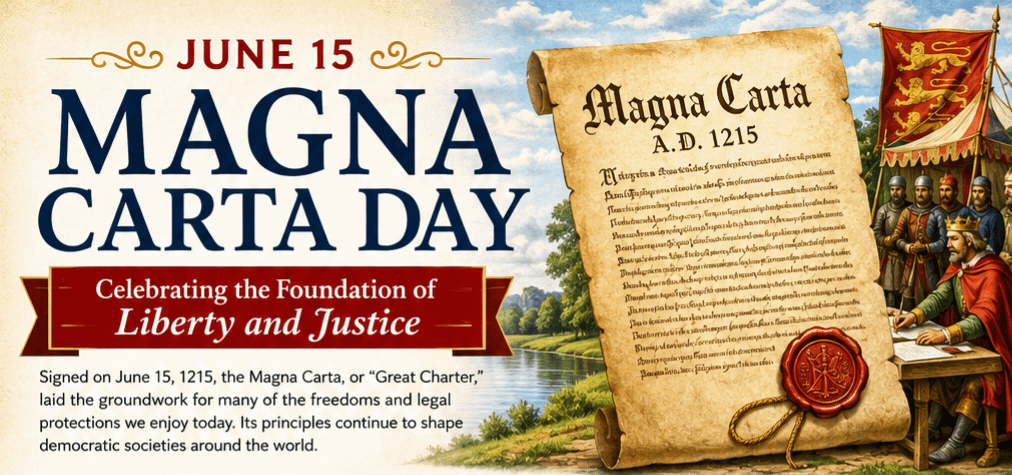
  • Magna Carta Day: Celebrating the Foundation of Liberty and Justice

    Magna Carta Day: Celebrating the Foundation of Liberty and Justice

    Every year on June 15, Magna Carta Day commemorates one of the most influential documents in human history. Signed in 1215, the Magna Carta, or “Great Charter,” laid the groundwork for many of the freedoms and legal protections that people enjoy today. While it was created over 800 years ago in medieval England, its impact continues to shape democratic societies around the world.

    Magna Carta Day is more than a historical observance. It is an opportunity to reflect on the principles of liberty, justice, accountability, and the rule of law that remain essential in modern life.

    The Story Behind the Magna Carta

    The Magna Carta was signed on June 15, 1215, at Runnymede, a meadow near the River Thames in England. At the time, King John faced growing opposition from powerful barons who were frustrated by heavy taxes, arbitrary decisions, and abuses of royal authority.

    The barons demanded limits on the king’s power and protections for their rights. After intense negotiations, King John agreed to a charter containing a series of legal reforms and guarantees.

    Although the original Magna Carta was intended to address specific disputes between the king and the nobility, its broader principles eventually transcended its medieval origins and became a symbol of freedom and justice for all.

    Why the Magna Carta Matters

    Before the Magna Carta, monarchs often ruled with nearly unlimited authority. The charter introduced a revolutionary concept:

    No one, not even the king, is above the law.

    This principle became a cornerstone of constitutional government and remains a foundational idea in democratic nations today.

    The Magna Carta established several important concepts, including:

    • The right to a fair trial
    • Protection from unlawful imprisonment
    • Due process of law
    • Limits on government power
    • The idea that rulers must obey the law
    • Protection of individual rights

    While many of its original clauses addressed medieval concerns, the document’s broader message continues to inspire legal systems around the world.

    The Magna Carta’s Influence on America

    The influence of the Magna Carta extends far beyond England. Many of the ideas found in the charter helped shape the development of the United States.

    America’s Founding Fathers drew inspiration from Magna Carta principles when crafting important documents such as:

    • The Declaration of Independence
    • The United States Constitution
    • The Bill of Rights

    Concepts like due process, trial by jury, protection against unlawful detention, and limitations on government authority can all trace part of their heritage back to the Magna Carta.

    The Fifth Amendment and Fourteenth Amendment, which guarantee due process under the law, reflect principles first articulated in the Great Charter centuries earlier.

    The Rule of Law: A Lasting Legacy

    Perhaps the Magna Carta’s greatest contribution is its emphasis on the rule of law.

    The rule of law means that laws apply equally to everyone, regardless of status, wealth, or position. Governments, leaders, and citizens alike are expected to follow the same legal standards.

    This principle protects people from arbitrary decisions and helps ensure fairness within society.

    Without the rule of law, freedom becomes fragile. The Magna Carta reminds us that liberty depends upon accountability, justice, and equal treatment under the law.

    Lessons for Modern Society

    Even in the twenty-first century, the Magna Carta offers valuable lessons:

    Freedom Requires Vigilance

    Rights and freedoms cannot be taken for granted. History shows that liberty must be protected and preserved by each generation.

    Power Must Have Limits

    The Magna Carta teaches that unchecked power can lead to injustice. Healthy societies establish systems of checks and balances to prevent abuse.

    Justice Should Be Accessible to All

    The charter helped establish the principle that justice should not be reserved for the privileged few. Fair treatment under the law remains an ongoing goal for societies worldwide.

    Individual Rights Matter

    The Magna Carta recognized that individuals possess rights that governments should respect and protect.

    Magna Carta Day Celebrations

    While Magna Carta Day is not a widely observed public holiday, historians, legal scholars, educators, and civic organizations often mark the occasion through:

    • Educational programs
    • Historical reenactments
    • Public lectures
    • Museum exhibits
    • Discussions about constitutional rights and freedoms
    • Civic engagement activities

    Many use the day as an opportunity to explore the roots of democracy and the ongoing importance of protecting civil liberties.

    Why Magna Carta Day Still Matters

    In an era of rapid change, political debate, and evolving technology, Magna Carta Day serves as a reminder of timeless values.

    The principles first outlined in 1215 continue to influence how governments function, how courts operate, and how citizens understand their rights.

    The Magna Carta stands as a testament to humanity’s enduring pursuit of justice, fairness, and freedom. It reminds us that liberty is strengthened when power is accountable, laws are applied equally, and individual rights are respected.

    As we observe Magna Carta Day, we honor not only a historic document but also the ideals that continue to guide free societies around the world.

    The Great Charter’s message remains as relevant today as it was more than eight centuries ago: true freedom flourishes when everyone, including those in power, is subject to the law.

    Read More Holidays & National Days
  • This Day in American History – June 15

    This Day in American History – June 15

    Every day in American history holds stories of courage, innovation, sacrifice, and change. June 15 is no exception. From landmark political moments to cultural achievements and events that shaped the nation, this date offers a fascinating glimpse into America’s journey through time.

    1775: George Washington Appointed Commander of the Continental Army

    One of the most significant events in American history occurred on June 15, 1775, when the Continental Congress unanimously appointed George Washington as Commander-in-Chief of the Continental Army.

    At the time, the American colonies were on the brink of full-scale war with Great Britain. The battles of Lexington and Concord had already been fought, and colonial leaders recognized the need for a unified military force. Washington, a respected military veteran from Virginia, was chosen not only for his leadership abilities but also to help unite the northern and southern colonies.

    Washington accepted the responsibility with humility, reportedly refusing a salary and requesting only reimbursement for expenses. His leadership during the Revolutionary War would become one of the defining factors in America’s eventual independence.

    The appointment marked the beginning of a military command that would ultimately lead to victory over the British Empire and pave the way for the creation of the United States.

    1844: Charles Goodyear Receives Patent for Vulcanized Rubber

    On June 15, 1844, inventor Charles Goodyear received a patent for the process of vulcanizing rubber.

    Before vulcanization, rubber was highly impractical. It became sticky in hot weather and brittle in cold temperatures. Goodyear’s process involved heating rubber with sulfur, creating a material that was stronger, more durable, and resistant to temperature changes.

    This invention revolutionized American industry. Vulcanized rubber became essential for tires, machinery, footwear, and countless manufactured products. Although Goodyear himself struggled financially throughout much of his life, his innovation transformed transportation and manufacturing worldwide.

    Today, his name remains synonymous with the tire industry through the Goodyear Tire & Rubber Company, though the company was founded after his death.

    1864: Arlington Estate Becomes a Military Cemetery

    During the American Civil War, June 15, 1864, marked the beginning of a historic transformation. Union officials started burying soldiers on the Arlington estate, the former home of Confederate General Robert E. Lee.

    The decision ensured the property could never again be used as a private residence and addressed the growing need for burial space as casualties mounted during the war.

    This site would later become Arlington National Cemetery, one of the most revered military cemeteries in the United States. Today, it serves as the final resting place for hundreds of thousands of veterans, service members, and notable Americans.

    1916: National Defense Act Strengthens America’s Military

    On June 15, 1916, President Woodrow Wilson signed the National Defense Act.

    With tensions rising in Europe during World War I, the legislation significantly expanded the U.S. Army and National Guard. It modernized military preparedness and provided a framework that would help America respond to future global conflicts.

    The act represented a major shift in how the United States viewed national defense and military readiness.

    1978: King Hussein Marries Queen Noor

    While not an American event, June 15, 1978, became a notable date in international affairs when King Hussein married Queen Noor.

    Born Lisa Halaby in Washington, D.C., Queen Noor became one of the most prominent American-born figures to marry into a foreign royal family. Her humanitarian work and advocacy would earn worldwide recognition.

    1996: Ella Fitzgerald Passes Away

    On June 15, 1996, America lost one of its greatest musical legends when Ella Fitzgerald died at the age of 79.

    Known as the “First Lady of Song,” Fitzgerald’s extraordinary vocal range and improvisational skills helped define American jazz music. Over a career spanning nearly six decades, she recorded hundreds of songs and won numerous awards.

    Her influence continues to be felt throughout jazz, popular music, and American culture.

    June 15 Birthdays

    Several notable Americans were born on June 15:

    • James Hunt (1779), Governor of North Carolina
    • Helen Hunt Jackson (1830), author and advocate for Native American rights
    • Courteney Cox (1964), actress known for her role on the television series Friends

    Reflecting on June 15

    June 15 reminds us how individual actions can leave lasting marks on history. From George Washington accepting command of a fledgling army to Charles Goodyear’s transformative invention and the establishment of Arlington National Cemetery, this day reflects America’s enduring themes of leadership, innovation, sacrifice, and perseverance.

    History is not merely a collection of dates and events—it is the story of people whose decisions continue to influence our lives today. As we look back on June 15, we honor those who helped shape the nation and remember the lessons their experiences continue to teach us.

    Read More History & Culture

  • This Day in American History – June 14

    This Day in American History – June 14

    June 14: The Stars and Stripes Become America’s Flag

    Every day in American history carries stories that helped shape the nation, but few dates are as symbolic and patriotic as June 14. Known today as Flag Day, June 14 commemorates the adoption of the American flag and celebrates one of the most recognizable symbols of freedom in the world.

    From the birth of the Stars and Stripes in 1777 to the creation of Flag Day traditions that continue today, June 14 represents the ideals, sacrifices, and unity that define the American spirit.

    1777: Congress Adopts the American Flag

    The most significant event associated with June 14 occurred during the American Revolution.

    On June 14, 1777, the Second Continental Congress passed a resolution establishing an official flag for the newly independent United States.

    The resolution stated:

    “Resolved, That the flag of the United States be thirteen stripes, alternate red and white; that the union be thirteen stars, white in a blue field, representing a new constellation.”

    Though simple in wording, this declaration created one of the most enduring national symbols in history.

    At the time, the thirteen stars and thirteen stripes represented the original thirteen colonies that had declared independence from Great Britain. The design symbolized unity among the colonies as they fought for freedom and self-government.

    While many associate the creation of the first flag with Betsy Ross, historians continue to debate the exact origins of the design. Regardless of who sewed the first flag, June 14 marks the day the Stars and Stripes officially became America’s national banner.

    The Meaning Behind the Flag

    Over the centuries, the American flag evolved as new states joined the Union.

    Today, the flag contains:

    • 50 stars representing the 50 states.
    • 13 stripes honoring the original colonies.
    • Red symbolizing valor and courage.
    • White symbolizing purity and innocence.
    • Blue symbolizing vigilance, perseverance, and justice.

    The flag has flown over battlefields, schools, government buildings, homes, and historic moments throughout American history. It serves as a reminder of the nation’s ideals and the sacrifices made to preserve them.

    The Birth of Flag Day

    Although the flag was adopted in 1777, the observance of Flag Day did not become widespread until much later.

    In the late 1800s, educators and patriotic organizations began encouraging celebrations honoring the American flag.

    One of the earliest recognized observances occurred in 1885 when Wisconsin schoolteacher Bernard J. Cigrand organized a celebration commemorating the anniversary of the flag’s adoption.

    Cigrand spent decades promoting a national holiday dedicated to the American flag and is often referred to as the “Father of Flag Day.”

    His efforts inspired communities across the nation to hold annual observances on June 14.

    President Wilson Makes It Official

    In 1916, President Woodrow Wilson issued a proclamation officially recognizing June 14 as Flag Day.

    While it was not yet a federal holiday, the proclamation encouraged Americans to celebrate the flag and reflect on its significance.

    The observance gained popularity throughout the twentieth century as schools, veterans groups, and civic organizations embraced annual Flag Day ceremonies.

    National Flag Day Becomes Law

    A major milestone occurred in 1949.

    President Harry S. Truman signed an Act of Congress designating June 14 as National Flag Day.

    Although Flag Day is not a federal holiday that closes government offices, it remains an important national observance.

    Communities across America celebrate with parades, patriotic ceremonies, educational events, and displays of the American flag.

    The United States Army Birthday

    June 14 carries another historic significance.

    The United States Army was established on June 14, 1775, more than a year before the Declaration of Independence.

    The Continental Congress created the Continental Army to defend the colonies against British forces.

    Under the leadership of George Washington, the Army became a vital force in securing American independence.

    As a result, June 14 is also celebrated as the Army’s birthday, honoring generations of soldiers who have served the nation.

    Flag Day Traditions Across America

    Today, Americans celebrate June 14 in many ways:

    • Flying the American flag at homes and businesses.
    • Participating in community parades.
    • Attending veterans’ ceremonies.
    • Learning about flag etiquette and history.
    • Honoring military service members and veterans.
    • Reflecting on the freedoms represented by the Stars and Stripes.

    The largest Flag Day parade in the United States is traditionally held in Troy, New York, drawing thousands of participants and spectators each year.

    Why June 14 Still Matters

    The American flag has witnessed the nation’s greatest triumphs and most difficult challenges.

    It flew during the Revolutionary War, survived the Civil War, inspired Francis Scott Key during the War of 1812, accompanied explorers to the Moon, and continues to represent the United States around the world.

    For many Americans, the flag is more than cloth and color. It represents freedom, sacrifice, opportunity, resilience, and unity.

    June 14 serves as an opportunity to remember the nation’s founding principles and honor those who have defended them throughout history.

    Final Thoughts

    June 14 stands as one of the most patriotic days on the American calendar. It marks both the birth of the American flag and the founding of the United States Army, two institutions deeply woven into the story of the nation.

    As Americans raise the Stars and Stripes each Flag Day, they celebrate not only a symbol but the enduring ideals of liberty, courage, and unity that continue to guide the United States more than two centuries after the flag first appeared as a “new constellation” in the sky of freedom.

    Read More History & Culture

  • This Day in American History – June 13

    This Day in American History – June 13

    June 13 has been the date of several important events that shaped the United States, from the American Revolution to landmark Supreme Court decisions and major moments in civil rights and journalism. Here are some of the most significant events that occurred on this day in American history.

    Marquis de Lafayette Arrives in America (1777)

    On June 13, 1777, the young French nobleman Marquis de Lafayette arrived near Charleston, South Carolina, to offer his services to the American colonies in their fight for independence. Only 19 years old at the time, Lafayette would become one of General George Washington‘s most trusted allies and a key figure in securing French support for the American Revolution. His contributions helped strengthen the Continental Army and ultimately aided America’s victory over Britain.

    Lewis and Clark Reach the Great Falls (1805)

    During their famous expedition across the American West, Meriwether Lewis and several members of the Corps of Discovery reached the Great Falls of the Missouri River on June 13, 1805. The discovery confirmed they were on the correct route toward the Pacific Ocean and provided valuable geographic information about the vast territory acquired through the Louisiana Purchase.

    Miranda Rights Established (1966)

    One of the most important legal decisions in American history was handed down on June 13, 1966, when the Supreme Court of the United States ruled in the landmark case Miranda v. Arizona. The Court determined that criminal suspects must be informed of their constitutional rights before police questioning.

    This ruling created what Americans now know as the “Miranda Warning,” including the famous phrase:

    “You have the right to remain silent.”

    The decision continues to influence law enforcement procedures across the nation today.

    Thurgood Marshall Nominated to the Supreme Court (1967)

    On June 13, 1967, President Lyndon B. Johnson nominated Thurgood Marshall to serve on the Supreme Court.

    Marshall had already made history as the lead attorney in the landmark civil rights case Brown v. Board of Education, which ended legal school segregation. His nomination marked a major milestone in the struggle for civil rights and equal justice in America. He later became the first African American Justice in Supreme Court history.

    The Pentagon Papers Are Published (1971)

    On June 13, 1971, The New York Times began publishing excerpts from the Pentagon Papers, a secret government study detailing U.S. involvement in Vietnam.

    The documents, leaked by Daniel Ellsberg, revealed that multiple administrations had misled the public about the scope and progress of the Vietnam War. The publication became a landmark victory for freedom of the press and government accountability.

    Pioneer 10 Reaches a Historic Milestone (1983)

    On June 13, 1983, NASA’s Pioneer 10 crossed the orbit of Neptune, becoming the first human-made object to leave the central solar system. Launched in 1972, Pioneer 10 expanded humanity’s understanding of the outer planets and paved the way for future deep-space exploration.

    June 13: A Day of Freedom, Justice, and Discovery

    From Lafayette’s arrival during the American Revolution to the establishment of Miranda Rights, the nomination of Thurgood Marshall, and the publication of the Pentagon Papers, June 13 represents America’s continuing pursuit of liberty, justice, and truth. It is also a reminder of the nation’s spirit of exploration, symbolized by both Lewis and Clark’s journey across the frontier and Pioneer 10’s voyage into deep space.

    Today We Remember

    • 1777 – Lafayette arrives in America to aid the Revolutionary cause.
    • 1805 – Lewis and Clark reach the Great Falls of the Missouri River.
    • 1966 – Miranda Rights become law.
    • 1967 – Thurgood Marshall is nominated to the Supreme Court.
    • 1971 – The Pentagon Papers are first published.
    • 1983 – Pioneer 10 becomes the first spacecraft to pass beyond Neptune’s orbit.

    “History is not just a record of the past—it is the foundation upon which the future is built.”

  • This Day in American History – June 12

    This Day in American History – June 12

    Remembering the Events That Shaped the United States

    Every day in American history carries stories of courage, innovation, conflict, and progress. June 12 is no exception. From landmark civil rights victories to significant political events and moments of national achievement, this date has played an important role in shaping the American story.

    Let’s take a look back at some of the most notable events that occurred on June 12 throughout United States history.


    1776 – Virginia Adopts the Declaration of Rights

    One of the most influential documents in American history was adopted on June 12, 1776, when the Virginia Convention approved the Virginia Declaration of Rights.

    Written primarily by George Mason, the declaration outlined fundamental rights belonging to all citizens, including freedom of the press, religious liberty, and protections against government abuse. It became a model for both the United States Constitution and the Bill of Rights.

    The document established the revolutionary idea that government exists to serve the people and derives its power from their consent. These principles helped shape the foundation of American democracy and continue to influence governments around the world.


    1898 – The Philippines Declares Independence During the Spanish-American War

    During the Spanish-American War, June 12, 1898, marked the declaration of Philippine independence from Spain.

    Although the event occurred overseas, it became closely tied to American history because the United States would soon become involved in governing the Philippines after Spain’s defeat.

    The conflict marked America’s emergence as a global power and signaled a shift from continental expansion to international influence.


    1924 – George H.W. Bush Is Born

    On June 12, 1924, future President George Herbert Walker Bush was born in Milton, Massachusetts.

    Bush would go on to become the 41st President of the United States, serving from 1989 to 1993. Before becoming president, he served as a Navy pilot during World War II, a congressman, ambassador to the United Nations, CIA director, vice president, and ultimately commander-in-chief.

    His presidency saw major world events, including the end of the Cold War, the reunification of Germany, and Operation Desert Storm.

    Bush’s lifelong dedication to public service made him one of the most experienced leaders ever elected to the White House.


    1963 – Civil Rights Leader Medgar Evers Is Assassinated

    One of the most tragic moments in the Civil Rights Movement occurred on June 12, 1963.

    Civil rights activist Medgar Evers was assassinated outside his home in Jackson, Mississippi.

    Evers served as the Mississippi field secretary for the NAACP and worked tirelessly to challenge segregation, voter suppression, and racial injustice throughout the South.

    His murder shocked the nation and galvanized support for civil rights legislation. The outrage surrounding his death helped build momentum for the Civil Rights Act of 1964.

    Today, Evers is remembered as one of the heroes who sacrificed everything in the fight for equality and justice.


    1967 – The Supreme Court Strikes Down Laws Banning Interracial Marriage

    On June 12, 1967, the United States Supreme Court issued one of its most historic civil rights decisions in the case of Loving v. Virginia.

    The Court unanimously ruled that state laws prohibiting interracial marriage were unconstitutional.

    The case involved Richard and Mildred Loving, a Virginia couple who had been sentenced to prison simply because they were married to each other.

    Chief Justice Earl Warren wrote that marriage is one of the “basic civil rights of man.”

    The ruling invalidated anti-miscegenation laws nationwide and represented a major victory for civil rights and individual freedom.

    Many Americans now celebrate June 12 as Loving Day, honoring the landmark decision and the principles of equality it affirmed.


    1987 – President Ronald Reagan Challenges the Soviet Union

    On June 12, 1987, President Ronald Reagan delivered one of the most memorable speeches of the Cold War while standing at the Brandenburg Gate in West Berlin.

    During the speech, Reagan challenged Soviet leader Mikhail Gorbachev with the famous words:

    “Mr. Gorbachev, tear down this wall!”

    The Berlin Wall had become a symbol of division between East and West during the Cold War.

    Although the wall would remain standing for two more years, Reagan’s speech became one of the defining moments of the struggle for freedom and democracy. When the wall finally fell in 1989, many viewed the event as a powerful symbol of the Cold War’s end.


    1994 – Nicole Brown Simpson and Ronald Goldman Are Murdered

    On June 12, 1994, Nicole Brown Simpson and Ronald Goldman were murdered in Los Angeles.

    The investigation and subsequent trial of former football star O.J. Simpson became one of the most widely followed legal cases in American history.

    The trial captivated the nation, raised questions about race, media influence, policing, and the justice system, and remains one of the most discussed criminal cases ever tried in the United States.


    June 12 and the Ongoing Story of America

    June 12 reminds us that American history is a story of both triumph and struggle. It includes moments when citizens expanded freedom, challenged injustice, and defended democratic values.

    From the Virginia Declaration of Rights helping shape the nation’s founding ideals, to the Loving v. Virginia decision advancing civil rights, to powerful speeches that influenced world events, this date highlights the continuing pursuit of liberty and equality.

    History is more than a collection of dates—it is a record of people whose actions changed the course of the nation. By remembering these events, we gain a deeper understanding of the challenges faced by previous generations and the responsibilities carried by our own.

    As we reflect on June 12, we honor those who helped shape America and recognize that the story of the United States is still being written every day.

    Read More History & Culture

  • This Day in American History – June 11

    This Day in American History – June 11

    June 11 has been a significant date throughout American history, marked by important events that shaped the nation’s military, political, social, and cultural landscape. From historic battles and groundbreaking civil rights moments to notable achievements in space exploration and sports, this day offers a fascinating look into America’s past.

    1776 – The Continental Congress Forms a Committee to Draft the Declaration of Independence

    As tensions between the American colonies and Great Britain reached a breaking point, the Continental Congress appointed a committee to draft a formal declaration explaining why the colonies sought independence. The committee included Thomas Jefferson, John Adams, Benjamin Franklin, Roger Sherman, and Robert Livingston.

    Jefferson would go on to write the first draft of what became the Declaration of Independence, one of the most important documents in American history.

    1963 – Governor George Wallace’s “Stand in the Schoolhouse Door”

    One of the defining moments of the Civil Rights Movement occurred on June 11, 1963, when Alabama Governor George Wallace stood in the doorway of Foster Auditorium at the University of Alabama in an attempt to block the enrollment of African American students Vivian Malone and James Hood.

    Following orders from President John F. Kennedy and federal authorities, Wallace eventually stepped aside. The event symbolized the growing struggle between segregationist policies and the push for civil rights and equal education.

    Later that evening, President Kennedy delivered a nationally televised address calling civil rights a moral issue and urging Congress to act.

    1963 – President Kennedy’s Historic Civil Rights Address

    On the same day as the University of Alabama confrontation, President John F. Kennedy addressed the nation from the White House.

    In his speech, Kennedy declared that civil rights were a moral issue “as old as the scriptures and as clear as the American Constitution.” His remarks helped pave the way for the landmark Civil Rights Act of 1964.

    The speech remains one of the most important presidential addresses in American history.

    1987 – Margaret Thatcher Addresses Congress

    British Prime Minister Margaret Thatcher became the first British prime minister in history to address a joint session of the United States Congress for a second time.

    Known as the “Iron Lady,” Thatcher reinforced the strong alliance between the United States and the United Kingdom during the Cold War era and emphasized the importance of democratic values and international cooperation.

    2001 – Timothy McVeigh Executed

    On June 11, 2001, Timothy McVeigh was executed by lethal injection at the federal prison in Terre Haute, Indiana.

    McVeigh was convicted for carrying out the 1995 Oklahoma City bombing, which killed 168 people and injured hundreds more. The attack remains one of the deadliest acts of domestic terrorism in American history.

    The execution brought a measure of closure to many families affected by the tragedy.

    Notable Birthdays on June 11

    Gene Wilder (1933–2016)

    Beloved actor, comedian, and writer Gene Wilder was born on this day. He became famous for iconic roles in films such as:

    • Willy Wonka & the Chocolate Factory
    • Young Frankenstein
    • Blazing Saddles

    His unique humor and memorable performances continue to entertain generations.

    Joe Montana (1956– )

    Hall of Fame quarterback Joe Montana was born on June 11, 1956. Widely regarded as one of the greatest quarterbacks in NFL history, Montana led the San Francisco 49ers to four Super Bowl championships and became known for his calm leadership under pressure.

    June 11 in American Culture

    June 11 serves as a reminder of America’s continuing journey toward equality and justice. The events of 1963, in particular, highlight the courage of those who challenged discrimination and helped move the nation closer to fulfilling its founding ideals.

    It is also a day to remember the importance of leadership, perseverance, and the ongoing effort to create a more perfect union.

    Reflection

    History is often shaped by individuals willing to stand up for what they believe is right. Whether it was the nation’s founders pursuing independence, civil rights activists demanding equality, or leaders guiding America through difficult times, June 11 reminds us that progress often requires courage and determination.

    As we look back on this day in American history, we honor those whose actions continue to influence the freedoms and opportunities enjoyed by Americans today.

    Read More History & Culture

  • This Day in American History – June 10

    This Day in American History – June 10

    Every day in American history carries stories of courage, innovation, sacrifice, and progress. June 10 is no exception. From significant military achievements to cultural milestones and historic political moments, this date has left a lasting mark on the United States.

    Let’s take a look back at some of the most notable events that occurred on June 10 throughout American history.

    The Continental Congress Creates the United States Army (1775)

    One of the most important events associated with this period of June occurred during the early days of the American Revolution. In June 1775, delegates of the Second Continental Congress took critical steps toward organizing colonial resistance against British rule.

    Just days before officially appointing George Washington as commander-in-chief, Congress worked to establish what would become the Continental Army. These actions laid the foundation for the military force that would eventually secure American independence.

    Without the creation of this organized fighting force, the thirteen colonies may never have succeeded in their struggle against the British Empire. The decisions made during June 1775 helped shape the future United States and remain among the most important moments in American history.

    The U.S. Army Captures Guam During World War II (1944)

    On June 10, 1944, American forces intensified operations aimed at recapturing Guam from Japanese control during World War II.

    Guam had been seized by Japan shortly after the attack on Pearl Harbor in 1941. The island held tremendous strategic importance because of its location in the Pacific Ocean. American military planners recognized that regaining control would provide a valuable base for future operations against Japan.

    The campaign demonstrated the determination and sacrifice of American servicemen during one of the most significant conflicts in world history. Guam would eventually become a major staging area for Allied forces as they moved closer to the Japanese mainland.

    Today, Guam remains an important American territory and military installation in the Pacific.

    Alcoholics Anonymous Founded (1935)

    On June 10, 1935, a meeting between Bill Wilson and Dr. Bob Smith in Akron, Ohio, marked the beginning of what would become Alcoholics Anonymous (AA).

    Although AA is not a government organization, its impact on American society has been enormous. The group introduced a revolutionary peer-support model for individuals struggling with alcohol addiction.

    Millions of Americans have found hope, recovery, and support through the principles established by Alcoholics Anonymous. The organization’s influence has extended far beyond addiction recovery, inspiring numerous support groups and treatment programs throughout the country.

    The founding of AA represents an important chapter in American public health and social support history.

    The First U.S. Patent for a Ballpoint Pen (1943)

    Innovation has always been part of the American story. On June 10, 1943, significant advancements in writing technology helped transform how Americans communicated.

    The development and widespread adoption of the ballpoint pen made writing faster, cleaner, and more accessible. While inventors around the world contributed to its creation, American manufacturing and distribution helped make the ballpoint pen a household staple.

    What seems like a simple tool today revolutionized offices, schools, businesses, and daily life across the nation.

    Judy Garland Receives Worldwide Recognition (1968)

    June 10 also marks a notable period in American entertainment history. During the late 1960s, legendary actress and singer Judy Garland continued to be celebrated for her extraordinary contributions to American culture.

    Best known for her iconic role as Dorothy in The Wizard of Oz, Garland became one of the most beloved entertainers of the twentieth century. Her influence on music, film, and popular culture remains evident decades later.

    Her story reflects both the glamour and challenges of Hollywood’s Golden Age and continues to resonate with audiences today.

    Ronald Reagan’s Historic Berlin Speech Preparations (1987)

    As the Cold War approached its final years, June 10 served as a key date in preparations surrounding one of President Ronald Reagan’s most famous foreign policy moments.

    Only days later, Reagan would deliver his historic challenge at the Berlin Wall:

    “Mr. Gorbachev, tear down this wall!”

    The speech became one of the defining moments of the Cold War and symbolized America’s commitment to freedom and democracy around the world.

    The Berlin Wall would eventually fall in 1989, marking a major victory for democratic ideals and signaling the approaching end of the Cold War.

    American Innovation and Progress

    Throughout history, June 10 has reflected many themes that define the American experience:

    • Determination during times of war
    • Advances in technology and innovation
    • Breakthroughs in public health and recovery
    • Cultural achievements in entertainment
    • Leadership on the world stage

    Each generation contributes new chapters to the American story. The events remembered on June 10 remind us that history is built through the efforts of ordinary citizens, visionary leaders, brave servicemen and women, and innovators willing to challenge what is possible.

    Conclusion

    June 10 stands as a day filled with moments that helped shape the United States. From the formation of America’s earliest military forces to advances in recovery programs, cultural achievements, and Cold War leadership, this date reflects the resilience and progress that have defined the nation.

    History is more than a collection of dates—it is the story of people whose actions continue to influence our lives today.

    As we remember June 10, we honor the individuals who helped build, protect, and strengthen America, leaving a legacy that continues to inspire future generations.

    Read More History & Culture

  • This Day in American History – June 9

    This Day in American History – June 9

    A Day of Courage, Innovation, and Turning Points

    Every day in American history tells a story. Some days are remembered for battles won, groundbreaking inventions, or influential leaders. Others remind us of moments that shaped the nation in ways that still impact our lives today.

    June 9 is one of those dates. Throughout American history, this day has witnessed remarkable achievements, significant milestones, and events that helped define the United States.

    Let’s take a journey through history and explore some of the most important events that occurred on June 9.


    June 9, 1772 – The Burning of the HMS Gaspee

    One of the lesser-known events leading up to the American Revolution occurred on June 9, 1772.

    The British customs schooner HMS Gaspee had been enforcing trade laws in Rhode Island waters, frustrating colonists who viewed British taxation and trade restrictions as unfair.

    When the ship ran aground near Providence, a group of colonists boarded the vessel, wounded its commander, and set the ship on fire.

    The incident became known as the Gaspee Affair.

    Many historians consider it one of the earliest acts of organized resistance against British rule and an important precursor to the American Revolution.

    The event demonstrated the growing frustration among colonists and helped unite Americans against what they viewed as government overreach.


    June 9, 1865 – The Confederate Army Surrenders in the West

    Although General Robert E. Lee surrendered at Appomattox Court House in April 1865, not all Confederate forces immediately laid down their arms.

    On June 9, 1865, Confederate General Edmund Kirby Smith formally surrendered the last major Confederate force west of the Mississippi River.

    This surrender effectively ended organized Confederate military resistance and marked one of the final chapters of the Civil War.

    The end of the war brought relief to a nation devastated by four years of conflict and began the difficult process of Reconstruction.

    The Civil War remains the deadliest conflict in American history, costing more than 600,000 lives and permanently shaping the future of the United States.


    June 9, 1954 – Joseph McCarthy’s Influence Begins to Fade

    During the early 1950s, Senator Joseph McCarthy became one of the most controversial figures in American politics.

    Known for accusing numerous individuals of being communists without sufficient evidence, McCarthy fueled a period of fear known as the Red Scare.

    On June 9, 1954, attorney Joseph Welch famously challenged McCarthy during the Army-McCarthy hearings with the now-famous question:

    “Have you no sense of decency, sir, at long last?”

    The televised exchange became a turning point in public opinion.

    Many Americans began questioning McCarthy’s methods, and his political influence quickly declined.

    The moment remains one of the most memorable confrontations in American political history and serves as a reminder of the importance of fairness, evidence, and civil discourse.


    June 9, 1973 – Secretariat Wins the Triple Crown

    Horse racing fans witnessed history on June 9, 1973.

    The legendary racehorse Secretariat won the Belmont Stakes and captured the coveted Triple Crown.

    What made the victory extraordinary was not simply winning—it was how he won.

    Secretariat finished an astonishing 31 lengths ahead of the competition, setting a Belmont Stakes record that still stands today.

    His performance is widely regarded as one of the greatest achievements in sports history.

    More than fifty years later, Secretariat remains a symbol of excellence, determination, and athletic greatness.


    June 9, 1993 – The Rise of the Digital Information Age

    Throughout the early 1990s, the internet was beginning to transform communication, business, and education.

    On June 9, 1993, the development of web browser technology continued advancing rapidly, helping make the World Wide Web more accessible to everyday Americans.

    These technological advancements would eventually reshape nearly every aspect of modern life—from shopping and banking to social media and remote work.

    The digital revolution that emerged during this period continues to influence how Americans connect, learn, and conduct business today.


    Famous Americans Born on June 9

    June 9 has also produced several notable figures in American history and culture.

    Johnny Depp (1963)

    Award-winning actor Johnny Depp was born on June 9, 1963.

    Known for his unique performances and memorable characters, Depp became one of Hollywood’s most recognizable stars.

    Michael J. Fox (1961)

    Born on June 9, 1961, Michael J. Fox became famous for his roles in television and film, particularly the Back to the Future trilogy.

    Beyond acting, Fox has become an inspirational advocate for Parkinson’s disease research and awareness.

    Cole Porter (1891)

    One of America’s most celebrated composers and songwriters, Cole Porter was born on June 9, 1891.

    His music remains influential in American theater and popular music.


    Why June 9 Matters

    History is not merely a collection of dates and events.

    It is a story of people making choices, facing challenges, and striving to build a better future.

    June 9 reminds us of:

    • The courage of those who resisted oppression before the American Revolution.
    • The sacrifices made during the Civil War.
    • The importance of accountability in government.
    • The pursuit of excellence in sports.
    • The innovation that continues to drive technological progress.

    Each event reflects a different aspect of the American experience.


    Reflection for Today

    As we remember June 9, we are reminded that history is shaped by ordinary people who take extraordinary action.

    Whether standing up for freedom, pursuing excellence, speaking truth to power, or embracing innovation, the lessons of this day continue to inspire future generations.

    History teaches us that every day has the potential to become significant.

    What we do today may one day become part of someone else’s history lesson tomorrow.

    Happy June 9 — and may we continue learning from the people and events that shaped America.

    Read More History & Culture

  • This Day in American History – June 8

    This Day in American History – June 8

    Every day in American history carries stories of courage, innovation, sacrifice, and achievement. June 8 is no exception. From pivotal moments in warfare to groundbreaking technological advancements and influential political events, this date has helped shape the United States into the nation it is today.

    Let’s take a journey through some of the most notable events that occurred on June 8 throughout American history.

    June 8, 1789 – James Madison Introduces the Bill of Rights

    One of the most important moments in American constitutional history occurred on June 8, 1789, when James Madison introduced a series of amendments to the U.S. Constitution in the House of Representatives.

    These proposed amendments would eventually become known as the Bill of Rights.

    Madison recognized that many Americans feared the new federal government might become too powerful. To protect individual liberties, he proposed amendments guaranteeing freedoms such as:

    • Freedom of speech
    • Freedom of religion
    • Freedom of the press
    • The right to bear arms
    • Protection from unreasonable searches and seizures
    • The right to a fair trial

    Ten of Madison’s proposed amendments were ratified in 1791 and remain among the most important protections of individual liberty in American law today.

    June 8, 1861 – Tennessee Joins the Confederacy

    During the early months of the American Civil War, the state of Tennessee officially voted to secede from the Union on June 8, 1861.

    Tennessee became the last state to join the Confederate States of America.

    The decision reflected the deep divisions that existed across the nation regarding states’ rights, slavery, and the future of the United States. Tennessee would become the site of several major battles during the Civil War, including the Battle of Shiloh and the Battle of Chattanooga.

    The state’s strategic location made it one of the most contested regions during the conflict.

    June 8, 1942 – The Battle of Midway Continues

    One of the most significant turning points of World War II occurred during the days surrounding June 8, 1942.

    The Battle of Midway effectively concluded with a decisive American victory over Japan.

    The battle had begun on June 4 and by June 8, Japanese forces had suffered devastating losses, including four aircraft carriers and hundreds of aircraft.

    American naval forces, led by commanders such as Chester W. Nimitz, successfully halted Japanese expansion across the Pacific.

    Historians often describe Midway as the turning point of the Pacific War because it shifted the momentum from Japan to the United States and its allies.

    June 8, 1953 – The Supreme Court Rules on Restaurant Segregation

    On June 8, 1953, the Supreme Court of the United States issued a ruling that challenged racial segregation in public facilities.

    The decision marked another step forward in the long struggle for civil rights in America.

    While the Civil Rights Movement would continue for many years, cases during this era laid the foundation for landmark rulings that would eventually dismantle legalized segregation throughout the country.

    June 8, 1968 – Funeral Train of Robert F. Kennedy

    On June 8, 1968, the funeral train carrying Robert F. Kennedy traveled from New York City to Washington, D.C.

    Millions of Americans watched in grief as the train passed through towns and cities along the East Coast.

    Kennedy had been assassinated just days earlier while campaigning for the presidency.

    Images from the funeral train became some of the most memorable photographs of the turbulent 1960s, reflecting a nation mourning another fallen leader after the assassinations of President John F. Kennedy and Dr. Martin Luther King Jr.

    June 8, 1982 – President Reagan Addresses the British Parliament

    On June 8, 1982, President Ronald Reagan delivered a historic speech before the British Parliament.

    In the address, Reagan predicted that democracy would eventually triumph over communism and that freedom would spread throughout Eastern Europe and beyond.

    His remarks became one of the defining speeches of the Cold War era.

    Less than a decade later, the Soviet Union would collapse, dramatically reshaping global politics.

    June 8, 2001 – Celebrating Scientific Discovery

    The early 21st century marked a period of rapid advancement in science and technology.

    Around this time, American researchers and innovators continued to make breakthroughs in medicine, computing, communications, and space exploration.

    The innovations developed during this era helped pave the way for today’s digital world, including smartphones, cloud computing, and advanced medical treatments.

    Famous Birthdays on June 8

    Several notable Americans were born on June 8, including:

    • Frank Lloyd Wright (1867), one of America’s most influential architects.
    • Barbara Bush (1925), wife of President George H. W. Bush.
    • Kanye West (1977), influential musician and entrepreneur.

    Why We Remember History

    History is more than a collection of dates and events.

    It is the story of people who made decisions, overcame challenges, defended freedoms, and shaped the future.

    June 8 reminds us of the importance of liberty, leadership, sacrifice, and perseverance. Whether through the creation of the Bill of Rights, victories in wartime, advances in civil rights, or the pursuit of democracy, the events of this day continue to influence America today.

    As we reflect on June 8, we gain a deeper appreciation for the generations who came before us and the lessons they left behind.

    Their stories remain an important part of the American journey.

    Read More History & Culture

  • This Day in American History – June 7

    This Day in American History – June 7

    Remembering the Events That Shaped America

    Every day in American history carries stories of courage, innovation, sacrifice, and change. June 7 is no exception. From military victories and political milestones to groundbreaking achievements in science and culture, this date has witnessed moments that helped shape the United States into the nation it is today.

    Let’s take a journey through some of the most notable events that occurred on June 7 throughout American history.


    June 7, 1776: Richard Henry Lee Proposes Independence

    One of the most significant moments in American history occurred on June 7, 1776, when Virginia delegate Richard Henry Lee presented a resolution before the Second Continental Congress declaring:

    “That these United Colonies are, and of right ought to be, free and independent States.”

    This proposal became known as the Lee Resolution and served as the foundation for the Declaration of Independence that would be adopted less than a month later on July 4, 1776.

    Although Congress delayed the final vote to build support among all colonies, Lee’s resolution marked the first formal step toward breaking ties with Great Britain.

    Without June 7, there may never have been a July 4.


    June 7, 1892: Homer Plessy Challenges Segregation

    On June 7, 1892, Homer Plessy intentionally violated Louisiana’s Separate Car Act by sitting in a whites-only railroad car.

    His arrest led to the landmark Supreme Court case Plessy v. Ferguson in 1896.

    The Court’s ruling established the controversial “separate but equal” doctrine, which legalized racial segregation for decades.

    Although the decision was a setback for civil rights, Plessy’s courageous act became an important chapter in the long struggle for equality that eventually led to the Civil Rights Movement and the historic ruling in Brown v. Board of Education in 1954.


    June 7, 1942: The Battle of Midway Ends

    One of the most important battles of World War II concluded on June 7, 1942.

    The Battle of Midway was fought between the United States and Japan in the Pacific Ocean.

    American forces achieved a decisive victory, sinking four Japanese aircraft carriers while losing only one of their own.

    Military historians often describe Midway as the turning point of the Pacific War.

    The victory halted Japanese expansion and shifted momentum toward the Allies.

    The bravery and determination of American sailors, pilots, and intelligence personnel helped change the course of World War II.


    June 7, 1965: The U.S. Supreme Court Expands Privacy Rights

    On June 7, 1965, the Supreme Court issued its decision in Griswold v. Connecticut.

    The ruling struck down a state law prohibiting married couples from obtaining contraceptives.

    More importantly, the Court recognized a constitutional right to privacy.

    This decision became a foundation for numerous future rulings involving personal freedoms and individual rights.

    The case remains one of the most influential Supreme Court decisions in American legal history.


    June 7, 1982: Priscilla Presley Opens Graceland to the Public

    On June 7, 1982, Graceland, the former home of legendary entertainer Elvis Presley, opened as a public museum.

    The mansion quickly became one of the most visited homes in America, attracting millions of visitors from around the world.

    Graceland preserves the legacy of Elvis and offers a glimpse into one of the most influential figures in American music history.

    Today it remains a major cultural landmark and tourist destination.


    June 7, 1998: James Byrd Jr. Murder Shocks America

    On June 7, 1998, James Byrd Jr., an African American man from Jasper, Texas, was murdered in a racially motivated hate crime.

    The horrific crime shocked the nation and reignited discussions about racism and hate crimes in America.

    Public outrage eventually contributed to the passage of the Matthew Shepard and James Byrd Jr. Hate Crimes Prevention Act in 2009.

    The tragedy serves as a reminder that the fight for equality and justice requires continual vigilance.


    Notable Birthdays on June 7

    Paul Gauguin (1848)

    The influential artist whose post-impressionist works inspired generations of painters.

    Dean Martin (1917)

    Singer, actor, comedian, and one of the most beloved entertainers of the twentieth century.

    Prince (1958)

    One of America’s greatest musicians, known for his extraordinary talent, innovation, and lasting impact on popular music.


    Why June 7 Matters

    History is more than a collection of dates and events.

    It is the story of people who made choices, took risks, fought battles, challenged injustice, and pursued dreams.

    June 7 reminds us of:

    • The courage to seek independence.
    • The determination to challenge unfair laws.
    • The sacrifices made during wartime.
    • The ongoing pursuit of civil rights and equality.
    • The cultural contributions that enrich American life.

    Every generation inherits the lessons of those who came before.

    By remembering history, we gain a deeper understanding of who we are and where we are going.


    Final Thoughts

    June 7 stands as a remarkable day in American history. It marks the beginning of America’s journey toward independence, highlights pivotal moments in civil rights and constitutional law, commemorates military heroism during World War II, and celebrates cultural icons who left their mark on the nation.

    History is not merely about the past—it is a guide for the future.

    As we reflect on the events of June 7, we honor the individuals whose actions helped shape the American story and continue to inspire generations today.

    Read More History & Culture