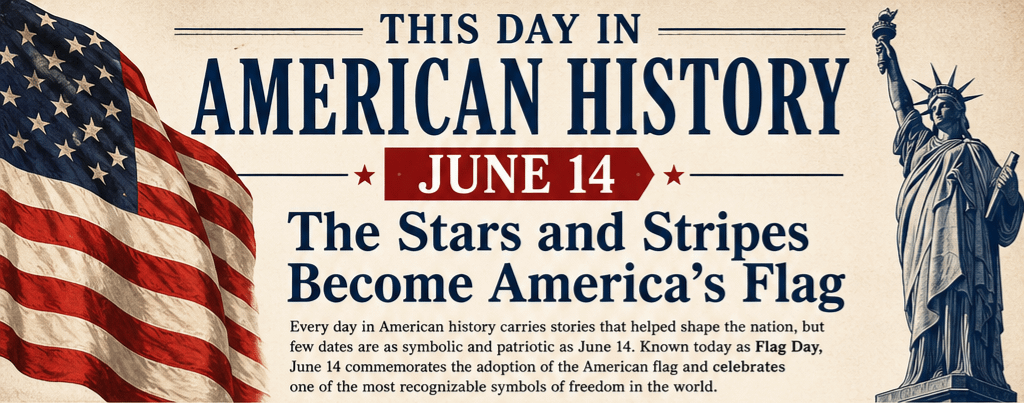
June 14: The Stars and Stripes Become America’s Flag
Every day in American history carries stories that helped shape the nation, but few dates are as symbolic and patriotic as June 14. Known today as Flag Day, June 14 commemorates the adoption of the American flag and celebrates one of the most recognizable symbols of freedom in the world.
From the birth of the Stars and Stripes in 1777 to the creation of Flag Day traditions that continue today, June 14 represents the ideals, sacrifices, and unity that define the American spirit.
1777: Congress Adopts the American Flag
The most significant event associated with June 14 occurred during the American Revolution.
On June 14, 1777, the Second Continental Congress passed a resolution establishing an official flag for the newly independent United States.
The resolution stated:
“Resolved, That the flag of the United States be thirteen stripes, alternate red and white; that the union be thirteen stars, white in a blue field, representing a new constellation.”
Though simple in wording, this declaration created one of the most enduring national symbols in history.
At the time, the thirteen stars and thirteen stripes represented the original thirteen colonies that had declared independence from Great Britain. The design symbolized unity among the colonies as they fought for freedom and self-government.
While many associate the creation of the first flag with Betsy Ross, historians continue to debate the exact origins of the design. Regardless of who sewed the first flag, June 14 marks the day the Stars and Stripes officially became America’s national banner.
The Meaning Behind the Flag
Over the centuries, the American flag evolved as new states joined the Union.
Today, the flag contains:
- 50 stars representing the 50 states.
- 13 stripes honoring the original colonies.
- Red symbolizing valor and courage.
- White symbolizing purity and innocence.
- Blue symbolizing vigilance, perseverance, and justice.
The flag has flown over battlefields, schools, government buildings, homes, and historic moments throughout American history. It serves as a reminder of the nation’s ideals and the sacrifices made to preserve them.
The Birth of Flag Day
Although the flag was adopted in 1777, the observance of Flag Day did not become widespread until much later.
In the late 1800s, educators and patriotic organizations began encouraging celebrations honoring the American flag.
One of the earliest recognized observances occurred in 1885 when Wisconsin schoolteacher Bernard J. Cigrand organized a celebration commemorating the anniversary of the flag’s adoption.
Cigrand spent decades promoting a national holiday dedicated to the American flag and is often referred to as the “Father of Flag Day.”
His efforts inspired communities across the nation to hold annual observances on June 14.
President Wilson Makes It Official
In 1916, President Woodrow Wilson issued a proclamation officially recognizing June 14 as Flag Day.
While it was not yet a federal holiday, the proclamation encouraged Americans to celebrate the flag and reflect on its significance.
The observance gained popularity throughout the twentieth century as schools, veterans groups, and civic organizations embraced annual Flag Day ceremonies.
National Flag Day Becomes Law
A major milestone occurred in 1949.
President Harry S. Truman signed an Act of Congress designating June 14 as National Flag Day.
Although Flag Day is not a federal holiday that closes government offices, it remains an important national observance.
Communities across America celebrate with parades, patriotic ceremonies, educational events, and displays of the American flag.
The United States Army Birthday
June 14 carries another historic significance.
The United States Army was established on June 14, 1775, more than a year before the Declaration of Independence.
The Continental Congress created the Continental Army to defend the colonies against British forces.
Under the leadership of George Washington, the Army became a vital force in securing American independence.
As a result, June 14 is also celebrated as the Army’s birthday, honoring generations of soldiers who have served the nation.
Flag Day Traditions Across America
Today, Americans celebrate June 14 in many ways:
- Flying the American flag at homes and businesses.
- Participating in community parades.
- Attending veterans’ ceremonies.
- Learning about flag etiquette and history.
- Honoring military service members and veterans.
- Reflecting on the freedoms represented by the Stars and Stripes.
The largest Flag Day parade in the United States is traditionally held in Troy, New York, drawing thousands of participants and spectators each year.
Why June 14 Still Matters
The American flag has witnessed the nation’s greatest triumphs and most difficult challenges.
It flew during the Revolutionary War, survived the Civil War, inspired Francis Scott Key during the War of 1812, accompanied explorers to the Moon, and continues to represent the United States around the world.
For many Americans, the flag is more than cloth and color. It represents freedom, sacrifice, opportunity, resilience, and unity.
June 14 serves as an opportunity to remember the nation’s founding principles and honor those who have defended them throughout history.
Final Thoughts
June 14 stands as one of the most patriotic days on the American calendar. It marks both the birth of the American flag and the founding of the United States Army, two institutions deeply woven into the story of the nation.
As Americans raise the Stars and Stripes each Flag Day, they celebrate not only a symbol but the enduring ideals of liberty, courage, and unity that continue to guide the United States more than two centuries after the flag first appeared as a “new constellation” in the sky of freedom.
Leave a Reply