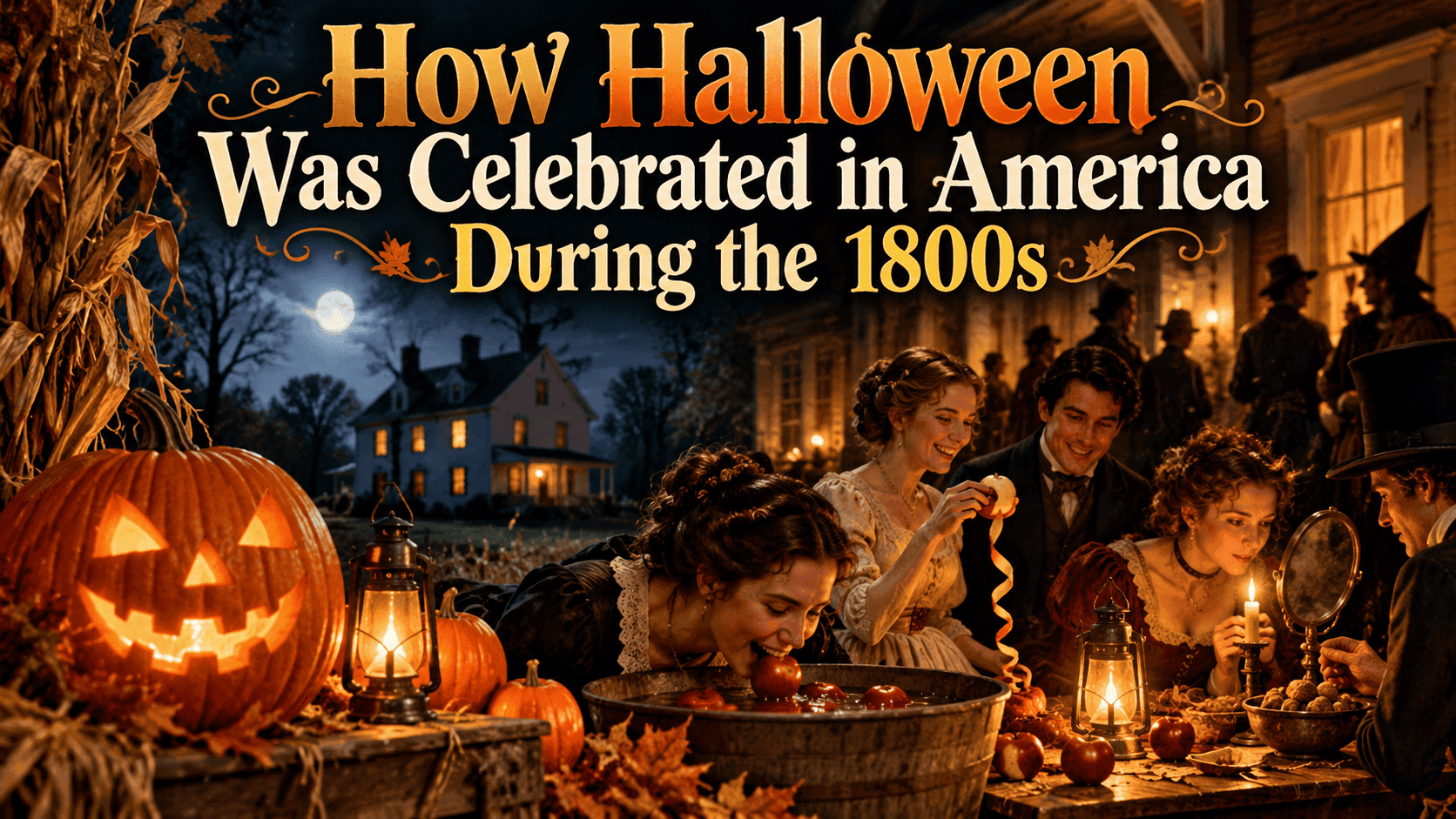
Halloween in America during the 1800s looked very different from the holiday we celebrate today. There were no neighborhoods filled with inflatable ghosts, no plastic pumpkins overflowing with candy, and no children going door to door shouting “trick or treat” as a widespread national tradition.
Instead, Halloween was a fascinating mixture of old European customs, supernatural beliefs, harvest celebrations, fortune-telling games, neighborhood mischief, and community gatherings.
Throughout the 19th century, Americans gradually transformed Halloween from a collection of regional folk traditions into a recognizable autumn celebration. By the late 1800s, parties, costumes, ghost stories, and playful traditions were becoming increasingly popular.
Understanding how Americans celebrated Halloween during the 1800s reveals the surprising history behind many traditions that continue today.
The Origins of Halloween in 19th-Century America
At the beginning of the 1800s, Halloween was not celebrated throughout the United States in the way it is today.
Its customs were especially familiar among communities with Scottish, Irish, and other European cultural connections.
Halloween traditions had developed over centuries from several influences, including the ancient Gaelic festival of Samhain, Christian observances surrounding All Saints’ Day and All Souls’ Day, and European folk customs.
Samhain marked a seasonal transition associated with the end of the harvest and the approach of winter. In later folklore, this period was connected with supernatural activity, spirits, and the mysterious boundary between the living and the dead.
By the 1800s, many of these traditions had become social activities involving games, stories, food, and predictions about the future.
As European immigrants brought their customs to America, Halloween gradually became part of the country’s changing cultural landscape.
However, the holiday’s popularity varied significantly by region, religion, and community.
Irish and Scottish Immigrants Helped Popularize Halloween
One of the most important developments in American Halloween history occurred during the middle of the 19th century.
Large numbers of Irish immigrants arrived in the United States, particularly during and after the Great Famine of the 1840s.
Many brought Halloween customs that had been practiced in Ireland for generations.
Scottish immigrants also contributed traditions involving fortune-telling, seasonal games, supernatural stories, and festive gatherings.
These communities helped preserve and spread Halloween celebrations in American towns and cities.
Immigrant families continued traditions such as carving lanterns, playing apple games, sharing ghost stories, and gathering with neighbors.
Over time, Americans from other cultural backgrounds began adopting some of these customs.
Halloween increasingly became an occasion for entertainment rather than solely a night associated with supernatural beliefs.
By the end of the century, newspapers, magazines, and party guides were helping introduce Halloween activities to a wider American audience.
Halloween Was Closely Connected to the Harvest Season
During much of the 1800s, American life was strongly influenced by agriculture.
For rural families, autumn was an important season when crops were harvested, food was preserved, and preparations were made for winter.
Halloween arrived during this period of seasonal change.
Many gatherings featured familiar autumn foods and decorations, including apples, nuts, corn, and pumpkins.
Families and neighbors might come together for seasonal festivities, games, and shared meals.
These celebrations were often simple compared with modern Halloween parties.
Instead of expensive decorations, people used materials available around their homes and farms.
Dried cornstalks, autumn leaves, pumpkins, and other harvest items helped create a festive atmosphere.
The association between Halloween and the autumn harvest remains one of the holiday’s strongest traditions.
Pumpkins Became an American Halloween Symbol
One of the most recognizable Halloween traditions developed through the adaptation of European lantern-carving customs.
In Ireland and parts of Britain, people had carved faces into turnips and other root vegetables to create lanterns.
These lanterns were sometimes connected with folklore about wandering spirits and mysterious nighttime figures.
When immigrants brought these customs to America, pumpkins offered an appealing alternative.
Pumpkins were already widely grown in North America, and their large size and relatively soft flesh made them easier to carve than many root vegetables.
During the 1800s, carved pumpkins gradually became associated with Halloween.
Some were given frightening faces and illuminated with candles.
Others served as seasonal decorations.
The development was gradual, and not every American household carved pumpkins.
Nevertheless, by the late 19th century, the jack-o’-lantern was becoming an increasingly recognizable Halloween symbol.
The glowing pumpkin faces that decorate American porches today grew out of this combination of immigrant folklore and American agricultural traditions.
Fortune-Telling Games Were Among the Most Popular Activities
One of the biggest differences between Halloween in the 1800s and Halloween today was the popularity of fortune-telling.
Many young people viewed Halloween as a special occasion for predicting romance, marriage, and future happiness.
These games were often playful social activities rather than serious attempts to predict the future.
Young women and men participated in traditions intended to reveal the identity of a future spouse or provide clues about their romantic lives.
Apple Peeling Fortune-Telling
A popular tradition involved peeling an apple while attempting to keep the peel in one long piece.
The participant would throw the peel over a shoulder.
According to the game, the shape formed by the fallen peel might resemble the first letter of a future spouse’s name.
This activity combined entertainment, romance, and superstition.
Roasting Nuts
Another fortune-telling game involved placing nuts near a fire.
Participants might assign names to the nuts, representing themselves and someone they admired.
The way the nuts burned, cracked, or moved was interpreted as a prediction about the relationship.
A nut that burned steadily might suggest lasting affection, while one that jumped or cracked could be interpreted as a warning.
Mirror Fortune-Telling
Some Halloween traditions involved looking into a mirror by candlelight in hopes of seeing the face of a future husband or wife.
Versions of this custom included holding a candle, eating an apple, or performing a particular ritual.
Although these activities sound frightening today, they were often associated with romantic curiosity.
Such games became familiar features of Halloween entertainment during the 19th century.
Bobbing for Apples Was a Favorite Halloween Game
Apple bobbing was another traditional activity associated with Halloween celebrations.
Participants attempted to retrieve apples floating in a tub or basin of water without using their hands.
The game required patience, determination, and a willingness to get wet.
In some traditions, the activity also carried romantic or fortune-telling meanings.
For example, successfully capturing an apple might be interpreted as a sign of good luck in love.
Apple games were especially suitable for autumn gatherings because apples were plentiful during the harvest season.
The activity became popular enough to remain associated with Halloween long after many of its original superstitions faded.
Even today, bobbing for apples is remembered as a classic old-fashioned Halloween game.
Ghost Stories Added Mystery to Halloween Night
Ghost stories were an important part of 19th-century entertainment.
Before television, radio, and modern movies, families and friends frequently entertained one another through storytelling.
Halloween provided a particularly fitting occasion for tales involving spirits, haunted houses, mysterious travelers, and unexplained events.
Some stories came from European folklore, while others reflected local American legends.
People might gather around a fireplace or candlelit room to share frightening tales.
The darkness of autumn evenings added to the atmosphere.
Stories about ghosts and supernatural encounters were not always limited to Halloween, but the holiday’s association with the spirit world made them especially appropriate.
The popularity of ghost stories also reflected the broader 19th-century fascination with death, spiritualism, and the possibility of communication with the departed.
This interest helped establish Halloween as a night associated with mystery and the supernatural.
Halloween Mischief Was Common in Some Communities
Not every Halloween tradition involved harmless games or quiet gatherings.
During the 1800s, Halloween also developed a reputation for pranks and mischief in certain communities.
Young people sometimes used the holiday as an opportunity to play tricks on neighbors.
Pranks could include moving gates, hiding household objects, making frightening noises, or rearranging items left outside.
Some tricks were relatively harmless.
Others caused property damage or created serious inconvenience.
The extent of Halloween mischief varied considerably by location and period.
In some places, these activities became an accepted part of the holiday.
In others, residents complained about disturbances and disorder.
By the late 1800s, concern about Halloween pranks helped encourage more organized celebrations.
Community gatherings and supervised parties offered alternatives to nighttime mischief.
This shift eventually contributed to the development of the more family-oriented Halloween celebrations of the 20th century.
Halloween Costumes Were Different From Modern Costumes
Costumes are now one of Halloween’s most recognizable features, but elaborate commercial costumes were not a standard part of American Halloween celebrations during most of the 1800s.
Disguising oneself had older roots in European seasonal customs, including traditions of masking and visiting homes.
Some immigrant communities preserved elements of these practices.
However, organized costume parties became more visible in American Halloween culture toward the end of the 19th century.
People attending masquerades or themed gatherings might wear homemade disguises.
These could involve masks, unusual clothing, or costumes representing supernatural characters.
Unlike modern Halloween costumes featuring superheroes, movie characters, and celebrities, 19th-century disguises often drew on folklore, masquerade traditions, and imaginative homemade designs.
Costumes were not yet the universal Halloween expectation they would later become.
Halloween Parties Became More Popular in the Late 1800s
By the final decades of the 19th century, Halloween was becoming increasingly associated with organized social gatherings.
Parties were especially popular among young people and families who enjoyed traditional games and seasonal entertainment.
Hosts might decorate rooms with autumn materials and arrange activities for guests.
Common party entertainment included apple games, fortune-telling, storytelling, music, and refreshments.
Halloween gatherings also created opportunities for courtship.
Young adults could socialize, participate in playful romantic predictions, and enjoy an evening together.
Newspapers and magazines helped spread ideas for Halloween entertainment.
As printed descriptions of games and party customs circulated, celebrations became more familiar to Americans who had not grown up practicing them.
This growing popularity helped establish Halloween as a social holiday.
What Did Americans Eat on Halloween During the 1800s?
Food played an important role in many Halloween gatherings.
However, there was no single Halloween menu followed throughout the country.
The foods served depended on local customs, family traditions, and what was available during the season.
Apples were especially important because they were used in games and refreshments.
Nuts were also popular, both as snacks and as part of fortune-telling activities.
Other seasonal foods might include pumpkin dishes, baked goods, and homemade sweets.
Families with Irish or Scottish backgrounds sometimes maintained traditional foods associated with autumn celebrations.
In Ireland, for example, barmbrack, a fruit bread connected with fortune-telling customs, was associated with Halloween.
Such traditions could continue within immigrant households in America.
Unlike today’s Halloween celebrations, candy was not yet the central focus of the holiday.
The modern practice of distributing individually wrapped sweets to large numbers of trick-or-treaters developed much later.
Did Children Go Trick-or-Treating in the 1800s?
The familiar American tradition of children dressing in costumes and going door to door asking for candy was not widespread during the 1800s.
Although older European customs involved people visiting homes in disguise, singing, performing, or requesting food, these practices were not identical to modern trick-or-treating.
Some communities maintained forms of seasonal visiting and masquerading.
However, the standardized Halloween custom known today as trick-or-treating emerged primarily during the 20th century.
The phrase “trick or treat” became established in North American Halloween culture decades after the 1800s.
For most 19th-century Americans who celebrated Halloween, the holiday was more closely associated with parties, games, fortune-telling, and occasional pranks than organized candy collecting.
This is one of the clearest differences between Victorian-era Halloween and the modern celebration.
Halloween in Rural America Versus American Cities
Halloween celebrations during the 1800s were not identical across the country.
In rural communities, seasonal gatherings often reflected agricultural life.
Harvest foods, household games, and local folklore shaped the festivities.
Families might gather in homes or community spaces to enjoy entertainment after the autumn harvest.
In growing cities, immigrant neighborhoods helped preserve traditional Halloween customs.
Urban social gatherings and organized parties became increasingly important as the century progressed.
Newspapers and magazines also helped connect rural and urban celebrations by sharing descriptions of games and traditions.
However, Halloween remained unevenly observed.
Some Americans celebrated enthusiastically, while others paid little attention to the occasion.
Religious beliefs, cultural backgrounds, and regional traditions all influenced whether and how Halloween was observed.
How Victorian Culture Influenced Halloween
The Victorian era, which spanned much of the 19th century, influenced the development of Halloween entertainment in America.
Victorian social life placed considerable importance on gatherings, parlor games, etiquette, and organized entertainment.
Halloween fit naturally into this environment, particularly through its romantic fortune-telling traditions.
Young people enjoyed games that allowed them to discuss courtship and marriage in a playful setting.
Halloween also appealed to the Victorian fascination with supernatural subjects.
Ghost stories, mysterious predictions, and spiritual themes were common features of popular culture.
As the century progressed, Halloween parties increasingly combined these interests with seasonal decorations and social entertainment.
The result was a holiday that could be both mysterious and lighthearted.
This Victorian influence helped shape the transition from older folk customs toward the organized Halloween parties familiar in later generations.
Were Halloween Celebrations Religious in the 1800s?
Halloween’s historical connections with religion remained important during the 19th century, although their significance varied among Americans.
The name Halloween comes from All Hallows’ Eve, the evening before All Saints’ Day on November 1.
In Christian traditions, All Saints’ Day honors saints, while All Souls’ Day, observed in some traditions on November 2, commemorates the departed faithful.
These observances were part of the broader historical background of Halloween.
However, many American Halloween activities during the 1800s were primarily social or folkloric rather than religious.
Fortune-telling games, harvest parties, and pranks did not necessarily reflect formal church practices.
Some religious communities discouraged Halloween customs because of their associations with superstition or disorder.
Others participated in seasonal gatherings without emphasizing supernatural beliefs.
The relationship between religion and Halloween was therefore complex, just as it remains today.
How Halloween Changed Between 1800 and 1900
The transformation of Halloween throughout the 19th century was gradual.
At the beginning of the century, Halloween was not a broadly established American holiday.
Its traditions were concentrated in particular communities, especially those influenced by Irish and Scottish customs.
During the middle decades, immigration helped spread these practices.
By the late 1800s, Halloween parties, seasonal decorations, fortune-telling games, and ghost stories were becoming increasingly recognizable.
Halloween’s evolution during the 1800s
| Early 1800s | Regional folk customs and limited recognition outside certain communities. |
| 1840s–1860s | Irish immigration and continued Scottish traditions helped spread Halloween practices. |
| 1870s–1880s | Social gatherings, games, and seasonal customs became more visible in American popular culture. |
| 1890s | Party entertainment, masquerades, and Halloween imagery gained broader recognition. |
By 1900, many elements of modern Halloween had recognizable predecessors.
However, the holiday had not yet developed its familiar combination of widespread neighborhood trick-or-treating, mass-produced costumes, and commercial candy traditions.
Those changes would become more prominent during the following century.
Halloween Traditions From the 1800s That Still Exist Today
Although Halloween has changed dramatically, several 19th-century traditions remain recognizable.
1. Carving jack-o’-lanterns: The custom of creating illuminated faces in pumpkins continues to be a major Halloween activity.
2. Bobbing for apples: This traditional autumn game remains associated with old-fashioned Halloween celebrations.
3. Sharing ghost stories: Frightening tales continue to entertain people during the Halloween season.
4. Wearing costumes: Homemade disguises and masquerade traditions helped lay the groundwork for modern costume celebrations.
5. Decorating with harvest materials: Pumpkins, cornstalks, and autumn leaves remain popular Halloween decorations.
6. Hosting Halloween parties: Social gatherings became increasingly popular during the late 1800s and remain central to the holiday.
7. Playing spooky games: Although fortune-telling games are less common today, Halloween entertainment still frequently incorporates mystery, suspense, and playful superstition.
These surviving customs demonstrate how much of modern Halloween developed from traditions practiced generations ago.
What Would a Halloween Night in 1890 Have Looked Like?
Imagine attending a Halloween gathering in an American home in 1890.
The room might be decorated with pumpkins, apples, and autumn greenery.
Candles or oil lamps would provide light, creating shadows across the walls.
Guests might gather around a table to play fortune-telling games involving apple peels and nuts.
Others might attempt to catch floating apples with their teeth.
Young people could laugh as they tried to discover the initials of their future spouses.
Someone might entertain the group with a frightening ghost story.
Homemade refreshments would be shared, and music or conversation might continue into the evening.
Outside, a few mischievous youngsters might be planning tricks on their neighbors.
This imagined scene would not represent every American household in 1890, but it brings together several customs documented in the holiday culture of the period.
It also shows how Halloween could combine laughter, romance, superstition, and a little fear.
Why Halloween Became an Important American Tradition
Halloween’s growth during the 1800s reflects a larger story about American culture.
Immigrants brought traditions from their homelands and adapted them to new surroundings.
Local communities combined inherited customs with American seasonal life.
Games that once carried supernatural meanings became popular forms of entertainment.
Harvest symbols became holiday decorations.
Ghost stories and disguises helped create a recognizable atmosphere of mystery.
As these customs spread, Halloween gradually became a shared celebration among people from different backgrounds.
Its transformation also demonstrates how holidays evolve over time.
Traditions rarely remain exactly as they began.
Instead, each generation reshapes them according to its own experiences, values, and interests.
Halloween in America is an especially vivid example of that process.
Final Thoughts: Remembering Halloween in 19th-Century America
Halloween during the 1800s was a holiday in transition.
It began the century as a collection of regional and immigrant traditions and ended it as an increasingly recognizable occasion for seasonal parties, games, ghost stories, and playful mischief.
The celebrations were often simpler than those of today, but they contained many familiar elements.
People carved lanterns, played games with apples, shared frightening stories, and gathered with friends and neighbors.
For young adults, Halloween could be a night of romance and predictions about the future. For others, it was an opportunity to enjoy the autumn season or participate in mischievous traditions.
Modern Halloween owes much to the customs that spread and evolved throughout 19th-century America.
The next time you see a glowing jack-o’-lantern, hear a ghost story, or attend a Halloween party, remember that these traditions connect us with generations of Americans who celebrated the season long before Halloween became the major holiday we know today.
If you could experience Halloween for one night in 1800s America, would you rather attend an old-fashioned Victorian Halloween party, listen to ghost stories by candlelight, or try the mysterious fortune-telling games of the past?
Leave a Reply