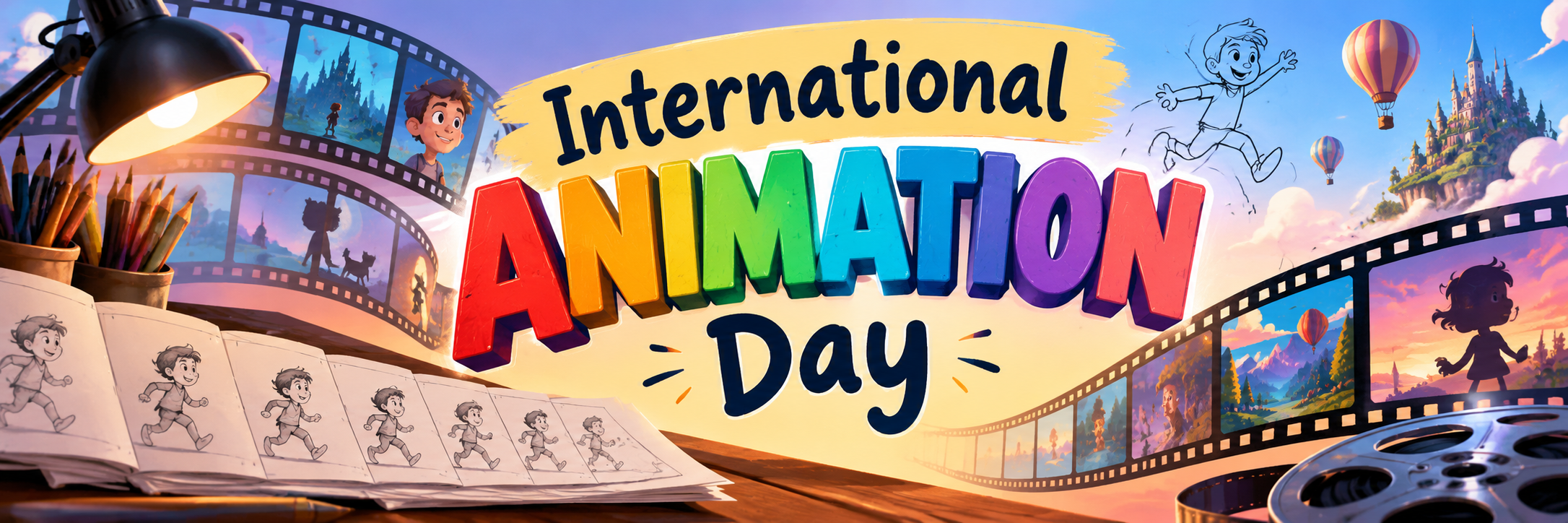
Celebrating the Magic of Animation
Every year on October 28, people around the world celebrate International Animation Day, a special occasion dedicated to recognizing the creativity, imagination, artistry, and technological innovation behind animation. From beloved childhood cartoons to breathtaking animated films, animation has become one of the most powerful forms of storytelling in modern entertainment.
Animation is more than moving pictures. It is an art form that brings imagination to life, transforms ordinary drawings into unforgettable characters, and creates worlds that would otherwise exist only in our dreams.
Whether through traditional hand-drawn techniques, stop-motion photography, computer-generated imagery, or modern digital animation, artists continue to push the boundaries of what is possible.
International Animation Day celebrates not only the finished films and television shows that audiences enjoy but also the talented individuals who work behind the scenes to make these creations possible.
It is a day to appreciate the animators, illustrators, writers, directors, designers, voice actors, and countless creative professionals whose dedication brings animated stories to life.
When Is International Animation Day Celebrated?
International Animation Day is celebrated annually on October 28.
The observance was established in 2002 by the International Animated Film Association, commonly known as ASIFA.
The date commemorates an important milestone in animation history: the first public presentation of Émile Reynaud’s Théâtre Optique at the Musée Grévin in Paris, France, on October 28, 1892.
This groundbreaking presentation introduced audiences to projected moving images created through a series of individually crafted pictures.
Although animation techniques had been explored before this event, Reynaud’s presentation represented a significant advancement in the development of animated entertainment.
Today, International Animation Day is recognized through screenings, exhibitions, workshops, educational activities, and celebrations organized by animation enthusiasts and cultural institutions around the world.
The History of International Animation Day
The history of animation stretches back long before computers, television, and modern filmmaking.
For centuries, people have experimented with ways to create the illusion of movement through pictures.
Early visual inventions demonstrated that a rapid sequence of slightly different images could make stationary drawings appear to move.
Devices such as the phenakistiscope, zoetrope, and praxinoscope helped establish the principles that would eventually become the foundation of modern animation.
One of the most influential pioneers was French inventor and artist Émile Reynaud.
In 1892, Reynaud introduced his Théâtre Optique, which allowed audiences to watch projected animated sequences.
Unlike simple mechanical devices that displayed repeating movements, his presentations could tell longer stories through carefully arranged images.
His work helped demonstrate that animation could become a form of narrative entertainment rather than simply a scientific curiosity.
More than a century later, ASIFA established International Animation Day to honor this historical achievement and promote animation as an important cultural and artistic medium.
What Is Animation?
Animation is the process of creating the illusion of movement by displaying a sequence of images that change slightly from one frame to the next.
When these images are presented rapidly, viewers perceive continuous motion.
This technique allows artists to make drawings, models, objects, and computer-generated characters appear alive.
Animation can be used for entertainment, education, advertising, scientific visualization, artistic expression, and communication.
What makes animation especially remarkable is its freedom from many of the physical limitations of live-action filmmaking.
An animated character can fly through space, travel through time, transform into another creature, or explore an imaginary universe.
Through animation, nearly anything an artist can imagine can become part of a visual story.
The Different Types of Animation
Over the years, animation has developed into several distinctive styles, each offering its own creative possibilities.
1. Traditional Hand-Drawn Animation
Traditional animation involves creating individual drawings that represent successive moments of movement.
Historically, artists drew characters on paper and transferred them to transparent sheets known as cels.
These images were photographed in sequence to produce animated scenes.
Classic animated films helped establish this technique as one of the most recognizable forms of animation.
Although modern technology has changed production methods, the artistic principles of hand-drawn animation remain influential.
2. Computer-Generated Animation
Computer-generated imagery, commonly called CGI, uses digital software to create characters, environments, and movement.
Three-dimensional animation has become especially popular in feature films, television productions, and video games.
Artists build digital models, create virtual skeletons for movement, apply textures, establish lighting, and render scenes.
CGI allows filmmakers to create detailed imaginary worlds while maintaining precise control over movement and visual effects.
3. Stop-Motion Animation
Stop-motion animation uses physical objects or models that are photographed one frame at a time.
Between photographs, the animator moves the objects slightly.
When the images are played in sequence, the objects appear to move independently.
Clay animation, puppet animation, and object animation are popular examples of stop-motion techniques.
This method requires patience, precision, and exceptional attention to detail.
4. Two-Dimensional Digital Animation
Digital 2D animation combines traditional drawing principles with modern computer software.
Artists create characters and backgrounds digitally, allowing them to animate movement without relying entirely on physical materials.
This technique is widely used in television cartoons, online videos, educational programs, and independent animation projects.
5. Motion Graphics
Motion graphics combine animated text, shapes, illustrations, and visual elements to communicate information.
They are frequently used in advertisements, presentations, documentaries, websites, and educational videos.
Unlike character-driven animation, motion graphics often focus on explaining ideas or presenting information in a visually engaging way.
How Animation Changed Entertainment
Animation has transformed entertainment by making stories possible that would be difficult or impossible to create through conventional filming.
Early animated shorts introduced audiences to imaginative characters and humorous situations.
As the industry developed, animated feature films demonstrated that the medium could support complex stories, memorable music, emotional relationships, and cinematic adventures.
The release of Snow White and the Seven Dwarfs in 1937 marked a major milestone in American feature animation.
Decades later, Toy Story, released in 1995, became the first feature-length film created entirely with computer animation.
These achievements helped reshape the possibilities of animated filmmaking.
Today, animation is a global industry encompassing theatrical films, streaming productions, television series, video games, independent shorts, and online entertainment.
Japanese anime, European artistic animation, American animated features, and productions from many other regions demonstrate the diversity of styles and storytelling traditions within the medium.
Animation continues to evolve as artists experiment with new technologies and creative approaches.
Why Animation Matters Beyond Entertainment
Although animation is often associated with cartoons and children’s movies, its importance extends far beyond entertainment.
Animation can explain complicated scientific concepts, illustrate historical events, demonstrate medical procedures, and help students understand difficult subjects.
Educational animation makes abstract information easier to visualize.
In advertising, animation allows companies to communicate messages through memorable characters and creative visual storytelling.
In architecture and engineering, animated models can demonstrate how structures, machines, and systems function.
Animation also plays an important role in accessibility and public communication by presenting information through engaging visual sequences.
Perhaps most importantly, animation provides artists with a unique way to express emotions, cultural experiences, and personal perspectives.
An animated story can explore friendship, loss, courage, hope, identity, and the human experience with extraordinary creativity.
The Emotional Power of Animated Stories
One of animation’s greatest strengths is its ability to connect with audiences emotionally.
Animated characters may be fictional, but the feelings they represent are often deeply human.
Stories about family, friendship, sacrifice, belonging, and perseverance can resonate with viewers regardless of age.
An animated film can make audiences laugh one moment and cry the next.
Through music, movement, expressions, and storytelling, animators communicate emotions that sometimes require very few words.
Animation can also address difficult subjects in ways that feel approachable without diminishing their importance.
Stories about grief, separation, growing older, and finding purpose demonstrate that animation is not limited to lighthearted entertainment.
Its ability to combine imagination with genuine emotion makes it a powerful storytelling medium.
The Artists Behind the Animation
Creating an animated production requires collaboration among many talented professionals.
Animators develop character movements and performances.
Story artists transform scripts into visual sequences.
Character designers establish the appearance and personalities of fictional figures.
Background artists create the environments where stories unfold.
Writers develop narratives, while directors guide the overall creative vision.
Voice actors give characters distinctive personalities through dialogue and performance.
Composers and sound designers contribute music and audio that enhance the emotional impact of each scene.
Editors, technical artists, lighting specialists, and production teams help bring all these elements together.
A few seconds of finished animation may require hours or even days of careful work.
International Animation Day offers an opportunity to recognize the dedication and creativity behind every frame.
How to Celebrate International Animation Day
There are many enjoyable and meaningful ways to participate in International Animation Day.
Watch a favorite animated movie. Revisit a childhood classic or discover an animated film from another country.
Explore the history of animation. Learn about pioneering artists, early animation devices, and the technological developments that shaped the industry.
Try creating your own animation. Use a smartphone, drawing application, or simple flipbook to experiment with movement.
Support independent animators. Discover short films and creative projects made by emerging artists.
Attend an animation event. Look for film screenings, exhibitions, workshops, or educational activities celebrating the medium.
Introduce children to animation. Encourage young people to explore drawing, storytelling, and creative expression.
Appreciate the creative process. Watch behind-the-scenes documentaries or interviews that reveal how animated productions are made.
Even something as simple as sharing a favorite animated memory can be a meaningful way to celebrate.
Interesting Facts About Animation
Animation has a fascinating history filled with creativity and innovation.
-
The word animation comes from a Latin root associated with giving life or spirit.
-
Émile Reynaud’s Théâtre Optique presentation in 1892 is commemorated by International Animation Day.
-
Early animation devices created the illusion of motion before the invention of modern cinema.
-
Snow White and the Seven Dwarfs became a landmark in feature-length cel animation.
-
Toy Story helped establish computer-generated animation as a major force in filmmaking.
-
Stop-motion animation can involve thousands of individual photographs.
-
Animation is used in medicine, science, education, architecture, and many other fields.
-
Animated storytelling is practiced across the world, with distinctive artistic traditions and cultural influences.
These facts highlight how animation combines artistic imagination with technical achievement.
The Future of Animation
Animation continues to change as new technologies expand what artists can create.
Advances in computer graphics, real-time rendering, virtual production, and digital drawing tools are making sophisticated animation techniques more accessible.
Independent creators can now produce animated content using equipment and software that would once have been available only to major studios.
Artificial intelligence is also influencing certain aspects of animation production, although its use raises important questions about artistic ownership, consent, employment, and the protection of creative work.
Despite technological advancements, the foundation of meaningful animation remains the same: human imagination and storytelling.
Technology may change how animated images are produced, but memorable characters and emotionally powerful stories still depend on creativity, thoughtful direction, and artistic vision.
The future of animation will likely combine new technical possibilities with the timeless desire to tell stories.
Why International Animation Day Is Worth Celebrating
International Animation Day reminds us that creativity can transform something as simple as a drawing into an experience that touches millions of lives.
Animation has entertained generations, inspired artists, educated students, and helped people see the world through different perspectives.
It has given audiences unforgettable characters, imaginative adventures, and meaningful stories that remain part of their lives long after the screen goes dark.
Behind every animated creation is an extraordinary combination of patience, imagination, skill, and dedication.
Celebrating animation means celebrating the people who believe that an idea, a drawing, or a simple movement can become something remarkable.
Final Thoughts: Imagination Has No Limits
International Animation Day, celebrated every October 28, is more than a tribute to cartoons and animated movies. It is a celebration of artistic expression, technological innovation, cultural storytelling, and the limitless possibilities of imagination.
From the pioneering work of Émile Reynaud to today’s sophisticated digital productions, animation has continued to grow while preserving its ability to inspire wonder.
Whether you enjoy traditional cartoons, animated feature films, anime, stop-motion productions, or modern computer animation, this day offers an opportunity to appreciate the creativity that makes these experiences possible.
Animation teaches us that even the simplest image can become extraordinary when imagination brings it to life.
Happy International Animation Day!
What animated movie, television show, or character has left the greatest impression on your life, and why does it remain special to you?


Leave a Reply