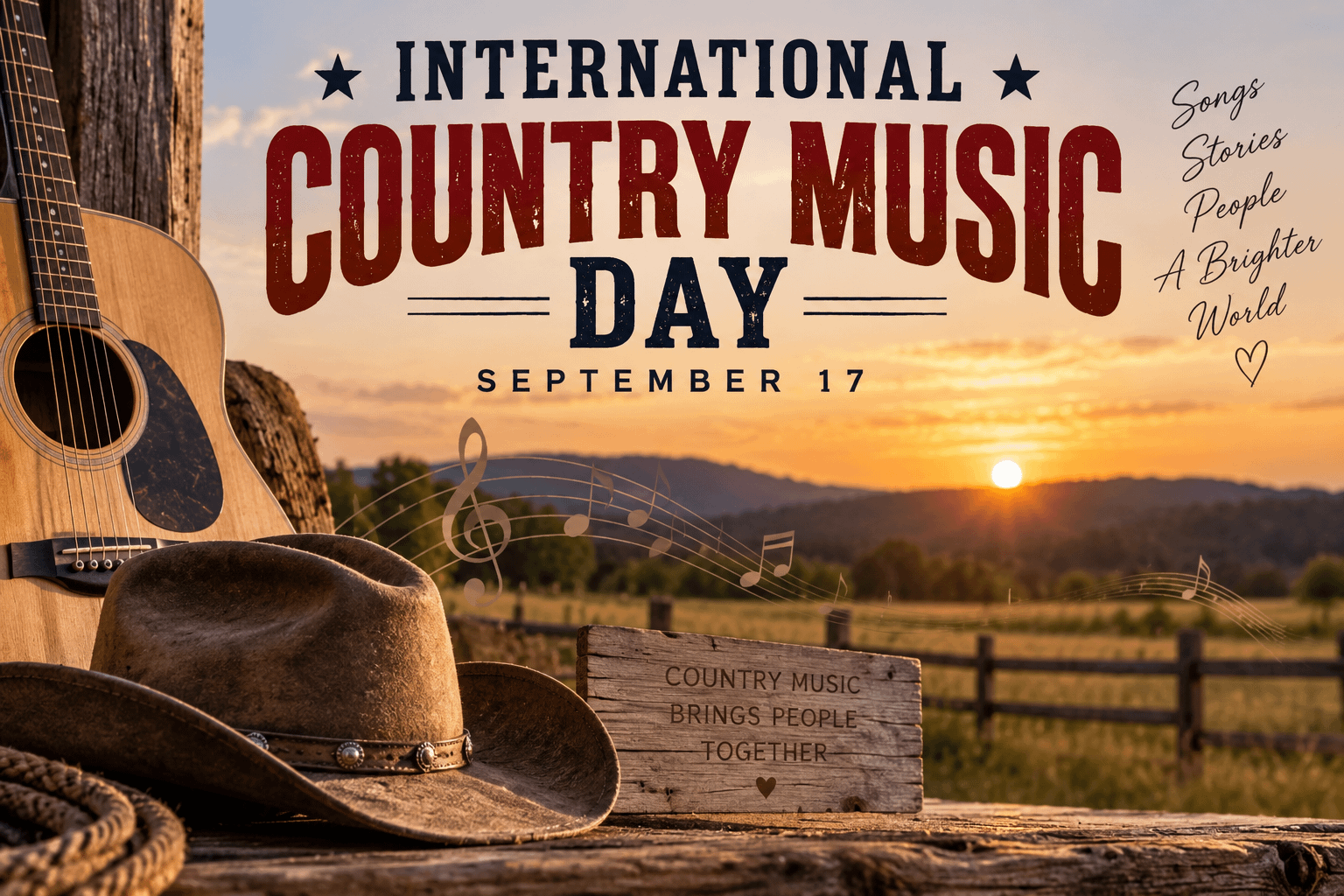
Every year on September 17, music lovers have a reason to turn up the volume, revisit an old favorite, and celebrate a genre built around stories of life, love, family, heartbreak, faith, home, and perseverance: International Country Music Day.
Country music has a remarkable ability to make ordinary moments feel meaningful. A song about a dusty road can remind someone of childhood. A song about losing someone can bring back memories of a person who is deeply missed. A love song can transport us to another chapter of our lives, while an upbeat anthem can make an ordinary afternoon feel like a celebration.
That emotional connection is at the heart of International Country Music Day.
It is a day to appreciate the singers, songwriters, musicians, and fans who have helped country music grow from its traditional roots into a worldwide musical force.
What Is International Country Music Day?
International Country Music Day is observed on September 17 and celebrates country music, its history, its performers, and the people who continue to keep the genre alive.
The date is especially fitting because September 17 is the birthday of Hank Williams, who was born in 1923 and became one of the most influential figures in country music history.
Williams’ career was tragically short, but songs such as “Your Cheatin’ Heart,” “Hey, Good Lookin’,” and “I’m So Lonesome I Could Cry” helped establish a songwriting tradition that continues to influence artists generations later.
Country music has changed dramatically since Williams’ era, but one thing has remained remarkably consistent: the importance of telling a good story.
Country Music Is Storytelling Set to Music
Perhaps more than almost any other popular genre, country music is associated with storytelling.
The best country songs don’t simply give us a melody. They introduce us to people, places, struggles, memories, and moments.
Sometimes the story is joyful.
Sometimes it is heartbreaking.
Sometimes it is about falling in love.
Sometimes it is about watching love disappear.
Country songs have explored marriage, divorce, parenthood, friendship, drinking, small-town life, working hard, losing loved ones, starting over, chasing dreams, finding faith, making mistakes, and learning to live with regret.
Those subjects are universal.
You don’t have to live on a farm, drive a pickup truck, or wear cowboy boots to understand what it feels like to miss someone.
You don’t have to grow up in the American South to understand heartbreak.
And you certainly don’t have to be a country musician to appreciate a song about trying to make it through another difficult day.
Country music works because beneath the instruments and accents are stories about being human.
The Roots of Country Music
Modern country music developed from several musical traditions, particularly those found throughout the southern United States and Appalachia.
Folk songs brought by European immigrants blended with African American musical traditions, gospel, blues, string-band music, ballads, and other regional styles.
Instruments including the fiddle, guitar, banjo, mandolin, and eventually steel guitar became important parts of the evolving country sound.
During the 1920s, improvements in recording technology and radio broadcasting helped bring rural musicians to much larger audiences.
One of the landmark moments came with the Bristol Sessions of 1927, recordings made in Bristol, Tennessee, and Virginia. Performers associated with those sessions, including the Carter Family and Jimmie Rodgers, became enormously influential.
As recordings traveled across America and radio became part of everyday life, country music began moving far beyond the communities where many of its traditions originated.
Nashville and the Grand Ole Opry
No discussion of country music history would be complete without Nashville.
Nashville, Tennessee, eventually became known worldwide as Music City, and the city remains closely associated with country music.
One of its most famous institutions is the Grand Ole Opry.
Beginning as a radio program in 1925, the Opry became one of the most important stages in country music history. Generations of performers have appeared on the program, helping introduce artists and songs to audiences throughout the United States and beyond.
For aspiring country musicians, performing at the Grand Ole Opry became more than another concert.
It became a milestone.
Nashville also developed into an enormous songwriting and recording center. Behind countless country hits are professional songwriters who may never become household names but whose words have become part of millions of people’s lives.
That songwriting culture remains one of Nashville’s greatest contributions to music.
The Legends Who Built Country Music
Country music history is filled with unforgettable personalities.
Hank Williams brought vulnerability and emotional honesty to his songwriting.
Johnny Cash developed a distinctive sound and image while singing about love, faith, prisoners, hardship, redemption, and people living on society’s margins.
Patsy Cline demonstrated the extraordinary emotional power of the country voice.
Loretta Lynn wrote candidly about women’s experiences and everyday struggles.
Willie Nelson helped reshape expectations about what a country star could sound and look like.
Waylon Jennings became a central figure in the outlaw country movement.
Dolly Parton combined extraordinary songwriting ability with unmistakable personality, humor, compassion, and business talent.
George Jones, Tammy Wynette, Merle Haggard, Conway Twitty, Charley Pride, Glen Campbell, and many others helped build the foundation upon which later generations would stand.
Each artist brought something different.
Together, they demonstrated just how broad country music could become.
Country Music Continues to Evolve
Country music has never remained frozen in one era.
Traditional country gave way to new styles and movements, including honky-tonk, the Nashville Sound, Bakersfield country, outlaw country, country rock, neotraditional country, country pop, Americana, and many other variations.
The 1980s and 1990s produced another generation of enormously popular performers.
Artists such as George Strait, Reba McEntire, Alan Jackson, Garth Brooks, Vince Gill, Brooks & Dunn, Shania Twain, and Tim McGraw helped bring country music to massive audiences.
The 1990s in particular became an era many fans still remember with tremendous affection.
Songs from that period combined memorable melodies with storytelling, romance, humor, heartbreak, and energetic live performances.
Country music continued changing during the 2000s and beyond as artists incorporated influences from pop, rock, folk, R&B, hip-hop, and other genres.
Some fans prefer traditional country.
Others love contemporary country.
Many enjoy both.
Those debates about what “real country” sounds like are practically a country music tradition themselves.
But musical evolution is nothing new.
Country has always borrowed, blended, changed, and reinvented itself.
Songs for the Best and Worst Days of Life
One reason country music develops such devoted fans is its willingness to talk about difficult emotions.
There are country songs for weddings.
There are songs for breakups.
There are songs about becoming a parent.
There are songs about losing parents.
There are songs about children growing up.
There are songs about people who died too soon.
There are songs about loneliness, addiction, regret, forgiveness, faith, and second chances.
Sometimes we hear a song years after something happened and suddenly remember exactly where we were.
Music can preserve memories in ways few other things can.
A particular song might remind you of riding in the car with your father.
Another might remind you of your mother singing in the kitchen.
One might bring back memories of your first love.
Another might remind you of someone who is no longer here.
That can make listening painful.
But it can also make music incredibly meaningful.
Sometimes a song becomes a place where a memory continues to live.
Country Music and Heartbreak
If country music has one unofficial specialty, heartbreak would certainly be a contender.
Country musicians have been writing about broken hearts for generations.
There is something comforting about hearing someone put feelings into words when you can’t find the words yourself.
A songwriter might describe loneliness in three minutes more accurately than someone could explain it during an hour-long conversation.
That’s part of music’s power.
When life hurts, a song doesn’t necessarily fix anything.
But sometimes it reminds us that someone else has felt something similar.
And occasionally, knowing we aren’t the first person to experience heartbreak makes carrying it slightly easier.
Country Music and Faith
Faith has also played an important role throughout country music history.
The genre’s roots are closely connected to gospel music, hymns, churches, and spiritual traditions.
Many country performers have recorded gospel albums or songs about prayer, forgiveness, heaven, redemption, and trusting God through difficult seasons.
For listeners who share those beliefs, these songs can become much more than entertainment.
They can become encouragement.
A familiar hymn or country gospel song may bring comfort during grief, uncertainty, or fear.
Again, country music meets people where life actually happens.
Country Music Around the World
Although country music is strongly associated with the United States, its audience stretches far beyond America’s borders.
Country music has passionate listeners and performers throughout Canada, Australia, the United Kingdom, Europe, and many other parts of the world.
That international popularity makes the name International Country Music Day especially appropriate.
The details of people’s lives may differ from one country to another, but the emotions found in country songs don’t require translation.
Love is love.
Heartbreak is heartbreak.
Missing home is universal.
So is missing someone you love.
And everyone understands the desire to believe tomorrow might be better than today.
How to Celebrate International Country Music Day
There are plenty of ways to celebrate on September 17:
- Create a country music playlist featuring songs from several generations.
- Listen to a country legend you’ve never explored before.
- Revisit the songs you grew up hearing.
- Watch a country music documentary or concert.
- Support an independent country musician.
- Attend a local country music performance.
- Learn about the history of country music.
- Share your favorite country song with someone.
- Try writing your own country song or poem.
- Spend the evening listening to music with family or friends.
You could also make the celebration personal.
Choose five country songs connected to important moments in your life.
Maybe one reminds you of childhood.
Another reminds you of someone you loved.
Another represents heartbreak.
Another represents rebuilding your life.
And the final song represents where you hope to go next.
Music can become a soundtrack to our personal history.
Celebrate the Songwriters
International Country Music Day is also a perfect opportunity to recognize songwriters.
The singer receives the applause, but sometimes another person wrote the words that made millions of listeners cry.
Songwriting is one of country music’s greatest traditions.
A talented songwriter can take something enormous—love, death, regret, parenthood, faith—and capture it in a few verses and a chorus.
That simplicity is deceptive.
Writing something that sounds natural while carrying genuine emotional weight is extraordinarily difficult.
The greatest country songs often sound like someone simply sat beside you and told you a story.
That is the magic.
Why Old Country Songs Never Really Get Old
Trends change.
Production techniques change.
Radio formats change.
Artists come and go.
But a great song can survive all of it.
Someone can discover a Hank Williams song decades after it was recorded and still recognize the loneliness in his voice.
A young listener can hear Johnny Cash for the first time and understand immediately why his music mattered.
Someone who wasn’t alive during Patsy Cline’s career can still feel the emotion in her recordings.
That is what separates a popular song from a timeless one.
Technology ages.
Human emotion doesn’t.
More Than Boots, Trucks, and Back Roads
Country music sometimes gets reduced to stereotypes.
Cowboy hats.
Pickup trucks.
Beer.
Back roads.
Small towns.
Those things certainly appear in country songs, sometimes frequently.
But the genre has always been much larger than its stereotypes.
At its best, country music explores what happens inside people’s homes, relationships, families, hearts, and memories.
It tells stories about ordinary people.
People working long hours.
People trying to raise families.
People falling in love.
People making terrible mistakes.
People burying someone they love.
People asking God for help.
People starting over.
People laughing at themselves.
People refusing to give up.
Those aren’t exclusively country experiences.
They’re human experiences.
A Song Can Become Part of Your Story
Most country music fans probably have at least one song that means far more to them than the songwriter could ever know.
Maybe you played it repeatedly during the happiest period of your life.
Maybe someone you loved used to sing it.
Maybe it played during a road trip you’ll never forget.
Maybe it helped you survive a breakup.
Maybe it reminds you of someone who passed away.
That is one of the beautiful things about music.
An artist writes a song based on one experience, but once that song is released, listeners begin attaching their own stories to it.
Eventually, it belongs to millions of different memories.
International Country Music Day Is About the Stories We Carry
International Country Music Day may officially celebrate a musical genre, but ultimately it celebrates something even bigger.
It celebrates stories.
Country music reminds us that ordinary lives are worth singing about.
Your first love matters.
Your heartbreak matters.
Your family matters.
Your memories matter.
The person you miss matters.
The mistakes you’ve made matter.
The lessons you’ve learned matter.
The place you call home matters.
And the road you’ve traveled to become the person you are today matters.
That is why country music continues connecting with generation after generation.
The instruments may change.
The artists may change.
The sound may evolve.
But somewhere there will always be a songwriter with a guitar trying to turn a piece of life into a song.
And somewhere else, someone will hear it and quietly think:
“That’s exactly how I feel.”
So this September 17, celebrate International Country Music Day by turning up a favorite song, discovering an artist you’ve never heard before, remembering the legends who built the genre, and appreciating the stories country music has preserved for generations.
And perhaps most importantly, think about the country song that has become part of your own story.
What country song means the most to you, and what memory comes rushing back every time you hear it?
Leave a Reply