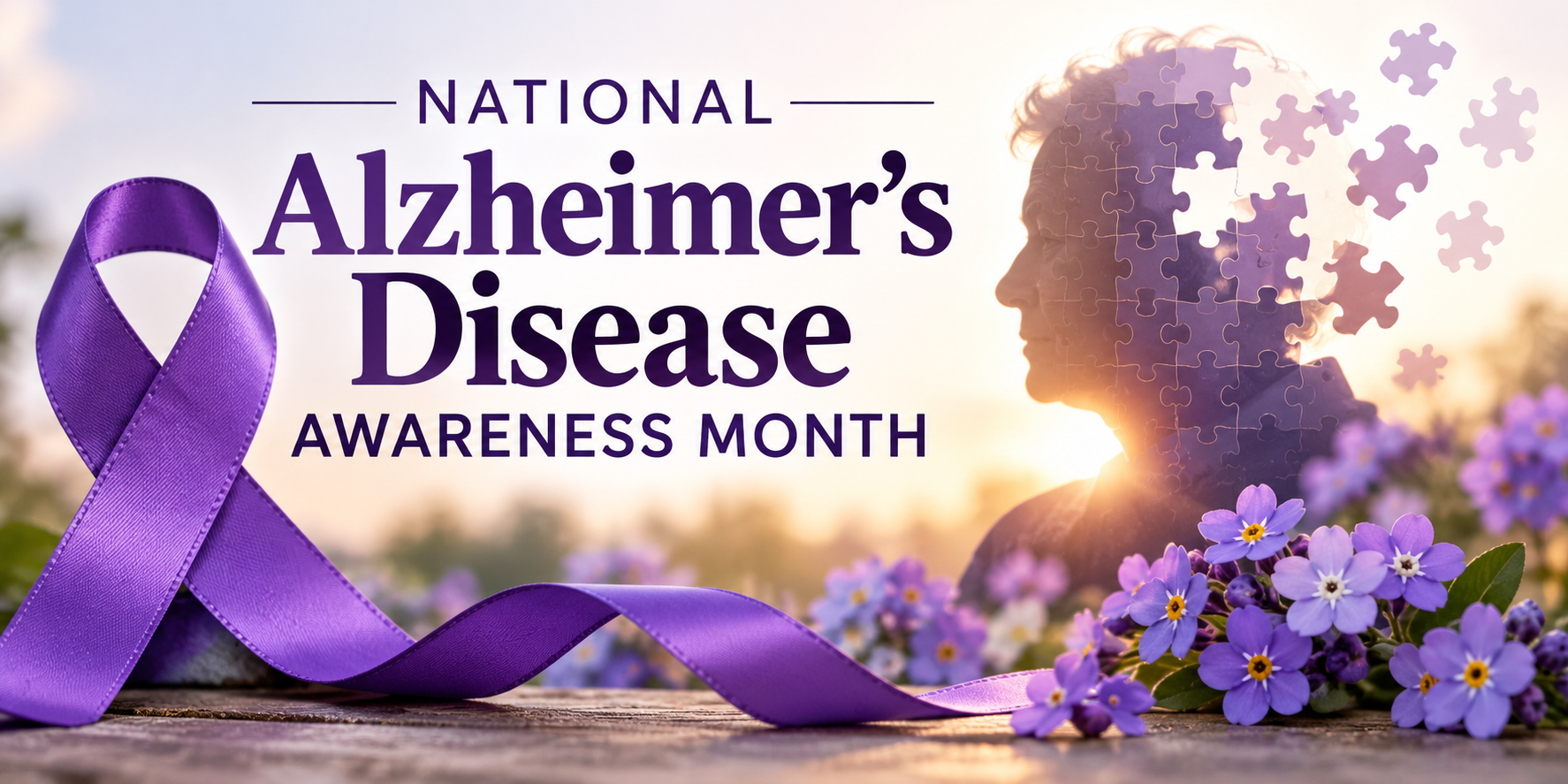
November is National Alzheimer’s Disease Awareness Month — a time to raise awareness, honor those living with Alzheimer’s disease, support caregivers, and encourage communities to come together in the fight against this life-changing condition.
Every November, National Alzheimer’s Disease Awareness Month reminds us of the importance of compassion, education, early detection, and continued research into one of the most challenging health conditions affecting older adults and their families.
Alzheimer’s disease does more than affect memory. It can gradually change how someone thinks, communicates, recognizes familiar faces, and performs everyday activities. For families, the experience can be heartbreaking as they watch someone they love struggle with things that once came naturally.
But this month is about more than recognizing the difficulties of Alzheimer’s. It is also about celebrating the strength of caregivers, encouraging research, promoting brain health, and reminding families that they do not have to face the journey alone.
Understanding Alzheimer’s disease is one of the first steps toward building a more supportive and compassionate world.
What Is National Alzheimer’s Disease Awareness Month?
National Alzheimer’s Disease Awareness Month is observed every November in the United States.
The observance was established in 1983, when President Ronald Reagan designated November as a month dedicated to increasing public awareness of Alzheimer’s disease.
At that time, an estimated two million Americans were living with the condition. Today, the number is substantially higher, making awareness and education increasingly important.
The month encourages individuals, families, healthcare professionals, organizations, and communities to learn about Alzheimer’s disease and take meaningful action.
Its primary goals include:
-
Increasing public understanding of Alzheimer’s disease and other dementias.
-
Encouraging early recognition of symptoms.
-
Supporting individuals living with Alzheimer’s.
-
Recognizing the dedication of family caregivers.
-
Promoting research into treatments and prevention.
-
Reducing stigma and misunderstandings surrounding dementia.
-
Helping families find support and educational resources.
November also marks National Family Caregivers Month, making it an especially meaningful time to recognize the people who provide daily care and emotional support to loved ones.
What Is Alzheimer’s Disease?
Alzheimer’s disease is a progressive brain disorder that affects memory, thinking, behavior, and the ability to carry out daily activities.
It is the most common cause of dementia, accounting for an estimated 60% to 80% of dementia cases.
Dementia is not a single disease. Instead, it is a general term describing a decline in cognitive abilities severe enough to interfere with everyday life.
Alzheimer’s disease involves changes in the brain, including the accumulation of abnormal proteins known as amyloid-beta and tau. These changes are associated with damage to nerve cells and the connections between them.
Over time, the disease can affect important abilities such as remembering information, making decisions, communicating, and recognizing surroundings.
Although Alzheimer’s is most commonly diagnosed in adults over age 65, younger individuals can also develop the condition. This is known as younger-onset Alzheimer’s disease.
Alzheimer’s is not a normal part of aging. While occasional forgetfulness can happen as people grow older, persistent memory problems that interfere with daily life deserve medical attention.
Understanding the Early Warning Signs of Alzheimer’s Disease
Recognizing potential symptoms early can help individuals and families seek medical evaluations, understand available treatments, and prepare for future care needs.
Symptoms vary from person to person, but several warning signs deserve attention.
1. Memory Loss That Disrupts Daily Life
One of the most recognizable early symptoms is difficulty remembering recently learned information.
Someone may repeatedly ask the same questions, forget important appointments, or increasingly rely on others to remember everyday details.
2. Difficulty Planning or Solving Problems
Activities that once seemed simple may become challenging.
Examples include following a familiar recipe, managing household bills, or keeping track of monthly expenses.
3. Trouble Completing Familiar Tasks
A person may struggle with everyday activities such as preparing meals, operating familiar appliances, or navigating a familiar route.
4. Confusion About Time or Place
Individuals may lose track of dates, seasons, or the passage of time.
They may also become confused about where they are or how they arrived somewhere.
5. Difficulty Understanding Visual Information
Some people experience problems judging distances, interpreting images, or understanding spatial relationships.
These difficulties can affect activities such as driving or moving safely through unfamiliar environments.
6. Problems Finding Words
Someone living with Alzheimer’s may struggle to follow conversations, repeat themselves, or have difficulty naming familiar objects.
7. Misplacing Objects
Individuals may place belongings in unusual locations and struggle to retrace their steps.
8. Changes in Judgment
Alzheimer’s can affect decision-making, including financial choices, personal hygiene, and recognizing potentially unsafe situations.
9. Withdrawal From Activities
Someone experiencing cognitive changes may gradually withdraw from hobbies, social gatherings, or activities they previously enjoyed.
10. Changes in Mood or Personality
Confusion, anxiety, frustration, suspicion, or increased irritability may appear as the disease progresses.
It is important to remember that these symptoms do not automatically mean someone has Alzheimer’s. Other conditions, including medication effects, depression, sleep disorders, vitamin deficiencies, and thyroid problems, can cause similar symptoms.
A healthcare professional can help determine the underlying cause.
The Different Stages of Alzheimer’s Disease
Alzheimer’s disease generally progresses gradually, although the rate of progression differs significantly among individuals.
Understanding the stages can help families anticipate changing needs.
Early-Stage Alzheimer’s Disease
During the early stage, individuals may remain independent and continue participating in work, hobbies, and social activities.
However, they may experience increased forgetfulness, difficulty concentrating, or challenges organizing tasks.
Common experiences include forgetting names, misplacing belongings, and struggling to remember recently learned information.
This stage provides an important opportunity to discuss future wishes, financial planning, healthcare decisions, and support needs while the person can actively participate.
Middle-Stage Alzheimer’s Disease
The middle stage is often the longest and may last several years.
Memory difficulties become more noticeable, and individuals may need additional assistance with everyday activities.
They may experience confusion about their surroundings, changes in sleeping patterns, difficulty communicating, or increased frustration.
Families often begin providing more hands-on care during this period.
Late-Stage Alzheimer’s Disease
During the advanced stage, individuals typically require extensive assistance with daily activities.
Communication may become limited, and physical abilities such as walking, swallowing, and maintaining personal care may decline.
Even when verbal communication becomes difficult, gentle touch, familiar music, reassuring voices, and compassionate attention may continue to provide comfort.
Every person experiences Alzheimer’s differently. The stages are general descriptions rather than exact timelines.
How Alzheimer’s Disease Affects Families
Alzheimer’s disease affects more than the person receiving the diagnosis.
It can change family relationships, daily routines, financial circumstances, and emotional well-being.
Watching someone you love gradually lose familiar abilities can be an incredibly painful experience.
Family members may find themselves adjusting to new responsibilities while processing feelings of sadness, fear, frustration, and uncertainty.
A spouse may become a full-time caregiver. An adult child may begin managing a parent’s medical appointments. Grandchildren may struggle to understand why a grandparent no longer remembers certain details.
These changes can create emotional and practical challenges.
Yet families also discover opportunities to demonstrate extraordinary love, patience, and dedication.
A familiar song, a shared photograph, a gentle conversation, or simply sitting together can create meaningful moments of connection.
Even when memories become difficult to access, the dignity and worth of the person remain unchanged.
The Emotional Experience of Loving Someone With Alzheimer’s
One of the most difficult aspects of Alzheimer’s disease is experiencing changes in a loved one while they are still physically present.
Families sometimes describe this as a form of ongoing grief.
The person they love is still there, but familiar conversations, shared memories, and everyday interactions may gradually change.
This experience can involve anticipatory grief, which is grief connected to expected future losses, and ambiguous loss, which describes a loss that may be difficult to define or fully resolve.
Caregivers may miss the conversations they once shared, the advice their loved one provided, or the independence their family member previously enjoyed.
These feelings are natural responses to a difficult situation.
However, Alzheimer’s does not erase the importance of a person’s life, relationships, or accomplishments.
Families can continue honoring their loved one’s identity by sharing stories, playing meaningful music, looking through photographs, and maintaining comforting traditions.
Love can continue to be expressed in ways that do not depend entirely on memory.
Recognizing the Incredible Work of Alzheimer’s Caregivers
Behind many individuals living with Alzheimer’s is a caregiver whose dedication often goes unnoticed.
Caregivers may be spouses, children, siblings, relatives, friends, or professional healthcare workers.
Their responsibilities can include preparing meals, managing medications, arranging appointments, assisting with personal care, providing transportation, and offering emotional reassurance.
As the disease progresses, caregiving responsibilities may become increasingly demanding.
Many caregivers balance these duties with employment, parenting, household responsibilities, and their own health needs.
The emotional demands can be equally significant.
Caregivers may experience exhaustion, isolation, sadness, frustration, and guilt.
National Alzheimer’s Disease Awareness Month provides an opportunity to recognize their sacrifices and remind them that asking for assistance is a sign of responsible caregiving, not failure.
Ways to Support an Alzheimer’s Caregiver
Supporting a caregiver does not always require a grand gesture.
Small acts of kindness can make an enormous difference.
Consider offering to prepare a meal, pick up groceries, provide transportation, help with household chores, or spend time with the person receiving care.
Sometimes, the most meaningful support is simply listening without judgment.
Rather than saying, “Let me know if you need anything,” consider offering something specific.
For example, ask whether you can bring dinner on Friday or handle grocery shopping for the week.
Practical assistance can reduce stress and remind caregivers that their community cares.
How to Communicate With Someone Living With Alzheimer’s
Communication can become more challenging as Alzheimer’s progresses, but meaningful connection remains possible.
A compassionate approach can help reduce confusion and frustration.
Speak Calmly and Clearly
Use simple sentences, maintain a gentle tone, and allow extra time for responses.
Avoid rushing conversations or asking multiple questions at once.
Maintain Eye Contact
Position yourself at eye level and offer your full attention.
This can help create a sense of comfort and connection.
Avoid Arguments Over Forgotten Details
Correcting every mistake may create unnecessary frustration.
When a forgotten detail does not involve safety or an important decision, reassurance and redirection may be more helpful than insisting on accuracy.
Use Familiar Memories and Activities
Music, photographs, family traditions, and familiar objects can encourage connection.
Even when someone cannot recall specific details, an activity may still provide enjoyment.
Be Patient
Someone living with Alzheimer’s may repeat questions or struggle to express thoughts.
Responding with patience and kindness helps preserve their dignity.
Remember the Person Behind the Diagnosis
Alzheimer’s is something a person experiences. It does not define everything about who they are.
Continue including them in conversations, family gatherings, and meaningful activities whenever possible.
Can Alzheimer’s Disease Be Prevented?
There is currently no guaranteed way to prevent Alzheimer’s disease.
However, research suggests that certain lifestyle choices may support brain health and help reduce the risk of cognitive decline.
These habits also offer benefits for cardiovascular health and overall well-being.
Stay Physically Active
Regular physical activity supports blood circulation, cardiovascular health, and overall brain function.
Walking, swimming, cycling, and other activities appropriate to a person’s abilities can be beneficial.
Eat a Balanced Diet
A nutritious eating pattern emphasizing vegetables, fruits, whole grains, legumes, nuts, fish, and healthy fats may support long-term health.
Mediterranean-style and MIND-style eating patterns have received attention in research on cognitive health.
Keep Your Brain Engaged
Reading, learning new skills, playing games, creating art, and participating in mentally stimulating activities can encourage lifelong learning.
These activities are worthwhile, although none has been proven to prevent Alzheimer’s on its own.
Maintain Social Connections
Spending time with family, friends, neighbors, and community groups can support emotional well-being and cognitive health.
Prioritize Quality Sleep
Sleep is important for memory, attention, and overall brain function.
Persistent sleep problems should be discussed with a healthcare professional.
Manage Existing Health Conditions
High blood pressure, diabetes, high cholesterol, hearing loss, and other health concerns may influence dementia risk.
Appropriate treatment and ongoing medical care can support overall health.
Avoid Smoking and Limit Alcohol
Avoiding tobacco and excessive alcohol consumption benefits both physical and cognitive health.
The most important message is that brain health deserves attention throughout life, not only after memory problems begin.
The Importance of Early Diagnosis
Many people hesitate to seek medical attention when they notice changes in memory or thinking.
Some fear receiving a diagnosis, while others assume their symptoms are simply part of getting older.
However, early medical evaluation can provide important benefits.
It may identify treatable conditions causing memory difficulties or help clarify whether someone has Alzheimer’s disease or another form of dementia.
A diagnosis can also give individuals and families more time to explore treatment options, arrange support services, discuss future preferences, and make financial or legal decisions.
Healthcare professionals may use medical histories, cognitive assessments, laboratory testing, brain imaging, and, in appropriate circumstances, specialized biomarker tests.
No single evaluation is right for every person.
If memory or thinking changes begin interfering with everyday life, scheduling an appointment with a healthcare professional is an important first step.
Advances in Alzheimer’s Research and Treatment
Although there is currently no cure for Alzheimer’s disease, scientific research continues to improve understanding of the condition.
Researchers are investigating why Alzheimer’s develops, how it progresses, and which treatments may slow its effects.
Some medications help manage cognitive or behavioral symptoms for certain individuals.
Other treatments, including anti-amyloid therapies such as lecanemab and donanemab, may modestly slow cognitive and functional decline in selected people with early symptomatic Alzheimer’s disease.
These therapies are not cures, are not appropriate for everyone, and can cause serious side effects, including brain swelling and bleeding. They require specialized evaluation and monitoring.
Researchers are also studying blood-based biomarkers, genetic risk factors, inflammation, lifestyle interventions, and new approaches to treatment.
Continued clinical trials remain essential to understanding which therapies are safe and effective.
Each scientific discovery offers another opportunity to improve diagnosis, care, and quality of life.
How to Observe National Alzheimer’s Disease Awareness Month
November offers many opportunities to make a meaningful difference.
You do not need to be a healthcare professional or have personal experience with Alzheimer’s to participate.
1. Educate Yourself and Others
Learn about the symptoms, stages, and challenges associated with Alzheimer’s disease.
Share accurate information with family members, friends, and community groups.
Education helps replace fear and misunderstanding with compassion.
2. Wear Purple
Purple is widely associated with Alzheimer’s awareness.
Wearing purple clothing or accessories can encourage conversations and demonstrate support for individuals and families affected by the disease.
3. Recognize a Caregiver
Reach out to someone caring for a loved one with Alzheimer’s.
Offer encouragement, express appreciation, or provide practical assistance.
A simple act of recognition can mean more than you realize.
4. Support Alzheimer’s Research
Consider supporting reputable organizations dedicated to research, education, and family services.
Donations, fundraising activities, and volunteer efforts can contribute to ongoing progress.
5. Participate in Community Events
Many communities organize educational programs, fundraising walks, caregiver workshops, and awareness activities.
These events can help families connect with others facing similar challenges.
6. Share a Personal Story
If Alzheimer’s has affected your family, sharing your experience may help others feel less alone.
Personal stories can challenge misconceptions and encourage greater understanding.
Always respect the privacy and wishes of the person whose experience you share.
7. Encourage Brain-Healthy Habits
Use November as an opportunity to promote physical activity, healthy eating, social engagement, and preventive healthcare.
8. Spend Meaningful Time With Someone Living With Alzheimer’s
Visit a loved one, listen to music together, share a meal, or enjoy a favorite activity.
Meaningful connection does not always require conversation or perfect memory.
Sometimes, simply being present is enough.
How Communities Can Become More Dementia-Friendly
Communities play an important role in helping individuals living with Alzheimer’s maintain dignity, independence, and social connection.
A dementia-friendly community recognizes that people experiencing cognitive challenges still deserve opportunities to participate in everyday life.
Businesses can train employees to communicate patiently with customers who appear confused.
Community centers can provide accessible activities for older adults.
Faith organizations can offer caregiver support groups and transportation assistance.
Neighbors can check in on families who may be experiencing isolation.
Local organizations can also provide educational workshops to help people recognize cognitive changes and respond appropriately.
Creating a more dementia-friendly community does not always require expensive programs.
It often begins with awareness, patience, and a willingness to help.
Breaking the Stigma Surrounding Alzheimer’s Disease
One of the biggest challenges associated with Alzheimer’s disease is the stigma that sometimes surrounds dementia.
People may feel embarrassed about memory difficulties or worry that others will treat them differently after a diagnosis.
Families may withdraw from social activities because they fear uncomfortable situations or misunderstandings.
These reactions can increase isolation at a time when support is especially important.
National Alzheimer’s Disease Awareness Month encourages society to replace judgment with understanding.
Someone living with Alzheimer’s should not be treated as though their diagnosis has erased their personality, experiences, or humanity.
They still deserve respect, friendship, meaningful activities, and opportunities to make choices.
Speaking openly and respectfully about dementia helps create an environment where families feel more comfortable seeking assistance.
Supporting Families Through the Difficult Moments
Alzheimer’s can create moments of uncertainty that are emotionally exhausting for everyone involved.
There may be days when a loved one seems more confused than usual.
There may be conversations that must be repeated, appointments that become difficult, or family gatherings that no longer feel the same.
During these moments, compassion matters.
Families benefit from remembering that difficult behaviors may reflect changes in the brain rather than intentional actions.
Establishing routines, simplifying the environment, and maintaining familiar activities may help reduce distress.
Caregivers also need permission to rest.
Respite care, support groups, professional guidance, and help from trusted family members can provide much-needed relief.
No caregiver should be expected to manage every responsibility alone.
When a family works together, the challenges of Alzheimer’s can become more manageable, even when the disease itself remains difficult.
The Importance of Preserving Memories and Family Stories
Memories help connect generations.
They remind us of family traditions, childhood experiences, accomplishments, celebrations, and the relationships that shape our lives.
When Alzheimer’s affects memory, preserving family stories can become especially meaningful.
Families may choose to create photo albums, record conversations, organize family recipes, or write down important experiences.
These projects can help future generations understand their family history.
They can also provide opportunities for individuals in the earlier stages of Alzheimer’s to participate in documenting their lives.
However, preserving memories should never become a source of pressure.
The goal is to create enjoyable experiences, not to test someone’s ability to remember.
A person may forget the details of an afternoon together, but that does not mean the experience lacked value.
The comfort, enjoyment, and connection experienced in the moment still matter.
Finding Hope While Living With Alzheimer’s Disease
Hope can take many forms.
For researchers, hope may mean developing better treatments or discovering ways to prevent Alzheimer’s.
For someone recently diagnosed, hope may mean maintaining independence and continuing meaningful activities for as long as possible.
For caregivers, hope may mean finding support, experiencing a peaceful day, or enjoying a moment of connection with someone they love.
Hope does not require pretending that Alzheimer’s is easy.
It means recognizing that life can still contain love, laughter, purpose, and meaningful relationships despite serious challenges.
A familiar smile, a favorite song, or a quiet moment holding hands can carry extraordinary meaning.
Alzheimer’s may change how people experience the world, but it does not eliminate their need for belonging, comfort, and human connection.
A Message to Families Affected by Alzheimer’s
To every family walking through the challenges of Alzheimer’s disease, your efforts matter.
The appointments you arrange, the meals you prepare, the questions you patiently answer, and the moments you spend providing comfort are expressions of care that deserve recognition.
Some days will be difficult.
There may be moments when you feel exhausted, overwhelmed, or uncertain about what comes next.
You may grieve changes in a relationship while continuing to love and support the person standing in front of you.
You do not have to be strong every moment.
You deserve understanding, rest, encouragement, and help.
Most importantly, remember that the person you love is more than their diagnosis.
Their life, history, relationships, and dignity continue to matter.
Even when Alzheimer’s changes the way memories are accessed or expressed, the love shared throughout a lifetime remains part of your family’s story.
Final Thoughts: Awareness Today, Compassion Every Day
National Alzheimer’s Disease Awareness Month is an opportunity to educate ourselves, support families, honor caregivers, and encourage continued scientific progress.
Although November brings special attention to Alzheimer’s disease, awareness and compassion should extend throughout the entire year.
Every conversation that reduces stigma matters.
Every caregiver who receives support matters.
Every family that finds helpful information matters.
And every person living with Alzheimer’s deserves to be treated with patience, dignity, and respect.
We may not yet have all the answers to Alzheimer’s disease, but we can choose how we respond to those affected by it.
We can choose understanding instead of judgment, kindness instead of impatience, and connection instead of isolation.
Because even when memories fade, every person deserves to feel valued, respected, and loved.
This November, take time to learn, share, encourage, and support.
Together, we can help build a world where no family feels forgotten while facing Alzheimer’s disease.
Have you or someone you love been affected by Alzheimer’s disease, and what is one lesson the experience has taught you about patience, compassion, or the importance of family?



Leave a Reply