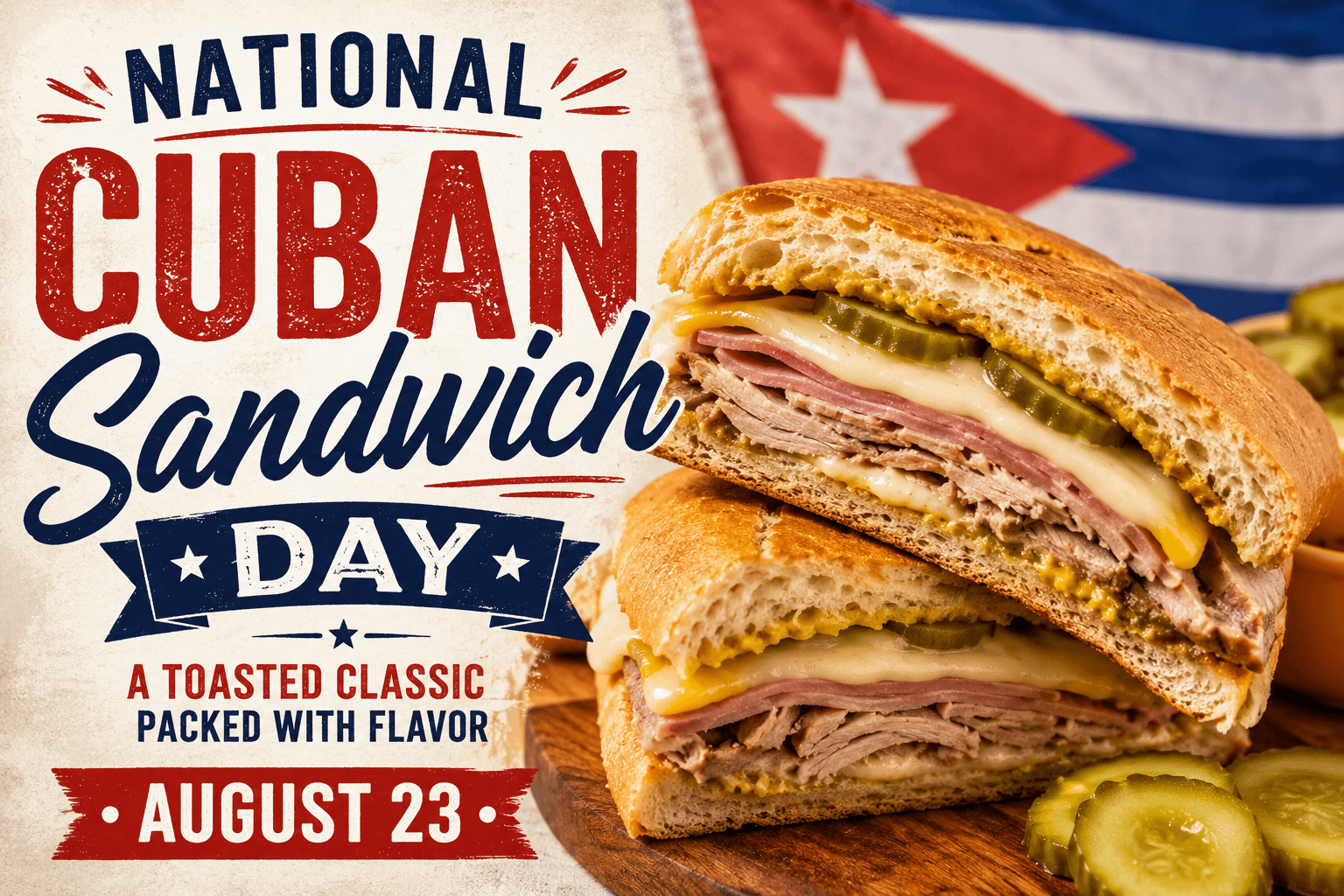
Every year on August 23, sandwich lovers have an especially delicious reason to celebrate: National Cuban Sandwich Day.
Few sandwiches have achieved the cultural recognition of the Cuban sandwich, commonly known as the Cubano. With layers of roasted pork, sliced ham, Swiss cheese, dill pickles, and yellow mustard tucked inside Cuban bread and pressed until hot and crispy, it delivers an impressive combination of salty, savory, tangy, creamy, and crunchy flavors.
But National Cuban Sandwich Day celebrates much more than lunch.
The story of the Cuban sandwich is connected to immigration, working-class communities, Florida history, Cuban culture, and the way food traditions evolve when different cultures come together.
From the historic neighborhoods of Tampa to the Cuban restaurants of Miami and sandwich shops across America, the Cubano has become an enduring favorite.
August 23 is the perfect day to discover its history, make one at home, support a Cuban restaurant, compare regional variations, or simply enjoy one of America’s great sandwiches.
What Is National Cuban Sandwich Day?
National Cuban Sandwich Day is observed each year on August 23 as a celebration of the famous pressed sandwich and the culinary traditions surrounding it.
Like many modern food holidays, the exact beginnings of the observance aren’t as important as what the day has become: an opportunity to appreciate a dish with deep cultural roots.
Restaurants may feature Cuban sandwich specials, home cooks may prepare their own versions, and food lovers can use the occasion to explore Cuban and Cuban-American cuisine.
And unlike some complicated culinary celebrations, participating is wonderfully easy.
All you really need is a Cuban sandwich.
What Exactly Is a Cuban Sandwich?
At first glance, a Cuban sandwich seems simple.
The classic combination generally includes:
- Cuban bread
- Roasted pork
- Sliced ham
- Swiss cheese
- Dill pickles
- Yellow mustard
Depending on where the sandwich is prepared, additional ingredients may appear.
The ingredients are layered inside the bread before the sandwich is pressed and heated until the exterior becomes crisp and golden and the Swiss cheese melts around the warm meat.
That final pressing step is essential.
Without it, you have a very good ham-and-pork sandwich.
With it, you have something entirely different.
The heat and pressure bring everything together. Cheese melts between layers of meat. Mustard spreads throughout the sandwich. The pickles provide acidity and crunch. The bread becomes beautifully toasted while absorbing some of the flavors from the filling.
Every bite offers several different textures and flavors simultaneously.
The Cuban Sandwich Has a Story to Tell
The history of the Cuban sandwich is closely connected with the movement of people between Cuba and Florida.
During the late 19th and early 20th centuries, Cuban immigrants established communities in Florida, including around Tampa and Key West. Tampa’s cigar industry became particularly important, attracting workers from several cultural backgrounds.
Workers needed meals that were convenient, inexpensive, filling, and easy to eat during the workday.
Sandwiches were an obvious solution.
Bread could hold meat, cheese, pickles, and condiments together in a portable meal that required little ceremony.
Over time, combinations of ingredients associated with Cuban communities and Florida’s multicultural population developed into what Americans today recognize as the Cuban sandwich.
The exact origins are debated, which isn’t unusual with foods that evolved naturally within communities rather than being invented by one documented person on one specific day.
What isn’t debated is the sandwich’s deep connection to Florida’s Cuban-American history.
Tampa and the Cuban Sandwich
Tampa plays an especially important role in Cuban sandwich history.
The city’s historic Ybor City neighborhood became famous for its cigar factories and immigrant population. Cuban, Spanish, Italian, and other communities lived and worked alongside one another.
Food naturally reflected those cultural interactions.
One distinctive ingredient became associated with Tampa’s version of the Cuban sandwich:
Genoa salami.
A Tampa-style Cuban sandwich may include:
- Cuban bread
- Ham
- Roasted pork
- Genoa salami
- Swiss cheese
- Pickles
- Mustard
The salami adds another layer of saltiness, richness, and spice.
For Tampa Cuban sandwich enthusiasts, it isn’t an optional novelty. It’s part of the tradition.
Miami and the Cuban Sandwich
Miami has its own strong connection to Cuban culture and Cuban-American cuisine.
Large waves of Cuban immigration during the 20th century profoundly influenced South Florida’s culture, neighborhoods, restaurants, bakeries, coffee shops, and food traditions.
The Miami-style Cuban sandwich generally keeps things somewhat simpler.
It typically contains:
- Roasted pork
- Ham
- Swiss cheese
- Pickles
- Mustard
- Cuban bread
Notice what’s missing?
Salami.
And that’s where the friendly rivalry begins.
Tampa vs. Miami: Which Cuban Sandwich Is Authentic?
Food debates can become surprisingly serious, and the Cuban sandwich is no exception.
Tampa supporters point toward the city’s early Cuban communities and cigar-industry history.
Miami supporters point toward South Florida’s enormous Cuban population and generations of Cuban-American culinary tradition.
Then comes the biggest question:
Does salami belong on a Cuban sandwich?
In Tampa, the answer is often an enthusiastic yes.
In Miami, the answer is frequently no.
Instead of trying to declare one city the permanent winner, National Cuban Sandwich Day provides a much more enjoyable solution:
Try both.
Food traditions evolve differently depending on the communities preparing them. Regional variations don’t necessarily erase tradition; sometimes they become traditions of their own.
That makes the Tampa-versus-Miami debate part of what makes the Cuban sandwich so interesting.
Why Cuban Bread Is So Important
Bread might appear to be merely the container holding everything together, but with a Cuban sandwich, it is one of the most important ingredients.
Traditional Cuban bread is generally long and relatively narrow, with a thin crust and soft, airy interior.
Fresh Cuban bread has a distinctive texture that works perfectly for pressing.
Once heated, the exterior becomes crisp while the interior remains tender enough to absorb flavors from the pork, cheese, mustard, and other ingredients.
The bread shouldn’t overwhelm the filling.
Instead, it should provide structure and texture while allowing the meats, cheese, pickles, and mustard to remain the stars.
If you live somewhere without Cuban bakeries, authentic Cuban bread can be difficult to find.
A quality French or Italian loaf can serve as a substitute.
It won’t create exactly the same sandwich, but it can still produce an excellent homemade Cubano.
The Importance of Roasted Pork
Ham is delicious.
Swiss cheese is essential.
Pickles and mustard provide the tang.
But roasted pork may be the ingredient that gives the Cuban sandwich its soul.
A beautifully seasoned pork roast creates tenderness, richness, and depth that ordinary deli meat simply can’t duplicate.
Many Cuban-inspired pork recipes use flavors associated with mojo, which often combines citrus, garlic, herbs, and spices.
Common ingredients may include:
- Sour orange juice
- Lime juice
- Orange juice
- Fresh garlic
- Oregano
- Cumin
- Olive oil
- Salt
- Black pepper
The pork is marinated and roasted until flavorful and tender.
Once cooled enough to handle, it can be sliced thinly for sandwiches.
If sour oranges aren’t readily available, combining orange juice with lime juice can help create a similar sweet-tart citrus profile.
Why Pickles Matter More Than You Think
It would be easy to dismiss pickles as a minor topping.
They’re not.
The meats and cheese in a Cuban sandwich are rich and salty. Without something acidic to cut through that richness, the sandwich could become heavy.
Dill pickles solve that problem beautifully.
They bring acidity, crunch, saltiness, and freshness.
Every bite of pickle resets your palate just enough to make the next bite of pork, ham, and melted cheese taste exciting again.
That’s why leaving out the pickles changes the character of the sandwich considerably.
Don’t Forget the Mustard
The same principle applies to yellow mustard.
Its sharp acidity contrasts beautifully with the fatty pork, ham, and cheese.
Some people who normally prefer fancy mustards might be tempted to substitute Dijon, honey mustard, or spicy brown mustard.
Experimenting is perfectly fine.
But if you’re trying to experience the traditional Cuban sandwich flavor profile, ordinary yellow mustard is difficult to beat.
Sometimes simple really is better.
Why Swiss Cheese Works
Swiss cheese provides a mild, slightly nutty flavor that complements the stronger flavors around it without overpowering them.
More importantly, it melts beautifully.
When the sandwich is pressed, Swiss cheese softens and melts between the layers of pork and ham, helping bind the ingredients together.
That melted cheese is part of what makes cutting into a freshly pressed Cubano so satisfying.
The Magic Happens When the Sandwich Is Pressed
A Cuban sandwich isn’t merely assembled.
It’s transformed.
Traditionally, the sandwich is heated and compressed using a sandwich press.
The pressure flattens the bread while heat crisps the exterior and melts the cheese.
This changes almost every ingredient.
The bread becomes crunchy.
The pork becomes warm.
The ham develops additional flavor from the heat.
The Swiss cheese melts.
The mustard spreads.
The pickles warm slightly while retaining their acidity.
Instead of tasting separate layers, you begin tasting one cohesive sandwich.
That’s why pressing is such an important part of making a proper Cubano.
Homemade Cuban Sandwich Recipe
Celebrating National Cuban Sandwich Day at home is easier than you might think.
Ingredients
For two large sandwiches:
- 1 loaf Cuban bread
- 6–8 ounces roasted pork, thinly sliced
- 4–6 ounces sliced ham
- 4 slices Swiss cheese
- Dill pickle slices
- Yellow mustard
- Butter, optional
- Genoa salami, optional for Tampa style
Instructions
Step 1: Prepare the bread
Cut your Cuban bread into sandwich-sized sections.
Slice each piece horizontally without completely crushing the soft interior.
Step 2: Spread the mustard
Spread yellow mustard across the inside of the bread.
Don’t be afraid to use enough to taste it. The mustard needs to stand up against several layers of meat and cheese.
Step 3: Add the ham
Layer sliced ham evenly across the sandwich.
Avoid piling everything into the center. Even distribution helps create the perfect bite from beginning to end.
Step 4: Add the roasted pork
Place thin slices of seasoned roasted pork over the ham.
If the pork has been refrigerated, allowing it to come closer to room temperature before assembling the sandwich can help everything heat evenly.
Step 5: Add salami if desired
Making a Tampa-inspired version?
Now is the time to add Genoa salami.
Making a Miami-inspired version?
Skip it.
Step 6: Add Swiss cheese
Arrange the cheese so that it covers most of the meat.
This helps create melted cheese throughout the sandwich.
Step 7: Add pickles
Place dill pickle slices evenly across the cheese.
You want pickle flavor in nearly every bite.
Step 8: Close the sandwich
Place the top portion of bread over the ingredients and gently press it together.
Step 9: Press and cook
Heat a sandwich press or panini maker.
Place the sandwich inside and cook until the bread is golden and crisp and the cheese has melted.
Don’t have a sandwich press?
No problem.
Place the sandwich in a heated skillet and put another heavy skillet on top. Press gently while cooking, then carefully flip the sandwich and repeat.
Step 10: Slice and serve
Remove the sandwich once the bread is crisp and the cheese is melted.
Cut diagonally and serve immediately.
Make Your Own Mojo-Style Pork
If you want to take your homemade Cuban sandwich to another level, prepare the pork yourself.
A simple marinade can combine:
- Orange juice
- Lime juice
- Olive oil
- Minced garlic
- Oregano
- Ground cumin
- Salt
- Black pepper
Marinate a pork shoulder or pork roast for several hours or overnight.
Slow-roast it until tender.
Allow it to rest before slicing.
Not only will you have incredible pork for your Cuban sandwiches, but leftover pork can be used for tacos, rice bowls, salads, breakfast dishes, and other meals.
What Goes Well With a Cuban Sandwich?
A Cubano is substantial enough to be a meal by itself, but adding a side makes the experience even better.
Consider pairing your sandwich with:
- Plantain chips
- Fried plantains
- Yuca fries
- French fries
- Sweet potato fries
- Black beans
- Rice and beans
- Potato chips
- Dill pickles
- Coleslaw
- Fresh fruit
- Green salad
- Corn salad
If you’re serving Cuban sandwiches for a gathering, consider offering several sides so guests can create their own plates.
Drinks to Serve With Your Cubano
The sandwich’s rich and salty flavors pair especially well with cold, refreshing drinks.
Nonalcoholic possibilities include:
- Fresh limeade
- Lemonade
- Iced tea
- Sparkling water with lime
- Pineapple juice
- Mango juice
- Guava nectar
- Cuban coffee after the meal
A strong Cuban-style coffee can be a particularly memorable way to finish the meal.
Turn August 23 Into Cuban Sandwich Night
National Cuban Sandwich Day doesn’t have to be something you celebrate alone.
Turn it into dinner with family or friends.
Prepare roasted pork ahead of time and create a sandwich-building station containing bread, ham, pork, Swiss cheese, mustard, pickles, and salami.
Everyone can build their preferred version.
Then press the sandwiches individually and serve them hot.
Add plantain chips, rice and beans, or another favorite side.
You now have a simple themed dinner centered around both food and history.
Hold a Tampa vs. Miami Taste Test
Want to make the celebration even more entertaining?
Create two Cuban sandwiches.
Make the first using:
Pork + Ham + Swiss + Pickles + Mustard
Then make another using:
Pork + Ham + Salami + Swiss + Pickles + Mustard
Cut both into small tasting portions.
Don’t tell everyone which is which.
Have friends or family taste each sandwich and vote for their favorite.
Team Miami or Team Tampa?
You might not settle the historical debate, but you’ll probably enjoy trying.
Support a Local Cuban Restaurant
National food days are also opportunities to support restaurants and small businesses.
Instead of making your sandwich at home, search for a Cuban restaurant, bakery, café, food truck, or sandwich shop in your community.
Order a Cuban sandwich and perhaps try another Cuban dish you’ve never had before.
Ask how the restaurant prepares its Cubano.
Does it include salami?
What type of bread do they use?
How is the pork seasoned?
You may discover that each restaurant has its own small variation while maintaining the sandwich’s recognizable identity.
Cuban Sandwich Variations
Once a dish becomes popular, experimentation is inevitable.
Today you’ll find plenty of creative interpretations.
Some restaurants and home cooks create:
Cuban sliders using small rolls for parties.
Cuban grilled cheese with extra melted cheese.
Cuban quesadillas using tortillas instead of bread.
Cuban flatbreads inspired by the sandwich’s toppings.
Cuban breakfast sandwiches featuring eggs alongside pork and ham.
Cuban-style burgers incorporating pickles, mustard, ham, pork, and Swiss cheese.
Cuban sandwich pizza using traditional Cubano ingredients as toppings.
These aren’t replacements for the classic sandwich, but they demonstrate how influential its flavor combination has become.
What Makes the Cuban Sandwich So Good?
Part of the answer comes down to balance.
Consider what happens in a single bite.
You have:
Richness from roasted pork.
Saltiness from ham.
Creaminess from melted Swiss cheese.
Acidity from pickles.
Tanginess from mustard.
Crunch from pressed bread.
Tenderness from slow-roasted pork.
Many successful dishes work because they combine contrasting flavors and textures.
The Cubano does exactly that.
Remove one of those components and you’ll notice the difference.
Together, however, they produce something remarkably satisfying.
A Sandwich Built for Sharing
Another reason Cuban sandwiches remain popular is their simplicity.
You don’t need formal dining.
You don’t need expensive ingredients.
You don’t need complicated plating.
A Cubano can be wrapped in paper, cut in half, and enjoyed practically anywhere.
That working-class simplicity remains part of its charm.
It’s food meant to satisfy hunger while delivering enormous flavor.
Food Is a Connection to History
Food can tell us where people traveled, where they settled, who they lived alongside, and which traditions they carried with them.
Recipes rarely remain frozen in time.
They travel.
They change.
They absorb new influences.
They become associated with neighborhoods and cities.
Eventually, dishes that began within specific communities can become familiar far beyond those communities.
The Cuban sandwich is an excellent example.
Its story reflects generations of cultural exchange between Cuba, Florida, immigrant communities, restaurants, bakeries, workers, and families.
When we celebrate a dish like the Cubano, we’re also acknowledging the people and communities who helped shape it.
Interesting Cuban Sandwich Facts
Here are a few things that make the sandwich especially interesting:
It has strong Florida connections. Tampa and Miami are both deeply associated with Cuban sandwich culture.
Tampa traditionally adds salami. This remains one of the most famous regional differences.
Pressing is essential. Heat and pressure give the Cubano its signature texture.
Cuban bread matters. Its light interior and crispable crust make it ideal for the sandwich.
Pickles aren’t just decoration. Their acidity helps balance rich meats and cheese.
Mustard provides contrast. The sharp flavor cuts through the richness of the sandwich.
Regional arguments are part of the fun. Tampa versus Miami remains an enduring conversation among Cuban sandwich enthusiasts.
Ways to Celebrate National Cuban Sandwich Day
There are plenty of ways to enjoy August 23.
You can:
- Order a Cuban sandwich from a local Cuban restaurant.
- Make traditional Cuban sandwiches at home.
- Prepare homemade mojo pork.
- Compare Tampa and Miami versions.
- Visit a Cuban bakery.
- Learn about Cuban-American history.
- Try Cuban coffee.
- Introduce someone to their first Cubano.
- Host a Cuban sandwich dinner.
- Share your favorite version on social media.
- Support a locally owned Cuban restaurant or food truck.
The celebration can be as simple as enjoying lunch or as elaborate as preparing an entire Cuban-inspired meal.
National Cuban Sandwich Day Is About Food, Culture, and Community
National food holidays can sometimes seem like they’re simply excuses to eat something delicious.
And admittedly, that’s not a bad reason to celebrate.
But food can also provide an entry point into history.
The Cuban sandwich reminds us that some of America’s most beloved foods were shaped by immigrant communities, workers, families, local businesses, and generations of cultural exchange.
A sandwich made from bread, pork, ham, cheese, mustard, and pickles might look simple.
Its story is anything but.
The Cubano represents the way food travels across borders and generations. It shows how communities preserve traditions while also adapting them to new surroundings.
And perhaps most importantly, it demonstrates one of food’s greatest powers:
Food brings people together.
Celebrate National Cuban Sandwich Day on August 23
On August 23, celebrate National Cuban Sandwich Day by treating yourself to a hot, freshly pressed Cubano.
Find a local Cuban restaurant.
Make one at home.
Try both Tampa and Miami versions.
Learn about the history behind the sandwich.
Share one with somebody who has never experienced it.
And when that crispy Cuban bread gives way to warm roasted pork, salty ham, melted Swiss cheese, tangy mustard, and crunchy pickles, take a moment to appreciate why this sandwich has earned such a passionate following.
Great food doesn’t always need dozens of ingredients or complicated techniques.
Sometimes all you need is good bread, flavorful meat, melted cheese, a few pickles, mustard, and a hot press.
Happy National Cuban Sandwich Day!
Are you Team Tampa with salami, Team Miami without salami, or do you simply love a great Cuban sandwich either way?
Read More Holidays & National Days
Leave a Reply