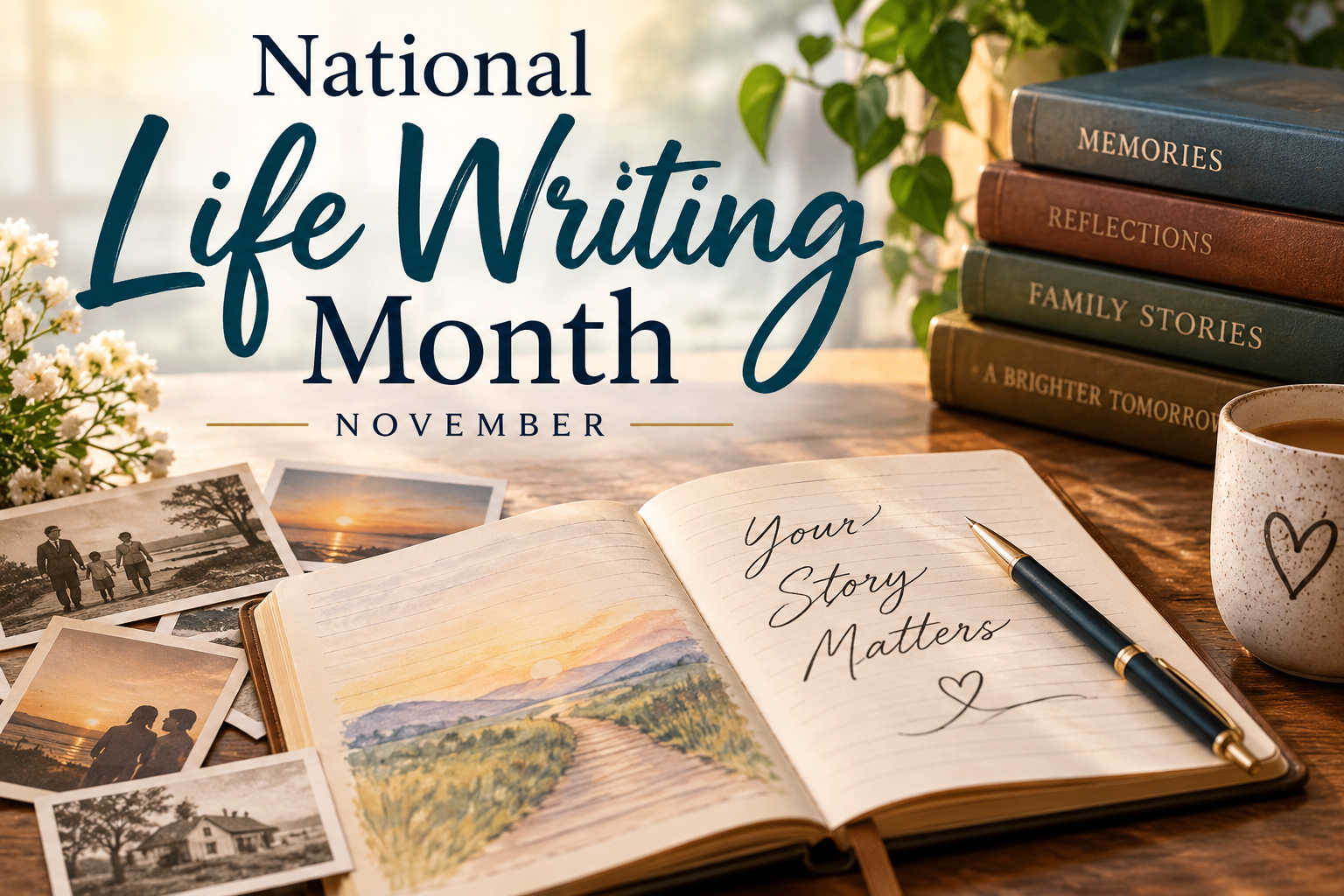
Every person has a story worth telling. Some stories are filled with happiness, adventure, and unforgettable accomplishments. Others are shaped by heartbreak, challenges, personal struggles, and moments that forever change the direction of our lives. Together, these experiences create the story of who we are.
National Life Writing Month, observed throughout November, encourages people to reflect on their experiences, document their memories, and share the stories that have shaped their lives.
You do not have to be a professional writer, a celebrity, or someone who has accomplished extraordinary things to have a meaningful story. Your life matters, your experiences have value, and your words may someday inspire someone who needs to hear them.
Whether you want to write a memoir, preserve family history, honor someone you love, or simply better understand your own journey, National Life Writing Month provides an opportunity to begin.
What Is National Life Writing Month?
National Life Writing Month is a November observance dedicated to encouraging people to write about their lives, experiences, memories, and personal histories.
Life writing is a broad form of storytelling that focuses on real experiences. It includes autobiographies, memoirs, journals, personal essays, family histories, letters, and reflections.
Unlike fictional storytelling, life writing draws from the moments, relationships, challenges, and accomplishments that have shaped a person’s identity.
The purpose is not necessarily to publish a bestselling book. Instead, it is to preserve experiences, explore personal growth, and create a meaningful record of one’s life.
National Life Writing Month reminds us that our stories deserve to be remembered, even when we believe our lives have been ordinary.
Sometimes, the most powerful stories come from everyday people who have experienced extraordinary love, loss, courage, and perseverance.
When Is National Life Writing Month Celebrated?
National Life Writing Month is observed annually from November 1 through November 30.
The month provides an opportunity to dedicate time to writing, reflecting, and preserving memories.
November is also associated with several writing-related activities, making it a fitting time to begin a personal storytelling project.
You can participate by writing a few sentences each day, starting a journal, interviewing family members, or working on a longer memoir.
There are no official rules requiring a certain number of words or a completed manuscript.
The important part is simply beginning.
Why Writing Your Life Story Matters
Many people underestimate the importance of their personal experiences.
They may believe that their lives are not interesting enough to write about or that nobody would want to read their memories.
However, the value of a life story is not measured by fame, wealth, or accomplishments.
It is measured by the experiences, relationships, lessons, and emotions that make someone human.
1. Your Memories Deserve to Be Preserved
Time changes many things.
Places disappear, families grow, traditions evolve, and people we love are no longer physically present.
Memories that once seemed unforgettable can gradually become less detailed.
Writing provides a way to preserve those moments before they fade.
You might remember childhood holidays, your first job, family gatherings, or the day you met someone who changed your life.
These experiences become part of a personal history that future generations may treasure.
2. Your Story Can Help Others
One of the most meaningful reasons to write about your life is the possibility of helping someone else.
Your experiences may provide encouragement to a person facing a similar situation.
Someone struggling with grief might find comfort in reading how another person learned to carry loss.
A person experiencing failure might discover hope through a story about perseverance.
Someone who feels alone might realize that another person understands their emotions.
You never know who may need the words you are afraid to write.
Sometimes, sharing your story becomes the encouragement someone else needs to keep going.
3. Writing Helps You Understand Yourself
Life often moves so quickly that we rarely take time to reflect on everything we have experienced.
Writing encourages us to slow down and examine our memories, decisions, relationships, and personal growth.
You may begin to recognize patterns in your life, appreciate challenges you have overcome, or discover lessons you did not fully understand at the time.
Reflection can provide a clearer perspective on who you were, who you have become, and who you hope to be.
4. Your Story Creates a Legacy
A personal legacy is about more than possessions or accomplishments.
It includes the values you lived by, the people you loved, the lessons you learned, and the memories you leave behind.
Writing allows your children, grandchildren, relatives, and future generations to understand the person behind the photographs.
They can discover what made you laugh, what frightened you, what inspired you, and what mattered most.
Your words can become a connection between generations.
The Emotional Power of Writing About Your Life
Writing about personal experiences can be deeply emotional.
Some memories bring laughter and gratitude. Others reopen feelings of sadness, regret, disappointment, or grief.
This emotional connection is part of what makes life writing meaningful.
When you write about something important, you are doing more than recording an event.
You are acknowledging that the experience mattered.
Writing About Happiness
Happy memories remind us of the beauty that has existed throughout our lives.
You might write about a childhood adventure, a special birthday, a family vacation, or an unexpected act of kindness.
These memories can help preserve moments of joy that might otherwise be forgotten.
Writing About Difficult Times
Not every chapter of life is easy.
Many people experience heartbreak, illness, financial struggles, broken relationships, or the death of someone they love.
Writing about difficult experiences can provide an opportunity to explore emotions and reflect on what those experiences have meant.
For some people, expressive writing can support emotional processing. However, it is not a replacement for professional mental health support, and revisiting painful memories may be overwhelming.
You are allowed to write slowly, take breaks, or leave certain experiences private.
You do not owe anyone the most painful chapters of your life.
Writing About Personal Growth
One of the most powerful parts of life writing is recognizing how much you have changed.
Think about the person you were ten or twenty years ago.
What did you believe?
What dreams did you have?
What challenges seemed impossible?
What have you learned since then?
Writing about personal growth allows you to recognize the strength, wisdom, and resilience you have developed through experience.
Writing About Grief, Loss, and the People We Love
For those who have experienced the death of someone they love, life writing can take on an especially personal meaning.
When someone dies, we do not simply lose their physical presence. We also lose the opportunity to create new memories with them.
Writing offers a way to preserve the memories that already exist.
A grieving parent might write about their child’s childhood, personality, favorite activities, accomplishments, and the countless little moments that made their relationship special.
A grieving spouse might document the story of a marriage, from the first meeting to the everyday experiences that created a lifetime of love.
Someone mourning a parent might write down family traditions, conversations, advice, and memories that deserve to be passed along.
These stories are not just about death.
They are about life, love, and the relationships that continue to matter.
Writing someone’s story is one way of keeping their memory present in the world.
For a parent who has lost a child, putting memories into words can become a meaningful act of love.
It allows the world to know that the child lived, was loved, and made a difference.
Writing cannot bring someone back or erase the pain of their absence. But it can preserve their name, their personality, and the impact they made.
Sometimes, a simple memory written down today becomes something precious years later.
Different Types of Life Writing
There is no single correct way to document your life.
The best approach depends on your personality, interests, and what you hope to accomplish.
Autobiography
An autobiography generally tells the story of someone’s life from childhood through later experiences.
It often follows a chronological structure and includes important milestones, relationships, challenges, and accomplishments.
Memoir
A memoir focuses on a particular period, relationship, experience, or theme rather than an entire lifetime.
Examples might include overcoming adversity, raising a family, navigating grief, or rebuilding life after a major change.
Personal Journaling
Journaling allows you to record everyday experiences, thoughts, emotions, and observations.
It does not require a formal structure or polished writing.
Even a few sentences each day can create a valuable record over time.
Family History
Family history writing preserves information about relatives, traditions, ancestors, and experiences shared across generations.
It may include interviews, photographs, letters, recipes, and family stories.
Letters and Personal Reflections
Letters can be written to children, grandchildren, loved ones, or even your younger self.
Some people write letters to loved ones who have passed away as a way to express thoughts they still wish to share.
These personal reflections can become some of the most meaningful forms of life writing.
How to Start Writing Your Life Story
Beginning can feel intimidating, especially when you are unsure where to start.
Fortunately, you do not need an outline, a publishing contract, or years of writing experience.
You only need a memory and a willingness to put it into words.
Step 1: Start With One Memory
Do not attempt to write your entire life story in one sitting.
Choose one meaningful moment.
It might be your earliest childhood memory, your first day of school, the birth of your child, or a conversation you have never forgotten.
Describe what happened, who was there, and why the memory remains important.
Step 2: Write Naturally
You do not need complicated vocabulary or perfect grammar.
Write the way you would tell the story to someone sitting across from you.
Your authentic voice is more important than sounding like a professional author.
Step 3: Include the Details
Small details bring memories to life.
Consider the sounds, smells, surroundings, weather, conversations, and emotions associated with an experience.
Instead of simply writing that you enjoyed family dinners, describe the food, laughter, conversations, and people gathered around the table.
Step 4: Be Honest With Yourself
Meaningful life writing does not require pretending that everything was perfect.
It is okay to acknowledge mistakes, regrets, disappointments, and difficult decisions.
You can also recognize accomplishments, kindness, love, and personal victories.
Your story becomes more authentic when you allow yourself to be human.
Step 5: Write Consistently
You do not need to spend hours writing every day.
Try setting aside ten to fifteen minutes.
A small writing habit can gradually produce a collection of meaningful stories.
Step 6: Decide What to Share
Not every personal memory needs to become public.
Some stories are meant for family members, while others may remain private.
You control which experiences you share and how much detail you include.
If your writing involves other living people, consider their privacy and how your account may affect them.
30 Life Writing Prompts for November
If you want to participate in National Life Writing Month but are unsure what to write, use these daily prompts.
| Day | Writing Prompt |
|---|---|
| 1 | What is your earliest childhood memory? |
| 2 | Describe the home where you grew up. |
| 3 | Who had the greatest influence on your childhood? |
| 4 | What is one family tradition you remember fondly? |
| 5 | Describe your first close friendship. |
| 6 | What was your favorite childhood activity? |
| 7 | Write about a teacher who made a difference. |
| 8 | What was your first job, and what did it teach you? |
| 9 | Describe a moment when you felt proud of yourself. |
| 10 | What is one mistake that taught you an important lesson? |
| 11 | Write about someone who changed your life. |
| 12 | What is one adventure you will never forget? |
| 13 | Describe a holiday memory that still makes you smile. |
| 14 | What was one of the biggest challenges you faced? |
| 15 | Write about a time when someone showed you kindness. |
| 16 | What does family mean to you? |
| 17 | Describe a moment when your life changed unexpectedly. |
| 18 | What advice would you give your younger self? |
| 19 | Write about someone you miss. |
| 20 | What is a lesson you learned about love? |
| 21 | Describe a time when you had to find courage. |
| 22 | What accomplishment means the most to you? |
| 23 | Write about a place that holds special memories. |
| 24 | What are you most grateful for today? |
| 25 | Describe a person whose memory you want to preserve. |
| 26 | What dream have you pursued or hope to pursue? |
| 27 | How have you changed over the past ten years? |
| 28 | What do you want future generations to know about you? |
| 29 | What is one story you have never told? |
| 30 | What would you like the next chapter of your life to look like? |
By the end of November, you could have thirty personal reflections that form the foundation of a memoir, family history, or personal journal.
How Families Can Celebrate National Life Writing Month Together
National Life Writing Month can also become a meaningful family activity.
Families often have stories that are passed down through conversations, but many of those memories are never recorded.
Consider gathering relatives and asking them to share experiences from different periods of their lives.
Grandparents might describe what childhood was like decades ago.
Parents could share stories about raising their children, important family milestones, or lessons they learned.
Children might write about their favorite memories, friendships, or dreams for the future.
You could create a family memory book that includes written stories, photographs, recipes, and letters.
Recording interviews can also help preserve voices and stories, with everyone’s permission.
These activities create opportunities for connection while building something that future generations can appreciate.
Can Writing Your Life Story Help With Healing?
Writing about personal experiences can be meaningful during periods of emotional difficulty.
When life feels overwhelming, putting thoughts into words may help some people identify feelings, organize memories, and understand their experiences.
For someone grieving, writing may offer a private space to remember a loved one or express emotions that are difficult to discuss.
For someone rebuilding after a difficult relationship, writing may help them reflect on personal boundaries, growth, and hopes for the future.
For others, writing may simply provide a quiet opportunity to reflect.
However, healing is not a guaranteed outcome of writing, and there is no requirement to turn painful experiences into inspirational lessons.
Some experiences remain difficult, even after many years.
Your story does not need a perfect ending to be worth telling.
Common Challenges When Writing About Your Life
Even people who enjoy writing sometimes struggle when documenting personal experiences.
Feeling that your story is not interesting: Remember that everyday experiences often become meaningful through the emotions and relationships connected to them.
Not knowing where to begin: Start with a single memory rather than attempting to organize your entire life.
Worrying about grammar: Focus on getting your thoughts onto the page. Editing can happen later.
Experiencing difficult emotions: Take breaks when needed and avoid forcing yourself to revisit painful experiences before you feel ready.
Being afraid of judgment: Begin with private writing. You can decide later whether anyone else will read it.
Struggling to remember details: Use photographs, letters, music, and conversations with relatives to help recall events. Be comfortable acknowledging when a memory is uncertain.
The goal is not perfection.
The goal is to give your experiences a place where they can be remembered.
How to Preserve Your Life Writing for Future Generations
Once you begin documenting your memories, consider how you want to preserve them.
Handwritten journals can become treasured family keepsakes.
Digital documents make it easier to organize, revise, and back up stories.
Printed memoirs allow family members to hold a physical record of your experiences.
You might also create a collection of letters for your children or grandchildren.
For digital writing, maintain backup copies in more than one secure location.
If your stories include sensitive information, decide who should have access to them.
A well-preserved life story can become a gift that continues long after the original writer is gone.
Why Your Story Matters Even If You Never Publish It
One of the biggest misconceptions about writing is that a story only matters if it reaches a large audience.
That simply is not true.
A journal nobody else reads can still help you reflect on your life.
A letter written to a child can become a treasured memory.
A collection of family stories can help relatives understand where they came from.
A personal reflection may help you recognize how far you have traveled through life’s challenges.
Your writing does not need thousands of readers to have meaning.
Sometimes, reaching one person is enough.
And sometimes, the person who benefits most from your words is you.
National Life Writing Month: A Reminder That Every Life Has Meaning
Every life contains moments worth remembering.
There are stories of love, laughter, friendship, courage, sacrifice, disappointment, forgiveness, and hope.
There are people who helped shape who we became and experiences that changed how we see the world.
Some chapters are filled with happiness.
Others are marked by pain we never expected to experience.
Yet every chapter contributes to the larger story of our lives.
National Life Writing Month reminds us that these experiences deserve recognition.
We do not have to wait until we are older, more successful, or more accomplished to begin writing.
We can start today.
A few sentences can become a paragraph. A paragraph can become a chapter. A chapter can become a collection of memories that lasts for generations.
And even if those words are never published, they still matter.
Final Thoughts: Your Life Is a Story Worth Telling
National Life Writing Month is more than a celebration of writing. It is a celebration of the lives, relationships, and experiences that make each person unique.
It encourages us to look beyond our daily routines and recognize the significance of the moments we have lived.
Writing gives us an opportunity to preserve happiness, acknowledge heartbreak, honor loved ones, and share lessons that might help someone else.
For those who have experienced loss, it can also provide a way to keep precious memories alive and ensure that the people we love are never reduced to the circumstances of their passing.
You do not need to have lived a perfect life to write a meaningful story.
You only need to have lived.
Your memories matter. Your experiences matter. Your voice matters. And your story deserves to be told.
This November, consider setting aside a little time to write something about your life.
You never know how much those words may mean to someone someday.
What is one memory, experience, or person from your life that you would want future generations to remember?


Leave a Reply