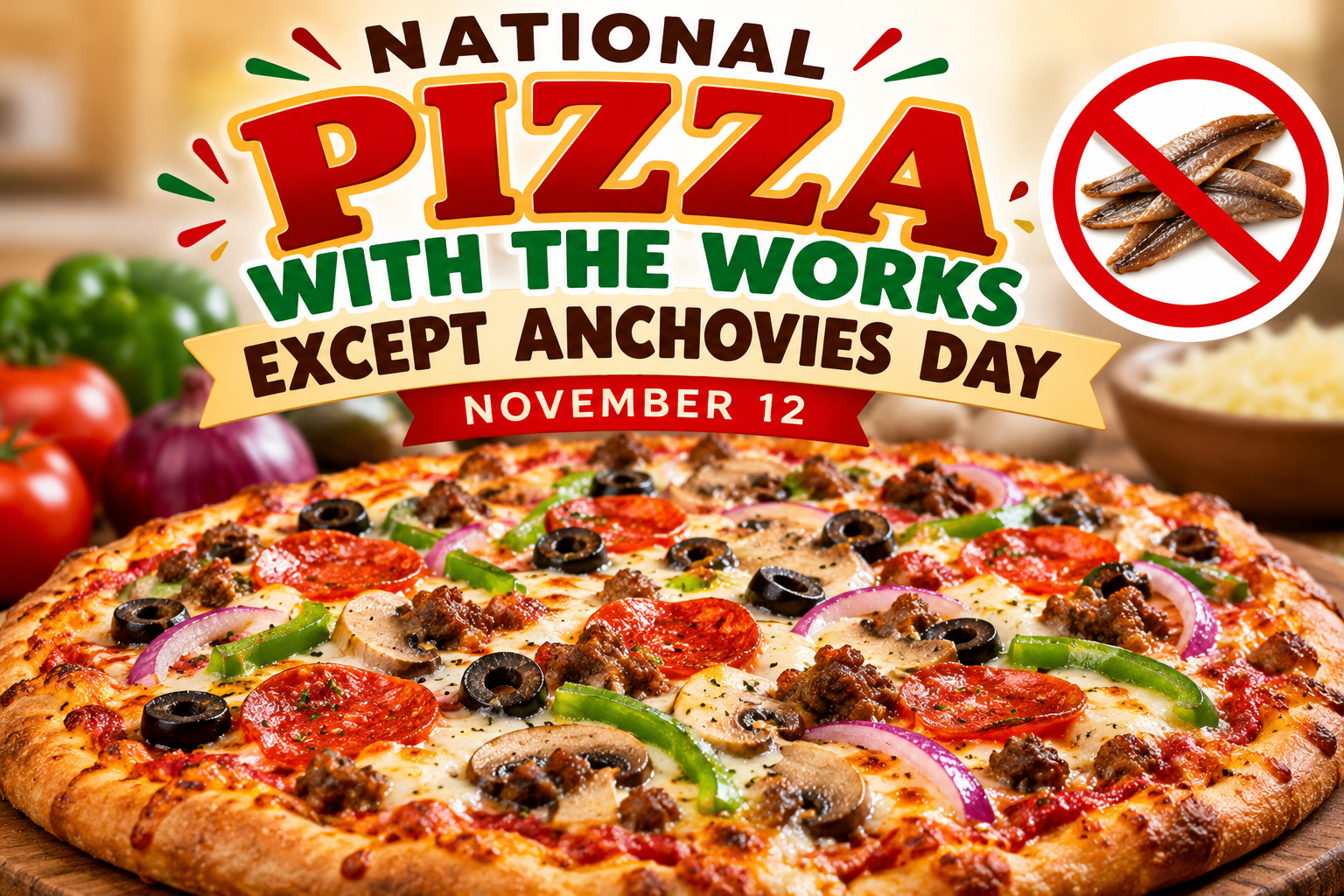
Every year on November 12, pizza lovers across the United States celebrate one of the most deliciously specific food holidays on the calendar: National Pizza with the Works Except Anchovies Day. This fun and flavorful observance is dedicated to enjoying a pizza piled high with your favorite toppings, with one notable exception: anchovies.
Whether you love pepperoni, sausage, mushrooms, onions, bell peppers, olives, or extra cheese, this unofficial national food holiday encourages you to embrace the wonderful variety of ingredients that make pizza one of America’s favorite meals.
Pizza has long been more than just food. It brings families together, makes parties more enjoyable, and creates opportunities for friends to share a meal. National Pizza with the Works Except Anchovies Day celebrates that experience by encouraging everyone to enjoy a fully loaded pizza made just the way they like it.
But where did this unusual holiday come from? Why are anchovies specifically excluded? And what makes a pizza with the works so irresistible?
Let’s explore the history, traditions, flavors, and fun ways to celebrate National Pizza with the Works Except Anchovies Day.
When Is National Pizza with the Works Except Anchovies Day?
National Pizza with the Works Except Anchovies Day is celebrated annually on November 12.
Unlike National Pizza Day, which takes place on February 9, this particular observance focuses on a specific style of pizza: one loaded with a generous assortment of toppings but without anchovies.
It is an informal food holiday rather than an official federal observance. Its precise origins are not well documented, but it has become a familiar entry on many national food holiday calendars.
The holiday gives pizza enthusiasts an excuse to order their favorite combination pizza, experiment with homemade creations, or gather with loved ones for a pizza night.
And the best part? There are no strict rules about which toppings qualify as “the works.”
As long as your pizza is generously topped and leaves off the anchovies, you’re ready to celebrate.
What Does Pizza with the Works Mean?
When someone orders a pizza “with the works,” they generally mean a pizza loaded with a variety of toppings.
Depending on the restaurant, this might be called a supreme pizza, combination pizza, deluxe pizza, or everything pizza.
Although ingredients vary by location, a traditional pizza with the works often includes:
-
Pepperoni
-
Italian sausage
-
Mushrooms
-
Green bell peppers
-
Onions
-
Black olives
-
Mozzarella cheese
-
Tomato pizza sauce
-
Additional toppings such as bacon, ham, or extra vegetables
The combination creates a pizza filled with savory meats, colorful vegetables, melted cheese, and rich flavors.
Each bite offers something different, making this style of pizza especially appealing to people who enjoy variety.
Of course, the one topping intentionally left off for this holiday is anchovies.
Why Are Anchovies Excluded?
One of the most entertaining aspects of National Pizza with the Works Except Anchovies Day is its very specific rejection of anchovies.
Anchovies are small, saltwater fish commonly preserved in salt or oil. They have a strong, salty flavor that can add a distinctive savory taste to food.
While anchovies are popular in certain Mediterranean dishes and traditional Italian preparations, they have long been a divisive pizza topping.
Some pizza enthusiasts appreciate their intense flavor, while others find them overpowering.
Their strong aroma and salty taste can dominate the other ingredients on a pizza, especially when several anchovies are used.
The holiday humorously recognizes this divide by encouraging people to enjoy nearly every popular pizza topping except anchovies.
However, anchovy lovers shouldn’t feel left out. The celebration is intended to be lighthearted, and personal pizza preferences are always worth respecting.
After all, the beauty of pizza is that everyone can customize it.
The History of Pizza: From Italy to American Dinner Tables
To appreciate National Pizza with the Works Except Anchovies Day, it helps to understand how pizza became one of the world’s most beloved foods.
Pizza’s Early Beginnings
The idea of topping flatbread with various ingredients dates back thousands of years.
Ancient civilizations, including the Greeks and Romans, enjoyed forms of flatbread seasoned with herbs, oils, and other ingredients.
However, the pizza we recognize today developed primarily in Naples, Italy.
During the 18th and 19th centuries, Naples became known for inexpensive flatbreads topped with ingredients such as tomatoes, garlic, oil, and cheese.
These early pizzas were especially popular among working-class residents because they were affordable, filling, and easy to eat.
The Rise of Neapolitan Pizza
Naples played a central role in transforming pizza into a recognizable dish.
Traditional Neapolitan pizza features a relatively thin center, a soft crust, tomato sauce, and simple, high-quality ingredients.
One famous variety is Pizza Margherita, typically made with tomatoes, mozzarella, and basil.
Its colors resemble the Italian flag, making it an enduring symbol of Italian culinary tradition.
Although a popular legend connects its creation to Queen Margherita in 1889, historians have questioned parts of that familiar origin story.
Pizza Arrives in America
Italian immigrants helped introduce pizza to the United States during the late 19th and early 20th centuries.
Pizza gained popularity in cities with large Italian American communities, particularly New York City.
One of America’s earliest well-known pizzerias, Lombardi’s in New York, traces its beginnings to 1905.
Over time, pizza spread beyond Italian neighborhoods and became a mainstream American favorite.
Following World War II, the growth of restaurants, frozen foods, and pizza delivery helped make pizza increasingly accessible.
Americans also began experimenting with different crusts, sauces, cheeses, and toppings.
These innovations eventually contributed to the creation of the heavily topped combination pizzas celebrated on November 12.
How Supreme Pizza Became an American Favorite
Traditional Italian pizza often emphasizes a few carefully selected ingredients.
American pizza culture, however, developed an enthusiasm for larger portions, abundant toppings, and creative combinations.
The supreme pizza became a natural expression of that approach.
Rather than choosing between meat and vegetables, customers could enjoy both.
Pepperoni provided a smoky, slightly spicy flavor. Sausage added richness. Mushrooms contributed an earthy taste, while onions and bell peppers supplied sweetness and texture.
Black olives brought a salty contrast, and mozzarella helped unite the ingredients.
The result was a pizza that offered a little bit of everything.
Today, supreme and combination pizzas are common menu offerings at independent pizzerias and major pizza chains.
While recipes differ, the central idea remains the same: a satisfying pizza featuring several complementary toppings.
How to Make the Ultimate Pizza with the Works Except Anchovies
One of the best ways to celebrate this holiday is by preparing a homemade loaded pizza.
Making your own allows you to choose the crust, control the toppings, and customize every detail.
Recipe details
35–45 min
Approx. total
3–4
Servings
Easy
Difficulty
Ingredients
For one large pizza, you’ll need:
-
1 large prepared pizza dough
-
¾ cup pizza sauce
-
2 cups shredded mozzarella cheese
-
½ cup sliced pepperoni
-
½ cup cooked Italian sausage
-
½ cup sliced mushrooms
-
½ cup diced green bell peppers
-
¼ cup sliced red onions
-
¼ cup sliced black olives
-
¼ cup cooked and crumbled bacon (optional)
-
1 tablespoon olive oil
-
½ teaspoon dried oregano
-
¼ teaspoon garlic powder
-
Crushed red pepper flakes (optional)
-
Fresh basil or grated Parmesan for garnish
And, naturally, no anchovies.
Step-by-Step Instructions
Step 1: Preheat the Oven
Preheat your oven to 475°F, or follow the temperature instructions provided with your pizza dough.
If you’re using a pizza stone, allow it to heat thoroughly before baking.
Step 2: Prepare the Dough
Lightly flour a clean surface and stretch or roll your pizza dough into a large circle.
Transfer it to a pizza pan or parchment-lined baking sheet suitable for the oven temperature.
Brush the outer edge with olive oil for a golden crust.
Step 3: Add the Sauce
Spread the pizza sauce evenly across the dough, leaving a small border around the edges.
Avoid adding too much sauce because a heavily topped pizza already contains plenty of moisture.
Step 4: Add the Cheese
Sprinkle the shredded mozzarella over the sauce.
The cheese helps create a delicious foundation for the toppings.
Step 5: Load Up the Toppings
Distribute the cooked sausage, pepperoni, mushrooms, bell peppers, onions, olives, and optional bacon evenly across the pizza.
Try to spread the ingredients rather than piling them in the center.
This helps the pizza cook evenly.
Step 6: Add Seasonings
Sprinkle oregano and garlic powder over the toppings.
Add crushed red pepper flakes if you enjoy a little heat.
Step 7: Bake the Pizza
Bake for approximately 12–18 minutes, depending on the dough thickness and oven.
The pizza is ready when the crust is golden brown, the cheese is bubbling, and the center of the dough is fully cooked.
Step 8: Slice and Enjoy
Allow the pizza to rest for a few minutes before slicing.
Garnish with fresh basil or Parmesan if desired.
Serve hot and enjoy your homemade pizza with the works, except anchovies.
Tips for Making the Perfect Loaded Pizza
A pizza with several toppings can be delicious, but adding too many ingredients without proper preparation can result in a soggy crust.
A few simple techniques can make a major difference.
1. Avoid Overloading the Center
Spread ingredients evenly across the entire pizza.
A large pile of toppings in the middle can prevent the crust from cooking properly.
2. Cook Raw Meat Before Adding It
Italian sausage, bacon, and other raw meats should be fully cooked before being placed on the pizza.
This improves food safety and prevents excess grease from collecting during baking.
3. Remove Excess Moisture
Mushrooms, tomatoes, and certain vegetables release water as they cook.
Patting ingredients dry or briefly sautéing moisture-heavy vegetables can help keep the crust crisp.
4. Use Quality Cheese
Mozzarella is a classic choice because it melts beautifully and has a mild flavor.
For additional richness, combine mozzarella with provolone or Parmesan.
5. Experiment with the Crust
Thin crust, traditional hand-tossed dough, and thick pan-style pizza all work well with loaded toppings.
Choose whichever style you enjoy most.
Creative Pizza with the Works Variations
National Pizza with the Works Except Anchovies Day is also an opportunity to explore creative combinations.
Meat Lover’s Supreme
For those who prefer a protein-packed pizza, combine pepperoni, sausage, bacon, ham, and mozzarella.
Add onions or peppers for a little extra flavor.
Garden Vegetable Supreme
Skip the meat and load your pizza with mushrooms, spinach, bell peppers, red onions, olives, tomatoes, and roasted garlic.
This colorful variation highlights the natural flavors of vegetables.
Spicy Supreme Pizza
Add jalapeños, spicy Italian sausage, pepperoni, red onions, and crushed red pepper.
A drizzle of hot honey after baking can provide a sweet contrast.
BBQ Chicken Supreme
Replace traditional tomato sauce with barbecue sauce.
Top with cooked chicken, red onions, bell peppers, mozzarella, and a little smoked Gouda.
Mediterranean Supreme
Combine spinach, roasted red peppers, olives, artichoke hearts, feta cheese, and mozzarella.
This variation offers bold Mediterranean-inspired flavors without anchovies.
Fun Facts About Pizza
Pizza has a fascinating history and continues to inspire creativity around the world.
Here are several interesting facts to share on National Pizza with the Works Except Anchovies Day.
1. Pizza originated in its modern form in Naples, Italy.
Although topped flatbreads existed much earlier, Naples played a defining role in developing modern pizza.
2. Pepperoni is an American-style topping.
Despite its Italian-sounding name, the familiar pepperoni used on American pizzas developed within Italian American food culture.
3. Hawaiian pizza was created in Canada.
Sam Panopoulos is widely credited with introducing the ham-and-pineapple combination at a restaurant in Ontario in 1962.
4. Pizza comes in many regional styles.
New York-style, Chicago deep-dish, Detroit-style, and Neapolitan pizza all have distinct characteristics.
5. Anchovies are traditionally used in some Italian pizzas.
Although excluded from this holiday, anchovies have a legitimate place in several Italian pizza traditions.
6. Pizza can be made with countless topping combinations.
From classic mozzarella and basil to barbecue chicken and roasted vegetables, the possibilities are nearly endless.
7. Pizza is a popular food for gatherings.
Its shareable format makes it convenient for birthdays, sporting events, movie nights, and family celebrations.
8. Pizza tastes different depending on the cooking method.
Wood-fired ovens, conventional ovens, and specialized pizza ovens create different textures and flavors.
9. Mozzarella is a traditional pizza cheese.
Its mild taste and melting properties make it especially suitable for pizza.
10. Pizza can be enjoyed for almost any meal.
While commonly served for lunch or dinner, leftover pizza has also become a familiar breakfast choice.
Fun Ways to Celebrate National Pizza with the Works Except Anchovies Day
There are plenty of ways to enjoy this delicious observance, whether you’re celebrating alone, with family, or with friends.
Host a Pizza Night
Invite friends or family members over for a homemade pizza party.
Set up a topping station with pepperoni, sausage, mushrooms, olives, onions, peppers, and several cheese options.
Allow everyone to create their own version of a supreme pizza.
The only rule for the holiday is to leave off the anchovies.
Support a Local Pizzeria
Visit a neighborhood pizza restaurant and order its supreme, deluxe, or combination pizza.
Local pizzerias often have their own signature topping combinations, making this a great opportunity to try something new.
Try a New Pizza Topping
Use the holiday as an excuse to experiment.
Consider roasted garlic, caramelized onions, artichokes, fresh basil, or smoked mozzarella.
You might discover a new favorite combination.
Have a Pizza-Making Competition
Challenge friends or family members to create the best loaded pizza.
Everyone can vote on categories such as best flavor, most creative toppings, and best presentation.
This can be an especially entertaining activity for families with children.
Share Your Pizza on Social Media
Take a picture of your favorite loaded pizza and share it with friends.
Ask others what they would include on their ultimate pizza with the works.
A simple food discussion can quickly turn into a lively debate about toppings.
What to Serve with Supreme Pizza
Although pizza can easily be a complete meal, pairing it with complementary dishes can make the occasion even more enjoyable.
A fresh garden salad provides a light contrast to the rich cheese and savory toppings.
Garlic bread or breadsticks are classic additions, especially when served with warm marinara sauce.
For something refreshing, consider sliced vegetables with a light dip.
Popular beverage choices include sparkling water, iced tea, lemonade, or soda.
If you’re hosting a gathering, you can finish the meal with brownies, cookies, or a simple fruit salad.
The goal is to create a relaxed, enjoyable meal rather than an overly complicated dining experience.
Can Pizza with the Works Be Part of a Balanced Diet?
Pizza often gets labeled as an indulgent food, but its nutritional value depends on the ingredients, portion sizes, and preparation methods.
A loaded pizza can provide carbohydrates from the crust, protein from cheese and meat, and some fiber and micronutrients from vegetables.
However, pizzas with large amounts of processed meat and cheese can also contain substantial sodium and saturated fat.
If you want to create a more balanced version, consider using a moderate amount of cheese, adding extra vegetables, and choosing leaner proteins.
A whole-wheat crust may provide additional fiber.
Pairing a few slices with a fresh salad can also help round out the meal.
There’s no need to turn a fun food holiday into a strict nutrition challenge. Enjoying your favorite foods in reasonable portions can be part of an overall balanced eating pattern.
Why Food Holidays Like This Matter
At first glance, National Pizza with the Works Except Anchovies Day might seem like nothing more than an amusing excuse to eat pizza.
However, informal food holidays often serve a larger purpose.
They encourage people to explore different foods, share traditions, support restaurants, and spend time together.
Food has a unique ability to create connections.
A pizza shared around a dinner table can become part of a family tradition.
A casual pizza night with friends can turn an ordinary evening into a memorable experience.
Even the playful debate over whether pineapple, mushrooms, olives, or anchovies belong on pizza can bring people together through conversation and laughter.
National Pizza with the Works Except Anchovies Day celebrates these simple pleasures.
It reminds us that enjoying food is not always about creating elaborate meals or following complicated recipes.
Sometimes, happiness comes from a hot pizza, good company, and a table filled with laughter.
The Great Pizza Topping Debate
Few foods inspire as many passionate opinions as pizza.
Some people believe pepperoni is essential, while others prefer sausage or vegetables.
Mushrooms are beloved by many but avoided by others.
Pineapple continues to inspire lively debates about whether fruit belongs on pizza.
And then there are anchovies, the topping specifically singled out by this November 12 celebration.
The truth is that pizza preferences are deeply personal.
What one person considers the perfect pizza might be completely different from another person’s ideal combination.
That’s what makes pizza so versatile.
There is no single topping combination that everyone must enjoy.
National Pizza with the Works Except Anchovies Day simply offers a playful opportunity to appreciate the generous, topping-filled side of pizza culture.
Final Thoughts: Celebrate November 12 with a Slice of Happiness
National Pizza with the Works Except Anchovies Day is a delicious reminder that some of life’s simplest pleasures are worth celebrating.
Observed every November 12, this unofficial food holiday invites pizza lovers to enjoy a generous combination of meats, vegetables, cheese, and sauce while skipping one famously divisive topping.
Whether you order a supreme pizza from your favorite restaurant, make a homemade creation, or host a pizza party with friends, the occasion is all about enjoying good food and good company.
You don’t need an elaborate celebration or an expensive meal to participate.
All you need is a pizza loaded with your favorite toppings, an appetite, and perhaps someone special to share it with.
So this November 12, pile on the pepperoni, sausage, mushrooms, peppers, onions, olives, and extra cheese.
Leave off the anchovies, slice up your masterpiece, and celebrate one of the most entertaining food holidays of the year.
Happy National Pizza with the Works Except Anchovies Day!
And now for the ultimate pizza debate: If you could build your perfect pizza with the works, which toppings would you absolutely include, and which one would you never allow on your pizza?



Leave a Reply