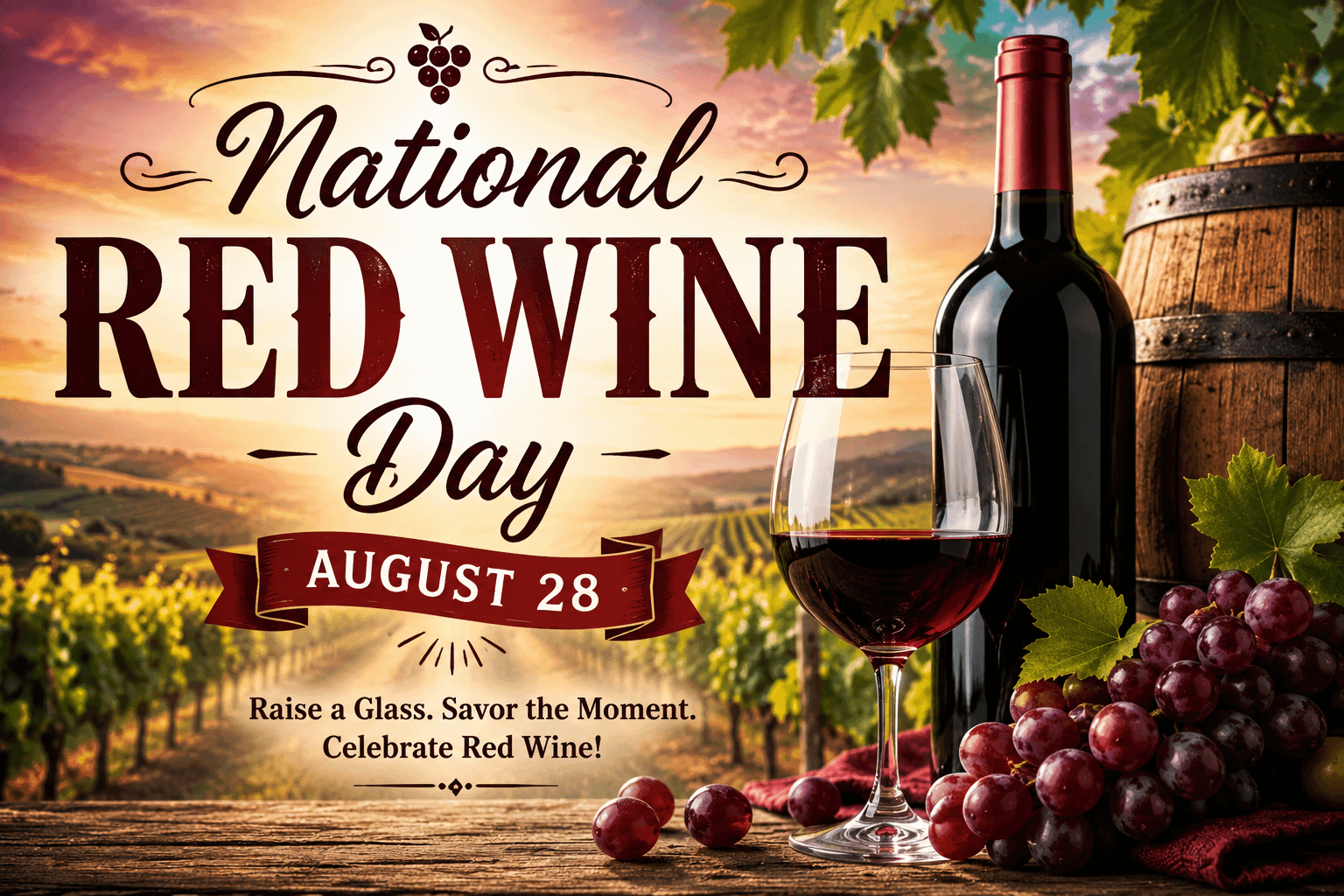
Every year on August 28, wine enthusiasts have an opportunity to uncork a favorite bottle, discover a new variety, and celebrate one of humanity’s oldest and most culturally significant beverages during National Red Wine Day.
From the deep, powerful flavors of Cabernet Sauvignon to the delicate fruitiness of Pinot Noir, red wine represents an enormous world of grapes, regions, traditions, flavors, and winemaking techniques. Two bottles sitting next to each other on a store shelf can offer completely different experiences—even when they’re made from the same grape.
National Red Wine Day celebrates all of it.
It’s a day to appreciate the farmers who grow the grapes, the winemakers who transform them, the regions that give wines their distinctive personalities, and the simple pleasure of sharing a bottle around the dinner table.
So pour a glass, prepare your favorite meal, and discover why red wine has fascinated people for thousands of years.
🍷 When Is National Red Wine Day?
National Red Wine Day is celebrated every year on August 28.
The modern observance is credited to writer and wine enthusiast Jace Shoemaker-Galloway. Sources generally place its creation around 2013–2014, with National Day Calendar listing 2014 and Days of the Year identifying Shoemaker-Galloway as its founder.
The timing might seem unusual.
Many people associate red wine with cool autumn evenings, winter dinners, fireplaces, roasts, and holiday celebrations. But August provides plenty of opportunities for red wine as well.
Think about everything coming off the grill during late summer—steak, burgers, ribs, barbecue chicken, sausages, vegetables, and smoky pizzas.
There are red wines that complement virtually all of them.
That’s part of the spirit behind National Red Wine Day: red wine doesn’t need to wait until winter.
🍇 Red Wine Has an Ancient History
National Red Wine Day may be relatively modern, but wine itself has an extraordinarily long history.
Humans have been experimenting with fermented grape beverages for thousands of years. Days of the Year traces wine-like beverages back thousands of years, including ancient fermented drinks containing wild grapes and other ingredients.
Over the centuries, wine became intertwined with agriculture, trade, religion, hospitality, cooking, celebrations, and everyday social life.
Ancient civilizations cultivated grapes and improved fermentation techniques. Later generations developed specialized vineyards, storage techniques, barrels, bottles, corks, aging methods, and regional traditions.
Eventually, wine became more than a beverage.
It became part of culture.
A bottle could represent the land where its grapes were grown, the weather of a particular year, generations of family tradition, and the decisions of the winemaker who produced it.
That remains true today.
🍷 What Actually Makes Red Wine Red?
The answer seems obvious: red grapes.
But there’s more to the story.
Much of red wine’s distinctive color comes from pigments contained in the skins of dark-colored wine grapes. During red-wine production, the juice typically ferments while remaining in contact with those skins.
Wine Folly explains that this skin contact is one of the fundamental differences between red- and white-wine production. The skins contribute the pigments that give red wine its characteristic color.
This process also helps extract other compounds that influence:
- Color
- Aroma
- Flavor
- Texture
- Tannins
- Structure
- Aging potential
The length of skin contact and the techniques used by the winemaker can dramatically influence the finished product.
That’s why red wines can range from bright translucent ruby to nearly opaque purple.
🍇 From Vineyard to Glass: How Red Wine Is Made
Creating red wine is a fascinating combination of agriculture, science, craftsmanship, and patience.
Although every winery has its own techniques, the basic process usually follows several important stages.
1. Growing the Grapes
Everything begins in the vineyard.
Winemakers and vineyard managers spend months caring for grapevines while monitoring weather, soil conditions, pests, disease, irrigation, canopy growth, and grape development.
Climate plays an enormous role.
Hotter growing regions can produce grapes with different characteristics than cooler regions. Even vineyards separated by relatively short distances can produce noticeably different wines.
2. Harvesting
When the grapes reach the desired ripeness, harvest begins.
Timing matters tremendously because grapes stop ripening after they’re picked. Harvesting too early or too late can substantially affect the resulting wine.
Some vineyards harvest mechanically.
Others harvest by hand.
Premium producers may carefully sort grapes to remove damaged fruit, leaves, stems, or other unwanted material.
3. Crushing and Destemming
After arriving at the winery, grapes may be destemmed and gently crushed.
Some winemakers intentionally leave some stems in the fermentation, particularly with certain grape varieties and styles.
This is one example of how winemaking decisions influence the final bottle.
4. Fermentation
Fermentation is where the transformation happens.
Yeast consumes naturally occurring grape sugars and produces alcohol.
During red-wine fermentation, the skins remain with the juice. Carbon dioxide causes skins and other solids to rise toward the top of the fermentation vessel, creating what winemakers call a cap.
Winemakers may regularly punch that cap downward or pump juice over it to maintain contact between the liquid and skins.
These techniques help extract color, aroma, flavor, and tannins.
5. Pressing
After fermentation, the liquid can be separated from the skins and solids.
The remaining grape material may then be pressed to extract additional wine.
6. Malolactic Fermentation
Many red wines undergo another transformation called malolactic fermentation.
During this process, sharper malic acid is converted into softer lactic acid, which can make a wine feel smoother and rounder. Wine Folly notes that nearly all red wines undergo this process.
7. Aging
Depending on the wine, aging might take place in:
- Stainless-steel tanks
- Concrete vessels
- Large wooden casks
- Oak barrels
- Bottles
Oak can introduce additional aromas and flavors while also influencing texture and development.
Eventually, the wine is bottled and prepared for sale.
Some reds are designed to taste fresh and delicious shortly after release.
Others can evolve for years or even decades.
🍷 Understanding Tannins
If you’ve ever taken a sip of red wine and noticed a drying sensation around your gums or tongue, you’ve probably experienced tannins.
Tannins naturally occur in grapes and can come from the skins, seeds, stems, and wood used during winemaking.
Some wines have relatively gentle tannins.
Others can be intensely structured.
For example, Pinot Noir generally has thinner skins and lower tannin levels than thick-skinned varieties such as Syrah.
Tannins aren’t necessarily good or bad.
They’re simply part of a wine’s structure.
They can also help certain wines develop beautifully with age.
🍇 Popular Red Wine Varieties to Explore
One of the easiest ways to celebrate National Red Wine Day is to explore several grape varieties.
Here are some of the world’s most popular.
🍷 Cabernet Sauvignon
Cabernet Sauvignon is arguably one of the world’s most recognizable red wine grapes.
It often produces wines that are bold, structured, and full-bodied.
Depending on the region and winemaking style, you might notice characteristics reminiscent of:
- Blackberry
- Black currant
- Plum
- Cedar
- Tobacco
- Herbs
- Vanilla
- Dark chocolate
- Baking spices
Cabernet Sauvignon can pair wonderfully with steak, roast beef, lamb, burgers, and aged cheeses.
🍷 Merlot
Merlot is often considered approachable because many examples have a softer, rounder character.
Common flavor associations include:
- Plum
- Black cherry
- Blackberry
- Cocoa
- Herbs
- Vanilla
Merlot can be enjoyed on its own or paired with roasted meats, pasta, pizza, chicken, pork, and cheese.
It also plays an important role in many famous Bordeaux blends.
🍷 Pinot Noir
Pinot Noir proves that red wine doesn’t have to be heavy.
It often produces lighter-bodied, aromatic wines featuring characteristics such as:
- Cherry
- Strawberry
- Raspberry
- Cranberry
- Herbs
- Earth
- Mushrooms
- Baking spices
Pinot Noir’s lighter structure makes it extremely versatile with food.
Try it with salmon, roasted chicken, pork, mushroom dishes, duck, or grilled vegetables.
🍷 Malbec
Today, Malbec is strongly associated with Argentina, although the grape has historical roots in France.
Malbec wines are often dark, rich, and fruit-forward.
You might encounter:
- Blackberry
- Plum
- Black cherry
- Cocoa
- Tobacco
- Spice
- Smoke
Malbec and grilled meat make an especially enjoyable combination.
🍷 Syrah and Shiraz
Syrah and Shiraz generally refer to the same grape, although the terminology can sometimes indicate different regional or stylistic traditions.
Syrah can produce powerful wines with flavors and aromas reminiscent of:
- Blackberry
- Blueberry
- Plum
- Black pepper
- Herbs
- Smoke
- Olive
- Spice
It’s an excellent companion for barbecue, grilled meats, lamb, and smoked foods.
🍷 Zinfandel
Zinfandel has become particularly associated with California.
Red Zinfandel can be bold, juicy, fruity, and spicy.
Common flavor associations include:
- Blackberry
- Raspberry
- Plum
- Cherry
- Pepper
- Cinnamon
- Baking spices
Pair it with burgers, ribs, barbecue chicken, pizza, or spicy sausages.
🍷 Sangiovese
Sangiovese is one of Italy’s great red grapes and is famously associated with Tuscany and Chianti.
Its naturally food-friendly character can include flavors reminiscent of:
- Cherry
- Red plum
- Herbs
- Tomato leaf
- Leather
- Earth
- Spice
It’s an obvious partner for Italian cuisine.
Try Sangiovese with pizza, lasagna, spaghetti and meatballs, tomato-based pasta, or roasted meats.
🍷 Tempranillo
Tempranillo is one of Spain’s signature grapes and plays a major role in wines from Rioja and other Spanish regions.
Depending on how it’s produced and aged, you might discover:
- Cherry
- Plum
- Dried fruit
- Leather
- Tobacco
- Vanilla
- Cedar
- Spice
Pair Tempranillo with grilled meat, tapas, roasted vegetables, or Manchego cheese.
🍷 Grenache
Grenache—known as Garnacha in Spain—is often juicy, fruit-forward, and wonderfully aromatic.
Common characteristics include:
- Strawberry
- Raspberry
- Cherry
- Herbs
- Pepper
- Spice
It’s also frequently blended with other grapes.
Grenache can be particularly enjoyable with grilled foods, Mediterranean dishes, pizza, and roasted vegetables.
🌎 Exploring the Great Red Wine Regions
National Red Wine Day can also become a trip around the world without leaving your dining room.
France
France contains some of the world’s legendary wine regions.
Bordeaux is famous for blends involving Cabernet Sauvignon, Merlot, Cabernet Franc, and other permitted grapes.
Burgundy is celebrated for Pinot Noir.
The Rhône Valley is famous for Syrah and Grenache-based wines, among others.
Italy
Italy offers an extraordinary range of indigenous grapes and regional traditions.
Explore:
- Chianti
- Barolo
- Barbaresco
- Brunello di Montalcino
- Amarone
- Montepulciano d’Abruzzo
You could spend years exploring Italian red wine alone.
Spain
Spain offers everything from youthful, fruit-forward reds to wines aged for extended periods.
Rioja is perhaps the most internationally recognizable example, but numerous Spanish regions deserve exploration.
Argentina
Argentina transformed Malbec into an international superstar.
The country’s high-altitude vineyards, particularly around Mendoza, have helped establish Argentina as one of the world’s important red-wine producers.
Australia
Australia produces an enormous variety of wines, but Shiraz remains one of its signature reds.
Styles range from rich and powerful to elegant and peppery.
United States
California dominates American wine production and includes internationally recognized regions such as Napa Valley and Sonoma County.
But great American red wine isn’t limited to California.
Oregon has become especially respected for Pinot Noir, while Washington produces outstanding Cabernet Sauvignon, Merlot, Syrah, and red blends.
🧀 The Art of Pairing Red Wine With Food
Wine pairing can sound intimidating, but it doesn’t have to be.
The basic goal is balance.
Neither the wine nor the food should completely overwhelm the other.
Try these combinations:
Cabernet Sauvignon + grilled steak
A classic combination for a reason.
Pinot Noir + salmon
Pinot’s lighter structure can complement richer fish.
Malbec + barbecue
Dark fruit and smoky grilled flavors work beautifully together.
Merlot + roasted chicken
A softer red can complement savory poultry dishes.
Sangiovese + tomato-based pasta
The acidity found in many Sangiovese wines works particularly well with tomato sauces.
Zinfandel + ribs
Fruit, spice, smoke, and barbecue can create a fantastic combination.
Tempranillo + tapas
Try it with cured meats, Manchego, roasted peppers, or grilled dishes.
🧀 Build a National Red Wine Day Cheese Board
Want an easy celebration?
Build a cheese board.
Include several cheeses with different textures and intensities, such as:
- Aged cheddar
- Gouda
- Manchego
- Parmesan
- Brie
- Blue cheese
- Goat cheese
Add:
- Crackers
- Baguette slices
- Grapes
- Apples
- Pears
- Dried fruit
- Nuts
- Olives
- Dark chocolate
- Fig spread
Then open two or three different red wines and experiment.
There are no points for getting the “correct” answer.
The fun is discovering what you enjoy.
🍫 Can Red Wine Pair With Chocolate?
Absolutely—but choosing the right combination helps.
Rich dark chocolate can work beautifully with certain full-bodied or sweeter red wines.
Experiment with:
- Dark chocolate
- Chocolate truffles
- Chocolate-covered strawberries
- Flourless chocolate cake
- Brownies
Try smaller portions of each and see how the flavors change when experienced together.
🍷 Host Your Own National Red Wine Day Tasting
One of the most entertaining ways to celebrate August 28 is hosting a red-wine tasting.
You don’t need dozens of bottles.
Four is plenty.
Try:
Wine #1 – Pinot Noir
Start lighter and more delicate.
Wine #2 – Merlot
Move toward something rounder.
Wine #3 – Malbec or Syrah
Introduce darker fruit and greater intensity.
Wine #4 – Cabernet Sauvignon
Finish with something structured and bold.
Pour small tasting portions.
Then compare each wine based on:
Appearance:
Is it pale ruby, deep red, purple, garnet, or nearly opaque?
Aroma:
What do you smell first?
Fruit:
Do you notice cherry, strawberry, blackberry, plum, or something else?
Other flavors:
Can you detect herbs, vanilla, chocolate, pepper, smoke, tobacco, or earth?
Acidity:
Does the wine make your mouth water?
Tannin:
Does it create a drying sensation?
Body:
Does it feel light, medium, or full?
Finish:
How long do the flavors remain after swallowing?
Finally, rank your favorites.
You might be surprised.
🍷 Try a Blind Wine Tasting
Want to make the celebration even more interesting?
Hide the bottles.
Have someone pour each wine without revealing what it is.
Everyone writes down:
- Favorite wine
- Least favorite wine
- Guess at the grape
- Guess at the price
- Flavor observations
- Food pairing suggestions
Then reveal the bottles.
People frequently discover that price, labels, and expectations influence what they think they’ll enjoy.
Blind tasting removes some of those expectations.
🍇 Why the Same Grape Can Taste So Different
One of the most fascinating things about wine is how dramatically geography can influence it.
Two Cabernet Sauvignons may taste completely different.
Why?
Because countless factors influence the grapes:
- Climate
- Soil
- Elevation
- Rainfall
- Sun exposure
- Vineyard orientation
- Harvest timing
- Fermentation
- Skin contact
- Yeast selection
- Oak aging
- Bottle aging
Even the decisions made during fermentation can change the wine considerably. Winemakers can use techniques such as punch-downs or pump-overs to influence extraction from the grape skins.
That’s why exploring wine never really ends.
There’s always another bottle, grape, region, vintage, or winemaking style to discover.
🍷 Does Red Wine Need to “Breathe”?
You’ve probably heard someone say a bottle of red wine needs to breathe.
Sometimes they’re right.
Exposure to oxygen can change the aromas and flavors of certain wines.
Simply opening a bottle doesn’t expose much surface area, however.
Pouring wine into a glass gives it considerably more contact with air.
A decanter creates even more.
Young, tannic wines may sometimes benefit from decanting, while delicate older wines may require more careful handling.
But don’t feel obligated to decant every bottle.
Try the wine first.
If it seems tight or muted, give it some time in the glass and see how it develops.
🌡️ Should Red Wine Be Served at Room Temperature?
“Serve red wine at room temperature” is one of those wine rules that can be misleading.
Modern homes can be considerably warmer than traditional wine cellars.
Many red wines are more enjoyable when served slightly cooler than a warm room.
Lighter reds can often be served relatively cool, while fuller-bodied reds may be served somewhat warmer.
If your bottle feels overly warm, don’t be afraid to chill it briefly before serving.
The goal isn’t following a rigid rule.
The goal is making the wine taste good.
🍷 Does Expensive Wine Always Taste Better?
No.
Price can reflect many things:
- Vineyard location
- Land costs
- Grape yields
- Labor
- Barrel aging
- Production methods
- Reputation
- Scarcity
- Marketing
- Distribution
But an expensive bottle isn’t automatically the bottle you’ll enjoy most.
Wine appreciation is personal.
Someone may genuinely prefer a $15 bottle to a $100 bottle.
That’s perfectly fine.
National Red Wine Day should be about discovery and enjoyment—not impressing anyone with the price tag.
🍇 Red Wine Is About More Than Drinking
One reason wine has remained culturally significant for so long is that it connects people.
Think about the moments when bottles are opened.
Weddings.
Anniversaries.
Holiday dinners.
Birthdays.
Romantic dates.
Vacations.
Family meals.
Dinner parties.
Reunions.
Celebrations.
Sometimes it’s simply two friends sitting around a table talking long after dinner has ended.
The wine becomes part of the memory.
That’s something humans have understood for generations.
🍷 15 Ways to Celebrate National Red Wine Day
There are plenty of ways to make August 28 special:
- Open your favorite bottle of red wine.
- Try a grape you’ve never tasted.
- Explore wine from another country.
- Visit a local winery.
- Attend a wine tasting.
- Create your own tasting flight at home.
- Host a blind tasting with friends.
- Prepare a red-wine-friendly dinner.
- Build a wine-and-cheese board.
- Pair red wine with chocolate.
- Learn about a famous wine region.
- Compare the same grape from two different regions.
- Learn how red wine is produced.
- Share your favorite bottle on social media using #NationalRedWineDay.
- Give a bottle to a wine-loving friend.
You could even start an annual tradition.
Buy one interesting bottle every August 28 and keep notes about what you tried.
After several years, you’ll have your own National Red Wine Day tasting history.
🍷 National Red Wine Day Is Really About Discovery
You don’t need to know the difference between Bordeaux and Burgundy.
You don’t need an expensive wine cellar.
You don’t need special glasses.
And you certainly don’t need to memorize tasting terminology.
Wine appreciation begins with something much simpler:
Pay attention to what you enjoy.
Try different grapes.
Taste wine from different countries.
Experiment with food pairings.
Compare inexpensive bottles with more expensive ones.
Ask questions when visiting wineries.
And don’t worry if you taste something completely different from what the tasting notes say.
Your palate belongs to you.
🍇 Raise a Glass on August 28
National Red Wine Day gives us an opportunity to appreciate something people have been creating and sharing for thousands of years.
Every bottle begins with grapes growing somewhere in the world.
Those grapes are harvested.
They’re fermented.
The wine is carefully developed, aged, bottled, transported, purchased, opened, and eventually poured into a glass.
Then comes the most important part.
It’s enjoyed.
Maybe you’re opening a bold Cabernet Sauvignon beside a grilled steak.
Maybe you’re having Pinot Noir with salmon.
Maybe it’s Malbec and barbecue.
Maybe you’re splitting a bottle of Merlot over pizza with someone you love.
Or perhaps you’re trying red wine for the first time.
However you celebrate, August 28 is an opportunity to explore the remarkable diversity behind one simple phrase: red wine.
So uncork something interesting, pour a glass, prepare some good food, and enjoy the occasion.
Here’s to the vineyards, grape growers, winemakers, traditions, meals, conversations, and memories that have made wine part of human culture for generations.
Happy National Red Wine Day! 🍷🍇
Please enjoy responsibly. If you drink alcohol, don’t drive.
🍷 National Red Wine Day Question
What’s your favorite red wine?
🍷 Cabernet Sauvignon
🍷 Merlot
🍷 Pinot Noir
🍷 Malbec
🍷 Shiraz/Syrah
🍷 Zinfandel
🍷 Sangiovese
🍷 Tempranillo
🍷 Or another favorite?
Tell us what you’re pouring for National Red Wine Day!
Leave a Reply