Food is about much more than satisfying hunger. It can tell the story of a family, preserve the traditions of a community, and connect generations through recipes that have been prepared and shared for decades.
That connection between food, history, family, and culture is at the heart of National Southern Food Heritage Day.
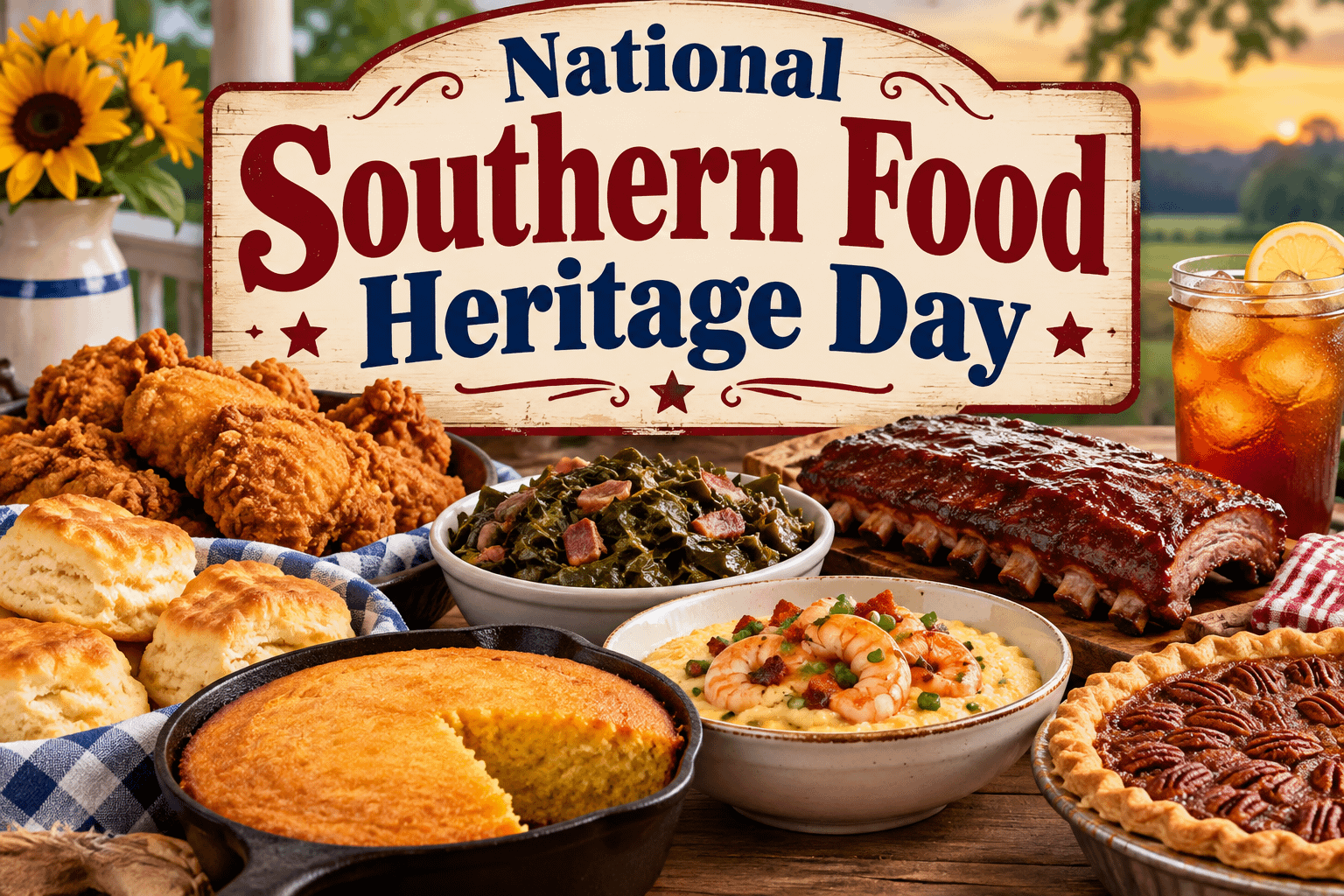
Southern food is one of the most recognizable culinary traditions in the United States. Mention Southern cooking and people may immediately picture crispy fried chicken, cornbread fresh from the oven, biscuits covered in gravy, barbecue cooked low and slow, collard greens simmering on the stove, shrimp and grits, gumbo, jambalaya, pecan pie, peach cobbler, or a tall glass of sweet tea.
But Southern food is much more complicated—and much more interesting—than any single collection of famous dishes.
It represents centuries of cultural exchange, survival, adaptation, agriculture, immigration, family traditions, and regional differences.
National Southern Food Heritage Day gives us an opportunity to celebrate those foods while also appreciating the people and history behind them.
What Is National Southern Food Heritage Day?
National Southern Food Heritage Day is observed on October 11 as a celebration of the culinary heritage associated with the American South.
The day encourages people to explore Southern cooking, learn about its history, preserve family recipes, support Southern restaurants and food traditions, and perhaps prepare a favorite Southern meal at home.
For some people, celebrating might mean making biscuits from scratch.
For others, it could mean smoking a rack of ribs, preparing shrimp and grits, baking a pecan pie, frying green tomatoes, making gumbo, or cooking a pot of greens using a recipe passed down through the family.
However you celebrate, the important part is recognizing that Southern food represents generations of history.
Every recipe has a story.
Every region has its specialties.
And many dishes that are considered Southern classics today developed through the contributions of several different cultures.
Southern Food Is Not Just One Cuisine
One of the biggest misconceptions about Southern cooking is that there is a single definition of “Southern food.”
The American South covers an enormous geographic area.
Food traditions can change dramatically depending on whether you are visiting Louisiana, Texas, Tennessee, Georgia, South Carolina, Mississippi, Alabama, Kentucky, Arkansas, Virginia, North Carolina, or another Southern community.
Coastal areas developed dishes around seafood.
Agricultural regions depended heavily on locally available crops.
Some areas became famous for barbecue.
Others developed distinctive Creole and Cajun cuisines.
Communities throughout Appalachia developed cooking traditions influenced by mountain life, preservation methods, hunting, gardening, and seasonal ingredients.
That diversity is part of what makes Southern food so fascinating.
You could travel throughout the South eating traditional regional foods for weeks and still discover something new.
The Many Cultures Behind Southern Cooking
Southern cuisine developed through the interaction of many cultures over several centuries.
Indigenous peoples cultivated crops and developed cooking techniques long before European colonization. Ingredients such as corn, beans, squash, and other native foods became essential parts of regional diets.
European settlers introduced additional livestock, cooking traditions, baking methods, and ingredients.
African culinary knowledge profoundly shaped Southern cuisine. Enslaved Africans and their descendants contributed ingredients, agricultural expertise, seasoning traditions, preparation techniques, and dishes that became fundamental to Southern cooking.
Later immigration and cultural exchange continued adding new influences.
French and Spanish traditions played especially important roles in Louisiana cuisine.
Caribbean influences can also be found throughout parts of the South.
The result was not one isolated culinary tradition but an evolving mixture of cultures and experiences.
Understanding those influences makes celebrating Southern food heritage more meaningful.
The dishes on the table often represent centuries of human history.
Cornbread: A Southern Staple
Few foods are more closely connected with Southern cooking than cornbread.
Corn had been cultivated by Indigenous peoples for thousands of years before European settlers arrived in North America.
Over time, cornmeal became an important ingredient throughout the South because corn could be grown successfully across much of the region.
Cornbread eventually developed countless regional and family variations.
Some recipes are simple and savory.
Others include sugar.
Some are baked in a cast-iron skillet until the outside develops a beautiful golden crust.
And that brings us to one of the great Southern food debates:
Should cornbread have sugar in it?
Ask that question at the right Southern dinner table and you may start a surprisingly passionate discussion.
But those differences demonstrate exactly why food heritage matters.
Recipes change from region to region and family to family.
There isn’t always one “correct” recipe.
Sometimes the recipe you grew up eating simply becomes the version that tastes like home.
The Southern Biscuit
A good Southern biscuit looks simple.
Flour.
Fat.
Milk or buttermilk.
A few additional ingredients.
Yet anyone who has attempted homemade biscuits knows that technique matters.
The best biscuits can be tender and flaky inside while developing a slightly crisp exterior.
Biscuits may be served with butter, honey, preserves, sausage gravy, country ham, fried chicken, or countless other accompaniments.
They can appear at breakfast, lunch, or dinner.
Perhaps most importantly, biscuits demonstrate one of the defining characteristics of traditional Southern cooking:
Taking relatively simple ingredients and turning them into something memorable.
Southern Fried Chicken
Fried chicken has become internationally associated with Southern cuisine.
A traditional Southern-style preparation might involve seasoning chicken, coating it with seasoned flour, and frying it until the outside becomes crisp while the inside remains juicy.
But fried chicken also reflects the multicultural development of Southern food.
Various European traditions included frying chicken, while African cooking traditions contributed seasoning techniques and culinary knowledge that helped shape what eventually became Southern fried chicken.
Over generations, countless families developed their own versions.
Some soak the chicken in buttermilk.
Some use a secret spice mixture.
Others swear by a particular frying method.
Like many traditional foods, the “best” fried chicken often depends on the memories associated with it.
Barbecue: One Word, Many Traditions
Few culinary subjects inspire stronger regional loyalty than Southern barbecue.
The word “barbecue” might describe completely different meals depending on where you are.
In parts of the Carolinas, pork dominates.
Texas is famous for beef brisket.
Memphis is closely associated with pork ribs and pulled pork.
Kansas City developed another distinctive barbecue tradition.
Even barbecue sauce changes dramatically by location.
Some sauces are vinegar-based.
Others are tomato-based.
South Carolina is particularly famous for mustard-based barbecue sauce.
And then there is the debate over sauce itself.
Some pitmasters believe properly smoked meat should need very little sauce.
Whatever style you prefer, traditional barbecue is usually built around patience.
Meat is cooked slowly, often over wood smoke, allowing heat, smoke, seasoning, and time to transform tougher cuts into tender food.
Barbecue also has an important social element.
Cookouts, church gatherings, family reunions, festivals, competitions, and community celebrations have long made barbecue about much more than the meat itself.
It brings people together.
Soul Food and Southern Food
Southern cuisine and soul food overlap considerably, but the terms are not completely interchangeable.
Soul food is deeply connected to African American history and culture, particularly the culinary traditions that developed through the experiences of Black communities in the South and later spread throughout the United States during migrations to other regions.
Foods commonly associated with soul food include collard greens, black-eyed peas, fried chicken, macaroni and cheese, cornbread, sweet potatoes, fried fish, and other dishes.
Many of these foods also appear broadly throughout Southern cuisine.
Recognizing the African American contribution to Southern food is essential when discussing Southern culinary heritage.
Some of America’s most celebrated foods would not exist in their present forms without generations of Black cooks, farmers, families, restaurateurs, and culinary innovators.
Louisiana: A Culinary World of Its Own
Southern food becomes even more diverse when we reach Louisiana.
Louisiana is famous for Cajun and Creole cuisines, each with its own complicated history and traditions.
Dishes such as gumbo, jambalaya, crawfish étouffée, red beans and rice, and po’boys demonstrate the extraordinary cultural mixture found in Louisiana cooking.
French, Spanish, African, Caribbean, Indigenous, and other influences helped shape the region’s food.
Gumbo is perhaps one of the greatest examples.
There isn’t one universal gumbo recipe.
Different cooks may use seafood, chicken, sausage, okra, filé powder, or combinations of ingredients depending on family and regional traditions.
Arguments over the “right” way to make gumbo can become almost as intense as arguments over barbecue.
And once again, those disagreements reveal something important.
Food heritage lives through people.
Families preserve traditions while simultaneously changing them.
Shrimp and Grits
Shrimp and grits has become another famous symbol of Southern cuisine.
Grits developed from Indigenous corn traditions and became especially important throughout the South.
Along coastal areas, seafood was naturally incorporated into local cooking.
Eventually, combinations of shrimp and grits became associated particularly with the coastal South.
Modern restaurants have transformed the dish in countless ways, adding cheese, bacon, sausage, sauces, spices, and other ingredients.
But at its core, shrimp and grits demonstrates something Southern cooking does exceptionally well:
Combining humble ingredients into deeply satisfying food.
Collard Greens
A pot of slowly cooked greens represents another longstanding Southern tradition.
Collard greens may be simmered with smoked meat, onions, seasonings, broth, vinegar, or other ingredients depending on the cook.
Similar dishes can be made with mustard greens or turnip greens.
For many families, greens aren’t simply a side dish.
They are part of holiday meals, Sunday dinners, and family gatherings.
Traditional Southern New Year’s meals sometimes include greens because their color is associated with money and prosperity.
Black-eyed peas may be served alongside them as another symbol of good fortune.
Whether or not you believe the superstition, starting the year with a plate of greens, black-eyed peas, and cornbread isn’t a bad tradition.
Southern Desserts Deserve Their Own Celebration
No celebration of Southern food would be complete without dessert.
Southern dessert traditions include an extraordinary collection of pies, cakes, cobblers, puddings, and other sweets.
Pecan pie is perhaps one of the most recognizable.
Peach cobbler is another classic.
Depending on the family and region, you may also encounter banana pudding, sweet potato pie, chess pie, hummingbird cake, red velvet cake, coconut cake, bread pudding, pralines, or blackberry cobbler.
Southern desserts often appear during holidays and family gatherings.
That makes them particularly powerful carriers of memory.
Someone may taste a slice of pie and immediately remember sitting in a grandparent’s kitchen decades earlier.
That emotional connection is one reason preserving recipes matters.
Why Family Recipes Are Worth Saving
National Southern Food Heritage Day is also an excellent reminder to preserve family recipes.
Many families have recipes that exist only in someone’s memory.
Grandma knows how to make the biscuits.
Dad knows how to season the ribs.
An aunt knows exactly how long the greens should cook.
Nobody writes anything down because everyone assumes there will always be time to ask.
Unfortunately, family knowledge can disappear surprisingly quickly.
Write those recipes down.
Better yet, cook them together.
Ask questions.
Take pictures.
Record the stories behind the food.
Why was this dish always served at Christmas?
Who originally created the recipe?
Did someone change an ingredient decades ago?
Was the recipe brought from another state or country?
Those details turn a recipe into family history.
One handwritten recipe card can sometimes preserve more emotional history than an entire photo album.
The Cast-Iron Skillet
If Southern kitchens had an official piece of cookware, the cast-iron skillet would certainly be a contender.
Cast iron can be used for cornbread, fried chicken, biscuits, steaks, vegetables, cobblers, and countless other dishes.
Properly cared for, cast-iron cookware can last for generations.
Some families literally pass skillets from grandparents to children and grandchildren.
That makes the cookware itself part of the family’s culinary heritage.
There is something special about preparing a family recipe in the same skillet that was used decades earlier.
Food Brings People Together
Perhaps the most important lesson of Southern food heritage isn’t about any particular recipe.
It’s about the table.
Southern food traditions have long been connected with gatherings.
Sunday dinners.
Church suppers.
Family reunions.
Fish fries.
Backyard barbecues.
Holiday meals.
Neighborhood cookouts.
Football weekends.
Birthday celebrations.
Food provides the excuse for people to sit down together.
Someone cooks.
Someone brings dessert.
Someone tells the same story everyone has heard 20 times.
Someone sneaks another biscuit before dinner.
Kids run around while adults talk.
And years later, those seemingly ordinary meals become some of our strongest memories.
That is food heritage.
It isn’t only what we ate.
It’s who was sitting beside us when we ate it.
How to Celebrate National Southern Food Heritage Day
There are plenty of ways to celebrate on October 11.
Cook a traditional Southern meal from scratch. Try fried chicken, cornbread, collard greens, shrimp and grits, gumbo, barbecue, biscuits and gravy, or another regional favorite.
Visit a locally owned Southern restaurant and try something you have never ordered before.
Call an older relative and ask about the foods they remember from childhood.
Write down a family recipe before it disappears.
Teach a child or grandchild how to prepare a traditional dish.
Learn about the African American, Indigenous, European, Caribbean, and immigrant influences that helped shape Southern cuisine.
Or simply gather around the table with people you care about.
Because ultimately, preserving food heritage doesn’t require a museum.
Sometimes it only requires a kitchen.
More Than Food
National Southern Food Heritage Day reminds us that food can carry history.
A bowl of gumbo can reflect generations of cultural exchange.
A cast-iron skillet can connect grandparents with grandchildren.
A plate of barbecue can represent decades of regional tradition.
A handwritten recipe card can preserve the memory of someone who is no longer sitting at the table.
And the smell of something cooking can suddenly transport us back to a kitchen we haven’t seen in years.
That is the remarkable power of food.
Recipes survive because people continue making them.
Traditions survive because someone decides they are worth teaching to another generation.
Stories survive because someone takes the time to tell them.
So this National Southern Food Heritage Day, enjoy the fried chicken, biscuits, barbecue, cornbread, greens, gumbo, shrimp and grits, pecan pie, peach cobbler, or whatever Southern dish means something to you.
But while you’re eating, remember the generations of people behind those foods.
Celebrate the cooks.
Celebrate the cultures.
Celebrate the families.
Celebrate the stories.
And most importantly, keep those traditions alive by sharing them with someone else.
What Southern dish brings back the strongest memories for you?