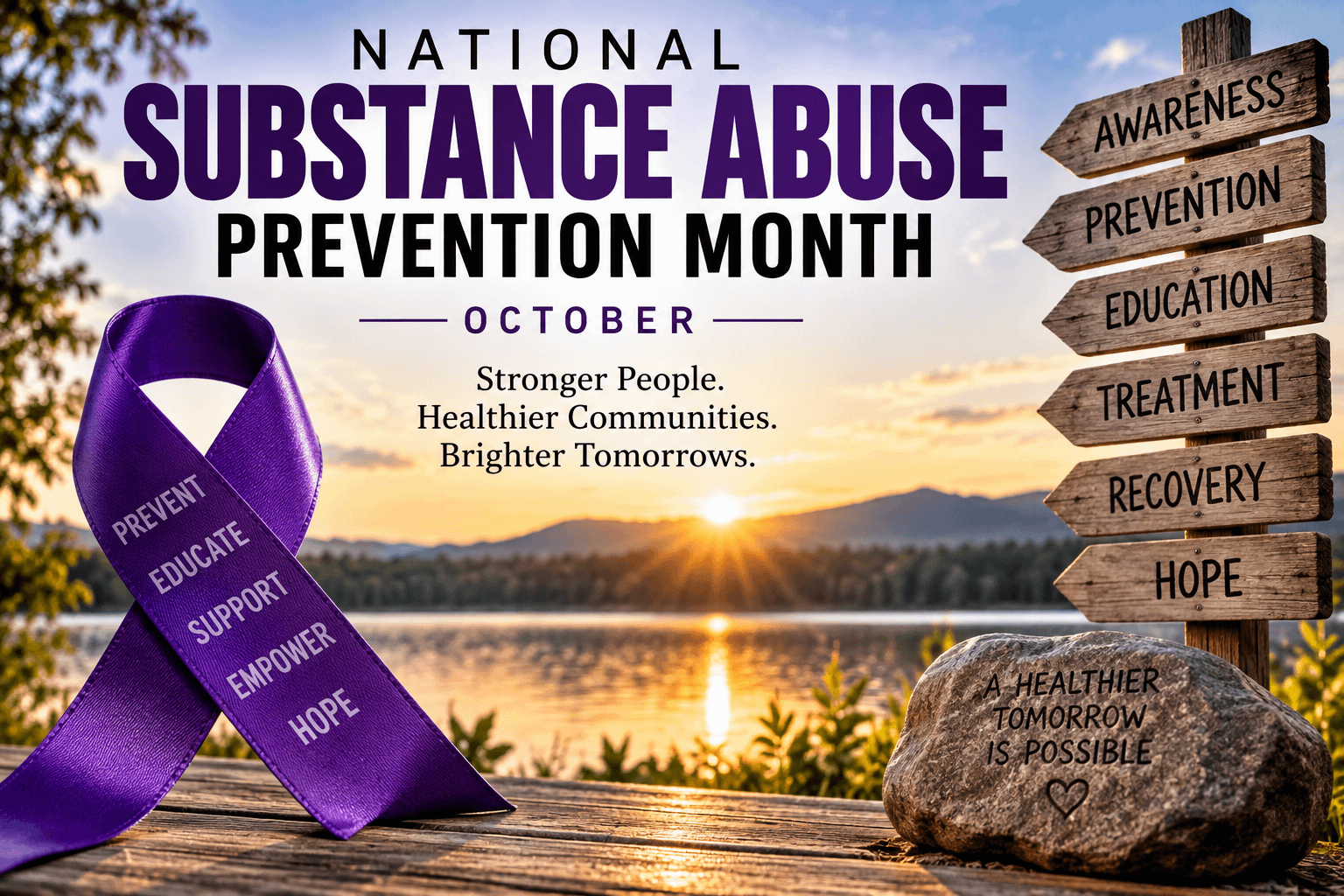
Every October, National Substance Abuse Prevention Month brings attention to an issue that affects individuals, families, schools, workplaces, and communities across the country. It is a time to increase awareness about substance misuse, strengthen prevention efforts, encourage honest conversations, and remind people that help and recovery are possible.
Substance misuse does not affect only one type of person or one kind of family. It can touch people from every background, age group, income level, and community. Sometimes the warning signs are obvious. Other times, a person may be struggling privately while continuing to work, attend school, raise a family, and appear as though everything is fine.
That is one reason prevention and awareness matter so much.
National Substance Abuse Prevention Month is not simply about telling people to avoid drugs or alcohol. Effective prevention also involves understanding why people may turn to substances, recognizing risk factors early, strengthening protective factors, supporting mental and emotional well-being, and making sure people know where they can turn when they need help.
Why Substance Abuse Prevention Matters
Substance misuse can have consequences far beyond the individual using a substance.
Families may experience broken trust, financial difficulties, conflict, fear, and emotional exhaustion. Children can be affected by instability within their homes. Friendships and relationships may suffer. Work and school performance can decline. Physical and mental health problems can become more serious.
In the most tragic circumstances, substance use can contribute to overdose and death.
Prevention gives us an opportunity to intervene before those consequences become severe.
Prevention can begin with something as simple as education. When young people understand the risks associated with substance use and have healthy coping skills, trusted adults, supportive environments, and meaningful opportunities in their lives, they may be better prepared to make safer decisions.
Adults need prevention resources too.
Stress, grief, loneliness, trauma, chronic pain, relationship problems, financial pressure, and mental health struggles can sometimes contribute to unhealthy patterns of substance use. Learning healthier ways to cope and seeking support early can make an enormous difference.
Understanding the Reasons Behind Substance Misuse
It is easy to look at substance misuse only as a behavior. But behind that behavior there may be a much deeper story.
Someone may be attempting to escape emotional pain.
Someone may be dealing with unresolved trauma.
Another person may be overwhelmed by anxiety, depression, loneliness, grief, or stress.
Some people begin using substances socially and gradually develop a pattern they did not expect. Others may become dependent after exposure to certain medications or substances.
There is rarely one simple explanation that applies to everyone.
That is why conversations about prevention should include compassion along with accountability and education.
Shame rarely creates the kind of environment where people feel comfortable admitting they need help. When someone believes they will immediately be judged or rejected, they may hide what is happening.
A supportive response can open a different door.
It can say:
You can talk about what is happening.
You can ask for help.
Your life still has value.
Recovery is worth pursuing.
Prevention Starts With Conversation
Families sometimes avoid discussing drugs and alcohol because they are uncomfortable topics.
Silence, however, does not protect people.
Age-appropriate conversations can help children and teenagers understand the risks they may encounter. These conversations do not always need to be dramatic lectures. They can happen naturally over time.
Parents and caregivers can ask questions, listen carefully, establish clear expectations, and create an environment where young people know they can talk about difficult situations without immediately being attacked or humiliated.
Young people may encounter pressure from friends, social situations, online content, or environments where substance use has become normalized.
Knowing they have someone trustworthy to call can be incredibly important.
That same principle applies to adults.
Sometimes a simple conversation between friends can become the beginning of change.
“Are you doing okay?”
“I’ve noticed you haven’t seemed like yourself lately.”
“Do you want to talk?”
Those words may seem small, but they communicate something powerful:
I see you, and I care about what happens to you.
Learn the Warning Signs
There is no single sign that proves someone is experiencing a substance-use problem. However, significant or unexplained changes can sometimes indicate that something is wrong.
Possible warning signs can include changes in behavior or personality, withdrawing from family and friends, declining performance at work or school, changes in sleep patterns, unexplained financial difficulties, increased secrecy, neglecting responsibilities, risky behavior, or continuing to use substances despite negative consequences.
Some of these signs can also be associated with other physical or mental health concerns.
The goal should not be to diagnose someone based on one behavior.
Instead, noticeable changes can be a reason to check in, listen, and encourage professional help when appropriate.
Mental Health and Substance Use
Mental health deserves an important place in substance abuse prevention.
For some people, substance use becomes an attempt to manage difficult emotions or experiences.
A person dealing with depression may want temporary relief from emotional pain. Someone struggling with anxiety may use alcohol or another substance because they believe it helps them relax. Someone living with trauma may try to numb painful memories.
Grief can also leave people searching for ways to escape feelings that seem unbearable.
But temporary relief can eventually create additional problems.
Supporting mental health, therefore, can also be an important part of prevention.
Counseling, peer support, healthy relationships, exercise, sleep, stress-management techniques, meaningful activities, community involvement, and professional treatment can all play roles in helping people develop healthier ways of coping.
Asking for help should be viewed as a responsible action, not a weakness.
Parents and Caregivers Have an Important Role
Parents cannot control every decision their children will eventually make, but they can create strong foundations.
Children and teenagers benefit from knowing that adults care about where they are, who they spend time with, and what is happening in their lives.
Clear boundaries matter.
Communication matters.
Consistency matters.
But connection matters too.
Young people should know that making a mistake does not mean they have lost the love of their family.
They should know that if they find themselves in a dangerous situation, they can call someone they trust.
Sometimes prevention is not one major conversation.
It is hundreds of small conversations that happen throughout childhood and adolescence.
Communities Can Make a Difference
Substance abuse prevention is not solely the responsibility of families.
Schools, healthcare professionals, community organizations, faith communities, youth programs, coaches, businesses, local leaders, and neighbors can all contribute.
Communities can support prevention through educational programs, youth activities, mentoring opportunities, mental health resources, safe medication storage and disposal efforts, overdose education, treatment referrals, and recovery-support programs.
When communities work together, people have more opportunities to receive help before reaching a crisis.
Reduce the Stigma Around Asking for Help
One of the biggest barriers someone may face is fear of what other people will think.
They may worry about disappointing their family.
They may fear losing friendships.
They may feel ashamed.
They may convince themselves that they should be able to solve the problem alone.
That isolation can make an already difficult situation worse.
We can help change that culture by talking about substance-use disorders and recovery with dignity and compassion.
A person struggling with substance use is still a person.
They are someone’s child, parent, sibling, spouse, friend, coworker, or neighbor.
Their struggle should not erase their humanity.
Recovery Is Possible
Prevention is important, but National Substance Abuse Prevention Month should also carry a message for people who are already struggling:
It is not too late to seek help.
Recovery may look different from one person to another. It may involve medical care, counseling, treatment programs, peer-support groups, medication when clinically appropriate, lifestyle changes, supportive relationships, or a combination of approaches.
Recovery may also include setbacks.
A setback does not have to become the end of someone’s story.
People can return to treatment.
They can rebuild relationships.
They can rediscover purpose.
They can create healthier routines.
They can learn how to face difficult emotions without depending on substances.
They can begin again.
Remembering Those We Have Lost
National Substance Abuse Prevention Month is also a time to remember the people whose lives have been lost because of substance-related causes and overdose.
Behind every statistic is a human being.
Someone had a favorite song.
Someone made people laugh.
Someone had dreams.
Someone had people who loved them.
Someone’s family still notices the empty chair.
Remembering those lives should strengthen our commitment to prevention, treatment, compassion, and education.
Their lives were more than the circumstances surrounding their deaths.
What You Can Do During National Substance Abuse Prevention Month
You do not have to be a healthcare professional to contribute to prevention.
Educate yourself about substance misuse and addiction. Talk openly with the young people in your life. Learn about resources available in your community. Safely store medications and properly dispose of medications you no longer need.
Pay attention when someone’s behavior suddenly changes.
Check on the friend who has become unusually quiet.
Listen before judging.
Encourage professional help when someone is struggling.
Support people who are working toward recovery.
And perhaps most importantly, remind people that they do not have to face difficult moments completely alone.
One Conversation Can Matter
We may never know which conversation becomes the turning point in someone’s life.
It could be a parent talking with a teenager before they face peer pressure.
It could be a teacher noticing that a student is struggling.
It could be a friend asking another friend whether everything is okay.
It could be someone finally admitting:
“I need help.”
That moment deserves compassion.
National Substance Abuse Prevention Month reminds us that prevention is not only about substances.
It is about people.
It is about creating families and communities where people feel supported, informed, connected, and valued.
It is about addressing problems before they become tragedies.
It is about making treatment easier to seek and recovery easier to talk about.
And it is about continuing to spread one message that someone may desperately need to hear:
There is hope. There is help. And your story does not have to end here.
What is one thing we can do in our families or communities to make it easier for someone struggling with substance use to ask for help?
Leave a Reply