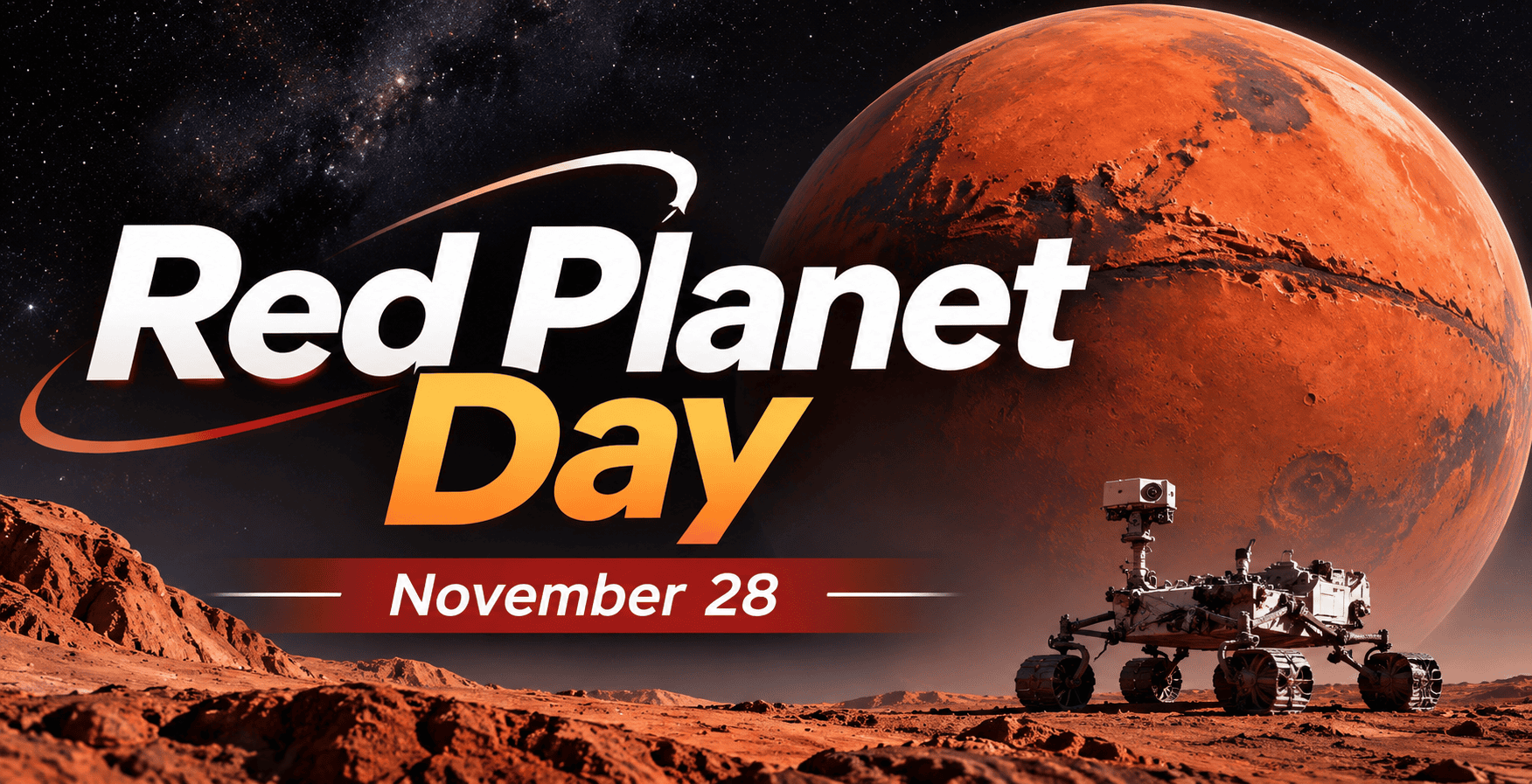
Every year on November 28, space enthusiasts, scientists, astronomers, and curious minds celebrate Red Planet Day, an observance dedicated to Mars, the fourth planet from the Sun. Known for its distinctive reddish appearance, mysterious landscapes, and potential to reveal clues about life beyond Earth, Mars has fascinated humanity for thousands of years.
Red Planet Day celebrates scientific discovery, space exploration, and humanity’s determination to understand the universe. It is also an opportunity to appreciate the extraordinary achievements of space agencies, researchers, and engineers who continue to explore one of our closest planetary neighbors.
From ancient civilizations observing Mars in the night sky to modern robotic explorers searching for evidence of ancient water, the Red Planet has remained one of the most intriguing destinations in our solar system.
When Is Red Planet Day?
Red Planet Day is observed annually on November 28.
The date commemorates NASA’s launch of Mariner 4 on November 28, 1964. This historic spacecraft became the first mission to successfully capture close-up images of Mars during its flyby in July 1965.
Before Mariner 4, scientists relied primarily on telescopic observations to study Mars. The spacecraft’s photographs provided humanity with its first close-range glimpse of the Martian surface, revealing a cratered landscape and changing scientific understanding of the planet.
Although Red Planet Day is an informal observance rather than an official federal holiday, it has become an occasion for celebrating astronomy, planetary science, and space exploration.
Why Is Mars Called the Red Planet?
Mars earned its nickname because of its reddish appearance in the night sky.
The planet’s surface contains significant amounts of iron-bearing minerals. Over time, chemical reactions involving iron and oxygen produced iron oxides, commonly associated with rust.
These iron oxides are found throughout the Martian soil and dust, giving much of the planet its familiar reddish-orange color.
Fine dust particles can also become suspended in the thin Martian atmosphere, contributing to the planet’s distinctive appearance.
Interestingly, Mars is not entirely red. Its surface includes brown, golden, gray, and darker regions, along with white polar ice caps.
Despite these variations, its overall reddish appearance makes Mars one of the most recognizable planets visible from Earth.
The History of Red Planet Day
Human fascination with Mars began long before modern space exploration.
Ancient civilizations observed the planet moving across the night sky and associated its reddish color with powerful gods, warfare, and mythology.
Mars in Ancient Civilizations
The ancient Romans named the planet after Mars, their god of war. Its reddish appearance reminded them of blood and battle.
The ancient Greeks associated the planet with Ares, their god of war.
In ancient Egyptian astronomy, Mars was known by a name often translated as “Horus of the Horizon” and was also associated with its reddish color.
Chinese astronomical traditions identified Mars with the fire element, reflecting its appearance.
These cultural interpretations demonstrate how strongly the planet influenced human imagination long before telescopes existed.
Early Scientific Observations
During the 1600s, astronomers began studying Mars through telescopes.
In 1659, Dutch astronomer Christiaan Huygens produced a drawing showing a recognizable dark feature on the Martian surface.
Later observations helped scientists estimate the planet’s rotation period and identify its polar caps.
During the late 1800s, Italian astronomer Giovanni Schiaparelli described features he called canali, meaning channels.
Some observers interpreted these markings as artificial canals, fueling speculation that intelligent civilizations might exist on Mars.
Although the canal theory was eventually discredited, it helped inspire generations of science fiction writers and space enthusiasts.
The Historic Launch of Mariner 4
The event that inspired Red Planet Day occurred on November 28, 1964, when NASA launched Mariner 4 from Cape Canaveral, Florida.
The spacecraft traveled through space for more than seven months before reaching Mars in July 1965.
On July 14, 1965, Mariner 4 made its historic flyby, collecting scientific measurements and taking photographs of the Martian surface.
The mission returned 21 complete images and a portion of a 22nd image.
These photographs revealed a heavily cratered surface, challenging some earlier expectations that Mars might resemble Earth more closely.
Mariner 4 also provided evidence that the Martian atmosphere was much thinner than scientists had previously estimated.
The mission represented a turning point in planetary exploration and helped establish the foundation for future missions to Mars.
10 Fascinating Facts About Mars
Mars is filled with remarkable features that make it one of the most interesting planets in our solar system.
1. Mars Is the Fourth Planet From the Sun
Mars orbits between Earth and Jupiter.
Its average distance from the Sun is approximately 142 million miles, compared with Earth’s average distance of about 93 million miles.
2. A Day on Mars Is Similar to a Day on Earth
One Martian day, called a sol, lasts approximately 24 hours and 39 minutes.
This makes the Martian day only slightly longer than an Earth day.
3. A Year on Mars Lasts 687 Earth Days
Because Mars travels farther from the Sun and moves along a larger orbit, it takes approximately 687 Earth days to complete one revolution.
4. Mars Has the Largest Known Volcano in the Solar System
Olympus Mons is an enormous shield volcano measuring roughly 13 to 14 miles high, depending on the reference point used.
It towers over the surrounding landscape and is one of the most impressive geological features in the solar system.
5. Mars Has a Gigantic Canyon System
Valles Marineris stretches approximately 2,500 miles across the Martian surface.
This massive canyon system is far longer than Earth’s Grand Canyon.
6. Mars Has Two Small Moons
Mars has two natural satellites named Phobos and Deimos.
Both are irregularly shaped and much smaller than Earth’s Moon.
7. Mars Experiences Seasons
Like Earth, Mars has a tilted rotational axis.
This tilt causes seasonal changes, including variations in temperature and the size of its polar ice caps.
However, Martian seasons last longer because the planet takes more time to orbit the Sun.
8. Mars Has Enormous Dust Storms
Martian dust storms can cover vast regions of the planet.
Occasionally, these storms expand until they obscure much of the planet’s surface.
9. Mars Once Had Liquid Water on Its Surface
Evidence from spacecraft and rovers indicates that rivers, lakes, and other bodies of liquid water existed on ancient Mars.
Scientists continue investigating how long these environments lasted and whether they could have supported microbial life.
10. Mars Is a Major Target for Future Human Exploration
Scientists and engineers are developing technologies that could eventually allow astronauts to travel to Mars.
However, challenges involving radiation, transportation, life support, and long-duration space travel must be addressed before humans can safely explore its surface.
NASA’s Exploration of Mars
Since the historic Mariner 4 mission, numerous spacecraft have helped scientists understand Mars.
Some of the most significant missions include:
Viking 1 and Viking 2 (1976): These missions successfully landed spacecraft on Mars and conducted experiments to investigate the Martian environment.
Mars Pathfinder (1997): This mission delivered the Sojourner rover, demonstrating that a small robotic vehicle could explore the Martian surface.
Spirit and Opportunity (2004): These rovers investigated Martian geology and discovered important evidence of past environments involving water.
Curiosity (2012): NASA’s Curiosity rover began exploring Gale Crater, studying the planet’s geology, climate history, and potential past habitability.
Perseverance (2021): The Perseverance rover landed in Jezero Crater to investigate ancient environments and collect samples that could eventually be studied on Earth.
Ingenuity (2021–2024): This small robotic helicopter demonstrated the first powered, controlled flight on another planet and completed 72 flights during its mission.
Each achievement has expanded scientific knowledge and brought humanity closer to understanding Mars.
Could Life Exist on Mars?
One of the greatest questions surrounding Mars is whether the planet ever supported life.
Scientists have discovered evidence that ancient Mars possessed liquid water, organic molecules, and environments that may have been suitable for microbial organisms.
However, these discoveries do not prove that life existed there.
Mars today is extremely cold and dry, with a thin atmosphere that offers limited protection from harmful radiation.
If life ever developed on Mars, scientists believe evidence of ancient microorganisms might be preserved in certain rocks or sediments.
Researchers are especially interested in locations that once contained lakes, rivers, or underground water systems.
The search for evidence of past life remains one of the most important goals of Martian exploration.
Why Is Exploring Mars Important?
Exploring Mars offers scientific benefits that extend far beyond the planet itself.
By studying Mars, scientists can better understand how rocky planets form and evolve.
Mars also provides valuable information about climate change on planetary timescales.
Evidence suggests that Mars once had a thicker atmosphere and a wetter environment before undergoing dramatic changes.
Understanding those changes may help scientists learn more about planetary atmospheres and the conditions necessary for habitability.
Mars exploration also encourages technological innovation.
Developing spacecraft, robotic systems, advanced communication equipment, and life-support technologies requires engineers to solve difficult problems.
Many of these advances can influence research and technology used on Earth.
Perhaps most importantly, Mars reminds humanity that there are still extraordinary discoveries waiting beyond our planet.
How to Celebrate Red Planet Day
Red Planet Day offers many opportunities to explore astronomy and learn about space.
Here are several meaningful ways to celebrate November 28.
Learn About Mars
Spend time discovering the planet’s geography, atmosphere, moons, and scientific mysteries.
Learning even a few new facts can deepen your appreciation for planetary science.
Look for Mars in the Night Sky
When Mars is visible, try locating it with the naked eye, binoculars, or a telescope.
Its visibility and brightness change depending on its position relative to Earth, so an astronomy guide can help you determine when and where to look.
Watch a Space Documentary
Explore documentaries about NASA missions, robotic rovers, or the possibility of future human exploration.
These programs can make complicated scientific subjects easier to understand.
Visit a Planetarium
A planetarium offers an opportunity to learn about the solar system through educational presentations and immersive displays.
Explore Images of Mars
Study photographs captured by spacecraft and robotic explorers.
Images of mountains, craters, valleys, and ancient riverbeds reveal the planet’s remarkable geological history.
Encourage Children to Learn About Space
Red Planet Day can inspire young people to become interested in astronomy, science, engineering, and mathematics.
Simple activities such as building a model of the solar system or drawing the Martian landscape can make learning enjoyable.
Share Interesting Mars Facts
Celebrate by sharing an educational fact about Mars with friends, family, or social media followers.
A single fascinating discovery can inspire someone else to explore the wonders of space.
The Future of Human Exploration on Mars
The possibility of sending astronauts to Mars has captured the imagination of scientists and the public for decades.
Unlike robotic missions, human exploration would allow astronauts to conduct detailed scientific investigations, make decisions directly on the surface, and study geological features in ways that machines cannot always accomplish.
However, reaching Mars presents enormous challenges.
Traveling to the planet could take several months, depending on spacecraft technology and planetary alignment.
Astronauts would need reliable systems for producing or recycling water, generating oxygen, growing or storing food, and protecting themselves from radiation.
They would also need equipment capable of operating in the harsh Martian environment.
Although no humans have traveled to Mars, ongoing research is helping scientists evaluate what future missions would require.
Red Planet Day provides an opportunity to appreciate how far exploration has progressed while recognizing the discoveries still ahead.
Why Red Planet Day Matters
Red Planet Day is more than a celebration of a distant world.
It represents curiosity, determination, scientific progress, and humanity’s desire to explore the unknown.
The story of Mars exploration demonstrates how knowledge develops over time.
Ancient observers saw a mysterious red light moving across the heavens. Early astronomers studied its surface through telescopes. Spacecraft eventually revealed its landscapes, atmosphere, and geological history.
Today, robotic explorers continue searching for clues about the planet’s past.
Every discovery raises new questions and encourages further investigation.
Mars also reminds us that exploration requires patience, cooperation, innovation, and the willingness to challenge previous assumptions.
These qualities are valuable not only in space exploration but also in everyday life.
The Cultural Impact of Mars
Beyond scientific discovery, Mars has influenced literature, movies, television, music, and popular culture.
For generations, writers imagined Martian civilizations, futuristic colonies, and adventures across the planet’s mysterious surface.
H. G. Wells helped popularize fictional Martian invasions through his 1898 novel The War of the Worlds.
Later, science fiction authors explored the possibility of human settlements and societies on Mars.
Modern films and novels often portray the challenges of surviving on the planet, drawing inspiration from real scientific research.
Although fictional representations sometimes exaggerate Martian conditions, they have helped maintain public interest in planetary exploration.
Science fiction has also inspired individuals to pursue careers in astronomy, aerospace engineering, and scientific research.
Mars demonstrates how imagination and scientific discovery can influence one another.
Final Thoughts on Red Planet Day
Red Planet Day, celebrated every November 28, honors one of humanity’s most fascinating planetary neighbors and the historic launch of Mariner 4 in 1964.
From its rust-colored landscapes and towering volcanoes to its ancient riverbeds and mysterious geological history, Mars continues to inspire scientific curiosity.
The Red Planet has transformed from a distant point of light into a world explored by orbiters, landers, rovers, and even a robotic helicopter.
Yet many important questions remain unanswered.
Did Mars ever support life? What caused its climate to change so dramatically? Could humans eventually establish a sustainable presence there?
These mysteries ensure that Mars will remain an important destination for future scientific exploration.
As we celebrate Red Planet Day, we recognize the achievements of past missions, appreciate the discoveries being made today, and look forward to what future generations may uncover.
The universe is filled with mysteries, and Mars reminds us that every great discovery begins with the courage to explore the unknown.
What fascinates you most about Mars: its mysterious past, the possibility of ancient life, or the dream of humans someday walking on the Red Planet?


Leave a Reply