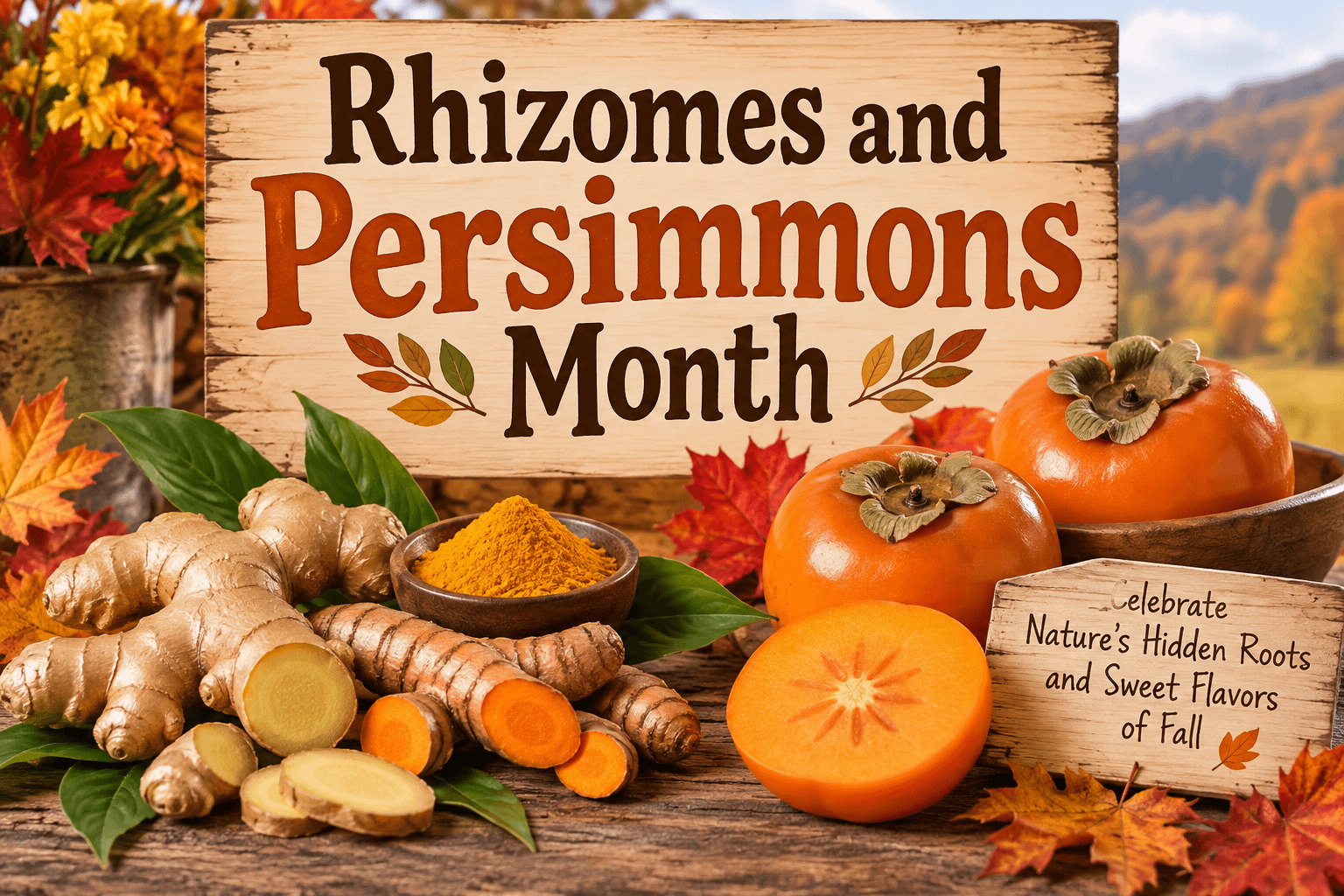
October is filled with the colors, aromas, and flavors of autumn. Pumpkins appear on porches, apples fill farmers markets, and comforting spices begin making their way into everything from baked goods to warm drinks. But among October’s many food celebrations is one of the more unusual observances of the season: Rhizomes and Persimmons Month.
Observed throughout October, Rhizomes and Persimmons Month celebrates two very different groups of foods. Rhizomes grow largely underground and include familiar culinary ingredients such as ginger and turmeric, while persimmons grow on trees and become brilliant orange fruits as autumn arrives.
At first, they may seem like an unlikely combination. One hides beneath the soil while the other hangs brightly from tree branches. One often brings spice, warmth, and earthiness to recipes, while the other offers natural sweetness.
Together, however, they provide a wonderful reminder of just how diverse the fall harvest can be.
What Exactly Is a Rhizome?
The word rhizome may sound unfamiliar, but chances are you have eaten one many times.
A rhizome is a modified underground plant stem. Unlike an ordinary root, a rhizome can produce new shoots and roots from its nodes. Plants use these underground structures to store nutrients and spread.
Some rhizomes have also become important culinary ingredients.
Two of the best-known edible examples are ginger and turmeric. Ginger is valued for its distinctive spicy, slightly citrusy flavor, while turmeric is famous for its earthy flavor and brilliant golden-yellow color. Both have important places in cuisines around the world.
Other plants that grow from rhizomes include certain varieties of bamboo, lotus, galangal, and many ornamental plants.
It is important, however, not to assume that every rhizome is edible. Some plants with rhizomes should never be eaten, so proper identification matters.
Ginger: One of the World’s Most Versatile Rhizomes
Ginger may be the perfect ingredient to experiment with during Rhizomes and Persimmons Month.
Fresh ginger has a powerful aroma and a flavor that can be simultaneously spicy, warm, citrusy, and slightly sweet. That complexity allows it to work in an enormous range of recipes.
Fresh ginger can be grated into stir-fries, curries, marinades, soups, sauces, and salad dressings. It can also be steeped in hot water for tea.
Then there is ginger’s sweeter side.
Gingerbread, ginger cookies, pumpkin desserts, cakes, muffins, and other fall treats frequently use ground ginger to create the warm flavor people associate with cooler weather.
October is therefore an ideal time to rediscover ginger.
Try adding freshly grated ginger to an ordinary recipe and notice how quickly its aroma transforms the dish.
Turmeric: The Golden Rhizome
Turmeric is another rhizome that deserves attention this month.
Its brilliant golden color makes it immediately recognizable. Turmeric is commonly dried and ground into a powder and is widely used in Indian, Middle Eastern, Southeast Asian, and other cuisines.
Turmeric can be incorporated into curries, rice dishes, soups, roasted vegetables, marinades, sauces, and beverages.
Fresh turmeric can also be used much like fresh ginger, although its intense color can easily stain cutting boards, clothing, countertops, and hands.
One of the joys of Rhizomes and Persimmons Month is simply becoming more adventurous with ingredients such as turmeric. You don’t necessarily need an elaborate recipe. Something as simple as adding turmeric to roasted vegetables or experimenting with it in a soup can introduce an entirely different flavor profile.
What Are Persimmons?
If rhizomes represent the hidden side of the autumn harvest, persimmons represent its colorful side.
Persimmons are beautiful fruits that often develop striking orange or reddish-orange colors as they ripen.
Their flavor can range from mildly sweet to incredibly rich and almost honey-like depending on the variety and ripeness.
Two varieties you’re particularly likely to encounter are Fuyu and Hachiya persimmons.
Fuyu persimmons are generally squat and rounded. They can be eaten while still relatively firm and have a crisp texture that makes them easy to slice and enjoy much like an apple.
Hachiya persimmons are more elongated or heart-shaped. They are highly astringent before fully ripening and are generally enjoyed when extremely soft, at which point the flesh develops a rich, almost custard-like texture.
Knowing which variety you purchased can make the difference between a delicious experience and a surprisingly unpleasant one.
Why Some Persimmons Make Your Mouth Feel Dry
Anyone who has bitten into an unripe astringent persimmon probably remembers the experience.
Instead of the sweetness you expected, your mouth suddenly feels incredibly dry and puckered.
That sensation comes from tannins in the fruit.
As an astringent persimmon ripens, its character changes dramatically. What was once unpleasantly puckering becomes wonderfully soft and sweet.
Waiting for a Hachiya persimmon to become properly ripe requires patience, but the transformation is part of what makes the fruit fascinating.
Fuyu persimmons offer a much easier introduction because they can usually be enjoyed while firm.
Enjoying Persimmons Fresh
Sometimes the simplest way to celebrate seasonal produce is the best.
Wash a ripe persimmon, slice it, and taste it on its own.
Fuyu persimmons are particularly convenient for snacking. Slice them into wedges or thin rounds and enjoy them plain.
They can also be added to a fall fruit plate alongside apples, pears, grapes, and pomegranate seeds.
Try adding sliced persimmon to yogurt or oatmeal in the morning.
You can also combine persimmons with greens, nuts, cheese, and a tangy dressing for an autumn salad.
The fruit’s vibrant orange color makes even simple dishes look like something created specifically for fall.
Baking With Persimmons
Persimmons can become even more interesting when used in desserts.
Soft persimmon pulp can be incorporated into breads, muffins, cakes, puddings, cookies, and other baked goods.
Its natural sweetness and moisture can give baked desserts a rich texture.
Persimmon bread is an especially fitting October or November treat. Add familiar fall spices such as cinnamon, nutmeg, ginger, or cloves and the kitchen quickly begins smelling like autumn.
You can also experiment with persimmon muffins, persimmon cake, persimmon cookies, or homemade preserves.
For someone who has never cooked with persimmons, Rhizomes and Persimmons Month provides the perfect excuse to try.
When Rhizomes Meet Persimmons
Perhaps the most interesting way to celebrate the month is to bring its two stars together.
Ginger and persimmon naturally complement each other.
Persimmons provide sweetness while ginger contributes warmth and a little bite.
Imagine a ginger-persimmon smoothie made with ripe persimmon, fresh ginger, yogurt, and cinnamon.
Or try persimmon ginger muffins, combining sweet fruit with warm spice.
A persimmon and ginger chutney could accompany roasted meats or vegetables.
You could even make a seasonal salad featuring sliced Fuyu persimmons with a ginger-based dressing.
The point isn’t necessarily to follow traditional combinations. Part of the fun is experimenting.
A Fall Persimmon and Ginger Smoothie
For a simple seasonal drink, try combining:
- 1 ripe persimmon
- 1 banana
- A small piece of fresh ginger
- 1 cup milk or your preferred alternative
- ½ teaspoon cinnamon
- A handful of ice
Blend everything until smooth.
Adjust the amount of ginger depending on how strong you want the flavor. A small amount adds warmth without overpowering the sweetness of the fruit.
It’s an easy introduction to exactly what this October celebration represents—two very different ingredients working together.
Visit a Farmers Market
Rhizomes and Persimmons Month is also a good reason to visit a local farmers market.
Instead of immediately purchasing your usual produce, spend a little time looking for something unfamiliar.
If persimmons are available, ask the grower which variety they are selling and how they recommend eating them.
Look for fresh ginger or turmeric as well.
Talking directly with farmers can teach you things about seasonal produce that you might never learn while quickly walking through a grocery store.
You might even discover a new favorite ingredient.
Try Growing Rhizomes
Gardeners can take the celebration one step further.
Several rhizomatous plants can be fascinating to grow because much of the action takes place beneath the soil.
Ginger and turmeric are especially interesting examples. Under appropriate growing conditions, the underground rhizomes expand while leafy shoots develop above the soil.
Growing them provides a completely different appreciation for ingredients that are normally encountered cleaned and packaged in a supermarket.
Even if you don’t have a large garden, learning about how rhizomes grow can make you appreciate the remarkable systems plants use to survive and reproduce.
Persimmons and the Beauty of Autumn
Persimmons also have value beyond the kitchen.
A persimmon tree filled with bright orange fruit can be a spectacular autumn sight.
While many trees are losing their leaves, persimmons can appear like glowing ornaments against increasingly bare branches.
That visual contrast captures something special about fall.
Autumn is often associated with endings—leaves falling, temperatures dropping, daylight shortening, and gardens slowing down.
Yet harvest season is also filled with abundance.
Persimmons remind us that even as one season begins fading, nature continues producing something beautiful.
The Mystery Behind the Celebration
Unlike some national food observances with clearly documented founders or organizations, the precise origin of Rhizomes and Persimmons Month is unclear. National Day Calendar says it is still researching the observance’s origins, while other holiday references similarly note that a founder has not been clearly identified.
That doesn’t prevent people from enjoying the idea behind it.
In fact, its unusual combination may be exactly what makes the observance memorable.
There are countless celebrations dedicated to familiar foods such as pizza, cookies, coffee, and desserts. Rhizomes and Persimmons Month encourages us to pay attention to ingredients that might otherwise receive considerably less attention.
Ways to Celebrate Rhizomes and Persimmons Month
Throughout October, challenge yourself to experience these foods in new ways. Pick up a persimmon you’ve never tried before, cook with fresh ginger instead of powdered ginger, experiment with turmeric, bake a persimmon dessert, or combine persimmons and ginger in the same recipe.
You could also visit a farmers market, research the different types of rhizomes growing around the world, learn the difference between Fuyu and Hachiya persimmons, or share your culinary experiments using #RhizomesAndPersimmonsMonth.
The celebration doesn’t have to be complicated.
Sometimes appreciating food simply means slowing down long enough to notice where it comes from, how it grows, and how many possibilities it offers.
From Beneath the Soil to the Autumn Tree
There is something beautifully fitting about celebrating rhizomes and persimmons together.
Rhizomes remind us that some of nature’s most valuable treasures develop where we cannot see them.
Persimmons demonstrate the opposite. Their bright fruit can become one of autumn’s most visible displays.
One grows quietly underground.
The other shines brightly above it.
Yet both eventually reach our kitchens and give us opportunities to experiment with new flavors, recipes, and traditions.
Celebrate Something Different This October
October already gives us plenty to celebrate, but Rhizomes and Persimmons Month encourages us to look beyond the most familiar flavors of fall.
Pick up a piece of fresh ginger.
Experiment with turmeric.
Slice into a crisp Fuyu persimmon.
Wait patiently for a Hachiya persimmon to become perfectly soft.
Bake something you’ve never made before.
Most importantly, use the month as an opportunity to appreciate the incredible variety nature provides.
From the spicy rhizomes hidden beneath the earth to the brilliant orange persimmons hanging from autumn trees, October’s harvest is filled with discoveries waiting to be tasted.
Have you ever cooked with fresh rhizomes or persimmons, and what would you like to make with them this fall?
Leave a Reply