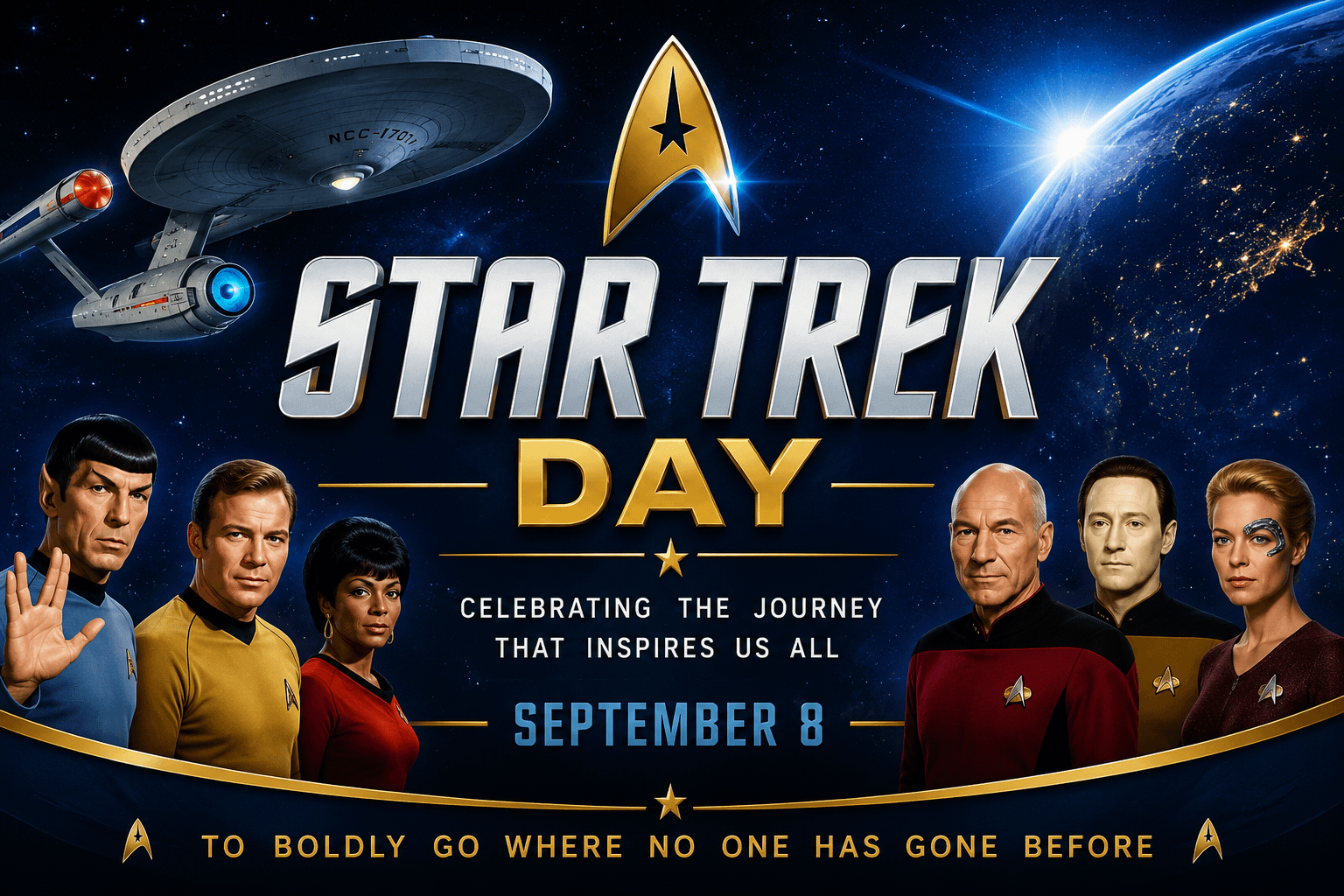
Every year on September 8, science-fiction fans around the world celebrate Star Trek Day, honoring one of the most influential franchises in television and entertainment history.
It all began on September 8, 1966, when American television audiences were introduced to the starship USS Enterprise and its crew. What started as a television series about exploring strange new worlds eventually became something much larger—a cultural phenomenon built around exploration, diversity, cooperation, scientific discovery, friendship, and optimism about humanity’s future.
More than six decades later, Star Trek continues to inspire generations of fans.
From Captain James T. Kirk and Mr. Spock to Captain Jean-Luc Picard, Benjamin Sisko, Kathryn Janeway, Michael Burnham, and the many crews who followed, Star Trek has repeatedly asked viewers to imagine something extraordinary:
What could humanity become if we learned to work together?
Star Trek Day is a celebration of that possibility.
Why Is Star Trek Day Celebrated on September 8?
Star Trek Day commemorates the American television premiere of the original Star Trek series on September 8, 1966.
Created by Gene Roddenberry, the series followed the adventures of Captain James T. Kirk, Mr. Spock, Dr. Leonard “Bones” McCoy, Lieutenant Uhura, Scotty, Sulu, Chekov, and the rest of the crew aboard the USS Enterprise.
Their mission became one of television’s most recognizable concepts: traveling through space, discovering new civilizations, encountering unfamiliar cultures, and exploring the unknown.
The original series initially lasted only three seasons.
At the time, few could have imagined what it would eventually become.
Instead of disappearing after cancellation, Star Trek found an increasingly passionate audience through reruns. Fans organized conventions, wrote letters, collected memorabilia, discussed episodes, and kept the universe alive.
That enthusiasm helped transform a canceled television show into one of the largest science-fiction franchises in history.
A Future Built on Hope
One of the reasons Star Trek has remained relevant is its fundamentally optimistic view of humanity.
Science fiction often imagines futures dominated by destruction, authoritarian governments, environmental catastrophe, artificial intelligence gone wrong, or civilizations struggling to survive.
Star Trek certainly explores conflict and danger, but underneath those stories is something different.
Hope.
The Star Trek universe imagines a future in which humanity has overcome many of the divisions that once separated people.
Earth is no longer defined primarily by wars between nations. Humanity has reached beyond its planet and become part of a larger interstellar community.
Exploration replaces conquest.
Knowledge becomes more important than wealth.
Cooperation becomes more powerful than division.
Curiosity becomes a defining human characteristic.
It is an ambitious vision, but that is exactly why generations have found it inspiring.
Star Trek does not simply ask what technology might look like hundreds of years from now.
It asks what people might become.
The Original Crew That Started It All
The original Star Trek series introduced characters who became cultural icons.
Captain James T. Kirk represented courage, leadership, instinct, and a willingness to make difficult decisions.
Spock, the Enterprise’s Vulcan science officer, became one of science fiction’s most recognizable characters. His struggle to balance logic with his human emotions created some of the franchise’s most memorable stories.
Dr. Leonard McCoy provided another perspective. Emotional, compassionate, outspoken, and frequently frustrated by Spock’s logic, McCoy represented the deeply human side of the crew.
Together, Kirk, Spock, and McCoy formed one of television’s great character dynamics.
But the Enterprise was never just about those three.
Characters including Uhura, Scotty, Sulu, and Chekov helped create a crew that represented an unusually international and diverse vision for 1960s American television.
The bridge of the Enterprise showed viewers a future where people from different backgrounds worked together toward a common purpose.
Nichelle Nichols and the Importance of Lieutenant Uhura
One of Star Trek’s most significant contributions to television history came through Nichelle Nichols, who portrayed Lieutenant Nyota Uhura.
Seeing a Black woman serving as a respected officer on the bridge of a futuristic starship was meaningful during an era when American society was experiencing enormous struggles over civil rights and racial equality.
Uhura was intelligent, capable, professional, and essential to the Enterprise crew.
Her presence helped demonstrate something powerful without requiring a speech in every episode:
In this imagined future, humanity had moved beyond many of the racial barriers that defined the 20th century.
Nichols’ influence eventually reached beyond entertainment. She later worked with NASA to help encourage women and minorities to pursue opportunities in the American space program.
That connection between Star Trek and real-world space exploration became one of the franchise’s most remarkable legacies.
“Live Long and Prosper”
Few phrases from science fiction are as recognizable as:
“Live long and prosper.”
Associated with Spock and the Vulcans, the greeting became part of popular culture far beyond Star Trek fandom.
It represents more than longevity.
It expresses a wish that another person experiences a meaningful, successful, and fulfilling life.
The accompanying Vulcan salute became equally famous.
For many fans, those simple words symbolize something at the heart of Star Trek: the idea that we can wish prosperity for others rather than seeing their success as a threat to our own.
Star Trek: The Next Generation
Star Trek entered a new era in 1987 with Star Trek: The Next Generation.
Set decades after the original adventures, the series introduced a new USS Enterprise commanded by Captain Jean-Luc Picard.
Patrick Stewart’s portrayal of Picard created a different kind of captain.
Where Kirk was often instinctive and action-oriented, Picard frequently relied on diplomacy, philosophy, careful reasoning, and negotiation.
His crew included Commander William Riker, Data, Geordi La Forge, Worf, Beverly Crusher, Deanna Troi, and others who became beloved characters in their own right.
The Next Generation expanded the philosophical side of Star Trek.
Episodes examined artificial intelligence, personal identity, morality, war, prejudice, diplomacy, individual rights, and the responsibilities that come with power.
One of the most fascinating characters was Data, an android who spent much of his existence attempting to understand humanity.
Ironically, his desire to become more human often revealed what being human actually means.
Deep Space Nine and the Complexity of the Future
Star Trek: Deep Space Nine took the franchise in another direction.
Instead of focusing primarily on a starship traveling from planet to planet, the series centered on a space station positioned near a strategically important wormhole.
Captain Benjamin Sisko became the show’s central leader.
Deep Space Nine explored themes that were often darker and more complicated than previous Star Trek stories.
War, religion, politics, occupation, trauma, morality, family, sacrifice, and cultural identity became major parts of the series.
The Dominion War storyline forced characters to confront difficult questions about how far people should go to protect the society they believe in.
It demonstrated that Star Trek’s optimistic future was not automatically guaranteed.
Maintaining those ideals sometimes required courage and sacrifice.
Voyager Goes Far From Home
Star Trek: Voyager introduced Captain Kathryn Janeway, the first woman to serve as the primary captain of a Star Trek television series.
After being transported tens of thousands of light-years away from Earth, Voyager’s crew faced an enormous challenge: finding a way home.
Their journey transformed the series into a story about perseverance.
The crew encountered civilizations the Federation had never seen while attempting to maintain their principles despite being separated from familiar support systems.
Characters including Seven of Nine, the Doctor, Chakotay, Tuvok, B’Elanna Torres, Tom Paris, and Harry Kim helped create another memorable Star Trek family.
Voyager repeatedly explored a question familiar throughout the franchise:
Do your principles still matter when following them becomes difficult?
Star Trek’s answer is usually yes.
The Star Trek Universe Continues Growing
The franchise continued expanding through additional television series and movies.
Star Trek: Enterprise explored humanity’s earlier adventures in deep space before the Federation became the organization familiar to longtime fans.
Later productions introduced new generations of viewers to the universe through series including Star Trek: Discovery, Star Trek: Picard, Star Trek: Strange New Worlds, Star Trek: Lower Decks, and Star Trek: Prodigy.
Each interpretation approaches the Star Trek universe differently.
Some emphasize exploration.
Others focus on humor, adventure, character relationships, political conflict, or the consequences of decisions made across generations.
But the central idea remains recognizable.
There is always another horizon.
There is always something new to discover.
Technology That Inspired Reality
Star Trek has also become famous for imagining technologies that resemble devices eventually developed in the real world.
Characters carried handheld communicators decades before smartphones became common.
They used portable computer tablets long before modern tablets appeared in millions of homes.
Enterprise crew members communicated with computers through spoken commands, something that once seemed futuristic but is now part of everyday technology.
Video communication, advanced medical imaging, automatic doors, voice-controlled computers, and other concepts shown in science fiction gradually became increasingly familiar.
Not every Star Trek technology exists, of course.
Humanity is still waiting for practical transporters, warp drives, replicators, and holodecks.
But the franchise demonstrates an important relationship between imagination and innovation.
Before someone can build something revolutionary, somebody often has to imagine that it might be possible.
The Prime Directive
One of Star Trek’s most interesting concepts is the Prime Directive.
Starfleet officers are generally prohibited from interfering with the natural development of less technologically advanced civilizations.
The idea sounds straightforward.
In practice, it creates enormous moral dilemmas.
What happens when a civilization is facing destruction?
Should Starfleet save millions of people if doing so changes their society forever?
When does helping become interfering?
Can an advanced civilization truly understand the consequences of imposing its values on another culture?
These questions helped Star Trek become more than an adventure series.
Some of its best episodes function almost like philosophical thought experiments.
There may not be an easy answer.
That is the point.
The Meaning of “Infinite Diversity in Infinite Combinations”
Another important philosophy associated with Star Trek is Infinite Diversity in Infinite Combinations, often abbreviated as IDIC.
The concept celebrates the idea that differences can create strength and beauty.
Different cultures.
Different perspectives.
Different experiences.
Different ways of thinking.
Throughout the franchise, characters frequently discover that understanding someone different from themselves requires patience and curiosity.
The message remains remarkably relevant.
You do not have to become identical to someone else to respect them.
Sometimes differences are precisely what allow people to solve problems together.
Friendship Is at the Heart of Star Trek
For all the spaceships, aliens, battles, planets, and futuristic technology, Star Trek ultimately succeeds because of its characters.
Friendship has always been one of the franchise’s strongest themes.
Kirk, Spock, and McCoy.
Picard and his Enterprise crew.
Sisko and Jake.
O’Brien and Bashir.
Janeway and her Voyager family.
Seven and the people who helped her rediscover her humanity.
The characters argue.
They disagree.
They challenge one another.
But when danger arrives, they stand together.
That sense of loyalty is one reason viewers become emotionally attached to these fictional crews.
The Enterprise is not memorable merely because it is a starship.
It becomes memorable because it feels like a home.
Star Trek Fans Built a Community
Star Trek also helped shape modern fan culture.
Long before social media allowed fans to instantly connect, Star Trek enthusiasts organized conventions, fan clubs, newsletters, gatherings, and letter-writing campaigns.
Fans helped keep the franchise alive.
They debated episodes, created costumes, collected memorabilia, learned Klingon phrases, built models of starships, and formed friendships around their shared enthusiasm.
The term “Trekkie” became internationally recognizable.
Star Trek conventions eventually grew into major events where actors, writers, creators, collectors, and fans could celebrate the franchise together.
In many ways, Star Trek fandom helped establish the blueprint for the massive pop-culture convention communities that exist today.
More Than Entertainment
The greatest legacy of Star Trek may be the people it inspired.
Scientists, engineers, astronauts, doctors, writers, programmers, and inventors have spoken about being influenced by the franchise.
For a child watching the Enterprise travel among the stars, science suddenly looked exciting.
Space exploration seemed possible.
Engineering looked adventurous.
Astronomy became a doorway into discovering something enormous.
That is one of science fiction’s greatest powers.
A fictional future can inspire real people to build parts of that future.
Lessons We Can Take From Star Trek
You do not need to travel aboard a starship to appreciate the philosophy behind Star Trek.
Its lessons can apply to everyday life.
Stay curious.
Explore ideas you do not understand.
Listen before judging.
Respect people whose experiences are different from yours.
Use knowledge responsibly.
Stand beside your friends.
Question assumptions.
Choose diplomacy when possible.
Have courage when circumstances demand it.
And never stop wondering what might exist beyond the next horizon.
Star Trek reminds us that exploration is not only about traveling somewhere new.
Sometimes exploration means changing how we see the world.
How to Celebrate Star Trek Day
There are plenty of ways to celebrate September 8.
Watch your favorite Star Trek movie or television episode. Revisit the original series or introduce someone to the franchise for the first time.
Wear a Starfleet shirt or uniform.
Practice your Vulcan salute.
Display your favorite collectibles.
Have a Star Trek marathon with friends or family.
Read about real-world space exploration and discoveries.
Learn about the scientists and astronauts inspired by science fiction.
Or simply spend some time looking at the night sky.
Every star overhead represents another reminder of just how enormous the universe truly is.
Humanity has explored only a tiny fraction of it.
September 8 Celebrates the Adventure That Continues
When Star Trek premiered on September 8, 1966, it was impossible to know how far the Enterprise would ultimately travel.
The original television series became movies.
Those movies led to new television series.
New crews took command.
New generations discovered the franchise.
And Star Trek became something larger than a television show.
It became an idea.
It imagined a future where humanity survives its greatest challenges and eventually learns that cooperation is stronger than division.
It celebrates science without forgetting compassion.
It embraces technology while constantly questioning how technology should be used.
It imagines countless alien civilizations while repeatedly reminding viewers to examine their own humanity.
Perhaps that is why Star Trek continues to resonate after so many decades.
The universe may be enormous.
The future may be uncertain.
There will always be unfamiliar places, difficult challenges, and mysteries waiting beyond the horizon.
But there will also always be opportunities to learn.
To explore.
To understand one another.
And to become something better than we were yesterday.
On Star Trek Day, September 8, fans can celebrate the stories, characters, ships, adventures, friendships, and ideas that have kept this remarkable universe alive since 1966.
And wherever humanity’s journey ultimately takes us, Star Trek leaves us with an invitation that still captures the imagination:
Keep exploring. Keep wondering. Keep looking toward the stars.
Which Star Trek captain, character, series, movie, or moment is your favorite, and what made it memorable to you?
Leave a Reply