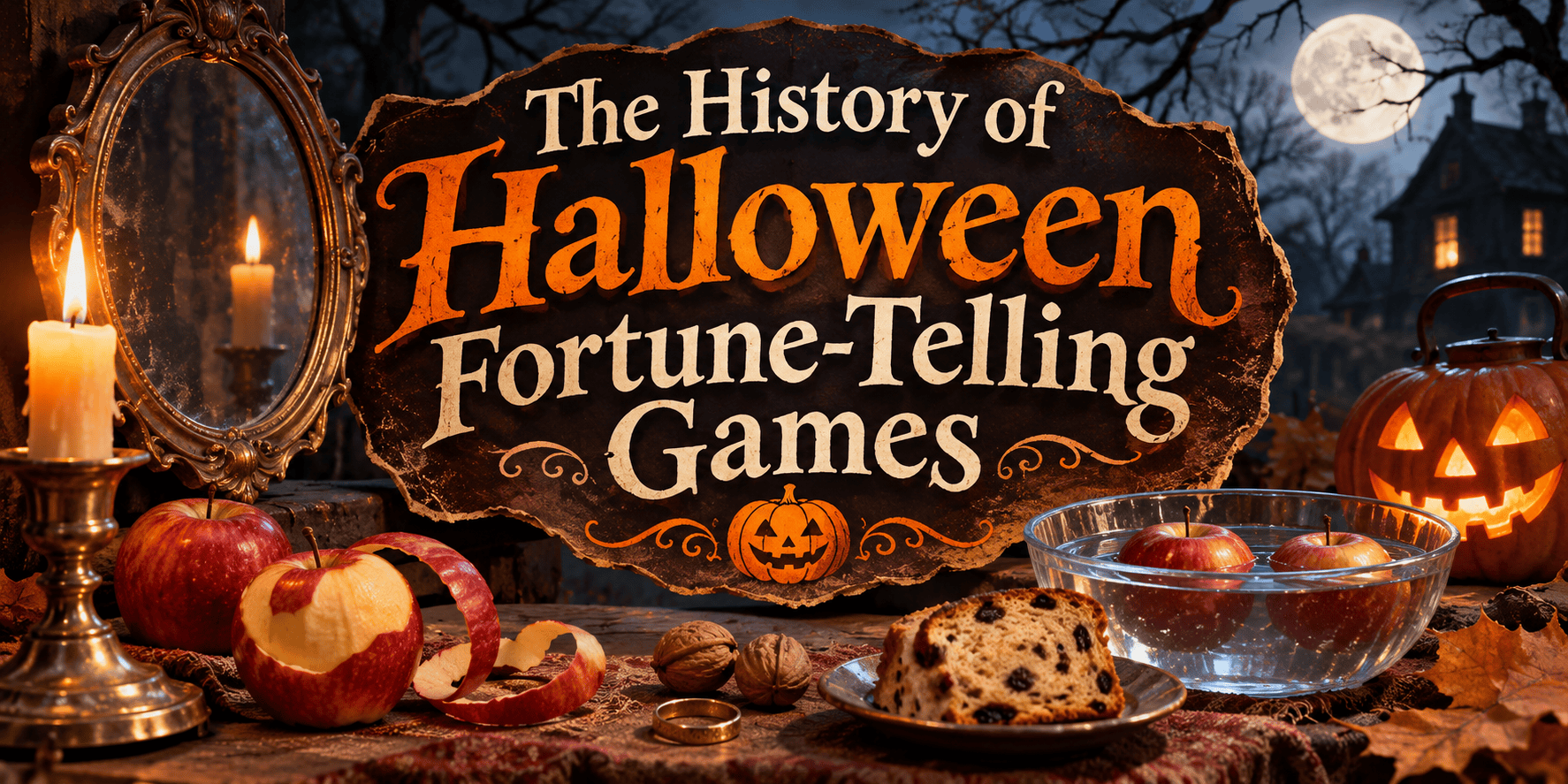
Halloween is known today for costumes, candy, haunted houses, and spooky decorations. However, long before trick-or-treating became a popular tradition, Halloween was also a night when people gathered to play mysterious games designed to predict their futures.
From peeling apples in front of mirrors to tossing nuts into fireplaces, Halloween fortune-telling games were once among the most anticipated activities of the holiday. Young people especially enjoyed these traditions, hoping to discover whom they would marry, whether love would last, and what the coming year might bring.
These games combined ancient folklore, superstition, romance, and entertainment. Although many have disappeared from modern celebrations, they reveal a fascinating side of Halloween history that is often overlooked.
Why Halloween Became Associated With Fortune-Telling
The connection between Halloween and fortune-telling developed from centuries of European seasonal traditions.
Halloween falls on October 31, the evening before All Saints’ Day in the Christian calendar. Its history also intersects with Samhain, a Gaelic seasonal festival marking the transition from the harvest season into winter.
In Irish and Scottish folklore, this time of year was associated with supernatural activity, spirits, and unusual encounters. The changing seasons encouraged beliefs that ordinary boundaries might become less secure and that hidden knowledge could sometimes be revealed.
However, historians cannot establish that every later Halloween fortune-telling custom originated directly from ancient Samhain ceremonies. Many familiar games are documented much later, particularly in eighteenth- and nineteenth-century Britain and Ireland.
By those centuries, Halloween had become an occasion for social gatherings where young people played games involving love, marriage, luck, and predictions about the future.
Some participants took these customs seriously, while others enjoyed them as playful entertainment.
1. Apple Peeling to Discover a Future Spouse
One of the best-known Halloween fortune-telling games involved an ordinary apple.
A young person would carefully peel an apple, attempting to keep the skin in one long, unbroken strip.
Once the peeling was complete, the participant would throw the strip over their shoulder.
According to tradition, the apple peel would land in a shape resembling the first letter of the name of their future husband or wife.
For example, a peel shaped like an M might suggest that the person’s future spouse would have a name beginning with that letter.
The longer and more complete the peel, the better the chance of receiving a recognizable prediction.
This game was especially popular among young people interested in romance and marriage.
Apples were readily available during the autumn harvest, making them convenient objects for seasonal celebrations.
The tradition also demonstrated how ordinary household items could become symbols of mysterious possibilities on Halloween night.
2. Looking Into a Mirror to See a Future Husband or Wife
Another famous Halloween fortune-telling tradition involved mirrors.
According to several versions of the custom, a young woman would enter a darkened room carrying a candle and look into a mirror at midnight.
In some variations, she was instructed to eat an apple or perform another ritual while watching her reflection.
The superstition claimed that the face or image of her future husband might appear behind her in the mirror.
Other versions warned that seeing a frightening image could predict misfortune.
These beliefs made mirror fortune-telling one of Halloween’s more unsettling traditions.
The combination of darkness, candlelight, and anticipation could make an ordinary reflection seem mysterious.
Mirrors had long been associated with supernatural beliefs in European folklore. People sometimes imagined that reflective surfaces could reveal hidden truths or provide glimpses into another world.
By the nineteenth and early twentieth centuries, mirror fortune-telling had become a recognizable theme in Halloween games, stories, and illustrations.
Today, the custom survives mainly through folklore, ghost stories, and historical descriptions.
3. Roasting Nuts to Predict Romantic Relationships
Before Halloween became strongly associated with candy, nuts played an important role in seasonal celebrations.
In parts of Britain and Ireland, Halloween was sometimes called Nut-Crack Night or Nutcrack Night, reflecting the popularity of nuts and fireside entertainment.
One fortune-telling game involved placing two nuts near or inside a fireplace.
Each nut represented someone involved in a possible romantic relationship.
Participants watched how the nuts behaved as they heated.
According to some versions of the superstition, nuts that burned quietly together suggested harmony and lasting affection.
If one nut jumped away, cracked violently, or separated from the other, it could be interpreted as a warning of conflict or an unsuccessful romance.
Different communities sometimes assigned different meanings to the results.
The tradition became particularly famous through the Scottish poet Robert Burns.
In his 1785 poem Halloween, Burns described several Scottish Halloween customs, including the use of nuts to predict romantic outcomes.
His poem remains an important historical source for understanding how Halloween games were practiced in eighteenth-century Scotland.
4. The Halloween Game of Three Bowls
One unusual Scottish Halloween tradition involved choosing between bowls without knowing what they contained.
The custom appears in historical descriptions of Halloween divination, including Burns’s poem.
In a well-known version, three dishes were arranged before a blindfolded participant.
One contained clean water, another contained dirty water, and the third was empty.
The participant reached forward and selected a bowl.
Each choice carried a supposed prediction about marriage.
Clean water suggested marriage to someone who had never been married.
Dirty water suggested marriage to a widow or widower.
An empty bowl suggested that the participant would remain unmarried.
The game was repeated in some versions to test whether the prediction remained consistent.
Although the interpretations reflected the marriage expectations of earlier societies, the tradition illustrates how Halloween entertainment often centered on discovering a person’s romantic future.
5. Finding a Ring in Halloween Food
Food-based fortune-telling was another popular part of Halloween celebrations.
One particularly enduring tradition comes from Ireland, where a fruit bread known as barmbrack became associated with Halloween.
Small objects were sometimes baked into the bread, and each object carried a symbolic meaning.
The most famous was a ring.
Whoever discovered the ring in their slice was believed to be destined for marriage, sometimes within the coming year.
Other objects could represent different fortunes.
A coin might symbolize wealth or prosperity.
A piece of cloth could represent financial hardship.
A thimble or other object might suggest remaining unmarried, depending on the local tradition.
These predictions were not standardized everywhere, and the objects used varied between households and regions.
The tradition remains recognizable in Ireland today, where Halloween barmbrack is still associated with the hidden ring.
Modern celebrations should avoid baking hard or sharp objects directly into food because they can present choking or dental hazards.
6. Pulling Cabbage or Kale to Predict Marriage
One of the strangest historical Halloween fortune-telling games involved vegetables.
In Scotland, young people sometimes visited gardens at night and pulled up stalks of kale or cabbage.
The appearance of the stalk was believed to reveal information about a future spouse.
A straight stalk might suggest an attractive or well-proportioned partner.
A crooked stalk might suggest a different physical appearance.
The amount of soil attached to the roots could supposedly indicate the future spouse’s wealth or financial prospects.
Some versions even involved tasting the stalk to predict the temperament of the person they would marry.
This tradition is another custom described in Robert Burns’s Halloween.
Although it may seem amusing today, it reflected the importance of marriage and economic security in rural communities.
It also shows how closely Halloween fortune-telling was connected to agricultural life.
7. The Halloween Apple Bobbing Tradition
Apple bobbing is one of the few traditional Halloween games that remains familiar to many people.
Participants attempt to grab apples floating in water using only their mouths.
The game has a long association with autumn festivities and Halloween gatherings.
However, apple bobbing was not always simply a competition.
In some versions of Halloween folklore, success in catching an apple was associated with romantic fortune or future marriage.
Certain customs involved identifying apples with potential romantic partners, while others treated the first successful participant as especially fortunate.
The exact rules differed from place to place.
Apples were important seasonal symbols because they were harvested in autumn and frequently appeared in European love-divination traditions.
Over time, apple bobbing became more widely recognized as a party game rather than a serious attempt to predict the future.
Today, individual apples suspended on strings or other no-shared-water variations can provide a more hygienic alternative to traditional communal apple bobbing.
8. Throwing Shoes to Predict Marriage
Shoes were also used in historical fortune-telling customs.
One traditional game involved throwing a shoe over the shoulder or toward a doorway.
The direction in which the shoe landed was interpreted as a prediction about the participant’s future.
In some versions, a shoe pointing toward the door suggested that its owner would soon leave home, perhaps through marriage.
A shoe pointing inward could indicate that the person would remain at home longer.
Similar shoe-divination customs appeared at weddings and other seasonal celebrations, not exclusively on Halloween.
These games reflected a period when marriage often meant leaving one’s family household and beginning a new domestic life.
The symbolism was simple: the direction of the shoe represented the direction of the person’s future.
9. Using Candles to Predict the Future
Candles were important objects in historical Halloween celebrations.
Before electric lighting, candlelight created the atmosphere for evening gatherings and fortune-telling games.
Some customs involved observing candle flames, shadows, or reflections.
Others required participants to carry candles while performing rituals intended to reveal a future spouse.
A steady flame might be interpreted favorably, while unusual movements could be treated as signs of uncertainty.
However, candle interpretations varied widely, and not every candle-related superstition was specifically associated with Halloween.
The connection between flames and supernatural knowledge belonged to a broader collection of European folk beliefs.
On Halloween, the darkness and seasonal atmosphere made candle-based rituals especially dramatic.
10. Dreaming About a Future Spouse
Not every Halloween fortune-telling tradition required a group of people.
Some customs were performed privately before bedtime.
According to various folk beliefs, a person could perform a special ritual on Halloween night and then dream about the individual they would eventually marry.
The rituals differed.
Some involved particular foods, personal objects, or spoken phrases.
Others involved placing something beneath a pillow or following a prescribed bedtime routine.
Similar dream-divination customs were also associated with other dates, including St. Agnes’ Eve and certain midsummer celebrations.
The underlying belief was that dreams could reveal information unavailable during waking life.
For young people living in communities where courtship and marriage carried considerable social importance, the possibility of dreaming about a future partner held obvious appeal.
Why So Many Halloween Games Focused on Marriage
One of the most interesting aspects of historical Halloween fortune-telling is how frequently the games concerned romance.
People wanted to know whom they would marry, when the wedding would occur, whether a relationship would succeed, and whether a future spouse would be wealthy.
This emphasis reflected the social realities of earlier centuries.
Marriage influenced financial stability, household arrangements, social position, and family relationships.
For many young women in particular, marriage could substantially affect their opportunities and future security.
Halloween gatherings provided a socially accepted opportunity to discuss these subjects through games and laughter.
The games could also create opportunities for flirting and interaction between unmarried young people.
Although the predictions were based on superstition rather than evidence, the activities allowed participants to express hopes and anxieties about their futures.
How Halloween Fortune-Telling Became Popular in America
European immigrants carried many Halloween traditions to North America.
Irish and Scottish communities were especially influential in the development of American Halloween customs during the nineteenth century.
As Halloween celebrations became more widespread, fortune-telling games appeared at parties, social gatherings, and community events.
By the late nineteenth and early twentieth centuries, Halloween party guides and magazines frequently recommended games involving apples, mirrors, nuts, and romantic predictions.
Halloween was not yet entirely centered on children collecting candy.
Many celebrations were organized for teenagers and adults.
Parties featured seasonal decorations, refreshments, storytelling, games, and opportunities for socializing.
Fortune-telling was particularly well suited to these gatherings because it created suspense and encouraged participation.
Someone might peel an apple to discover a mysterious initial, while another participant attempted to predict marriage through a hidden object or unusual ritual.
The results often produced laughter, embarrassment, and excitement.
These activities helped make Halloween an important social occasion.
Halloween Fortune-Telling in the Victorian Era
The Victorian period played a significant role in preserving and popularizing Halloween games.
During the nineteenth century, printed accounts of folklore and holiday customs helped spread knowledge of traditional celebrations.
In Britain and North America, Halloween parties increasingly combined older customs with organized indoor entertainment.
Romantic fortune-telling games appealed to young adults because they allowed discussions of courtship within a playful social setting.
The Victorian fascination with spiritualism, ghosts, and supernatural mysteries also contributed to an atmosphere in which unusual predictions could capture people’s imaginations.
However, Halloween fortune-telling and organized spiritualism were not the same practice.
Most traditional Halloween games were folk customs or social amusements rather than attempts to communicate with the dead.
By the early twentieth century, Halloween postcards and party materials often depicted young women looking into mirrors, peeling apples, or attempting to discover the identities of future husbands.
These images provide evidence of how strongly romance and fortune-telling were associated with Halloween before modern trick-or-treating became dominant.
How Halloween Fortune-Telling Games Changed During the 1900s
Halloween celebrations changed significantly during the twentieth century.
Community parties, school events, costumes, and neighborhood activities became increasingly prominent.
Trick-or-treating grew into a major American Halloween custom, particularly during the middle decades of the century.
As Halloween became more child-centered, many older marriage-divination games gradually lost popularity.
Apple bobbing survived because it could easily be adapted into a family-friendly competition.
Other activities, such as mirror rituals and fireplace fortune-telling, became less common.
Changes in household technology also mattered.
Open fireplaces were no longer central gathering places in many homes, making traditional nut-roasting games less practical.
Changing attitudes toward marriage and courtship reduced the importance of some predictions.
Meanwhile, Halloween entertainment increasingly emphasized costumes, horror movies, haunted attractions, decorations, and candy.
Fortune-telling did not disappear completely, but it became a smaller part of the holiday.
Were Halloween Fortune-Telling Games Ever Considered Real?
The answer depends on the period, community, and individual participant.
Some people regarded these customs as genuine ways of discovering hidden information.
Others participated because the games were entertaining or because everyone in the community enjoyed them.
Historical descriptions often combine sincere folk beliefs with humor and social amusement.
Robert Burns’s Halloween, for example, portrays traditional practices in a lively setting where romance, nervous anticipation, and playful behavior overlap.
It would be inaccurate to assume that everyone who participated believed the predictions literally.
Likewise, it would be misleading to describe every custom as nothing more than a joke.
Folklore frequently exists between belief and entertainment.
People may enjoy a ritual, repeat a family tradition, and wonder about its meaning without being completely convinced that it predicts the future.
There is no scientific evidence that apple peels, nuts, mirrors, or hidden objects can reveal future marriages or other personal events.
Their historical importance lies in what they tell us about the hopes, fears, and social customs of earlier generations.
Halloween Fortune-Telling Games That Can Still Be Enjoyed Today
Although most people no longer use Halloween games to predict their futures seriously, several traditional activities can be adapted for modern parties.
Apple peeling can become a lighthearted challenge to see who can create the longest unbroken peel.
A paper version of the three-bowl game can use hidden symbols representing different humorous predictions.
Guests can draw folded slips containing fictional fortunes about adventures, friendships, or unexpected opportunities.
A safe, non-food version of the hidden-ring tradition can involve finding a ring-shaped token among wrapped party favors.
Participants can also create imaginary predictions inspired by historical folklore.
These adaptations preserve the playful atmosphere of traditional Halloween gatherings without requiring participants to believe in supernatural powers.
They also provide an opportunity to explain the historical origins of the games.
What Halloween Fortune-Telling Reveals About the Past
The history of Halloween fortune-telling offers more than a collection of unusual superstitions.
It provides a glimpse into how earlier generations approached uncertainty.
People living centuries ago faced many of the same emotional questions people ask today.
Would they find love?
Would they have a happy marriage?
Would they experience prosperity?
Would their future be better than their present?
Without modern entertainment or technology, communities turned ordinary objects into opportunities for storytelling, laughter, and speculation.
An apple peel could become a mysterious initial.
A nut could represent a romantic relationship.
A cabbage stalk could supposedly reveal the characteristics of a future spouse.
A mirror could become a place where imagination and superstition met.
These games also demonstrate how Halloween blended seasonal celebrations, folklore, social interaction, and supernatural beliefs.
Not every custom came from the same historical period or cultural tradition, but together they helped shape Halloween’s distinctive character.
Why These Forgotten Halloween Traditions Still Matter
Modern Halloween celebrations are very different from those enjoyed two hundred years ago.
Today, people often associate October 31 with elaborate costumes, decorated homes, scary movies, and bags of candy.
Yet the older fortune-telling traditions remind us that Halloween was once closely connected to questions about life’s uncertainties.
For young people in particular, the holiday provided an opportunity to imagine their futures.
Some games were romantic.
Others were frightening.
Many were simply amusing.
Together, they transformed an ordinary autumn evening into a night filled with anticipation and mystery.
Preserving knowledge of these customs helps us understand how Halloween developed across different generations and cultures.
It also reminds us that familiar holidays often contain layers of history that are easy to overlook.
Final Thoughts
The history of Halloween fortune-telling games reveals a fascinating world of folklore, romance, superstition, and seasonal entertainment.
Long before Halloween became dominated by trick-or-treating and haunted attractions, people gathered around fireplaces, peeled apples, examined mirrors, and played unusual games intended to reveal their futures.
Some of these customs grew out of Scottish and Irish traditions, while others belonged to broader European folk practices that became associated with Halloween over time.
Although their supernatural predictions have no scientific basis, the games remain valuable pieces of cultural history.
They show how people used imagination and shared traditions to explore life’s biggest uncertainties.
And perhaps that is what makes these forgotten Halloween customs so interesting.
Beneath the mysterious rituals and unusual predictions were ordinary people wondering about love, happiness, prosperity, and the years ahead.
If you could bring back one old-fashioned Halloween fortune-telling game for a modern Halloween party, which would you choose?

Leave a Reply