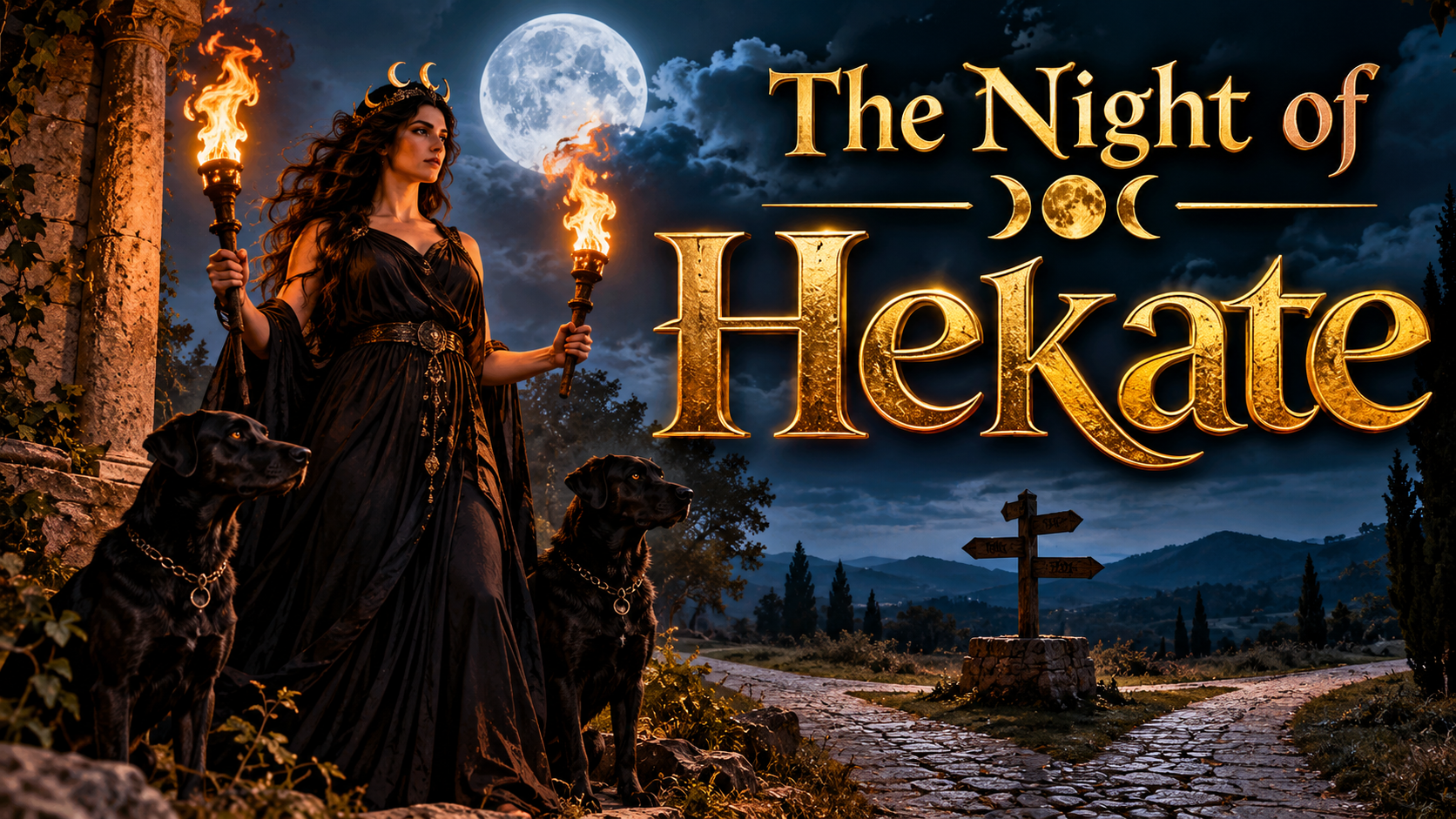
Every year on November 16, some modern Pagans, witches, and followers of ancient Greek religious traditions observe The Night of Hekate, a night associated with mystery, transformation, protection, and the ancient Greek goddess Hekate.
Known as a goddess of crossroads, magic, spirits, and the boundaries between worlds, Hekate has fascinated people for thousands of years. Her presence in Greek mythology represents the unknown, the choices people face, and the mysteries that exist beyond ordinary human understanding.
The Night of Hekate offers an opportunity to explore ancient beliefs, reflect on life’s transitions, and learn how traditions from centuries ago continue to influence modern spiritual practices.
But who was Hekate? Why was she associated with darkness and crossroads? And how did November 16 become connected with her name?
What Is the Night of Hekate?
The Night of Hekate is a modern observance commonly associated with November 16, honoring Hekate, an ancient Greek goddess whose influence extended across several areas of religious and spiritual life.
Although November 16 appears on contemporary observance calendars, historians have not established that this specific date was an annual festival dedicated to Hekate in ancient Greece.
Instead, ancient Greek worship included offerings to Hekate at crossroads, household entrances, and during particular phases of the lunar calendar.
One important tradition was Hekate’s Deipnon, a ritual meal or offering associated with the end of the lunar month.
Modern observances often draw inspiration from these historical practices while introducing contemporary interpretations involving reflection, meditation, candlelight, and personal transformation.
For many participants, the occasion represents a symbolic moment to acknowledge endings, consider new beginnings, and seek wisdom when facing uncertainty.
Who Was Hekate in Greek Mythology?
Hekate, also spelled Hecate, was a powerful and complex goddess in ancient Greek religion.
Unlike deities associated with only one particular responsibility, Hekate possessed influence across multiple realms.
She was connected with the earth, sea, heavens, crossroads, nighttime, spirits, and eventually magic and witchcraft.
In Hesiod’s Theogony, written around the late eighth or early seventh century BCE, Hekate appears as the daughter of the Titans Perses and Asteria.
Hesiod describes her as a goddess honored by Zeus and possessing considerable authority.
This early portrayal is particularly interesting because it differs from the darker image frequently associated with Hekate today.
She was not originally understood simply as a goddess of witchcraft or the underworld.
Instead, she could grant prosperity, success, and favor to those who honored her.
Over time, her religious identity developed, and her associations with spirits, nighttime, magic, and the dead became increasingly prominent.
Her complicated character made her one of the most intriguing figures in Greek mythology.
Why Was Hekate the Goddess of Crossroads?
One of Hekate’s most recognizable associations is with crossroads.
In ancient Greece, crossroads were more than places where roads intersected.
They could represent uncertainty, transition, and the meeting of different paths.
Hekate was believed to have protective powers at these locations, particularly where three roads met.
Statues and images of the goddess were sometimes placed at crossroads or entrances.
Her connection with three-way intersections contributed to artistic representations showing three bodies or three faces looking in different directions.
These images symbolized her ability to watch over multiple approaches.
In modern spiritual interpretations, crossroads often represent important decisions.
A person standing at a crossroads must choose which direction to follow, knowing that different paths may lead to different outcomes.
The symbolism makes Hekate particularly meaningful to people experiencing changes in relationships, careers, personal beliefs, or major life circumstances.
The Connection Between Hekate and the Underworld
Hekate also appears in the ancient Greek story of Persephone.
According to the Homeric Hymn to Demeter, Persephone was taken into the underworld by Hades.
Her mother, Demeter, desperately searched for her missing daughter.
Hekate heard Persephone’s cries but did not witness everything that happened.
Carrying torches, she approached Demeter and helped her seek information about the disappearance.
Later, Hekate became associated with Persephone as a companion.
This mythology strengthened Hekate’s connection with the boundaries between the living world and the underworld.
Her torches became important symbols of guidance through darkness.
Rather than representing darkness alone, Hekate could also represent the light needed to navigate it.
That distinction remains central to many modern interpretations of the goddess.
Why Is November 16 Associated With Hekate?
November 16 is commonly identified as the Night of Hekate on modern calendars of informal holidays and spiritual observances.
However, the historical origins of this particular date are uncertain.
Ancient Greek religious calendars generally followed lunar cycles, and different cities maintained their own festival traditions.
Hekate’s Deipnon was associated with the dark moon, near the end of the lunar month, rather than a fixed November date.
Some modern practitioners recognize November 16 as the Night of Hekate and November 30 as Hekate’s Day at the Crossroads.
These dates should be understood as contemporary observances rather than universally documented ancient Greek festivals.
Recognizing this distinction helps preserve the historical meaning of Hekate’s worship while respecting how religious traditions continue to evolve.
Ancient Traditions Associated With Hekate
Worship of Hekate included several practices that reflected her protective and spiritual responsibilities.
1. Offerings at Crossroads
Ancient worshippers sometimes left food offerings at crossroads associated with Hekate.
These offerings could include cakes, eggs, and other foods, although practices varied by place and period.
They were intended as acts of religious devotion.
2. Hekate’s Deipnon
Hekate’s Deipnon, meaning Hekate’s supper, was connected with the end of the lunar month.
Food offerings were placed outside, sometimes at crossroads.
The ritual was associated with honoring Hekate and addressing spiritual concerns connected with the household.
Modern practitioners sometimes reinterpret the tradition through charitable giving or other symbolic offerings.
3. Torches and Light
Torches frequently appeared in artistic representations of Hekate.
They reflected her connection with nighttime, guidance, and the search for Persephone.
Today, candles often serve as symbolic substitutes in modern observances.
4. Household Protection
Hekate was associated with entrances, gateways, and thresholds.
Images of the goddess could be placed near doorways as protective religious symbols.
This connection emphasized her role as a guardian of boundaries.
5. Honoring the Dead
As Hekate’s mythology developed, she became increasingly associated with ghosts, spirits, and the underworld.
Some modern traditions include remembrance of deceased loved ones, although these practices vary considerably.
Symbols Associated With Hekate
Several objects and animals have become recognizable symbols of the goddess.
Torches: Represent illumination, guidance, and the ability to move through darkness.
Keys: Symbolize access, thresholds, and the opening or closing of doors. Keys are especially prominent in later religious and modern spiritual interpretations.
Dogs: Dogs were closely associated with Hekate in ancient religion and mythology. Their barking was sometimes connected with her supernatural presence.
Crossroads: Represent boundaries, transitions, and choices.
The Moon: Hekate developed lunar associations, although she should not be confused with Selene, the Greek goddess most directly identified with the moon.
Triple-Form Images: Represent her ability to oversee multiple directions and boundaries.
Together, these symbols illustrate the complexity of a goddess whose influence extended beyond a single religious responsibility.
How Is the Night of Hekate Observed Today?
There is no universal method for observing the Night of Hekate.
Modern practices vary among Hellenic polytheists, Pagans, witches, and individuals interested in ancient mythology.
Some people approach the occasion as a religious celebration, while others appreciate its historical and cultural significance.
Common contemporary activities include lighting candles, studying mythology, making appropriate offerings, journaling, meditating, and reflecting on personal decisions.
Others use the occasion to clean their homes, organize meaningful possessions, or release habits they no longer wish to maintain.
Some practitioners choose to honor ancestors or remember loved ones who have died.
For people who do not follow Hekate spiritually, November 16 can simply provide an opportunity to learn about ancient Greek religion and the influence of mythology on contemporary culture.
Hekate and the Meaning of Personal Transformation
One reason Hekate continues to resonate with modern audiences is her association with transitions.
Life regularly presents situations where the future is uncertain.
People change careers, move to unfamiliar places, begin relationships, experience loss, and face decisions that alter their direction.
The crossroads associated with Hekate provide a powerful metaphor for these experiences.
A crossroads does not necessarily represent danger.
It can also represent opportunity.
Sometimes moving forward requires leaving something familiar behind.
Sometimes wisdom means recognizing that a particular path is no longer right.
And sometimes the most important decision is to wait until the direction becomes clearer.
These interpretations are modern reflections inspired by Hekate’s symbolism rather than teachings that all ancient worshippers necessarily shared.
Nevertheless, they help explain why her mythology remains relevant.
Hekate in Modern Witchcraft and Popular Culture
Hekate has become an influential figure in contemporary witchcraft, modern Paganism, literature, and popular entertainment.
She is frequently portrayed as a goddess associated with magical knowledge, independence, and hidden mysteries.
Her name appears in works of literature, including Shakespeare’s Macbeth, where Hecate is connected with supernatural activity and the witches.
Modern fantasy stories also draw inspiration from her mythological identity.
However, fictional portrayals often emphasize frightening or sinister characteristics that do not fully represent her historical religious significance.
In ancient Greek traditions, Hekate could be protective, generous, and powerful.
Understanding her complete history provides a more balanced perspective than viewing her exclusively as a figure of darkness.
Interesting Facts About Hekate
-
Hekate was honored in ancient Greek religion long before the development of modern witchcraft traditions.
-
Hesiod described her as a goddess possessing authority across several realms.
-
She played an important role in the mythological search for Persephone.
-
Dogs were among the animals most closely associated with her.
-
Triple-form representations of Hekate became particularly recognizable in ancient art.
-
Her worship included practices associated with crossroads and household entrances.
-
Hekate’s Deipnon followed the lunar calendar rather than a fixed modern date.
-
Her name is sometimes spelled Hecate in English.
-
Her influence continues through mythology, literature, religious practice, and popular culture.
The Difference Between Ancient Worship and Modern Observances
Understanding the difference between historical traditions and modern celebrations is especially important when discussing the Night of Hekate.
Ancient Greek religion was not a single, completely uniform system.
Religious practices differed between cities, regions, and historical periods.
Likewise, contemporary people who honor Hekate do not necessarily share identical beliefs.
Some attempt to reconstruct historical Greek religious practices as accurately as possible.
Others combine ancient symbolism with newer spiritual traditions.
Still others regard Hekate primarily as a mythological figure worthy of cultural study.
November 16 provides an example of how an ancient deity can become associated with a modern annual observance.
The date’s popularity does not automatically establish it as an ancient festival, but it demonstrates the continuing influence of Greek mythology.
Why the Night of Hekate Still Matters
Thousands of years after the earliest surviving accounts of Hekate, her mythology continues to inspire curiosity.
Her enduring appeal comes partly from the questions represented by her symbols.
What happens when we reach a crossroads?
How do we find direction when the future is unclear?
Why have human societies created stories about guardians, boundaries, darkness, and the unknown?
These questions connect ancient mythology with experiences people still recognize today.
Studying Hekate also provides insight into the religious beliefs of ancient Greece.
Her history reminds us that mythology is rarely simple.
A goddess associated with spirits and darkness could also be associated with protection, prosperity, and guidance.
Her character challenges the assumption that ancient divine figures always belonged to clearly defined categories of good or evil.
Final Thoughts: Remembering the Mysteries of Hekate
The Night of Hekate, observed by some on November 16, brings attention to one of ancient Greek mythology’s most mysterious and multifaceted goddesses.
From her association with crossroads and household protection to her appearance in the story of Persephone, Hekate occupied an important place in ancient religious imagination.
Although the modern November observance should not be confused with a historically established annual festival, it offers an opportunity to appreciate the traditions, symbols, and stories surrounding her.
For some, the night holds religious significance. For others, it provides an opportunity to explore history, mythology, and the ways ancient beliefs continue to shape modern culture.
Perhaps the most enduring image of Hekate is not simply a goddess standing in darkness, but a figure holding torches where different paths meet.
That image captures a timeless human experience: standing before the unknown and searching for the wisdom to choose a direction.
If you were standing at a crossroads in your life, what would help you find the courage and clarity to choose your next path?
Leave a Reply