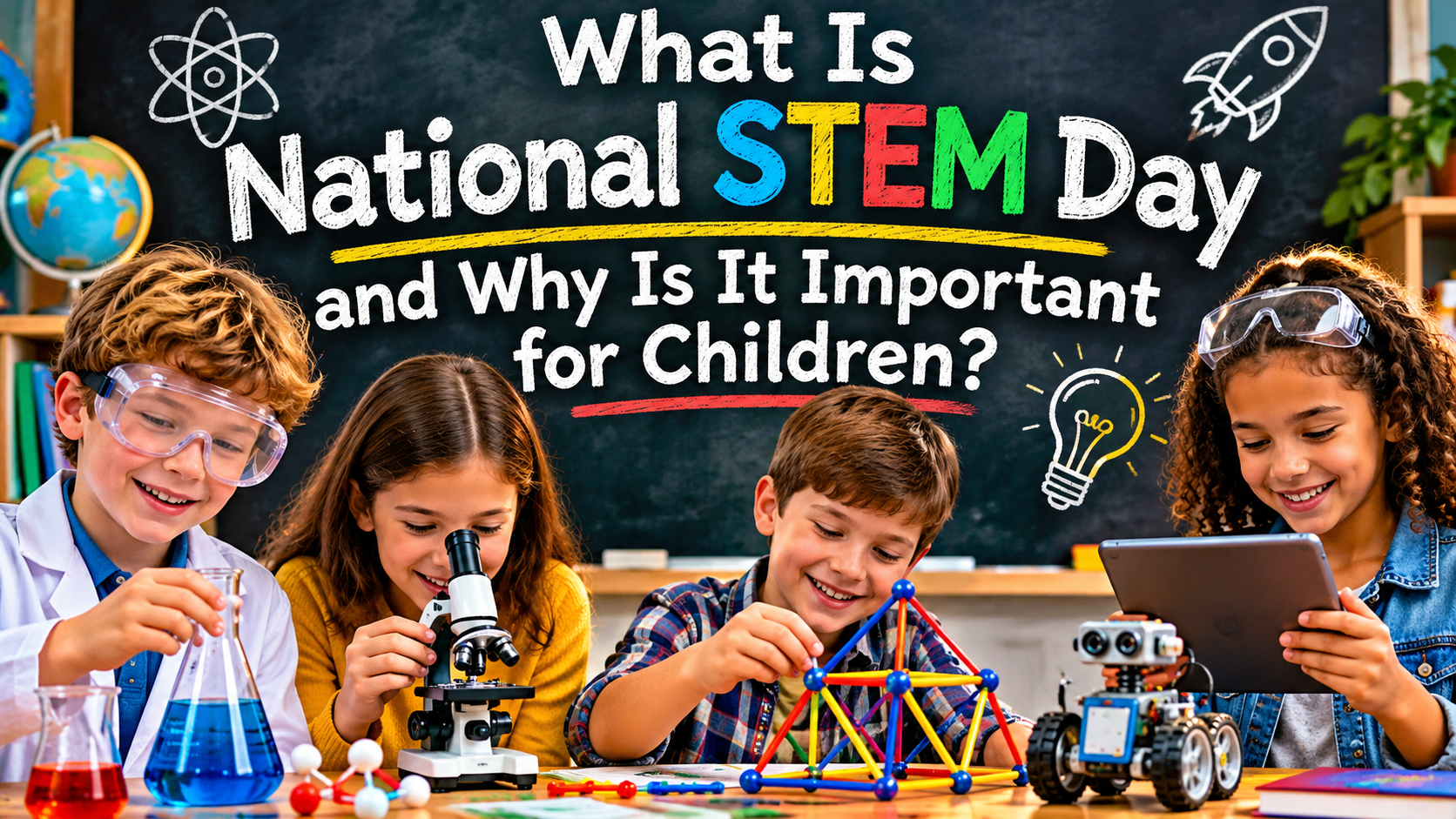
Every year on November 8, National STEM Day celebrates the importance of science, technology, engineering, and mathematics in education and everyday life. This special observance encourages children to explore their curiosity, develop problem-solving skills, and discover how STEM subjects shape the world around them.
From building simple structures with blocks to experimenting with household materials, STEM learning gives children opportunities to ask questions, test ideas, and develop creative solutions. National STEM Day reminds parents, teachers, and communities that learning does not have to be limited to textbooks or classrooms.
As technology continues to influence nearly every aspect of modern society, introducing children to STEM concepts at an early age can help prepare them for future educational opportunities, careers, and everyday challenges.
But what exactly is National STEM Day, why is it celebrated, and how can families encourage children to become interested in science, technology, engineering, and mathematics?
What Is National STEM Day?
National STEM Day is an annual observance celebrated on November 8 in the United States. Its purpose is to promote education and interest in four important academic and professional fields:
-
Science: Understanding the natural world through observation, experimentation, and discovery.
-
Technology: Learning how tools, computers, and digital systems help solve problems and improve everyday life.
-
Engineering: Designing, building, and improving structures, machines, and systems.
-
Mathematics: Developing numerical reasoning, recognizing patterns, and solving problems using logical thinking.
These subjects are closely connected and frequently work together in real-world situations.
For example, designing a bridge requires engineering knowledge, mathematical calculations, scientific principles, and sometimes advanced technology.
National STEM Day encourages children to recognize these connections and understand that STEM learning can be exciting, practical, and accessible.
When Is National STEM Day Celebrated?
National STEM Day is celebrated annually on November 8.
Sunday, November 8, 2026
National STEM Day 2026
Schools, libraries, museums, educational organizations, and families may recognize the occasion through hands-on experiments, educational workshops, classroom activities, and community events.
Although November 8 provides a special opportunity to highlight STEM education, children can benefit from exploring these subjects throughout the year.
What Is the History of National STEM Day?
National STEM Day is commonly associated with an initiative launched by MGA Entertainment in 2015 to encourage children to explore science, technology, engineering, and mathematics.
The observance helped draw attention to the importance of making STEM subjects enjoyable and accessible to young learners.
The broader STEM education movement developed over many years as educators, researchers, and policymakers recognized the importance of preparing students for an increasingly technological world.
STEM education emphasizes connections between academic subjects rather than treating science, mathematics, technology, and engineering as completely separate disciplines.
Today, National STEM Day serves as an opportunity to promote curiosity, innovation, creativity, and educational opportunities for children from different backgrounds.
Why Is National STEM Day Important for Children?
National STEM Day matters because it highlights skills that children can use throughout their education and adult lives.
STEM education is not simply about preparing children to become scientists, engineers, or computer programmers. It also encourages important abilities that apply to everyday situations.
1. STEM Education Encourages Critical Thinking
Children naturally ask questions about how things work.
Why does ice melt? How do airplanes fly? What makes plants grow? Why do some objects float while others sink?
STEM activities encourage children to investigate these questions instead of simply memorizing answers.
Through observation, experimentation, and discussion, children learn to examine information, consider possible explanations, and draw conclusions based on evidence.
These critical-thinking skills can help them make informed decisions throughout their lives.
2. STEM Activities Develop Problem-Solving Skills
One of the greatest benefits of STEM education is its emphasis on solving problems.
Children may be challenged to build a tower that will not collapse, create a paper airplane that travels farther, or design a simple device using recycled materials.
When their first attempt does not work, they must consider what went wrong and try another approach.
This process teaches persistence, adaptability, and the importance of learning from mistakes.
Rather than viewing failure as the end of an activity, children can begin recognizing it as part of discovery.
3. STEM Learning Builds Creativity and Imagination
Although STEM subjects are often associated with numbers and technical knowledge, creativity plays an important role in scientific and technological innovation.
Engineers must imagine new designs. Scientists develop creative experiments. Programmers find different ways to solve challenges.
Children who participate in STEM activities can combine imagination with practical thinking.
For example, building a model city from cardboard allows children to explore engineering principles while expressing their creativity.
National STEM Day celebrates the relationship between imagination and discovery.
4. STEM Education Helps Prepare Children for Future Careers
Science, technology, engineering, and mathematics influence numerous industries, including healthcare, transportation, agriculture, construction, manufacturing, and communications.
Potential STEM-related careers include software development, environmental science, medical research, robotics, engineering, cybersecurity, and data analysis.
Not every child will choose a STEM career, and that is perfectly reasonable.
However, early exposure can help children discover interests and talents they might otherwise never explore.
A child who enjoys building structures may develop an interest in architecture or engineering. Another who loves studying animals may become interested in biology or veterinary science.
National STEM Day introduces children to possibilities they may not yet know exist.
5. STEM Activities Encourage Teamwork and Communication
Many STEM projects involve collaboration.
Children working together to build a bridge, conduct an experiment, or design a robot must share ideas, communicate clearly, and consider different approaches.
These experiences help develop cooperation, listening skills, and respect for other people’s perspectives.
Working as a team also teaches children that complex problems often benefit from multiple viewpoints.
Why Should Children Learn STEM at an Early Age?
Early childhood is an important period for developing curiosity and foundational learning skills.
Young children naturally experiment with their surroundings. They stack objects, explore textures, recognize patterns, and ask questions about everyday experiences.
These activities already involve basic STEM concepts.
For example, a toddler stacking blocks explores balance and gravity. A preschooler sorting colorful objects practices classification and early mathematical thinking.
Introducing age-appropriate STEM activities can build on children’s natural interests.
Early STEM experiences may help children develop confidence in their abilities and become more comfortable exploring unfamiliar ideas.
The goal is not to pressure young children into advanced academic work. Instead, it is to create enjoyable learning experiences that encourage exploration.
What Are Some Fun National STEM Day Activities for Kids?
Families and educators do not need expensive equipment or specialized laboratories to celebrate National STEM Day.
Many engaging STEM activities use ordinary household materials.
1. Build a Homemade Volcano
A baking soda and vinegar volcano is a popular introductory science experiment.
Children can create a small volcano model using a container and modeling clay, then combine baking soda with vinegar to observe a chemical reaction.
The reaction produces carbon dioxide gas, creating bubbles and foam.
This activity introduces basic chemistry while encouraging children to make predictions and observe results.
2. Create a Paper Bridge
Give children paper, tape, and two sturdy supports.
Challenge them to build a bridge capable of holding small objects.
They can experiment with folding paper, changing the bridge’s shape, and adjusting the supports.
This activity introduces engineering concepts involving structure, stability, and weight distribution.
3. Grow Seeds in a Clear Container
Plant beans or other easy-to-grow seeds in a transparent container with suitable growing material.
Children can observe changes over several days, including root development and early plant growth.
Encourage them to record their observations and discuss the conditions plants need to survive.
This activity introduces biology and scientific observation.
4. Make a Balloon-Powered Car
Using lightweight materials, wheels, a straw, and a balloon, children can construct a simple vehicle powered by escaping air.
When the balloon releases air backward, the vehicle can move forward.
This experiment introduces motion, forces, and basic engineering design.
Adult supervision is important when working with small parts and balloons.
5. Explore Coding Through Games
Coding activities introduce children to logical thinking, sequencing, and problem-solving.
Younger children can begin with unplugged coding games that involve giving directions or arranging instructions in the correct order.
Older children may enjoy beginner-friendly visual programming activities that allow them to create animations or simple games.
Coding helps demonstrate how technology follows organized instructions.
6. Conduct a Sink-or-Float Experiment
Fill a container with water and gather several safe household objects.
Ask children to predict which objects will float and which will sink.
After testing their predictions, discuss how materials, shape, and density affect the results.
This simple experiment encourages observation, comparison, and scientific reasoning.
How Can Parents Encourage STEM Learning at Home?
Parents play an important role in supporting children’s curiosity.
Encouraging STEM learning does not require advanced scientific knowledge or expensive educational products.
Simple everyday interactions can introduce valuable concepts.
Cooking together teaches measurement, temperature, and chemical changes. Gardening introduces biology, weather, and environmental science. Building with blocks develops spatial reasoning and engineering skills.
Parents can also encourage learning by asking open-ended questions.
Instead of immediately explaining why something happens, ask children what they think might happen next or how they could test their ideas.
Allowing children to investigate and experiment helps them become active participants in their education.
Most importantly, parents can create an environment where asking questions and making mistakes are accepted parts of learning.
How Can Schools Celebrate National STEM Day?
Schools can recognize National STEM Day by organizing activities that make STEM subjects engaging and accessible.
Teachers may introduce classroom experiments, engineering competitions, robotics demonstrations, mathematics challenges, or collaborative design projects.
Schools can also invite professionals working in STEM-related careers to speak with students about their experiences.
Hearing from scientists, engineers, healthcare professionals, and technology specialists can help children understand how classroom subjects connect with real occupations.
Libraries and community organizations may also host educational workshops or demonstrations.
These activities can make National STEM Day a meaningful experience for students with different interests and learning styles.
Why Is STEM Education Important for Girls and Underrepresented Students?
National STEM Day also provides an opportunity to encourage greater participation among students who may face barriers to STEM education.
Historically, some STEM fields have experienced unequal representation across gender and demographic groups.
Providing children with supportive learning environments, positive role models, and access to educational resources can help address these barriers.
Girls and boys should have equal opportunities to explore robotics, engineering, coding, mathematics, and scientific discovery.
Children from underserved communities also benefit from access to educational programs, technology, and hands-on learning experiences.
Encouraging participation from diverse backgrounds can help more young people recognize that STEM opportunities are available to them.
What Is the Difference Between STEM and STEAM Education?
STEM stands for science, technology, engineering, and mathematics.
STEAM includes these four subjects while adding the arts.
The arts component can involve visual design, creative expression, music, and other artistic disciplines.
STEAM education emphasizes how creativity and technical knowledge can complement one another.
For example, designing a video game may require programming, mathematical reasoning, visual artwork, and storytelling.
Similarly, architecture combines engineering principles with artistic design.
Both STEM and STEAM approaches encourage children to connect ideas across different subjects and develop practical skills.
Frequently Asked Questions About National STEM Day
Is National STEM Day a Federal Holiday?
No. National STEM Day is an educational observance rather than a federal holiday.
Schools, government offices, and businesses generally operate according to their regular schedules.
What Age Group Is National STEM Day For?
National STEM Day can be celebrated by children of all ages, from preschool students to teenagers.
Activities should be adapted to match children’s developmental stages, abilities, and interests.
Why Is November 8 National STEM Day?
November 8 is the established annual date for the observance promoted by MGA Entertainment. It is sometimes associated with the wordplay of November 8 being written as NOV8, resembling “innovate.”
Can Families Celebrate National STEM Day for Free?
Yes. Families can celebrate using household materials, outdoor observations, library resources, and simple educational activities.
STEM learning does not have to involve expensive technology.
What Is the Main Goal of National STEM Day?
The primary goal is to encourage interest in science, technology, engineering, and mathematics while helping children recognize the importance of these subjects in everyday life.
How Does STEM Education Help Children in Everyday Life?
STEM learning helps children practice reasoning, measurement, observation, planning, and problem-solving.
These abilities can be useful when cooking, managing money, understanding technology, completing school assignments, and making everyday decisions.
Why National STEM Day Matters for the Future
National STEM Day is about more than celebrating academic subjects. It is about encouraging the next generation to become curious thinkers, creative problem-solvers, and confident learners.
Children growing up today will encounter technologies and challenges that continue to evolve.
Developing a foundation in scientific reasoning, mathematical thinking, and technological understanding can help them navigate those changes.
Equally important, STEM education encourages children to recognize that their questions and ideas have value.
A simple childhood experiment may inspire a lifelong interest in science. Building a model bridge could spark curiosity about engineering. Learning basic coding might introduce a child to new creative possibilities.
These early experiences can influence how children approach learning and problem-solving in the years ahead.
Final Thoughts: Celebrating National STEM Day With Children
National STEM Day, celebrated every November 8, reminds us that curiosity is one of the most powerful tools children possess.
Science, technology, engineering, and mathematics are not simply subjects found in school textbooks. They are part of the world children experience every day.
Whether children are planting seeds, building structures, experimenting with water, exploring computers, or asking questions about nature, they are developing skills that can support their future learning.
Parents, teachers, and communities can make a meaningful difference by providing opportunities for exploration, encouraging questions, and celebrating the process of discovery.
The greatest gift of National STEM Day may not be teaching children every answer. It may be inspiring them to keep asking questions, exploring possibilities, and believing they are capable of discovering something new.


Leave a Reply