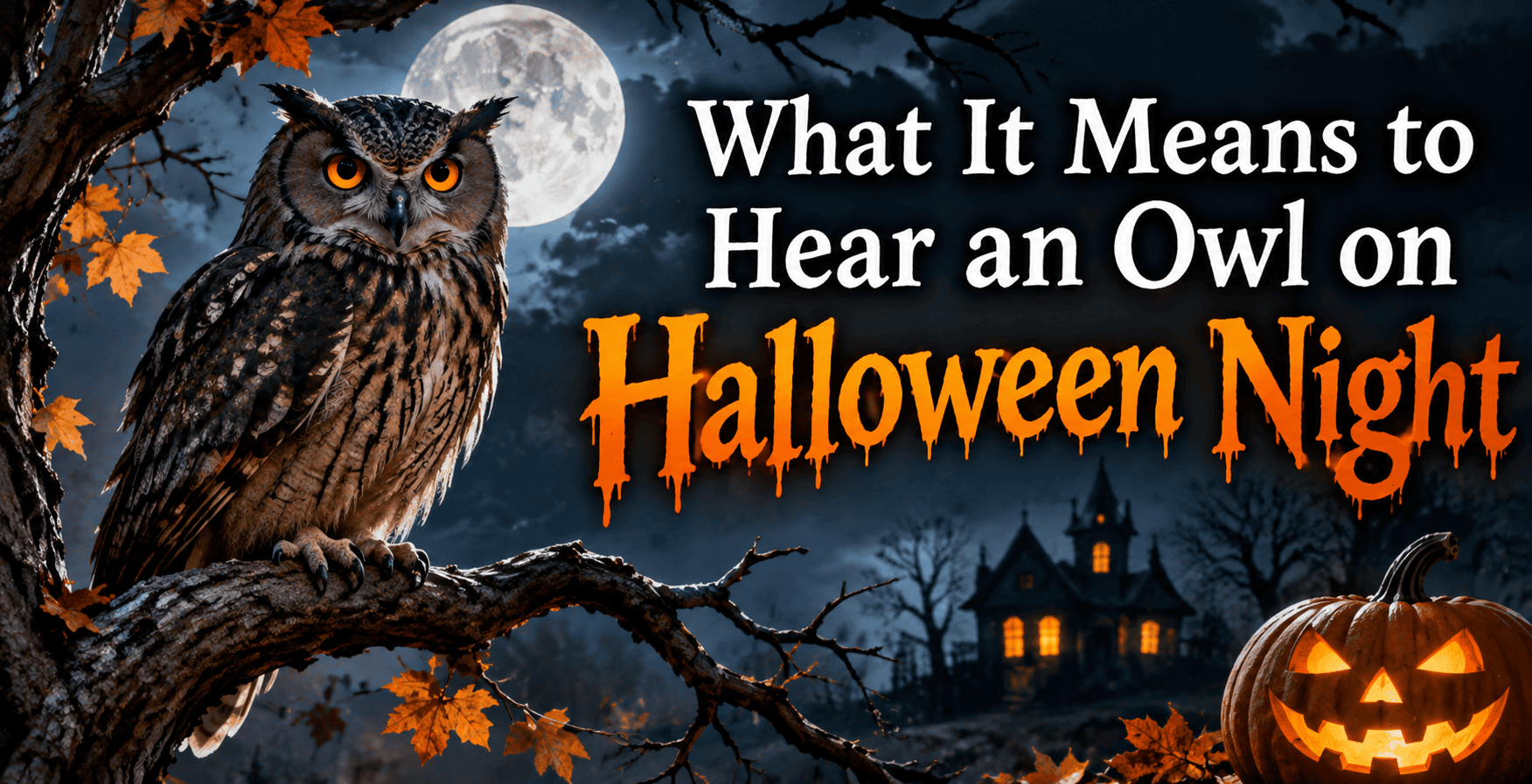
Halloween is a night filled with mystery, superstition, and traditions that have been passed down for generations. From black cats crossing our paths to strange shadows appearing in the darkness, certain sights and sounds have long been associated with the supernatural. Among the most mysterious of these is the haunting call of an owl echoing through the night.
Hearing an owl on Halloween night has fascinated people for centuries. In some cultures, the sound is believed to be a warning of approaching danger or death. In others, it represents wisdom, protection, spiritual awareness, or a message from beyond the physical world.
But what does it really mean when you hear an owl hooting on Halloween?
The answer depends on history, folklore, cultural beliefs, and how people have interpreted these mysterious birds throughout the centuries.
Why Owls Are Associated With Halloween
Owls have become one of Halloween’s most recognizable symbols, appearing alongside witches, pumpkins, bats, and black cats.
Their connection to Halloween comes largely from their nighttime behavior and their long association with mystery and the supernatural.
Unlike many birds that are most active during daylight hours, numerous owl species hunt after sunset. Their ability to move almost silently through the darkness makes them seem especially mysterious.
Their large, forward-facing eyes, unusual calls, and ability to turn their heads through an extraordinary range of motion have also contributed to their reputation as creatures possessing unusual powers.
Before people understood much about owl behavior, these characteristics sometimes inspired supernatural explanations.
An owl calling from a dark forest or sitting silently on a rooftop could easily become the subject of frightening stories.
Over time, European folklore and later Halloween imagery helped establish the owl as a symbol of nighttime mystery.
Today, an owl’s haunting call remains one of the sounds people most strongly associate with a spooky Halloween atmosphere.
1. Hearing an Owl Was Once Considered a Warning of Death
One of the oldest and most unsettling owl superstitions is the belief that hearing one at night predicts death.
In some European traditions, an owl calling near a home was interpreted as an omen that someone in the household might soon die.
The belief was particularly frightening when an owl repeatedly called from a nearby tree, roof, or window.
People sometimes believed the bird was announcing an approaching tragedy.
The association between owls and death also appears in ancient Roman accounts, where certain owl sightings and calls were interpreted as unfavorable omens.
These beliefs developed partly because owls were active in darkness, a time historically associated with danger, uncertainty, and the unknown.
On Halloween, when traditional stories suggest the boundary between the living and the dead becomes thinner, an owl’s call could seem especially ominous.
However, there is no scientific evidence that hearing an owl predicts death or misfortune.
The superstition reflects historical fears rather than any actual supernatural ability.
2. Some Believe an Owl Is a Messenger From the Spirit World
Another interpretation of hearing an owl on Halloween involves communication with spirits.
Halloween has historical connections to Samhain, a seasonal festival observed in ancient Celtic societies.
Samhain marked the transition from the harvest season into winter and was associated in some traditions with encounters between the human world and the supernatural.
As Halloween customs developed, stories about ghosts, spirits, and mysterious nighttime visitors became increasingly common.
Within broader folklore, owls were sometimes imagined as creatures capable of traveling between the physical and spiritual worlds.
Their ability to appear unexpectedly and disappear silently into the darkness contributed to this reputation.
Some modern spiritual interpretations suggest that hearing an owl could symbolize a message from someone who has passed away.
Others interpret the call as a reminder to reflect on memories, relationships, or unresolved emotions.
These are personal and cultural interpretations, not established facts about owls.
Still, the symbolism helps explain why hearing an owl on Halloween can feel particularly meaningful to some people.
3. An Owl’s Call Can Symbolize Wisdom and Hidden Knowledge
Not every owl superstition is frightening.
In ancient Greek mythology, owls were closely associated with Athena, the goddess of wisdom and strategic warfare.
The little owl became an important symbol connected with Athena and the city of Athens.
Because of this association, owls came to represent intelligence, observation, and knowledge.
This symbolism continues today.
Owls frequently appear in books, artwork, educational imagery, and popular culture as wise creatures.
In modern symbolic interpretations, hearing an owl on Halloween might represent the importance of paying attention to something you have overlooked.
It may also be viewed as an invitation to trust your judgment or think carefully before making an important decision.
Although these interpretations are not scientifically supported messages from the bird, they demonstrate how the same animal can represent very different ideas across cultures.
For some people, an owl is frightening.
For others, it is a symbol of understanding.
4. Hearing an Owl Three Times Was Considered Especially Ominous
Numbers have played an important role in superstition for centuries, and the number three appears frequently in folklore.
In some versions of owl-related folk beliefs, hearing repeated calls was thought to strengthen the significance of the omen.
A story might claim that hearing an owl three times meant danger was approaching or that an important event would soon occur.
However, there is no single universal tradition establishing three owl calls as a warning.
Such interpretations vary between communities, storytellers, and regional customs.
In reality, owls often call repeatedly because vocal communication is an essential part of their behavior.
They may be defending territory, communicating with a mate, or responding to another owl.
What once sounded like a supernatural warning may simply be an ordinary nighttime conversation between birds.
5. Owls Have Long Been Connected to Witches
One reason owls appear so frequently in Halloween decorations is their association with witches and magic.
In European folklore, certain nocturnal animals were believed to have connections with supernatural powers.
Cats, bats, toads, and owls all appeared in different magical stories and traditions.
Some tales described witches taking animal forms, while others associated animals with magical companions or nighttime activities.
Owls fit naturally into this imagery because of their silent flight, mysterious appearance, and haunting calls.
Their ability to see and hunt in low light also contributed to the impression that they possessed unusual abilities.
During later centuries, Halloween illustrations, greeting cards, decorations, and entertainment helped strengthen the visual connection between owls and witchcraft.
An owl perched beside a witch or sitting on a crooked tree branch became a familiar Halloween scene.
Although owls have no actual connection to witchcraft, their place in Halloween folklore remains strong.
6. An Owl Near Your House Was Believed to Carry a Special Meaning
Hearing an owl in the distance is one thing.
Hearing one directly outside your bedroom window on Halloween night can feel entirely different.
Some traditional superstitions treated an owl calling near a home as particularly significant.
Depending on the region, people interpreted it as a warning, a sign of approaching visitors, or an indication that something unusual might happen.
Other interpretations were more positive, connecting the bird with watchfulness or protection.
These beliefs were not consistent across cultures.
In practical terms, an owl calling near a house may simply have found a suitable hunting area or resting place.
Residential neighborhoods can provide owls with trees, open spaces, rodents, and other prey.
An owl may also use a rooftop, fence, or branch as a convenient place from which to call.
Its presence does not indicate that anything supernatural is happening inside the home.
7. Different Cultures Have Different Beliefs About Owls
One of the most interesting aspects of owl folklore is how dramatically its meaning changes between cultures.
In ancient Greece, the owl was closely connected with wisdom through Athena.
In some ancient Roman traditions, owls were associated with unfavorable omens and disturbing nighttime events.
In parts of European folklore, owls were linked with death, witchcraft, and supernatural warnings.
Some Indigenous American traditions also assign spiritual or symbolic significance to owls, but these beliefs differ greatly among individual nations and communities. It would be inaccurate to describe one interpretation as representing all Indigenous cultures.
In Japanese culture, owls can be associated with good fortune and protection, partly through wordplay involving the Japanese word for owl, fukurō.
These differences reveal something important.
The meaning attached to an owl often tells us more about human traditions than about the bird itself.
The same nighttime call can inspire fear in one community and comfort in another.
8. Why Hearing an Owl on Halloween Feels So Mysterious
There is a psychological reason an owl’s call can feel more frightening on Halloween than on an ordinary night.
Expectations influence how people interpret unfamiliar sounds.
On Halloween, people are surrounded by imagery involving ghosts, haunted houses, witches, and supernatural events.
A sound that might otherwise go unnoticed can suddenly seem meaningful.
Imagine standing outside on a cool October evening.
The neighborhood is quiet.
Leaves rustle in the trees.
The moon appears between passing clouds.
Then, from somewhere in the darkness, an owl begins calling.
The sound echoes across the neighborhood.
You cannot immediately see where it is coming from.
Because Halloween is already associated with mystery, your imagination may begin connecting the sound with stories you have heard.
This does not mean anything supernatural is happening.
It means atmosphere, memory, and expectation can influence the way we experience the natural world.
9. What Does It Mean When an Owl Hoots at Midnight?
Midnight has long held a special place in folklore.
It is often portrayed as the hour when ghosts appear, magical events occur, and supernatural forces become more active.
Because Halloween is associated with these traditions, hearing an owl at midnight can seem especially eerie.
In some popular interpretations, an owl calling at midnight symbolizes change, hidden knowledge, or a warning to remain alert.
Others connect it with spirits or the unknown.
However, owls do not recognize midnight as a supernatural hour.
Many owl species are active throughout different portions of the night.
Their calling patterns depend on factors such as species, season, territory, and breeding behavior.
An owl hooting at midnight is usually doing exactly what owls naturally do.
The mystery comes from the stories people have attached to the sound.
10. Can Hearing an Owl on Halloween Mean Good Luck?
Although owls are frequently portrayed as frightening Halloween creatures, some traditions view them positively.
Owls can symbolize wisdom, protection, good fortune, and awareness.
In certain cultural and personal interpretations, seeing or hearing an owl may be considered a favorable sign.
Some people associate an owl’s appearance with the beginning of a new chapter in life.
Others see it as a reminder to observe their surroundings carefully or approach decisions thoughtfully.
These interpretations are symbolic rather than predictive.
There is no evidence that hearing an owl creates good luck or bad luck.
Nevertheless, positive owl symbolism provides an interesting contrast to the frightening stories that dominate Halloween folklore.
11. What Science Says About Owls Hooting at Night
While folklore offers mysterious explanations, wildlife biology provides practical reasons owls make sounds after dark.
Owls use vocalizations to communicate with one another.
Different species produce different calls, including hoots, whistles, screeches, barks, and other sounds.
Some of the most common reasons owls call include:
-
Territorial communication: Owls may call to establish or defend their territory.
-
Attracting mates: Vocalizations can help individuals locate and communicate with potential partners.
-
Maintaining contact: Owl pairs may use calls to communicate with each other.
-
Responding to other owls: One owl’s call may trigger a response from another nearby.
-
Defensive behavior: Certain calls can signal agitation or warn other animals away.
Not all owls make the familiar deep hooting sound.
For example, barn owls are known for harsh screeches rather than the classic hoots often heard in Halloween movies.
Great horned owls, on the other hand, produce deep, resonant hooting calls that many people associate with nighttime forests.
Because some owl species become more vocal during particular seasons, autumn evenings can be a good time to hear them in certain regions.
The fact that Halloween falls on October 31 does not make owls behave differently.
Their calls are part of normal animal communication.
12. Why Owls Became Symbols of Fear and Mystery
To understand why owls became associated with frightening superstitions, it helps to consider how people experienced nighttime before modern lighting.
Centuries ago, darkness presented genuine dangers.
Traveling after sunset could be difficult, and unfamiliar sounds were harder to identify.
An owl’s call might echo through a forest without revealing the bird’s location.
Its silent flight could make it appear suddenly and disappear just as quickly.
These unusual characteristics encouraged people to develop stories explaining the bird’s behavior.
When an animal seemed capable of moving through darkness effortlessly, it was easy to imagine that it possessed special knowledge or supernatural powers.
Over generations, those stories became part of local folklore.
Halloween eventually provided a natural setting for these mysterious associations.
Today, even people who do not believe in supernatural omens may still experience a moment of uneasiness when an owl calls unexpectedly from the darkness.
That reaction demonstrates how powerful traditional stories can remain.
13. Should You Be Afraid If You Hear an Owl on Halloween?
No. There is no reason to fear an owl simply because you hear it on Halloween night.
Owls are important birds of prey that help maintain healthy ecosystems.
Many species feed on rodents and other small animals, making them valuable members of local wildlife communities.
Their haunting calls may sound unusual, but they are not warnings of supernatural danger.
If you hear an owl nearby, consider listening quietly rather than approaching it.
Avoid shining bright lights directly at the bird or attempting to attract it with repeated recorded calls.
Giving owls space allows them to continue hunting and communicating without unnecessary disturbance.
You may even discover that hearing an owl becomes one of your favorite parts of spending time outdoors at night.
14. The Symbolic Meaning of Hearing an Owl on Halloween
Even without believing in supernatural omens, people can appreciate the symbolic meaning of an owl’s call.
For some, it represents wisdom and the importance of seeing beyond appearances.
For others, it symbolizes mystery and the many things about nature that humans have yet to understand.
Some people connect owls with personal memories, spiritual reflection, or moments of quiet contemplation.
Others simply enjoy the atmosphere their calls create on an autumn evening.
Halloween is a holiday shaped by history, imagination, and centuries of storytelling.
An owl’s call brings all three together.
It reminds us how ordinary events in nature can inspire extraordinary legends.
15. What Should You Do If You Hear an Owl on Halloween Night?
If you hear an owl calling on Halloween, there is no need to worry about an approaching curse, tragedy, or supernatural event.
Instead, take a moment to appreciate the experience.
Listen to the rhythm of the call.
Notice whether another owl responds.
Consider how the sound might have inspired stories hundreds of years ago.
You can also try identifying the species by its distinctive vocalization.
Different owls produce remarkably different sounds, and learning to recognize them can make nighttime wildlife encounters more interesting.
Above all, remember that hearing an owl is an opportunity to experience nature rather than a reason to fear it.
The stories surrounding these birds may be mysterious, but the animals themselves are fascinating.
Final Thoughts: What Does It Really Mean to Hear an Owl on Halloween Night?
Hearing an owl on Halloween night has carried many meanings throughout history.
Some traditions viewed it as a warning of death or danger. Others associated it with spirits, witchcraft, wisdom, protection, or good fortune.
These interpretations developed from cultural beliefs, ancient mythology, and the mysterious behavior of nocturnal birds.
Scientifically, however, an owl’s call is simply a form of communication.
It does not predict the future, announce death, or indicate that supernatural forces are nearby.
Yet that does not make the experience any less fascinating.
There is something unforgettable about hearing an owl call through the darkness on Halloween night.
The sound connects us with centuries of legends, old superstitions, and the natural mysteries that inspired them.
Perhaps that is the real magic of the owl.
It reminds us that even the most ordinary sounds can carry extraordinary stories.
If you heard an owl calling outside your home on Halloween night, would you consider it a sign of good luck, a mysterious warning, or simply one of nature’s most haunting sounds?

Leave a Reply