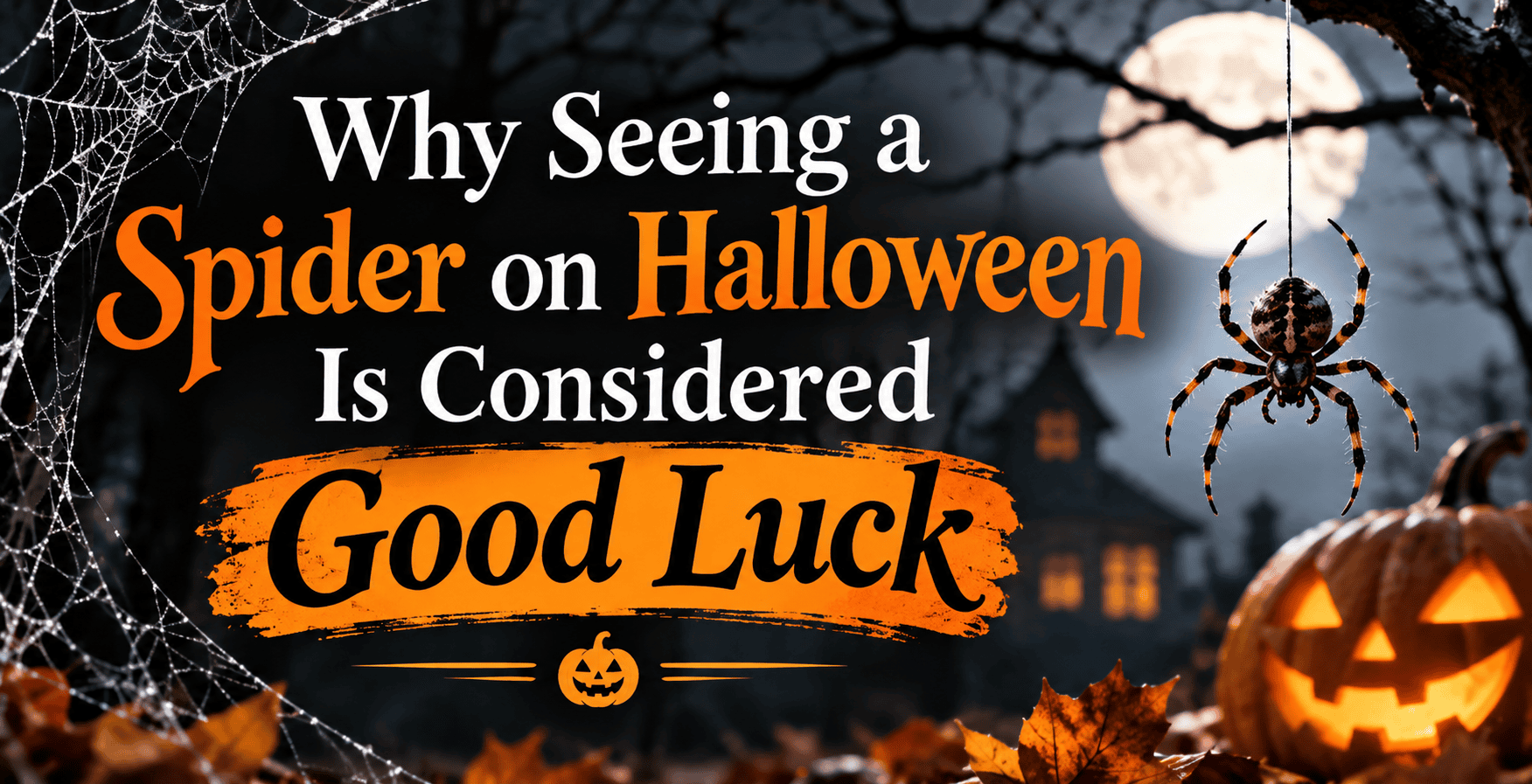
Halloween is a holiday filled with mysterious traditions, spooky decorations, and centuries-old superstitions. From black cats crossing your path to bats flying through the night, certain animals have become powerful symbols of the Halloween season. Among these creatures, spiders hold a particularly fascinating place in Halloween folklore.
While many people associate spiders with fear, haunted houses, and creepy decorations, an old Halloween superstition suggests that seeing a spider on Halloween can actually be a sign of good luck.
According to a popular piece of Halloween folklore, spotting a spider on October 31 may mean that the spirit of a deceased loved one is nearby, watching over you and offering protection.
Although this belief is a superstition rather than a proven spiritual occurrence, it adds an unexpected sense of comfort and mystery to one of the year’s most supernatural holidays.
But where did this belief come from? Why are spiders associated with Halloween, and how did creatures that frighten so many people become symbols of protection, fortune, and spiritual connections?
The answers involve ancient beliefs, European folklore, the symbolism of spiderwebs, and the fascinating relationship between Halloween and the supernatural.
The Halloween Superstition About Seeing a Spider
One of the more touching superstitions associated with Halloween claims that seeing a spider on Halloween means a departed loved one’s spirit is watching over you.
In versions of this modern Halloween folklore, the spider represents a spiritual presence rather than something frightening.
Instead of interpreting the encounter as a warning or a reason to be afraid, believers may view it as a reassuring sign that someone they love remains close in spirit.
This idea fits naturally with Halloween’s long-standing associations with remembrance, death, and the unseen world.
However, the exact historical origin of this particular superstition is uncertain. It is frequently repeated in collections of Halloween beliefs, but there is little reliable evidence establishing when or where it first appeared.
Nevertheless, the tradition continues to capture people’s imaginations.
For someone who has lost a family member, friend, or another important person, the symbolism can feel especially meaningful.
A small spider appearing on Halloween might become a personal reminder of love, memory, and the connections people continue to feel with those who have passed away.
Why Are Spiders Associated With Halloween?
HALLOWEEN HISTORY AND FOLKLORE
Spiders have become one of Halloween’s most recognizable symbols.
Their webs decorate haunted houses, their silhouettes appear on Halloween invitations, and oversized artificial spiders are common decorations throughout October.
But the connection between spiders and Halloween developed through several overlapping cultural associations.
1. Spiders Are Associated With Dark and Mysterious Places
Spiders frequently build webs in quiet, undisturbed locations such as attics, basements, barns, abandoned buildings, and dark corners.
These environments also feature prominently in ghost stories and haunted-house imagery.
As haunted houses became popular symbols of Halloween entertainment, spiderwebs became a convenient visual way to suggest that a building was old, neglected, or mysterious.
Over time, spiders became almost inseparable from traditional Halloween decorations.
2. Spiders Have Long Appeared in Folklore
Across different cultures, spiders have appeared in legends involving wisdom, creativity, patience, fate, and supernatural power.
Their ability to produce intricate webs made them especially fascinating to earlier generations.
Some traditions viewed spiders as clever creatures, while others connected them with mysterious forces.
These varied beliefs helped establish spiders as creatures that could symbolize much more than their physical appearance.
3. Spiders Became Part of Witchcraft Imagery
Spiders also became associated with witches in European folklore and later popular culture.
Historical beliefs about witchcraft often involved unusual animals, magical ingredients, and supernatural companions.
Although cats, toads, and other animals were especially prominent in witchcraft traditions, spiders eventually became familiar elements of witch-themed imagery.
Modern Halloween decorations reinforced that association through bubbling cauldrons, cobweb-covered rooms, and spiders hanging from witches’ hats.
4. Spiderwebs Create an Atmosphere of Mystery
Few natural structures look quite as mysterious as a spiderweb.
A web can be nearly invisible until moonlight, morning dew, or a passing beam of light reveals its delicate pattern.
This visual quality makes spiderwebs especially effective in Halloween settings.
They suggest hidden activity, forgotten spaces, and things that may be present even when they cannot immediately be seen.
The Connection Between Halloween and the Spirit World
To understand why seeing a spider on Halloween might be interpreted as a message from a deceased loved one, it helps to explore Halloween’s historical relationship with the dead.
Halloween developed through a combination of older seasonal traditions, Christian observances, and later folk customs.
One of its important historical influences was Samhain, a Gaelic seasonal festival associated with the transition from the harvest season into winter.
In Irish and Scottish traditions, Samhain was a significant turning point in the year.
Folklore associated this period with supernatural beings, unusual encounters, and a world in which ordinary boundaries could seem less secure.
The popular idea that the boundary between the living and the dead becomes especially thin at Halloween reflects these broader supernatural associations, although historical beliefs were more varied than modern summaries sometimes suggest.
Christian observances also influenced Halloween’s development.
All Hallows’ Eve falls on October 31, immediately before All Saints’ Day on November 1. All Souls’ Day, observed on November 2 in many Christian traditions, specifically commemorates the faithful departed.
Together, these observances helped reinforce the season’s connection with remembrance and mortality.
Within this cultural atmosphere, it is understandable that people might interpret an unexpected encounter with an animal as something spiritually significant.
A spider appearing on Halloween could therefore become part of a larger tradition of looking for signs, messages, and reminders of those who are no longer physically present.
Why Spiders Are Considered Symbols of Good Luck
The belief that spiders can bring good fortune is not limited to Halloween.
In various cultures and folk traditions, spiders have been associated with prosperity, creativity, patience, and protection.
These positive interpretations may help explain why a Halloween spider could be viewed as a welcome visitor.
Spiders and Financial Prosperity
In some British and European folk traditions, certain small spiders have been called money spiders.
Seeing one, or having one crawl onto your clothing, has sometimes been interpreted as a sign of coming financial luck.
The details differ depending on the region and the version of the superstition.
These beliefs are cultural traditions, not predictions of actual financial events.
Spiders and Patience
A spider may spend considerable time constructing a web.
Its careful movements and intricate patterns have made it a natural symbol of patience, persistence, and preparation.
In symbolic interpretations, seeing a spider can serve as a reminder that worthwhile things sometimes require time and effort.
Spiders and Creativity
Spiderwebs are remarkable natural structures.
Their complex geometric patterns have inspired artists, storytellers, and spiritual symbolism.
Because spiders create their own webs, they are often associated with creativity and the ability to shape one’s surroundings.
Spiders and Protection
Spiders help control populations of flies, mosquitoes, and other insects.
This practical benefit has encouraged positive attitudes toward spiders in some households and traditions.
Although people may fear them, many spiders are beneficial creatures that play important roles in natural ecosystems.
Does Seeing a Spider on Halloween Mean a Loved One Is Nearby?
The idea that a Halloween spider represents a deceased loved one is one of the holiday’s most emotionally meaningful superstitions.
According to the belief, the spider may symbolize someone who has passed away but continues to watch over the living.
For people who find comfort in spiritual signs, this interpretation can transform an ordinary encounter into a moment of reflection.
Imagine walking through your home on Halloween evening and noticing a small spider resting near a window.
Someone unfamiliar with the superstition might simply move away or carefully relocate the spider.
Someone who knows the tradition might instead pause and remember a parent, grandparent, spouse, child, or friend they deeply miss.
The spider itself does not provide scientific evidence of a spiritual presence.
Yet the moment may still carry personal meaning.
Human beings have long used symbols to express emotions that are difficult to put into words.
Butterflies, cardinals, feathers, rainbows, and other natural sights are sometimes interpreted as reminders of departed loved ones.
Spiders occupy a similar place in this particular Halloween tradition.
For those who appreciate the symbolism, the encounter can become an opportunity to remember someone special.
The Meaning of Spiderwebs in Ancient Beliefs and Folklore
Spiderwebs have inspired symbolism across many cultures.
Because a web consists of numerous connected strands, it has often been used as a metaphor for relationships, destiny, and the interconnected nature of life.
In some stories, the spider represents a skilled creator or weaver.
One famous example comes from Greek mythology.
The story of Arachne tells of a talented weaver who challenged the goddess Athena and was transformed into a spider.
The myth connects spiders with extraordinary weaving ability, pride, and the consequences of challenging divine authority.
In West African storytelling traditions, Anansi is a famous spider figure associated with cleverness, storytelling, and trickery.
Anansi stories have also traveled through the African diaspora, becoming important parts of Caribbean and African American storytelling traditions.
These examples demonstrate that spiders have held many different meanings throughout history.
They have represented wisdom, mischief, skill, creativity, and supernatural transformation.
However, these traditions should not be confused with the specific Halloween belief about deceased loved ones. They illustrate the broader cultural symbolism of spiders rather than proving a single historical origin for that superstition.
Other Halloween Superstitions Involving Animals
Spiders are not the only creatures associated with supernatural beliefs on Halloween.
Several animals have developed their own reputations through centuries of folklore.
Black Cats
Black cats are among the most famous Halloween symbols.
In some European superstitions, they became associated with witches and misfortune.
However, other traditions consider black cats lucky.
In parts of Britain, for example, black cats have been viewed as symbols of prosperity or good fortune.
Bats
Bats are associated with Halloween partly because of their nocturnal behavior and connection with dark environments.
Their presence in old buildings, caves, and nighttime landscapes contributed to their mysterious reputation.
Bats also became associated with vampire stories, strengthening their place in Halloween imagery.
Owls
Owls have appeared in folklore as symbols of wisdom, mystery, and sometimes death or supernatural warnings.
Their nighttime activity and distinctive calls made them especially memorable in traditional stories.
Ravens and Crows
Ravens and crows have long appeared in myths involving prophecy, transformation, battle, and the supernatural.
Their dark feathers and intelligent behavior make them particularly effective symbols in Gothic literature and Halloween storytelling.
Each of these animals demonstrates how ordinary wildlife can acquire extraordinary meanings through human imagination and cultural traditions.
Is It Bad Luck to Kill a Spider on Halloween?
Some versions of Halloween superstition discourage harming spiders, particularly because they are considered possible symbols of protection or spiritual visitors.
Within that belief system, killing a spider might be interpreted as rejecting good fortune.
However, there is no universal Halloween tradition establishing that killing a spider brings bad luck.
Different communities have developed different beliefs about spiders, and some traditions regard them negatively rather than positively.
From a practical perspective, most spiders encountered around homes are harmless to humans and can help control insect populations.
If a spider is somewhere inconvenient, carefully relocating it when safe is often preferable to killing it.
People should still avoid handling unfamiliar spiders directly, especially in regions where medically significant species occur.
Respecting wildlife does not require believing in supernatural consequences.
What Does It Mean When a Spider Appears in Your House on Halloween?
A spider appearing inside a home on Halloween can have several interpretations, depending on whether someone approaches the experience through folklore, symbolism, or science.
From a folklore perspective, the encounter might be considered a sign of good fortune or spiritual protection.
From a symbolic perspective, the spider may represent patience, creativity, connection, or remembrance.
From a scientific perspective, a spider is generally seeking shelter, food, a mate, or a suitable location for its web.
Spiders are present throughout the year, and their visibility can change with seasonal conditions and species behavior.
In some areas, certain spiders become more noticeable during autumn because mature males are moving around in search of mates.
That timing may make spider encounters seem especially common near Halloween.
The natural explanation does not prevent someone from appreciating the cultural symbolism.
Both can be understood separately without confusing superstition with established fact.
Five Interesting Facts About Spiders and Halloween
1. Spiders Have Eight Legs
Spiders are arachnids, not insects.
They have eight legs, while insects have six.
This distinctive appearance helps explain why spiders are so recognizable in Halloween decorations.
2. Not Every Spider Builds a Web to Catch Prey
Some spiders create elaborate webs, while others actively hunt.
Jumping spiders, for example, use their excellent vision and powerful jumping ability to capture prey.
3. Spider Silk Is Remarkably Strong
Spider silk combines strength and flexibility in ways that have attracted considerable scientific interest.
Different spider species produce different kinds of silk for webs, egg sacs, safety lines, and other purposes.
4. Spiders Help Control Insect Populations
Spiders are important predators in many ecosystems.
They consume large numbers of insects and other small animals, contributing to ecological balance.
5. The Lucky Halloween Spider Belief Has an Uncertain Origin
Although the superstition about spiders representing departed loved ones is widely repeated, its precise origins remain unclear.
It is best understood as a popular piece of Halloween folklore rather than a historical fact that can be confidently traced to one ancient civilization.
Why the Lucky Spider Tradition Remains Popular
Halloween is often presented as a holiday devoted to fear.
People decorate their homes with skeletons, ghosts, tombstones, witches, and monsters.
Horror movies, haunted attractions, and frightening costumes dominate much of the celebration.
Yet Halloween also has a quieter side.
Its history includes remembrance, changing seasons, family traditions, and reflection on mortality.
The lucky spider superstition brings these themes together.
It takes a creature commonly associated with fear and gives it a gentler meaning.
Instead of symbolizing danger, the spider becomes a reminder of protection.
Instead of representing something frightening, it becomes a symbol of connection.
And instead of making Halloween entirely about scary things, the superstition introduces an opportunity to remember people who remain important in our lives.
That contrast may help explain why the belief continues to appeal to people.
How to Celebrate the Lucky Spider Tradition on Halloween
People who enjoy Halloween folklore can incorporate the lucky spider superstition into their celebrations without treating it as a literal prediction.
A family might share the story while decorating the house with artificial spiderwebs.
Parents could explain that different cultures have assigned different meanings to spiders, including creativity, patience, and good fortune.
Someone who has lost a loved one might use the tradition as a gentle reminder to share a favorite memory or tell a meaningful story.
Others might simply appreciate the chance to view spiders with curiosity rather than fear.
Halloween traditions do not always need to be frightening.
Sometimes their greatest value comes from the stories they encourage people to share.
Frequently Asked Questions About Seeing Spiders on Halloween
Is seeing a spider on Halloween good luck?
According to a popular Halloween superstition, seeing a spider on October 31 is considered good luck. Some versions suggest that the spider represents a deceased loved one watching over you. This is a folkloric belief, not a scientifically established occurrence.
What does a spider symbolize on Halloween?
Spiders can symbolize mystery, supernatural forces, patience, creativity, protection, and connections with the spirit world. Their meaning depends on the cultural tradition or personal interpretation.
Why are spiders used as Halloween decorations?
Spiders and spiderwebs became popular Halloween imagery because they are associated with dark corners, abandoned buildings, haunted houses, and witchcraft themes.
Does a spider in your home mean money is coming?
Some traditional superstitions associate spiders, particularly so-called money spiders, with financial prosperity. There is no evidence that seeing a spider predicts financial gain.
Are spiders associated with witches?
Yes. Spiders appear in some witchcraft-related folklore and have become familiar features of modern witch-themed Halloween decorations. However, their symbolism varies across cultures and historical periods.
Should you leave a spider alone on Halloween?
There is no supernatural requirement to leave a spider undisturbed. However, many spiders are beneficial and harmless, so avoiding unnecessary harm is generally a sensible approach.
Is the Halloween spider superstition an ancient Celtic belief?
The specific claim that a Halloween spider represents a deceased loved one is sometimes connected to ancient Celtic traditions, but reliable historical evidence for that precise origin is lacking. It should not be presented as a documented ancient Celtic custom.
Final Thoughts: A Small Spider With a Meaningful Halloween Message
Halloween is filled with traditions that turn everyday sights into symbols of mystery, imagination, and wonder.
The belief that seeing a spider on Halloween brings good luck is one of the holiday’s more unusual and touching superstitions.
While spiders are often portrayed as frightening creatures, this tradition offers a different interpretation.
A spider can represent patience, creativity, protection, or even a personal reminder of someone dearly missed.
There is no scientific evidence that a spider carries a message from the spirit world, and the exact historical origin of the Halloween superstition remains uncertain.
Still, folklore does not have to be literally true to hold cultural or emotional meaning.
Sometimes a small encounter with nature can inspire a moment of gratitude, reflection, or remembrance.
So if you happen to notice a spider this Halloween, you might remember that not every Halloween superstition is about bad luck or frightening warnings.
Some are about hope, good fortune, and the enduring memories of those we love.
Have you ever heard the superstition that seeing a spider on Halloween means a departed loved one is watching over you? Do you consider spiders lucky, or do they still give you the creeps?
Leave a Reply