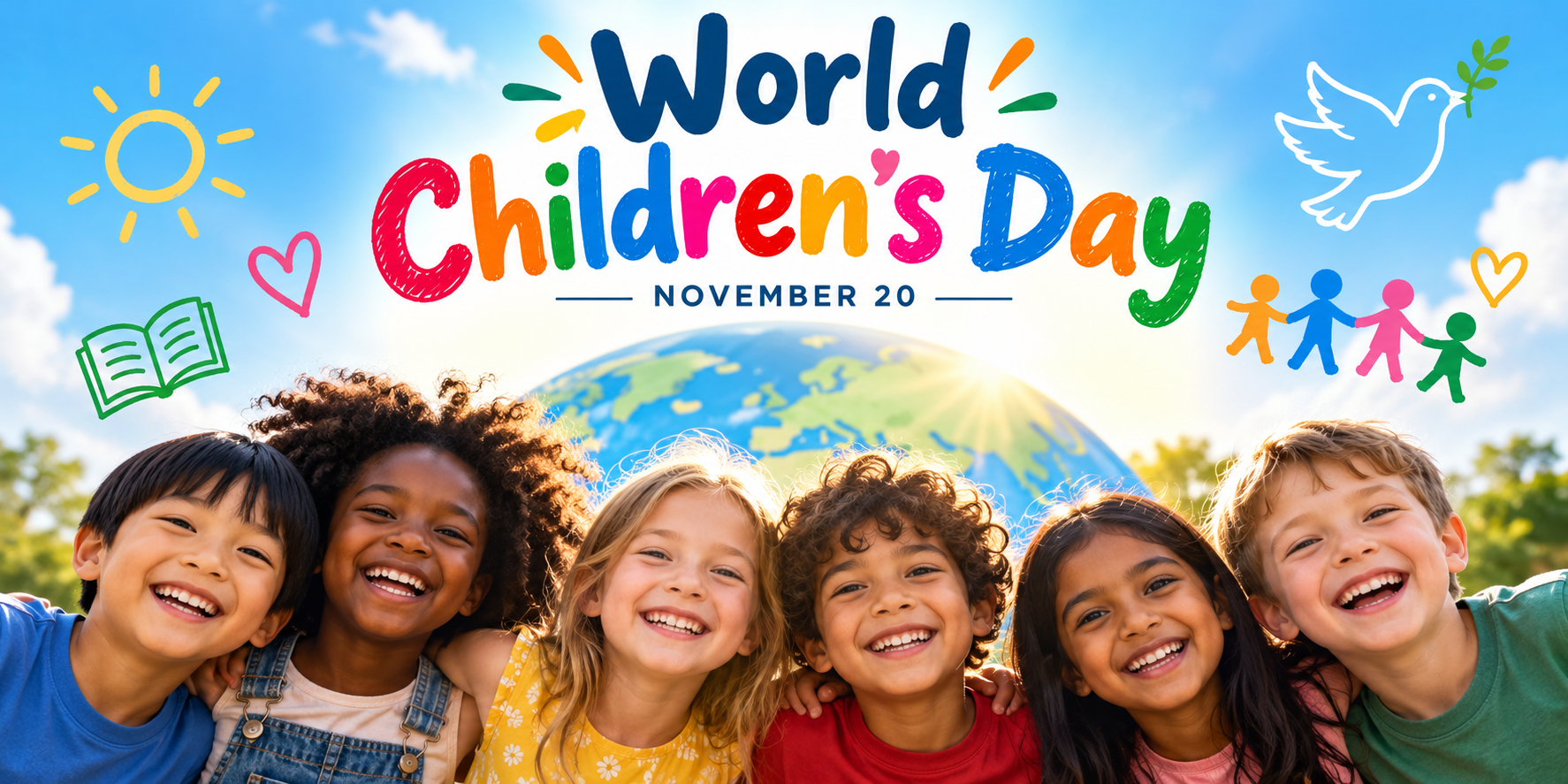
Every child deserves to grow up feeling loved, protected, valued, and supported. Every child deserves the opportunity to dream, learn, explore, and discover the world without fear. Most importantly, every child deserves a childhood filled with hope, happiness, and the knowledge that their life matters.
World Children’s Day, observed annually on November 20, is a global celebration dedicated to recognizing children’s rights, promoting their well-being, and encouraging people everywhere to create a better future for the next generation.
It is more than a date on the calendar. It is a reminder that children are not simply the future of our world. They are an important part of our world today.
From the laughter of a toddler discovering something new to the determination of a teenager pursuing a dream, every stage of childhood carries meaning and possibility.
World Children’s Day encourages families, communities, schools, organizations, and governments to work together to ensure every child has the opportunity to thrive.
What Is World Children’s Day?
World Children’s Day is an international observance established to promote children’s rights, encourage international cooperation, and improve the lives of children worldwide.
The United Nations established Universal Children’s Day in 1954, encouraging countries to observe a day dedicated to children’s welfare and understanding among children.
November 20 was later recommended as the date for the observance and holds special historical significance because two important international agreements concerning children’s rights were adopted on that date.
Today, World Children’s Day is recognized around the world through educational activities, community events, awareness campaigns, charitable initiatives, and conversations about the challenges children face.
The day also celebrates the achievements, creativity, resilience, and potential of young people.
Although childhood experiences differ across countries and cultures, the message remains universal: every child deserves dignity, safety, opportunity, and respect.
When Is World Children’s Day Celebrated?
World Children’s Day is celebrated every year on November 20.
November 20, 2026 — Friday
Observance: International United Nations observance
Purpose: Promote children’s rights, protection, education, health, and well-being
Different countries also celebrate national Children’s Days on other dates, reflecting their own traditions and histories.
However, November 20 remains the internationally recognized date associated with World Children’s Day.
The History of World Children’s Day
The history of World Children’s Day reflects decades of international efforts to recognize that children require special care, protection, and opportunities.
For much of history, children’s needs were often overlooked in discussions about laws, education, employment, and human rights.
As societies developed, growing awareness of child labor, poverty, inadequate education, and exploitation inspired efforts to protect young people.
1954: The Establishment of Universal Children’s Day
On December 14, 1954, the United Nations General Assembly recommended that countries establish Universal Children’s Day.
The goal was to encourage international understanding among children and promote activities supporting children’s welfare.
Countries were encouraged to choose a date they considered appropriate.
The observance gradually became an important opportunity to raise awareness about children’s needs and encourage governments to prioritize their well-being.
1959: Declaration of the Rights of the Child
On November 20, 1959, the United Nations General Assembly adopted the Declaration of the Rights of the Child.
This declaration outlined important principles concerning children’s welfare, including access to education, protection from neglect, and opportunities for healthy development.
Although the declaration was not a legally binding treaty, it helped establish a foundation for future international agreements.
It emphasized that children deserve special safeguards because of their physical and emotional development.
1989: Convention on the Rights of the Child
On November 20, 1989, the United Nations General Assembly adopted the Convention on the Rights of the Child.
This landmark international treaty established a comprehensive framework recognizing children’s civil, political, economic, social, and cultural rights.
The convention recognizes that children are individuals with rights, rather than simply dependents whose needs are determined entirely by adults.
It emphasizes the importance of protecting children from discrimination, abuse, exploitation, and neglect.
The treaty also recognizes children’s rights to education, healthcare, identity, family relationships, and participation in decisions affecting their lives.
The adoption of this convention made November 20 especially significant in the history of children’s rights.
Why World Children’s Day Matters
World Children’s Day matters because childhood experiences can shape the course of an entire lifetime.
The love, encouragement, education, and protection children receive during their early years influence their confidence, health, relationships, and opportunities.
When children grow up in supportive environments, they are better positioned to develop their talents, build meaningful relationships, and contribute positively to their communities.
Unfortunately, millions of children worldwide continue to face serious challenges.
Some grow up without reliable access to nutritious food or clean drinking water.
Others experience violence, displacement, discrimination, inadequate healthcare, or barriers to education.
Many children live in communities affected by poverty, conflict, and natural disasters.
World Children’s Day brings attention to these realities while encouraging meaningful action.
It reminds us that improving children’s lives requires more than good intentions. It requires compassion, responsible leadership, strong communities, and continued commitment.
Understanding the Fundamental Rights of Children
Children’s rights are essential protections and freedoms that help young people grow, develop, and participate in society.
These rights apply to every child, regardless of nationality, race, religion, disability, family background, or economic circumstances.
1. The Right to Education
Education gives children the knowledge, skills, and confidence to pursue opportunities throughout their lives.
Every child deserves access to quality learning in an environment that encourages curiosity, creativity, and personal development.
Education also helps children understand their responsibilities, recognize their potential, and develop respect for others.
A classroom should be a place where children feel safe asking questions, making mistakes, and discovering their strengths.
2. The Right to Safety and Protection
Children deserve protection from violence, abuse, neglect, exploitation, and harmful practices.
Safety includes more than physical protection.
Children also need emotional security, trustworthy relationships, and environments where they can express concerns without fear.
Parents, caregivers, educators, community leaders, and governments all have responsibilities in creating safer environments for children.
3. The Right to Healthcare
Healthy childhood development requires access to appropriate medical care, nutritious food, clean water, and safe living conditions.
Preventive healthcare, vaccinations, treatment for illness, and mental health support all contribute to children’s well-being.
A child’s health should never be treated as unimportant simply because they are young.
4. The Right to Love and Family Relationships
Children benefit from stable, nurturing relationships with adults who care about their well-being.
Love, encouragement, patience, and consistency help children develop trust and emotional resilience.
Families come in many forms, and children may receive care from parents, grandparents, relatives, foster caregivers, or other responsible adults.
What matters most is that children experience safety, belonging, and genuine care.
5. The Right to Be Heard
Children have thoughts, feelings, concerns, and perspectives that deserve consideration.
Listening to children helps them develop confidence and teaches them that their voices matter.
This does not mean children must make every decision independently.
Instead, it means adults should consider children’s views in ways appropriate to their age and maturity.
6. The Right to Play and Rest
Play is an important part of healthy childhood development.
Through play, children develop imagination, social skills, problem-solving abilities, and emotional understanding.
Children also need time to rest, explore their interests, and enjoy recreational activities.
A childhood filled entirely with pressure and responsibilities can deprive young people of experiences essential to their development.
The Importance of Making Children Feel Loved
One of the most meaningful gifts adults can give children is the feeling of being genuinely loved.
Children may not remember every present they receive or every activity they participate in.
However, moments of connection can leave lasting impressions.
They may remember a parent sitting beside them when they were frightened.
They may remember a grandparent sharing stories, a teacher believing in their abilities, or a caregiver celebrating a small achievement.
They may remember someone attending their school performance, cheering at their game, or simply asking how their day went.
These moments help children understand that they matter.
Love is not measured only by expensive gifts, elaborate vacations, or material possessions.
Sometimes love is expressed through ordinary actions.
A conversation at the dinner table.
A hug after a difficult day.
A bedtime story.
An encouraging word.
A willingness to listen.
A promise that is kept.
Children need to know they are valued not only when they succeed but also when they struggle.
They deserve to feel loved when they make mistakes, experience disappointment, or need guidance.
Unconditional care creates a foundation of security that can influence how children see themselves and others.
Why Spending Time With Children Is So Important
Modern life can become overwhelming.
Work responsibilities, financial concerns, household obligations, and technology often compete for attention.
As a result, meaningful family time can unintentionally become less frequent.
World Children’s Day offers an opportunity to reconsider how we spend time with the children in our lives.
Children do not always need complicated activities to feel connected.
They often appreciate simple moments of undivided attention.
Cooking dinner together, playing a board game, going for a walk, reading a book, or having a conversation can strengthen relationships.
These shared experiences communicate something powerful:
You are important enough for me to give you my time.
Time also creates opportunities for children to share concerns they might otherwise keep hidden.
A child who feels comfortable talking about small problems may be more willing to discuss serious challenges later.
Strong relationships develop through consistency, trust, and genuine interest.
The goal is not to become a perfect parent or caregiver.
The goal is to remain present, supportive, and willing to grow alongside the child.
The Challenges Facing Children Around the World
While World Children’s Day celebrates childhood, it also highlights the difficulties many young people face.
Childhood Poverty
Poverty can limit access to nutritious food, adequate housing, healthcare, educational resources, and safe environments.
Children experiencing financial hardship may face obstacles that affect their physical development and future opportunities.
Supporting families, improving access to essential services, and creating economic opportunities can help reduce these disadvantages.
Limited Access to Education
Some children cannot attend school regularly because of poverty, conflict, displacement, discrimination, or inadequate educational infrastructure.
Others attend schools without sufficient supplies, trained teachers, or accessible facilities.
Expanding educational opportunities helps children develop skills and increases their chances of achieving greater independence.
Violence and Exploitation
Children can experience abuse, trafficking, forced labor, bullying, and other forms of exploitation.
Protecting children requires effective laws, accessible support services, public awareness, and adults willing to recognize and report concerns.
Children should never have to earn the right to feel safe.
Mental Health Challenges
Children and teenagers can experience anxiety, depression, loneliness, grief, and emotional distress.
These challenges deserve understanding rather than dismissal.
Adults can support children’s emotional health by listening without judgment, encouraging healthy communication, and seeking professional support when needed.
A child’s emotional pain is real, even when adults do not fully understand its cause.
War and Displacement
Armed conflict and humanitarian emergencies can disrupt children’s education, separate families, and expose young people to traumatic experiences.
Children affected by conflict often need protection, healthcare, educational support, and opportunities to rebuild stability.
World Children’s Day reminds us that children should not be forgotten during crises.
How Parents Can Make World Children’s Day Meaningful
Parents and caregivers have an opportunity to turn World Children’s Day into something personal and memorable.
Rather than treating the occasion as another holiday requiring expensive gifts, families can focus on strengthening relationships.
Spend time asking children about their dreams, interests, friendships, and concerns.
Encourage them to discuss what makes them happy and what they wish adults understood better.
Celebrate their accomplishments, including achievements that might seem small.
A child learning to ride a bicycle, improving in a difficult subject, helping a friend, or overcoming a fear deserves encouragement.
Parents can also use the day to teach kindness, gratitude, and respect.
Discuss why every child deserves fair treatment and why helping others matters.
Most importantly, remind children that their value does not depend on grades, popularity, athletic ability, or accomplishments.
Their lives matter simply because they are human beings worthy of love and respect.
How Schools Can Celebrate World Children’s Day
Schools play an important role in helping children understand their rights and responsibilities.
Teachers can organize educational activities that encourage students to learn about childhood experiences around the world.
Classroom discussions might explore kindness, inclusion, fairness, and respect for different cultures.
Students can create artwork expressing their hopes for the future.
Schools may also organize reading activities, community service projects, cultural celebrations, or student-led discussions.
Older students can research challenges facing children globally and explore practical ways communities can help.
Activities should encourage participation without making children feel pressured to share private or painful experiences.
World Children’s Day can also provide an opportunity for schools to review their commitment to safe, welcoming, and inclusive learning environments.
Ways to Celebrate World Children’s Day
World Children’s Day can be recognized through meaningful actions at home, at school, or throughout the community.
-
Spend quality time with a child. Put away distractions and enjoy an activity together.
-
Listen to children’s opinions. Ask what they would change to make the world better.
-
Read a book together. Encourage imagination, learning, and conversation.
-
Support a children’s charity. Consider donating supplies, money, or time to a reputable organization.
-
Recognize a child’s achievements. Celebrate effort, kindness, creativity, and perseverance.
-
Teach children about their rights. Explain why safety, education, healthcare, and respect matter.
-
Encourage acts of kindness. Help children understand how small gestures can make a difference.
-
Support local schools. Volunteer or contribute needed educational materials.
-
Promote inclusion. Encourage children to welcome others and stand against bullying.
-
Create a family memory. Take a walk, cook together, share stories, or enjoy a favorite tradition.
The most meaningful celebration is one that helps children feel appreciated and reminds adults of their responsibilities.
The Role of Communities in Protecting Children
Raising and protecting children is not solely the responsibility of parents.
Communities influence childhood experiences through schools, neighborhoods, recreational programs, healthcare services, and public policies.
Safe playgrounds, accessible libraries, youth programs, and supportive community organizations provide valuable opportunities for children.
Neighbors can help create environments where families feel connected and supported.
Businesses can contribute through educational sponsorships, charitable initiatives, and family-friendly workplace policies.
Local leaders can prioritize safe streets, quality schools, and resources for vulnerable families.
When communities invest in children, they invest in long-term social well-being.
Children who experience encouragement and opportunity are better equipped to become adults who contribute positively to society.
Teaching Children Kindness and Compassion
Academic success and personal achievement are important, but character development also matters.
Children benefit from learning how to treat others with kindness, empathy, honesty, and respect.
Adults teach these values most effectively through their own behavior.
When children see adults helping neighbors, apologizing after mistakes, respecting differences, and showing patience, they learn that compassion is something people practice.
Simple conversations can reinforce these lessons.
Ask children how they think another person might feel.
Encourage them to include classmates who seem lonely.
Praise acts of generosity and thoughtfulness.
Help them understand that everyone experiences difficulties that may not be immediately visible.
Teaching compassion prepares children not only to succeed personally but also to build healthier relationships and stronger communities.
The Importance of Encouraging Children’s Dreams
Every child has unique interests, talents, and possibilities.
Some dream of becoming doctors, teachers, artists, athletes, scientists, or firefighters.
Others have not yet discovered what they want to pursue.
Both experiences are normal.
Children need opportunities to explore without feeling that their future has already been decided for them.
Encouragement can make a significant difference in how children approach challenges.
When adults recognize effort, support curiosity, and allow room for mistakes, children learn that growth is possible.
Not every dream will unfold exactly as imagined.
Interests may change, abilities may develop, and unexpected opportunities may appear.
What matters is helping children believe they can learn, improve, and contribute something meaningful.
A child’s potential should never be dismissed because of their background, circumstances, or early struggles.
Remembering Children Who Are No Longer With Us
World Children’s Day can also carry a deeply emotional meaning for parents and families who have experienced the death of a child.
While the world celebrates children’s laughter, accomplishments, and possibilities, grieving parents may find themselves remembering the child they can no longer hold.
They may think about the first time they heard their child’s voice.
The laughter that once filled their home.
The ordinary moments that became precious memories.
The dreams they had for their child’s future.
For these families, World Children’s Day may bring both love and sorrow.
A child’s death does not erase the love that existed or the significance of their life.
Their memories remain part of their family’s story.
Their names still deserve to be spoken.
Their birthdays and important milestones still matter.
And the love their parents carry does not disappear simply because their child is no longer physically present.
Some families may choose to honor their child by sharing memories, supporting another child, making a charitable donation, or spending quiet time remembering.
Others may simply need space to grieve.
There is no single correct way to experience this day.
World Children’s Day can remind us to appreciate the children who are here while also remembering those whose lives ended far too soon.
Every child matters, including those who live on in the hearts of the people who love them.
Why Children Need Encouragement, Not Perfection
Children are constantly learning.
They make mistakes, experience frustration, test boundaries, and sometimes struggle to understand their emotions.
These experiences are part of development.
Expecting children to behave perfectly can create unnecessary pressure and discourage them from trying new things.
Instead, children benefit from guidance that combines clear expectations with patience and understanding.
When a child makes a mistake, adults have an opportunity to teach responsibility without attacking the child’s worth.
When a child struggles academically, encouragement and appropriate support can be more helpful than comparison with others.
When a child experiences disappointment, listening and reassurance can help them develop resilience.
Children need to understand that failure is not the opposite of growth.
It is often part of learning.
The goal should be to help children become confident, compassionate, responsible individuals rather than expecting them to meet impossible standards.
World Children’s Day and the Future of Our Society
The future of every community is influenced by how it treats its youngest members.
Children who receive quality education, appropriate healthcare, emotional support, and opportunities to develop their abilities are better prepared to navigate adulthood.
They may become the teachers who inspire future generations.
The healthcare professionals who care for families.
The scientists who discover new solutions.
The artists who encourage creativity.
The community leaders who advocate for positive change.
However, children should not be valued only for what they might accomplish as adults.
Their happiness, safety, and dignity matter right now.
Investing in childhood means recognizing both present needs and future possibilities.
It means understanding that the decisions adults make today can influence the opportunities available to young people tomorrow.
World Children’s Day Quotes and Inspirational Messages
World Children’s Day is an opportunity to share messages that celebrate childhood and encourage compassion.
“Every child deserves a childhood filled with love, laughter, safety, and endless possibilities.”
“Children do not need a perfect world to feel loved, but they deserve adults who are willing to work toward a better one.”
“The greatest gift we can give a child is the confidence to believe their life matters.”
“Every child has a voice worth hearing, a dream worth encouraging, and a future worth protecting.”
“A child’s happiness should never be considered less important than an adult’s ambitions.”
“Small moments of love can become the memories a child carries for a lifetime.”
“Protecting children today helps create a more compassionate world tomorrow.”
“Every child deserves someone who believes in them, especially when they struggle to believe in themselves.”
These messages can be shared with family members, educators, community groups, or on social media to encourage greater awareness.
How to Make a Difference Beyond November 20
Although World Children’s Day is observed once a year, supporting children should remain an everyday commitment.
Meaningful change often begins with consistent actions.
Parents can strengthen relationships by making time for conversations.
Teachers can help students feel included and capable.
Community members can volunteer with reputable youth organizations.
Businesses can support educational programs and family resources.
Individuals can advocate for policies that improve children’s safety, health, and opportunities.
People can also make a difference by treating children with patience and respect during ordinary interactions.
Not everyone has the resources to launch a major initiative or make a substantial financial contribution.
However, nearly everyone can offer encouragement, demonstrate kindness, or support efforts that protect young people.
Small actions become meaningful when practiced consistently.
Frequently Asked Questions About World Children’s Day
Is World Children’s Day celebrated on November 20 every year?
Yes. The United Nations observes World Children’s Day annually on November 20, although individual countries may celebrate their own national Children’s Days on different dates.
Who established World Children’s Day?
The United Nations General Assembly established Universal Children’s Day in 1954 to promote international understanding and children’s welfare.
Why was November 20 chosen?
November 20 marks the adoption of the Declaration of the Rights of the Child in 1959 and the Convention on the Rights of the Child in 1989.
What is the main purpose of World Children’s Day?
Its primary purpose is to promote children’s rights, raise awareness of challenges affecting young people, and encourage action that improves children’s lives.
Is World Children’s Day an official United Nations observance?
Yes. It is a United Nations observance, although it is not automatically a public holiday in every country.
How can families celebrate World Children’s Day?
Families can spend quality time together, discuss children’s rights, participate in community activities, support charitable organizations, and remind children how much they are valued.
What is the difference between World Children’s Day and National Children’s Day?
World Children’s Day is the international observance associated with the United Nations and November 20. National Children’s Days are country-specific celebrations that may occur on different dates.
Final Thoughts: Every Child Deserves to Matter
World Children’s Day is more than an international observance.
It is a reminder of the responsibility we share to protect, encourage, and care for the youngest members of society.
Every child deserves to feel safe in their home, supported in their education, respected in their community, and loved by the people responsible for their care.
Every child deserves opportunities to discover their talents, develop meaningful friendships, and experience the simple joys of childhood.
And every child deserves to know that their life has value.
We cannot solve every challenge facing children around the world in a single day.
But we can choose to make a difference through our actions, priorities, and relationships.
We can listen more carefully.
We can show greater patience.
We can encourage dreams instead of dismissing them.
We can protect children who cannot protect themselves.
And we can remember that childhood passes more quickly than we often realize.
This World Children’s Day, November 20, take a moment to celebrate the children in your life, honor the children you carry in your heart, and consider how you can help make the world a little kinder for the next generation.
Because every child matters.
Every childhood matters.
And every child deserves a future filled with hope.
What is one lesson, memory, or act of kindness from your childhood that you believe every child deserves to experience?



Leave a Reply