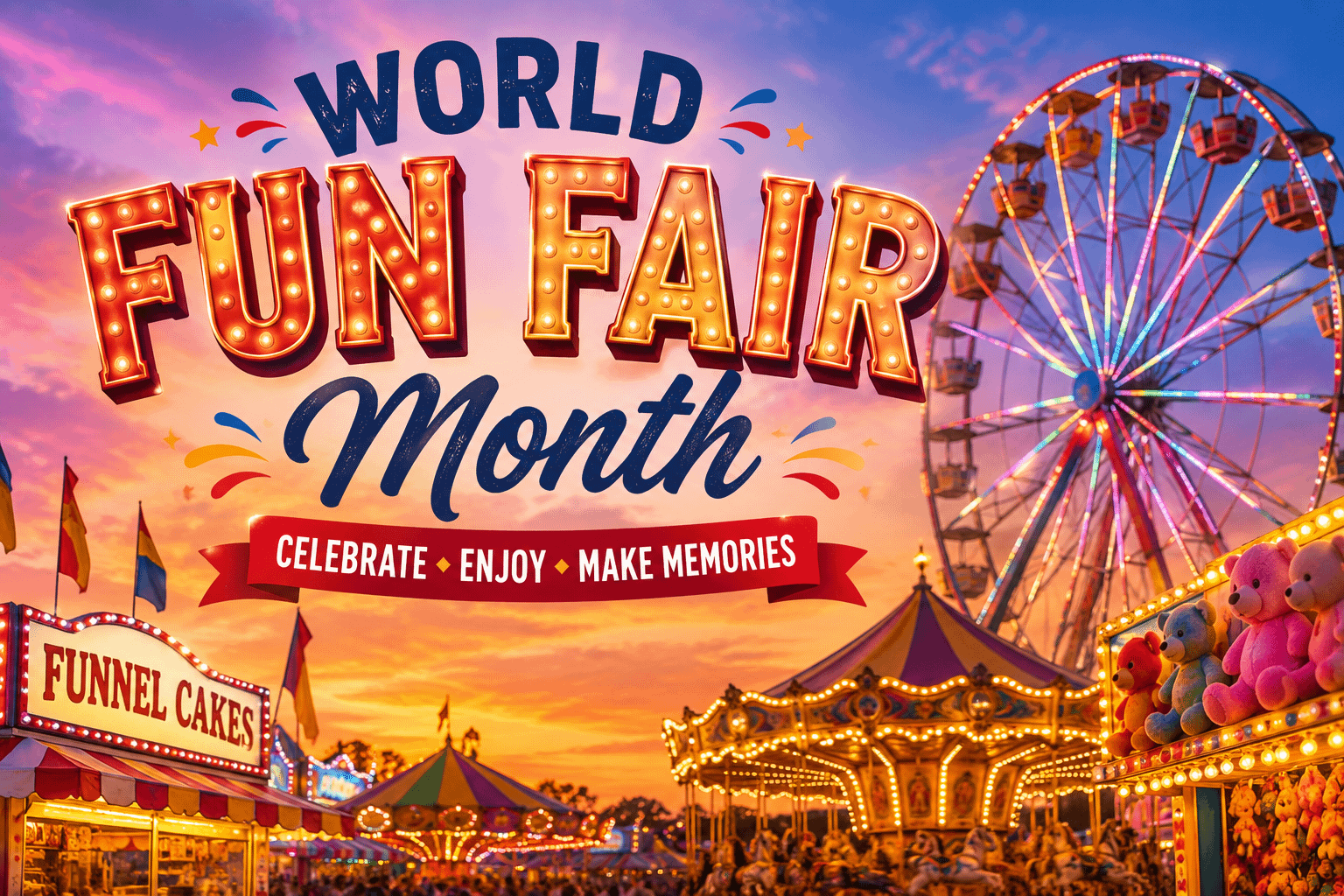
Every September, World Fun Fair Month celebrates the colorful, exciting, and nostalgic world of fun fairs, carnivals, amusement rides, games, food stands, and traveling entertainment. It is a month dedicated to recognizing an experience that has brought generations of families and friends together for laughter, adventure, and unforgettable memories.
From the glow of a Ferris wheel against the evening sky to the smell of popcorn and cotton candy drifting through the midway, a fun fair has a special atmosphere that is difficult to duplicate anywhere else. You might arrive planning to stay for an hour and suddenly find yourself spending the entire evening trying different foods, playing games, riding attractions, and enjoying the energy of the crowd.
World Fun Fair Month is an opportunity to celebrate that magic while also recognizing the people and traditions that keep fun fairs alive.
What Is World Fun Fair Month?
World Fun Fair Month is observed during September and celebrates the fun fair industry and the communities surrounding it.
Fun fairs can take many different forms. Some are small traveling carnivals that visit communities for only a few days. Others are large annual fairs featuring amusement rides, agricultural exhibits, concerts, competitions, food vendors, games, and entertainment.
Despite their differences, they share an important purpose: bringing people together to have fun.
For generations, fairs have provided a place where children, parents, grandparents, couples, and groups of friends can escape their normal routines and enjoy something different.
September is especially appropriate for the celebration because late summer and early fall have traditionally been popular times for fairs and community festivals in many places.
The Long History of Fairs
The idea of gathering for fairs goes back centuries.
Historically, fairs were not simply entertainment events. They were important marketplaces where merchants, farmers, craftspeople, entertainers, and residents could gather to trade goods and exchange information.
Over time, entertainment became an increasingly important part of these gatherings.
Musicians performed. Entertainers attracted crowds. Games appeared. Food vendors served visitors. Mechanical attractions eventually transformed the traditional fairground into something closer to the carnival and amusement experience we recognize today.
Modern technology may have changed the rides, lights, music, and attractions, but the basic appeal remains remarkably similar.
People gather.
They eat.
They laugh.
They explore.
They experience something outside their ordinary routines.
The Magic of the Midway
There is something unmistakable about walking onto a fairground.
Before you even reach the rides, you can often hear the music and excitement.
Bright lights flash across the midway. Ride operators call out to visitors. Game booths display enormous stuffed animals waiting to be won. Children point excitedly toward the rides while families decide what attraction they should try first.
Then there are the smells.
Popcorn.
Caramel apples.
Funnel cakes.
Cotton candy.
Corn dogs.
French fries.
Barbecue.
The combination creates an atmosphere that immediately feels like a celebration.
A fun fair appeals to nearly every sense at once, which may help explain why fair memories can remain so vivid years later.
The Ferris Wheel: A Symbol of the Fair
Few attractions represent the traditional fair better than the Ferris wheel.
Rising high above the midway, it offers riders a completely different perspective of the celebration below.
During the day, passengers might see the surrounding community stretching into the distance.
At night, the experience becomes something entirely different.
The lights of the midway glow beneath you while music and laughter drift upward from the crowds.
For some people, the Ferris wheel is exciting.
For others, it is romantic.
For children, reaching the top can feel like an enormous adventure.
Whatever the experience, the Ferris wheel has become one of the most recognizable symbols of fairs around the world.
Thrill Rides and Adrenaline
Of course, not everyone visits the fair for a relaxing ride.
Some people head directly toward whichever attraction looks the fastest, tallest, or most terrifying.
Spinning rides, drop towers, swinging attractions, roller coasters, and other thrill rides have become major features of many modern fairs.
Part of their appeal is the anticipation.
You stand in line listening to people scream.
You watch the ride move.
You begin wondering whether getting in line was a good idea.
Then the safety restraint locks into place.
A few minutes later, you are laughing, screaming, or wondering why your friends convinced you to ride it.
And somehow, once it ends, someone inevitably says:
“Let’s do it again!”
Fair Games and the Dream of Winning Big
The midway would not feel complete without carnival games.
Ring toss.
Basketball challenges.
Balloon darts.
Water races.
Bottle knockdowns.
Shooting galleries.
Strength tests.
Each game offers the possibility of walking away with a prize.
Sometimes the prize is small.
Sometimes it is a stuffed animal almost as large as the person carrying it.
But winning isn’t always the most memorable part.
The fun often comes from friendly competition.
Parents challenge their children.
Couples compete against each other.
Friends attempt to prove who has the best aim.
Even when nobody wins the giant prize, everyone usually walks away with a story.
Fair Food Is Part of the Experience
For many people, the food is almost as important as the rides.
Fair food has developed a personality of its own.
You may find traditional favorites such as:
- Funnel cakes covered in powdered sugar
- Cotton candy
- Corn dogs
- Caramel and candy apples
- Popcorn
- Soft pretzels
- French fries
- Ice cream
- Lemonade
- Barbecue
- Fried dough
- Churros
- Snow cones
- Burgers and sausages
Then there are the more adventurous creations.
Modern fairs have become famous for experimenting with unusual combinations, oversized portions, and foods that somehow find their way into a deep fryer.
Visitors may discover something completely unexpected and decide, “I have to try that.”
Eating something you wouldn’t normally order is simply part of the fun.
Fun Fairs Bring Communities Together
Beyond rides and food, fairs can play an important role in community life.
Local fairs often provide opportunities for small businesses, nonprofit organizations, farmers, craftspeople, performers, schools, clubs, and community groups to connect with residents.
Some fairs showcase local agriculture.
Others highlight handmade products and crafts.
Young people may participate in competitions or exhibits.
Local musicians and entertainers may perform before audiences they otherwise wouldn’t have an opportunity to reach.
Families encounter neighbors they haven’t seen recently.
Old friends reconnect.
New memories are created.
For a few days, the fairground can become one enormous community gathering place.
The People Behind the Fun
World Fun Fair Month is also an opportunity to recognize the people working behind the scenes.
Creating a successful fair requires an enormous amount of work.
Rides must be transported, assembled, inspected, operated, maintained, and eventually taken apart again.
Food stands need supplies.
Games need operators.
Grounds must be maintained.
Tickets must be sold.
Entertainment must be coordinated.
Safety procedures must be followed.
For traveling fair and carnival workers, the lifestyle can mean moving from one community to another throughout the season.
Visitors experience a few hours of entertainment, but behind those hours are countless people working to make the experience possible.
Why Fun Fairs Create Powerful Memories
Ask someone about their childhood fair experiences and they may remember surprisingly specific details.
Their first Ferris wheel ride.
The stuffed animal they won.
The first roller coaster that terrified them.
The funnel cake they shared with their family.
The song playing while they walked through the midway.
The person who held their hand on a scary ride.
These moments can become attached to people and periods of our lives.
Years later, returning to a fair can bring those memories rushing back.
Perhaps that is one reason fairs remain popular even when entertainment is available almost everywhere.
A fair isn’t simply something you watch.
It is something you experience.
A Tradition Shared Across Generations
One of the beautiful things about fun fairs is their ability to connect generations.
Grandparents who once visited fairs as children can return with grandchildren.
Parents can introduce their children to rides they loved growing up.
A child experiencing cotton candy or riding a Ferris wheel for the first time may be creating a memory that lasts for decades.
The rides may become faster.
The lights may become brighter.
Technology may change.
But some traditions remain wonderfully familiar.
There is still excitement when you see the fair from a distance.
There is still anticipation when you purchase your tickets.
And there is still that final look back at the glowing midway when it is time to go home.
Ways to Celebrate World Fun Fair Month
The easiest way to celebrate is to visit a fair or carnival during September if one is happening in your community.
Bring family or friends and make an evening of it.
Ride something you loved as a child.
Try a food you’ve never tasted before.
Challenge someone to a carnival game.
Take a ride on the Ferris wheel after sunset.
Take plenty of photographs.
You can also support local fairs by attending performances, visiting community booths, purchasing items from vendors, and learning about the organizations participating in the event.
If you can’t attend a fair, you can still celebrate.
Look through photographs from previous fairs. Share your favorite carnival memories with family. Make homemade versions of classic fair foods. Watch a movie featuring amusement parks or carnivals. Ask older relatives about the fairs they attended when they were younger.
The celebration is ultimately about remembering the joy these traditions have created.
Make New Memories This September
Life moves quickly.
Responsibilities pile up.
Schedules become crowded.
Sometimes we need an excuse to do something simply because it is fun.
World Fun Fair Month provides exactly that reminder.
Ride the Ferris wheel.
Eat the funnel cake.
Try to win the oversized stuffed animal.
Laugh when your friend talks you into riding something you immediately regret.
Take pictures.
Stay until the lights shine brightly against the night sky.
Most importantly, enjoy the people who are standing beside you.
Because years from now, you probably won’t remember how many emails you answered that day or what was waiting on your to-do list.
You might remember laughing together at the fair.
Celebrating the Joy of the Fun Fair
World Fun Fair Month is about more than amusement rides and carnival games. It celebrates a tradition that has brought entertainment, excitement, and community together for generations.
Fairs give us an opportunity to temporarily escape everyday routines and experience something colorful, unpredictable, and joyful.
Whether your favorite part is the thrilling rides, carnival games, live entertainment, delicious food, or simply walking through the midway beneath thousands of glowing lights, September is the perfect month to appreciate everything that makes the fun fair special.
So when the fair comes to town, gather the people you care about and go make some memories.
The Ferris wheel is turning.
The midway lights are glowing.
And somewhere nearby, there’s probably a funnel cake with your name on it.
Happy World Fun Fair Month!
Leave a Reply