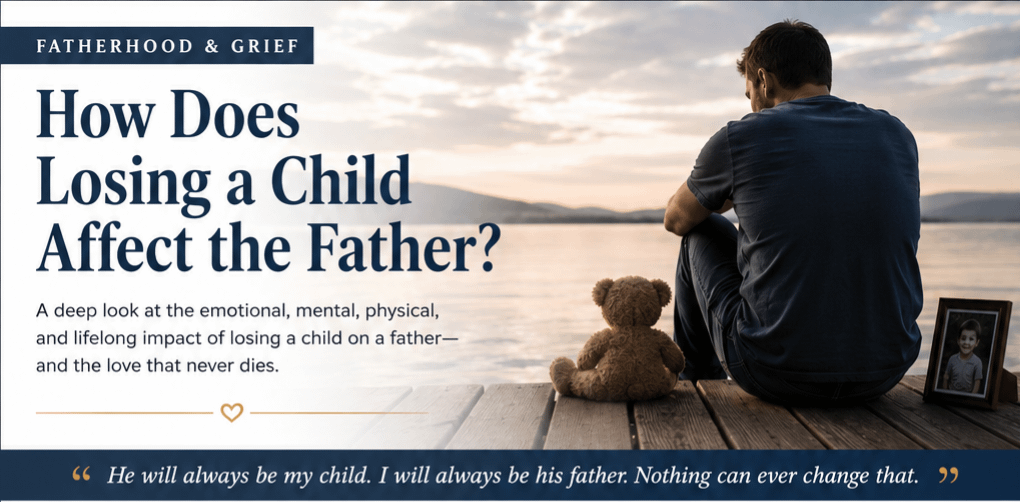
The Loss That Changes a Man Forever
There are many painful experiences a person may endure throughout life. The loss of a parent, the end of a marriage, financial hardship, illness, and countless other struggles can leave lasting scars. Yet for many fathers, nothing compares to the death of a child.
The natural order of life suggests that parents should leave this world before their children. Fathers spend years protecting, teaching, guiding, and preparing their children for adulthood. They dream of graduations, careers, weddings, grandchildren, and countless milestones still to come. When a child dies, those dreams die as well.
The loss of a child is not simply the loss of a person. It is the loss of a future, a relationship, a purpose, and a piece of a father’s own identity.
Many people assume fathers grieve differently because they hurt less. The truth is that fathers often grieve differently because they have been conditioned to hide their pain. Their suffering frequently remains unseen, buried beneath responsibilities, silence, and expectations.
Yet beneath that silence often exists a heartbreak that lasts a lifetime.
The Day Life Splits Into Before and After
Most fathers who lose a child describe life as being divided into two distinct chapters:
Before the loss.
After the loss.
Everything changes the moment they receive the phone call, hear the diagnosis, witness the accident, or experience the final goodbye.
The world continues moving forward around them, but their own life seems frozen in time.
Many fathers can recall every detail of the day their child died:
- The weather
- The sounds in the room
- The exact words spoken
- The drive to the hospital
- The moment everything changed
Years later, those memories remain vivid.
Life becomes measured not by calendars but by the distance from the loss.
One year since.
Five years since.
Ten years since.
The pain may change shape, but the date remains permanently etched into a father’s heart.
The Crushing Weight of Responsibility
One of the deepest wounds many fathers carry is the belief that they failed.
A father is often raised to believe his role is to protect his family.
To keep them safe.
To solve problems.
To prevent harm.
When a child dies, many fathers immediately begin blaming themselves.
Even when the loss was completely beyond their control, they often think:
“What if I had done something differently?”
“What if I had been there?”
“What if I had noticed something sooner?”
“What if I could have stopped it?”
These thoughts can continue for years.
A father’s mind becomes trapped in endless scenarios, replaying moments repeatedly while searching for answers that may never exist.
The reality is that many child deaths occur despite loving parents doing everything they possibly could.
Unfortunately, grief rarely listens to logic.
The Silent Nature of a Father’s Grief
Society often gives mothers permission to grieve openly.
People expect tears.
People expect emotional expression.
People offer support.
Fathers frequently receive a different message.
Be strong.
Take care of your family.
Handle the arrangements.
Support your spouse.
Get back to work.
Hold everything together.
As a result, many fathers become silent grievers.
They cry alone.
They mourn privately.
They carry unbearable pain without sharing it.
Some never discuss their grief with anyone.
The result is that many grieving fathers suffer in isolation while appearing functional on the outside.
Others mistakenly assume they are coping well because they are not openly emotional.
In reality, they may be struggling every day just to get out of bed.
When the World Stops Understanding
One of the loneliest aspects of child loss is realizing that the world eventually moves on.
Friends return to normal life.
Coworkers stop asking how you’re doing.
Family members mention your child less often.
The support that arrives immediately after the loss slowly fades.
But for the father, nothing has changed.
His child is still gone.
The empty bedroom remains.
The memories remain.
The longing remains.
Many fathers describe feeling abandoned as time passes.
People expect healing according to a timeline.
Grief does not follow a timeline.
A father may appear fine for months before suddenly breaking down over a photograph, a song, or a simple memory.
Love does not expire.
Neither does grief.
The Emotional Effects of Losing a Child
The emotional consequences of child loss can be overwhelming.
Deep Sadness
The sadness associated with losing a child often feels different from ordinary sorrow.
It reaches into every area of life.
Simple tasks become difficult.
Activities that once brought happiness lose meaning.
Even joyful moments become bittersweet because the child is missing from them.
Anger
Many fathers experience anger after loss.
Anger at:
- Doctors
- Drivers
- Circumstances
- The world
- Themselves
- God
This anger often stems from helplessness.
When there are no answers, anger fills the space where understanding should be.
Fear
The loss of one child can create overwhelming fear about losing others.
Many fathers become hypervigilant.
They worry constantly about loved ones.
Every unanswered phone call can trigger panic.
Every delay can create anxiety.
The loss teaches them how quickly life can change.
Guilt
Guilt may become one of the heaviest burdens.
Even when fathers bear no responsibility, they frequently feel responsible.
Guilt often becomes grief’s closest companion.
Depression After Child Loss
Depression is extremely common among bereaved fathers.
Many experience:
- Loss of motivation
- Difficulty concentrating
- Sleep disturbances
- Appetite changes
- Isolation
- Emotional numbness
- Hopelessness
Some fathers no longer recognize the person they have become.
They may continue functioning outwardly while internally feeling disconnected from life.
The challenge is that many men do not seek help because they believe they should be able to handle it themselves.
Unfortunately, grief often grows heavier when carried alone.
The Physical Impact of Grief
Grief does not affect only emotions.
It affects the body as well.
Many fathers report:
- Chronic fatigue
- Headaches
- Muscle pain
- Digestive problems
- High blood pressure
- Difficulty sleeping
- Weakened immune systems
The body carries grief just as the heart does.
Months and years of emotional stress can take a significant physical toll.
Many fathers discover that grief has changed their health as much as it has changed their emotions.
Marriage and Relationship Challenges
The death of a child can place tremendous strain on relationships.
Parents often grieve differently.
One parent may want to talk.
The other may need silence.
One may cry openly.
The other may withdraw.
Neither approach is wrong.
Yet these differences can create misunderstanding.
Many fathers love their spouses deeply but struggle to communicate their grief.
Many mothers interpret silence as emotional distance.
Many fathers interpret emotional discussions as overwhelming.
Both are hurting.
Both are grieving.
Both miss the same child.
Learning to respect each other’s grief journey becomes essential for survival.
The Pain of Milestones Never Reached
Perhaps one of the most difficult aspects of losing a child is mourning future experiences that will never happen.
A father grieves:
- The graduation he won’t attend
- The wedding he won’t witness
- The grandchildren he won’t meet
- The holidays they’ll never share
- The conversations they’ll never have
Each passing year creates new losses.
The child remains the same age in memory while the world continues aging around them.
Many fathers find themselves calculating:
“My son would be 25 today.”
“My daughter would have graduated this year.”
“My child should be celebrating this milestone.”
These invisible losses continue throughout life.
Holidays Are Never the Same
For grieving fathers, holidays often become emotional battlegrounds.
The world celebrates.
Families gather.
Traditions continue.
Yet someone important is missing.
The empty chair speaks loudly.
The absent laughter echoes through the room.
Even joyful occasions carry sadness.
Many fathers learn to smile while simultaneously carrying grief.
They celebrate for those still present while mourning the one who isn’t.
This emotional balancing act becomes part of every holiday season.
The Fear of Forgetting
As years pass, many fathers develop a profound fear.
What if I forget?
What if I forget their voice?
Their laugh?
The way they walked?
The way they smiled?
The fear of memory fading can become heartbreaking.
This is why many fathers preserve:
- Photographs
- Videos
- Voice messages
- Clothing
- Letters
- Personal belongings
These items become treasures because they help keep the connection alive.
Finding Purpose Again
For a long time, many grieving fathers simply survive.
Getting through one day becomes enough.
Eventually, some discover purpose again.
Not because they stopped grieving.
Not because they moved on.
But because they learned to carry their grief differently.
Some fathers honor their child through:
- Charitable work
- Writing
- Advocacy
- Mentoring
- Support groups
- Community service
The goal is not replacing the child.
Nothing can do that.
The goal is carrying their love forward.
A Father’s Love Never Dies
The greatest misunderstanding about child loss is the belief that grief eventually ends.
For many fathers, it never truly does.
The intensity changes.
The frequency changes.
The way it is carried changes.
But the love remains.
A father never stops being a father because his child died.
He continues loving.
He continues remembering.
He continues missing.
Years later, he may still talk to his child.
Think about them daily.
Wonder who they would have become.
Celebrate their birthday.
Honor their memory.
That love is proof that the relationship never truly ends.
Final Thoughts
Losing a child affects every part of a father’s life. It changes how he sees himself, how he sees the world, and how he experiences the future. It can bring sadness, anger, guilt, loneliness, and emotional pain unlike anything he has ever known.
Yet within that pain exists something equally powerful: love.
The reason the grief is so deep is because the love is so deep.
A grieving father may never fully heal from the loss of his child, but he can learn to live alongside the pain. He can find purpose again. He can continue moving forward while carrying memories, love, and the bond that death cannot erase.
Because no matter how many years pass, no matter how much time separates them, he will always be their father.
And they will always be his child.
A Father’s Guide to Surviving the Loss of a Child
Leave a Reply