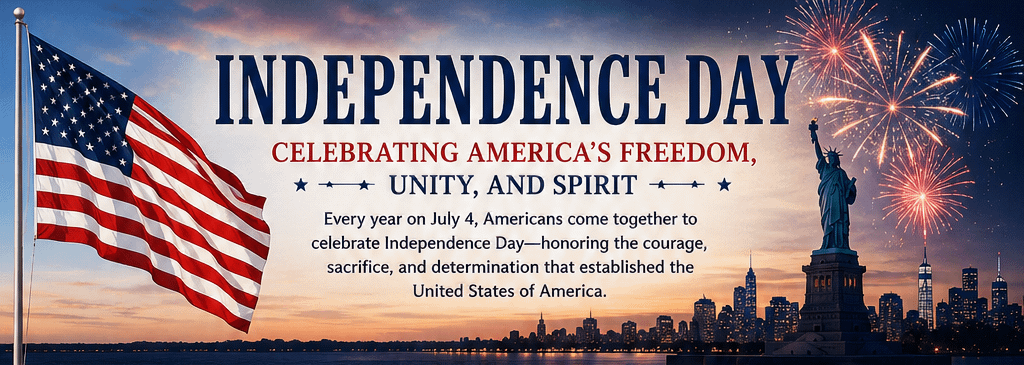
Every year on July 4, Americans gather with family and friends to celebrate Independence Day, one of the nation’s most cherished holidays. Filled with fireworks, parades, barbecues, concerts, and displays of the American flag, the Fourth of July is much more than a summer celebration. It is a reminder of the courage, sacrifice, and determination that gave birth to the United States of America.
Independence Day honors the moment when thirteen colonies declared their independence from Great Britain in 1776, beginning a new chapter built on the ideals of liberty, equality, and self-government. Nearly 250 years later, those principles continue to inspire generations of Americans.
The Road to Independence
During the mid-1700s, the American colonies were under British rule. Although many colonists considered themselves loyal British subjects, growing frustrations emerged over taxation without representation, restrictive trade laws, and increasing government control.
Events such as the Boston Massacre in 1770, the Boston Tea Party in 1773, and the battles of Lexington and Concord in 1775 intensified tensions between the colonies and Great Britain.
As conflict escalated, leaders from the thirteen colonies met during the Second Continental Congress to determine the future of America.
The Declaration of Independence
On July 2, 1776, the Continental Congress voted in favor of independence.
Two days later, on July 4, 1776, delegates formally adopted the Declaration of Independence, primarily written by Thomas Jefferson, with contributions from John Adams, Benjamin Franklin, Roger Sherman, and Robert R. Livingston.
The Declaration boldly proclaimed that:
- All people are created equal.
- They possess certain unalienable rights.
- Those rights include life, liberty, and the pursuit of happiness.
- Governments exist to protect those rights.
- The people have the authority to replace governments that fail to do so.
These revolutionary ideas forever changed the course of history.
Winning America’s Freedom
Declaring independence was only the beginning.
The American Revolutionary War continued until 1783, with soldiers, volunteers, and ordinary citizens sacrificing greatly for the dream of an independent nation.
After years of hardship, perseverance, and decisive victories—including the surrender of British forces at Yorktown in 1781—Great Britain officially recognized American independence through the Treaty of Paris in 1783.
The United States had become a free and independent nation.
Why We Celebrate on July 4
Although the vote for independence occurred on July 2, the Declaration of Independence was officially adopted on July 4.
The printed copies distributed throughout the colonies carried the July 4 date, making it the day Americans have celebrated ever since.
Interestingly, John Adams believed Americans would forever celebrate July 2 rather than July 4. History ultimately chose otherwise.
Independence Day Traditions
Over the centuries, Independence Day has become a celebration of both American history and community.
Popular traditions include:
- Fireworks displays
- Patriotic parades
- Family barbecues and cookouts
- Picnics in local parks
- Flag ceremonies
- Outdoor concerts
- Community festivals
- Baseball games
- Wearing red, white, and blue
- Singing patriotic songs such as The Star-Spangled Banner and America the Beautiful
For many families, these traditions create memories that are passed from one generation to the next.
The Meaning Behind the Fireworks
Fireworks have been part of Independence Day celebrations since the very first anniversary in 1777.
The colorful explosions symbolize celebration, hope, victory, and the excitement surrounding America’s birth.
Today, millions of Americans gather to watch spectacular fireworks displays that light up city skylines and small-town communities alike.
Symbols of Independence Day
Several iconic symbols are closely associated with the Fourth of July.
The American Flag
The Stars and Stripes represents unity among the states and honors those who have defended America’s freedoms.
The Bald Eagle
As the national bird, the bald eagle symbolizes strength, courage, and freedom.
The Liberty Bell
Located in Philadelphia, the Liberty Bell remains one of the most recognizable symbols of American independence and liberty.
Red, White, and Blue
The colors of the American flag each carry symbolic meaning:
- Red represents courage and sacrifice.
- White symbolizes purity and honesty.
- Blue stands for vigilance, perseverance, and justice.
A Time to Remember Those Who Served
While Memorial Day specifically honors those who gave their lives in military service and Veterans Day recognizes all who have served, Independence Day also offers an opportunity to express gratitude for the men and women who have protected the nation’s freedoms throughout history.
Their dedication has helped preserve the liberties first declared in 1776.
Celebrating Safely
As millions enjoy the holiday, safety remains an important part of the celebration.
Consider these tips:
- Attend professional fireworks displays whenever possible.
- Keep children supervised around fireworks and grills.
- Stay hydrated during outdoor activities.
- Wear sunscreen during daytime celebrations.
- Practice safe grilling techniques.
- Never drink and drive.
Simple precautions help ensure everyone enjoys a memorable holiday.
Independence Day Today
Modern Independence Day reflects America’s diversity while celebrating shared values.
Communities across the country celebrate in unique ways, yet all are united by appreciation for freedom, opportunity, and the ongoing pursuit of a more perfect nation.
Whether attending a parade, gathering with loved ones, watching fireworks, or quietly reflecting on history, Americans participate in a tradition that has endured for nearly two and a half centuries.
Final Thoughts
Independence Day is more than a date on the calendar—it is a celebration of courage, sacrifice, resilience, and hope. It reminds us of the vision of those who believed a nation founded on liberty could thrive through the commitment of its people.
As fireworks illuminate the night sky each July 4, they serve as a powerful reminder that freedom is both a gift and a responsibility. By honoring the past, appreciating the present, and working toward a brighter future, Americans continue the legacy that began in 1776.
Happy Independence Day!
Read More Holidays & National Days
Leave a Reply