Category: Inspiration & Motivation

  • Inspiration of the Day: Cultivating Personal Growth

    Inspiration of the Day: Cultivating Personal Growth

    Personal growth rarely happens all at once. It happens quietly, through the decisions we make every day.

    It happens when we choose to keep going after disappointment. It happens when we admit that something in our lives needs to change. It happens when we learn from our mistakes instead of allowing them to define us. And sometimes, personal growth begins simply because we finally decide that we no longer want to remain where we are.

    Cultivating personal growth means intentionally becoming a stronger, wiser, healthier, and more authentic version of yourself. It doesn’t mean becoming perfect. It means becoming willing to learn, change, heal, and move forward.

    Like planting a garden, growth requires patience. You cannot plant a seed today and become frustrated tomorrow because there isn’t a tree standing in front of you. You water it. You protect it. You give it sunlight. You allow time to do its work.

    Your life works much the same way.

    Every positive habit you develop is a seed.

    Every lesson you learn is a seed.

    Every boundary you establish is a seed.

    Every time you choose courage instead of fear, you plant another seed.

    You may not immediately see the results, but that doesn’t mean nothing is happening beneath the surface.

    Growth Begins With Self-Awareness

    Before we can grow, we have to become willing to look at ourselves.

    That can be uncomfortable.

    It is much easier to identify what everyone else should change than to examine our own habits, attitudes, fears, and decisions. Personal growth requires us to ask ourselves difficult questions.

    What am I doing that is helping my life?

    What am I doing that is holding me back?

    What habits need to change?

    What am I avoiding because I am afraid?

    What kind of person do I want to become?

    Self-awareness isn’t about criticizing yourself. It is about understanding yourself.

    There is a significant difference.

    Constant self-criticism keeps you trapped in shame. Self-awareness gives you information that can help you move forward.

    You can acknowledge a weakness without believing you are weak.

    You can admit you made a mistake without believing you are a failure.

    You can recognize that something needs to change without hating the person you are today.

    Growth begins when honesty and hope exist together.

    Stop Expecting Yourself to Have Everything Figured Out

    One of the biggest obstacles to personal growth is believing that you should already know everything.

    You shouldn’t.

    Life is constantly teaching us.

    There will be situations you don’t know how to handle. There will be decisions you wish you had made differently. There will be relationships that teach you painful lessons. There will be moments when you look back and wonder why you didn’t understand something sooner.

    That’s part of being human.

    Instead of saying, “I should have known better,” try asking:

    “What can I learn from this?”

    That question changes everything.

    Mistakes can become teachers.

    Disappointment can become wisdom.

    Failure can become experience.

    Heartbreak can teach boundaries.

    Loss can change your priorities.

    Hard seasons can reveal strength you never knew you possessed.

    You cannot rewrite yesterday, but you can allow yesterday to teach you how to live tomorrow differently.

    Growth Often Happens During Difficult Seasons

    We usually imagine personal growth as something positive and exciting.

    Sometimes it is.

    But some of our greatest growth happens during seasons we never would have chosen.

    Pain forces us to examine what matters.

    Failure forces us to reconsider our approach.

    Heartbreak teaches us about ourselves and others.

    Uncertainty teaches patience.

    Loss reminds us how precious time and love truly are.

    None of this means we have to be grateful for everything painful that happens. Some experiences simply hurt.

    But even when we cannot change what happened, we can decide what we do next.

    Pain can leave scars while still teaching us something.

    You can carry memories of difficult seasons without allowing those seasons to control the rest of your life.

    Sometimes growth sounds like:

    “This hurt me, but it will not be the end of my story.”

    Small Improvements Matter

    People often abandon personal development because they expect dramatic results too quickly.

    They decide to exercise and expect to transform their health immediately.

    They start saving money and become discouraged because their bank account hasn’t changed dramatically.

    They begin working on their confidence and wonder why insecurity still appears.

    They start healing emotionally and become frustrated when difficult days return.

    Growth doesn’t usually work that way.

    Small improvements repeated consistently can eventually create enormous changes.

    Read ten pages.

    Walk an extra ten minutes.

    Drink another glass of water.

    Save a few dollars.

    Learn something new.

    Make the phone call you’ve been avoiding.

    Clean one area of your home.

    Write down one goal.

    Spend five minutes reflecting.

    Encourage someone.

    Pray.

    Rest when you need to.

    Take one step.

    Then tomorrow, take another.

    You don’t have to transform your entire life today.

    You simply have to keep moving in a healthier direction.

    Become Comfortable Being a Beginner

    Growth requires humility because whenever you learn something new, you have to accept that you won’t immediately be good at it.

    Everyone who became skilled at something was once a beginner.

    Every successful business owner once had questions.

    Every great cook once ruined a meal.

    Every confident speaker once felt nervous.

    Every experienced writer once stared at a blank page.

    Every person who developed discipline once struggled with consistency.

    Don’t allow embarrassment to prevent education.

    Ask questions.

    Try things.

    Make mistakes.

    Learn.

    Try again.

    Being inexperienced isn’t something to be ashamed of. Refusing to learn because you’re afraid of looking inexperienced can keep you trapped.

    Give yourself permission to be a beginner.

    Surround Yourself With Growth

    Your environment influences you more than you may realize.

    The conversations you participate in, the people you spend time with, the content you consume, and the places where you spend your energy can either encourage growth or quietly discourage it.

    Pay attention to what regularly enters your mind.

    Are you constantly surrounded by negativity?

    Are you spending time with people who discourage every new idea?

    Are you consuming content that leaves you angry, jealous, fearful, or discouraged?

    Or are you surrounding yourself with things that encourage you to learn, think, create, heal, and improve?

    You don’t have to remove everyone from your life who thinks differently than you.

    But you should intentionally make room for people and environments that encourage you to become better.

    Spend time with people who challenge you in healthy ways.

    Read books.

    Listen to meaningful conversations.

    Learn from people with more experience.

    Seek wisdom.

    Ask questions.

    Your environment becomes part of the soil where your growth takes place.

    Choose that soil carefully.

    Learn to Let Go of What No Longer Serves You

    Personal growth isn’t only about adding things to your life.

    Sometimes it requires removing them.

    You may need to let go of an unhealthy habit.

    You may need to stop carrying resentment.

    You may need to distance yourself from a toxic situation.

    You may need to stop seeking approval from people who will never give it.

    You may need to release unrealistic expectations about where you thought your life would be by now.

    Some things belonged to an earlier version of you.

    That doesn’t mean they were always bad. It simply means they may no longer belong in the life you’re building.

    Growth requires space.

    Sometimes you create that space by letting go.

    Don’t Compare Your Growth to Someone Else’s

    Comparison can destroy your appreciation for your own progress.

    You see someone’s success without seeing the years it took them to reach it.

    You see their confidence without knowing the battles they fought.

    You see the finished product without seeing the mistakes, failures, sleepless nights, doubts, and sacrifices behind it.

    Your journey is your own.

    Someone else may be ahead of you in one area while you’re ahead of them in another.

    There is no universal timeline for becoming the person you’re meant to become.

    Instead of asking:

    “Why am I not where they are?”

    Ask:

    “Am I growing compared with where I used to be?”

    That is a much healthier measurement.

    Maybe you’re more patient than you were last year.

    Maybe you’re finally setting boundaries.

    Maybe you’re taking better care of yourself.

    Maybe you’re learning to forgive.

    Maybe you’re becoming more confident.

    Maybe you’re rebuilding after a difficult season.

    Maybe you’re simply getting out of bed and trying again.

    Progress doesn’t always look impressive from the outside.

    But progress is still progress.

    Discipline Will Carry You When Motivation Disappears

    Motivation feels wonderful, but it isn’t reliable.

    Some mornings you will feel inspired.

    Other mornings you won’t.

    Personal growth becomes sustainable when you learn to continue even when the excitement disappears.

    That’s where discipline matters.

    Discipline means doing what supports the life you want even when you don’t particularly feel like doing it.

    You won’t always feel like exercising.

    You won’t always feel like working toward your goals.

    You won’t always feel like reading, learning, saving, practicing, or improving.

    That’s normal.

    You don’t need perfect motivation.

    You need consistent action.

    Even imperfect consistency can change your life.

    Rest Is Part of Growth

    Personal development does not mean constantly pushing yourself.

    Sometimes growth requires slowing down.

    Your body needs rest.

    Your mind needs quiet.

    Your emotions need space.

    There is nothing admirable about exhausting yourself simply to prove that you’re productive.

    Rest doesn’t mean you’re giving up.

    A farmer doesn’t stand over a field demanding that crops grow faster. There are seasons for planting, watering, harvesting, and resting.

    Your life has seasons too.

    Sometimes you will accomplish a great deal.

    Sometimes you will need to recover.

    Both can be productive in different ways.

    Celebrate Who You Are Becoming

    Many people are so focused on the distance remaining that they forget to recognize the distance they’ve already traveled.

    Look back occasionally.

    Not to live in the past, but to recognize your progress.

    Think about situations you survived that once seemed impossible.

    Think about lessons you’ve learned.

    Think about boundaries you’ve developed.

    Think about habits you’ve changed.

    Think about the courage you’ve discovered.

    You might not be exactly where you want to be yet.

    That’s okay.

    You’re still becoming.

    Celebrate that.

    Keep Planting Seeds

    Personal growth is not a destination you eventually reach.

    There will always be something new to learn.

    There will always be another level of wisdom to develop.

    There will always be opportunities to become more patient, compassionate, courageous, disciplined, loving, and resilient.

    So keep planting seeds.

    Plant kindness.

    Plant discipline.

    Plant knowledge.

    Plant courage.

    Plant faith.

    Plant healthier habits.

    Plant forgiveness.

    Plant dreams.

    Plant hope.

    Some seeds will grow quickly.

    Others may take years.

    And some may grow in ways you never expected.

    Your responsibility isn’t to have your entire future figured out.

    Your responsibility is to keep tending the life you’ve been given.

    Inspiration of the Day

    You don’t have to become a completely different person overnight.

    Start with one decision.

    One habit.

    One lesson.

    One courageous step.

    Become a little stronger.

    A little wiser.

    A little healthier.

    A little more patient.

    A little more intentional.

    Then do it again tomorrow.

    One day you may look back and realize that all those small decisions created a life that looks completely different from the one you once knew.

    Personal growth doesn’t require perfection.

    It requires willingness.

    The willingness to learn.

    The willingness to change.

    The willingness to admit when you’re wrong.

    The willingness to begin again.

    The willingness to keep moving forward when progress feels slow.

    Keep cultivating yourself.

    Keep learning.

    Keep healing.

    Keep challenging yourself.

    Keep planting seeds.

    Because the person you’re becoming is being shaped by the choices you’re making today.

    What is one small change you can make today that your future self will thank you for?
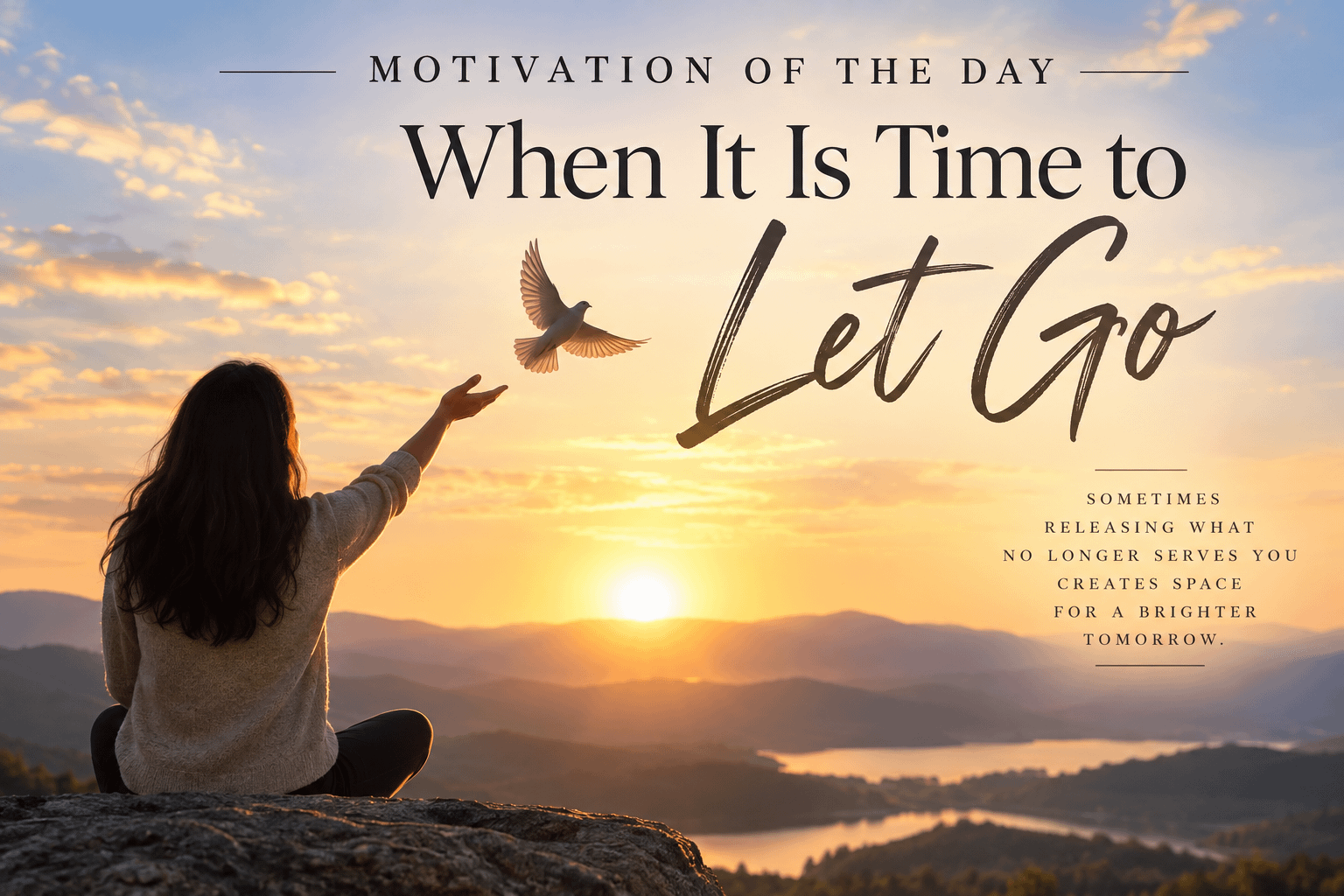
  • Motivation of the Day: When It Is Time to Let Go

    Motivation of the Day: When It Is Time to Let Go

    There comes a point in life when holding on takes more strength than walking away.

    We hold on because we remember how things used to be. We hold on because we believe things might change. We hold on because we have invested time, love, energy, hope, and pieces of ourselves into something we never imagined losing.

    Sometimes we hold on because letting go feels like admitting defeat.

    But letting go is not always giving up.

    Sometimes letting go is choosing yourself.

    Sometimes it is accepting that a chapter has ended, even though you desperately wanted another page.

    Sometimes it is finally understanding that you cannot force something to remain in your life when it has already begun to disappear.

    And sometimes the strongest decision you will ever make is saying:

    This hurts me more than it helps me, and I am finally ready to release it.

    You Cannot Carry Everything Forever

    Life gives us many things to carry.

    Memories.

    Responsibilities.

    Dreams.

    Relationships.

    Regrets.

    Disappointments.

    Expectations.

    Pain.

    Some things deserve to be carried because they make us stronger, remind us who we are, or connect us to the people we love.

    Other things slowly become weights.

    At first, you may not notice how heavy they have become. You simply adjust. You learn to function while carrying them.

    You wake up with the weight.

    You go to work with the weight.

    You smile while carrying it.

    You talk to people while carrying it.

    You lie awake at night carrying it.

    Eventually, something that was once only a small burden begins consuming your emotional energy.

    That is when you have to ask yourself an important question:

    Am I holding onto this because it still belongs in my life, or because I am afraid of what life will look like without it?

    The answer may be uncomfortable.

    But sometimes uncomfortable truths are exactly what we need before change can begin.

    Letting Go Does Not Erase What Happened

    One reason letting go can be difficult is because we sometimes believe releasing something means pretending it never mattered.

    That is not true.

    You can let go of someone and still appreciate the memories you shared.

    You can leave a situation and still be grateful for what it taught you.

    You can release an old dream without believing that dreaming was foolish.

    You can forgive yourself for mistakes without pretending those mistakes never happened.

    You can move forward without erasing your past.

    The past will always be part of your story.

    But it does not have to control the next chapter.

    There are people, places, seasons, dreams, and experiences that were important for a particular part of your life.

    They helped shape you.

    They taught you.

    They challenged you.

    They may even have changed you forever.

    But something being important once does not automatically mean it belongs in your life forever.

    Some things are chapters.

    They were never meant to become the entire book.

    Stop Trying to Force What No Longer Fits

    Many people exhaust themselves trying to repair things that cannot be repaired by one person alone.

    A relationship requires two people willing to work.

    Trust requires honesty.

    Friendship requires effort from both sides.

    Growth requires willingness.

    Change requires action.

    You cannot continue doing everyone’s part and expect a healthy outcome.

    You cannot force another person to care.

    You cannot force someone to communicate.

    You cannot force someone to respect you.

    You cannot force someone to appreciate you.

    You cannot force someone to choose you.

    And you cannot keep sacrificing your peace trying to convince someone of your worth.

    There comes a moment when you have done what you reasonably can.

    You have explained yourself.

    You have tried again.

    You have forgiven.

    You have waited.

    You have hoped.

    You have given another chance.

    Maybe several.

    Eventually, another chance becomes another opportunity for the same pain.

    That is when letting go may become an act of self-respect.

    Sometimes We Hold On to Who Someone Used to Be

    One of the hardest things about relationships is realizing that sometimes we are not holding onto the person standing in front of us.

    We are holding onto a memory.

    We remember the conversations.

    The laughter.

    The attention.

    The promises.

    The moments when everything felt right.

    And because those memories are powerful, we keep waiting for that version of the person to return.

    But eventually we have to look at what is happening now.

    Not what happened five years ago.

    Not what someone promised.

    Not what you hoped they would become.

    Look at what their actions are showing you today.

    People can change.

    Relationships can change.

    Circumstances can change.

    Sometimes things can be rebuilt.

    But you cannot build a future entirely from memories of the past.

    You have to respond to reality as it exists now.

    Let Go of the Need for an Explanation

    Sometimes you will never receive the explanation you deserve.

    You may never fully understand why someone hurt you.

    You may never know why someone left.

    You may never receive the apology you hoped for.

    You may never understand why a friendship ended, why an opportunity disappeared, or why someone suddenly changed.

    For a long time, you might search for answers.

    You replay conversations.

    You analyze messages.

    You think about what you could have done differently.

    But closure does not always arrive through someone else’s words.

    Sometimes closure is something you give yourself.

    You say:

    I may never understand everything that happened, but I refuse to spend the rest of my life waiting for an explanation before allowing myself to move forward.

    That is powerful.

    Because your healing should not depend entirely on someone who contributed to your pain.

    Let Go of Who You Used to Be

    Not everything we need to release involves another person.

    Sometimes we need to let go of an older version of ourselves.

    Maybe you made mistakes.

    Maybe you stayed somewhere longer than you should have.

    Maybe you trusted someone who betrayed that trust.

    Maybe you wasted time.

    Maybe you ignored warning signs.

    Maybe you were not the person you wish you had been.

    You cannot return to yesterday and rewrite it.

    But you can learn from it.

    Growth requires accepting that the person who made those mistakes does not have to remain the person you are today.

    You are allowed to change.

    You are allowed to grow.

    You are allowed to become wiser.

    You are allowed to stop punishing yourself for something you finally understand.

    Take the lesson.

    Leave the shame.

    Keep moving.

    Let Go of the Life You Thought You Would Have

    This may be one of the hardest forms of letting go.

    Most of us quietly create a picture of the future.

    We imagine who will be beside us.

    We imagine where we will live.

    We imagine what our family will look like.

    We imagine careers, celebrations, relationships, vacations, milestones, and countless ordinary moments.

    Then life happens.

    Plans change.

    Relationships end.

    People leave.

    Opportunities disappear.

    Unexpected events change everything.

    Suddenly you are standing in a life that looks nothing like the one you imagined.

    There is real grief in that.

    You are not only grieving what happened.

    Sometimes you are grieving everything that will never happen because of it.

    Those feelings deserve acknowledgment.

    But eventually, another question appears:

    What can I build from the life that remains?

    The future may not look the way you originally imagined.

    That does not automatically mean there is nothing meaningful ahead.

    Life can still surprise you.

    New relationships can appear.

    New opportunities can develop.

    New dreams can replace old ones.

    You can discover parts of yourself you never would have found if everything had gone according to your original plan.

    Different does not always mean worse.

    Sometimes different simply means unwritten.

    There Is a Difference Between Giving Up and Letting Go

    Giving up says:

    “I cannot do this.”

    Letting go can say:

    “I have done what I can, and this is no longer healthy for me.”

    Giving up can come from hopelessness.

    Letting go can come from wisdom.

    Giving up sometimes happens before we have truly tried.

    Letting go often happens after we have tried for far too long.

    Learning the difference matters.

    There are things in life worth fighting for.

    Dreams worth pursuing.

    Relationships worth repairing.

    Goals worth chasing.

    Difficult seasons worth enduring.

    But perseverance does not mean blindly holding onto everything forever.

    Wisdom means knowing what deserves another effort and what requires release.

    Strength is not measured only by how long you can hold on.

    Sometimes strength is measured by whether you are brave enough to finally open your hand.

    Make Room for Something New

    Imagine trying to carry several heavy boxes while someone offers you something valuable.

    You might want it.

    You might need it.

    But your hands are full.

    Life can work the same way.

    We become emotionally occupied by situations that ended years ago.

    We remain consumed by old resentment.

    We repeatedly revisit the same disappointments.

    We stay attached to people who have already moved on.

    Then we wonder why we cannot move forward.

    Sometimes the new chapter cannot fully begin because we are still standing in the doorway of the old one.

    Letting go creates space.

    Space for peace.

    Space for healing.

    Space for friendships.

    Space for opportunities.

    Space for love.

    Space for purpose.

    Space for becoming who you are supposed to become next.

    You do not know everything waiting for you.

    But you may never discover it if all of your energy remains focused on what is behind you.

    Letting Go May Hurt Before It Heals

    There is something important people do not always mention.

    Making the right decision does not guarantee that the decision will feel good immediately.

    You can walk away from something unhealthy and still miss it.

    You can know a relationship needed to end and still cry.

    You can understand that a door needed to close and still wish it had stayed open.

    You can choose yourself and still question whether you made the correct decision.

    Healing rarely moves in a straight line.

    One day you may feel powerful.

    The next day you may miss everything you released.

    That does not mean you made a mistake.

    It means you are human.

    Your heart sometimes takes longer to accept what your mind already understands.

    Give yourself that time.

    Forgiveness Can Be Part of Letting Go

    Forgiveness does not mean pretending something was acceptable.

    It does not mean allowing someone back into your life.

    It does not mean eliminating boundaries.

    It does not mean forgetting what happened.

    Sometimes forgiveness simply means refusing to allow bitterness to control you anymore.

    Resentment keeps you emotionally connected to something you may desperately want to leave behind.

    You replay what happened.

    You imagine different outcomes.

    You think about what the person deserves.

    Meanwhile, they continue occupying space in your mind.

    Forgiveness can become a declaration:

    What happened mattered, but it will not control the rest of my life.

    Forgiveness may happen slowly.

    That is okay.

    The goal is not pretending you were never hurt.

    The goal is reaching the point where the hurt is no longer driving your life.

    Stop Looking Back for Permission to Move Forward

    Sometimes we continue looking backward because a small part of us hopes something will change.

    Maybe they will call.

    Maybe they will apologize.

    Maybe the opportunity will return.

    Maybe everything will somehow become what it used to be.

    And occasionally, second chances do happen.

    But you cannot put your entire life on hold waiting for one.

    There are mornings you have not seen yet.

    There are conversations you have not had.

    There are people you have not met.

    There are places you have never visited.

    There are opportunities you cannot currently imagine.

    There may even be another version of yourself waiting to emerge.

    Do not sacrifice all of that because you are afraid to release yesterday.

    When It Is Time, Let Go

    You will probably never feel completely ready.

    There may never be a perfect moment.

    You may still have questions.

    You may still care.

    You may still remember.

    You may still wish things were different.

    But eventually you have to choose whether your past will continue controlling your future.

    Letting go does not mean the experience meant nothing.

    Sometimes it means it meant enough that you learned everything you could from it.

    Take the memories that make you smile.

    Take the lessons that made you wiser.

    Take the strength you discovered while surviving difficult moments.

    Take the clarity you gained.

    Take the person you have become.

    And leave behind whatever keeps you from becoming who you can still be.

    You have carried it long enough.

    You have replayed it long enough.

    You have questioned yourself long enough.

    You have waited long enough.

    You are allowed to put the weight down.

    You are allowed to walk toward something different.

    You are allowed to choose peace.

    You are allowed to start again.

    And you are allowed to believe that letting go of what no longer belongs in your life may create room for something you never expected to find.

    Sometimes the ending you fought against becomes the beginning you desperately needed.

    So when you know deep inside that it is time, do not be ashamed of walking away.

    Take the lesson.

    Keep the memories that deserve to remain.

    Release what you cannot change.

    Turn toward what is still possible.

    And keep moving forward.

    What are you holding onto today that might finally be time to let go?

  • Inspiration of the Day: Learning to Love Again

    Inspiration of the Day: Learning to Love Again

    Learning to love again can be one of the most difficult and courageous things we ever do.

    When you have experienced heartbreak, betrayal, disappointment, grief, or loss, love can begin to feel dangerous. Something that once brought happiness can become connected with memories of pain. You may still want love in your life, but part of you hesitates whenever someone gets too close.

    You remember what happened before.

    You remember how much you gave.

    You remember how badly it hurt when everything changed.

    So you protect your heart.

    There is nothing unusual about becoming cautious after being hurt. When you have experienced deep emotional pain, opening your heart again requires more than simply meeting the right person. It requires rebuilding trust, rediscovering hope, and accepting that loving someone always involves a certain amount of vulnerability.

    Learning to love again does not mean forgetting what happened.

    It means refusing to allow yesterday’s pain to decide tomorrow’s possibilities.

    Your Heart Remembers

    The heart has a remarkable memory.

    Sometimes a new person can do absolutely nothing wrong, yet something they say or do reminds you of someone from your past. Suddenly, the walls start going back up.

    You begin questioning everything.

    What if I get hurt again?

    What if I trust someone and they leave?

    What if I give everything I have and discover that it still isn’t enough?

    These fears can become powerful enough to convince us that being alone is safer.

    And in one sense, it is.

    If you never let anyone close, they cannot break your heart.

    But protecting yourself from every possibility of heartbreak can also protect you from some of life’s most meaningful connections.

    There comes a point when you have to decide whether your past will remain a warning or become a permanent prison.

    You can learn from what happened without allowing it to control everything that happens next.

    You Don’t Have to Rush

    Learning to love again isn’t a race.

    You don’t have to wake up tomorrow ready for another relationship. You don’t have to prove that you have moved on. You don’t have to force yourself into dating because other people think enough time has passed.

    Your heart doesn’t operate according to someone else’s schedule.

    Take your time.

    Learn who you are now.

    Pain changes us. Loss changes us. Years of experiences change our priorities, expectations, and understanding of relationships.

    The person you are today may want something completely different from the person you were ten years ago.

    That isn’t necessarily a bad thing.

    You may understand yourself better now.

    You may recognize unhealthy behaviors sooner.

    You may appreciate kindness more deeply.

    You may understand the importance of communication.

    You may value peace instead of excitement and consistency instead of promises.

    Before opening your heart to someone else, become comfortable with the person you have become.

    Someone New Is Not Someone From Your Past

    One of the greatest challenges in loving again is resisting the temptation to make a new person pay for what someone else did.

    Your caution may be understandable, but every new relationship deserves the opportunity to become its own story.

    The person standing in front of you didn’t necessarily cause the wounds behind you.

    That doesn’t mean ignoring warning signs.

    It doesn’t mean trusting blindly.

    And it certainly doesn’t mean accepting disrespect because you want love.

    It simply means allowing someone’s actions to reveal who they are rather than assuming you already know how the story will end.

    Trust doesn’t have to be given immediately.

    It can be earned.

    Slowly.

    Honestly.

    One action at a time.

    Pay attention to consistency. Notice whether words match actions. Look at how someone treats you when things aren’t convenient. Notice whether they respect your boundaries and whether you can speak openly without constantly fearing their reaction.

    Healthy love doesn’t demand immediate trust.

    It helps create it.

    Love May Look Different This Time

    Many of us grow up believing love is supposed to be dramatic.

    Butterflies.

    Constant excitement.

    Grand gestures.

    Passionate declarations.

    Those things can be wonderful, but lasting love is often much quieter.

    Sometimes love looks like someone checking whether you made it home safely.

    It looks like listening when you’ve had a terrible day.

    It looks like remembering the little things you’ve mentioned.

    It looks like showing up when life isn’t exciting.

    It looks like sitting together without needing to fill every moment with conversation.

    It looks like honesty when honesty is uncomfortable.

    It looks like choosing each other repeatedly rather than making promises once.

    After experiencing enough of life, you may discover that peace is one of the most romantic things another person can give you.

    You don’t have to spend your days wondering where you stand.

    You don’t have to decode mixed signals.

    You don’t have to constantly chase reassurance.

    Love can feel safe without becoming boring.

    It can be passionate without becoming destructive.

    It can be exciting without becoming chaotic.

    Vulnerability Is Part of Loving

    Eventually, loving someone requires taking a risk.

    There is no way around it.

    You can establish boundaries. You can move slowly. You can pay attention to warning signs. You can make wiser decisions than you made before.

    But you cannot guarantee that another person will never hurt you.

    That’s what makes opening your heart difficult.

    Love requires vulnerability.

    It requires saying, in some form, “This matters to me.”

    And whenever something matters, losing it becomes possible.

    But vulnerability isn’t the same as weakness.

    It takes tremendous strength to remain capable of loving after you have experienced reasons to shut everyone out.

    Anyone can build walls.

    It takes courage to build a door.

    Don’t Lose Yourself in Love

    Learning to love again also means learning from the ways you may have loved before.

    You can love someone deeply without disappearing inside the relationship.

    Keep your friendships.

    Keep your interests.

    Keep pursuing your goals.

    Take care of yourself.

    Maintain healthy boundaries.

    Continue becoming the person you want to be.

    A healthy relationship should add something meaningful to your life without requiring you to surrender your identity.

    Love isn’t supposed to erase you.

    Two people should be able to walk together while still remaining individuals.

    You don’t have to abandon your needs to prove your devotion.

    You don’t have to tolerate disrespect to demonstrate loyalty.

    You don’t have to continually sacrifice your peace because you are afraid someone will leave.

    The right kind of love should give both people room to grow.

    Your Past Does Not Disqualify You From Happiness

    Sometimes after enough heartbreak, people quietly begin believing that love simply isn’t meant for them.

    Maybe you’ve thought:

    “I already had my chance.”

    “Maybe I’m supposed to be alone.”

    “I’m too damaged for someone to understand me.”

    “Nobody is going to want everything that comes with my story.”

    But your past is part of your story. It doesn’t have to be the conclusion.

    You aren’t required to arrive in someone’s life without scars.

    Most adults carry something.

    Heartbreak.

    Regret.

    Loss.

    Fear.

    Mistakes.

    Disappointment.

    A person capable of mature love isn’t looking for someone who has never been hurt. They are looking for someone willing to communicate, grow, care, and build something genuine.

    Your scars don’t prevent you from loving.

    Sometimes they teach you how precious love really is.

    Let Someone Know the Real You

    When you finally meet someone you care about, there may be a temptation to hide the parts of yourself you fear they won’t understand.

    Eventually, though, meaningful love requires being known.

    Not all at once.

    Not before trust has been established.

    But gradually.

    Let someone learn your story.

    Tell them what matters to you.

    Talk about what scares you.

    Share your hopes.

    Explain why certain things are difficult.

    Allow them to understand the experiences that helped shape the person you are today.

    You shouldn’t have to perform a perfect version of yourself to keep someone interested.

    Real connection begins when two imperfect people can gradually become comfortable being genuine with each other.

    Love Can Enter Quietly

    Sometimes we expect love to arrive dramatically.

    But it may begin as friendship.

    A conversation you didn’t expect to enjoy.

    Someone who makes you laugh again.

    Someone you slowly begin looking forward to hearing from.

    Someone who notices when you’re unusually quiet.

    Someone who doesn’t pressure you to become something you’re not.

    And one day you realize something has changed.

    You’re smiling at your phone.

    You’re thinking about them.

    You’re wondering how their day went.

    You’re beginning to imagine possibilities you once believed were gone forever.

    That doesn’t mean you need to rush.

    It simply means your heart may be waking up again.

    Loving Again Doesn’t Erase the Love That Came Before

    For people who have experienced profound loss, loving again can sometimes create complicated emotions.

    Moving forward can feel like leaving something—or someone—behind.

    But the heart isn’t limited to one chapter.

    New love doesn’t have to erase old love.

    New happiness doesn’t invalidate previous pain.

    Creating new memories doesn’t destroy the memories you treasure.

    Human beings have an extraordinary capacity to carry both.

    We can remember and continue.

    We can grieve and laugh.

    We can miss someone and still appreciate the people standing beside us today.

    We can honor what was while remaining open to what could still be.

    Moving forward isn’t the same thing as forgetting.

    Give Yourself Permission to Be Happy

    Sometimes the hardest part isn’t finding someone new.

    It’s believing you’re allowed to be happy again.

    After years of surviving difficult circumstances, happiness itself can feel unfamiliar.

    You might question it.

    You might wait for something to go wrong.

    You might even push good things away because disappointment feels more familiar than hope.

    But you don’t have to sabotage today’s happiness because yesterday ended painfully.

    When something good enters your life, allow yourself to experience it.

    Enjoy the conversation.

    Enjoy the laughter.

    Enjoy being wanted.

    Enjoy discovering someone.

    Enjoy having something to look forward to.

    You don’t need to know exactly where everything is going before appreciating where you are.

    Sometimes life isn’t asking you to make a lifelong promise.

    Sometimes it’s simply asking you to stop being afraid of today’s happiness.

    Start With One Small Step

    If you’ve closed your heart for a long time, don’t expect the walls to disappear overnight.

    Start small.

    Have the conversation.

    Accept the invitation.

    Give someone an opportunity to know you.

    Say how you really feel when you’re ready.

    Allow yourself to become excited about someone without immediately predicting how everything might end.

    You don’t have to know whether someone will be in your life forever before allowing them to matter today.

    Relationships unfold one day at a time.

    Let them.

    You Are Still Capable of Love

    Maybe your heart has been broken.

    Maybe someone betrayed your trust.

    Maybe you’ve experienced a loss that changed you permanently.

    Maybe years have passed since you allowed yourself to truly become emotionally close to someone.

    Maybe you’ve convinced yourself that part of your life is over.

    But your ability to love didn’t disappear.

    It may have become guarded.

    It may have become cautious.

    It may have been buried underneath grief, disappointment, fear, and survival.

    But it can still be there.

    And when you’re ready, you can begin opening that part of yourself again.

    Not because you’ve forgotten what happened.

    Because you’ve learned from it.

    Not because you’re guaranteed never to experience pain again.

    Because you’ve discovered that fear shouldn’t make every decision.

    Not because you need another person to complete you.

    Because sharing life with someone can still be beautiful.

    Inspiration of the Day

    Learning to love again isn’t about returning to the person you were before your heart was broken.

    That person has changed.

    Instead, it’s about allowing the person you are today to believe in connection again.

    Move slowly.

    Protect your peace.

    Pay attention to actions.

    Keep your boundaries.

    Be honest about your fears.

    Let trust develop naturally.

    And when someone gives you genuine reasons to believe they care, don’t let someone else’s mistakes automatically close the door.

    Your story isn’t finished because one chapter hurt.

    There may still be conversations you haven’t had.

    Laughter you haven’t heard.

    Places you haven’t visited together.

    Memories you haven’t made.

    Someone you haven’t met—or perhaps someone already in your life whom you’re only beginning to see differently.

    You don’t have to force love.

    You don’t have to chase it.

    But you can leave enough room in your heart for love to find you.

    After everything your heart has survived, are you willing to believe that something beautiful could still be ahead?

  • Motivation of the Day: Keeping Your Word, Even When It Hurts You to Do It

    Motivation of the Day: Keeping Your Word, Even When It Hurts You to Do It

    There are moments in life when keeping your word is easy. You make a promise, circumstances cooperate, and following through requires very little sacrifice.

    Then there are the promises that cost you something.

    They cost you time.

    They cost you comfort.

    They force you to swallow your pride.

    They require you to show up when you would rather stay home.

    Sometimes keeping your word means doing something that no longer benefits you. Sometimes it means honoring a commitment after your feelings have changed. Sometimes it means standing behind something you said when walking away would be much easier.

    Those are the moments when your word truly means something.

    Anyone can keep a promise when it is convenient.

    Character is revealed when keeping that promise becomes difficult.

    Your Word Says Something About Who You Are

    Your reputation is not built only by what you accomplish.

    It is built by what people learn they can expect from you.

    When you tell someone you will be there, are you there?

    When you say you will finish something, do you finish it?

    When you make a commitment, do you honor it when circumstances become uncomfortable?

    Your word becomes part of your identity.

    People eventually learn whether your promises are meaningful or merely words spoken in the moment.

    More importantly, you learn something about yourself.

    Every time you keep your word despite discomfort, you strengthen your confidence in your own character.

    You begin knowing that when you say something, you mean it.

    That kind of self-respect cannot be purchased.

    It is earned through thousands of decisions no one else may ever notice.

    Integrity Is Often Expensive

    Integrity sounds wonderful until it requires sacrifice.

    It is easy to talk about honesty, loyalty, responsibility, and commitment when nothing is being demanded from you.

    The real test arrives when those values become inconvenient.

    Maybe you promised someone you would help them, and then something more enjoyable came along.

    Maybe you committed yourself to finishing a project, but halfway through you became exhausted.

    Maybe you promised yourself that you would change a habit, and now temptation is telling you that one exception will not matter.

    Maybe someone disappointed you, hurt you, or failed to keep their side of an agreement, and now you are struggling with whether your own promise still matters.

    These moments can hurt because integrity sometimes demands something that your emotions do not want to give.

    You may not feel like doing it anymore.

    But feelings and principles are not always the same thing.

    Feelings change quickly.

    Principles give you something steady to stand on.

    Keeping Your Word to Yourself Matters Too

    Some of the most frequently broken promises are the ones we make privately.

    “I’m going to take better care of myself.”

    “I’m going to stop letting fear control me.”

    “I’m going to finish what I started.”

    “I’m going to save money.”

    “I’m going to walk away from situations that keep destroying my peace.”

    “I’m going to start rebuilding my life.”

    Nobody may know you made those promises.

    There may be no public consequences when you break them.

    But you know.

    Every time you continually break commitments to yourself, your confidence can slowly weaken.

    You begin wondering whether you can trust your own decisions.

    The opposite is also true.

    When you tell yourself you will do something and repeatedly follow through, you create evidence that you can depend on yourself.

    You do not need perfection.

    You need consistency.

    You need enough moments where your actions tell your mind:

    “When I make a commitment, I take it seriously.”

    That changes how you see yourself.

    Sometimes Doing the Right Thing Does Not Feel Good

    One of the biggest misconceptions about personal growth is believing that doing the right thing will always feel rewarding.

    Sometimes it does not.

    Sometimes doing the right thing hurts.

    You might apologize when your pride wants to remain silent.

    You might show kindness to someone who was not kind to you.

    You might fulfill an obligation knowing you will receive little appreciation.

    You might return something that would have been easy to keep.

    You might admit that you made a mistake when hiding it would protect your image.

    You might walk away from something tempting because you already gave someone your commitment.

    Nobody may congratulate you.

    Nobody may even notice.

    But character is often built in moments without applause.

    Doing what is right because it is right creates a strength that circumstances cannot easily take away.

    Your Feelings Can Change After You Make a Commitment

    There is something important to understand about promises:

    The version of you who made the commitment and the version of you who must fulfill it may feel completely different.

    You may have been excited when you said yes.

    Now you are tired.

    You may have been optimistic.

    Now you are frustrated.

    You may have believed something would be simple.

    Now you realize how much work it requires.

    That does not automatically mean the commitment should be abandoned.

    Sometimes growth requires allowing your earlier values to guide your current emotions.

    You said you would do it.

    So you keep moving.

    Not because every promise should trap you forever, but because discomfort alone should not determine your character.

    There Is a Difference Between Integrity and Self-Destruction

    Keeping your word matters, but wisdom matters too.

    A promise should never become an excuse to remain in abuse, danger, exploitation, or a situation that is seriously harming you.

    Circumstances can change.

    Information can change.

    People can violate agreements.

    You are allowed to establish boundaries.

    You are allowed to acknowledge that a commitment must be reconsidered when continuing would cause serious harm.

    Integrity does not require destroying yourself.

    Sometimes honesty means going back to someone and saying:

    “I meant what I said when I made that commitment, but circumstances have changed. I cannot continue in the way I originally promised.”

    The important thing is how you handle it.

    Do not disappear.

    Do not pretend the promise never happened.

    Do not rewrite history.

    Communicate honestly.

    Take responsibility.

    Do what you reasonably can to make things right.

    Integrity is not blindly keeping every promise regardless of consequences.

    Integrity is treating your words seriously.

    Do Not Make Promises Too Quickly

    One of the best ways to become someone who keeps their word is to stop giving your word casually.

    You do not need to say yes to everything.

    You do not need to promise things just because you are uncomfortable saying no.

    You do not need to commit yourself in emotional moments without considering what fulfilling that commitment will require.

    Think before you promise.

    Can you realistically do this?

    Do you truly intend to follow through?

    Are you agreeing because you believe in the commitment, or because you are afraid of disappointing someone?

    A thoughtful no is often more respectful than an enthusiastic yes followed by excuses.

    Protect the meaning of your word.

    When you say, “I will,” let those words carry weight.

    Excuses Become Easier Every Time You Use Them

    There will always be reasons not to follow through.

    You are tired.

    You are busy.

    Something unexpected happened.

    You changed your mind.

    You are frustrated.

    You do not feel appreciated.

    Some excuses are legitimate.

    Life genuinely interferes sometimes.

    But when excuses become your automatic response whenever something becomes uncomfortable, they begin controlling your life.

    Eventually quitting becomes easier than continuing.

    Avoidance becomes easier than accountability.

    You begin negotiating with every promise.

    That is why small commitments matter.

    When you practice showing up despite discomfort, discipline grows.

    You learn that you do not have to obey every feeling.

    You can be tired and still finish.

    You can be nervous and still show up.

    You can be disappointed and still act with integrity.

    You can be uncomfortable and still do what you said you would do.

    People Remember Reliability

    Talent can impress people.

    Charm can attract people.

    Words can inspire people.

    Reliability makes people trust you.

    There is enormous value in becoming the person others know they can depend on.

    The person who shows up.

    The person who answers.

    The person who follows through.

    The person whose promises do not disappear when circumstances become inconvenient.

    You do not need to announce that you are trustworthy.

    Live in a way that proves it.

    Over time, consistency speaks louder than any claim you could make about yourself.

    Keeping Your Word Builds Discipline

    Every difficult commitment becomes a training ground.

    Imagine you promised yourself you would walk every morning.

    One day you wake up feeling motivated.

    Walking is easy.

    Another morning you wake up tired and discouraged.

    That walk suddenly becomes about far more than exercise.

    It becomes a decision about whether your feelings control your commitments.

    When you get up anyway, something changes.

    You strengthened discipline.

    The same principle applies throughout life.

    Do the work you said you would do.

    Make the phone call.

    Keep the appointment.

    Finish the assignment.

    Honor the deadline.

    Have the difficult conversation.

    Follow through.

    Each action may seem small, but together they create a person who can endure difficulty without immediately abandoning what matters.

    Sometimes Nobody Will Know What It Cost You

    One of the hardest parts about integrity is that others often see the action without understanding the sacrifice.

    They may see you show up.

    They do not see the exhaustion.

    They may see you fulfill a promise.

    They do not know how badly you wanted to walk away.

    They may see you do the right thing.

    They do not know how much easier the wrong choice would have been.

    That is okay.

    Not every honorable decision needs recognition.

    There are victories that happen entirely inside you.

    You know the battle you fought.

    You know what it required.

    You know you could have taken the easier road.

    And you chose differently.

    Sometimes that knowledge is enough.

    Your Children, Friends, and Family Are Watching More Than You Realize

    We teach people how to live not only through advice but through example.

    If you tell your children that promises matter but constantly break yours, they notice.

    If you talk about responsibility but disappear whenever something becomes inconvenient, people notice.

    If you preach loyalty but abandon commitments as soon as they become difficult, your words lose power.

    People learn more from patterns than speeches.

    Sometimes the best lesson you can give someone is simply allowing them to watch you follow through.

    Let them see that keeping your word matters.

    Let them see that responsibility sometimes requires sacrifice.

    Let them see that character is not based on convenience.

    You Will Occasionally Fail

    You will break promises.

    You will forget commitments.

    You will misjudge what you can handle.

    You will disappoint people.

    That does not mean you abandon the entire idea of integrity.

    Own what happened.

    Say you were wrong.

    Apologize when necessary.

    Repair what you can.

    Then do better.

    There is a tremendous difference between someone who occasionally fails to keep their word and someone who refuses to take responsibility for continually breaking it.

    Integrity includes accountability after failure.

    Sometimes the strongest thing you can say is:

    “I said I would do this, and I did not. That was wrong. I want to make it right.”

    No excuses.

    No blaming.

    Just responsibility.

    The Hardest Promises Can Shape You the Most

    Some promises will require very little from you.

    Others will stretch you.

    Those difficult commitments can teach patience, discipline, humility, endurance, loyalty, and self-respect.

    You may reach a moment when everything inside you says:

    “Just quit.”

    Before you do, ask yourself one question:

    Did something truly change that makes this commitment wrong, unsafe, or unreasonable—or has keeping my word simply become uncomfortable?

    That distinction matters.

    There will be times when changing direction is necessary.

    But there will also be times when the only thing standing between you and keeping your promise is temporary discomfort.

    Push through those moments.

    That is where character grows.

    Let Your Yes Mean Something

    You do not have to promise the world.

    Promise less.

    Follow through more.

    Become careful about the commitments you make and serious about honoring the ones you choose.

    Let your yes mean yes.

    Let people know they do not have to chase you.

    Let your family know your promises are dependable.

    Let your friends know that when you say you will be there, you will make every reasonable effort to be there.

    Most importantly, let yourself know that your own words have value.

    Final Thought

    Keeping your word when everything is easy does not require much strength.

    Keeping your word when it costs you something is different.

    That is when commitment becomes character.

    There will be days when honoring your promises feels inconvenient.

    There will be moments when walking away would feel better.

    There will be situations where nobody would blame you for choosing the easier path.

    But sometimes you keep going anyway.

    You keep the appointment.

    You complete the work.

    You make the call.

    You show up.

    You honor the commitment.

    You do what you said you would do.

    Not because it feels good.

    Not because someone is watching.

    Not because you expect a reward.

    You do it because you want your words and your actions to match.

    The pain of keeping your word may last for a moment.

    The strength you develop from becoming someone who can be trusted may stay with you for a lifetime.

    What promise or commitment do you need to follow through on today, even though part of you wishes you could walk away from it?

  • Inspiration of the Day: The Quiet Strength Behind Trying to Heal

    Inspiration of the Day: The Quiet Strength Behind Trying to Heal

    Healing does not always look like strength.

    Sometimes, healing looks like getting out of bed when you would rather stay underneath the covers. Sometimes it means making it through another day while carrying pain nobody else can see. Sometimes it is smiling for a moment and then feeling guilty because you forgot, just briefly, how much you were hurting.

    And sometimes healing is simply being able to say:

    “I am still trying.”

    There is tremendous strength hidden inside those three words.

    You may not feel strong. You may not believe you are making progress. You may look at your life and see all the places that still hurt rather than noticing how far you have already traveled.

    But every time you choose to keep going, there is strength behind that choice.

    Healing Is Often Quiet

    We tend to imagine strength as something obvious.

    We picture someone standing tall after adversity, overcoming every obstacle and confidently moving forward. We celebrate dramatic transformations, incredible comebacks, and stories where everything eventually falls perfectly into place.

    But some of the strongest people you will ever meet are fighting battles you cannot see.

    Their strength is quiet.

    It is waking up after another difficult night.

    It is going to work while carrying heartbreak.

    It is answering the phone when isolation feels easier.

    It is making dinner when you have little energy.

    It is allowing yourself to laugh again.

    It is asking someone for help.

    It is praying even when you do not understand why certain things happened.

    It is continuing to love despite knowing how deeply love can hurt.

    These things might appear small from the outside, but when you are healing, they can require enormous courage.

    You Don’t Have to Heal on Anyone Else’s Timeline

    One of the hardest parts of healing is feeling like you should be further along.

    Maybe enough time has passed that people assume you are doing better.

    Maybe friends have stopped asking how you are.

    Maybe everyone around you appears to have continued with their lives while part of you still feels stuck somewhere in the past.

    You begin wondering:

    Why am I still struggling?

    But healing does not follow a calendar.

    There isn’t a deadline for grief.

    There isn’t an expiration date on heartbreak.

    There isn’t a certain number of weeks, months, or years after which you suddenly become the person you were before everything changed.

    Some experiences change us permanently.

    Healing isn’t necessarily about becoming who you used to be. Sometimes it is about slowly discovering who you are becoming.

    Give yourself permission to take the time you need.

    Some Days, Surviving Is Progress

    There will be days when you feel stronger.

    You may wake up feeling hopeful. You might accomplish something you have been putting off. You might spend time with people you care about and genuinely enjoy yourself.

    Those days matter.

    But difficult days matter too.

    A bad day doesn’t erase your progress.

    Crying again doesn’t mean you have gone backward.

    Missing someone doesn’t mean you haven’t healed.

    Feeling overwhelmed doesn’t mean you have failed.

    Sometimes progress is simply getting through the day.

    If all you managed to do today was survive something that once felt impossible to survive, recognize the strength in that.

    Tomorrow can be different.

    Healing Doesn’t Mean Forgetting

    Sometimes people resist healing because they are afraid of what it represents.

    If you heal, does that mean what happened wasn’t important?

    If you laugh again, does that mean you have forgotten?

    If you start building a new life, are you abandoning the life you once had?

    No.

    Healing does not erase love.

    Healing doesn’t erase memories.

    Healing doesn’t change the importance of the people, relationships, dreams, or experiences that shaped you.

    You can carry the past while continuing into the future.

    You can miss someone deeply and still find reasons to smile.

    You can honor what was while becoming curious about what might still be.

    Your heart has room for both.

    You Are Allowed to Rest

    Healing can become exhausting when you turn it into another responsibility.

    You don’t have to spend every day working on yourself.

    You don’t have to constantly read another book, listen to another podcast, journal another page, or figure out another lesson hidden inside your pain.

    Sometimes you need to rest.

    Sometimes you need a quiet afternoon.

    Sometimes you need to watch something that makes you laugh.

    Sometimes you need to sit outside and listen to the world around you.

    Sometimes you need to stop trying to solve everything.

    Rest is not giving up.

    Rest can be part of healing.

    You are allowed to put down what you are carrying for a little while.

    Strength Can Mean Asking for Help

    There is another kind of quiet strength that deserves recognition: allowing someone else to help carry the weight.

    You don’t always have to handle everything alone.

    Talk to someone you trust.

    Spend time with someone who makes you feel safe.

    Reach out to family, friends, a counselor, a support group, a pastor, or another person who can listen without judging you.

    You don’t have to wait until things become unbearable.

    Sometimes saying “I’m having a hard time” is one of the strongest things a person can do.

    We were never meant to carry every burden alone.

    Celebrate the Small Victories

    When you are trying to heal, start noticing the small victories.

    Maybe you got out of the house today.

    Maybe you finally cleaned something you had been ignoring.

    Maybe you called a friend.

    Maybe you took a walk.

    Maybe you cooked yourself a meal.

    Maybe you listened to a song that once made you cry and this time it made you smile.

    Maybe you thought about the future and, for the first time in a long time, felt a tiny bit of excitement.

    Don’t dismiss these moments.

    Healing is often built from hundreds of seemingly insignificant victories.

    One day you may look backward and realize those tiny steps carried you much farther than you realized.

    You Can Be Healing and Hurting at the Same Time

    Healing isn’t the absence of pain.

    You can be healing while still hurting.

    You can be grateful and grieving.

    You can feel hopeful and afraid.

    You can love your life while missing someone who should still be part of it.

    You can laugh during the afternoon and cry that evening.

    Human emotions aren’t always neat or logical.

    You don’t have to choose between being okay and being hurt.

    Sometimes you are both.

    That doesn’t mean something is wrong with your healing.

    It means you are human.

    Becoming Someone New

    Eventually, healing may become less about returning to your old life and more about creating something meaningful from the life you have now.

    You begin understanding that moving forward does not require leaving everything behind.

    You carry lessons.

    You carry memories.

    You carry scars.

    You carry love.

    You carry pieces of the people who changed your life.

    And slowly, you begin building again.

    Maybe differently.

    Maybe more carefully.

    Maybe with a heart that has been broken but has also learned how precious life truly is.

    There is strength in rebuilding after life has changed you.

    Keep Trying

    You don’t need to have everything figured out today.

    You don’t need to know exactly where your life is going.

    You don’t need to pretend everything is okay.

    You only need enough courage for the next step.

    Some days that step will be enormous.

    Other days it may simply be getting out of bed.

    Both count.

    The world may never see everything you have survived. People may never understand how much effort it took for you to reach this point.

    But you know.

    You know the nights you thought would never end.

    You know the moments when giving up felt easier than continuing.

    You know how many times you had to rebuild yourself after being knocked down again.

    And yet you are still here.

    Still trying.

    Still hoping.

    Still searching for peace.

    Still learning how to live with what cannot be changed.

    That is the quiet strength behind trying to heal.

    You don’t have to heal loudly.

    You don’t have to prove your strength to anyone.

    Just keep taking the next step, however small it needs to be.

    Because sometimes the strongest thing you can do is simply wake up tomorrow and try again.

    What is one small step you can take today that would help you move a little closer toward healing?

  • Motivation of the Day: Smile Often, Think Positively

    Motivation of the Day: Smile Often, Think Positively

    Life will not always give you a reason to smile.

    There will be difficult mornings, disappointing news, unexpected setbacks, stressful responsibilities, painful memories, and days when everything seems heavier than it should. You may wake up already exhausted. You may find yourself worrying about things you cannot control. You may struggle with circumstances that seem determined to steal your peace.

    Yet even during those moments, two simple choices can make a meaningful difference in the way you move through your day:

    Smile often. Think positively.

    That does not mean pretending everything is perfect.

    It does not mean ignoring pain, hiding disappointment, or convincing yourself that problems do not exist.

    Positive thinking is not about denying reality. It is about deciding that your difficulties will not be allowed to control every thought you have.

    A smile will not magically solve every problem either. But sometimes smiling reminds you that there is still something inside you that refuses to surrender.

    Sometimes the smallest change in your attitude can change the direction of your entire day.

    Your Thoughts Help Shape Your Day

    Every day begins with thousands of thoughts.

    Some are encouraging.

    Some are fearful.

    Some are hopeful.

    Some are negative.

    Some appear automatically because of what you have experienced before.

    The important question is not whether negative thoughts ever enter your mind. They will.

    The important question is whether you allow them to stay in control.

    You might wake up thinking:

    “I already know today is going to be terrible.”

    Then every inconvenience seems to confirm that thought.

    Traffic feels worse.

    A slow response from someone feels personal.

    A mistake feels catastrophic.

    A difficult conversation feels impossible.

    The mind begins collecting evidence for the story you already told yourself.

    But you can also choose a different starting point.

    Instead of saying, “Today is going to be terrible,” try saying:

    “I do not know what today will bring, but I will handle it one moment at a time.”

    That statement does not promise an easy day.

    It simply reminds you that you are capable of facing whatever comes.

    Positive thinking often begins with changing the words you use inside your own mind.

    Smiling Is a Small Act of Resistance

    There are days when smiling comes naturally.

    You hear something funny.

    You spend time with someone you love.

    You receive good news.

    You enjoy a beautiful morning.

    Those smiles are easy.

    Then there are the smiles that require effort.

    Those smiles matter too.

    Sometimes smiling during a difficult season is a quiet way of saying:

    “Life has hurt me, but it has not taken everything from me.”

    You can still notice something beautiful.

    You can still laugh.

    You can still enjoy music.

    You can still appreciate a good meal.

    You can still watch the sunrise.

    You can still talk with someone who makes you feel understood.

    You can still find small reasons to be grateful.

    Your smile does not erase your struggles.

    It simply proves that your struggles are not the only thing happening in your life.

    There can be pain and beauty at the same time.

    There can be disappointment and gratitude at the same time.

    There can be uncertainty and hope at the same time.

    Human beings are capable of carrying more than one emotion.

    Allow yourself to experience the good moments when they appear.

    You do not have to feel guilty for smiling during a difficult season.

    Stop Expecting Perfection

    Negative thinking often grows when reality fails to match our expectations.

    We imagine how something should happen.

    We imagine how someone should respond.

    We imagine how quickly success should arrive.

    Then life takes a different direction.

    Suddenly frustration begins growing.

    One of the healthiest things you can do is release the expectation that everything must happen perfectly.

    You are going to have bad days.

    You are going to make mistakes.

    People are going to disappoint you.

    Plans are going to change.

    Opportunities are going to fall through.

    Some goals are going to take longer than expected.

    None of those things automatically mean you are failing.

    They mean you are living.

    Instead of asking:

    “Why isn’t everything working?”

    Try asking:

    “What can I learn from what is happening?”

    Instead of saying:

    “I messed everything up.”

    Try:

    “I made a mistake, and now I know something I did not know before.”

    Instead of thinking:

    “I should already be further ahead.”

    Remind yourself:

    “My journey does not have to look like someone else’s.”

    Changing your perspective does not change the past.

    But it can change what you do next.

    Protect Your Mind From Constant Negativity

    It is difficult to think positively when you constantly surround yourself with negativity.

    Pay attention to what enters your mind throughout the day.

    Social media.

    News.

    Arguments.

    Complaints.

    Gossip.

    Negative conversations.

    Comparison.

    Criticism.

    You may not be able to avoid every negative situation, but you can become more intentional about what receives your attention.

    Sometimes protecting your peace means turning something off.

    Sometimes it means unfollowing accounts that constantly make you angry.

    Sometimes it means stepping away from conversations that accomplish nothing.

    Sometimes it means spending more time around people who encourage growth instead of constantly predicting failure.

    Your mind needs positive input too.

    Read something encouraging.

    Listen to uplifting music.

    Watch something that makes you laugh.

    Spend time outside.

    Call someone who makes you feel better after talking with them.

    Feed your mind with things that remind you that life contains possibility.

    Positive Thinking Does Not Mean Ignoring Problems

    There is an important difference between positive thinking and pretending.

    If something needs to be fixed, fix it.

    If you made a mistake, acknowledge it.

    If you are hurting, allow yourself to feel it.

    If you need help, ask for it.

    Positive thinking does not mean saying everything is wonderful when everything clearly is not.

    It means believing that problems can be confronted.

    It means believing that difficult situations can eventually change.

    It means remembering that one bad chapter does not have to become your entire story.

    A positive person can still cry.

    A positive person can still feel frustrated.

    A positive person can still have moments of fear.

    A positive person can still admit:

    “I am struggling today.”

    The difference is that they do not automatically assume today’s struggle will last forever.

    They leave room for tomorrow to be different.

    Look for What Is Still Good

    Sometimes life becomes so difficult that we become focused entirely on what is wrong.

    The mind starts building a list.

    What went wrong.

    Who disappointed you.

    What you lost.

    What you do not have.

    What you wish were different.

    If you spend enough time staring at what is missing, eventually it becomes difficult to notice what remains.

    Try intentionally looking for what is still good.

    Maybe you have someone who cares about you.

    Maybe you have a place to sleep tonight.

    Maybe you watched the sun come up.

    Maybe you had a good cup of coffee.

    Maybe someone sent you an encouraging message.

    Maybe you have another opportunity tomorrow.

    Maybe you survived something you once thought would destroy you.

    Maybe you still have dreams.

    Maybe you still have faith.

    Maybe you are simply here.

    Sometimes gratitude begins with very small things.

    Those small things count.

    Do Not Let One Moment Ruin the Entire Day

    Something frustrating happens at 8:00 in the morning.

    By noon, you are still replaying it.

    By evening, you are still talking about it.

    One bad moment has now occupied the entire day.

    We all do this occasionally.

    But one difficult moment does not deserve that much power.

    When something goes wrong, deal with it as best you can.

    Then remind yourself:

    “This was a bad moment. It does not have to become a bad day.”

    Reset.

    Take a walk.

    Drink some water.

    Step outside.

    Listen to music.

    Call someone.

    Change your environment.

    Start again.

    You are allowed to restart your day at any hour.

    You do not need to wait until tomorrow.

    Speak to Yourself With Encouragement

    Many people would never speak to another person the way they speak to themselves.

    They make one mistake and immediately think:

    “I am stupid.”

    They experience one rejection and think:

    “Nobody will ever want me.”

    Something fails and they think:

    “I never do anything right.”

    Imagine saying those words repeatedly to someone you care about.

    You probably would not.

    So why say them to yourself?

    Start replacing harsh internal criticism with honest encouragement.

    Instead of:

    “I cannot do this.”

    Try:

    “This is difficult, but I can keep learning.”

    Instead of:

    “Nothing ever works out.”

    Try:

    “This did not work, but something else might.”

    Instead of:

    “I am a failure.”

    Try:

    “I experienced a failure. That does not define who I am.”

    The way you speak to yourself matters.

    Your internal voice follows you everywhere.

    Make sure it is not constantly working against you.

    Smile at Other People

    A smile is one of the simplest forms of kindness.

    Smile at the cashier.

    Smile at the person holding the door.

    Smile at your coworker.

    Smile at your neighbor.

    Smile at someone walking past you.

    You never know what another person is carrying.

    That person you casually pass may be having one of the hardest days of their life.

    You do not need to know their story to offer a small moment of kindness.

    A smile costs nothing.

    Yet sometimes it reminds someone that they have been noticed.

    Kindness also has a way of changing your own mood.

    When you begin looking for opportunities to make someone else’s day slightly better, you spend less time trapped inside your own frustrations.

    Let Yourself Laugh Again

    Life becomes exhausting when everything becomes serious.

    Responsibilities matter.

    Bills matter.

    Work matters.

    Problems matter.

    But laughter matters too.

    Find things that make you laugh.

    Watch an old comedy.

    Talk to the friend who always makes you smile.

    Remember funny stories.

    Play with your children or grandchildren.

    Be silly sometimes.

    Life does not always need to be productive.

    Sometimes a good day includes accomplishing very little while laughing a lot.

    Those moments are not wasted.

    They are part of living.

    Believe That Better Days Can Exist

    Positive thinking ultimately requires hope.

    Hope does not promise that tomorrow will be perfect.

    Hope simply says:

    “Tomorrow might be better.”

    That possibility matters.

    If today was difficult, tomorrow gives you another opportunity.

    If you failed today, tomorrow allows you to try again.

    If you felt discouraged today, tomorrow might bring encouragement from an unexpected place.

    Life can change quickly.

    Some of the people you have not met yet may eventually become incredibly important to you.

    Some of the opportunities you do not know about yet may completely change your direction.

    Some of the places you have not visited yet may become favorite memories.

    Some of the happiest moments of your life may still be ahead.

    Do not let today’s circumstances convince you that you already know how your story ends.

    You do not.

    Keep going.

    Focus on What You Can Control

    Many negative thoughts come from worrying about things beyond our control.

    You cannot control every person’s opinion.

    You cannot control everything that happened yesterday.

    You cannot control every outcome.

    You cannot force people to behave differently.

    You cannot predict everything that will happen tomorrow.

    But you can control many things.

    You can control how you respond.

    You can control what you say.

    You can control what you give your attention to.

    You can control whether you try again.

    You can control whether you apologize.

    You can control whether you forgive.

    You can control whether you keep moving forward.

    You can control whether you spend today constantly worrying about tomorrow.

    Spend more energy on what belongs to you.

    Release what does not.

    Some Days Positive Thinking Will Be Hard

    There will be mornings when motivational words do not immediately help.

    There will be seasons when smiling feels difficult.

    That is okay.

    You do not need to force yourself to perform happiness.

    Sometimes success means simply getting through the day.

    Sometimes positivity looks like saying:

    “Today hurts, but I am still here.”

    Sometimes hope looks like:

    “I do not feel strong right now, but I will keep going.”

    Sometimes progress looks like getting out of bed.

    Sometimes courage looks like asking someone to sit with you.

    Sometimes strength looks like resting instead of pushing harder.

    Give yourself permission to have difficult days without deciding that your entire life is difficult.

    Feel what you need to feel.

    Then keep moving when you are ready.

    Make Positivity a Daily Practice

    Positive thinking becomes stronger when it becomes intentional.

    Each morning, think of one thing you are grateful for.

    Each afternoon, notice something good around you.

    Each evening, think about something that went right.

    Maybe it was something small.

    Small things still matter.

    Do this consistently and you begin training yourself to notice the positive moments you once overlooked.

    You start noticing sunlight through the window.

    A good conversation.

    A favorite song.

    A quiet moment.

    A delicious meal.

    A stranger’s kindness.

    A message from a friend.

    A beautiful sunset.

    You begin realizing that happiness is not always created by major life events.

    Often it is built from hundreds of small moments that we almost missed because we were too busy worrying about everything else.

    Your Attitude Can Be a Source of Strength

    You cannot choose everything that happens to you.

    You can choose what happens inside you afterward.

    You can become bitter, or you can learn.

    You can become permanently discouraged, or you can try again.

    You can carry every disappointment forever, or you can slowly release what no longer deserves space in your life.

    Positive thinking is not weakness.

    Sometimes choosing hope after disappointment requires tremendous strength.

    Smiling after surviving difficult experiences can be an act of courage.

    Continuing to believe that something good may still happen after life has hurt you takes faith.

    You do not have to pretend the past did not happen.

    You simply do not have to let it decide your entire future.

    Smile Often, Think Positively

    Today, smile when you can.

    Smile because you woke up.

    Smile because you have another opportunity.

    Smile because your story is still being written.

    Smile because somewhere ahead there may be a moment that makes all the struggling feel worthwhile.

    Think positively—not because life is always easy, but because your thoughts should give you strength rather than constantly drain it.

    When something goes wrong, look for the lesson.

    When someone disappoints you, protect your peace.

    When you make a mistake, forgive yourself and learn.

    When you feel overwhelmed, focus on the next small step.

    When negativity surrounds you, intentionally look for something good.

    When life gives you a reason to cry, allow yourself to cry.

    And when life gives you a reason to smile again, do not hold it back.

    You have survived difficult days before.

    You have walked through situations you once wondered whether you could handle.

    You have probably overcome more than you give yourself credit for.

    Keep moving.

    Keep believing.

    Keep looking for reasons to be grateful.

    Keep surrounding yourself with people and things that remind you that there is still goodness in this world.

    Most importantly, do not underestimate how much your mindset can influence the way you experience your life.

    You cannot always choose the circumstances.

    But whenever possible, choose hope over hopelessness.

    Choose gratitude over constant complaining.

    Choose possibility over defeat.

    Choose kindness over bitterness.

    Choose another attempt instead of giving up.

    And whenever life gives you even the smallest reason—

    Smile.

    Because sometimes that smile is the beginning of a better thought.

    And sometimes one better thought is all you need to start turning the day around.

    What is one thing you can smile about today, even if everything else is not going exactly the way you hoped?

  • Inspiration of the Day: The Power of Self-Acceptance

    Inspiration of the Day: The Power of Self-Acceptance

    There comes a point in life when you realize that constantly fighting against yourself is exhausting.

    You spend years wishing you were different. You compare your life to other people’s lives. You replay mistakes you cannot change. You criticize your appearance, question your abilities, regret decisions, and wonder why you aren’t further along.

    Sometimes you become so focused on the person you think you should be that you forget to appreciate the person you already are.

    That is where self-acceptance begins.

    Self-acceptance doesn’t mean believing you are perfect. It doesn’t mean ignoring your weaknesses, refusing to grow, or pretending that every decision you’ve made was right. It means looking honestly at yourself—your strengths, weaknesses, victories, failures, scars, regrets, dreams, and imperfections—and deciding that you are still worthy of respect, compassion, and another chance.

    There is tremendous power in reaching the point where you can say:

    This is who I am today. I am still growing, but I don’t have to hate myself while I grow.

    Stop Fighting the Person in the Mirror

    One of the hardest battles we can fight is the battle against ourselves.

    Maybe you don’t like where you are in life.

    Maybe you’ve gained weight.

    Maybe a relationship ended.

    Maybe your career hasn’t gone according to plan.

    Maybe you’ve made financial mistakes.

    Maybe you’ve lost people you thought would always be beside you.

    Maybe you’ve experienced something that changed you permanently.

    You may look at yourself and think, I should have done better.

    Sometimes that thought can motivate change. But when it becomes constant self-condemnation, it can keep you trapped.

    There is a difference between taking responsibility and punishing yourself forever.

    You can acknowledge mistakes without allowing them to define your entire identity.

    You can regret something you did while recognizing that you’ve learned from it.

    You can dislike your current circumstances without disliking yourself.

    You can want a better future while accepting who you are today.

    You Are More Than Your Worst Moment

    Most people have moments they wish they could erase.

    Words they wish they could take back.

    Relationships they wish they had handled differently.

    Opportunities they wish they hadn’t missed.

    Decisions they would change if they could somehow return to yesterday.

    But you cannot build your entire identity around your worst moment.

    You are not only the mistakes you’ve made.

    You are also every time you got back up.

    Every lesson you learned.

    Every person you helped.

    Every apology you sincerely offered.

    Every difficult day you survived.

    Every moment you chose kindness when bitterness would have been easier.

    Every time you kept going when quitting seemed tempting.

    Your story contains mistakes, but it also contains growth.

    Self-acceptance allows you to acknowledge both.

    Stop Comparing Your Journey

    Comparison is one of the quickest ways to lose appreciation for your own life.

    You see someone else’s success and wonder why you haven’t accomplished the same thing.

    You see their relationship and question yours.

    You see their house, career, appearance, family, vacations, followers, accomplishments, or lifestyle and suddenly your own life seems inadequate.

    But you are comparing two completely different journeys.

    You don’t know everything another person has experienced to reach where they are.

    More importantly, they haven’t lived your life.

    They haven’t carried your responsibilities.

    They haven’t experienced your disappointments.

    They haven’t survived your losses.

    They haven’t walked through your battles.

    Your timeline belongs to you.

    Someone else’s success does not mean you have failed.

    Someone else’s happiness does not mean happiness is unavailable to you.

    Someone else’s progress does not make your progress meaningless.

    Instead of asking, “Why am I not where they are?”

    Ask yourself:

    “Am I moving forward from where I was?”

    That is a much healthier measurement.

    Accepting Yourself Doesn’t Mean Staying the Same

    There is a misconception that self-acceptance means becoming comfortable with everything about yourself and never changing.

    It is actually the opposite.

    Real self-acceptance can create a healthier foundation for change.

    Consider the difference between these two thoughts:

    “I hate myself, so I need to change.”

    and

    “I care about myself, so I want to grow.”

    Both may lead to action, but they come from completely different places.

    One is punishment.

    The other is purpose.

    You can accept your body while working toward becoming healthier.

    You can accept your current financial situation while working toward financial stability.

    You can accept that you’ve struggled emotionally while learning healthier ways to cope.

    You can accept your past while creating a different future.

    You can accept that you aren’t where you want to be while continuing to move toward where you want to go.

    Self-acceptance isn’t surrender.

    It is refusing to destroy yourself while you’re rebuilding yourself.

    Your Scars Are Part of Your Story

    Life leaves scars.

    Some are visible.

    Others are hidden so deeply that nobody knows they exist.

    Heartbreak changes us.

    Loss changes us.

    Failure changes us.

    Betrayal changes us.

    Disappointment changes us.

    Sometimes we wish we could return to the person we were before everything happened.

    But perhaps the goal isn’t to become that person again.

    Perhaps the goal is to accept the person you’ve become while continuing to shape the person you’re becoming.

    You may be more cautious now.

    You may trust differently.

    You may have days when sadness arrives unexpectedly.

    You may carry memories that never completely disappear.

    That doesn’t mean you’ve failed.

    It means you’ve lived.

    Your scars don’t erase your value.

    They are evidence that something hurt—and you are still here.

    Give Yourself the Compassion You Give Others

    Think about how you speak to someone you love when they’re struggling.

    You probably don’t tell them they’re worthless because they failed.

    You don’t tell them their entire life is ruined because they made a mistake.

    You don’t constantly remind them of everything they’ve done wrong.

    You encourage them.

    You remind them of their strengths.

    You tell them tomorrow is another opportunity.

    You give them grace.

    Why is it sometimes so difficult to offer ourselves the same compassion?

    Your inner voice matters.

    When you repeatedly tell yourself you’re a failure, unlovable, unattractive, weak, or incapable, those words can shape how you approach life.

    Try replacing condemnation with honesty and encouragement.

    Instead of:

    “I always screw everything up.”

    Try:

    “I made a mistake, and I can learn from it.”

    Instead of:

    “I’ll never be good enough.”

    Try:

    “I’m still becoming the person I want to be.”

    Instead of:

    “I’m too far behind.”

    Try:

    “My journey doesn’t have to follow anyone else’s timeline.”

    Small changes in how you speak to yourself can create powerful changes in how you see yourself.

    Make Peace With What You Cannot Change

    There are parts of your past that cannot be rewritten.

    No amount of regret can change yesterday.

    No amount of replaying an old conversation can change what was said.

    No amount of wishing can undo certain losses.

    No amount of self-punishment can create a different history.

    Eventually, peace requires accepting that some chapters are finished.

    That doesn’t mean those chapters didn’t matter.

    It means you stop trying to live inside them.

    Take the lessons.

    Keep the memories worth keeping.

    Make amends where possible.

    Forgive where you can.

    Learn what you need to learn.

    Then give yourself permission to continue living.

    Your past deserves acknowledgment, but your future deserves a chance.

    You Don’t Need Everyone’s Approval

    Self-acceptance becomes much harder when your value depends on what everyone else thinks about you.

    You will never please everyone.

    Someone will misunderstand you.

    Someone will criticize you.

    Someone won’t like the decisions you make.

    Someone may judge you based on an old version of yourself.

    Someone may decide you’re too quiet, too loud, too emotional, too ambitious, too different, or simply not what they expected.

    You cannot spend your entire life reshaping yourself to satisfy every person you meet.

    Listen to constructive criticism.

    Own your mistakes.

    Remain willing to learn.

    But don’t surrender your identity simply because someone else doesn’t understand it.

    There is freedom in knowing who you are without requiring everyone else to approve.

    Celebrate How Far You’ve Come

    Sometimes we’re so focused on the distance remaining that we forget the distance already traveled.

    Think about what you’ve survived.

    Think about the situations you once thought would destroy you.

    Think about the nights you didn’t know how you would make it through.

    Think about the disappointments that once seemed unbearable.

    Think about everything life has taught you.

    You made it here.

    Maybe you’re tired.

    Maybe you’re still healing.

    Maybe some pieces of your life aren’t where you want them to be.

    But you’re here.

    That matters.

    You don’t have to wait until you’ve reached some imaginary finish line before being proud of yourself.

    Celebrate progress.

    Celebrate resilience.

    Celebrate the small victories nobody else sees.

    Sometimes simply getting through another difficult day is an accomplishment.

    Become Your Own Safe Place

    There is something powerful about becoming comfortable with yourself.

    You stop constantly chasing validation.

    You become less afraid of being alone.

    You stop apologizing for every little thing that makes you different.

    You become more willing to set boundaries.

    You become more careful about who receives access to your life.

    You begin choosing relationships because they add something meaningful to your life—not because you desperately need someone else to convince you that you’re valuable.

    Self-acceptance creates an inner foundation.

    People can encourage you.

    They can love you.

    They can support you.

    But they shouldn’t have complete control over whether you believe you matter.

    Your worth cannot depend entirely on whether someone stays, leaves, praises, criticizes, accepts, or rejects you.

    You Are Still Becoming

    Maybe you’re reading this during a season when you don’t feel particularly proud of yourself.

    That’s okay.

    You don’t have to have everything figured out.

    You don’t have to know exactly what happens next.

    You don’t need a perfect plan.

    You simply need to keep becoming.

    Learn.

    Grow.

    Heal.

    Try again.

    Change what needs changing.

    Accept what cannot be changed.

    Forgive yourself where forgiveness is needed.

    Be accountable without being cruel to yourself.

    Be ambitious without believing your current self is worthless.

    There will always be another level of growth available.

    But don’t become so obsessed with the person you’re trying to become that you reject the person carrying you there.

    Inspiration of the Day

    Self-acceptance is one of the greatest gifts you can give yourself because it allows you to stop living at war with who you are.

    You have flaws.

    So does everyone else.

    You have regrets.

    You have scars.

    You have weaknesses.

    You have chapters you probably wouldn’t choose to relive.

    But you also have strength.

    You have lessons.

    You have experiences that have shaped you.

    You have qualities that make you uniquely you.

    And most importantly, your story isn’t finished.

    You can accept who you are today while still working toward who you want to become tomorrow.

    You don’t need to wait until you’re thinner, richer, more successful, completely healed, perfectly confident, or finally approved by everyone around you before deciding that your life has value.

    Start where you are.

    Accept the person you see in the mirror.

    Treat that person with compassion.

    Then keep moving forward.

    You don’t have to become perfect to become proud of who you are. You simply have to recognize that you are a work in progress—and every work in progress deserves the opportunity to become something greater.

    What would change in your life if you stopped fighting against yourself and started accepting who you are while still believing in who you can become?

  • Motivation of the Day: When You Get Disappointed and Hurt

    Motivation of the Day: When You Get Disappointed and Hurt

    Disappointment hurts because it usually begins with hope.

    You believed something would work out. You trusted someone. You imagined a certain future. You gave your time, your effort, your loyalty, or your heart to something that mattered to you. Then reality turned out differently than you expected.

    Sometimes disappointment is small and temporary. Other times it cuts deeply enough to change how you see people, relationships, opportunities, and even yourself.

    Maybe someone you trusted let you down.

    Maybe someone made promises they never intended to keep.

    Maybe you worked hard for something and still failed.

    Maybe you opened your heart only to have it broken.

    Maybe you were there for someone who disappeared when you needed them.

    Maybe you expected life to finally become easier, only to face another setback.

    Whatever caused the hurt, disappointment can leave you wondering why you bothered believing in anything at all.

    But disappointment does not mean your hope was foolish.

    It means you cared.

    And caring takes courage.

    Sometimes the People You Trust Will Hurt You

    Some of the deepest disappointment comes from people.

    You can prepare yourself for difficulties in life, but it is much harder to prepare for betrayal, rejection, broken promises, or abandonment from someone you trusted.

    When a stranger disappoints you, you may move on quickly.

    When someone you love disappoints you, the pain can stay much longer.

    You start replaying conversations.

    You wonder what changed.

    You question whether everything they told you was real.

    You may even start questioning yourself.

    Why did I trust them?

    Why didn’t I see it coming?

    Why did I give them another chance?

    Why wasn’t I enough?

    But someone else’s decision to hurt you does not determine your value.

    You can be loyal and still be betrayed.

    You can be loving and still have someone walk away.

    You can be honest and still be lied to.

    You can give your best and still have someone fail to appreciate it.

    Not everything that happens to you is a reflection of who you are.

    Sometimes it reveals who someone else chose to be.

    Do Not Blame Yourself for Having Hope

    After being disappointed, it is easy to become angry at yourself for believing things could work out.

    You might tell yourself that you should have known better.

    You might regret trusting someone.

    You might wish you had never gotten excited.

    You might decide that hoping for anything only sets you up to get hurt.

    But hope is not weakness.

    There is nothing wrong with believing someone when they give you a reason to trust them.

    There is nothing wrong with wanting something good to happen.

    There is nothing wrong with dreaming about a better future.

    Hope is one of the reasons people continue moving forward.

    The goal is not to stop hoping.

    The goal is to become wiser without becoming bitter.

    There is a difference.

    Wisdom says, “I learned from what happened.”

    Bitterness says, “I will never trust anyone again.”

    Wisdom protects your heart.

    Bitterness imprisons it.

    Learn the lesson, but do not let disappointment convince you that nothing good will ever happen again.

    Give Yourself Permission to Be Hurt

    Strength does not mean pretending you are fine.

    Sometimes people rush themselves through disappointment because they think they should be stronger.

    They smile when they want to cry.

    They say, “I’m okay,” when they are hurting.

    They stay busy so they do not have to think.

    They avoid talking about what happened because they do not want anyone to know how deeply it affected them.

    But pain does not disappear simply because you ignore it.

    If something hurt you, acknowledge it.

    You do not have to apologize for being disappointed.

    You do not have to minimize what happened just because someone else thinks you should be over it.

    Emotions take time to process.

    Healing takes time.

    You can be strong and still admit that something broke your heart.

    You can be courageous and still cry.

    You can keep moving forward while admitting that you wish things had turned out differently.

    That is not weakness.

    That is honesty.

    You Cannot Control Every Outcome

    One of the hardest lessons in life is realizing that effort does not always guarantee the outcome you want.

    You can work hard and still lose.

    You can love deeply and still experience heartbreak.

    You can treat people well and still be mistreated.

    You can prepare carefully and still have plans fall apart.

    You can do everything you believe is right and still face disappointment.

    That can feel incredibly unfair.

    But your power is not always found in controlling what happens.

    Sometimes your power is found in deciding what happens next.

    You may not control someone’s decision to leave.

    You can control whether you let their departure destroy your future.

    You may not control whether someone betrays your trust.

    You can control whether their actions turn you into someone you do not want to become.

    You may not control whether an opportunity disappears.

    You can control whether you keep looking for another one.

    Life will not always give you the outcome you deserve.

    But you still get to choose your response.

    Do Not Make Permanent Decisions During Temporary Pain

    Disappointment can make everything feel hopeless.

    In painful moments, your mind may start creating permanent conclusions based on temporary emotions.

    “I will never trust anyone again.”

    “I will never love again.”

    “I will never succeed.”

    “Nothing ever works out for me.”

    “Everyone eventually leaves.”

    “My life will always be like this.”

    Pain speaks loudly.

    But pain does not always tell the truth.

    You may feel defeated today without being defeated forever.

    You may feel alone today without being alone forever.

    You may feel lost today without staying lost forever.

    You may not see the next opportunity yet.

    That does not mean one is not coming.

    Do not close doors that tomorrow’s version of you may be grateful remained open.

    Give yourself time.

    Sometimes Disappointment Is Redirection

    You will not always understand why something failed.

    Maybe you desperately wanted a relationship to work.

    Maybe you wanted a particular job.

    Maybe you wanted someone to choose you.

    Maybe you wanted an opportunity that seemed perfect.

    When that door closes, disappointment can make you feel like everything was taken away.

    But sometimes what feels like rejection becomes redirection.

    There may be another relationship where respect is mutual.

    Another opportunity that better fits your life.

    Another friendship where your loyalty is returned.

    Another dream you have not discovered yet.

    You cannot always see the entire road while standing in the middle of disappointment.

    Sometimes you only understand years later why certain things had to end.

    You look backward and realize that what devastated you once eventually led you somewhere you never would have found otherwise.

    That does not mean every painful experience was necessary.

    It means pain does not have to be wasted.

    You can use what happened to become wiser, stronger, and more intentional about where you place your time and heart.

    Stop Looking for Closure From People Who Hurt You

    One of the hardest parts of disappointment is wanting answers.

    Why did they do it?

    Why did they change?

    Why didn’t they keep their promise?

    Why wasn’t I worth the effort?

    Why couldn’t they simply be honest?

    Sometimes you will get answers.

    Sometimes you never will.

    And waiting forever for someone else to give you closure can keep your life emotionally tied to them.

    Eventually, you may have to create your own closure.

    You may need to say:

    It happened.

    It hurt.

    I wish it had been different.

    But I am not going to spend the rest of my life trying to understand someone else’s choices.

    Not every question will receive an answer.

    Sometimes peace comes when you stop needing one.

    Let the Experience Teach You

    Pain can make you bitter, or it can make you wiser.

    You decide what you carry forward.

    Maybe you learned that actions matter more than promises.

    Maybe you learned that consistency matters.

    Maybe you learned to pay attention when someone’s behavior repeatedly contradicts their words.

    Maybe you learned not to abandon your own needs trying to keep someone else happy.

    Maybe you learned the importance of boundaries.

    Maybe you discovered strength you did not know you possessed.

    Every disappointment can contain a lesson.

    But take the lesson without carrying the weight forever.

    You do not have to keep reopening the wound to prove that what happened mattered.

    It mattered.

    You remember.

    You learned.

    Now you are allowed to continue living.

    Do Not Let One Person Change Your Heart

    When someone hurts you deeply, it can be tempting to build walls around yourself.

    You may decide that nobody deserves your trust.

    You may stop letting people get close.

    You may assume everyone has hidden motives.

    Protecting yourself after being hurt is understandable.

    But be careful that the person who hurt you does not indirectly control every relationship that comes afterward.

    They already caused enough pain.

    Do not give them the power to determine how you treat people who had nothing to do with what happened.

    You can have boundaries without becoming cold.

    You can move slowly without closing your heart completely.

    You can protect yourself while still believing good people exist.

    Trust does not need to be automatic.

    It can be earned.

    Slowly.

    Honestly.

    Consistently.

    Your Worth Has Not Changed

    Rejection and disappointment often attack your confidence.

    You start wondering whether you were good enough.

    Whether you deserved better.

    Whether something is wrong with you.

    But another person’s inability to recognize your value does not erase it.

    An opportunity falling apart does not make you a failure.

    A relationship ending does not make you unlovable.

    Someone walking away does not mean you were worthless.

    A setback does not erase every step of progress you made before it happened.

    You are still you.

    The disappointment may change you.

    Hopefully, it teaches you.

    Hopefully, it strengthens you.

    Hopefully, it helps you recognize what you deserve.

    But it does not get to define your entire story.

    Keep Moving, Even Slowly

    There will be days when motivation feels impossible.

    That is okay.

    You do not always need to make enormous progress.

    Sometimes moving forward means getting out of bed.

    Sometimes it means going for a walk.

    Sometimes it means answering one email.

    Sometimes it means calling someone you trust.

    Sometimes it means finally deleting something that keeps reopening the wound.

    Sometimes it means deciding that today you will not look backward.

    Small steps still count.

    Healing often happens quietly.

    You may not notice yourself getting stronger.

    Then one day you realize you made it through an entire morning without thinking about what happened.

    Then an entire afternoon.

    Eventually, you hear the person’s name or remember the situation and it no longer destroys your day.

    That is progress.

    Believe That Better Days Can Still Come

    Disappointment can make today’s pain feel like tomorrow’s destiny.

    It isn’t.

    There are people you have not met yet.

    Places you have not visited.

    Conversations you have not had.

    Memories you have not created.

    Opportunities you do not know exist.

    Reasons to smile that have not happened yet.

    Your future contains things your present cannot see.

    Do not let one painful chapter convince you that the whole book ends badly.

    You are still writing it.

    Some chapters will hurt.

    Some will confuse you.

    Some will make you question everything.

    But there can also be chapters of healing.

    Growth.

    Love.

    Peace.

    Purpose.

    Laughter.

    And new beginnings.

    Motivation of the Day

    When you get disappointed and hurt, remember this:

    You survived the moment you thought would break you.

    You are still here.

    Maybe you’re bruised emotionally.

    Maybe you’re exhausted.

    Maybe you’re still trying to understand what happened.

    But you are here.

    And as long as you are here, your story is not finished.

    Do not let disappointment steal your ability to dream.

    Do not let betrayal steal your ability to love.

    Do not let failure steal your willingness to try.

    Do not let rejection convince you that you have no value.

    Take whatever time you need to heal.

    Learn what the experience came to teach you.

    Leave behind what no longer deserves space in your heart.

    Then keep moving.

    Not because what happened did not matter.

    But because your future matters too.

    Sometimes the greatest comeback begins right after the moment that left you feeling completely defeated.

    You may not feel strong today.

    Keep going anyway.

    You may not know what comes next.

    Keep going anyway.

    You may still be disappointed.

    Keep going anyway.

    Because the pain you feel today does not get the final word.

    What if the disappointment you’re facing right now isn’t the end of your story, but the beginning of a stronger version of you?

  • Inspiration of the Day: Reclaiming Your Voice

    Inspiration of the Day: Reclaiming Your Voice

    There comes a point in life when you realize how much of yourself you have silenced.

    Maybe you stopped saying what you really felt because you were afraid of starting an argument. Maybe you learned to keep your opinions to yourself because someone constantly dismissed them. Perhaps you became so focused on keeping everyone else happy that somewhere along the way, you forgot how to speak up for yourself.

    Sometimes losing your voice happens suddenly.

    Other times, it happens one small piece at a time.

    You say, “It’s fine,” when it isn’t.

    You say, “Whatever you want,” even though you have an opinion.

    You apologize for things that don’t require an apology.

    You allow people to cross boundaries because confronting them feels harder than tolerating their behavior.

    Eventually, silence can become a habit.

    But your voice is still there.

    And today can be the day you begin reclaiming it.

    Your Voice Is More Than the Words You Speak

    Reclaiming your voice doesn’t necessarily mean becoming louder.

    It means becoming more honest.

    Your voice is the ability to say what you believe, express what you feel, communicate what you need, establish boundaries, defend your values, and live according to who you truly are.

    Sometimes your voice sounds like:

    “I disagree.”

    Sometimes it sounds like:

    “That hurt me.”

    Sometimes it sounds like:

    “I need help.”

    Sometimes it sounds like:

    “I don’t want to do that.”

    And sometimes the most powerful words you can say are:

    “This is what I want for my life.”

    Your voice is an expression of your identity.

    When you continually silence yourself to make other people comfortable, you may eventually feel disconnected from that identity.

    Reclaiming your voice means reconnecting with yourself.

    Why We Sometimes Become Silent

    Most people don’t wake up one morning and decide that their thoughts and feelings no longer matter.

    Silence often develops because of experiences.

    Maybe every time you expressed an opinion, someone criticized you.

    Maybe you were in a relationship where speaking honestly resulted in conflict.

    Maybe you grew up believing that keeping everyone happy was your responsibility.

    Maybe you’ve experienced rejection, betrayal, heartbreak, grief, or disappointment that made opening yourself to others feel dangerous.

    Or perhaps you’ve simply spent years putting everyone else’s needs ahead of your own.

    Whatever brought you to this point, recognizing your silence is the beginning of changing it.

    Ask yourself:

    When did I start believing that keeping quiet was easier than being myself?

    The answer might reveal something important.

    Stop Shrinking Yourself for Other People

    You should never have to become smaller so someone else can feel bigger.

    Yet many people do exactly that.

    They hide their accomplishments because they don’t want others to feel threatened.

    They downplay their dreams because someone called them unrealistic.

    They stop sharing ideas because nobody seemed interested.

    They change their personality depending on who enters the room.

    Eventually, they become experts at making themselves invisible.

    But you weren’t meant to spend your life disappearing.

    There will always be people who don’t understand you.

    There will always be people who disagree with you.

    There may even be people who prefer the quieter version of you because that version was easier for them to control, ignore, or take for granted.

    Their comfort doesn’t have to determine your identity.

    You are allowed to take up space.

    You are allowed to have opinions.

    You are allowed to have dreams.

    You are allowed to change.

    You are allowed to become someone who finally speaks for themselves.

    Reclaiming Your Voice Starts With Honesty

    Before you can become honest with the world, you have to become honest with yourself.

    What do you actually want?

    What are you tired of tolerating?

    What relationships are draining you?

    What dreams have you abandoned?

    What conversations have you been avoiding?

    What truth have you been afraid to admit?

    These aren’t always comfortable questions.

    Sometimes we avoid answering them because we already know the answers.

    Once we acknowledge the truth, we may realize something needs to change.

    And change can be frightening.

    But living a life that doesn’t feel like your own can become far more painful.

    You don’t need to change everything overnight.

    Start by telling yourself the truth.

    That alone can be incredibly freeing.

    Learn to Say No Without Explaining Everything

    One of the strongest ways to reclaim your voice is learning that “no” is a complete response.

    You don’t always need an elaborate explanation.

    You don’t have to invent excuses.

    You don’t have to apologize repeatedly.

    You can simply say:

    “I can’t do that.”

    “That doesn’t work for me.”

    “I’m not comfortable with that.”

    “I appreciate you asking, but I’m going to pass.”

    At first, setting boundaries may feel uncomfortable, especially if you’re used to always saying yes.

    But discomfort doesn’t automatically mean you’re doing something wrong.

    Sometimes discomfort simply means you’re doing something new.

    People who genuinely respect you will learn to respect your boundaries too.

    Speak Even When Your Voice Shakes

    Confidence doesn’t always come before action.

    Sometimes confidence comes because you acted despite being afraid.

    You may need to speak while your heart is racing.

    You may need to have a difficult conversation even though you’re nervous.

    You may need to say what you believe even though someone could disagree.

    You may need to ask for something without knowing what the answer will be.

    Courage isn’t always a booming voice.

    Sometimes courage sounds like a quiet sentence spoken after years of silence.

    “I deserve better than this.”

    That’s courage.

    “I need help.”

    That’s courage.

    “I’m hurting.”

    That’s courage.

    “I don’t agree.”

    That’s courage.

    “I’m ready to start over.”

    That’s courage too.

    You don’t have to wait until you’re fearless.

    Speak anyway.

    Your Past Doesn’t Get the Final Word

    Sometimes people lose their voice because their past convinced them that speaking doesn’t matter.

    Maybe someone betrayed your trust.

    Maybe someone made you feel insignificant.

    Maybe you opened your heart and someone used your vulnerability against you.

    Maybe life changed unexpectedly, leaving you wondering who you were supposed to become afterward.

    Pain can make silence feel safe.

    If you don’t open yourself up, maybe nobody can hurt you.

    If you don’t share your dreams, nobody can criticize them.

    If you don’t love deeply, maybe you won’t experience heartbreak.

    But protecting yourself from pain can sometimes mean protecting yourself from life.

    Your past deserves to be acknowledged.

    It deserves to be processed.

    But it doesn’t deserve unlimited authority over your future.

    You can carry the lessons without carrying the chains.

    You Don’t Need Everyone to Understand You

    One of the greatest freedoms you can discover is realizing that not everyone has to understand your choices.

    People may question your decisions.

    They may misunderstand your intentions.

    They may disagree with your boundaries.

    They may even criticize the person you’re becoming.

    That’s okay.

    You don’t need unanimous approval to live authentically.

    Listen to wise advice. Be willing to learn. Admit when you’re wrong. Consider other perspectives.

    But don’t hand strangers, friends, family members, or critics the steering wheel to your life.

    Advice can guide you.

    It doesn’t have to control you.

    Ultimately, you have to live with the choices you make.

    Reclaim the Dreams You Stopped Talking About

    Think about something you once wanted badly.

    Maybe you wanted to start a business.

    Write a book.

    Travel somewhere new.

    Create something.

    Fall in love again.

    Build a community.

    Help people.

    Return to school.

    Change careers.

    Start over.

    Maybe somewhere along the way, you stopped talking about it.

    Life happened.

    Responsibilities increased.

    People doubted you.

    You doubted yourself.

    And the dream slowly became something you only thought about occasionally.

    Reclaiming your voice can also mean reclaiming those dreams.

    Say them out loud again.

    Write them down.

    Make a plan.

    Take one step.

    Your dream doesn’t have to make sense to everyone else.

    It only has to matter enough to you that you’re willing to pursue it.

    Your Voice Can Help Someone Else Find Theirs

    Something powerful happens when one person decides to speak honestly.

    Other people realize they aren’t alone.

    When you talk openly about struggles, someone else may finally feel understood.

    When you share your story of surviving something difficult, another person may find hope.

    When you establish healthy boundaries, someone watching may realize they can do the same.

    When you admit that you’re still figuring life out, someone else may stop feeling ashamed because they don’t have everything together either.

    Your voice doesn’t have to be perfect to be meaningful.

    Sometimes people don’t need perfect words.

    They need honest ones.

    Your experiences may eventually become encouragement for someone walking through something similar.

    What once made you feel alone could someday become the very thing that connects you with another person.

    Stop Apologizing for Becoming Stronger

    Growth changes people.

    And sometimes the people around you won’t immediately understand the changes you’re making.

    If you’ve spent years saying yes, your first no may surprise people.

    If you’ve always remained quiet, speaking up may make someone uncomfortable.

    If you’ve constantly sacrificed your needs, prioritizing yourself occasionally may be called selfish.

    If you’ve tolerated disrespect, establishing boundaries may create tension.

    That doesn’t automatically mean you’re doing something wrong.

    Sometimes people become accustomed to a version of you that benefited them.

    Growth requires you to decide whether you’re going to remain that person forever.

    You don’t owe anyone permanent access to an outdated version of yourself.

    You are allowed to grow.

    Start Small

    Reclaiming your voice doesn’t require a dramatic announcement.

    You can begin quietly.

    Share your opinion when someone asks.

    Tell someone when something bothers you.

    Ask for what you need.

    Say no when you genuinely mean no.

    Speak positively about something you’ve accomplished.

    Talk about your goals without immediately minimizing them.

    Tell someone you appreciate them.

    Ask a question you’ve been afraid to ask.

    Say, “I don’t know.”

    Say, “I was wrong.”

    Say, “I need some time.”

    Say, “I love you.”

    Say, “I miss you.”

    Say, “I’m proud of myself.”

    Every honest sentence strengthens your connection with your own voice.

    Be Careful Who Gets Access to Your Vulnerability

    Reclaiming your voice doesn’t mean telling everyone everything.

    There is strength in discernment.

    Some people have earned the privilege of hearing your deepest thoughts.

    Others haven’t.

    Vulnerability should be shared with people who treat it with care.

    You can be authentic without exposing every part of yourself to everyone.

    You can have boundaries and still be honest.

    You can be open while remaining wise.

    Your story belongs to you.

    You decide who gets to hear which chapters.

    Forgive Yourself for the Years You Stayed Silent

    You may look backward and wish you’d spoken sooner.

    You may remember moments when you should have defended yourself.

    You may wish you’d said no.

    You may regret not pursuing something.

    You may wonder why you allowed certain situations to continue.

    Don’t spend the rest of your life punishing yourself for what you didn’t know then.

    You were doing what you knew how to do at the time.

    Now you know more.

    Now you see things differently.

    Now you can choose differently.

    Growth isn’t about condemning your former self.

    It’s about allowing today’s wisdom to create tomorrow’s life.

    Reclaiming Your Voice Is Reclaiming Your Life

    Your voice isn’t only about speaking.

    It’s about choosing.

    Choosing what you accept.

    Choosing what you walk away from.

    Choosing who gets access to your life.

    Choosing what you pursue.

    Choosing what you believe.

    Choosing how you respond when life knocks you down.

    Choosing who you’re becoming.

    Every time you make a decision based on your values instead of your fear, you’re reclaiming another piece of yourself.

    And eventually, something changes.

    You stop asking everyone else for permission.

    You stop constantly questioning whether you’re allowed to want more.

    You stop apologizing for having boundaries.

    You stop hiding your personality.

    You stop shrinking.

    You begin living.

    Inspiration of the Day

    If you’ve spent years feeling unheard, overlooked, dismissed, or afraid to speak, remember this:

    Your voice still matters.

    It doesn’t matter how long you’ve been silent.

    It doesn’t matter how many times someone ignored you.

    It doesn’t matter how many times you questioned yourself.

    Today is another opportunity.

    Speak honestly.

    Set the boundary.

    Share the idea.

    Ask for help.

    Tell someone how you feel.

    Pursue the dream.

    Stand up for yourself.

    Tell your story.

    Your voice doesn’t need to sound like anyone else’s.

    It only needs to sound like you.

    You may stumble over the words at first.

    You may question yourself afterward.

    Your voice may shake.

    That’s okay.

    Keep using it.

    Because every time you choose honesty over silence, courage over fear, and authenticity over approval, you reclaim another piece of the person you were always meant to be.

    You spent enough time wondering whether your voice mattered. Now it’s time to use it.

    What is one thing you’ve been afraid to say that you finally need to give yourself permission to speak?

  • Motivation of the Day: Finding the Spark That Keeps You Moving Forward

    Motivation of the Day: Finding the Spark That Keeps You Moving Forward

    There are days when motivation comes naturally. You wake up ready to take on the world, your goals feel exciting, and the path ahead seems full of possibility.

    Then there are the other days.

    The days when getting started feels difficult. The days when you question whether your effort is making any difference. The days when the dream that once excited you feels far away.

    Those are the moments when you need to find your spark.

    Your spark is the reason you keep going when enthusiasm fades. It is the quiet reminder that there is still something worth pursuing, building, changing, or becoming.

    And sometimes, finding that spark is exactly what helps you take the next step forward.

    Motivation Does Not Always Look Like Excitement

    People often imagine motivation as a burst of energy.

    They picture someone waking up inspired, working tirelessly, accomplishing goals, and staying positive every step of the way.

    Real motivation is often much quieter.

    Sometimes motivation is simply getting out of bed when you would rather stay there.

    Sometimes it is answering one email.

    Sometimes it is taking a ten-minute walk.

    Sometimes it is trying again after something did not work.

    Sometimes it is deciding that yesterday’s disappointment will not control today’s choices.

    You do not have to feel unstoppable to move forward.

    You simply need enough willingness to take one more step.

    Remember Why You Started

    When you feel disconnected from your goals, return to the beginning.

    Ask yourself why you started.

    Maybe you wanted to build a better future.

    Maybe you wanted to become healthier.

    Maybe you wanted to create something meaningful.

    Maybe you wanted to prove to yourself that you were capable of more.

    Maybe you wanted to help your family.

    Maybe you wanted to turn a difficult chapter of your life into something that could eventually help someone else.

    Your original reason may have become buried beneath stress, responsibility, setbacks, and exhaustion.

    Bring it back to the surface.

    Write it down.

    Say it out loud.

    Remind yourself what mattered enough to make you begin.

    Your “why” can become fuel when your energy is running low.

    Stop Waiting to Feel Completely Ready

    One of the biggest traps in life is waiting for the perfect moment.

    You may tell yourself:

    I’ll start when I feel more confident.

    I’ll try again when life slows down.

    I’ll work on the dream when I have more time.

    I’ll make the change when I’m completely ready.

    But perfect conditions rarely arrive.

    Most progress begins while people are still nervous, uncertain, tired, or figuring things out.

    You do not need complete confidence.

    You need enough courage to begin.

    Movement often creates motivation.

    Once you take the first small step, the second step becomes easier.

    Then the third.

    Eventually, momentum begins to replace hesitation.

    Find Something Small to Look Forward To

    When life feels overwhelming, big goals can sometimes feel too distant.

    That is when smaller sparks become important.

    Give yourself something to look forward to.

    It might be a morning cup of coffee.

    A favorite meal.

    A walk outside.

    A conversation with someone you care about.

    A new book.

    A weekend project.

    A relaxing evening.

    A small personal goal.

    Life does not always need one enormous source of motivation.

    Sometimes several small reasons to keep moving are enough.

    Small joys matter.

    They remind you that life still contains moments worth experiencing.

    Progress Creates Its Own Spark

    One of the best ways to rebuild motivation is to create evidence that you are moving forward.

    Finish something small.

    Clean one room.

    Write one page.

    Walk one block.

    Make one phone call.

    Complete one task you have been avoiding.

    Then acknowledge it.

    Progress does not have to be dramatic to be meaningful.

    Every completed action sends a message to your mind:

    I am still moving.

    That realization can become powerful.

    You begin to trust yourself again.

    You begin to believe that change is possible.

    And that belief creates momentum.

    Stop Comparing Your Journey to Someone Else’s

    Comparison can quickly drain motivation.

    You see someone else’s success and wonder why you are not further ahead.

    You see their highlight reel while living through every difficult detail of your own journey.

    But you do not know the entire story behind someone else’s progress.

    You do not know how long they struggled.

    You do not know how many times they failed.

    You do not know what advantages or obstacles shaped their path.

    Their timeline is not your timeline.

    Your job is not to outperform everyone around you.

    Your job is to become stronger, wiser, healthier, more capable, and more fulfilled than the person you were yesterday.

    Sometimes the only competition that matters is the person you used to be.

    Your Spark Can Change

    What motivates you today may not be what motivated you five years ago.

    That is okay.

    People grow.

    Priorities change.

    Dreams evolve.

    Life experiences reshape what matters.

    Maybe you once chased success.

    Now you value peace.

    Maybe you once wanted recognition.

    Now you want freedom.

    Maybe you once wanted to prove something to everyone else.

    Now you simply want to prove something to yourself.

    Do not be afraid to redefine what motivates you.

    Your spark should reflect the person you are becoming, not only the person you used to be.

    Difficult Seasons Can Reveal New Purpose

    Sometimes the spark that keeps you going is born from hardship.

    A setback can change your direction.

    A disappointment can reveal what truly matters.

    A painful season can deepen your empathy.

    A closed door can push you toward an opportunity you never considered.

    You may not understand the purpose of a difficult moment while you are living through it.

    But over time, struggle can become a teacher.

    It can reveal strength you did not know you had.

    It can show you what you are willing to fight for.

    It can help you discover a deeper reason to keep moving.

    Give Yourself Permission to Start Again

    Maybe you lost your motivation.

    Maybe you stopped working toward a goal.

    Maybe you made mistakes.

    Maybe you walked away from something that once mattered.

    That does not mean your opportunity is gone.

    You are allowed to start again.

    You are allowed to change direction.

    You are allowed to create a new plan.

    You are allowed to begin from where you are instead of where you think you should be.

    Starting over is not always failure.

    Sometimes it is wisdom.

    Sometimes it means you learned enough from the first attempt to build something stronger the next time.

    Discipline Carries You When Motivation Cannot

    Motivation is powerful, but it is not always dependable.

    Some mornings you will feel inspired.

    Other mornings you will not.

    That is where discipline becomes important.

    Discipline says:

    I said I would do this, so I will take one step today.

    You do not need to complete everything.

    You simply need to stay connected to the direction you want your life to move.

    Consistency keeps your goals alive during the days when excitement disappears.

    Small disciplined actions eventually create results that renew your motivation.

    Protect Your Spark

    Motivation can be fragile.

    Constant negativity can weaken it.

    Self-doubt can weaken it.

    Spending too much time around people who discourage you can weaken it.

    Protect what gives you hope.

    Surround yourself with people who encourage growth.

    Read things that inspire you.

    Listen to messages that remind you of your strength.

    Spend time in environments that help you think clearly.

    Limit the voices that constantly tell you what cannot be done.

    You do not need everyone to understand your dream.

    You need enough belief to keep working toward it.

    Celebrate How Far You Have Already Come

    Sometimes you are so focused on where you want to go that you forget how far you have traveled.

    Think about the challenges you have already survived.

    Think about the things you once believed you could never handle.

    Think about the difficult seasons you made it through.

    Think about the skills you have developed.

    Think about the lessons you have learned.

    Think about the strength you carry today that you did not have years ago.

    You have already overcome things that once looked impossible.

    That history matters.

    It reminds you that you are capable of continuing.

    You Do Not Need the Entire Road

    One of the biggest reasons people lose motivation is because they try to see the entire journey at once.

    They think about everything that needs to happen.

    Every obstacle.

    Every responsibility.

    Every possible problem.

    It becomes overwhelming.

    Instead, focus on the next step.

    Not the next year.

    Not the next hundred steps.

    Just the next one.

    What can you do today?

    What can you improve today?

    What decision can you make today?

    What small action would move your life in the direction you want?

    Take that step.

    Tomorrow, take another.

    The Spark Is Sometimes Hidden, Not Gone

    There may be moments when you believe your motivation has disappeared completely.

    Maybe you feel exhausted.

    Maybe life has disappointed you.

    Maybe you have been trying for a long time without seeing the results you hoped for.

    Your spark may not be gone.

    It may simply be buried beneath fatigue, frustration, disappointment, or fear.

    Give yourself space to rediscover it.

    Rest when you need to.

    Reflect.

    Reconnect with what matters.

    Talk with people who remind you of your potential.

    Return to the things that once made you feel alive.

    Sometimes motivation does not need to be created.

    It simply needs to be uncovered.

    Keep Moving, Even Slowly

    Life does not require you to move at full speed every day.

    Some days you will run.

    Some days you will walk.

    Some days you may barely move at all.

    What matters is that you continue returning to the direction you want your life to go.

    Slow progress is still progress.

    A difficult day does not erase everything you have accomplished.

    A setback does not mean the journey is over.

    You can rest without quitting.

    You can struggle without giving up.

    You can feel uncertain and still continue.

    Today’s Motivation

    Find one reason to keep going today.

    It does not have to be enormous.

    Maybe it is a dream.

    Maybe it is someone you love.

    Maybe it is the future version of yourself.

    Maybe it is the belief that your life still has chapters you have not written yet.

    Hold onto that reason.

    Protect it.

    Feed it with action.

    Let it remind you that one difficult season does not define your entire story.

    The spark that keeps you moving forward may begin as something small.

    But small sparks can become powerful fires.

    And sometimes all it takes is one little spark to remind you that you are not finished yet.

    What is the spark that keeps you moving forward when life gets difficult?