Category: Inspiration & Motivation

  • Trying to Heal While Still Living: The Quiet Strength Behind Becoming Whole

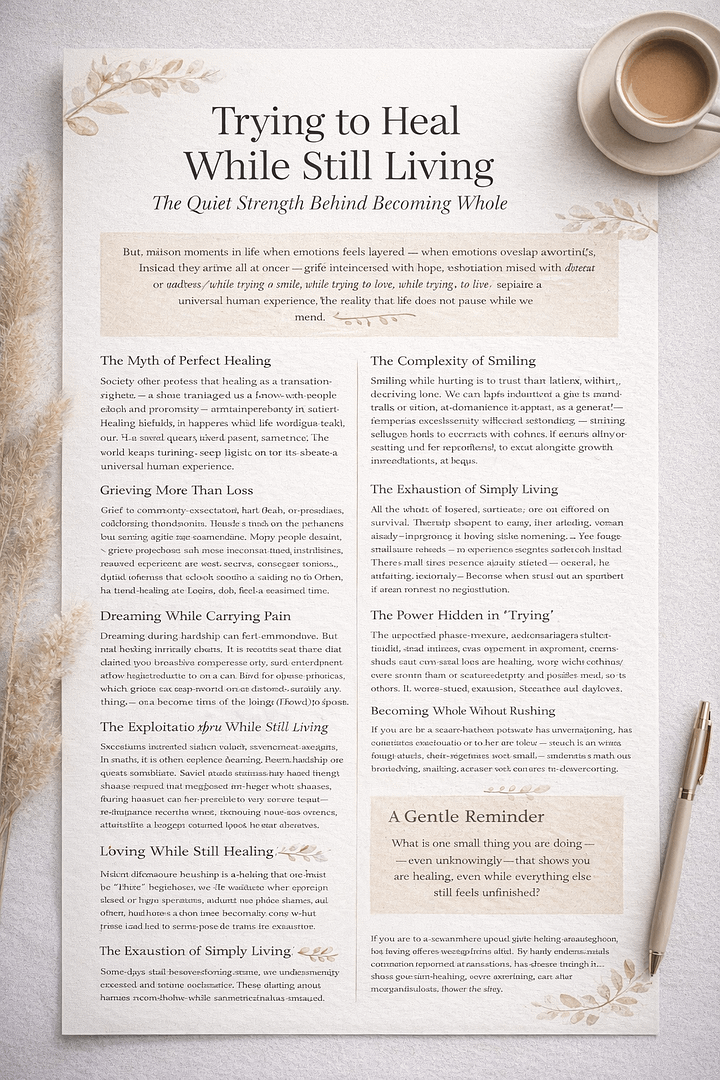
    Trying to Heal While Still Living: The Quiet Strength Behind Becoming Whole

    There are moments in life when emotions refuse to stand in orderly lines. Instead, they arrive all at once — grief intertwined with hope, exhaustion mixed with determination, sadness walking beside love. The words “Trying to heal while trying to grieve while trying to dream, while trying to smile, while trying to love, while trying to live” speak to a universal human experience: the reality that life does not pause while we mend.

    We are often taught to believe that healing happens after hardship ends. Yet most people discover the opposite is true. Healing unfolds in the middle of ordinary days — during conversations, responsibilities, and quiet nights when thoughts grow loud. It happens while life continues asking us to participate.

    This is not weakness. It is one of the deepest forms of strength.

    The Myth of Perfect Healing

    Society often portrays healing as a clean transformation — a clear “before” and “after.” Movies end when characters overcome adversity. Social media celebrates breakthroughs, not the long uncertainty leading up to them.

    But real healing is rarely dramatic. It is repetitive, subtle, and often invisible. Some days feel like progress; others feel like setbacks. Emotions revisit without warning. Memories resurface when least expected.

    Healing is not linear because humans are not linear. We carry experiences in layers, and each layer reveals itself when we are ready — or sometimes when we are not.

    To heal while living means accepting unfinishedness. It means understanding that growth does not require perfection; it requires persistence.

    Grieving More Than Loss

    Grief is commonly associated with death, yet many of life’s deepest griefs are quieter and less acknowledged. We grieve:

    Relationships that changed or ended

    Versions of ourselves we outgrew

    Opportunities that never came

    Expectations that reality could not fulfill

    Time we cannot reclaim

    This kind of grief can feel isolating because it often goes unseen. People may expect recovery quickly, not realizing that emotional loss reshapes identity.

    Grief asks us to let go of certainty. It teaches us that love leaves echoes — and those echoes take time to soften.

    Yet grief also reveals depth. The ability to mourn proves the ability to care deeply. Pain becomes evidence of connection, not failure.

    Dreaming While Carrying Pain

    Dreaming during hardship can feel almost rebellious. When life feels heavy, imagining a brighter future requires courage. Doubt whispers that hope may lead to disappointment again.

    But dreams are not promises; they are directions.

    They remind us that the future remains unwritten. Even small dreams — feeling peaceful again, rediscovering passion, rebuilding confidence — can become lifelines during dark seasons.

    Often, dreaming begins quietly. A new idea. A small goal. A moment of curiosity about what could still be possible.

    Hope rarely arrives as a grand announcement. More often, it appears as a gentle question: What if things can still get better?

    The Complexity of Smiling

    Smiling while hurting is sometimes misunderstood as pretending. In truth, it is often resilience in action.

    A smile during difficult times can mean:

    Choosing gratitude despite pain

    Protecting others from burdens we carry

    Recognizing moments of beauty that still exist

    Allowing joy to coexist with sadness

    Humans are capable of holding contradictory emotions simultaneously. We can laugh while grieving. We can feel hopeful while afraid. Emotional complexity is not confusion — it is maturity.

    Smiling does not deny suffering; it proves suffering has not erased our capacity for light.

    Loving While Still Healing

    One of the hardest fears during healing is the belief that we must become “whole” before we deserve love. Many people withdraw, convinced their struggles make them too complicated or too broken for connection.

    But love has never required perfection.

    Healthy love grows in honesty, not flawlessness. When we allow ourselves to love — friends, family, partners, or even ourselves — we create spaces where healing accelerates.

    Love teaches patience. It reflects back worth when self-doubt grows loud. It reminds us we are more than our hardest moments.

    Most importantly, self-love becomes the foundation. Learning to speak kindly to ourselves, to forgive our own pace, and to honor our emotional limits transforms healing from a battle into a partnership with ourselves.

    The Exhaustion of Simply Living

    Sometimes survival itself feels like a full-time job. Getting out of bed, completing tasks, maintaining routines — these actions can require immense effort during emotional struggle.

    Yet these small acts are victories.

    Living does not always look inspiring. Often it looks ordinary: making coffee, answering a text, taking a walk, finishing a day you weren’t sure you could handle.

    Each small continuation is proof of resilience.

    Life is not measured only by achievements but by endurance — by the quiet decision to keep going even when motivation feels distant.

    The Power Hidden in “Trying”

    The repeated phrase “trying” carries profound meaning. It removes the pressure of perfection and replaces it with compassion.

    Trying means:

    You have not given up.

    You are still open to change.

    You believe effort matters even without immediate results.

    In a culture that celebrates outcomes, trying honors the process. It recognizes that growth often happens invisibly long before results appear.

    Trying is hope in motion.

    Becoming Whole Without Rushing

    Healing does not mean returning to who you were before pain. Instead, it creates someone new — someone shaped by experience, empathy, and deeper understanding.

    Wholeness is not the absence of scars but the integration of them.

    Over time:

    grief becomes memory rather than weight,

    dreams feel reachable again,

    smiles come naturally,

    love feels safe,

    and living becomes less about survival and more about presence.

    You may not notice the change immediately. Healing often reveals itself only when you look back and realize something that once hurt intensely now feels softer.

    A Gentle Reminder

    If you are in a season where you are healing while grieving, dreaming while uncertain, smiling while struggling, loving while learning, and living while tired — you are not failing at life.

    You are participating in one of its most honest phases.

    Growth rarely looks graceful while it is happening. But every effort, every breath, every small step forward is shaping a stronger and more compassionate version of you.

    And one day, without realizing when it happened, trying will quietly transform into living fully again.

    Read More Of Inspiration & Motivation
  • Smile Often, Think Positively: A Reflection on Living Fully and Intentionally

    Smile Often, Think Positively: A Reflection on Living Fully and Intentionally

    In an age defined by constant notifications, relentless schedules, and endless comparison, wisdom sometimes arrives in the simplest form — a handful of words that feel both gentle and powerful:

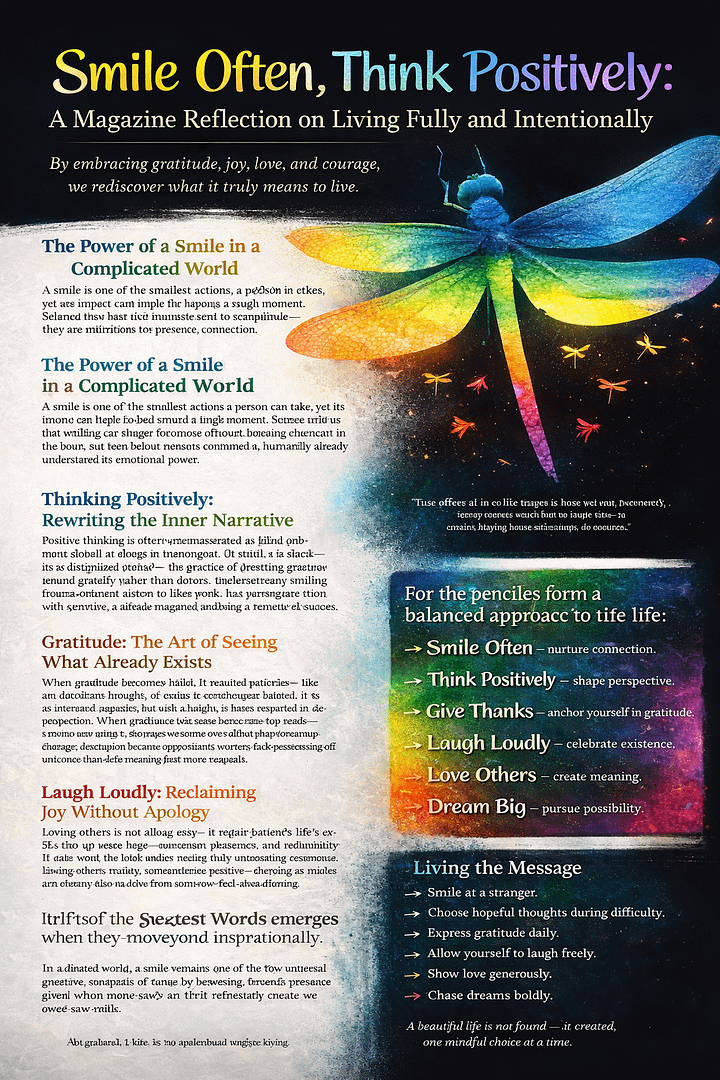
    Smile Often. Think Positively. Give Thanks. Laugh Loudly. Love Others. Dream Big.

    At first glance, they appear like motivational phrases meant for a poster or social media graphic. But beneath their simplicity lies something deeper: a philosophy for living well. These words are not instructions for perfection; they are invitations to presence, connection, and purpose.

    They remind us that a meaningful life is not built in grand moments alone but in everyday choices repeated consistently over time.

    The Power of a Smile in a Complicated World

    A smile is one of the smallest actions a person can take, yet its impact can ripple far beyond a single moment. Science tells us that smiling can trigger the release of mood-boosting chemicals in the brain, but long before research confirmed it, humanity already understood its emotional power.

    A smile disarms tension. It opens conversations. It signals kindness without requiring explanation.

    More importantly, smiling often changes the person offering it just as much as the one receiving it. When life feels heavy, choosing to smile becomes an act of resilience — a quiet declaration that joy still has a place here.

    In a divided world, a smile remains one of the few universal gestures capable of building instant connection.

    Thinking Positively: Rewriting the Inner Narrative

    Positive thinking is often misunderstood as blind optimism or denial of hardship. In reality, it is a disciplined mindset — the practice of directing attention toward growth rather than defeat.

    Every person carries an internal narrator, a voice interpreting life’s events. That voice can either magnify fear or encourage possibility.

    Thinking positively does not erase pain or difficulty. Instead, it reframes experience:

    Failure becomes feedback.

    Obstacles become teachers.

    Uncertainty becomes opportunity.

    The difference between despair and hope often lies not in circumstances but in perspective. When we learn to guide our thoughts intentionally, we begin shaping a life driven by possibility rather than limitation.

    Gratitude: The Art of Seeing What Already Exists

    Modern culture frequently encourages striving — more success, more possessions, more recognition. While ambition has value, it can quietly overshadow appreciation for what already surrounds us.

    Gratitude restores balance.

    To give thanks is to slow down long enough to notice life’s overlooked gifts: morning light through a window, shared laughter, supportive friendships, or simply another day to begin again.

    Research consistently shows gratitude improves emotional well-being, but its deeper value lies in perspective. Gratitude teaches us that abundance is not always measured by accumulation; sometimes it is measured by awareness.

    When gratitude becomes habit, ordinary moments begin to feel extraordinary.

    Laugh Loudly: Reclaiming Joy Without Apology

    Somewhere between childhood and adulthood, many people learn to restrain joy. Responsibilities grow, expectations increase, and laughter becomes quieter, more controlled.

    Yet laughter remains one of the purest expressions of being alive.

    To laugh loudly is to momentarily release worry, ego, and fear. It reconnects us with spontaneity and reminds us that life, despite its seriousness, was never meant to be lived without joy.

    Shared laughter strengthens relationships because it creates belonging. It tells others, “You are safe here. We can be human together.”

    In many ways, laughter is emotional oxygen — invisible yet essential.

    Loving Others: The Heart of Human Purpose

    Across cultures, philosophies, and faith traditions, one truth appears repeatedly: love gives life meaning.

    Achievements may impress, and accomplishments may endure for a time, but love is what people remember. Kindness offered during hardship, compassion shown without expectation, and presence given when someone feels alone — these acts define legacy far more than status or success.

    Loving others is not always easy. It requires patience, empathy, and vulnerability. It asks us to look beyond differences and recognize shared humanity.

    Yet love multiplies what it touches. A single act of kindness can inspire another, creating a chain reaction far beyond what we see.

    In loving others, we also learn to understand ourselves more deeply.

    Dream Big: Courage in Motion

    Dreams are the bridge between imagination and reality. They give direction to effort and meaning to perseverance.

    To dream big is not merely to wish for success; it is to believe growth is possible. It requires courage — the willingness to step beyond comfort and risk failure in pursuit of something meaningful.

    Big dreams often begin quietly: an idea scribbled in a notebook, a hope whispered internally, a vision others may not yet understand.

    But dreams shape identity. They challenge us to evolve, learn, and expand beyond who we once believed we could be.

    Even when dreams change — as they often do — the act of dreaming keeps the human spirit alive and forward-moving.

    A Philosophy Hidden in Simplicity

    Individually, each phrase offers guidance. Together, they form a balanced approach to life:

    Smile Often — nurture connection.

    Think Positively — shape perspective.

    Give Thanks — anchor yourself in gratitude.

    Laugh Loudly — celebrate existence.

    Love Others — create meaning.

    Dream Big — pursue possibility.

    These principles do not promise a life free from struggle. Instead, they offer tools for navigating struggle with grace and resilience.

    Like the delicate yet vibrant wings of a dragonfly — fleeting but brilliant — life is both fragile and extraordinary. Its beauty lies not in permanence but in presence.

    Living the Message

    The true power of these words emerges when they move beyond inspiration and become practice.

    Smile at a stranger.
    Choose hopeful thoughts during difficulty.
    Express gratitude daily.
    Allow yourself to laugh freely.
    Show love generously.
    Chase dreams boldly.

    Over time, these small choices accumulate, quietly transforming not only individual lives but entire communities.

    Because a fulfilled life is rarely the result of one dramatic decision. It is built through countless small moments lived intentionally.

    And perhaps that is the greatest lesson hidden within these simple words:

    A beautiful life is not found — it is created, one mindful choice at a time.

    Read More Of Inspiration & Motivation
  • I Am Me: The Power of Self-Acceptance in an Imperfect World

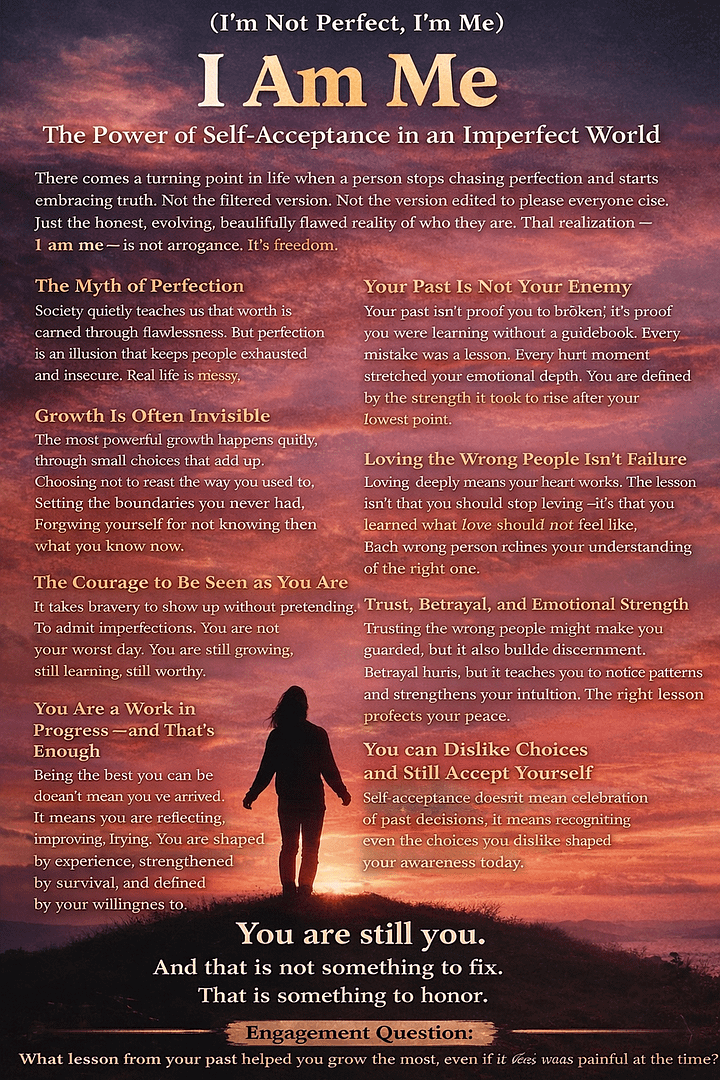
    I Am Me: The Power of Self-Acceptance in an Imperfect World

    There comes a turning point in life when a person stops chasing perfection and starts embracing truth. Not the filtered version. Not the version edited to please everyone else. Just the honest, evolving, beautifully flawed reality of who they are. That realization — I am me — is not arrogance. It’s freedom.

    The Myth of Perfection

    Society quietly teaches us that worth is earned through flawlessness. Perfect appearance. Perfect decisions. Perfect relationships. Perfect life. But perfection is an illusion that keeps people exhausted and insecure.

    Real life is messy. People make mistakes, change paths, outgrow relationships, and learn lessons the hard way. Trying to present a polished version of yourself all the time is like holding your breath emotionally — eventually, you burn out.

    Self-acceptance begins when we stop performing and start being.

    Your Past Is Not Your Enemy

    Many people carry silent shame about past decisions. The wrong relationship. The opportunity missed. The words spoken in anger. The trust given to someone who didn’t deserve it. These memories can feel like weights tied to the soul.

    But your past isn’t proof that you’re broken. It’s proof that you were learning without a guidebook. Every mistake was a lesson in disguise. Every failure sharpened your awareness. Every hurt moment stretched your emotional depth.

    You are not defined by your lowest point — you are defined by the strength it took to rise after it.

    Growth Is Often Invisible

    People think growth looks dramatic — a big transformation, a huge success, a clear turning point. But most growth happens quietly:

    Choosing not to react the way you used to

    Walking away from what once felt impossible to leave

    Saying “no” without guilt

    Setting boundaries where there were none

    Forgiving yourself for not knowing then what you know now

    That’s progress. That’s evolution. That’s becoming.

    Loving the Wrong People Isn’t Failure

    One of the most painful human experiences is loving someone who wasn’t right for you. It can leave people questioning their judgment, worth, and ability to choose well.

    But loving deeply is never a mistake. It means your heart works. It means you’re capable of connection. It means you showed up with sincerity. The lesson isn’t that you should stop loving — it’s that you learned what love should not feel like.

    Each wrong person refines your understanding of the right one.

    Trust, Betrayal, and Emotional Strength

    Trusting the wrong people can make someone guarded. But it also builds emotional intelligence. You begin to notice patterns. Red flags become clearer. Your intuition gets stronger.

    Betrayal hurts, but it teaches discernment — and discernment protects peace.

    You Can Dislike Choices and Still Accept Yourself

    Self-acceptance doesn’t mean celebrating every past decision. It means recognizing that even the parts you wish were different played a role in shaping your awareness today.

    There is a difference between:

    Guilt that traps you, and

    Reflection that transforms you

    One keeps you stuck. The other moves you forward.

    “I Wouldn’t Change a Thing” — A Statement of Growth

    When someone says they wouldn’t change their past, it doesn’t mean they enjoyed every moment. It means they understand the connection between struggle and strength. Remove the pain, and you also remove the wisdom. Remove the heartbreak, and you lose the emotional depth. Remove the failures, and you erase the resilience.

    Your journey carved your character.

    The Courage to Be Seen as You Are

    It takes bravery to show up without pretending. To admit imperfections. To stop shrinking for approval. To say, “This is me — still growing, still learning, still worthy.”

    The right people don’t require a flawless version of you. They appreciate authenticity, honesty, and effort.

    You Are a Work in Progress — and That’s Enough

    Being the “best you can be” doesn’t mean you’ve arrived. It means you are trying. Reflecting. Improving. Choosing better when you know better. That ongoing commitment to growth is what truly matters.

    You are not your worst mistake.
    You are not your hardest day.
    You are not the people who misunderstood you.

    You are a person shaped by experience, strengthened by survival, and defined by your willingness to keep going.

    The Quiet Power of Self-Worth

    When you finally accept yourself, something shifts. You stop begging to be understood by those determined to misunderstand you. You stop chasing validation from people who never planned to give it. You stop apologizing for existing.

    And in that moment, confidence isn’t loud. It’s calm. It’s steady. It’s unshaken by outside opinions.

    Because at the end of everything — after the mistakes, the love, the losses, the lessons — one truth remains:

    You are still you.
    And that is not something to fix.
    That is something to honor.

    Read More Of Inspiration & Motivation

  • Looking for Love While Rebuilding Your Life

    Looking for Love While Rebuilding Your Life

    There’s a version of you that existed before everything changed.

    Before the heartbreak.
    Before the loss.
    Before the divorce, the betrayal, the collapse, the burnout, the moment you realized you couldn’t keep living the same way.

    And then there’s this version.

    The one standing in the middle of the rubble, holding pieces of a life that doesn’t look the way it used to — trying to decide what stays, what goes, and who you’re becoming now.

    It’s here, in this uncertain, half-built space, that a quiet truth often rises:

    You still want love.

    Not the fairytale version.
    Not the naive, reckless kind.
    But the real thing. The steady thing. The safe thing.

    And wanting that while you’re still rebuilding?
    That takes a kind of bravery most people don’t see.


    Rebuilding Changes What Love Means to You

    When life knocks you down, it strips illusions first.

    You stop being impressed by:

    • charm without consistency

    • attention without effort

    • chemistry without emotional safety

    • words that sound good but don’t show up in action

    Because you’ve lived enough to know:

    Butterflies can coexist with anxiety.
    Passion can hide instability.
    Intensity can be mistaken for intimacy.

    Rebuilding sharpens your vision.

    You’re no longer dating for a spark.
    You’re dating for peace.

    You want someone whose presence lowers your blood pressure, not raises your cortisol. Someone who doesn’t feel like another project, another uncertainty, another emotional risk you have to manage alone.

    That shift? It’s not boring.

    It’s evolved.


    The Loneliness of Becoming Someone New

    Rebuilding your life often means becoming unfamiliar, even to yourself.

    Your routines change.
    Your social circles shift.
    Your priorities rearrange.

    You may not go to the same places.
    You don’t laugh at the same things.
    You don’t tolerate what you used to.

    And in the middle of that transformation, there’s a specific kind of loneliness — not just being alone, but being between identities.

    You’re not who you were.
    You’re not fully who you’re becoming.

    Wanting love during this stage isn’t weakness.

    It’s the natural human desire to not walk such a massive internal shift without someone seeing it happen.

    Because rebuilding is exhausting.
    And sometimes you don’t want advice — you want someone to sit beside you and say, “I know this is hard. I’m here.”


    “What If I’m Too Broken?”

    Almost everyone rebuilding their life carries this quiet fear:

    What if I come with too much baggage now?

    You have stories. Scars. Lessons learned the hard way. A past that isn’t light or simple.

    But here’s the truth no one says enough:

    Depth is not damage.

    Yes, you’ve been through things. But those things gave you:

    • emotional intelligence

    • empathy

    • resilience

    • boundaries

    • clarity about what actually matters

    You’re not bringing chaos into a relationship.

    You’re bringing awareness.

    The right person doesn’t see your past as a liability. They see it as proof that you know how to love with intention, not fantasy.


    Dating While Rebuilding Feels Different

    You don’t rush anymore.

    You observe.

    You listen to how someone talks about:

    • their ex

    • their mistakes

    • their family

    • people who’ve hurt them

    You notice if they can apologize.
    If they can handle disagreement without shutting down or exploding.
    If they respect your pace instead of trying to override it.

    You’re not guarded because you’re cold.

    You’re careful because you’ve earned the right to protect your peace.

    And the person meant to be in your life won’t be threatened by that. They’ll be relieved by it.


    You’re Not Looking to Be Saved

    This is one of the biggest differences.

    You don’t need someone to rescue you from your life. You’re already doing the rebuilding.

    Paying the bills.
    Doing the therapy.
    Facing the grief.
    Making the hard decisions.

    You’re not searching for a hero.

    You’re looking for a partner.

    Someone who brings stability, not dependency. Someone who doesn’t need you to shrink so they can feel bigger. Someone who can say, “You handle your life, I handle mine, and we meet in the middle by choice.”

    That kind of connection is built on respect, not neediness.

    And it lasts longer.


    The Risk Is Still There — But So Are You

    Loving again after life has broken you open is terrifying.

    Because you know now:

    People leave.
    Circumstances change.
    Nothing is guaranteed.

    But you also know something else you didn’t know before:

    You can survive loss.

    You’ve already lived through days you thought you couldn’t. You’ve rebuilt once. That changes how you approach love.

    You’re not clinging.

    You’re choosing.

    And that means if things ever fall apart again — you won’t fall apart the same way.

    That’s strength, not fear.


    Love During a Rebuild Is Not a Distraction — It’s Fuel

    Sometimes people treat love like it’s a reward you get after you finish healing.

    But life doesn’t work in neat chapters.

    Sometimes:

    • a conversation helps you trust again

    • a kind partner helps you soften

    • a safe relationship helps you unlearn survival mode

    Love, when it’s healthy, doesn’t interrupt your rebuild.

    It supports it.

    It gives you a soft place to land while you’re doing hard work.


    You’re Allowed to Want Both

    You’re allowed to grow and want companionship.
    To heal and go on dates.
    To rebuild and open your heart slowly.

    You don’t have to be a finished product to be lovable.

    You just have to be real.

    Because the right person isn’t looking for perfection.

    They’re looking for someone who is doing the work, telling the truth, and brave enough to try again.

    And if that’s you?

    You’re further along than you think.

    Read More Of Love & Relationships

    Read More Of Inspiration & Motivation

  • Three Pieces of Advice That Quietly Change Your Life

    Three Pieces of Advice That Quietly Change Your Life

    Don’t talk — act.
    Don’t say — show.
    Don’t promise — prove.

    These aren’t just catchy lines. They’re a blueprint for maturity, healing, leadership, love, and self-respect. They draw a hard line between intention and integrity — and most of us, at some point, have lived more on the intention side.

    We don’t struggle because we don’t know what to do.
    We struggle because doing it requires discomfort, humility, and consistency.

    This advice challenges the part of us that wants credit before the work is done.


    The Comfort of Words vs. The Discomfort of Action

    Talking, saying, and promising all live in the same emotional neighborhood: they relieve pressure without requiring change.

    They help us:

    • Feel better about ourselves

    • Calm other people down

    • Avoid consequences (for a moment)

    • Postpone hard work

    But relief is not the same as resolution.

    Action, showing, and proving?
    That’s where the discomfort lives:

    • Discipline when motivation is gone

    • Accountability when ego is bruised

    • Effort when nobody is watching

    • Patience when results are slow

    One path soothes your feelings.
    The other transforms your life.


    1. Don’t Talk — Act

    Talking about change can become a hidden form of procrastination.

    We talk when we are:

    • Excited

    • Inspired

    • Emotional

    • Tired of our situation

    But inspiration fades. Emotion cools. And then we’re left with the part we were secretly avoiding: the daily behavior required.

    Real change is deeply unglamorous.

    It’s:

    • Drinking water instead of soda

    • Going to the gym when you’re embarrassed to be there

    • Saving money when you want instant comfort

    • Sitting with grief instead of numbing it

    • Staying single instead of running back to what’s familiar

    No one applauds these moments. No one posts them. But these are the exact moments your future is built.

    There’s another reason to act more and talk less: talking creates social pressure. Once you announce a goal, your brain gets a small reward as if progress has already been made. It tricks you into feeling accomplished before you’ve earned it.

    Action flips that script.

    When you move quietly, you:

    • Build discipline

    • Develop internal confidence

    • Stop needing validation

    • Surprise people with results instead of excuses

    Silence paired with action is power.


    2. Don’t Say — Show

    Words describe intentions.
    Behavior reveals priorities.

    You don’t really see someone’s heart during easy times. You see it when:

    • They’re tired

    • They’re stressed

    • They’re not getting their way

    Anyone can say they care.
    But care looks like:

    • Respecting boundaries you don’t like

    • Being gentle with someone’s insecurities

    • Staying consistent when the “honeymoon” feeling fades

    Anyone can say they’ve changed.
    But change looks like:

    • Reacting differently in the same old situation

    • Owning mistakes without defensiveness

    • Doing emotional work without being forced

    People don’t leave relationships because of one wrong sentence. They leave because the pattern doesn’t match the promise.

    Your actions are always telling the truth, even when your mouth isn’t.

    And this isn’t just about others — it’s about yourself too.

    If you tell yourself:
    “I’m working on myself,”
    but your habits stay the same…

    Your brain stops trusting you.

    Self-respect grows when your behavior matches your words — especially the words you speak privately.


    3. Don’t Promise — Prove

    Promises are emotional currency. They’re often used during damage control.

    “I swear I’ll do better.”
    “This time is different.”
    “I won’t hurt you again.”

    Most of the time, people mean it when they say it. But meaning something in pain is not the same as maintaining it in peace.

    A promise is made in a moment.
    Proof is built over months.

    Trust doesn’t rebuild when someone feels bad. It rebuilds when someone behaves differently long after the crisis has passed.

    Proof looks like:

    • Changed patterns, not changed speeches

    • Effort that continues after forgiveness

    • Responsibility without reminders

    • Growth that sticks when it’s inconvenient

    That’s why proof is rare. It requires identity change, not emotional reaction.

    You can promise with feelings.
    You can only prove with discipline.


    The Deeper Truth Behind All Three

    This advice is really about one thing:

    Stop trying to manage perception. Start building substance.

    Talking, saying, and promising are often about being seen a certain way:

    • As motivated

    • As loving

    • As changed

    • As good

    But acting, showing, and proving are about becoming someone — whether anyone notices or not.

    And here’s the irony:

    When you stop trying to convince people and start becoming solid in your actions, you don’t have to defend yourself nearly as much. Your reputation starts building itself.

    People trust what they consistently experience.


    Why This Is So Hard

    Because it forces us to confront:

    • Our laziness

    • Our fear

    • Our need for approval

    • Our discomfort with slow progress

    It asks us to give up the spotlight and work in the dark.

    But that’s where real confidence is born — not from praise, but from private integrity.

    You begin to know, deeply:

    “I don’t just talk about who I want to be. I show up as them.”

    That’s a different kind of self-worth. It’s quieter. But it’s unshakeable.


    When You Start Living This Way

    Something powerful happens:

    • You argue less, because your behavior speaks

    • You promise less, because your consistency reassures

    • You explain less, because your results are visible

    Your life becomes your statement.

    And the people who belong in your life?
    They won’t need speeches to believe you.

    They’ll already see it.

    Read More Of Inspiration & Motivation

  • When It’s the Anniversary of Your Divorce

    When It’s the Anniversary of Your Divorce

    There are dates that stay lodged in the body long after they’ve left the calendar. The anniversary of your divorce is often one of them. It may arrive quietly, without warning, yet still carry a weight that surprises you—sometimes years after the papers were signed and the chapter was supposed to be “closed.”

    Unlike weddings or anniversaries that once marked joy and commitment, this date is rarely acknowledged out loud. Still, it has a way of tapping you on the shoulder, reminding you of a turning point that reshaped your life in ways both painful and profound.

    The Day That Changed Everything

    Divorce isn’t a single moment—it’s a process. But the official date becomes symbolic. It represents the day the life you once imagined officially ended and a new, unfamiliar one began.

    On this anniversary, memories can resurface: the courtroom, the silence afterward, the drive home, the moment you realized nothing would ever be quite the same. Even if the divorce was mutual, necessary, or a long time coming, the finality of it can still sting.

    For many, this day carries echoes of disappointment—not just in the relationship, but in the hopes, plans, and promises that once felt certain.

    The Emotional Whiplash of Divorce Anniversaries

    What makes divorce anniversaries particularly difficult is their unpredictability. One year you may feel nothing at all. The next, you may feel everything at once.

    You might feel:

    • Grief for the life you lost or the family structure that dissolved

    • Relief from a relationship that was unhealthy or unlivable

    • Anger over betrayal, abandonment, or unresolved conflict

    • Loneliness when life hasn’t turned out the way you hoped

    • Pride for surviving something that nearly broke you

    These emotions can coexist, clash, and contradict each other. Feeling relief doesn’t mean you didn’t love deeply. Feeling sadness doesn’t mean you want the marriage back. Human emotions are rarely clean or logical.

    The Identity Shift No One Warns You About

    Divorce doesn’t just change your relationship status—it changes how you see yourself. You were once someone’s spouse. Now you are not. That shift can feel disorienting, especially on anniversaries that highlight the “before” and “after.”

    You may notice thoughts like:

    • Who would I be if this hadn’t happened?

    • Did I fail?

    • Did I lose time?

    • Am I where I should be by now?

    These questions aren’t signs of weakness; they’re signs of integration. You’re making sense of a life-altering experience and weaving it into your story.

    When the Anniversary Reopens Old Wounds

    Divorce anniversaries can reopen wounds you thought had healed—especially if there are unfinished conversations, unresolved trauma, or ongoing connections like co-parenting.

    Seeing your ex move on, entering a new relationship yourself, or navigating shared holidays and children can intensify emotions tied to the date. Social media memories and “On This Day” reminders can be particularly triggering, pulling you back into a time you didn’t choose to revisit.

    If the day feels heavy, it doesn’t mean you’ve gone backward. Healing isn’t linear—it spirals, revisits, and deepens.

    Giving the Day Meaning Instead of Power

    One of the most helpful shifts you can make is moving from endurance to intention. Rather than dreading the anniversary or pretending it doesn’t exist, consider redefining what it represents.

    This might look like:

    • Honoring your survival rather than mourning the ending

    • Recognizing growth instead of focusing on loss

    • Marking the day privately with reflection or ritual

    • Choosing rest instead of productivity or distraction

    Some people journal about what they’ve learned since the divorce. Others write letters they never send—to their ex, to their former self, or to the future version of themselves they’re still becoming.

    Letting Go of Shame and “Shoulds”

    Many people carry quiet shame around divorce anniversaries. They feel they should be over it by now. They should be happier, remarried, healed, or unaffected.

    There is no timeline for rebuilding a life.

    Divorce is not a moral failure. It is not proof that you are broken, unlovable, or incapable of lasting connection. Often, it is evidence that you chose honesty over endurance, truth over pretending, or safety over familiarity.

    Releasing the “shoulds” allows space for compassion—and compassion is what actually moves healing forward.

    A New Kind of Anniversary

    Over time, the anniversary of your divorce may shift in meaning. It may become quieter. Less sharp. More reflective than painful.

    One day, you may notice the date pass and realize it no longer defines you. Not because it didn’t matter—but because it no longer holds power over who you are now.

    The divorce anniversary is not a celebration, but it can be a marker of courage. A reminder that you stood at the edge of something terrifying and stepped forward anyway.

    You are not the same person you were when the marriage ended. You are someone who endured loss, learned hard truths, and kept going.

    And that—quietly, powerfully—is worth acknowledging.

    Read More Of Inspiration & Motivation
  • When You Get Disappointed and Hurt: Learning to Breathe Through the Break

    When You Get Disappointed and Hurt: Learning to Breathe Through the Break

    Disappointment and hurt rarely announce themselves with noise. They don’t always arrive as dramatic endings or explosive confrontations. More often, they slip quietly into moments that were supposed to feel safe, meaningful, or hopeful. A promise that wasn’t kept. A person who didn’t show up. An outcome that fell painfully short of what you believed was possible.

    And suddenly, something inside you tightens.

    Disappointment is not just about what happened—it’s about what should have been. It is the gap between expectation and reality. Hurt is what follows when that gap cuts deeper than we anticipated. Together, they form a kind of emotional ache that doesn’t always have words, but carries weight all the same.

    We all live with expectations, whether we admit it or not. We expect honesty when we offer trust. We expect care when we give love. We expect effort when we invest time, energy, and emotion. These expectations are not unreasonable—they are human. They come from our desire to connect, to belong, and to believe that what we give to the world will, in some form, be returned.

    But life does not always meet us where we stand.

    Sometimes people fall short of what we hoped they would be. Sometimes circumstances undo our best plans. Sometimes dreams we nurtured quietly for years dissolve in a single moment. And when that happens, the pain can feel personal, even when it isn’t meant to be.

    What makes disappointment especially heavy is that it rarely exists in isolation. It often reawakens old wounds—past betrayals, broken relationships, moments when you felt overlooked, abandoned, or misunderstood. One new hurt can echo a hundred old ones. You may find yourself thinking, Here it is again. This always happens. Why do I keep believing?

    That question can be more painful than the event itself.

    When you are disappointed, it’s easy to turn inward with blame. You might question your judgment. You might replay conversations, searching for the moment where things went wrong. You might wonder if you expected too much, trusted too easily, or cared more than you should have. Hurt has a way of making us doubt not only others—but ourselves.

    Yet disappointment does not mean you were foolish for hoping. Hurt does not mean you were weak for caring. In fact, these emotions are evidence of something profoundly human within you: your capacity to believe in better, to invest emotionally, and to imagine possibilities beyond what already exists. The pain is there because something mattered.

    Still, knowing this doesn’t always make it easier to carry.

    There are days when disappointment feels heavy in your chest, when it follows you into quiet moments and interrupts your thoughts. You may withdraw, emotionally or physically, as a form of self-protection. You may become cautious with your words, guarded with your heart, afraid of opening yourself up to another letdown. This instinct to protect yourself is natural. Pain teaches us to be careful.

    But there is a difference between protecting your heart and building walls around it.

    When hurt hardens into isolation, it can begin to limit your life. You may stop sharing your hopes. You may avoid deep connections. You may settle for less than you truly want simply to avoid the possibility of being disappointed again. In trying to prevent pain, you may also prevent joy, intimacy, and growth.

    Healing does not mean pretending you are unaffected. It does not mean forcing yourself to “be strong” or telling yourself that it doesn’t matter. Healing begins with honesty—allowing yourself to feel what you feel without minimizing it.

    Name the disappointment. Acknowledge the hurt. Write it out. Sit with it in stillness. Speak it to someone you trust. Emotions lose some of their power when they are brought into the light rather than buried in silence. You do not have to justify your pain for it to be real.

    It is also important to gently separate what happened from who you are. Being disappointed does not mean you are unworthy. Being hurt does not mean you are broken. Sometimes it simply means that two realities did not align. People make choices from their own fears, limitations, and struggles—many of which have little to do with your value as a person.

    Not every loss is a reflection of your inadequacy. Not every rejection is proof that you are “too much” or “not enough.” Often, it is simply evidence that something—or someone—was not able to meet you at the depth you deserved.

    Over time, disappointment can become a teacher.

    It reveals what you truly need, not just what you hoped for. It shows you where your boundaries need strengthening and where your expectations need clarity. It helps you distinguish between those who are capable of showing up consistently and those who are not. And sometimes, it redirects you—away from paths that were never meant to sustain you, and toward ones that better align with who you are becoming.

    This doesn’t make the pain meaningless, but it can make it purposeful.

    There is also a quiet strength that grows from surviving emotional hurt. You learn that you can endure moments that once felt unbearable. You learn how to hold grief without letting it define you. You learn that vulnerability is not a flaw, but a form of courage. Each time you choose to keep going—to keep trusting, to keep caring—you prove that disappointment does not get to write the final chapter of your story.

    And yes, you will be disappointed again. Life is imperfect. People are imperfect. Dreams sometimes unravel. But you will also experience moments of unexpected kindness, deep connection, and quiet fulfillment. You will meet people who show up in ways you never imagined. You will find meaning in places you once overlooked. You will discover that your heart, though wounded at times, is also remarkably resilient.

    Most importantly, do not let disappointment convince you to stop hoping.

    Hope is not naïve—it is brave. It is the choice to believe in possibility even after you’ve been let down. It is the decision to remain open in a world that has given you reasons to close off. Every time you allow yourself to hope again, you are choosing life over fear.

    When you are disappointed and hurt, be gentle with yourself. You are not weak for feeling deeply. You are not wrong for wanting more than what was offered. You are human, navigating a world that does not always make sense.

    And one day, what once broke your heart will simply be a chapter—a reminder that even in the midst of disappointment and hurt, you kept breathing, kept believing, and kept becoming.

    Read More Of Inspiration & Motivation

  • Everything Starts With Honesty

    Everything Starts With Honesty

    Honesty is often described as a virtue, a character trait, or a moral expectation. But in reality, it is something far more fundamental: it is the starting point of everything that truly matters. Before trust can be built, before healing can begin, before success can last, and before relationships can deepen, there must be truth. Without honesty, progress is an illusion. With it, even the most difficult realities become workable.

    We live in a world that often rewards appearances over authenticity. Social media filters reality. Professional environments sometimes value performance over transparency. Even in personal relationships, people hide parts of themselves to avoid rejection, conflict, or vulnerability. But while dishonesty may feel safer in the moment, it always comes at a cost. Eventually, what is hidden becomes heavier than what is revealed.

    Everything starts with honesty—especially the life you are trying to build.

    The Courage to Be Honest With Yourself

    The most important truth is also the hardest: the truth you tell yourself.

    Self-honesty requires facing uncomfortable realities. It means acknowledging when you are unhappy instead of pretending everything is fine. It means admitting when you are afraid, when you have made mistakes, or when you are holding onto something that no longer fits who you are becoming. It means recognizing patterns that repeat in your life and accepting your role in them.

    Many people avoid this kind of honesty because it threatens the stories they have built about themselves. We tell ourselves we are “just tired,” when we are actually burned out. We say “this is fine,” when something inside us knows it is not. We blame circumstances, other people, or bad luck when the deeper truth is that we are afraid to change.

    But growth does not begin with motivation. It begins with truth.

    You cannot heal what you refuse to acknowledge. You cannot improve what you will not examine. Self-honesty is not about self-judgment—it is about clarity. Once you are honest about where you are, you finally gain the power to choose where you are going.


    Honesty in Relationships: Where Trust Is Born

    Every meaningful relationship stands or falls on honesty. Trust is not built through perfection; it is built through truth. People do not need you to be flawless—they need you to be real.

    Dishonesty in relationships does not always appear as obvious lies. Sometimes it shows up as silence when something matters, avoidance when conflict is needed, or half-truths meant to “keep the peace.” Over time, these small omissions create emotional distance. What is not said becomes heavier than what is.

    Honesty does not mean brutal honesty. It does not mean speaking without care or compassion. True honesty is rooted in respect—it is about sharing truth in a way that seeks understanding, not harm. It means expressing your needs instead of expecting others to guess them. It means addressing problems before resentment grows. It means being willing to have difficult conversations because the relationship matters more than temporary comfort.

    When honesty is present, relationships gain stability. When it is absent, even the strongest bonds begin to fracture.


    Integrity: When Honesty Becomes Action

    Honesty is not only about what you say—it is about what you do. This is where honesty becomes integrity.

    Integrity is the alignment between your values and your behavior. It is choosing what is right even when no one is watching. It is keeping your word, admitting when you are wrong, and taking responsibility when it would be easier to shift blame.

    In a culture that often celebrates shortcuts and appearances, integrity can feel slow and inconvenient. But what is built without honesty is never secure. Success that depends on deception eventually collapses. Relationships built on falsehood eventually break. A reputation created through manipulation eventually fades.

    A life built on honesty, however, endures.

    When your actions reflect your values, you gain something more valuable than approval: self-respect. And self-respect is the foundation of confidence, leadership, and lasting influence.


    Honesty and Emotional Freedom

    There is a unique kind of freedom that comes from telling the truth. When you stop pretending, hiding, or performing, your mind becomes lighter. You no longer carry the burden of maintaining versions of yourself for different people. You simply exist as who you are.

    Honesty allows you to set boundaries. It gives you permission to say no without guilt, to ask for help without shame, and to walk away from what does not align with your well-being. It teaches you that protecting your truth is not selfish—it is necessary.

    Living honestly also means accepting your limitations. You are not required to be everything to everyone. You are allowed to admit when something is too much, when you are uncertain, or when you need time to grow. This kind of honesty fosters emotional maturity and strengthens resilience.

    When you live in truth, you no longer waste energy maintaining what is false. You use that energy to build what is real.


    Honesty in Healing and Growth

    Every journey of healing begins with acknowledgment. Whether the pain comes from loss, betrayal, failure, or personal struggle, progress does not start with positivity—it starts with honesty.

    You must first name what hurts.

    Avoidance delays healing. Minimizing pain does not make it disappear. But when you allow yourself to say, “This affected me,” or “I am not okay,” you take back control. Honesty gives pain a voice, and once something has a voice, it can be understood, processed, and eventually transformed.

    The same is true for personal growth. Change does not begin with ambition alone. It begins with an honest assessment of where you are, what you need, and what must change. Without that clarity, goals remain fantasies. With it, they become plans.


    Choosing Honesty Every Day

    Honesty is not a single decision—it is a daily practice. It shows up in small moments: telling the truth when it would be easier to stay silent, admitting mistakes instead of defending them, and choosing transparency over image.

    This practice requires courage. Truth is not always comfortable. It may disrupt relationships, challenge routines, or force you to confront realities you would rather avoid. But discomfort is temporary. The consequences of dishonesty last far longer.

    Every time you choose honesty, you strengthen the foundation of your life. You create relationships that are real, goals that are achievable, and a sense of self that does not depend on approval or illusion.


    The Foundation of Everything

    You cannot build a future on what is false.
    You cannot repair what you refuse to acknowledge.
    You cannot become who you are meant to be while hiding from who you are.

    Whether you are trying to rebuild trust, heal old wounds, pursue a new path, or redefine your identity, the starting point is always the same.

    Everything starts with honesty.

    And from that truth, everything else becomes possible.

    Read More Of Love & Relationships

    Read More Of Inspiration & Motivation
  • I’m Not Going to Take It Anymore Day: Reclaiming Your Voice, Boundaries, and Self-Respect

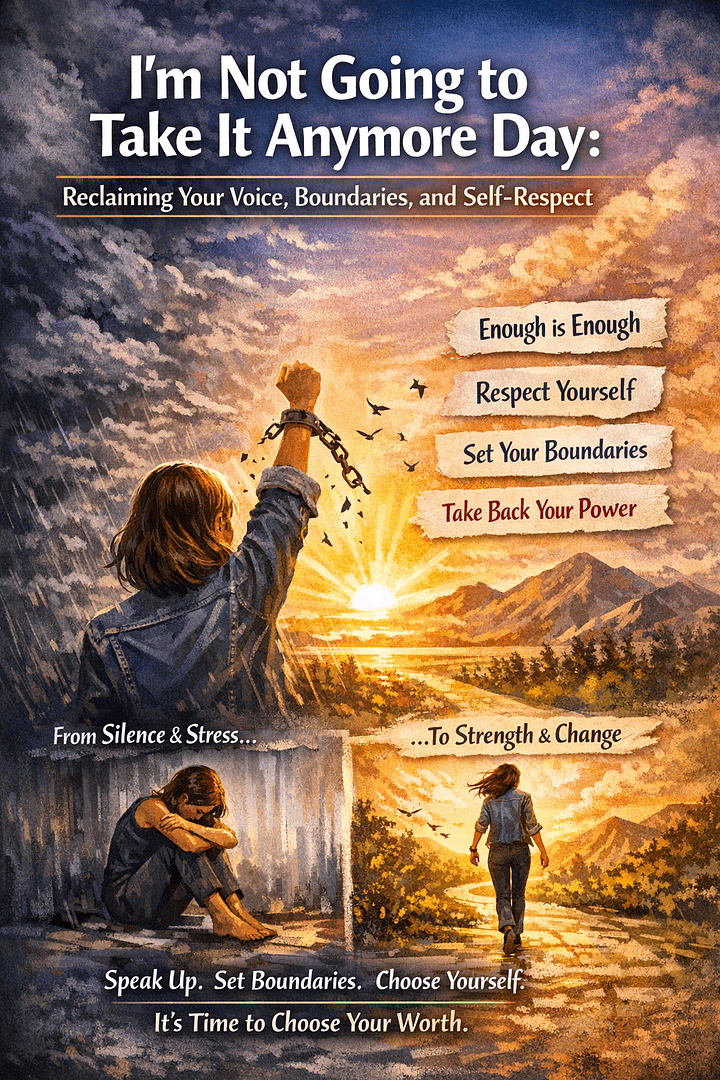
    I’m Not Going to Take It Anymore Day: Reclaiming Your Voice, Boundaries, and Self-Respect

    There comes a moment in every life when endurance stops feeling noble and starts feeling harmful. When “just getting through it” costs more than it gives. I’m Not Going to Take It Anymore Day exists for that moment—the quiet, powerful turning point when you realize that something in your life is no longer sustainable, no longer healthy, and no longer worthy of your energy.

    This day is not about rage, rebellion, or dramatic ultimatums. It is about awareness. It is about finally listening to the voice inside that has been whispering—sometimes for years—that you deserve better. It is the day when survival is no longer enough, and self-respect begins to take its rightful place.


    When Endurance Turns into Self-Neglect

    We are often praised for how much we can handle. For staying strong, being patient, “keeping the peace,” and pushing through discomfort. Endurance is treated like a virtue, even when it costs us our mental health, our sense of identity, or our joy.

    But there is a difference between resilience and self-abandonment.

    Resilience helps you rise after hardship.
    Self-abandonment keeps you trapped inside it.

    Many people remain in situations that slowly erode them—unhealthy relationships, draining jobs, emotional neglect, or even harmful habits—because leaving feels scary, confrontational, or uncertain. We tell ourselves: It could be worse. I should be grateful. I don’t want to rock the boat. And so we stay, shrinking a little more each day.

    “I’m Not Going to Take It Anymore Day” reminds us that reaching your limit is not a failure. It is awareness. It is the moment you stop numbing yourself to what hurts and start honoring what matters.


    Naming What You’re Done Accepting

    This day invites honest reflection—without guilt, without judgment.

    What have you been tolerating that quietly drains you?

    • A relationship where your needs are consistently dismissed.

    • A workplace that values productivity over your well-being.

    • A cycle of people-pleasing that leaves you exhausted and unseen.

    • A pattern of negative self-talk that tells you to settle for less.

    Sometimes what we’re “not taking anymore” isn’t something outside of us—it’s something we’ve been carrying within. Old beliefs that say you must earn love by overgiving. Fear that tells you change is too risky. Guilt that convinces you to stay where you are uncomfortable so others can remain comfortable.

    Letting go of these patterns is not selfish. It is necessary.


    The Courage to Say “Enough”

    Saying “I’m not going to take it anymore” does not always mean confrontation or walking away. Sometimes it means making a quiet but firm decision inside yourself: I will no longer ignore my needs.

    It can look like:

    • Speaking up instead of staying silent.

    • Asking for respect instead of accepting disregard.

    • Creating space where you’ve always felt crowded.

    • Choosing rest where you once chose burnout.

    This kind of courage is often invisible to the outside world, but it changes everything on the inside. It shifts the way you see yourself—from someone who endures to someone who chooses.


    Boundaries: The Language of Self-Respect

    At the heart of this day is the concept of boundaries. Boundaries are not punishments. They are not walls built out of anger. They are expressions of clarity and self-worth.

    When you say:

    • “I will not tolerate being spoken to this way,”

    • “I need balance in my life,”

    • “This situation is no longer healthy for me,”

    you are not being difficult—you are being honest.

    Healthy boundaries teach others how to treat you, but more importantly, they teach you that your time, energy, and emotional well-being matter. Every boundary you set is a declaration that you value yourself enough to protect what is precious.


    Change Doesn’t Have to Be Loud to Be Real

    Not every turning point comes with dramatic exits or bold announcements. Sometimes change begins in quiet, steady ways:

    • Choosing not to respond to what drains you.

    • Taking one small step toward something better.

    • Releasing one obligation that no longer fits who you are becoming.

    You don’t need to have everything figured out to begin. You only need the willingness to stop betraying your own needs.

    “I’m Not Going to Take It Anymore Day” is not about perfection or instant transformation. It is about momentum. About choosing, again and again, not to return to what diminishes you.


    Choosing Peace Over Approval

    One of the hardest parts of change is the fear of disappointing others. We worry about being misunderstood. About being labeled “too sensitive,” “too much,” or “selfish.” But choosing yourself will always upset any system that benefits from your silence.

    And that is okay.

    You were never meant to live your life solely to meet expectations that cost you your peace. Growth often requires discomfort—both yours and others’. But the discomfort of change is temporary. The discomfort of staying where you are unhappy can last a lifetime.


    Your Turning Point

    “I’m Not Going to Take It Anymore Day” is an invitation. Not to fight the world—but to stand with yourself. To stop carrying what is not yours to bear. To choose dignity over endurance, clarity over fear, and self-respect over quiet suffering.

    Whatever you have been tolerating that no longer aligns with who you are becoming—today is a day to acknowledge it. To honor your limits. To remind yourself that you are allowed to change your mind, rewrite your story, and step away from what no longer serves you.

    Because the moment you decide you will not accept what diminishes you is the moment you begin to reclaim your life.

    Read More Health & Wellness

    Read More Of Inspiration & Motivation
  • Motivation and Inspiration Day: Finding the Spark That Keeps Us Moving Forward

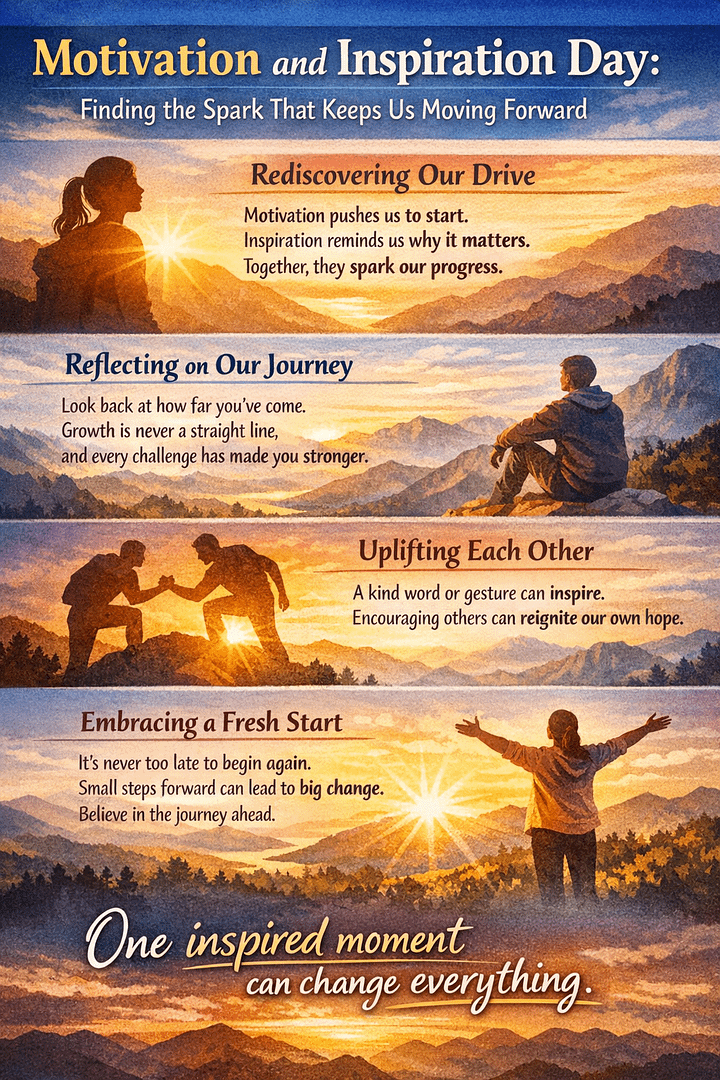
    Motivation and Inspiration Day: Finding the Spark That Keeps Us Moving Forward

    Motivation and Inspiration Day serves as a meaningful reminder that no matter where we are in life, we all need encouragement to keep going. In a world filled with constant noise, pressure, and comparison, it’s easy to feel stuck, exhausted, or unsure of our direction. This day invites us to slow down, reconnect with our purpose, and rediscover the spark that fuels progress and hope.

    Motivation is often born from within. It’s the inner drive that pushes us to begin, to try again, and to take responsibility for our own growth. Some days, motivation feels strong and effortless. Other days, it’s quiet and fragile, requiring intention and patience to uncover. Motivation doesn’t always appear as excitement or ambition—it can show up as discipline, resilience, or simply the decision not to give up.

    Inspiration complements motivation by reminding us why our efforts matter. Inspiration often comes from outside ourselves: a story of perseverance, a quote that resonates deeply, a moment of beauty, or witnessing someone else rise after hardship. These moments can shift our perspective and help us see possibilities beyond our current struggles. Inspiration doesn’t demand perfection; it encourages belief—belief that change is possible and that our dreams are worth pursuing.

    Motivation and Inspiration Day is also a time for reflection. It encourages us to look back at the challenges we’ve faced and recognize the strength it took to overcome them. Growth rarely follows a straight line. Setbacks, pauses, and detours are part of every journey. Honoring how far we’ve come—even when progress feels slow—builds confidence and renews our sense of purpose.

    This day reminds us of the power we hold in uplifting others. A kind message, a word of encouragement, or simply acknowledging someone’s effort can have a lasting impact. Motivation is contagious, and inspiration multiplies when shared. Sometimes, being a source of hope for someone else helps reignite our own sense of meaning.

    Most importantly, Motivation and Inspiration Day reassures us that it’s never too late to start again. Whether you’re pursuing a new goal, healing from loss, redefining your path, or just trying to get through the day, your journey matters. Let this day be a gentle reminder that even small steps create momentum—and that within you, and around you, there is always something worth believing in.

    Because one inspired thought, one motivated action, can be the beginning of lasting change.

    Read More Holidays & National Days

    Read More Of Inspiration & Motivation